

In normal times, one third of global fertiliser trade – along with 35 per cent of crude oil and a fifth of liquified natural gas – passes through the maritime corridor located south of Iran, but tanker traffic has essentially come to a standstill.
In response, United Nations Secretary-General António Guterres established a task force to facilitate the safe passage of fertilisers and related raw materials for humanitarian purposes.
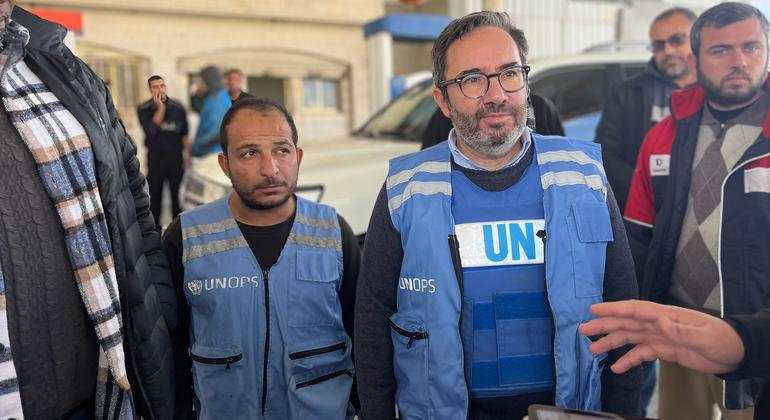
It is headed by Jorge Moreira da Silva, Executive Director of the UN Office for Project Services (UNOPS), which provides infrastructure, procurement and project management services across the world.
“We cannot afford to wait,” he said in an exclusive interview with UN News.
“The planting season is upon us, and the risk of a major food crisis is real. We need the support and the cooperation of all stakeholders to make this mechanism a success.”
He told Reem Abaza that the UN task force he is leading will be able to get its “one stop platform” up and running in just seven days, if combatants blocking the strait allow fertilizers and other raw material through, to benefit the world’s most vulnerable.
The interview has been condensed and edited for clarity
Jorge Moreira da Silva: The idea of the task force was to develop a mechanism focused on fertilisers and related raw materials such as urea, sulphur, and ammonia, to prevent a massive humanitarian crisis. We have one-third of all fertilisers in the world going through the Strait of Hormuz, so you can see how important the Persian Gulf is for the production of fertilisers and how impacted is the entire supply chain of fertilisers with the disruption of the Strait of Hormuz.
If we don’t get some solution immediately, the crisis will be very significant and severe, particularly for the poorest countries and for the poorest citizens
But we also know that there are some countries that are more dependent on those fertilisers. Unfortunately, some of those countries were already highly vulnerable due to previous shocks, such as Sudan, Somalia, Mozambique, Kenya, Sri Lanka. These are just a few countries that are high importers of fertilisers coming from the region.
UN News: We’re talking about a time-sensitive period because it is the agricultural season in some parts of the world, and not having fertilisers will have a huge effect on food security. But how fast can you be operational?
Jorge Moreira da Silva: The point of speed, as you mentioned, is a critical one. Diplomacy and nature do not have the same speed. And I know that there are diplomatic efforts towards a political solution for the Middle East, and for this war, to have a lasting peace.
But the point that I’ve been making is we can’t wait until everything is fixed to at least get something fixed in time for the planting season. The planting season has already started, and in most countries in Africa it will end in May. So, if we don’t get some solution immediately, the crisis will be very significant and severe, particularly for the poorest countries and for the poorest citizens.
I want to stress one point. The mechanism is not a way to compromise or challenge the freedom of navigation. Freedom of navigation is an indisputable principle, and the Secretary-General and I have been very clear in stating the need to reinstate the freedom of navigation.
But what we are saying is: while we don’t have that freedom of navigation fully embedded and established because there are these negotiations in the context of the war, at least let’s have a time-bound, exceptional, limited mechanism just for fertilizers and related raw materials because this will still be in time for the planting season.
UN News: Can you explain how this mechanism will work?
Jorge Moreira da Silva: The mechanism is based on one principle, which is confidence building. It draws on previous experience with the Black Sea Grain Initiative, also in the context of the war in Ukraine; the UN Verification and Inspection Mechanism for Yemen (UNVIM) where UNOPS monitors, verifies and inspects all vessels going to Yemen via Djibouti; and also the UN 2720 mechanism for Gaza, also managed by UNOPS, where we approve the consignments going to Gaza, the trucks, and also monitor on the ground the supply of those goods.
At least let’s have a time-bound, exceptional, limited mechanism just for fertilizers and related raw materials
This mechanism for the Strait of Hormuz will be based on the same principle of building trust through more accountability and transparency. It’s basically a mechanism that would go through a series of steps such as registration, de-confliction, monitoring, verification, and reporting. It’s a system that would facilitate the logistics operation.
It’s about commercial vessels carrying fertilizers and related raw materials, but the purpose is to avoid a humanitarian crisis.
The question is why fertilizers, because there are so many other important items in the Gulf such as oil and gas? The case for fertilizers is because there is a clear nexus between the lack of access to fertilizers and the disruption to food systems, and therefore starvation and hunger looming in many countries.
UN News: This is a very complex operation, as you mentioned. How are you coordinating with the different stakeholders, including shipping and insurance companies?
Jorge Moreira da Silva: We are working very closely with the International Chamber of Commerce and with the International Maritime Organization (IMO). We are also in contact with the shipping companies and with the insurance companies. They are all very supportive of this initiative because they know how important it is to have a stable and predictable environment for their operations.
UN News: You mentioned the Black Sea Grain Initiative as a model. How does the situation in the Strait of Hormuz compare to what we saw in the Black Sea?
Jorge Moreira da Silva: It’s a different context, but the principle is the same. It’s about creating a safe corridor for the transit of essential goods. In the Black Sea, it was about grain; here, it’s about fertilizers. But in both cases, the goal is to prevent a humanitarian crisis and to ensure that the most vulnerable populations have access to the food and the resources they need.
UN News: Finally, what is your message to the international community regarding the importance of this task force?
Jorge Moreira da Silva: My message is that we cannot afford to wait. The planting season is upon us, and the risk of a major food crisis is real. We need the support and the cooperation of all stakeholders to make this mechanism a success. It’s not just about logistics or economics; it’s about saving lives and ensuring that the most basic human needs are met.