

Ct was in April 2022, eight months after the capture of Kabul by the Taliban, that their supreme leader, Mullah Haibatullah Akhundzada, proclaimed a ban on poppy cultivation throughout the territory of the “Islamic Emirate of Afghanistan”. Skepticism is therefore required among specialists in the fight against narcotics. They see this declaration by the new master of Afghanistan as a simple maneuver to facilitate the lifting of international sanctions. They recall that the Taliban had already banned the production of opium in July 2000 by a fatwa from their leader and founder, Mullah Omar.
Read the previous column by Jean-Pierre Filiu | Article reserved for our subscribers “We must never forget why peace, signed between Israel and Lebanon in 1983, collapsed less than a year later”
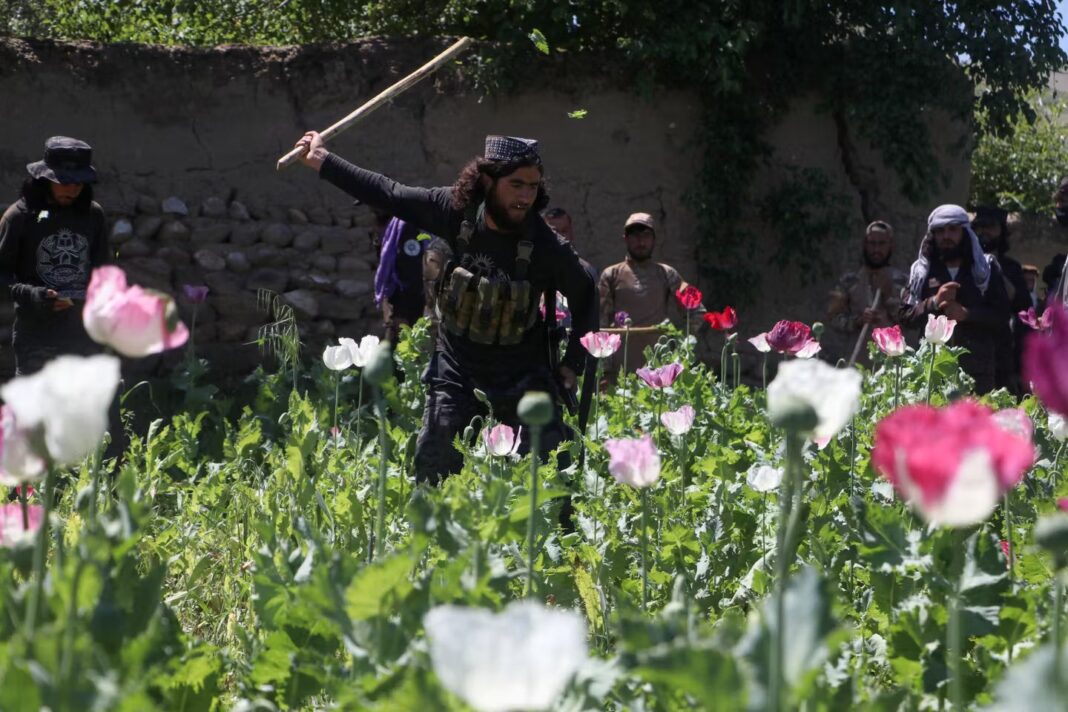
This prohibition, brutally implemented, had effectively dried up the main source of heroin in the world, but at the cost of angering a large part of the Afghan peasantry, deprived of foreign currency resources, without any form of compensation. The resentment of the rural population against the Taliban contributed significantly to the speed of their overthrow in the fall of 2001. Reduced to nothing more than insurgents, the Taliban had, for two decades, pledged their slow and patient reconquest of power on proven complicity with drug trafficking networks.
A country “free from opium”
Foreign observers, however, underestimated the determination of Mullah Haibatullah Akhundzada, reclusive in his stronghold of Kandahar, to make the ideological “purity” of the Taliban regime prevail over all other considerations. The April 2022 ban does not concern the poppy fields already planted, which produced 6,200 tonnes of opium that year, or 80 to 90% of the world’s production of this narcotic (and an equivalent level of heroin production).
But the prohibition decreed by the undisputed leader of the Taliban applies in all its rigor during the 2023 harvest: the area cultivated with poppies falls from 233,000 to 10,800 hectares, with a collapse in opium production to 333 tonnes, according to the United Nations. The ban on poppy cultivation is particularly severe in the southwest of the country, the cradle of the Taliban movement, with areas still cultivated concentrated in the mountainous provinces of the northeast, bordering Tajikistan and Pakistan.
You have 61.14% of this article left to read. The rest is reserved for subscribers.
Originally published at Almouwatin.com