


Exhibition ‘Psychiatry: Death Instead of Help’ documents practices criticised by the WHO and the UN
PRESSETEXT // Düsseldorf/Stuttgart (pts001/10 May 2026/08:30) – In German psychiatric institutions, patients and their relatives report treatments in which minors are allegedly medicated with very high doses of neuroleptics not approved for children, restrained for many hours and subjected to electroconvulsive therapy – in some cases against their expressly stated will. At the same time, the World Health Organisation (WHO) and the UN High Commissioner for Human Rights point out in their guidelines that electroconvulsive therapy (ECT) without free and informed consent violates physical and mental integrity and may be classified as ill-treatment or torture. The international travelling exhibition ‘Psychiatry: Death Instead of Help’ addresses this criticism and documents accounts from those affected.
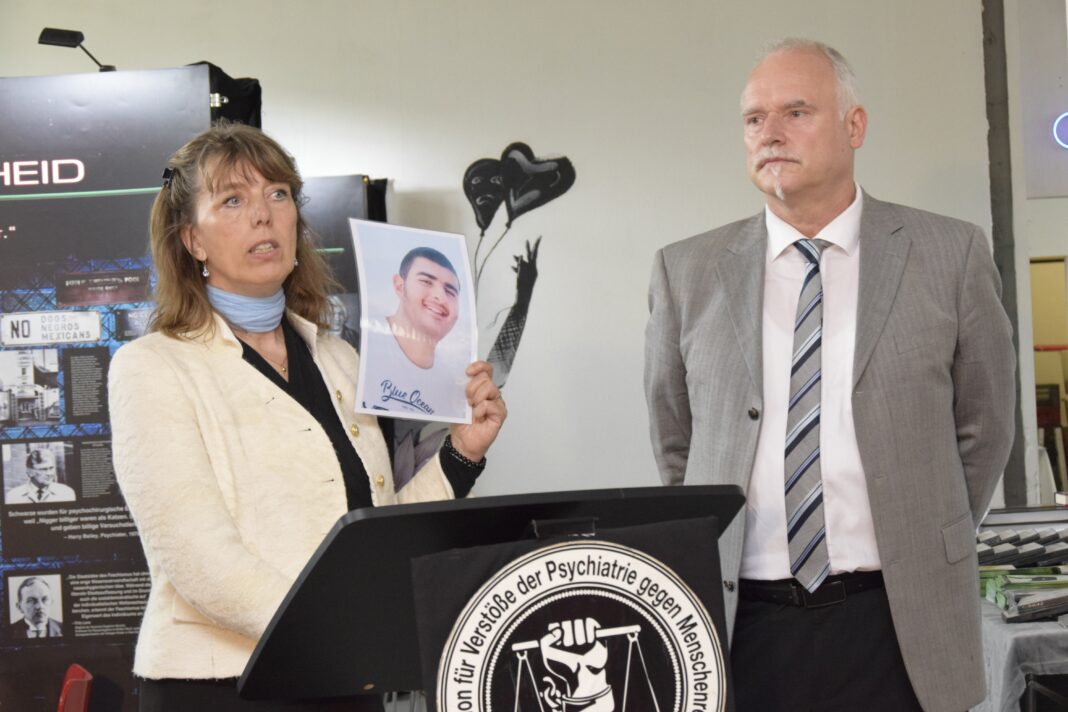
A mother reports that her son David (name changed), who was 15 at the time, was restrained for a total of 107 hours in a child and adolescent psychiatric clinic in 2023 with a court order. A year later, the teenager died following a serious illness; based on current knowledge, no causal link with the psychiatric treatment can be established. The police are investigating the case.
An international exhibition entitled “Psychiatry: Death Instead of Help” ended on 18 April in Düsseldorf after seven days, attracting 664 visitors. It was promoted, among other things, with 1,000 posters and via digital advertising displays in the city centre. The focus was on documented accounts which, according to the organisers, left many visitors stunned.
One mother described how her underage autistic son had been given a highly potent psychotropic drug at a child and adolescent psychiatric facility, which, she claimed, is not approved for the treatment of children and adolescents. She describes her son as a peace-loving boy with no history of aggression and makes serious allegations against those responsible: “My son’s life was destroyed by psychiatric abuse.”
Subsequently, the boy developed cancer and died at the end of 2024. The mother has filed a criminal complaint on suspicion of unlawful detention, mistreatment of a person under her care, and bodily harm in connection with the 7-point restraint of her son.
Another case was documented during the exhibition by volunteers from the KVPM together with the now 26-year-old woman concerned, “Sarah H.” (name changed). According to her account, she has filed a criminal complaint against the then head of a child and adolescent psychiatric ward on suspicion of bodily harm through the administration of poison or other harmful substances.
According to the patient records submitted by the victim, the then 14-year-old girl was treated in 2014 with a neuroleptic that is not authorised in Germany for those under 18. The documented dosage was 1,100 mg daily – significantly higher than the maximum dose specified for adults – plus so-called on-demand medication, whereby further doses were reportedly administered depending on her behaviour. These details were verified against the medical records. Police officers also expressed concern after reviewing the documents.
Alongside these individual cases, there is an international debate regarding the use of coercive psychiatric measures and electroconvulsive therapy (ECT). In their guidelines, the WHO and the UN High Commissioner for Human Rights recommend that ECT should not be used on children and should be prohibited by law. At the same time, it is emphasised that ECT without free and informed consent violates physical and mental integrity and could be classified as ill-treatment or torture.
One German psychiatrist is demonstratively opposed to these positions: the Mannheim-based psychiatrist Prof. Alexander Sartorius publicly defends electroconvulsive therapy and sharply attacks the WHO in a report in the Süddeutsche Zeitung on 1 April 2026. Sartorius is one of the best-known advocates of electroconvulsive therapy in Germany. He also expressly supports the use of electroconvulsive therapy on children. In an interview with the psychiatric journal ‘Eppendorfer’ in 2018, he responded to the question of whether someone would be treated against their will by saying: ‘We’ve already done that’ – referring to a minor girl.
According to the organisers, this highlighted a fundamental conflict for many visitors to the exhibition: whilst international organisations warn against certain practices, these continue to be advocated and practised in Germany as therapeutic measures.
Critical voices are also being reported from within the psychiatric system itself. After visiting the exhibition, a nurse explained that, for reasons of conscience, she could no longer practise her profession in a psychiatric institution.
The debate has been further fuelled by a report from a care home in Düsseldorf: a nun working there stated that, according to her observations, almost all of the over 150 residents receive one to three psychotropic drugs daily – partly due to alleged aggression. According to the KVPM, she was informed on site that, according to the package leaflets, many of these drugs can themselves trigger aggression and violent outbursts.
Current case: Coercive measures and the prospect of electroconvulsive therapy in North Rhine-Westphalia
Another recent case brought to the attention of the KVPM in the context of the exhibition concerns a patient in a psychiatric facility in North Rhine-Westphalia. According to the documents available to the KVPM and the patient’s own account, treatment with strong psychotropic drugs was carried out against her expressly stated will and on the basis of a court order. In the event of refusal, she reports being subjected to physical restraints and further coercive measures.
The patient has provided the KVPM with the court order. According to the KVPM’s account, this shows that she was classified by the treating psychiatrist as uncooperative regarding her illness, and the order explicitly specifies the dose of neuroleptics with which she may be treated.
The patient further reports that she has been told she may undergo electroconvulsive therapy (ECT); a court hearing is reportedly scheduled for this purpose. According to her, this has so far only been communicated to her verbally during a consultation with a doctor.
The patient denies posing a danger to herself or others and describes herself as well-adjusted and organised in the daily routine of the facility. At the same time, she describes significant side effects from previous treatments, including a marked tendency towards aggression whilst on neuroleptics.
In the view of the KVPM, this case demonstrates the far-reaching extent to which interventions in the self-determination and physical integrity of psychiatric patients can go – including the threat of highly controversial measures such as electroshock therapy and heavy medication, even against the express will of those affected.
The international travelling exhibition “Psychiatry: Death Instead of Help” was on display at the Wehrhahn in Düsseldorf, presenting a chronology of psychiatric practices that have been criticised internationally for years – from restraints and electroshock therapy to fatalities – through 14 large-format panels and films featuring over 160 experts and those affected. Whilst cuts to talk therapy are being discussed, according to the KVPM, billions continue to flow into the psychiatric system every year for psychotropic drugs, and substantial funds are spent on electroconvulsive therapy.
In the view of KVPM Germany, the psychiatric methods described frequently lead to permanent physical and psychological damage and are a key factor in prolonged hospital stays, relapses and new disorders induced by psychotropic drugs.
The organisers’ conclusion is clear: in their view, the documented accounts reveal conditions that are incompatible with a modern constitutional state. “We demand the implementation of the international WHO/UN guideline ‘Mental Health, Human Rights and Legislation’ in Germany and, consequently, the abolition of coercive practices in psychiatry.”
When, according to available documents, a 14-year-old is treated with the maximum dose of a neuroleptic not approved for children, when it is publicly acknowledged that electroconvulsive therapy was administered against the will of minors, and when a woman currently in a psychiatric institution in North Rhine-Westphalia states that she fears being treated with electroconvulsive therapy against her will, even though the WHO and UN emphasise that ECT without consent violates physical and mental integrity and can be classified as ill-treatment or torture, a fundamental question arises:
How can such practices continue to be a reality in Germany – in a democracy committed to human rights and the special protection of children and young people?
In the organisers’ view, silence or relativisation is no longer an option. The exhibition will continue in Germany and worldwide. It is currently on display until 16 May 2026 in a marquee on Pariser Platz in Stuttgart city centre. As always, admission is free.