

Georgette Gagnon, UN Deputy Special Representative currently leading the UN mission, UNAMA, reflected on recent visits across the country and said communities repeatedly described mounting hardship.
Ms. Gagnon noted that the country’s de facto authorities have consolidated territorial and administrative control and currently face “no meaningful armed or political challenge,” but warned that this apparent stability masks deeper risks.
“What exists is increasing control by the de facto authorities without a clear end-state,” she told the Council.
She pointed to demographic and economic pressures as major concerns, noting that nearly 5.9 million Afghans have returned since 2023 and up to 2.8 million more could return this year despite limited opportunities and strained communities.
Afghanistan remains one of the world’s largest humanitarian crises, with 21.9 million people requiring assistance in 2026.
Struggling women and girls
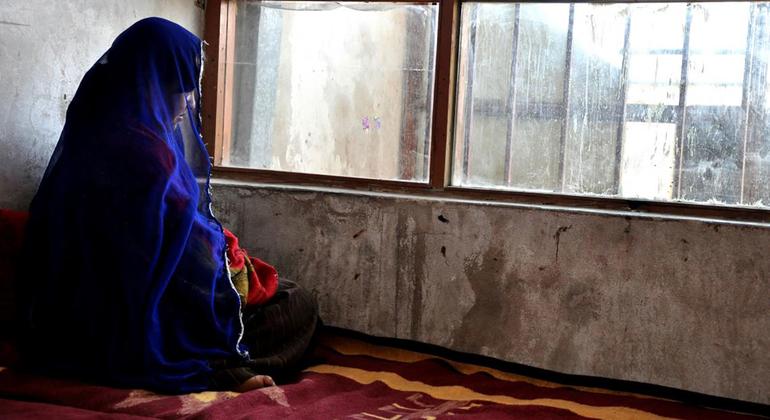
The top official warned of “severe and growing restrictions” with long-term consequences when it comes to women and girls, noting that an estimated 3.8 million girls aged seven to 18 are out of school.
“Each year, approximately 250,000 more girls are permanently excluded from secondary education pathways, creating a lost generation of talent and potential,” she said, adding that increasing restrictions have damaged Afghanistan’s economy and weakened sectors such as health and education.
She also renewed calls for authorities to reverse restrictions affecting women, including the continued exclusion of Afghan female UN staff from UN premises.
Edem Wosornu (on screen), Director of the Crisis Response Division of the Office for the Coordination of Humanitarian Affairs, addresses the UN Security Council meeting on the situation in Afghanistan.
‘Nearly half the country needs help’
Edem Wosornu, Director of OCHA’s Crisis Response Division, warned that humanitarian conditions continue to deteriorate under the combined pressures of conflict, hunger, climate shocks and underfunding.
“Afghanistan remains one of the world’s largest and most complex humanitarian crises,” she said. “Nearly half the country needs help.”
She reported that renewed fighting along the Afghanistan–Pakistan border earlier this year displaced more than 100,000 people and left vulnerable communities cut off from assistance for weeks.
“Hunger is growing across Afghanistan,” Wosornu said, noting that 4.7 million people now face severe food insecurity, 50 per cent more than at the same point last year, while 3.7 million children are suffering acute malnutrition.
She described reports of some families making desperate decisions to survive, including selling their own daughters, while restrictions on women continue to undermine humanitarian operations.
Metra Mehran, Founder of the Afghanistan Justice Archive, addresses the UN Security Council meeting on the situation in Afghanistan.
Institutionalised oppression
Civil society representative Metra Mehran, founder of the Afghanistan Justice Archive, described what she called a system of institutionalised gender oppression in Afghanistan.
“Since August 2021, the Taliban have enacted over 230 decrees,” she said, arguing that authorities have systematically stripped women and girls of basic rights including to education, employment, movement and participation in public life. “The Taliban have even criminalized women’s voices and faces.”
She highlighted a recently enacted Criminal Procedure Code that she said formalizes discrimination and legalises violence against women.
“Men effectively own their wives,” Ms. Mehran told the Council, warning that women resisting restrictions have faced arrests, violence and intimidation.
She also warned that states and international institutions have legal obligations under international law to act now.
“This is not only our fight,” she said in closing. “It is a test of our global system. A test of multilateralism. And a test of whether the principles recited in chambers like this truly mean anything in practice.”
UNAMA’s Gagnon emphasized that continued engagement remains necessary despite limited progress. “Ongoing and constant dialogue is essential, together with principled and pragmatic engagement, even where progress towards the end state is incremental,” she said.