

Secretary-General calls for international cooperation as the General Assembly confronts technological risk, climate pressure and unresolved conflicts
United Nations Secretary-General António Guterres has placed artificial intelligence, climate change, inequality and the wars in Gaza and Ukraine at the centre of his agenda for the General Assembly’s high-level week. His message to world leaders was direct: national policies alone cannot manage threats that increasingly cross borders, but international cooperation is being weakened precisely when it is most needed.
Speaking in New York six days before heads of state and government gather for the 81st session’s main diplomatic meetings, Guterres described the present moment as an “era of deep uncertainty”. He identified uncontrolled artificial intelligence, the climate crisis and deepening inequality as “three existential threats”.
The Secretary-General’s remarks ahead of the General Assembly linked these challenges through a common argument: institutions must be capable of setting shared rules without abandoning the principles of the UN Charter, international law and human rights.
Diplomacy under pressure
Guterres devoted part of his intervention to Gaza, the wider Middle East and Russia’s war against Ukraine. He called for renewed diplomacy, de-escalation and dialogue, while warning that civilians must not be made to bear the consequences of strategic rivalry.
In the Middle East, he said de-escalation must be “priority one, priority two and priority three”. He called on all parties to respect navigational rights in the Hormuz and Bab al-Mandab Straits and to avoid actions that harm civilians.
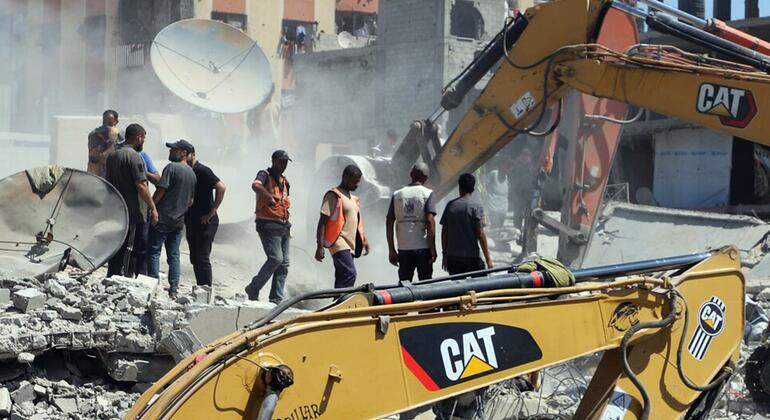
He also drew attention to Palestinian suffering in Gaza, renewed his support for a two-State solution and said the annexation of the occupied West Bank must stop. These demands place civilian protection and the prohibition of territorial acquisition by force at the centre of the UN position.
On Ukraine, Guterres said there was still no end in sight more than four years after Russia launched its full-scale invasion. He called for an immediate ceasefire as the first step towards a just, lasting and comprehensive peace.
Both conflicts are expected to feature prominently during the forthcoming debates. The Assembly has already adopted an extensive programme covering international security, development, human rights and institutional reform, as detailed in The European Times’ report on the 81st session’s agenda.
The General Assembly can provide political legitimacy, public scrutiny and a forum for negotiation. It cannot, however, compel the major powers to compromise. Guterres’s appeal therefore exposes a familiar difficulty: the international system possesses agreed principles, but its ability to apply them depends heavily on the governments whose interests are often in conflict.
A warning against an AI race
Artificial intelligence occupied almost half of the Secretary-General’s remarks. He acknowledged its potential to improve healthcare, education and climate action, but argued that governments cannot ignore warnings that development is moving faster than society’s understanding of the risks.
National regulation remains essential because governments have the primary responsibility to protect their populations. Yet national rules alone may prove inadequate when developers, computing infrastructure, data and digital services operate across several jurisdictions.
Guterres warned that voluntary pauses by a small group of companies or countries would not be effective if their competitors continued developing increasingly powerful systems. With the United States and China central to the global technology race, fragmented safety measures could create incentives for weaker standards.
“The world cannot afford a race to the bottom on AI safety,” he said.
The Secretary-General pointed to the Independent International Scientific Panel on AI as one mechanism for improving the evidence available to governments. Scientific advice, however, is only one part of governance. Meaningful safeguards would also require transparency from developers, independent access for evaluators, accountability when systems cause harm and protection against discrimination, surveillance and the concentration of power.
Guterres’s emphasis on human dignity is particularly important. The risks surrounding AI are not confined to hypothetical future systems. Automated decision-making already affects access to employment, public services, credit, information and policing. Errors and biases can fall most heavily on groups that have the least power to challenge them.
Climate and inequality remain inseparable
The climate crisis formed the second part of Guterres’s existential-threat framework. Although international negotiations often treat climate policy, development and inequality as separate files, their consequences are closely connected.
Lower-income countries and vulnerable communities generally have fewer resources to protect homes, food systems and public services from drought, flooding and extreme heat. Many also face high debt costs that restrict investment in adaptation and cleaner infrastructure.
For European governments, the challenge extends beyond domestic emissions targets. Their decisions on climate finance, trade, energy and development assistance influence whether poorer countries can pursue a transition without deepening poverty or dependence.
The same principle applies within Europe. The costs of heating, cooling, transport and home renovation cannot be distributed without considering income and housing conditions. Climate measures that ignore inequality risk losing public trust, while delayed action leaves vulnerable households more exposed to rising physical and economic damage.
Reform without abandoning principles
Guterres acknowledged that the United Nations and other multilateral institutions require reform. Bodies created for a different distribution of global power often fail to represent contemporary political, demographic and economic realities.
His argument was not that reform should weaken existing obligations. Institutional change, he said, must strengthen the application of the UN Charter, international law, human rights and sustainable development.
This distinction will matter during the General Assembly high-level week. Governments frequently agree that the multilateral system needs to change, but differ sharply over representation, veto powers, financing and enforcement.
The credibility of the gathering will therefore depend on more than the number of speeches delivered in New York. On war, governments will be judged by whether they protect civilians and support diplomacy grounded in international law. On AI, the measure will be whether they can establish enforceable safeguards without allowing geopolitical competition to dictate the lowest standard. On climate and inequality, promises will need financing and implementation.
Guterres has defined the common thread: threats shared across borders require cooperation across borders. The question awaiting world leaders is whether they are prepared to accept the responsibilities that follow from that principle.