In California, the governor’s election sows chaos among Democrats
Who will replace the charismatic Gavin Newsom as governor of California? A Democrat, many Americans would undoubtedly answer, as this progressive state in the western United States, the most populous in the country, seems to have been won over to the blue camp for decades. But since last weekend, the answer is no longer so obvious.
Also readPresidential 2028: Can Gavin Newsom, slayer of Trump, embody Democratic hope?
On Sunday, April 12, the Democratic Party’s favorite candidate, Congressman Eric Swalwell, officially left the race for governor. For several weeks, he was at the heart of various controversies, accused of having sexually assaulted a former collaborator, of having sent intimate photos to several women or of having hired a nanny and having paid her from campaign funds – accusations that he denied.
Exit, therefore, the favorite, who leaves behind a certain form of chaos. Because the list of his potential replacements is long. And for the moment, none are really doing well.
“This is a complete game changer,” says Kim Nalder, professor of political science at Sacramento State University, to the Guardian. “We are going to see some Democratic voters once again interested in candidates who were perhaps not at the top of their list. »
Myriad of candidates
Seven Democratic candidates remain in the running to succeed Gavin Newsom, who, after two terms, cannot run again.
Also readHow to communicate like Trump? The governor of California tries the exercise
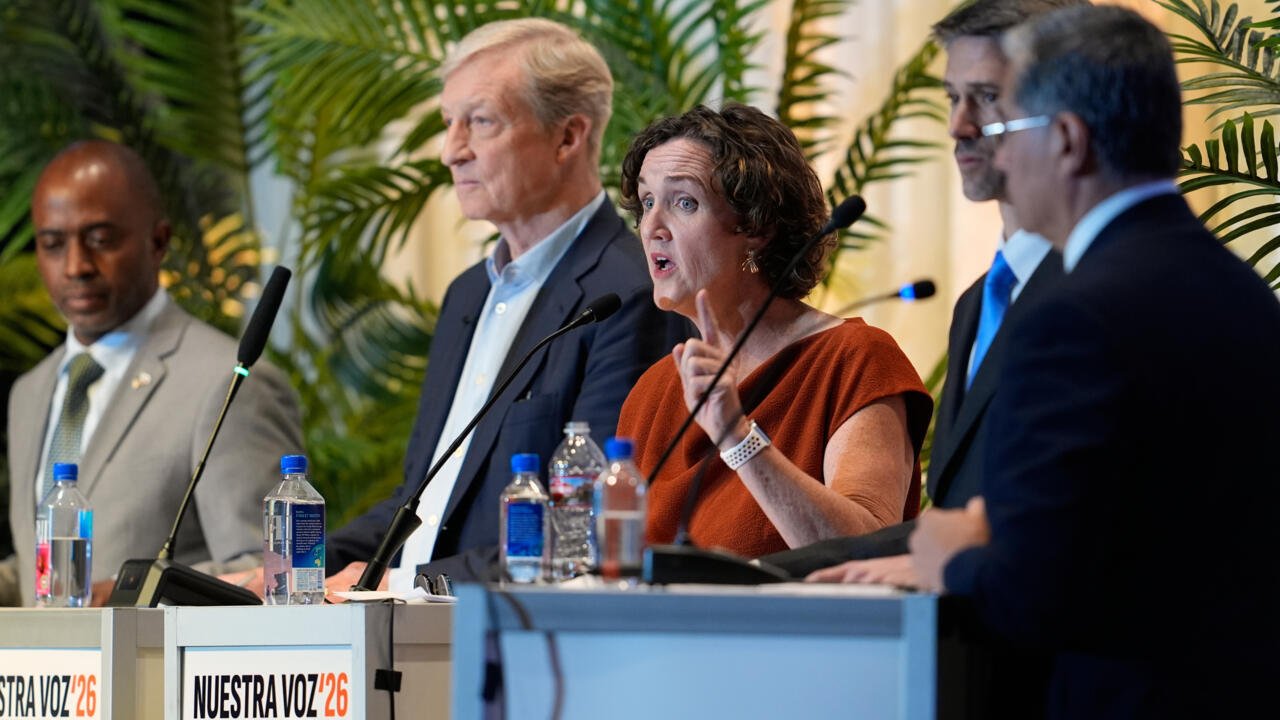
Among them: Katie Porter, former Democratic congresswoman; Tom Steyer, billionaire financier, environmental activist and disappointed 2020 presidential candidate; Matt Mahan, Mayor of San Jose; Xavier Becerra, Joe Biden’s Secretary of Health during the Covid-19 epidemic; or the mayor of Los Angeles, Antonio Villaraigosa.
For the moment, the first two seem to enjoy a slight lead in the polls. But like Eric Swalwell, they have to face their share of controversies. Katie Porter is thus regularly singled out for a story dating from 2025, when she threatened to leave the set of a television show after tense exchanges with the journalist. Enough to see yourself labeled as “angry” by your opponents.
Tom Steyer, for his part, owes his growing notoriety to his portfolio. He is currently the one who has devoted the most funds to his electoral campaign. So much so that his face appears everywhere, to the point of generating a certain unease. “Anyone who lives in California has inevitably come across his face on advertising inserts,” notes Eric Schickler, professor of political science at the University of California at Berkeley, to the Times. “But some are embarrassed by the display of this wealth. Especially since Tom Steyer has never held public office. »
Behind them, the other candidates are hot on their heels. On Saturday, Matt Mahan, for example, was able to give new impetus to his campaign, when he received a million dollars in donations from a real estate developer, Rick Caruso.
A 100% Republican election?
However, having a whole host of candidates in one pocket greatly complicates the race for California governorship. Because before the general election, scheduled for November 3, 2026, we must indeed pass the crucial stage of the primaries, scheduled for June 2.
And in California, because of an election rule adopted in 2010, these primaries are nonpartisan. Overall, they function like the first round of a French presidential election: all the candidates in the running are at the same level, regardless of their party, and it is the two who obtain the most votes who are qualified for the general election. In other words, there is no guarantee that a party will be represented in the general election.
If no candidate stands out among the large number of contenders for the post of governor, the Democratic camp therefore sees the threat that its electorate will disperse, leaving two Republicans to come out on top in the primaries. The state would then inevitably fall into the hands of a Republican governor, for the first time since Arnold Schwarzenegger (2003-2011).
Because opposite, there are only two Republicans vying for place. The first, Steve Hilton, is an Anglo-American, former adviser to British Prime Minister David Cameron, regular speaker on the conservative channel Fox News. The second, Chad Bianco is sheriff of the large Riverside County, a county which runs from east of Los Angeles to Joshua Tree National Park.
Even before the ouster of Eric Swalwell, this fear was heard in the Democratic camp. In mid-March, a poll commissioned by the Los Angeles Times estimated that Katie Porter could collect 13% of voting intentions, at the same level as Eric Swalwell. Tom Steyer was at 10%. All were left behind by the two Republicans with Steve Hilton, receiving 17% of the voting intentions, and Chad Bianco 16%.
“This scenario of two Republicans who manage to qualify remains unlikely, as the Democratic vote is strong in this state,” according to Eric Schickler. “But the very fact that this is a possibility shows how disorganized the Democratic race is. »
In various simulations carried out by Paul Mitchell, a prominent data analyst on the Democratic field, the chances of a total failure of the Democrats in the general election are indeed slightly less than 1 in 5.
And according to experts, this is notably due to American President Donald Trump. The latter has indeed given his official support to Steve Hilton. If the electorate follows the voting instructions, the number of votes for their opponent could therefore drastically decrease to the point of seeing them come in at least third.
A democratic malaise
Among Democrats, a question persists: how did we get to this point? The problem, ultimately, is that “no obvious successor to Gavin Newsom – a Democratic figure who would be known and with a strong personality – has emerged,” said Garry South, who worked on four campaigns for governor of California.
For a long time, however, the Democrats were waiting for a Kamala Harris, who returned to California after the 2024 election, or an Alex Padilla, this Latin American senator fervent opponent of Trump’s migration policy, or even a Rob Bonta, the attorney general of the state. But everyone refused.
Is the position too risky in a political career? Governing California is a daunting challenge. While the state boasts of being the fourth largest economy in the world, it faces a chronic budget deficit, an exorbitant cost of living and a housing shortage. Since 2023, the majority of voters believe that their state is moving in the wrong direction, according to a survey by the Public Policy Institute of California.
Originally published at Almouwatin.com