“We are worried about the risks of inflation”: States must be ready for “difficult times” according to the head of the IMF
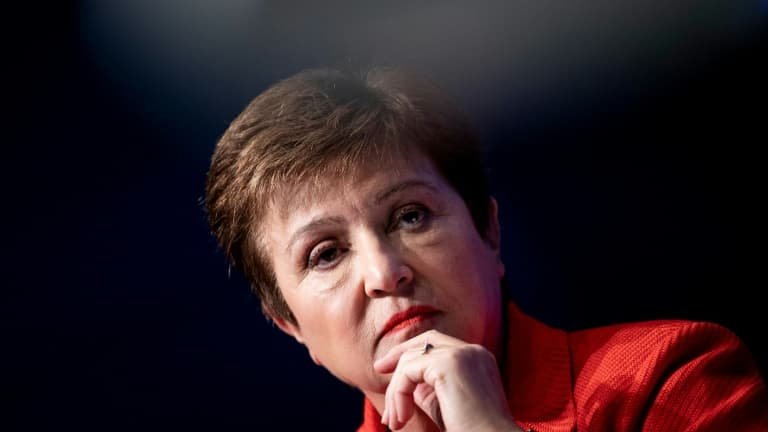
“Countries must take necessary measures to reduce activities that use the most energy. We must do it now, not wait several weeks,” insisted the Managing Director of the International Monetary Fund (IMF), Kristalina Georgieva, during the annual meetings of the institution and the World Bank this week in Washington.
States must “prepare for difficult times” if oil prices remain high due to the war in the Middle East, IMF Managing Director Kristalina Georgieva stressed at a press conference on Wednesday.
“We must prepare for difficult times” if the conflict continues and oil prices remain high, assured the head of the International Monetary Fund (IMF), before adding: “all countries are concerned, even if the shock can be asymmetrical”.
Delegations from the majority of countries around the world have been present in Washington since Monday to participate in the annual meetings of the Fund and the World Bank (WB), which last until the end of the week.
Concern about fertilizers and feed
Unsurprisingly, the repercussions of the war in the Middle East, particularly on gas and oil, led to a surge in oil prices. “We have discussions with all countries,” assured Christian Mumssen, director of Strategy for the Institution, during a press briefing.
“This will allow us to better understand how the shock affects them, what political choices have already been made and whether they are expecting additional assistance from the IMF, which we should of course provide, via our usual tools,” he added.
“Countries must take necessary measures to reduce activities that use the most energy. We must do it now, not wait several weeks,” insisted Kristalina Georgieva.
At the same time, the impact on fertilizers, part of which as well as certain ingredients come from the region, adds difficulties, increasing the risk of a food crisis in the States.
“We are worried about the risks of inflation, in particular as it concerns food prices if the delivery of fertilizer at a reasonable price (is not) quickly restored,” admitted the managing director of the IMF.
Christian Mumssen admitted to being “particularly worried about low-income countries”, precisely because of the impact of the conflict on food. As a reminder, at the end of March the World Trade Organization (WTO) qualified fertilizers as “alert issue number 1”, anticipating a “cumulative effect” next year “on the quantity (of crops) but also on prices”.
“If the Strait of Hormuz is blocked for three months, the impact will be obvious,” underlined the deputy director general of the WTO, Jean-Marie Paugam.
Prudence of central banks
In these countries, households spend on average 36% of their consumption on food, compared to 20% in emerging countries and less than 9% for developed countries. The Director General of the Fund asked States not to commit to significant expenditure “while the level of global debt is at its highest since the Second World War”.
According to the Fiscal Monitor report on fiscal policies, released by the IMF earlier today, global debt reached the equivalent of 94% of global GDP last year, and could reach 100% by 2029 if no effort is made.
“Some countries are implementing untargeted measures, export controls or poor tax cuts. The intentions are good but protecting their citizens with this type of measure will only prolong the difficulties linked to high prices,” warned Kristalina Georgieva.
At the same time, central banks must be cautious “and see how this will evolve” before making any decisions regarding their key rates, particularly if inflation expectations remain anchored. “If we get out of the conflict quickly, they shouldn’t need to act,” she said.
In the immediate future, however, the emergency remains the financial situation of the countries, while the IMF already had nearly forty active programs even before the outbreak of war. Already, the Fund has received “a dozen requests” for new aid programs, “a number of them from sub-Saharan Africa,” Kristalina Georgieva said.
These countries “need our attention, and are an important focus of our discussions this week on how we can best help them in the face of a world of frequent shocks and uncertainty,” she added.
Originally published at Almouwatin.com