

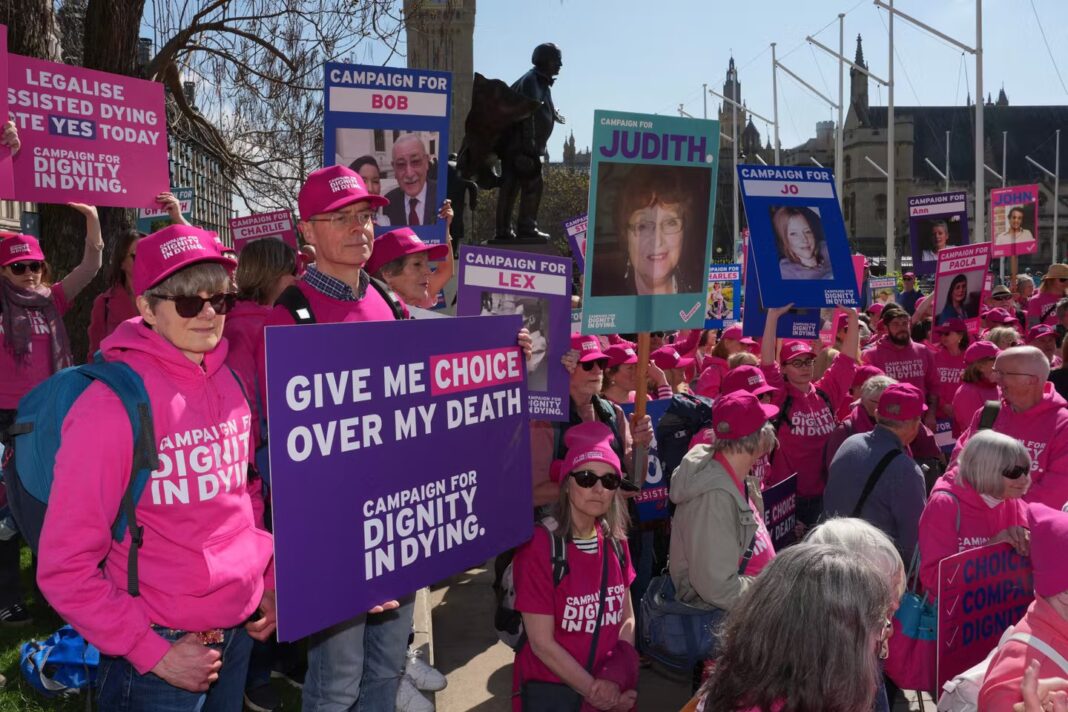

An assisted dying bill in England and Wales failed to pass Parliament on Friday after its review failed to be finalized on time after being stalled for months in the House of Lords.
In a historic vote in June 2025, the House of Commons approved the legalization of assisted dying in England and Wales for certain terminally ill patients. But the bill stalled in the House of Lords, where more than 1,200 amendments had been tabled, making it impossible to pass it in time. The last debate on the text was held on Friday in this upper and unelected house, and concluded with the abandonment of the text.
Lord Charlie Falconer, who brought this law into the upper house, denounced during a press conference “pure obstructionism on the part of a small group” of peers. At the opening of the session on Friday, he was keen to emphasize that this “bill, so important for so many people”, was not going to be “rejected on the merits, but due to procedural maneuvers”.
Both chambers must approve the bill for it to take effect. It is customary for texts still under discussion at the end of a parliamentary session to be generally abandoned.
Read also | Article reserved for our subscribers In the United Kingdom, the House of Commons passes a law on assisted dying
Labor MP Kim Leadbeater, who presented the text at the end of 2024, said on Friday morning on [ses] colleagues, activists and families to ensure that the issue is brought up again in the next parliamentary session.” Lord Falconer accused a “small minority” of Lords of having “disrespected” those who supported the bill by multiplying the amendments, echoing the same regret expressed Thursday in a letter signed by more than 200 members of the upper house.
Strong mobilization
A handful of supporters of the text gathered again Friday morning in front of Parliament to denounce the blockage. Among them Rebecca Wilcox, daughter of a television star in the United Kingdom, Esther Rantzen, who has terminal lung cancer. She deplored to Agence France-Presse a “denial of democracy”.
The debate on assisted dying has given rise to lively and often emotional exchanges since 2024, both in Parliament and outside, where supporters and detractors of the text have mobilized on numerous occasions. Supporters of the law argue that it could have provided more dignity and freedom of choice over the end of life for people with incurable illnesses.
According to the text, a patient’s request had to be validated by two doctors and a panel of experts, and the person concerned had to be able to administer the lethal substance themselves. The Lords opposed to the bill assured that they had only carefully examined its contents.
The president of Care Not Killing, Gordon Macdonald, welcomed the failure of a text that he considered “both dangerous and inapplicable”, “riddled with gaps”. If it had been adopted, it would have “left the most vulnerable, including people suicidal or under financial pressure, dangerously exposed” to pressure, he said in a press release.
The Memorable World
Test your general knowledge with the editorial staff of “Le Monde”
Test your general knowledge with the editorial staff of “Le Monde”
Discover
Newsletter
“In the news”
Every morning, browse the essential news of the day with the latest headlines from “World”
Register
Event
Info lecture halls
In the age of AI and social networks, information is being questioned: at the “Amphis de l’Info” journalists come to meet you.
Discover
The World Application
The Morning of the World
Every morning, find our selection of 20 articles not to be missed
Download the app
Newsletter subscribers
” International “
The essential international news of the week
Register
Event
Info lecture halls
In the age of AI and social networks, information is being questioned: at the “Amphis de l’Info” journalists come to meet you.
Discover
“The World” with Perplexity
A question about this article?
Get instant answers with Perplexity AI
Ask us
The Isle of Jersey and the Isle of Man, dependencies of the British Crown with their own government, have already approved similar texts, which are still awaiting the royal seal before they can come into force. In Scotland, Parliament rejected in mid-March, with a fairly narrow majority (69 against 57), a similar project aimed at legalizing assisted dying.
Read also | Article reserved for our subscribers Despite promises, the too slow growth of palliative care in France
Originally published at Almouwatin.com