



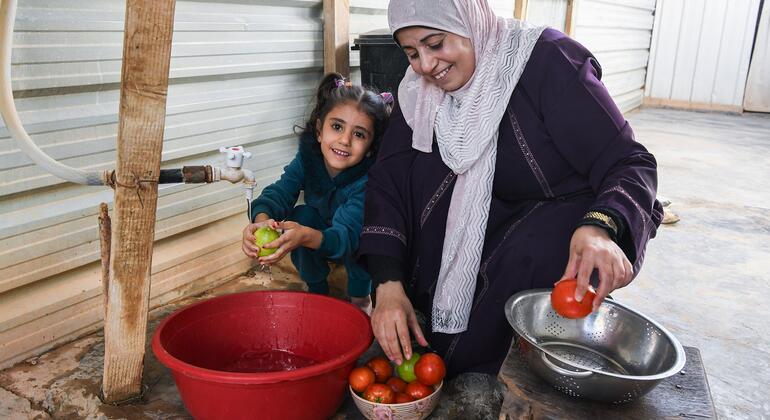

Zaatari refugee camp hosts more than 80,000 Syrians and well over half are children.
According to the agency, unless investment comes soon, its water and sanitation services could stop in a matter of months.
UNICEF regional spokesperson Louise Wateridge pointed out that many children in Zaatari had been born in the camp.
‘A lifeline’
“For them, the risk of disruption to water and sanitation services will add yet another layer of instability to lives already shaped by war and displacement. Access to safe water and sanitation remains essential for children and families who remain here,” she said.
“Until they are able to return to Syria, these services are a lifeline.”
Ms. Wateridge warned that declining rainfall, a lack of groundwater and rising demand are placing too much pressure on the water system.
For the moment, the only solution is to bore ever-deeper wells by between seven and 10 metres every year.
“We have to manage every cubic metre carefully and the plan further ahead,” the agency said, noting that its programme is 90 per cent underfunded.
US migration scheme ‘triggering cascade’ of rights violations, experts warn
Independent UN human rights experts warned on Monday that the United States’ policy of sending migrants and asylum seekers to third countries is exposing people to torture, persecution and enforced disappearance.
At least 23,000 people have already been sent to 29 countries and territories, with agreements now covering 35, and the experts said more are being signed “every day”.
“The harms caused by this US Government scheme are no longer hypothetical,” they said. “The arrangements are triggering a cascade of human rights violations.”
Living in limbo
Many migrants are being transferred to places where they have no ties, and some of those countries are themselves gripped by conflict, displacement and poverty, with little capacity to protect new arrivals.
Children, women, people with disabilities, trafficking victims and LGBT people face the gravest risks, independent experts warn.
The experts also cautioned that pressure on migrants to return to their home countries cannot be considered voluntary when they are detained, penniless and without legal advice.
“States cannot contract out of their international legal obligations,” they said, calling on all governments involved to halt the arrangements immediately.
“Human rights must be at the centre of migration governance, not sacrificed in the pursuit of deterrence.”
The experts are appointed by the UN Human Rights Council, serve in an independent capacity and receive no salary for their work.
Planting trees is cost-effective response to growing global challenges
The UN Food and Agriculture Organization (FAO) on Monday issued an appeal to take better care of the world’s forests as a holistic way to lay down roots against the climate crisis and hunger.
An estimated 489 million hectares of forest were lost between 1990 and 2025 through deforestation, the agency said, while more than 460 million hectares of forest are now “degraded” worldwide.
Population growth, land-use change and rising demand for natural resources are among the reasons for this change.
In a new report, FAO insists that planting trees and restoring land will also help protect vital biodiversity and rural farming communities in support of sustainable development.
Wood from the trees
One third of the world’s population depends on trees and forests for food security and work.
The agency’s State of the World’s Forests (SOFO) 2026 report warns that action at scale will require greater investment and sustained political commitment from governments if it’s to be successful.
Restoring more than one billion hectares of degraded land could generate $1.8 trillion per year in benefits, including better biodiversity, improved water courses and healthier soils.
Colombia: Türk hails ‘landmark’ restorative justice steps
UN human rights chief Volker Türk on Monday welcomed victim reparation measures in Colombia involving former FARC-EP leaders and army officers who have acknowledged responsibility for grave abuses during the country’s armed conflict.
The two former adversaries are now working side by side at a cemetery in Pitalito, Huila, searching for the disappeared so remains can be returned to their families.
The work forms part of restorative orders imposed by the Special Jurisdiction for Peace, in place of prison sentences.
“Colombia’s landmark restorative measures with respect to that conflict, now underway, are a global achievement for transitional justice,” Mr. Türk said, calling the collaboration “a powerful contribution to truth, reparation, and healing” for victims and their families.
Sustained funding plea
He urged sufficient funding for the Comprehensive System for Peace. “This cannot be a one-off,” he said.
The UN has supported Colombia’s peace process since the 2016 agreement, which ended more than five decades of conflict.
The UN human rights office helped create the Comprehensive System for Peace, provided technical assistance and kept victims’ rights at the centre of the Special Jurisdiction’s work.
UN mine action service UNMAS, has strengthened national capacity by supporting demining operations of the Campaña Colombiana Contra las Minas (CCCM), a Colombian organization in Algeciras, Huila (file photo).

