
Clothes that can monitor our health, help us in our day-to-day lives and enhance our entertainment experiences are
Electronics in our clothing: Developing our future wardrobes
UCLA Scientists Uncover How Gut Bacteria Rapidly Adapt to Support Human Health

Across Europe and beyond, scientists are increasingly discovering that the invisible world inside our bodies holds the key to better health. The human gut is home to trillions of microorganisms — a vast ecosystem known as the microbiome — that plays a central role in how we digest food, fight disease, and regulate our immune system. Research into this microbial community is transforming modern medicine, suggesting that nurturing a healthy gut could improve wellbeing in ways once thought impossible.
Every person carries a population of microbes in their gastrointestinal tract that outnumbers their body’s own human cells. Many of these microscopic residents help by producing essential vitamins, nutrients, and protective compounds, while others contribute indirectly by crowding out harmful bacteria. The balance of this internal ecosystem is crucial to our overall health and, as new research shows, its adaptability may be one of its most powerful traits.
A team of scientists from the California NanoSystems Institute (CNSI) at UCLA has uncovered a genetic mechanism that helps bacteria in the gut evolve at remarkable speed. The study, published in Science, focuses on what are known as diversity-generating retroelements, or DGRs — small clusters of genes that can deliberately introduce changes in bacterial DNA. These controlled mutations allow bacteria to adapt quickly to new conditions, giving them a competitive edge and a better chance to thrive.
Researchers discovered that DGRs are more abundant in the gut microbiome than in any other environment measured on Earth. Yet their impact inside the human body had not been fully understood until now. According to the study, about one-quarter of these elements target genes essential for bacteria to attach to surfaces and form new colonies — a key step in establishing a community within the digestive tract.
The scientists also found that DGRs are not confined to one organism. They can move between bacterial strains and are even passed from mothers to their infants, helping newborns populate their own digestive systems from the start. This ability to share adaptive traits may ensure that beneficial bacteria take hold early and stay resilient throughout life.
“One of the real mysteries in the microbiome is exactly how bacteria colonize us,” said Jeff F. Miller, senior author of the study, director of the California NanoSystems Institute, and professor of microbiology, immunology, and molecular genetics at UCLA. “It’s a highly dynamic system intimately connected with human physiology, and this knowledge about DGRs could one day be applied for engineering beneficial microbiomes that promote good health.”
The research represents a significant step toward understanding how the microbial world within us evolves and maintains the delicate balance that supports human life. As efforts grow in Europe and around the world to develop probiotics and therapies that strengthen the microbiome, these findings offer a glimpse into how we might one day design microbial ecosystems that actively promote health and prevent disease.
For more information, visit the California NanoSystems Institute at UCLA website.
Source: UCLA, Science Journal.
Rights chief warns ‘abominable atrocities’ likely continue in Sudan’s El Fasher

“Today, traumatised civilians are still trapped inside El Fasher and are being prevented from leaving,” said UN human rights chief Volker Türk in a statement released on Friday.
“I fear that the abominable atrocities such as summary executions, rape and ethnically motivated violence are continuing within the city.”
The statement comes amid mounting reports from UN human rights watchdogs and other experts of widespread violence and war crimes after the city of El Fasher fell to the Rapid Support Forces (RSF) militia on 23 October this year, which has been battling former allies-turned-rivals – the military government in Khartoum – for control of Sudan for over two years.
Violence continues even for those who managed to flee the city, since exit routes have become scenes of “unimaginable cruelty,” Mr. Türk added.
No sign of de-escalation
The High Commissioner said that since the capture of El Fasher civilian casualties, destruction and mass displacement have been mounting.
He further warned that developments on the ground show “clear preparations for intensified hostilities, with everything that implies for its long-suffering people.”
In an interview with UN News on Thursday, UN Special Adviser on genocide prevention Chaloka Beyani raised concerns over allegations of war crimes in El Fasher.
“We see massive violations of international human rights law, direct attacks on civilians, non-compliance with international humanitarian law, which regulates conduct in relation to hostilities, and that the attacks are largely on civilians,” he said.
On Friday, UN independent experts also voiced concern over the humanitarian situation, pointing out “sadistic levels” of sexual violence and abuse.
“We are appalled by credible reports of ethnically targeted summary executions of civilians in El Fasher by the RSF, which are prohibited under international law and constitute war crimes and may also amount to crimes against humanity,” they said. “They must cease immediately and prompt independent investigations are critical.”
Reported ceasefire agreement
The RSF reportedly agreed to a ceasefire on Thursday, proposed by the United States and Arab countries – but the national army has not signed on and attacks are continuing, according to news reports, including explosions around government-held Khartoum.
Meanwhile, UN agencies continue to push for an end to hostilities.
“The Security Council’s arms embargo is clear: the provision of continuing military support to sustain parties committing serious violations must stop,” said Mr. Türk.
He repeated his plea for an “immediate end to the violence both in Darfur and Kordofan,” adding that “bold and urgent action is required by the international community.”
The UN Human Rights Council will hold a special session on the situation in and around El Fasher, on Friday 14 November.
World News in Brief: Russian rights abuses in Ukraine, US a no-show for rights review, Orlando Blooms highlights Rohingya plight

During their mission from 2 to 6 November, the three members of the Human Rights Council-mandated Commission of Inquiry met survivors, families of victims and human rights groups in Kyiv.
“People spoke of unimaginable suffering – homes destroyed, loved ones killed, and lives upended,” said chairperson Erik Møse.
The investigators – who are not UN staff and receive no salary for their work – said they documented continuing violations of international human rights and humanitarian law, mostly committed by Russian forces and officials, including indiscriminate attacks, torture, deportations and sexual violence.
These, they concluded, amount to war crimes and crimes against humanity.
The team also investigated abuses by Ukrainian forces, such as arbitrary detention and ill-treatment of people accused of collaboration, though limited access prevented full inquiries.
Justice must prevail
After hearing victims’ testimonies, the investigators renewed their call for accountability and reparations. “Justice must honour those whose lives were deliberately cut short,” they said, stressing the need for mental health and psychosocial support for survivors.
The visit follows the investigators’ latest report to the UN General Assembly, which detailed Russia’s coordinated actions to drive out Ukrainian civilians from occupied areas and forcibly transfer them elsewhere.
UN rights body regrets US withdrawal from human rights review
The UN Human Rights Council has expressed regret over the United States’ decision not to take part in a key review of its human rights record, scheduled for this week in Geneva.
The review, known as the Universal Periodic Review (UPR), is a process in which all UN Member States have their human rights performance examined by their peers.
The US was due to appear before the Council’s Working Group on Friday but declined to do so – the first time the country has refused to take part in its own review.
Jürg Lauber (centre), President of the UN Human Rights Council, presides the meeting of the scheduled universal periodic review of the United States of America.
Postponed
Council members urged Washington to resume cooperation with the UPR and said they would reschedule the review for 2026, though it could take place earlier if the US re-engages.
The decision follows the Trump administration’s recent disengagement from the Human Rights Council itself, although all UN Member States that are not among the 47 members of the Council remain observers, able to represent themselves during proceedings.
The previous US withdrawal, in 2018 under the first Trump administration, did not prevent the country from taking part in its 2020 UPR – making this year’s absence unprecedented.
Documents compiled for the planned review, including reports by UN experts and civil society groups, remain available online. The US did not submit its own national report before the deadline.
The council said it would continue efforts to persuade the US to return to the process, stressing that the UPR system relies on equal participation by all 193 UN Member States.
Orlando Bloom highlights plight of Myanmar’s Rohingya
UNICEF Goodwill Ambassador Orlando Bloom visited Bangladesh this week to see the impact of severe cuts to aid work on children living in camps in Cox’s Bazar.
The star actor met some of the 500,000 children in the vast camp, along with their families.
They are “100 per cent dependent on aid”, but it is shrinking, he warned.
At risk from the funding cuts are education, health, protection and survival for people in the camps who are mainly ethnic Rohingya who fled persecution in neighbouring Myanmar – most of them following an systematic military operation in August 2017.
“It’s a very transient environment, there are so many people coming and going,” the veteran British actor and UNICEF champion observed.
Precarious and unstable
“We met a mother who has just arrived who still feels you just had to flee the conflict. It felt very unstable and unsafe. So, this is really, a lifeline for these families in these communities and without their support, they have nothing.”
In June, UNICEF had to temporarily close most schools in Cox’s Bazar because of funding shortages; almost 150,000 children were affected.
And although youngsters of all ages recently went back to class after a fundraising push, the threat of an imminent funding shortfall in early 2026 risks closing all schools again, potentially impacting more than 300,000 children.
Trends and projections: greenhouse gas emissions largely on track to 2030 targets
The European Union remains largely on track to achieve its 2030 targets to reduce net greenhouse gas emissions, according to the latest annual check-up on EU progress to its energy and climate targets published by the European Environment Agency today. Total net greenhouse gas emissions in the EU fell by a further 2.5% in 2024, […]
DR Congo hunger crisis worsening amid fighting and lack of aid funding
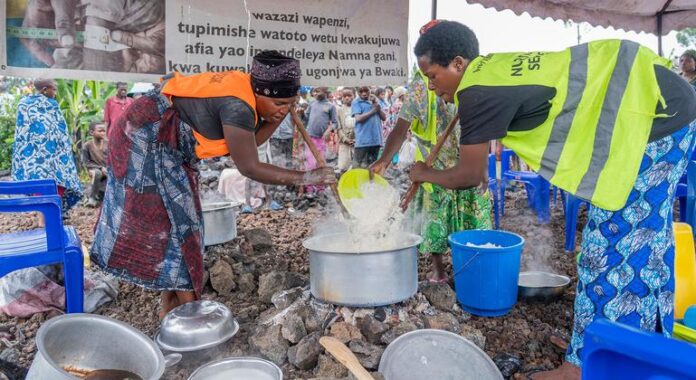
UN aid agencies are struggling to access provinces overrun by Rwanda-backed M23 rebel fighters at the start of the year, although dramatic funding shortfalls for humanitarian work have also contributed to the dire situation. Kigali has consistently denied providing military backing to the group.
Help could be provided more easily if air access were re-established, WFP insisted, as two airports in M23 areas “have been closed basically since the end of January…we’re urgently calling for a humanitarian air corridor, to be established”, said Cynthia Jones, WFP’s Country Director for DRC.
The alert follows the release of a report by UN-backed food insecurity experts at the Integrated Food Security Phase Classification platform (IPC), warning that nearly 25 million people are experiencing high levels of food insecurity, denoted as IPC3 on a scale of one to five, with five indicating famine.
This includes an alarming three million individuals who face “emergency” levels of hunger – IPC4 – a number that is “surging” and which is “almost double since last year”, said Ms. Jones.
“This means what for families? It means that they’re skipping their meals, depleting all of their household assets. They’re selling off their animals,” she said, speaking via video from Kinshasa to journalists in Geneva.
According to the UN agency, “people are already dying of hunger” in parts of eastern DR Congo.
Ms. Jones noted that fighting between M23 militiamen and DRC government forces is continuing, sparking new displacement and people “forced from their home over and over again”.
In eastern DR Congo, this has left about 5.2 million displaced people “including 1.6 million that have been displaced this year alone, making DRC one of the world’s largest displaced person crisis”, the WFP official added.
Despite deepening hunger, funding is running out for lifesaving humanitarian work and the UN agency has been forced to reduce the number of people it assists, from around one million at the start of the year, to 600,000 now.
“We will only be able to support a fraction of those in need” moving forward, Ms. Jones said, in an appeal for $350 million to support emergency food and nutrition assistance over the next six months. “Without it, we will have to make further cuts reduce [assistance] even further, down to 300,000 – which is only 10 per cent of the three million in need.”
Without a significant funding boost, the WFP warned of a “total pipeline break” in assistance by March 2026.
“That means a complete halt of all emergency food assistance in the eastern provinces.”
The dire funding shortfall has also impacted the agency internally, too. “We’re starting to close downtown offices, we’re reducing our footprint, the number of staff and juggling how to maintain the operational capacity to deliver in a very complex environment,” Ms. Jones explained.
And yet aid assistance remains vital for those displaced in eastern provinces including North Kivu, South Kivu, Ituri and Tanganyika because vital services have closed amid ongoing insecurity.
“The banks are closed, there’s no money available and this has just had a major impact on the population and on the humanitarian response,” Ms. Jones explained. “It has devastated livelihoods and really put the food security of affected people in dire, dire circumstances.”
As the conflict drags on, families seek shelter in urban centres such as Ituri, where host communities are already struggling to cope. Equally worrying is the fact that millions of subsistence farmers forced from their homes or too fearful to access their land have missed the planting season this year.
“The women, children, men, they’ve just been suffering devastating sequences of the violence, perpetrated by the non-state armed groups and fleeing from conflict. They’re tired, exhausted and need peace,” Ms. Jones insisted.
‘Worrying reports’ continue of abductions and disappearances in Syria

“Eleven months after the fall of the former government in Syria, we continue to receive worrying reports about dozens of abductions and enforced disappearances,” Spokesperson Thameen Al-Keetan said at a press briefing in Geneva.
Syria is undergoing a political transition following the overthrow of the Assad regime in December 2024 and 13 years of brutal civil war.
Families in distress
In response to a journalist’s question, Mr. Al-Kateen said OHCHR had managed to document at least 97 people who have been abducted since the beginning of the year.
This is in addition to the more than 100,000 people who went missing during the father and son rule of the Assads, which lasted some five decades.
While some families have been reunited with their loved ones, “many still live with the distress of not knowing where they are, or what happened to them,” he said.
He stressed that “the fate and whereabouts of all those who have gone missing, both before and after the fall of the former government, must urgently be clarified.”
In this regard, he underscored OHCHR’s support for the work of the Independent Institution on Missing Persons in the Syrian Arab Republic (IIMP).
Karla Quintana, who leads the UN body, recently said that “everyone in Syria knows someone who has gone missing.”
Missing aid worker
Mr. Al-Keetan highlighted the case of Hamza Al-Amarin, a volunteer with the Syria Civil Defense, commonly known as the White Helmets.
He went missing on 16 July of this year while supporting a humanitarian evacuation mission during violence in Suweida, located in the south, and remains unaccounted for.
“We stress that all armed actors – both exercising State power and otherwise – must respect and protect humanitarian workers at all times, everywhere, as required by international human rights law and applicable humanitarian law,” the Spokesperson said.
“Accountability and justice for all human rights violations and abuses, past and present, are essential for Syria to build a durable, peaceful and secure future for all its people.”
In Brazil, Guterres calls for a “fair, rapid and definitive” transition to clean energy

The latest surge took place on Friday Remarks at the Energy Transition Roundtable in Belém, Brazil, held just days before the official opening of the COP30 conference on climate change.
“The era of fossil fuels is coming to an end. Clean energy is on the rise. Let’s make the transition fair, rapid and definitive“, he said.
The “renewable energy revolution” is underway
The UN chief told world leaders that “the global energy landscape is evolving at lightning speed.”
Green energy sources accounted for 90 percent of new electricity capacity last year, while investments in these sources reached $2 trillion, $800 billion more than fossil fuels.
“The renewable energy revolution is here,” he said. “But we must move much faster – and ensure that all nations share in the benefits. »
The international community must ensure a “just, orderly and equitable” transition from fossil fuels, triple renewable energy capacity and double energy efficiency by the end of the decade.
Controlling global warming
However, some countries are not up to the task. Even if new national climate action plans are implemented, global temperature rise is still expected to exceed 2 degrees Celsius compared to pre-industrial times.
“That means more flooding, more heat, more suffering – everywhere,” he warned.
“To return below 1.5 degrees by the end of the century, global emissions must decline by almost half by 2030, reach net zero emissions by 2050 and then turn negative..”
Focus on policies and people
The Secretary-General stressed five areas of actionfirst calling on countries to “align their laws, policies and incentives with a just energy transition; and eliminate fossil fuel subsidies that distort markets and lock us in the past.”
Governments must “put people and equity at the center of the transition” and support workers and communities who rely on oil, coal and gas for their livelihoods, including through training and new opportunities.
This is particularly true for young people and women.
Support developing countries
“Invest in grids, storage and efficiency. Renewable energy is booming, infrastructure needs to catch up – fast,” he continued.
Since “technology must be part of the solution, not a new source of tension,” clean energy must power any new electricity demand “including that of the data centers that are driving the AI revolution.”
His final point highlighted the need to “unlock finance at scale for developing countries,” noting that Africa receives only 2% of global investment in clean energy.
“We must help developing countries implement their commitment to move away from fossil fuels: through stronger cooperation, investment and technology transfer – and tailored to different capacities and dependencies,” he said.
Originally published at Almouwatin.com
Best AI Study Tools Every STEM Student Should Try
Working in STEM is difficult sooner than it should be: proofs, derivations, non-compiling code, literature reviews that keep
World news in brief: Russia’s human rights violations in Ukraine, US absence from rights review, Orlando Blooms highlights plight of Rohingya

During their mission from November 2 to 6, the three members of the Human Rights Council-mandate Commission of inquiry met with survivors, families of victims and human rights groups in Kyiv.
“People spoke of unimaginable suffering – homes destroyed, loved ones killed and lives turned upside down,” said President Erik Møse.
The investigators – who are not U.N. staff and receive no salary for their work – said they documented continuing violations of human rights and international humanitarian law, mostly committed by Russian forces and officials, including indiscriminate attacks, torture, expulsions and sexual violence.
These, they conclude, constitute war crimes and crimes against humanity.
The team also investigated abuses by Ukrainian forces, such as arbitrary detention and mistreatment of people accused of collaboration, although limited access prevented a thorough investigation.
Justice must prevail
After hearing the victims’ testimonies, investigators renewed their call for accountability and reparations. “Justice must honor those whose lives were deliberately cut short,” they said, emphasizing the need for mental health support and psychosocial support for survivors.
The visit follows latest report from investigators at the United Nations General Assembly, which detailed Russia’s coordinated actions to remove Ukrainian civilians from occupied areas and forcibly transfer them elsewhere.
UN regrets US withdrawal from human rights review
The UN Human Rights Council expressed his regret following the United States’ decision not to participate in a key review of its human rights record, scheduled for this week in Geneva.
This review, known as the Universal Periodic Review (UPR), is a process where all UN member states have their human rights performance reviewed by their peers.
The United States was due to appear before the Council working group on Friday but declined to do so – the first time the country has refused to participate in its own review.
Jürg Lauber (center), president of the UN Human Rights Council, chairs the meeting of the planned universal periodic review of the United States of America.
Postponed
Council members urged Washington to resume cooperation with the UPR and said they would postpone the review until 2026, although it could take place sooner if the United States re-engages.
The move follows the Trump administration’s recent disengagement from the Human Rights Council itself, although all UN member states that are not part of the 47-member Council remain observers, able to represent themselves during the proceedings.
The previous US withdrawal, in 2018 under the first Trump administration, did not prevent the country from participating in its 2020 UPR, making this year’s absence unprecedented.
Materials compiled for the planned review, including reports from UN experts and civil society groups, remain available online. The United States did not submit its own national report by the deadline.
The Council said it would continue its efforts to persuade the United States to return to the process, emphasizing that the UPR system relies on equal participation of all 193 UN member states.
Orlando Bloom highlights plight of Myanmar’s Rohingya
UNICEF Goodwill Ambassador Orlando Bloom visited Bangladesh this week to see the impact of severe cuts in humanitarian work on children living in the Cox’s Bazar camps.
The star actor met some of the 500,000 children at the sprawling camp, as well as their families.
They depend “100% on aid”, but it is decreasing, he warned.
The funding cuts threaten the education, health, protection and survival of people living in the camps, mainly Rohingya who fled persecution in neighboring Myanmar – many following a systematic military operation in August 2017.
“It’s a very transitional environment, there are so many people coming and going,” observed the veteran British actor and UNICEF champion.
Precarious and unstable
“We met a mother who just arrived and still feels like you just have to run away from the conflict. It was very unstable and dangerous. So it’s really a lifeline for these families in these communities and without their support, they have nothing.”
In June, UNICEF had to temporarily close most schools in Cox’s Bazar due to a lack of funding; nearly 150,000 children were affected.
And although young people of all ages recently returned to the classroom after a fundraising campaign, the threat of a looming funding gap in early 2026 risks closing all schools again, potentially affecting more than 300,000 children.
Originally published at Almouwatin.com
