

On 8 March 2026, International Women’s Day in Europe is not only a commemoration of past struggles. It is also a snapshot of present power. The day was born in labour movements and sharpened by demands for peace, suffrage and equality. More than a century later, Europe can point to women at the head of major institutions, governments and political groups across the ideological spectrum. Yet the deeper picture remains unfinished: women are still under-represented in parliaments, still targeted with abuse in public life, and still facing a political culture that often treats their leadership as exceptional rather than normal.
From a day born in protest to a continent still deciding who leads
International Women’s Day traces its roots to labour and socialist movements in North America and Europe at the start of the twentieth century. The United Nations notes that the date of 8 March is closely tied to the 1917 strike by women in Russia demanding “bread and peace,” while the UN formally recognised the observance in 1977. In 2026, the UN theme is “Rights. Justice. Action. For ALL Women and Girls”, a formulation that fits the European mood: less ceremonial than before, and more conscious that gains can stall or even be reversed.
That sense of urgency is visible in the EU’s own numbers. According to Eurostat, women held 33.6% of seats in national parliaments across the EU in 2025. Finland, Sweden and Denmark posted the highest shares, while Cyprus, Hungary and Romania were among the lowest. A recent European Parliamentary Research Service briefing adds that women remain politically under-represented at every level of power, usually below the symbolic 40% mark, and that the upward trend seen over earlier electoral cycles has slowed. In the European Parliament itself, the share of women fell from 41% after the 2019 election to 38.5% after the 2024 vote.
That is why March 8 in Europe is best understood as a double exercise: memory and measurement. It recalls a day of collective struggle, but it also asks a blunt contemporary question — who actually holds power now? On that front, Europe in 2026 is more female at the top than at almost any moment in its history, even if representation below the summit remains.
From protest to institution
The most visible women in European politics today include several who sit at the very centre of the EU system. Ursula von der Leyen remains President of the European Commission and was the first woman to hold the office; she is now serving a second mandate running to 2029. Roberta Metsola, re-elected in 2024, leads the European Parliament and is the first woman to serve as its president for two terms. Kaja Kallas, appointed High Representative from December 2024, now occupies one of the Union’s most consequential foreign-policy posts. Together, they form an unmistakable image of women at the apex of Brussels power.
At national level, Giorgia Meloni remains one of the most consequential women in Europe as Italy’s prime minister, and the first woman ever to hold that office. From a different political tradition, Mette Frederiksen continues as Denmark’s prime minister and one of the continent’s most influential centre-left leaders on security, welfare and migration. Their politics differ sharply, but together they show that female leadership in Europe is no longer confined to one ideological family.
The women shaping the spectrum
No list of Europe’s most relevant women in politics is ever final or universally agreed. But if relevance is measured by institutional office, party leadership, parliamentary leverage and agenda-setting power, several other names stand out across the spectrum.
- Iratxe García Pérez, chair of the Socialists and Democrats group in the European Parliament, remains one of the EU’s most important centre-left voices on social policy, rule of law and enlargement.
- Valérie Hayer, chair of Renew Europe, is a key liberal figure in the Parliament’s pro-EU centre.
- Terry Reintke, co-chair of the Greens/EFA group, is among the most prominent green politicians in Brussels.
- Manon Aubry, co-chair of The Left, is one of the clearest voices from the democratic left in EU politics.
On the nationalist and hard-right side, female influence is equally real, even where it is divisive. Marine Le Pen leads the Rassemblement National group in the French National Assembly and remains one of the most consequential figures in French and European nationalist politics. In Germany, Alice Weidel is an AfD parliamentary co-chair and federal party spokesperson, making her one of the most visible women on the European far right. Whether admired or opposed, both help shape the continent’s political debate on sovereignty, migration, identity and the future of the EU.
What this means is simple but important: women are no longer merely asking to be admitted into Europe’s political arena. They are already defining it, arguing inside it, and fighting over its direction from almost every position on the ideological map. Europe’s female political class is not one bloc. It includes federalists and sovereigntists, liberals and conservatives, greens, social democrats, the radical left and the nationalist right. That diversity is a sign of democratic maturation, even when it produces fierce disagreement.
Power is still not parity
Yet visibility at the top should not be mistaken for equality throughout the system. Just days before this year’s Women’s Day, the European Commission’s new Gender Equality Strategy 2026-2030 warned that, at the current pace, the EU would still need around 50 years to reach full gender equality. UN Women, for its part, has stressed this week that no country in the world has yet achieved full legal equality for women and girls. In other words, Europe can celebrate progress without pretending the argument is over.
The obstacle is not only numbers. It is also the cost of participation. In his statement for International Women’s Day, Council of Europe Secretary General Alain Berset warned that online threats, including rape and murder threats, are discouraging women from entering politics and even pushing some out of office. A fresh European Parliament study on women’s rights and democracy points in the same direction, linking online misogyny, disinformation, deepfakes and technology-facilitated gender-based violence to a broader democratic threat. As The European Times has previously reported on online misogyny, the digital sphere has become one of the places where women’s political visibility is most aggressively punished.
What March 8 means in Europe now
So on 8 March 2026, International Women’s Day in Europe should be read neither as a mere festival of flowers nor as a narrow ritual of institutional messaging. Its real meaning lies in the tension between history and the present. The history says women built this day through protest, organisation and demands for justice. The present says women now occupy some of Europe’s highest offices, while still encountering barriers that male politicians are less likely to face.
The most relevant women in European politics today do not share one worldview, one constituency or one idea of Europe. But they do share one fact: they are central to the continent’s future. That, perhaps, is the clearest sign of how far March 8 has travelled — from a day asking whether women could enter politics at all, to a day asking which women, with which ideas, will shape Europe next.

 Just a week ago, Lebanon was “in relatively good shape,” Jeanine Hennis-Plasschaert, the United Nations special coordinator for Lebanon, said in a statement. press release. The armed forces are expanding state authority, long-promised reforms are finally moving forward, and preparations for legislative elections are underway. […]
 A safety alert was triggered this evening in Strombeek-Bever after the fire of an electric vehicle near Antwerpselaan. The authorities quickly activated the BE-Alert alert system to inform residents of the presence of potentially toxic fumes in the area. In the message sent to local residents, the authorities ask residents to […]
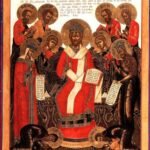 King of kings, the queen stands at your right – a special variation of the Deesis composition, where Christ is depicted as “King of kings and Lord of lords” (1 Tim. 6:15). It originally appeared to illustrate one of the verses from Psalm 44 – “The queen stood […]
 The report, Women in Parliament 2025, released ahead of International Women’s Day on March 8, also found that women’s leadership in Parliament had declined, with women occupying 12 of the 75 newly appointed speaker positions. At the same time, quotas have been identified as playing a “role […]