Sunday, September 20, 2026
Home Blog Page 128

In Vienna at UNODC, Petro Calls for a Smarter Drug Strategy

0
In Vienna at UNODC, Petro Calls for a Smarter Drug Strategy

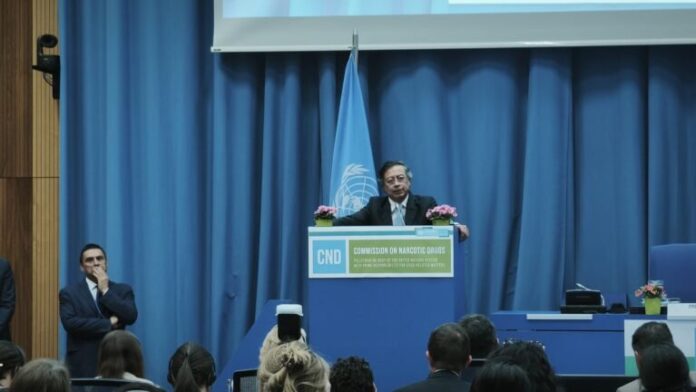
At the UN drug commission in Vienna on March 9, 2026, Colombian President Gustavo Petro delivered a speech that sharply criticized prohibition and exposed the social roots of coca cultivation in Colombia. But the broader lesson from his intervention, and from Europe’s own policy debate, is not that blanket legalization is the answer. It is […]

Originally published at Almouwatin.com

In Vienna at UNODC, Petro Calls for a Smarter Drug Strategy

0
In Vienna at UNODC, Petro Calls for a Smarter Drug Strategy

At the UN drug commission in Vienna on 9 March 2026, Colombian President Gustavo Petro delivered a speech that sharply criticised prohibition and exposed the social roots of coca cultivation in Colombia. But the broader lesson from his intervention, and from Europe’s own policy debate, is not that blanket legalization is the answer. It is that drug policy must move beyond false choices: states need stronger prevention and education, serious investment in vulnerable communities, intelligence-led international cooperation, and sustained action to dismantle the criminal and financial networks that profit from addiction and violence.

Speaking during the opening day of the 69th session of the UN Commission on Narcotic Drugs in Vienna, Petro gave one of the most politically charged interventions of the day. His speech, published by the Colombian presidency, challenged decades of orthodoxy on the “war on drugs” while forcing delegates to confront a question that has haunted Latin America for years: what happens when prohibition punishes the poor, enriches organised crime and still fails to eliminate demand?

Petro began with cannabis, using it as an example of what he sees as a historical and moral contradiction. Referring to the contrast between the human cost of prohibition in producing countries and the legalisation or normalisation of cannabis in parts of the global north, he asked why so many Colombians had died around a substance that is now legally sold in major American cities. His answer was blunt: “Prohibition implies the creation of the mafia. And the creation of the mafia implies death and violence.”

That line will be widely quoted, and with reason. It captures the core of Petro’s critique. But it should not be read too simply. His speech did not amount to a complete legalization blueprint for every substance, nor did it offer a permissive approach to drugs in general. What it did was reject the idea that criminal bans alone can solve a phenomenon driven by social despair, global demand, organised crime and massive financial flows.

More than a choice between prohibition and legalization

That distinction matters. It is possible to accept Petro’s criticism of prohibition without concluding that blanket legalization is the obvious alternative. In fact, the stronger conclusion from Vienna is that neither formula, on its own, is sufficient.

Prohibition by itself has often fuelled black markets, corruption and violence, especially in fragile rural regions where poor farmers bear the costs and criminal organisations capture the profits. Yet legalization, by itself, would not automatically dismantle trafficking routes, criminal logistics, money laundering systems or the multinational distribution chains that today behave less like old cartels and more like transnational corporate crime structures. A legal market for one substance does not neutralise the networks that traffic others, nor does it solve addiction, predatory supply chains, synthetic drug threats or the public-health emergencies linked to abuse.

That is why the most credible reading of Petro’s intervention is not “legalize everything” but “stop pretending that repression alone works.” From there, the real policy question becomes more serious: how do states reduce demand, protect the vulnerable and destroy the criminal infrastructure of supply?

Petro’s social diagnosis of the drug economy

One of the most striking parts of Petro’s speech was his attempt to describe different drugs not only chemically, but sociologically. Cannabis, he argued, emerged in modern history as a substance associated with youth protest. Cocaine, by contrast, belonged to a different social order. “Cocaine is the drug of capital, no longer of protest,” he said. “It is necessary to increase the working day.” In another pointed phrase, he described it as “the drug of Wall Street.”

Whether one accepts that framing in full or not, the political purpose was clear. Petro was trying to redirect attention from the fields of Colombia to the societies that consume, finance and normalise the demand. In that sense, his speech was also a challenge to Europe. As the European Union Drugs Agency has warned, cocaine remains the second most commonly used illicit drug in Europe after cannabis, and its availability across the continent continues to rise.

Petro reserved even harsher language for fentanyl, which he called “a drug of death.” Here too, his point was not to relativise cocaine or cannabis, but to argue that the spread of different substances reflects deeper crises inside societies: loneliness, despair, pressure, competition and social fragmentation. It was a controversial analysis, but one that underscored a wider truth often missing from diplomatic statements: drug markets are not only a law-enforcement problem. They are also a mirror of social breakdown.

Colombia’s coca fields and the question of inequality

Where Petro was at his strongest was in linking coca cultivation to inequality and land exclusion. He argued that coca leaf in Colombia is cultivated not because peasant communities are naturally tied to the cocaine trade, but because generations of poor rural families were displaced from fertile land by violence and left with few viable alternatives. In one of the clearest lines of his address, he said coca cultivation persists because Colombia has not been able “to democratise land tenure and give poor peasants fertile land to produce food.”

That argument has major implications for policy. If coca cultivation is rooted in exclusion, then eradication without social reform becomes a revolving door. One plantation is destroyed, another appears. One family loses a crop, another enters the trade. The cycle repeats because the economic logic remains intact.

That is why Petro defended voluntary crop substitution so strongly. He said his government has already reached 42,000 hectares in voluntary substitution efforts and argued that this method is more durable than forced eradication because communities themselves participate in uprooting the crop. “Voluntary substitution means that the heart, the spirit, the desire of the peasant excluded for generations is on the side of this government,” he said, describing farmers physically pulling coca plants “out by the root.”

On this point, the speech deserves serious attention. States will not defeat illicit production in poor rural areas unless they provide real alternatives: roads, legal markets, schools, public services, land security, credit and the possibility that a child can build a future outside the narco-economy.

Prevention is not a slogan but a state investment

Still, substitution at the source is only one side of the equation. If demand remains strong, criminal markets adapt. That is where prevention becomes central. Petro’s speech pointed forcefully toward the failures of the old model, but Vienna also highlighted something else: prevention and education cannot remain secondary add-ons in drug policy. They have to become core state investments.

The European Union’s statement to the same session made that case in more institutional language. The EU called for an “evidence-based, integrated, balanced, multidisciplinary and human rights-centred approach” and explicitly prioritised “evidence-based prevention, early intervention, treatment, care, recovery, social reintegration” alongside stronger security action. That balance is important. Prevention is not moralising rhetoric. It is a practical strategy to reduce the number of future consumers and shrink the business base of organised crime.

For that reason, education matters far beyond school campaigns. It includes early prevention in families and communities, credible information for young people, support services in vulnerable neighbourhoods, mental-health resilience, and long-term public investment in places where criminal recruitment is easiest. Prevention lowers demand over time. Lower demand weakens the market. And a weaker market gives criminal organisations less room to grow.

Destroying the networks, not only seizing the product

Petro’s strongest operational message was not about legalization at all. It was about networks. He argued that modern drug mafias are no longer isolated cartels of the past but multinational structures involved not only in narcotics, but also in arms trafficking, human exploitation and wider forms of organised crime. In his words, today’s criminal structures are “multinational” and deeply embedded in global routes of money and luxury.

That led him to one of the speech’s most important conclusions: “The kingpins of kingpins are untouched.” He argued that they do not live in the producer regions of the south and that reaching them requires political will to follow the money into the international financial system and the world’s wealthy urban centres.

Here Petro’s argument intersects with a position that many European governments would recognise. The EU told the Vienna session that its strategy includes stronger information exchange, better forensic and investigative capacity, deeper operational cooperation with partner countries, disruption of trafficking routes and illicit financial flows, and action against criminal infiltration of ports and logistical hubs. That is the hard centre of any serious anti-cartel policy.

Put plainly, the objective cannot only be to destroy crops or intercept shipments. It must be to dismantle distribution networks, freeze assets, expose money laundering, seize logistics chains, prosecute high-level organisers and connect intelligence across borders quickly enough to keep pace with organised crime. The state must be smarter, faster and more coordinated than the networks it is trying to defeat.

The lesson from Vienna

Petro came to Vienna to say that the old prohibitive model has failed too many communities in Latin America. On that point, his speech was powerful and, in important respects, persuasive. But the most useful conclusion for Europe and the wider international debate is not that legalization should simply replace prohibition.

The real lesson is harder and more demanding. Drug policy must leave behind simplistic binaries. States should not rely on prohibition as a final answer when it has repeatedly generated black markets and violence. But they should also not imagine that legalization would dissolve the criminal architectures that now span continents, as they will even increase them.

A serious strategy has to work at every level at once: prevention and education to reduce demand; public-health support for those at risk; rural development and crop substitution to reduce production; intelligence-sharing and law-enforcement cooperation to dismantle cartels and trafficking routes; and financial investigations strong enough to reach the upper tiers of the criminal economy. That is where the real struggle lies.

As The European Times has already reported from the opening of CND69 in Vienna, this week’s debate is about more than drugs alone. It is about what kind of states still have the capacity to protect life, confront organised crime and invest in prevention before violence becomes business. Petro’s speech raised that challenge sharply. The answer now depends on whether governments are willing to move from slogans to strategy and prevention.

Source link

Scientists uncover novel genetic code in microbes, opening new biotech frontier

0


Scientists at the Department of Energy’s Oak Ridge National Laboratory were part of a team that identified the

Source link

Vienna hosts global drug policy debate at UN CND69

0
Vienna hosts global drug policy debate at UN CND69

Vienna has once again become a diplomatic crossroads as the 69th session of the United Nations Commission on Narcotic Drugs opens at UNODC headquarters, bringing together governments, researchers and civil-society organisations for a week of debate on prevention, synthetic drugs, treatment and the future direction of global drug policy.

VIENNA — The start of the 69th session of the Commission on Narcotic Drugs has placed Vienna at the centre of one of the most consequential international policy debates of the week. From 9 to 13 March, delegates are meeting at the Vienna International Centre, home of the United Nations Office on Drugs and Crime, to review drug-market trends, assess international commitments and negotiate how states should respond to trafficking, addiction, prevention and public-health pressures.

The Commission may sound procedural, but the political stakes are real. In a recent official UNODC explainer, the body is described as the United Nations’ central drug policy-making forum, where member states take stock of implementation and confront the rapidly changing reality of illicit markets. This year’s session opened under the chairmanship of Armenia’s ambassador to the United Nations in Vienna, Andranik Hovhannisyan, with acting UNODC Executive Director John Brandolino among the senior figures leading the week.

An official UNODC media advisory issued ahead of the session made clear just how broad the programme is. Alongside the plenary and formal negotiations, the organisation said the week would include 169 side events and 23 exhibitions. That number matters because much of the real policy argument around CND no longer happens only in formal speeches. It also happens in the smaller rooms, where governments, NGOs, clinicians, youth organisations and campaigners compete to shape the language and priorities of international drug policy.

Where the sharper debates often happen

If the plenary offers the official diplomatic script, the side events provide the more revealing conversation. They show which actors are pressing for tougher criminal-justice responses, which are arguing for evidence-based prevention, which want stronger treatment systems and which are framing drug policy more explicitly through public health or human rights.

The Vienna NGO Committee on Drugs, one of the main civil-society reference points around the annual session, has underlined that broader ecosystem in its updated guide for 2026 participants. It has also organised informal dialogues during the session with John Brandolino, the President of the International Narcotics Control Board, the CND Chair and representatives of WHO, UNAIDS, OHCHR and UNDP. That programme reflects a simple reality: the Vienna week is not only about state-to-state diplomacy. It is also about how civil society, health institutions and international agencies try to influence the global agenda.

A broader overview published by the World Federation Against Drugs shows just how varied the side-event calendar has become. Among the sessions highlighted are discussions on women, youth and mental health across the life course, building resilient youth and families for drug prevention, collaboration across the continuum of care in drug demand reduction, synthetic drugs and youth protection, and human-rights-centred drug strategies. Taken together, the programme suggests that CND69 is not dominated by one message alone. It is a crowded and often competing debate about what actually works.

Prevention takes a visible place

One of the clearer themes running through this year’s side events is the push to give prevention more policy weight. That does not mean the enforcement agenda has disappeared. Rather, it means more actors are arguing that governments cannot claim to be serious about reducing harm while continuing to underinvest in programmes aimed at stopping drug use before it escalates.

Within that strand, a side event titled “The Hidden Costs of Ineffective Drug Prevention” adds to the week’s discussion by focusing on the economic and social consequences of poorly designed prevention policies. Organised by the Fundación para la Mejora de la Vida, la Cultura y la Sociedad, the session examines what is lost when prevention remains underfunded or disconnected from evidence-based practice. Its announced speakers include Robert Galibert, president of the Foundation for a Drug-Free Europe; Akira Fujino of Japan’s Drug Abuse Prevention Centre; Dr Francis Ndé, identified on the event materials as a medical adviser at the Council of the European Union; and Julie Delvaux, programmes director at Fundación MEJORA.

Another prevention-focused session, “From Implementation to Impact: Outcome-Based Capacity Building in Drug Education”, organised by the Foundation for a Drug-Free World, turns to the question of how education programmes can be measured not only by outreach but by practical results. According to the event announcement, speakers include Jessica Hochman, the foundation’s executive director; Juan Carlos Morales of Guatemala’s Executive Secretariat of the Commission Against Addictions and Illicit Drug Trafficking; and William W. Wu, Chief of Police of the Compton Unified School District Police Department in the United States. The emphasis is on local capacity, youth protection and whether prevention tools can move from broad messaging to demonstrable impact.

A wider struggle over what drug policy should be

The significance of these events lies in the larger argument surrounding them. In Vienna this week, drug policy is not being discussed simply as a technical matter of treaty implementation. It is being debated as a contested field where public health, criminal enforcement, education, rights language and political credibility all collide.

Some sessions emphasise resilience, families and early intervention. Others focus on synthetic substances, digital environments and the speed with which new threats spread. Still others are framed around human dignity, community support and the need for policies that do not treat treatment, prevention and recovery as separate silos. That breadth reflects a growing recognition that the illicit drug market has become too adaptive for any one-dimensional answer.

At the same time, the coexistence of so many themes also shows why the Commission remains politically sensitive. States often agree in principle on balanced, evidence-based responses, but disagree on what that balance should mean in practice: more resources for prevention, stronger policing, greater harm-reduction capacity, tougher supply controls, or some combination of all four.

Why Vienna still matters

The setting matters as much as the programme. Vienna remains one of the few places where the international system’s legal, security and health conversations are concentrated under one roof. In the case of CND69, that means governments, international organisations and NGOs are all trying, in parallel, to influence how the world defines an effective response to drugs in 2026.

That is why the side events deserve close attention. They are not a decorative annex to the official meeting. They are where the policy mood becomes visible. They show which narratives are advancing, which coalitions are forming and which parts of the global debate are gaining institutional traction.

For European readers, the Vienna session is also a reminder that many of the same arguments heard inside UNODC — over synthetic drugs, prevention, youth vulnerability, treatment capacity and evidence-based policy — are already shaping debates in Brussels, Strasbourg and national capitals. The value of watching Vienna is not only to follow what the United Nations says, but to see where the next phase of the argument may be heading.

Source link

Hungary’s data watchdog faces a credibility crisis

0
Hungary’s data watchdog faces a credibility crisis

Hungary’s data protection authority is meant to protect citizens from abuse. But when secrecy, surveillance and political power collide, European courts and institutions have repeatedly raised the same troubling question: is the watchdog truly independent, or only independent on paper? Hungary’s National Authority for Data Protection and Freedom of Information (NAIH) is supposed to be […]

Originally published at Almouwatin.com

Free iPhones for Low-Income Folks: No Contract, No Down Payment Deals from TAG Mobile 

0


Access to a smartphone has become essential for daily life in the United States. There is a growing

Source link

Best Budget Airlines for Traveling in Europe

0
Best Budget Airlines for Traveling in Europe

Best Budget Airlines for Traveling in EuropeWhich low-cost airline is best for Europe in 2026? There is no single winner for every traveler. Ryanair still dominates in terms of overall reach and fares, easyJet offers one of the best balances between network and convenience, Wizz Air remains particularly important in Central and Eastern Europe, Vueling is […]

Originally published at Almouwatin.com

Best Budget Airlines for Traveling in Europe

0
Best Budget Airlines for Traveling in Europe

Best Budget Airlines for Traveling in EuropeWhich low-cost airline is best for Europe in 2026? There is no single winner for every traveler. Ryanair still dominates in terms of overall reach and fares, easyJet offers one of the best balances between network and convenience, Wizz Air remains particularly important in Central and Eastern Europe, Vueling is […]

Originally published at Almouwatin.com

Best Budget Airlines for Travel Within Europe

0
Best Budget Airlines for Travel Within Europe

Which low-cost airline is best for Europe in 2026? There is no single winner for every traveler. Ryanair still dominates on sheer reach and headline fares, easyJet offers one of the strongest balances of network and practicality, Wizz Air remains especially important across Central and Eastern Europe, Vueling is often the natural choice for Spain […]

Originally published at Almouwatin.com

Best Budget Airlines for Travel Within Europe

0
Best Budget Airlines for Travel Within Europe

Which low-cost airline is best for Europe in 2026? There is no single winner for every traveler. Ryanair still dominates on sheer reach and headline fares, easyJet offers one of the strongest balances of network and practicality, Wizz Air remains especially important across Central and Eastern Europe, Vueling is often the natural choice for Spain and Mediterranean city pairs, Volotea is unusually strong on smaller regional routes, while Eurowings and Transavia can be smart picks when comfort, airport mix, or specific Western European bases matter more than the absolute lowest fare.

Europe’s budget airline market is mature, competitive and, for passengers, often confusing. The cheapest ticket is not always the cheapest trip. Once cabin bags, seat selection, airport choice, and schedule reliability enter the picture, the “best” airline depends less on branding than on the kind of journey you are making.

For readers planning a broader trip this year, The European Times recently outlined the wider rules and practical issues that shape travel across Europe in 2026. Within that picture, low-cost carriers remain central. They connect major capitals, secondary cities, islands and seasonal destinations on a scale traditional network airlines often do not match.

The best budget airlines, by type of traveler

Best overall balance: easyJet

If one airline comes closest to being the broad “safe recommendation” for many travelers, it is easyJet. The company says it had 163 airports, 1,202 routes and operations in 37 countries as of 30 September 2025. That scale matters because it gives passengers a large network without forcing them quite as often into very remote airports.

easyJet’s free under-seat bag allowance is also among the more generous in the European low-cost segment: up to 45 x 36 x 20 cm. For short trips, that can reduce the pressure to buy extras. In practical terms, easyJet often makes sense for travelers who want a budget fare but do not want every decision to feel like a baggage trap.

Best for the lowest headline fares and widest reach: Ryanair

Ryanair remains the giant of European low-cost travel. In its summer 2025 network announcements, the airline repeatedly described its schedule as more than 2,000 routes across more than 230 destinations. That scale makes it hard to ignore if your priority is simple: find the cheapest possible way to get from one European city to another.

But Ryanair is best for a specific kind of traveler: flexible, light-packing, price-first, and willing to use secondary airports where needed. Its free personal item allowance is smaller than easyJet’s at 40 x 30 x 20 cm, and many of its cheapest fares only look unbeatable if you can travel with that alone. For backpack-style weekend breaks, Ryanair is often unmatched. For travelers carrying more, the final bill can rise quickly.

Best for Central and Eastern Europe: Wizz Air

Wizz Air remains one of the most important low-cost players for Central and Eastern Europe. Its annual reporting said that, as of 31 March 2025, it connected close to 200 destinations across 55 countries, and the airline continues to expand aggressively in markets such as Romania, Poland, Italy and the Balkans.

Wizz is especially useful when the route you need is not well served by Western European carriers. Its free cabin allowance is 40 x 30 x 20 cm, with a larger trolley bag available only through priority options. That makes it attractive for travelers who can pack very light and who care more about direct connectivity than onboard frills.

Best for Spain, city breaks and Mediterranean routes: Vueling

Vueling is one of the strongest budget brands for Spain and nearby markets. The airline says it flies to more than 100 destinations, while its latest ESG reporting describes a network of more than 100 destinations in 30 countries. For Barcelona, many Spanish domestic links, and numerous Mediterranean city pairs, Vueling is often one of the first names worth checking.

Its free under-seat bag is 40 x 20 x 30 cm, and overhead cabin baggage is typically extra. For travelers moving between Spain, Italy, France and nearby leisure destinations, Vueling often combines good route logic with better airport choices than some ultra-low-cost competitors.

Best for smaller regional cities: Volotea

If your trip does not begin or end in a major capital, Volotea deserves far more attention than it usually gets. The airline says it will operate more than 430 routes in 2026, connecting more than 110 small and mid-sized cities in 17 countries, with more than half of those routes exclusive.

That is what makes Volotea different. It is not simply a cheaper alternative on trunk routes; it is often the only direct option on thinner intra-European links. If you are trying to avoid a train-to-airport-to-hub detour and just want a direct flight between secondary cities, Volotea can be one of the smartest choices in Europe.

Best if you want a budget airline with a slightly more premium feel: Eurowings

Eurowings is not always the absolute cheapest, but it is increasingly relevant for travelers who still want low-cost logic with a bit less friction. The airline says passengers can choose from more than 210 destinations, and its free small bag allowance in the BASIC fare is 40 x 30 x 25 cm.

There is also a reputational point in its favor: Skytrax ranked Eurowings as Europe’s best low-cost airline in 2025. Awards do not decide every booking, but they do suggest that some passengers value Eurowings’ service balance more than the ultra-minimalist approach of some rivals.

Best from the Netherlands and France for leisure travel: Transavia

Transavia, part of the Air France-KLM group, says it flies to more than 100 destinations in Europe and operates from seven home bases in the Netherlands and France. It can be an excellent choice for travelers departing from Dutch or French markets, especially toward southern Europe and holiday destinations.

Its always-included hand luggage item is 40 x 30 x 20 cm, while a larger cabin bag generally requires advance purchase. In practice, Transavia is often most attractive when its route map lines up with your city pair and you want a mainstream leisure carrier rather than the harshest ultra-low-cost model.

So which airline should most people choose?

For many travelers, the clearest answer is this:

  • Choose easyJet if you want the best all-round compromise.
  • Choose Ryanair if the absolute lowest fare matters most and you can travel very light.
  • Choose Wizz Air for Central and Eastern Europe or when it has the only sensible direct route.
  • Choose Vueling for Spain-heavy itineraries and many Mediterranean city breaks.
  • Choose Volotea when flying between smaller regional cities.
  • Choose Eurowings if you are willing to pay a little more for a smoother low-cost experience.
  • Choose Transavia when departing from the Netherlands or France on leisure-focused routes.

The real mistake is not choosing the “wrong” airline brand. It is comparing only the base fare and not the full trip. A €19 fare on a secondary-airport route with strict baggage limits can end up being worse value than a €39 fare from a more convenient airport with a more usable cabin bag.

The baggage question is still politically unsettled

Passengers should also remember that baggage rules are not just commercial choices; they are part of an active legal and political debate in Europe. In January 2026, the European Parliament said passengers should be allowed one personal item and one small piece of hand luggage free of charge. Consumer groups have also continued pressing authorities over what they see as unfair cabin-bag fees, while Spain’s enforcement action against several low-cost airlines remains part of a wider European dispute over passenger rights.

That means one practical rule matters more than ever: always check the airline’s live baggage terms before paying, even if you flew the same carrier last year. Policy, enforcement and litigation are all still moving.

And if something goes wrong after you book, European passenger-rights rules can still matter as much as the fare itself. Readers may want to keep handy this guide on what to do if your flight is cancelled in Europe and this explainer on how to challenge an airline that denies EU261 compensation.

Bottom line

The best budget airline for travel within Europe is not one airline but a shortlist. easyJet is probably the best all-rounder. Ryanair is still the strongest price machine. Wizz Air remains strategically important in the east of the continent. Vueling is a natural Spain-and-Mediterranean specialist. Volotea is unusually useful for regional routes. Eurowings and Transavia are often the better pick when the cheapest fare is not the only thing you care about.

For European travelers in 2026, the smartest booking habit is simple: compare fare, airport, bag policy, and timing together. In budget aviation, value is rarely just the number on the first search screen.

Source link