Saturday, March 28, 2026
Home Blog Page 145

World News in Brief: Funding cuts curb development, human rights in Belarus update, Ebola and mpox in Africa

0
World News in Brief: Funding cuts curb development, human rights in Belarus update, Ebola and mpox in Africa

Speaking in Geneva, she said the world was facing “declining respect for human rights and multilateralism”, with conflicts, debt, and shrinking development assistance threatening to reverse hard-won gains.

The 38-member economic cooperation organization, OECD, projects a nine to 17 per cent fall in aid next year, and up to 25 per cent for the least-developed countries bloc, while military spending has soared to record highs.

“The results speak for themselves: poverty reduction has stalled, and virtually all SDGs are off track,” Ms. Al Nashif said, citing the World Bank’s warning of a “lost decade for development.”

Way forward

Despite the bleak outlook, she said the right to development offered a practical path forward — by reshaping fiscal policies, strengthening social protection, and aligning global finance with human rights principles.

Nearly 40 years after the UN Declaration on the Right to Development, Ms. Al Nashif urged governments to “move from words to action”, noting new momentum through initiatives such as the Sevilla Commitment and renewed global solidarity voiced at the 80th UN General Assembly.

UN independent expert: Belarus is no ‘paradise’ for workers

“Belarus is not the worker’s paradise authorities say it is, despite their proclaimed commitment to economic and social rights,” said UN independent human rights expert on Belarus, Nils Muižnieks, addressing the UN General Assembly Monday.

In his capacity as a Human Rights Council-appointed expert, Mr. Muižnieks presented his latest report, which revealed pervasive politically-motivated discrimination and harassment in both the Belarusian public and private sectors.

Forced labour

He also found unjustified restrictions on access to jobs based on political grounds – and the use of forced labour for little or no pay as a form of punishment for persons unjustly incarcerated.

The report follows a two-year engagement under the International Labour Organization (ILO), which has put Belarus under enhanced scrutiny due to violations of trade unions’ rights.

Mr. Muižnieks – who is not a UN staffer and who receives no salary for his work – recalled that over 1,100 people continue to be detained arbitrarily in the country and that some of those released have been deported and had their passports confiscated, leaving them at risk of statelessness and afraid of returning back home.

IOM steps up Ebola and mpox preparedness across Africa

The International Organization for Migration (IOM) is scaling up its health response across Africa, responding swiftly to the Ebola outbreak in the Democratic Republic of the Congo (DRC) this past September and supporting mpox preparedness in several African countries.

The agency’s priority is to make fully operational all points of entry and screening to prevent disease in areas where there is human movement. 

“These measures help prevent the spread of disease and keep both travellers and border communities safe,” said Frantz Celestin, IOM’s regional director for East, Horn and Southern Africa.

Border communities face heightened risk due to high mobility and limited access to health services, but thanks to operational screening points, over 169,000 screenings have been conducted.

Improved mpox response 

The agency is also supporting national mpox responses in several countries. In Uganda and Ethiopia, health authorities are using IOM’s mobility data for public health planning and outbreak preparedness.

In Malawi and South Sudan, IOM is enhancing surveillance, contact tracing and access to vaccination at key border points.  
Source link

Hurricane Melissa: UN launches sea-lift operation to deliver aid

0
Hurricane Melissa: UN launches sea-lift operation to deliver aid

Latest news reports say wind speeds have reached 165mph (270km/h) while storm surges of 13 feet (3.9 metres) are expected to lash the Caribbean island nation.

Conditions are expected to significantly worsen with a third of the island already experiencing power cuts amid what US hurricane forecasters are describing as “an extremely dangerous and life-threatening situation.”

The World Food Programme (WFP) is coordinating a sea-lift operation from Barbados, carrying essential supplies from the International Organization for Migration, the UN Children’s Fund (UNICEF), and WFP itself.

“Some 2,000 relief kits are also planned for deployment once airports reopen and the weather conditions permit flights”, said UN Spokesperson Stephane Dujarric.

In collaboration with the Caribbean Disaster Emergency Management Agency and a joint aid hub established in Barbados, WFP is “instrumental” in the ongoing disaster response, with support from the European Union and Canada, emphasised Mr. Dujarric. 

UN ramps up relief efforts 

The slow-moving hurricane is expected to make landfall overnight local time in Cuba, to the northeast – with authorities planning to evacuate around half a million people to safer ground.

In Haiti, authorities have placed the departments of South and Grand’Anse on red alert, while other areas remain on orange alert.

“More than 3,600 people are sheltering in emergency sites in the Grand Sud département, with IOM supporting sheltering of 3,000 people preventively and the setting up of 100 shelters”, underscored Mr. Dujarric.

In addition, the UN and its partners continue to work closely with Haitian authorities to support preparedness and early action.

A satellite image shows Hurricane Melissa making landfall near New Hope, in western Jamaica.

Here is what UN agencies have lined up so far: 

  • WFP has pre-positioned more than 800 metric tons of food to assist 86,000 people in Haiti for two weeks.
  • UNICEF has pre-positioned water, sanitation, and hygiene kits for about 14,500 people and nutritional supplies for more than 4,000 children.
  • The UN reproductive health agency (UNFPA) has stocked reproductive health kits for 5,000 people and dignity kits for 4,000 people
  • The WHO-led Pan American Health Organization (PAHO) has provided medical kits for about 11,000 people.

‘Tremendous winds’

The latest forecasts indicate winds reaching 280km per hour – stronger than initially expected, according to the UNESCO Representative in Jamaica, Eric Falt.

“People often overlook the storm surge”, he told us, “which can raise sea levels by three or four meters”.

He also noted that Hurricane Melissa is a slow-moving storm, which poses a major problem.

“It could stay over an area for 12 hours, maybe even two days or more, which causes massive water accumulation.”

Emphasising the Jamaican Government’s “extraordinary” level of preparedness and the strong sense of solidarity across the Caribbean, the UNESCO representative noted that, despite the UN’s extensive readiness efforts, “nature ultimately dictates her will.”

He added that UN agencies continue to work closely together to respond to the evolving situation.
 

Source link

How to make European forests resilient to wildfires by working with nature

0
How to make European forests resilient to wildfires by working with nature

Nature-based solutions are key to reducing Europe’s growing risk of forest fires and to making forests more resilient to climate change, according to a briefing published today by the European Environment Agency (EEA).

Source link

Do You Really Need Supply Chain Planning Software Now?

0


Given the current market conditions, businesses are continuously looking for opportunities to improve efficiency and cut costs. Getting

Source link

Russian army committing murder in Ukraine: Independent rights commission

0
Russian army committing murder in Ukraine: Independent rights commission

The Russian military’s actions amount to two crimes against humanity, the Commission of Inquiry on Ukraine’s report states – firstly of “murder and of forcible transfer of population” and secondly, “deportations and transfers of civilians” from areas occupied by Russian forces, some of whom were tortured.

Systematic and coordinated

The attacks – which have struck a wide range of civilian targets in an area spanning over 300 kilometres along the right bank of the Dnipro River, across Dnipropetrovsk, Kherson, and Mykolaiv oblasts – are systematically coordinated actions designed to drive Ukrainians out of their homes, say the report’s authors.

Buildings have been damaged by drone and missile attacks in the western Ukrainian city of Lviv.

They have targeted individuals, houses and buildings, humanitarian distribution points and critical energy infrastructure servicing civilians.

They also targeted first responders – including ambulances and fire brigades, which are afforded special protection under international humanitarian law.

Many of the attacks struck the same vehicles and infrastructure repeatedly, deliberately setting them on fire, spreading terror among the civilian population and violating their fundamental human rights.

The report from the UN Human Rights Council-appointed investigation team – established in March 2022 – contains testimony from residents who have come under fire, describing their living conditions as unbearable.

‘Severe mental pain and suffering’

We are hit every day, drones fly at any time – morning, evening, day or night, constantly,” said a man interviewed for the report.

The investigators’ report documents that Russian authorities coordinated actions to deport or transfer groups of people from areas under occupation. Some were transferred to areas under Ukrainian Government control; others were sent to neighbouring Georgia.

Detention, torture and confiscation of documents and belongings are also laid out – acts which have “inflicted severe mental pain and suffering and amount to inhuman treatment as a war crime and a violation of human rights,” the report states.

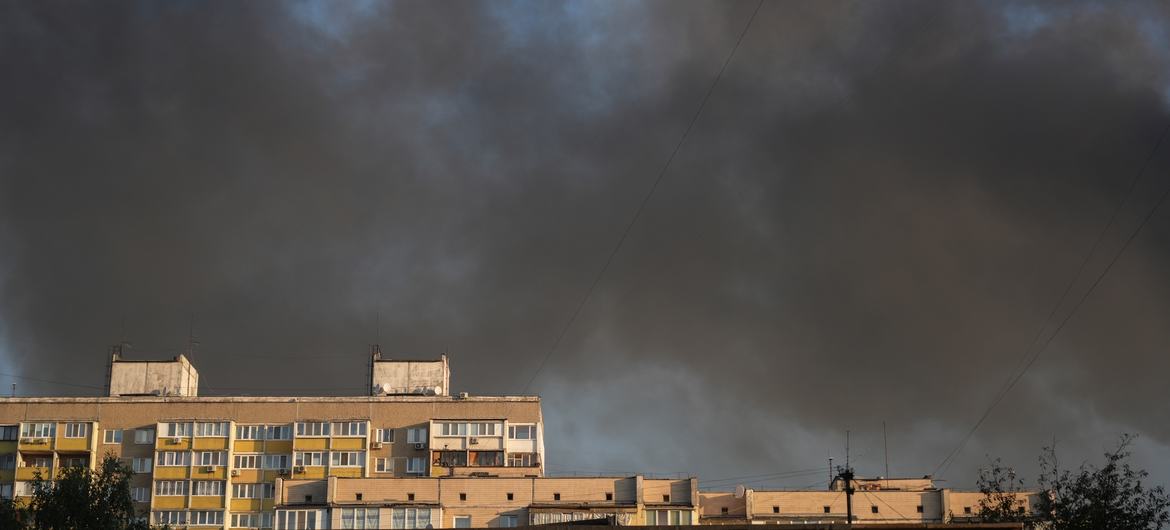
Thick black smoke fills the sky above residential buildings in Kyiv after a drone strike set fire to a nine-storey block in the neighbourhood.

© UNICEF/Oleksii Filippov

Thick black smoke fills the sky above residential buildings in Kyiv after a drone strike set fire to a nine-storey block in the neighbourhood.

On Monday, the Commission of Inquiry presented the report to the UN General Assembly’s Third Committee, which deals with social, humanitarian and cultural issues.

The findings are based on some 500 publicly available videos of crimes examined – 247 of which have had their locations technically verified – and 226 interviews with Ukrainian citizens.

The Commission also examined Russian allegations of drone attacks by Ukrainian armed forces against civilian targets in Russian occupied areas. It was unable to draw any conclusions due to lack of access to the territory, concerns relating to the safety of witnesses, and the lack of responses from Russian authorities.

Source link

Children are in danger as winter approaches and strikes resume in Ukraine

0

Dozens of civilian casualties were reported over the weekend and into Monday, including children injured, according to UN spokesman Stéphane Dujarric.

The hardest hit regions are Dnipro, Donetsk, Kharkiv, Kherson, kyiv, Sumy and Zaporizhzhia.

“Meanwhile, our humanitarian colleagues tell us that civilian evacuations continue from frontline communities in Donetsk region“, Mr. Dujarric told reporters in New York on Monday.

Between October 24 and 26, more than 900 people were evacuated, he added, also noting that the Ukrainian Humanitarian Fund has released $13 million since May to support local and national NGOs in the Kharkiv region, helping nearly 76,000 residents.

About half of those affected are women and girls. Assistance has included cash transfers, shelter, health services, water, sanitation, hygiene support and measures to prevent gender-based violence.

“We don’t see anything”

Winterization – providing lifesaving assistance to vulnerable populations to protect them from cold and harsh conditions – is a major concern, according to the United Nations Children’s Fund (UNICEF) warns.

Kenan Madi, Head of Field Operations, UNICEF Ukraine, said UN News that families on the front lines urgently need heating, warm clothing and other essential supplies.

Attacks on infrastructure impact basic services – from hospitals to water services to district heating. – making daily life extremely difficult for children,” he said.

“I just had a colleague who came back from Chernihiv,” he continued, adding: “The only thing he said to me was, “It’s really dark, you can’t see anything.” » Some rural areas are in a total blackout. This is what children in Ukraine are currently experiencing.»

UN response

Under these conditions, United Nations agencies are continuing their efforts to provide aid to communities. UNICEF provided access to clean water to 300,000 people in September alone and to more than three million people across the country so far this year.

Education remains disrupted: around 350,000 children in frontline regions attend school in person, while more than 400,000 follow a blended schedule and around 280,000 continue their schooling entirely online.

To mitigate these disruptions, the agency supports more than 150 learning centers offering remedial classes, social-emotional support and safe learning spaces. He also has rehabilitated more than 100 schools and kindergartens since 2022with 42 additional installations under repair this year.

Mental health a priority

Mental health services are also a priority. Last month, UNICEF provided psychosocial support to 16,000 children and 25,000 caregivers in frontline areas, and more than 300,000 people received mental health assistance throughout 2025.

Mr Madi highlighted the human toll, referring to the challenges faced by a mother of autistic twins.

“She deserves to get the help she needs, but this is not one person’s story. Many households are struggling with their daily lives. There are a lot of stories on the front line and unfortunately, from year to year the situation becomes more and more difficult for people, especially for children, and this is something very worrying for us.

Originally published at Almouwatin.com

World news in brief: funding cuts hamper development, human rights update in Belarus, Ebola and pox in Africa

0

Speaking in Geneva, she said the world was facing “a decline in respect for human rights and multilateralism”, with conflict, debt and a decline in development aid threatening to wipe out hard-won gains.

The OECD, a 38-member economic cooperation organization, forecasts aid cuts of 9 to 17 percent next year, and up to 25 percent for the bloc of least developed countries, while military spending has reached record levels.

“The results speak for themselves: poverty reduction has stalled and virtually all SDGs are behind schedule,” said Ms Al Nashif, citing the World Bank’s warning of a “lost decade for development”.

The way forward

Despite the bleak outlook, she said the right to development offered a practical way forward – reshaping fiscal policies, strengthening social protection and aligning global finance with human rights principles.

Nearly 40 years after the UN Declaration on the Right to Development, Ms. Al Nashif urged governments to “walk the talk,” noting new momentum through initiatives such as the Seville Commitment and renewed global solidarity expressed at the 80th UN General Assembly.

Independent UN expert: Belarus is not a “paradise” for workers

“Belarus is not a workers’ paradise, despite their proclaimed commitment to economic and social rights,” said Nils Muižnieks, an independent UN expert on human rights in Belarus, addressing the UN General Assembly on Monday.

In his capacity as Human Rights Council-designated expert, Mr. Muižnieks presented his latest reportwhich exposed pervasive politically motivated discrimination and harassment in the Belarusian public and private sectors.

Forced labor

It also found unjustified politically motivated restrictions on access to employment – ​​and the use of forced labor for little or no pay as a form of punishment for those unjustly incarcerated.

The report follows a two-year commitment under the auspices of the International Labor Organization (ILO), which has subjected Belarus to increased surveillance due to violations of trade union rights.

Mr Muižnieks – who is not a UN staff member and receives no salary for his work – recalled that more than 1,100 people continue to be arbitrarily detained in the country and that some of those released have been deported and had their passports confiscated, putting them at risk of statelessness and fear of returning home.

IOM scales up Ebola and Pox preparedness across Africa

The International Organization for Migration (IOM) East scaling its health response across Africa, responding quickly to Ebola in the Democratic Republic of Congo (DRC) last September and supporting mpox preparedness in several African countries.

The agency’s priority is to make all entry and screening points fully operational to prevent disease in areas where there is human movement.

“These measures help prevent the spread of disease and keep travelers and border communities safe,” said Frantz Celestin, IOM Regional Director for East, Horn and Southern Africa.

Border communities face increased risk due to their high mobility and limited access to health services, but thanks to operational testing points, more than 169,000 screenings have been carried out.

Improved mpox response

The agency also supports national responses to mpox in several countries. In Uganda and Ethiopia, health authorities use IOM mobility data for public health planning and epidemic preparedness.

In Malawi and South Sudan, IOM is strengthening surveillance, contact tracing and access to vaccination at key border points.

Originally published at Almouwatin.com

Russian army commits murder in Ukraine, independent rights commission says

0

According to the report of the Commission of Inquiry on Ukraine, the actions of the Russian army constitute two crimes against humanity: first, “killings and forced transfers of population” and second, “deportations and transfers of civilians” from areas occupied by Russian forces, some of whom were tortured.

Systematic and coordinated

The attacks – which hit a wide range of civilian targets in an area stretching more than 300 kilometers along the right bank of the Dnipro River in Dnipropetrovsk, Kherson and Mykolaiv oblasts – are systematically coordinated actions aimed at driving Ukrainians from their homes, the report’s authors say.

Buildings have been damaged by drone and missile attacks in the western Ukrainian city of Lviv.

They targeted individuals, homes and buildings, humanitarian distribution points and essential energy infrastructure serving civilians.

They also targeted first responders, including ambulances and firefighters, who enjoy special protection under international humanitarian law.

Many attacks hit the same vehicles and infrastructure repeatedly, deliberately setting them on fire, spreading terror among the civilian population and violating their basic human rights.

The UN report Human Rights CouncilThe designated investigation team – created in March 2022 – contains testimonies from residents who have faced criticism, describing their living conditions as unbearable.

“Severe mental pain and suffering”

We are affected every day, drones fly at all hours – morning, evening, day or night, constantlysaid one man interviewed for the report.

The investigators’ report indicates that Russian authorities coordinated actions to expel or transfer groups of people from areas under occupation. Some were transferred to areas under Ukrainian government control; others were sent to neighboring Georgia.

Detention, torture and confiscation of documents and property are also mentioned – acts which have “inflicted severe mental pain and suffering and constitutes inhumane treatment constituting a war crime and a violation of human rights”, says the report.

© UNICEF/Oleksii Filippov

Thick black smoke fills the sky above residential buildings in kyiv after a drone strike set fire to a nine-story building in the neighborhood.

On Monday, the commission of inquiry presented the report to the Third Committee of the United Nations General Assembly, which deals with social, humanitarian and cultural issues.

The findings are based on some 500 publicly available crime videos examined – 247 of which were technically verified – and 226 interviews with Ukrainian citizens.

The Commission also examined Russian allegations that Ukrainian armed forces attacked civilian targets in Russian-occupied areas with drones. She was unable to draw any conclusions due to lack of access to the territory, concerns over the safety of witnesses and the lack of response from Russian authorities.

Originally published at Almouwatin.com

Desperate need for water and food persists as Gaza families head north

0

Many families are returning to devastated neighborhoods where unstable buildings and unexploded ordnance pose life-threatening risks.

Water, food and essential services are still severely lacking“, OCHA said, as humanitarian partners race to meet growing demand amid widespread destruction.

Help is coming

Aid continues to arrive in Gaza, with more than 300 truckloads of supplies collected from the Palestinian side of the Kerem Shalom crossing between Friday and Saturday.

The cargo included thousands of pallets of wheat flour, canned food, rice and provisions for hot meals, as well as medical equipment, tents, tarpaulins and winter clothing.

While data on Sunday’s deliveries is still being compiled, the UN confirmed that hygiene kits, postpartum kits and shelter materials entered the Gaza Strip.

THE United Nations Office for Project Services which provides comprehensive emergency services (UNOPS) also distributed some 329,000 liters of diesel to keep hospitals, telecommunications and food operations running.

Hot dishes and bread

Humanitarian partners, working with 170 community kitchens, have now provided more than a million hot meals, mainly in southern and central Gaza.

In Deir al Balah, Khan Younis and Gaza City, 15 UN-supported bakeries produce tens of thousands of bales of bread daily, distributed free to shelters and communities across hundreds of sites.

Teams are also expanding their work to reduce risks from unexploded ordnance – largely caused by the Israeli offensive – as people begin to return home.

During the weekend, nearly 3,200 people in central and southern Gaza received security briefings. Since October 2023, according to OCHA, 150 incidents linked to explosive munitions have resulted in casualties, particularly among children.

Olive grove attacks: West Bank

In the occupied West Bank, OCHA reported continued violence linked to the olive harvest season, which began on October 9.

More than 85 settler attacks on Palestinian farmers and their land have disrupted harvests, injuring more than 110 people and damaging more than 3,000 trees in 50 villages.

Seventeen attacks were recorded last week, mainly in the Ramallah governorate. “These repeated incidents have devastated livelihoods and heightened fears among farming communities.“, said OCHA.

Despite the influx of aid, the UN warns that Gaza’s humanitarian needs remain overwhelming, with food, water and shelter still woefully inadequate as families risk everything to return home.

Originally published at Almouwatin.com

Press statement by President António Costa following his meeting with President of the United Arab Emirates Sheikh Mohamed bin Zayed Al Nahyan

0
How to make European forests resilient to wildfires by working with nature

European Council President António Costa had a meeting with President of the United Arab Emirates Sheikh Mohamed bin Zayed Al Nahyan, on 28 October, in Abu Dhabi.

Source link