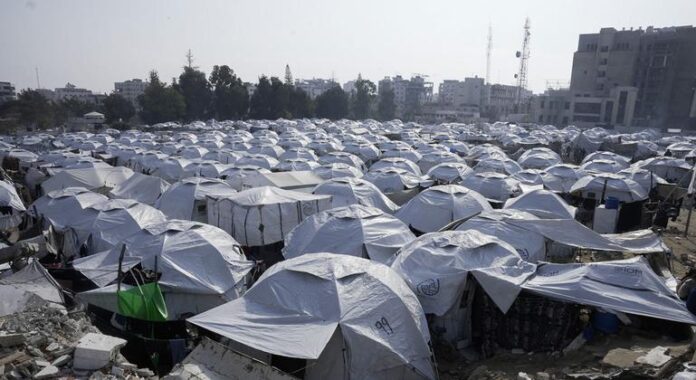
Since the ceasefire on 10 October, the UN migration agency IOM has dispatched more than 47,000 relief items, including 2,500 tents, to help families rebuild amid devastation.
“People in Gaza have endured unimaginable loss,” said IOM Director General Amy Pope.
“Shelter isn’t a luxury; it allows families to rest, to stay warm, and to begin rebuilding their lives. Every person deserves to live in safety and dignity, and humanitarian aid must reach everyone, everywhere.”
Shelter needs are extreme, with an estimated 90 per cent of the population displaced and at least 1.5 million people urgently requiring emergency shelter assistance.
“Many people are returning to find their homes reduced to rubble,” Ms. Pope added, warning that the recovery “cannot begin without safe housing”.
Despite the ceasefire, customs delays, insecurity, and limited crossings continue to hinder aid delivery. IOM has pre-positioned millions of relief items in nearby Jordan, including 28,000 additional tents and more than four million winter supply items ready for rapid deployment once access improves.
A million meals a day
At UN Headquarters in New York, Deputy Spokesperson Farhan Haq said the UN and partners are scaling up food, nutrition, and water services under the UN’s 60-day response plan.
“Our partners are now distributing over one million hot meals daily across the Strip,” he said, adding that six UN-supported bakeries have resumed bread production.
More than 150 nutrition sites are now operating across Gaza, supported by 20 mobile health and nutrition teams – double the number before the ceasefire. “This week alone, partners delivered enough therapeutic food to treat 1,200 children suffering from acute malnutrition,” Mr. Haq noted.
Water and sanitation support is also expanding, with hundreds of thousands of diapers, jerry cans and hygiene kits distributed, and 140 new water tanks installed to expand community access points.
Limited crossing points
Aid continues to enter through the two operational crossings, Kerem Shalom and Kissufim. On Wednesday alone, 127 UN-coordinated trucks were collected for distribution inside Gaza, carrying food, tents, medical supplies and fuel.
Mr. Haq emphasised that “more can and must be done”, urging Israel to open additional crossings, especially to the north, and to facilitate access for NGOs.
“We need full, safe and unrestricted humanitarian access,” he said. “The needs are immense – and they are growing by the day.”
In Nairobi, home to the UN Environment Programme (UNEP), Executive Director Inger Andersen highlighted the city’s unique role as the only UN headquarters in the Global South – and underscored UNEP’s long-standing work on climate change, biodiversity loss, and pollution.
Youth participation was also recognised as a driving force for environmental action and future leadership.
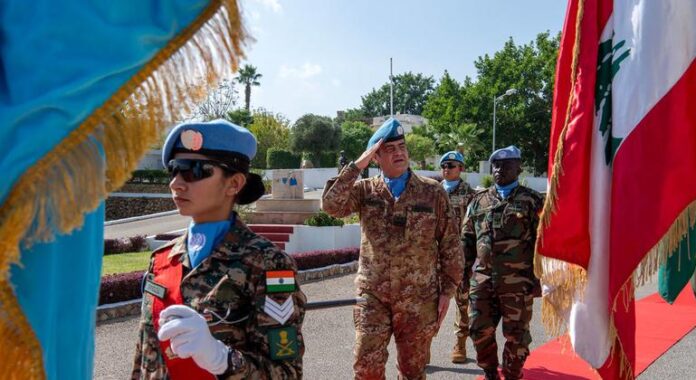
In Naqoura, Lebanon, the UN peacekeeping mission there (UNIFIL) marked the milestone alongside the 25th anniversary of Security Councilresolution 1325 on Women, Peace and Security.
Force Commander Major General Diodato Abagnara said peace “is not built by a few, it is built by everyone,” stressing inclusion as the heart of peacebuilding.
In Afghanistan, the UN Assistance Mission (UNAMA) reflected on its decades-long presence supporting peace, human rights, and development. Deputy Special Representative Georgette Gagnon reaffirmed the UN’s solidarity with Afghans, particularly women and girls, amid ongoing humanitarian challenges.
Across the Americas, UN offices highlighted progress on the Sustainable Development Goals, climate action, and youth engagement, reaffirming the UN’s role in promoting equality, resilience, and cooperation across the region.
Eighty years on, the UN continues to bring people and nations together to “save succeeding generations from the scourge of war” and work towards a fairer, more sustainable future for all.
Nearly one million affected by South Sudan floods
Nearly one million people have been impacted by devastating floods in South Sudan, the Office for Coordination of Humanitarian Affairs (OCHA) warned on Friday.
Since last month, flooding has affected more than 140 health facilities, disrupting access to essential services for thousands at a time when South Sudan is grappling with disease outbreaks, including cholera and malaria.
In fact, in the past week, the World Health Organization (WHO) reported over 104,000 malaria cases, including 16 deaths across the country – marking a 15 per cent increase in cases from the previous week, mainly due to the ongoing flooding.
To make matters worse, the ongoing floods are compounded by the ongoing conflict and acute food insecurity.
Agencies step up aid
Despite significant access challenges to parts of the country, the UN and its partners continue to reach flood-affected people with vital aid and evaluate needs to ensure the response remains targeted.
The World Food Programme (WFP) is on the ground delivering food and nutrition assistance.
The World Health Organization (WHO) and its partners have delivered over 50 metric tonnes of medical supplies to support the response efforts in Jonglei, Unity, and Upper Nile states. Additional assistance is on the way, including tents, cholera kits, and emergency health kits.
More weapons discovered in Lebanon but hope for recovery endures
The UN Interim Force in Lebanon (UNIFIL) continues to discover unauthorised weapons and ammunition caches in the south of the country, the UN Deputy Spokesperson Farhan Haq said during Friday’s press briefing.
On Wednesday, UNIFIL peacekeepers found mortar shells, fuses and a canon in one of their areas of operation, and small homemade explosive devices on Thursday.
Since 15 October, UNIFIL has been coordinating with the Lebanese Armed Forces (LAF) and Israeli Defense Forces to refurbish ‘Blue Line’ markers that were damaged during the conflict – a cessation of hostilities between Hezbollah militants and Israeli forces came into effect last November.
Peaceful activity
Mr. Haq added that following a request by LAF, the mission facilitated olive harvests by farmers near the Blue Line of separation over 40 times this month.
In addition to protecting agricultural activities amid ceasefire breaches, the peacekeepers conduct patrols together with Lebanese forces in those areas to ensure farmers’ safety.
Earlier this month, a public school was reopened in Naqoura, where UNIFIL’s headquarters are located, in what is a “clear sign of recovery and hope,” according to the mission.
In Nairobi, headquarters of the United Nations Environment Program (UNEP), Executive Director Inger Andersen highlighted the city’s unique role as the only UN headquarters in the Global South – and highlighted UNEP‘s long-standing work on climate change, biodiversity loss and pollution.
Youth participation has also been recognized as a driver of environmental action and future leadership.
In Naqoura, Lebanon, the UN peacekeeping mission (UNIFIL) marked this milestone on the occasion of the 25th anniversary of Security Councilresolution 1325 on women, peace and security.
Force Commander, General Diodato Abagnara, said peace “is not built by a few, it is built by everyone,” stressing that inclusion is at the heart of peacebuilding.
In Afghanistan, the United Nations Assistance Mission (MANUA) reflected on his decades-long presence in favor of peace, human rights and development. Deputy Special Representative Georgette Gagnon reaffirmed the UN’s solidarity with Afghans, particularly women and girls, amid persistent humanitarian challenges.
Across the Americas, United Nations offices highlighted progress in the field Sustainable Development Goalsclimate action and youth engagement, reaffirming the role of the UN in promoting equality, resilience and cooperation in the region.
Eighty years later, the UN continues to bring people and nations together to “save future generations from the scourge of war” and work towards a fairer and more sustainable future for all.
Nearly a million people affected by floods in South Sudan
Nearly a million people have been affected by devastating floods in South Sudan, according to the Office for the Coordination of Humanitarian Affairs (OCHA) warned on Friday.
Since last month, flooding has affected more than 140 health facilities, disrupting access to essential services for thousands of people, at a time when South Sudan is grappling with epidemics including cholera and malaria.
In fact, last week the World Health Organization (WHO) reported more than 104,000 malaria cases, including 16 deaths across the country, representing a 15 percent increase in cases from the previous week, mainly due to ongoing flooding.
Worse still, the ongoing floods are compounded by ongoing conflict and acute food insecurity.
Agencies step up their aid
Despite significant difficulties in accessing parts of the country, the UN and partners continue to provide lifesaving assistance to those affected by the floods and assess needs to ensure the response remains focused.
The World Food Program (PAM) is on the ground providing food and nutritional assistance.
The World Health Organization (WHO) and partners have delivered more than 50 tonnes of medical supplies to support response efforts in Jonglei, Unity and Upper Nile states. More help is on the way, including tents, cholera kits and emergency health kits.
Other weapons discovered in Lebanon but hope of recovery persists
The United Nations Interim Force in Lebanon (UNIFIL) continues to uncover caches of unauthorized weapons and munitions in the south of the country, UN deputy spokesperson Farhan Haq said at a press briefing on Friday.
UNIFIL soldiers found mortar shells, fuses and a cannon in one of their areas of operation on Wednesday, as well as small improvised explosive devices on Thursday.
Since October 15, UNIFIL has been working in coordination with the Lebanese Armed Forces (LAF) and the Israeli Defense Forces to refurbish the “Blue Line” markers that were damaged during the conflict – the cessation of hostilities between Hezbollah militants and Israeli forces came into effect last November.
Peaceful activity
Mr. Haq added that following a request from the army, the mission facilitated the harvest of olives by farmers near the Blue Line of Separation more than 40 times this month.
In addition to protecting agricultural activities in the event of ceasefire violations, peacekeepers conduct patrols with Lebanese forces in these areas to ensure the safety of farmers.
Earlier this month, a public school was reopened in Naqoura, where the UNIFIL headquarters is located, which constitutes a “clear sign of recovery and hope”, according to the mission.
In 1988, the international community united under the umbrella of the World Health Organization (WHO) leadership to eradicate polio. World Polio Day, which falls on October 24, raises awareness of the progress made and the challenges that remain to end its spread.
Polio can invade the nervous system and cause paralysis, most commonly in children.
“Decades ago, the world overcame geopolitical and geographic barriers to end smallpox. Let’s do the same for polio. Let’s finish the job“said WHO Director-General Tedros Adhanom Ghebreyesus.
Three decades ago, the Global Polio Eradication Initiative was created and is now run by the WHO and other non-US organizations and governments.
Since the initiative’s launch, the number of polio cases has fallen by more than 99 percent, with only 36 cases of the virus reported so far in 2025.
However, some regions of the world are still struggling to eradicate polio, and those that have succeeded must continue to support public health authorities in surveillance and prevention of the disease, says WHO.
Dr Catharina Boehme, who leads WHO in Southeast Asia, called on member states to reaffirm their commitment to vaccination campaigns and invest in surveillance and health systems.
“Together, we can protect every child from polio, everywhere, and build a healthier, more resilient future for all,” she said.
Gaps in vaccination coverage
While the WHO European region achieved polio-free status in 2002 and has remained free of endemic spread of the virus since then, vaccination coverage in the region declined in 2024, leaving more than 450,000 babies unprotected.
In Afghanistan, a ban on home vaccination has meant that more than a million children in southern regions have not participated in polio vaccination campaigns since May 2018, according to the WHO. Polio eradication strategy 2022-2026.
As a result, in 2019 and 2020 respectively, 90 percent and 75 percent of type 1 polio cases in Afghanistan came from areas currently inaccessible to vaccination.
“Gaps in immunization coverage leave children vulnerable and pose a risk to the health security of our region and beyond.
“We must not return to a time when polio regularly threatened lives and overwhelmed health systems.“, said Ihor Perehinets, WHO/Europe Regional Emergency Director.
Mr. Guterres was speaking to ambassadors at the iconic venue in New York on United Nations Daymarking 80 years of its creation. He spoke via video link from Hanoi, Vietnam’s capital, in an open and lively debate on how the UN faces an uncertain future.
As the principal UN organ charged with maintaining international peace and security, the Council exercises significant power, including the power to impose sanctions and authorize military action.
Five of its 15 members have a permanent seat and have been granted veto power under the United Nations Charter.
Although the Council has played a central role in maintaining peace, resolving conflicts and upholding international law, its veto system has often blocked action and drawn criticism.
The body’s structure is seen by many countries and senior officials as unrepresentative, leaving regions like Africa and Latin America without a permanent voice.
Invoking those who have looked to the Council for 80 years to end wars, Mr. Guterres said that “with the privilege of sitting at this table comes the duty – above all – to honor the faith of these people,” he said. “Without a Security Council fit for purpose, the world is in grave danger.
Chairing the October council, Russia praised the UN’s achievements but criticized the actions of Western governments, while elected (non-permanent) member Guyana said the body was unrepresentative, advocating for greater and meaningful global representation.
The United States has focused on operational reform, accountability and called for merit-based selection of the next secretary general – who will take the helm in January 2027 – emphasizing the primacy of national sovereignty and transparency in the selection process.
The US representative called for an end to the selection process based on regions taking turns, arguing that it was time to choose from a global list of candidates.
Secretary-General António Guterres (on screen) addresses members of the Security Council.
A UN for the weak, not the powerful
The UN chief painted a vivid picture of how Council decisions can impact citizens around the world:
“The Security Council has nothing to do with hegemons and empires. These are parents who lost their children, refugees thrown far from their homes, soldiers who sacrificed their limbs.
“In every shadow of this Chamber you are surrounded by the ghosts of the dead. But next to them is something else: the hopes of the living.»
He urged Council members to listen to these hopes.
“Listen carefully and you will hear the cries of your citizens coming together for peace; the murmurs of families yearning for security…The emblem of the United Nations bears not the laurel wreath of a victor, but the olive wreath of a peacemaker.»
But its legitimacy is fragile
Mr. Guterres highlighted the Council’s successes over eight decades, from helping Cambodia emerge from genocide to supporting South Africa’s transition from apartheid to deploying missions to Sierra Leone, Timor-Leste and Liberia.
However, its legitimacy remains fragile, he stressed, noting that violations of the United Nations Charter by some Member States, erodes trust and endangers global stability.
He called for expanded membership to better reflect global demographics, including permanent representation for Africa, Latin America and the Caribbean.
Mr. Guterres also encouraged discussions on proposals to limit the use of the veto.
A wide view of the Security Council as Secretary-General António Guterres (on screen) addresses members.
Russia: the divisive Western powers
Russian Ambassador Vassily Nebenzia praised the UN’s achievements but warned against the actions of Western powers.
“In an effort to maintain its waning influence, the West has divided the world into ‘us’ and ‘them’ – ‘democracies’ and ‘autocracies’ – a group of those who are chosen and those who violate their imposed order,” he said.
As a result, many of the principles of the United Nations Charter remain concepts and not reality. The “adventures” – from the invasion of Iraq and the color revolutions to the recent invasion of Iran – have led only to tragedy, he said.
Guyana: reform now
Guyana’s Ambassador, Carolyn Rodrigues-Birkett, echoed calls for reform, calling the current configuration of the Council unrepresentative.
“The Security Council must be reformed. Despite the magnitude of the UN’s work, the reality is that the success or failure of the UN as a whole is judged to a large extent through the action, or lack of action, of the Security Council,” she said.
She called for permanent seats for Africa and Latin America and a rotating seat for small island developing states, emphasizing that national interests and international cooperation are complementary.
United States: the UN “has lost its way”
The United States, represented by Ambassador Dorothy Shea, focused on accountability. She said the UN had become a “bloated bureaucracy” that had lost its way, calling for mandates with clear political goals and measurable benchmarks.
“The UN should serve member states rather than making them beholden to an unaccountable bureaucracy,” she said.
Regarding the next Secretary General, Ambassador Shea said the United States is looking for a leader who will return the UN to its founding purpose, respecting state sovereignty and prioritizing accountability and transparency.
She added that the selection process should be based on merit, attracting candidates from all regional groupings, and that the next Secretary-General should “take the UN back to basics and, in doing so, help realize the bold vision of peace and prosperity to which we are all committed.”
A humble urn
A photograph of a UN Security Council meeting on atomic energy in 1947.
At the start of the meeting, the UN chief recalled a remarkable moment in the UN’s early days: the first Security Council ballot box in 1946. To everyone’s surprise, a piece of paper was already inside – a note from Paul Antonio, a local New York mechanic who had made the ballot box.
“May I, who had the privilege of making this ballot box, vote first? May God be with every member of the United Nations and, through your noble efforts, bring us all – everywhere,” Mr. Antonio wrote.
“Paul Antonio – the mechanic never sat at this table. He never gave a speech or signed a treaty,” Mr Guterres told the ambassadors.
“But he believed in everyone here. He believed in you. I urge you: Honor that trust. Make this room worthy of the hopes of every man, woman and child.”
AUDIO: Secretary-General Guterres’ speech to the Security Council.
Since the October 10 ceasefire, the United Nations migration agency IOM has sent more than 47,000 relief items, including 2,500 tents, to help families rebuild amid the devastation.
“The people of Gaza have suffered unimaginable losses,” said Amy Pope, IOM Director General.
“Shelter is not a luxury; it allows families to rest, stay warm and begin rebuilding their lives. Every person deserves to live in safety and dignity, and humanitarian aid must reach everyone, everywhere.”
Shelter needs are extreme, with around 90 percent of the population displaced and at least 1.5 million people in urgent need of emergency shelter assistance.
“Many people are returning to find their homes reduced to rubble,” Ms Pope added, warning that recovery “cannot begin without safe housing”.
Despite the ceasefire, customs delays, insecurity and limited crossings continue to hamper the delivery of aid. IOM has prepositioned millions of relief items in neighboring Jordan, including an additional 28,000 tents and more than four million winter relief items, ready for rapid deployment once access improves.
A million meals a day
At UN headquarters in New York, deputy spokesperson Farhan Haq said the UN and its partners were scaling up food, nutrition and water services as part of the UN’s 60-day response plan.
“Our partners now distribute more than a million hot meals daily across the Strip.he said, adding that six UN-supported bakeries have resumed bread production.
More than 150 nutrition sites are now operating across Gaza, supported by 20 mobile health and nutrition teams, double the number before the ceasefire. “This week alone, partners delivered enough therapeutic food to treat 1,200 children suffering from acute malnutrition,” noted Mr. Haq.
Support for water and sanitation is also growing, with the distribution of hundreds of thousands of diapers, jerry cans and hygiene kits, and the installation of 140 new water tanks to expand community access points.
Limited crossing points
Aid continues to arrive through the two operational crossing points, Kerem Shalom and Kissufim. On Wednesday alone, 127 UN-coordinated trucks were collected for distribution inside Gaza, carrying food, tents, medical supplies and fuel.
Mr. Haq emphasized that “we can and must do more“, urging Israel to open additional crossing points, particularly to the north, and to facilitate access for NGOs.
“We need full, safe and unrestricted humanitarian access,” he said. “The needs are immense – and they are growing every day. »
The Prime Minister Starmer and President Macron today co-chaired a virtual meeting of the Coalition of the Willing, attended by President Zelenskyy. Leaders were united in their support for Ukraine and desire for a just and lasting peace.
You place your order, make payment and only later notice a small detail: only one letter of the website address was different.
This shows how easily you can fall into a cybercriminal trap. If you’re lucky, the amount lost is small and your bank acts quickly by refunding the money and reissuing your card. But not everyone is so lucky: in many countries, recovering stolen funds is almost impossible.
A bankruptcy lawyer has told UN News that a growing number of people are being forced to declare bankruptcy after losing money to cybercrime.
Anyone can be a victim of a cyberattack, regardless of where they live, and everyone deserves protection and support.
Many cybercrimes have their origins in parts of Southeast Asia, such as this abandoned fraudulent farm in the Philippines.
Although in some countries cybercriminal acts still do not clearly fall within the legal definition of “cybercrime” and international legal cooperation mechanisms are lacking, cybercrime itself is evolving rapidly.
What were once isolated attacks carried out by individual hackers have become large-scale operations run by organized criminal networks.
The Internet and new technologies, including artificial intelligence, allow criminals to act faster and on a larger scale, reach victims around the world and commit crimes with minimal human involvement.
From autonomous cyberattacks and fake images created using deep-fake technologies to malware and AI-enhanced phishing campaigns, the misuse of new technologies is challenging traditional systems for investigating and preventing cybercrime.
Phishing kits for criminals
The most common cybercrime today is phishing, which involves tricking victims into revealing passwords or financial information through fake websites or emails, such as at a local hardware store.
Even inexperienced criminals can now use ready-made “phishing kits” to instantly create realistic clones of major brand websites and send convincing fraudulent messages.
In recent years, billions of stolen username and password combinations have surfaced on the dark web. This data is used in so-called credential-stuffing attacks, i.e. automated login attempts on thousands of websites at once.
Turning the page on cybercrime
This page of digital history could soon be turned.
In December 2024, the United Nations General Assembly adopted the United Nations Convention against Cybercrime — the first international treaty on criminal justice in more than two decades.
The adoption of the document is the result of five years of negotiations between UN member states, with the participation of experts, civil society, academia and the private sector.
UN Secretary-General António Guterres called the adoption of the Convention a “decisive step” in global efforts to ensure online safety.
A cell phone, evidence of a cybercrime operation in Southeast Asia, is set aside for analysis.
On October 25, the Convention will be opened for signature at an official ceremony in Hanoi, Viet Nam. It will enter into force 90 days after its ratification by 40 states.
Global response to a global threat
The new document establishes a common international framework to combat cybercrime. It introduces unified definitions, investigation standards and victim assistance mechanisms, including compensation, restitution and removal of illegal content.
States will implement these measures in accordance with their national legislation but within the framework of agreed international principles. And perhaps with this Convention a new era will begin, one in which a single incorrect letter in an Internet address will no longer cost you anything.
The United Nations Office on Drugs and Crime (UNODC) leads the United Nations response to cybercrime by providing training and support to countries around the world.
The Vienna-based agency draws on its specialized expertise in criminal justice systems to provide technical assistance in prevention and awareness-raising, legislative reform, reorganization of law enforcement capacities, international cooperation, forensic support as well as in data collection, research and analysis on cybercrime.