Saturday, June 27, 2026
Home Blog Page 154

Sudan war: Aid teams say deal struck to reach stricken El Fasher

0
Sudan war: Aid teams say deal struck to reach stricken El Fasher

The essentials for survival in the town which was overrun by paramilitary fighters in October have been “completely obliterated”, UN humanitarians warned on Friday.

“The little that’s known at the moment about the current conditions in El Fasher is indeed beyond horrific,” said Ross Smith, Director of Emergency Preparedness and Response for the World Food Programme (WFP). “We know that there’s anywhere between 70 and 100,000 people potentially remaining trapped inside the city itself.”

Paramilitary Rapid Support Forces fighters who have been at war with the Sudanese army since April 2023 overran El Fasher – the regional capital of North Darfur – in October, after a 500-day siege.

That ordeal reduced people to eating peanut shells and animal feed, the UN human rights office warned at the time, while satellite footage indicated bloodstains from mass killings of civilians and executions based on ethnicity.

UN condemns deadly drone strike

The Secretary-General António Guterres expressed alarm on Friday over reports that at least 30 civilians were killed, with many others injured, in a drone strike in South Darfur State on Monday.

He once again condemned all attacks on civilians and demanded that parties abide by their obligation under international law, the UN Deputy Spokesperson Farhan Haq told journalists on Friday.

Calling for an immediate cessation of hostilities and resumption of talks, Mr. Guterres further reiterated his call on countries with influence over combatants to compel an immediate halt to the fighting and stop the flow of arms.

Access agreement

Securing access for aid teams remains an urgent priority, humanitarian agencies insist, amid network blackouts that have largely cut off communication with those remaining inside El Fasher.

Testimonies from survivors “describe the city as a crime scene with mass killings, with burnt bodies, with abandoned markets”, Mr. Smith explained.

“We are calling for and we’ve continued to call for unimpeded access into El Fasher to urgently respond to those that remain trapped in the city,” the WFP official stressed.

“I understand from discussions yesterday that we have agreement in principle with the Rapid Support Forces for a set of minimum conditions to enter the city; so, we anticipate to be able to do that very soon, to do some initial assessments and reconnaissance. After more than a year and a half under siege, the essentials for survival have been completely obliterated.”

Desert town becomes ‘massive’ IDP camp

Mr. Smith noted that those who have managed to flee El Fasher have risked their lives along roads “littered with mines” and unexploded ordnance.

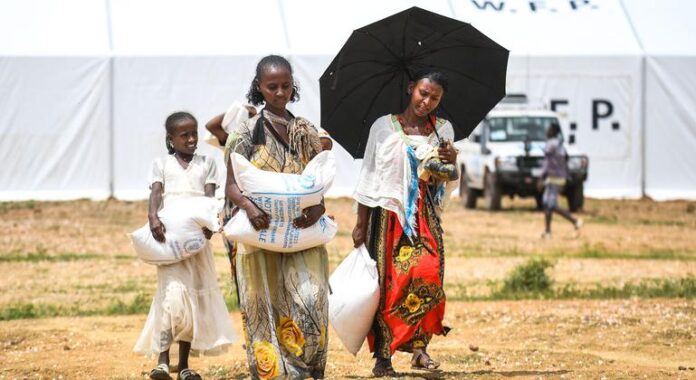
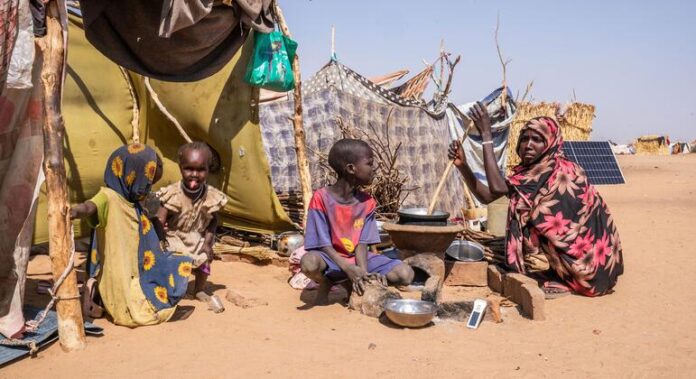
Many have reached shelter in Tawila – until recently a small desert town but which is now “a sprawling, massive displacement settlement” for more than 650,000 people, which is equivalent to the size of Luxembourg. Others have sought safety in Ad Dabbah in Northern State.

As UN aid teams and partners continue to push for access to all those in need, WFP-supported convoys are “en route to Tawila now, with enough for 700,000 people for the next month”, Mr. Smith said.

“These are families that have endured famine for many months on end and mass atrocities and are now living in overcrowded conditions with very limited support. There’s not enough shelter for people, many are staying in very makeshift structures: grass, straw structures, et cetera. Cholera and disease outbreak is widespread.”

12 million people displaced

Sudan is the world’s largest displacement crisis with more than 12 million people uprooted inside and outside the country.

Meanwhile, a worrying update from the UN refugee agency, UNHCR, on Friday confirmed that the security situation in nearby Kordofan has deteriorated further since 1 December.

After a week of heavy fighting, the RSF reportedly seized control of a Sudanese Armed Forces base in Babanusa, West Kordofan.

In South Kordofan, “civilians remain trapped in besieged cities such as Kadugli and Dilling, and as women, children, and the elderly find ways to escape, men and youth are often left behind due to specific high risks they face along flight routes such as detention by armed groups for perceived affiliation with parties to the conflict,” UNHCR said.

Latest data points to more than 40,000 people displaced from North Kordofan since 18 November. “UNHCR, through partners on the ground, is responding to the urgent needs of those displaced, but access remains challenging, and resources are critically low,” it said.

Source link

BiH: Joint Statement by High Representative Kallas and Commissioner Kos on the 30th anniversary of the Dayton Peace Accords

0

BiH: Joint Statement by High Representative Kallas and Commissioner Kos on the 30th anniversary of the Dayton Peace Accords Source link

Source link

Steel overcapacity: Council adopts mandate on new rules to protect EU steel industry from global overcapacity

0
Steel overcapacity: Council adopts mandate on new rules to protect EU steel industry from global overcapacity

The Council adopted its negotiating mandate on new rules to address the negative effects of global overcapacity on the EU steel industry, replacing the existing safeguards due to expire in June 2026.

Source link

Challenging outlook for meeting the EU’s long-term environment and climate objectives

0

Despite progress in key areas, the European Union (EU) remains likely off track for most 2030 environmental goals, according to the European Environment Agency’s (EEA) new 8th EAP assessment. Rising climate risks, slow transitions in production and consumption system and weakening enabling conditions highlight the urgent need for stronger, better financed and faster policy implementation. […]

Source link

UN sounds alarm as landmine deaths rise amid funding cuts

0
UN sounds alarm as landmine deaths rise amid funding cuts

Speaking on the sidelines of a key international meeting in support of landmine action taking place at UN Geneva, experts in the field explained how shrinking resources in Afghanistan and Nigeria have exposed civilians to unexploded ordnance.

They stressed that mine action programmes, often viewed as long-term recovery initiatives, are in fact emergency humanitarian interventions that save lives.

Afghanistan’s child victims

According to the UN-partnered Landmine Monitor report, a staggering 77 per cent of all casualties in Afghanistan last year were children.

Some 54 people are killed there every month by the explosive remnants of war, giving the country the third highest explosive ordnance casualty rate in the world.

“It tends to be kids, mostly boys in the hills tending sheep and goats and they are picking up things of interest and playing with them or throwing stones at them and killing or injuring themselves,” explained Nick Pond, who heads mine action work at the UN Assistance Mission in Afghanistan (UNAMA).

Despite the urgent need for more deminers to make Afghanistan safe after decades of conflict, a lack of funding has meant that the UN-led team has “dropped and dropped”, Mr. Pond told journalists. “In 2011 there were 15,000 people working in demining, and now we’ve got about 1,300.”

Total recorded child casualties in Afghanistan since 1999 number 30,154 children, “so the work in Afghanistan is key to decreasing the [global] number of casualties”, said Christelle Loupforest, UNMAS Representative in Geneva.

She noted that although mine clearance work in the Occupied Palestinian Territory and Sudan has recently received better support, the situation in Afghanistan and Nigeria remains dire, with programmes facing imminent suspension without new donor commitments.

“It’s the same for our programme in Ethiopia,” she said.

  • Programmes could end in March without an injection of funds
  • Afghan children make up most casualties; demining capacity is shrinking
  • Sudan faces severe contamination but just five UNMAS teams are there
  • Nigeria returnees encounter hidden explosive threats
  • Gaza and West Bank contamination restricts aid access and endangers civilians

Sudan’s growing dangers

The situation across Sudan is also deeply concerning for stretched landmine clearance teams who fear for the 1.5 million civilians who have returned to the capital, Khartoum, the initial epicentre of the ongoing conflict between the Sudanese Armed Forces and paramilitary Rapid Support Forces (RSF).

Just five UN Mine Action Service (UNMAS) clearance teams are at work in Sudan today and “all of them are in Khartoum, because the need is so big there”, explained Sediq Rashid, UNMAS chief in Sudan.

“Lots of accidents happened already and it’s very, very clear: unexploded ordnance is not different than Afghanistan or Syria or Nigeria.”

El Fasher latest

Summarising the situation in El Fasher, the city besieged for more than 500 days until recently overrun by RSF forces, Mr Rashid said that access remains extremely challenging. He noted that while civilians endured the siege, “the shelling never stopped” and even today “[it] is not completely stopped…there are reports of the presence of landmines as well, so it’s very concerning.”

Back in Khartoum, he said that teams have cleared the runway of the city’s main airport, “so we are hoping that at some point Khartoum Airport will become functional and that will make things much easier in terms of deploying the humanitarian aid workers to the area”.

At a school in Port Sudan, an explosive ordnance risk education in conducted for internally displaced persons.

Nigeria returnees at risk

In Nigeria, demining teams worry that displaced communities – with camps closing and nowhere else to go – risk returning to areas where lethal explosive remnants may be hidden from view.

A full 80 per cent of all civilian casualties have occurred in 11 of the 15 areas of return, said Edwin Faigmane, UNMAS chief in Nigeria.

In response, UNMAS has trained Nigerian security forces, police and civil defence workers on risk education in unstable and “hard-to-reach” areas.

The tactic has paid off, Mr Faigmane said, “as we have begun receiving reports back from the police or from community members saying that they found an item and that they’ve reported it to the village authorities or village leaders, who then reported on to the security and the military forces”.

Gazans still in extreme danger

In Gaza, UNMAS chief there Julius Van Der Walt noted that two years of intensive combat between Hamas fighters and Israeli forces had left an “absolutely immense” level of contamination.

This directly threatens civilians and obstructs essential support to the Strip’s 2.1 million residents by restricting humanitarian operations, slowing recovery efforts and making reconstruction extremely dangerous.

People are being injured “simply by collecting basic necessities on a day-to-day basis”, he said, while many families “have no choice” but to shelter in areas suspected of containing explosive ordnance. “Safer alternatives simply do not exist.”

UNMAS conducts an explosive hazard assessment of a logistics base in Rafah. The explosive ordnance that was found was marked with warning signs.

UNMAS conducts an explosive hazard assessment of a logistics base in Rafah. The explosive ordnance that was found was marked with warning signs.

West Bank situation worsening

Turning to the West Bank, Mr. Van Der Walt pointed to the increasing risk of widespread explosive ordnance contamination in densely populated areas, refugee camps, urban centres and rural areas. “Communities are being forced to live side by side with deadly remnants of war,” he said.

The UN Secretary-General’s campaign on mine action launched on 16 June 2025 to insist that the norms of humanitarian disarmament are upheld – and to accelerate mine action in support of human rights and national development.

The campaign is a call to action to strengthen international disarmament efforts, and protect civilians – in particular children who made up 46 per cent of casualties in 2024 – from the impact of explosive ordnance. 

Source link

Deep concerns for Palestinians amid intense Israeli raids in occupied West Bank

0

Around 100 hectares of Palestinian land have been reportedly confiscated to make way for the new route.

This would mark another step towards the progressive fragmentation of the West Bank, warned the head of the OHCHR’s Office in the Occupied Palestinian Territory, Ajith Sunghay.

“We are alarmed to hear that Israel has actually started building a new barrier and a road in the heart of the Jordan Valley,” he said on Friday.

“This is the most fertile land in the West Bank and the road is likely going to separate Palestinian communities from each other and the Palestinian farmers in Tubas from…land they own on the other side of the planned barrier.”

Mr. Sunghay maintained that the move would consolidate Israel’s annexation of the West Bank and remove all sources of livelihood for Palestinians.

He also noted that Jenin, Tulkarem and Nur shams camps have been emptied and that after almost one year, residents have not been allowed to return.

This raises concerns about forcible transfer which is prohibited under international law, the UN rights official said, before expressing concern about warnings issued to continue bulldozing Palestinian camps.

General Assembly boost for UNRWA

The General Assembly on Friday gave “a strong endorsement” to a ruling by the International Court of Justice (ICJ) that claims about the UN agency serving Palestine refugees (UNRWA) being infiltrated by Hamas militants in Gaza, lack substance.

That’s according to UNRWA chief Philippe Lazzarini, who tweeted that the resolution backed by 139 States also pushed back on allegations that the main aid provider in the Gaza Strip was not a neutral organization.

This vote is an important sign of support for UNRWA from the overwhelming majority of the international community. As the ICJ has stressed, UNRWA is the key humanitarian actor in the Occupied Palestinian Territory and everything must be done to facilitate our work, not hinder or prevent it.”

Nineteen nations abstained with 12 voting against. The United States, Argentina, Bolivia and Hungary were among those joining Israel in opposition.

Deputy UN Spokesperson Farhan Haq told reporters at the daily briefing that UN Secretary-General António Guterres was “heartened by the tremendous amount of support” for UNRWA from Member States.

Winter storms deepen humanitarian crisis

Heavy rains across the Gaza Strip have flooded more displacement sites, collapsed damaged buildings in Jabalya and Gaza City, and caused further casualties, including children.

Humanitarian agencies warn that overflowing drainage systems and contaminated water sources are heightening the risk of outbreaks of waterborne disease.

The immediate and sustained entry of spare parts and essential machinery must be facilitated,” aid coordination office, OCHA, stressed, noting that waste collection and safe disposal are now severely constrained.

As temperatures fall, families without access to gas or electricity are struggling to keep warm and are repeatedly moving in search of higher, safer ground.

Tent shortage

Aid partners are distributing winter clothing, tarpaulins and tents, but an estimated 1.3 million people still require urgent shelter support.

Since the ceasefire two months ago, fewer than 50,000 tents have entered Gaza for around 270,000 people. Thousands of pallets of shelter materials have been rejected and many NGOs have been blocked from operating.

Restrictions on the entry of aid must be lifted, OCHA said, including the ban on UNRWA, which has supplies for more than a million people stockpiled outside Gaza.

In the West Bank, more than 1,000 Palestinians have been displaced this year in Area C and East Jerusalem, largely due to demolitions for lacking Israeli permits that are nearly impossible to obtain.

OCHA continues to record an average of five Israeli settler attacks per day, with severe humanitarian impacts. The UN is calling for strengthened protection for Palestinians and an end to unlawful demolitions and settler violence.

Source link

Council decides to prohibit transfers of immobilised Central Bank of Russia assets back to Russia

0
Steel overcapacity: Council adopts mandate on new rules to protect EU steel industry from global overcapacity

The Council has decided to temporarily prohibit transfers of immobilised Central Bank of Russia assets back to Russia.

Source link

Amid Sudan’s unimaginable crisis, its people endure with hope

0
Amid Sudan’s unimaginable crisis, its people endure with hope

Fighting erupted between rival militaries in April 2023 following a breakdown in the transition to civilian rule, following the overthrow of longtime former President Omar al-Bashir four years earlier.

The army of Sudan’s military government has been battling the formerly allied fighters of the Rapid Support Forces (RSF) militia for control of the vast country, where more than 12 million people have been uprooted.

Millions have fled across the border in what is the world’s largest displacement crisis.

In an in-depth interview with UN News, the UN human rights office’s (OHCHR) top official in Sudan, Li Fung, outlines the scale of violations unfolding, the urgent need for accountability, and why the courage of Sudanese communities remains a vital source of hope.

This interview has been edited for length and clarity

UN News: As we mark Human Rights Day, how would you characterize the current human rights situation in Sudan?

Li Fung: It remains extremely grave. The situation is first and foremost a human rights and protection crisis driven by two and half years of conflict and widespread violations of international humanitarian law and international human rights law across the country.

This has triggered the world’s largest humanitarian emergency, mass displacement and shocking levels of hunger.

The scale and brutality of violations we continue to document reflect a crisis that has shattered the lives of millions, and stripped countless Sudanese of the basic protections every human being is entitled to.

The devastating impact of the conflict on the civilian population is hard to put into words. Cities reduced to rubble, families torn apart overnight, and civilians forced to make impossible choices just to survive.

But in this context, OHCHR continues to stand with the people of Sudan, to bear witness and document violations, to advocate for actions to protect human rights and to support the UN and humanitarian response.

On Human Rights Day, our message is clear: the human rights of the Sudanese people must be upheld. All parties must respect their obligations under international law, and they must protect civilians and ensure accountability for violations. The people of Sudan deserve peace, justice and full respect for their basic human rights.

Sudanses women meet OHCHR Team in Khartoum.

UN News: Many Sudanese fear that the ongoing violations will go unpunished. What accountability mechanism currently exists and what role can OHCHR play in ensuring justice for victims in Sudan?

Li Fung: Accountability does remain one of the most urgent challenges in Sudan, but despite the challenges of the current situation, there are various mechanisms.

OHCHR, and particularly our country office in Sudan, have a very important role to play in advancing accountability. We are continuing to document and verify violations of international law in extremely challenging conditions, from the perspective of preserving what has happened on the ground, giving a voice to survivors, victims and witnesses and ensuring that this can feed into accountability processes.

We also report to the High Commissioner [Volker Türk], who reports to the Human Rights Council, and this ensures that the situation in Sudan remains on the international agenda. Furthermore, we engage with survivors, we advocate for their rights, for their inclusion, and we support efforts to rebuild and strengthen rule of law institutions that can deliver justice.

At the international level, there are several important mechanisms as well, including the International Criminal Court [ICC], who has a mandate to investigate international crimes.

Also, the Human Rights Council has established an international, independent fact-finding mission on Sudan, whose role is complementary to our role as a country office, and they are documenting the violations, looking at responsibility and the international crimes that may have been committed.

But in amongst all these international efforts, it is important to highlight domestic accountability; and that is why we are working with different rule of law institutions looking at capacities to advance accountability and justice for the people of Sudan.

UN News: As we all know, access to the affected areas in Sudan and especially Darfur is extremely limited. How can the international community meaningfully support the documentation of human rights violations in these areas?

Li Fung: In terms of the response to the crisis in Sudan, the support of the international community is vital in many ways. Firstly, funding the human rights response, the humanitarian response requires resources to be able to meet the dire needs and the priorities of the people of Sudan.

Secondly, political action. Member States have got an incredibly important role to play in upholding international law, using their influence to press for dialogue, for peace, to reach a ceasefire, to really end arms flows, to advance on accountability and justice for the people of Sudan.

Documentation of the violations on the ground is critical for all these efforts because it really informs the efforts in response to the humanitarian needs, the priorities of the population, to advance the protection of civilians through very concrete, measurable actions.

OHCHR Team in Sudan listens to Sudanese women in Khartoum.

OHCHR Team in Sudan listens to Sudanese women in Khartoum.

UN News: This is not the first time that Sudan has witnessed such violations in human rights – and many attribute this to decades of impunity. What concrete actions must the international community take to finally break this vicious cycle of impunity?

Li Fung: Impunity feeds persistent cycles of violence and violations. Concrete actions can be taken including supporting all efforts to seek accountability, supporting fact-finding, monitoring and documentation, which will lead to accountability processes to really call for the protection of civilians and for investigation.

It is also key to include accountability on the pathway towards peace for Sudan, as well as to advocate for inclusion of all the voices of the Sudanese people from across the country, to achieve a sustainable, peaceful future for Sudan.

UN News: Finally, is there any light at the end of the tunnel regarding the human rights situation?

Li Fung: Yes, despite the immense suffering that we see and the scale of the violations that we continue to document, there is light, and it comes first and foremost from the Sudanese people themselves.

Despite enormous challenges, Sudanese human rights defenders, local humanitarian volunteers and community groups and networks continue to demonstrate extraordinary courage and persistence.

Their resilience and their initiatives to support their own communities underscore the urgent need for sustained international retention, for stronger protection measures and for unimpeded humanitarian access. Their determination, even in cities scarred by conflict, is a powerful reminder that the foundations of a just and sustained future still exist.

I think there’s also hope in the renewed attention on the situation in Sudan. It is unfortunate that despite many warnings about the risks of atrocities and widespread violations, it was only once this occurred that international attention started to be paid to Sudan. But now we need to seize on this moment. We will continue to stand with the people of Sudan.

Source link

From farm to classroom: feeding children and supporting farmers in Timor-Leste

0

In the mountainous municipality of Manufahi in southern Timor-Leste, where a healthy diet is often beyond the budget of most households, the UN is helping to ensure that the benefits of development are extended.

“Our students were not starving, but they should not have had a nutritious diet,” said Domingos de Jesus, principal of Cossamar primary school in the town of Same, where 500 students receive a meal each school day. “Now they eat more protein and vegetables and proportionately fewer carbohydrates.”

With full bellies, students are more alert and attentive in class, said Caetano Marcelo, principal of Betano primary school on the country’s southern coast. “It’s very important for their learning,” he added.

From farm to classroom: feeding children and supporting farmers in Timor-Leste

In Timor-Leste, a school cook prepares meals using local ingredients.

Some students’ families cannot afford breakfast, and most cannot afford nutritious meals. “Meat, eggs and some vegetables are difficult to buy for many families here,” Mr. de Jesus said. Most of the region’s 60,000 residents are small subsistence farmers.

In Timor-Leste18 percent of the population faces hunger on a daily basis and 45 percent of children under five suffer from stunted growth. Improving child nutrition is among the government’s top three priorities and a cornerstone of the new UN cooperation framework for sustainable development in the Asian island nation, which is expected to be signed in the coming weeks and implemented over the period 2026-2030.

The UN-supported school feeding program benefits more than 70,000 children across the country, while strengthening the government’s nutrition capacity, ensuring long-term sustainability.

The government has made school feeding a national priority, by decentralizing its management and financing to municipalities.

While this approach promotes local ownership and inclusion of locally grown produce, challenges remain in diversifying diets and ensuring consistent access to locally grown foods.

From farm to classroom: feeding children and supporting farmers in Timor-Leste

A farmer grows produce for school meal programs in Timor-Leste.

To fill these gaps, the World Food Program (PAM) and the Food and Agriculture Organization of the United Nations (FAO) are working alongside national and local authorities to strengthen menus and supply chains, improve kitchen infrastructure and train school staff in nutrition and hygiene, in support of the government’s vision of linking nutrition, education and local economic development for long-term sustainability.

Stew and Beans

On a recent Monday, the menu at the same school consisted of venison stew, vegetables and brown rice, all served on stainless steel trays provided by the Ministry of Education with support from PAM.

WFP also advised authorities on creating balanced meal plans using local ingredients and is helping to build a modern kitchen within the school grounds.

In Betano, where the children enjoyed chicken satay skewers with spinach, accompanied by rice and beans, on the same Monday, FAO kitchen equipment provided. WFP provided training on budget management, school menu preparation and kitchen hygiene.

“The students eat everything, and it’s great to see,” said Imana Imaculada Fernandes, the head cook at the Sámi school. “The meal plans – developed on advice from the government and WFP – include 75 percent local produce. »

Fernandes and her team can spend 35 US cents per day per child and an additional 7 cents for other costs, such as fuel and labor. “That’s 70 percent more than before – and that translates into more nutritious diets and better hygiene.”

Eat what you grow

The initiative also brings stable income to local farmers. Andre Pereira de Sousa and his neighbors in the suburb of Betano have seen steady demand for their tomatoes, watermelons, sweet potatoes and bananas.

“The biggest advantage is that we no longer waste time and use fuel going to the market,” he said. “We can use this time to improve our farms and spend more time with our families. » Stable demand has also reduced food waste and encouraged farmers to increase production.

The Betano farmers who supply the schools were among 9,000 households who benefited from an FAO program on conservation agriculture.

As a result, they have diversified into higher value crops and now use compost rather than fertilizer, reducing costs and the environmental impact of their farms. The group of farmers also received small mills to produce flour and prepare snacks to sell, as well as a trailer to transport their produce.

A united approach

The coordinated work of FAO and WFP illustrates an approach increasingly adopted by the United Nations, where agencies work in complementary ways to support the government.

“This is a great example where one plus one equals more than two, reinforcing the benefits of greater project sustainability,” said Funmi Balogun Alexander, the United Nations Resident Coordinator in Timor-Leste. “The new cooperation framework between Timor-Leste and the UN is built around such joint approaches.

Originally published at Almouwatin.com

Peace falters as fighting in eastern DR Congo raises fears of regional war

0
Peace falters as fighting in eastern DR Congo raises fears of regional war

A new offensive by the Alliance Fleuve Congo/Mouvement du 23 mars (AFC/M23) has reignited large-scale hostilities in South Kivu, just days after international agreements were signed to de-escalate the conflict.

The renewed fighting has caused civilian casualties, destroyed infrastructure and driven hundreds of thousands from their homes, according to United Nations officials and humanitarian groups.

The UN and the Security Council have repeatedly described the majority-Tutsi M23 militia as backed by Rwanda – a claim Kigali has repeatedly denied.

US Ambassador Mike Waltz told the Council on Friday that having brought Rwanda and DRC together in Washington to sign a peace agreement just last week, the Government was “incredibly disappointed” in Kigali’s actions in recent days in support of the M23 rebels which they fully control.

A crisis of ‘incalculable consequences’

Jean-Pierre Lacroix, head of UN Peace Operations, warned that the offensive has revived “the spectre of a regional flare-up with incalculable consequences,” saying the territorial expansion of AFC/M23 and the weakening of the DRC Government’s authority in eastern areas threaten national unity, sovereignty and territorial integrity.

He said recent diplomatic breakthroughs – including the Washington Accords signed on 4 December between DRC and Rwanda, and the Doha Framework Agreement in November between DRC and the AFC/M23 – had generated genuine hope for de-escalation.

But persistent ceasefire violations and renewed fighting now risk unravelling that progress.

The growing gap between political commitments and their effective implementation on the ground undermines the credibility of peace processes and fuels the sense of abandonment felt by civilians,” Mr. Lacroix said.

MONUSCO/Didier Vignon Dossou-Gba

MONUSCO peacekeepers on patrol near Bunia, the provincial capital of Ituri in eastern DR Congo.

MONUSCO, a critical lifeline

As violence escalates, the UN peacekeeping mission MONUSCO remains a central – and increasingly strained – pillar of civilian protection in eastern DRC, just days before the Security Council is set to decide on the renewal of its mandate.

Mr. Lacroix told Council members that MONUSCO continues to provide direct physical protection to around 100,000 displaced people living near its bases, particularly in North Kivu and Ituri, through daily patrols, early-warning systems and close engagement with communities.

He said the mission has adopted a more preventive posture, focusing on deterrence, rapid response and sustained presence around displacement sites where armed groups operate in close proximity.

Operations constrained

However, he cautioned that MONUSCO’s ability to carry out its mandate is being increasingly constrained. Restrictions imposed by AFC/M23 on freedom of movement, fuel supplies, water and electricity – along with the continued closure of Goma airport – are limiting mobility, delaying rotations and hampering humanitarian access.

At the same time, funding shortages and reductions in uniformed and civilian personnel, linked to the UN’s broader liquidity crisis, are affecting the mission’s rapid response capacity and operational reach.

Mr. Lacroix stressed MONUSCO’s role in protecting civilians and supporting de-escalation remains essential, warning that “diplomatic progress must now translate into real improvements on the ground.”

Dr. Javid Abdelmoneim of Médecins Sans Frontières, briefs the Security Council on health and humanitarian situation in eastern DR Congo.

Dr. Javid Abdelmoneim of Médecins Sans Frontières, briefs the Security Council on health and humanitarian situation in eastern DR Congo.

Health system collapsing

The humanitarian toll is mounting. Hospitals and clinics across North and South Kivu are struggling to cope with a steady influx of wounded civilians amid acute shortages of staff, medicines and equipment.

Dr. Javid Abdelmoneim, emergency medicine doctor and international president of Médecins Sans Frontières (MSF), said health systems in eastern DRC are “collapsing” under the combined impact of violence, mass displacement and shrinking humanitarian access.

“MSF teams continue to witness staggering levels of violence, displacement and deprivation,” he said. “This crisis is not easing.”

Sexual violence and disease outbreaks

Sexual violence remains widespread and systematic, particularly affecting women and girls.

Dr. Abdelmoneim said nearly 28,000 survivors sought care at MSF-supported facilities across eastern DRC in the first six months of the year alone – an average of more than 150 people a day. Many arrived too late for preventive treatment, while others never reached care at all.

At the same time, infectious diseases are spreading rapidly. Cholera cases have surpassed 38,000 this year, with deaths more than doubling compared to last year. Measles continues to spread, and malaria outbreaks are unfolding amid limited diagnostic and treatment capacity.

Broadcast of the Security Council meeting.

DR Congo pursuing solutions in good faith

The Democratic Republic of the Congo condemned what it described as a renewed Rwanda Defence Forces-M23 offensive launched shortly after the Washington Accord was signed, saying it violated commitments and worsened an already grave humanitarian situation.

Foreign Minister Thérèse Kayikwamba Wagner said Kinshasa had pursued diplomacy in good faith through US-, Qatari- and African-led processes but warned that continued attacks, civilian targeting and cross-border risks threaten regional stability.

She urged the Security Council to enforce resolution 2773 (2025), strengthen MONUSCO’s mandate and impose consequences for continued violations, stressing that durable peace requires accountability.

Rwanda alleges persecution in South Kivu

Rwanda rejected the accusations and said the renewed MONUSCO mandate should reinforce the Washington Peace Agreement and Doha Framework through strict impartiality and support for ceasefire implementation.

Ambassador Karoli Martin Ngoga stated that progress depended on political will from all parties and raised concerns over what he described as persecution of the Banyamulenge community in South Kivu, citing displacement, killings and blockades by Congolese forces and allied militias.

He called for a political solution and reaffirmed Kigali’s stated commitment to advancing durable peace through the Washington process.

Burundi condemns capture of Uvira

Ambassador Zéphyrin Maniratanga of Burundi condemned the reported capture of Uvira by Rwanda Defence Forces-backed M23 fighters, calling it a violation of resolution 2773 and warning of severe civilian suffering and mass displacement into his country.

He said cross-border artillery and drone strikes had hit Burundian territory, threatening sovereignty and regional stability.

He called for the full implementation of the Washington commitments, stronger civilian protection and urgent humanitarian assistance for refugees, while reaffirming its readiness to support peace efforts and defend its territorial integrity under the UN Charter.

Source link