Monday, September 21, 2026
Home Blog Page 171

Investing in climate adaptation strengthens European competitiveness

0

DISCLAIMER: Information and opinions reproduced in the articles are the ones of those stating them and it is their own responsibility. Publication in The European Times does not automatically means endorsement of the view, but the right to express it.

DISCLAIMER TRANSLATIONS: All articles in this site are published in English. The translated versions are done through an automated process known as neural translations. If in doubt, always refer to the original article. Thank you for understanding.

Source link

Rising hunger and displacement pose growing economic risk, UN tells Davos

0
Rising hunger and displacement pose growing economic risk, UN tells Davos

The UN World Food Programme (WFP) has reported that an estimated 318 million people worldwide now face crisis levels of hunger or worse, with hundreds of thousands already experiencing famine-like conditions.

It cautioned that deep funding shortfalls are forcing it to cut rations and scale back assistance at a time of surging needs.

Current forecasts put WFP’s funding at just under half of its required $13 billion budget for 2026, leaving the agency able to reach about 110 million people – a third of those in need.

Combatting hunger yields dividends

“Hunger drives displacement, conflict, and instability and these not only threaten lives, but disrupt the very markets that businesses depend on,” said Rania Dagash-Kamara, WFP Assistant Executive Director for Partnerships and Innovation.

“The world cannot build stable markets on a foundation of 318 million hungry people.”

Ms. Dagash-Kamara, who is attending the forum, said the private sector has a direct stake in addressing food insecurity, calling on companies to invest in supply chains, technology and innovation that can help stabilize fragile markets and protect workforces.

WFP is urging business leaders in Davos to keep hunger and food security among their top priorities, invest in supply chain systems that strengthen fragile markets, and support food-related technologies that improve efficiency and resilience.

Displaced families in South Kivu, Democratic Republic of the Congo, receive food aid. (file photo)

Migration powers growth and development

The UN International Organization for Migration (IOM) is also taking its case to the annual forum in Switzerland, calling on political and business leaders to rethink migration as a driver of growth rather than a burden.

Migration is one of the most powerful drivers of development when managed responsibly,said IOM Director General Amy Pope.

“Mobility can unlock economic potential, help communities thrive independently, and provide lasting solutions to displacement, while respecting national sovereignty and human rights.”

Partnerships and innovation

IOM said partnerships with private companies and foundations are already helping realise that approach.  

This includes using artificial intelligence to improve health screening and labour market policies, and programmes that support vocational training, entrepreneurship and durable solutions for displaced people.

At Davos, the agency is also highlighting the role of diaspora communities as investors and innovators.

“By using remittances and diaspora capital to support business creation and digital financial access, IOM aims to open new markets and create jobs, while helping communities become more self-reliant,” the agency said.

Other senior UN officials attending the forum include President of the General Assembly Annalena Baerbock; WHO chief Tedros Adhanom Ghebreyesus; Alexander De Croo, Administrator of the UN Development Programme; UN High Commissioner for Refugees Barham Salih; and Rafael Mariano Grossi, Director-General of the International Atomic Energy Agency.

Source link

Yemen: Children are dying and it’s going to get worse, warns aid veteran

0
Yemen: Children are dying and it’s going to get worse, warns aid veteran

“The simple narrative is, children are dying and it’s going to get worse,” said Julien Harneis, UN Resident and Humanitarian Coordinator in Yemen. “My fear is that we won’t hear about it until the mortality and the morbidity significantly increases in this next year.”

The alert follows an attempt by forces affiliated with the Southern Transitional Council (STC) to expand their presence in the resource-rich and strategically important eastern governorates of Hadramout and Al Mahra, a move reportedly reversed earlier this month by Government-aligned forces backed by Saudi Arabia.

The latest crisis comes after well over a decade of fighting between Houthi-led forces – who control the capital, Sana’a – and the internationally recognized government in Aden, backed by a Saudi-led military coalition. 

Complex operating environment

“It’s an extraordinarily complicated situation,” Mr. Harneis told journalists in Geneva. “Just in the last month in Aden, we went through a situation where you have the Government of Yemen in charge, then over 48 hours, the Southern Transitional [Council] situation took over the whole of the Government of Yemen areas, including areas they’ve never been in.”

Just four weeks later, however, a delegation from the STC released a statement while in Riyadh, Saudi Arabia, announcing that they had in fact “dissolved” their movement, allowing the Government in Yemen to retake the recently captured areas. “But at the same time, we’ve got demonstrations in Aden saying that, ‘No, we’re not [disbanded], we’re still there,’” Mr. Harneis explained.

Last week, UN Special Envoy for Yemen Hans Grundberg told the Security Council that this latest political and security upheaval underscored how quickly stability could unravel without a credible, inclusive political process to bring a negotiated end to the debilitating war.

Securing a peaceful future for the people of Yemen and providing lifesaving help has also been complicated by the ongoing detention of UN staff and diplomatic workers, among others, by Houthi rebels, who are backed by Iran and control Sana’a. 

Mr. Harneis described the torment for the families of the 69 staff members still being held: “It’s terrible for them; some families haven’t seen their loved ones in five years. They don’t know the conditions of their detention, they don’t know where they are, they don’t know if they’re going to be sentenced to death in the coming days.”

Millions going hungry

Latest UN data shows that more than 20 million Yemenis – about half the population – will face acute food insecurity next month, while tens of thousands could face famine-like conditions.

“We are expecting things to be much worse in 2026,” Mr. Harneis said.

A young boy is carried by his mother thorough a neighbourhood in Al Hawtah, Lahj Governate in Yemen.

The country’s health system is also collapsing. More than 450 facilities have already closed and thousands more are at risk of losing funding. Vaccination programmes are also under threat and only two-thirds of Yemen’s children are fully immunised, largely owing to a lack of access in the north.

“The way that economic and political decisions are playing out…food insecurity is only getting worse across all parts of the country”, the UN aid official maintained.

“We’re going to see a major change where the health system is not going to be supported in the way it has been in the past.”

Despite access restrictions, UN partners reached 3.4 million people with food assistance last year, along with emergency support during floods and disease outbreaks. 

The UN has been working in Yemen since the 1960s, helping to make development gains and protect the country’s most vulnerable people. “And then suddenly in the last couple of years this breakdown…inexplicably,” Mr. Harneis said. “That has a terrifying effect on the humanitarian workers.”

Source link

Server error!

0


Server error!

The server encountered an internal error and was
unable to complete your request. Either the server is
overloaded or there was an error in a CGI script.

If you think this is a server error, please contact
the webmaster.

Error 500

europeantimes.news
Apache

Source link

Mycelium-based blocks could be the future of construction

0


When mushrooms make the news, it’s often for grim reasons – a mysterious poisoning, toxic species in the

Source link

Five ways microplastics may harm your brain

0

Microplastics could be fuelling neurodegenerative diseases like Alzheimer’s and Parkinson’s, with a new study highlighting five ways microplastics Source link

Source link

Five ways microplastics may harm your brain

0


Microplastics could be fuelling neurodegenerative diseases like Alzheimer’s and Parkinson’s, with a new study highlighting five ways microplastics

Source link

Gaza humanitarian crisis ‘far from being over,’ UN aid coordination office warns

0
Gaza humanitarian crisis ‘far from being over,’ UN aid coordination office warns

“The humanitarian situation and crisis in Gaza is far from being over,” Olga Cherevko from the UN aid coordination office OCHA said on Friday in an update to journalists in Jerusalem.

“For the Palestinians in Gaza, their lives continue to be defined by displacement, trauma, uncertainty, and deprivation.”

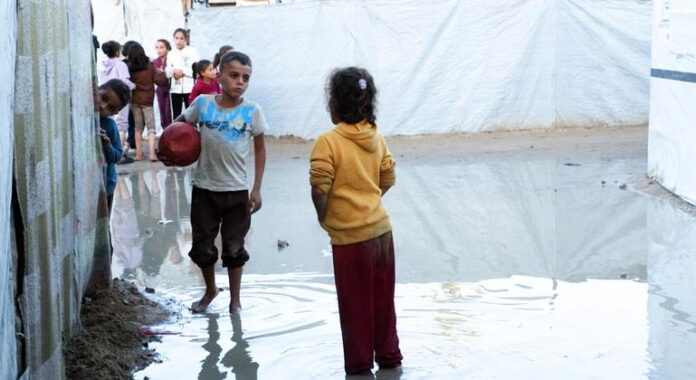
This has been further compounded by “severe recurrent storms that not only destroy people’s meagre belongings, but they’re also deadly – whether through crumbling buildings or by taking the lives of children who are highly susceptible to the cold”.

Repairing roads, clearing rubble

Since the ceasefire between Israel and Hamas, humanitarians have brought in over 165,000 metric tonnes of assistance into Gaza. They also repaired roads, rehabilitated hospitals, cleared rubble, and re-opened aid distribution points.  

“We celebrated our gains and showed once again that when we’re enabled to do so, we deliver,” Ms. Cherevko said, adding that “the results speak for themselves.”

During the first two months of the truce alone, over 1.3 million people received food packages, and over 1.5 million hot meals were prepared and delivered to people in need across Gaza, thus improving food security.

Progress remains fragile

When torrential floods hit Gaza, putting thousands of families at risk, humanitarians worked with municipalities to find safer options. They also distributed tents, tarpaulins, mattresses and warm clothes.

“But while this progress is clear, it remains fragile and could be reversed overnight,” she said. “Because airstrikes, shelling, and armed clashes continue with civilian casualties being reported daily. Most of Gaza lies in ruins and the needs far outpace our efforts to meet them.”

Ms. Cherevko said that “due to various impediments and restrictions placed on organizations operating in Gaza and specific types of supplies that could enter, we could basically only apply Band-Aids to a wound that can only be closed with proper care.”

The harsh winter storms have also reversed gains made on the humanitarian front “because no amount of tents or tarpaulins can replace repairing people’s homes”.

Additionally, despite humanitarians re-opening or establishing dozens of health service points, less than 40 per cent of healthcare facilities in Gaza are operational, while educational supplies critical for children who have not gone to school for two consecutive years continue to be barred from entry.

She also pointed to delays at border crossings, limited humanitarian corridors, delays, and other impediments, as well as restrictions on the operations of UN entities and international NGOs which “are putting lives at risk.”

A ceasefire ‘is not a recovery plan’

Ms. Cherevko stressed that “emergency response and its transition to early recovery cannot wait for political solutions. And a ceasefire in itself is not a recovery plan.”

What humanitarians working in Gaza need “remains very simple,” she said, calling for parties to the conflict to respect the ceasefire, ensure civilians are protected and that humanitarian access remains predictable, sustained and unimpeded.

Furthermore, restrictions on both aid agencies and critical supplies must be lifted, early recovery must be funded and enabled, and donor support must continue.

“The choices that are made today, both by the parties to the conflict and the donors will shape whether the pause to this fighting will translate to a path to stability or becomes just another quiet before the next storm,” she said.

 

Source link

Newly discovered star opens ‘laboratory’ for solving cosmic dust mystery

0

Seventy light-years from Earth, a star called Kappa Tucanae A harbors one of astronomy’s most perplexing mysteries: dust so Source link

Source link

Newly discovered star opens ‘laboratory’ for solving cosmic dust mystery

0


Seventy light-years from Earth, a star called Kappa Tucanae A harbors one of astronomy’s most perplexing mysteries: dust so

Source link