Tuesday, March 31, 2026
Home Blog Page 186

Fighting against the gangs: what is the new force of Haiti supported by the UN?

0

Here is what you need to know about the new force of deleting gangs (GSF).

What is the GSF?

The force of removal of gangs (GSF) in Haiti is a multinational mission newly authorized by the UN Security advice.

With a 12 -month term, the force of 5,550 people will operate alongside the Haitian authorities to neutralize gangs, secure infrastructure and support humanitarian access.

Its main objective is to protect vulnerable populations from the escalation of violence and prevent the movement that inevitably causes.

The Haitian police check the driver’s papers at a checkpoint.

The resolution of the Security Council has been co-produced by Panama and the United States and reflects broad international support for the multidimensional crisis which has deepened in Haiti in recent years.

What are the objectives of the new force?

Its fundamental objectives include carrying out intelligence operations to dismantle armed gangs, securing critical infrastructure and humanitarian insurance, while protecting the population.

The GSF will work in close collaboration with the Haitian authorities, in particular the national police in order to put Haiti able to assume responsibility for its own security.

The mission also aims to strengthen national institutions and to facilitate the conditions of long -term peace and development. An assistance office of the United Nations will be created to provide logistical and operational support.

What is the GSF replacing?

The gang suppression force (GSF) replaces the multinational security support mission (MSS) in Haiti, marking a change in strategy.

The MSS, led by Kenya, focused on the support of the Haitian national police with limited staff and resources. It was launched in October 2023 with the first contingent of the arrival in June the following year. He remained underfunded and never deployed the compulsory force of 2,500 people.

The GSF will be a greater and more robust force with a wider mandate.

Why is it necessary?

A force is urgent to remove the gangs in Haiti due to an unprecedented security situation.

Gang members are going through a district of Port-au-Prince.

Armed groups have now checked up to 90% of the capital of Haiti, Port-au-Prince, blocking access roads, attacking infrastructure and terrorizing civilians with ransom, rape and murders.

More than 5,600 people were killed only in 2024 only.

Since March 2025, violence has extended into previously intact areas of the country outside the capital, in particular the Articonites and Central departments where 92,000 and 147,000 people have been moved respectively.

In total, more than 1.3 million people have been moved and essential services such as health care and food distribution has collapsed.

The Haitian national police do not have the capacity to respond effectively.

Why is Haiti unable to deal with this problem alone?

Haiti cannot fight against his gang crisis due to the collapse of public institutions, the subressource police and overwhelming violence.

The gangs create criminal governance, exploit children and deal with weapons as well as drugs.

The UN has said on numerous occasions that impunity, corruption and institutional collapse fuel Haiti’s insecurity.

Will the GSF solve Haiti’s problems?

UN officials have stressed that security alone cannot resolve Haiti’s bustle.

The country faces several crises; Humanitarian needs, caused both by insecurity and natural disasters such as earthquakes, increase, the economy is in free fall, poverty and underdevelopment is rigorous and there has not been an elected government since the assassination of President Jenel Moise in 2021.

The inhabitants of Port-au-Prince have been forced to flee violence and live in tents in safer places.

UN member states have stressed that the GSF must be part of a broader strategy, including governance reform, humanitarian aid and long -term development.

In short, the GSF is a necessary but insufficient measure-international support must go beyond security to really help Haiti to recover.

When will the GSF start operations in Haiti?

The GSF should start operations following the expiration of the MSS mandate on October 2, 2025, although it takes time to strengthen new force to the target of 5,500 security staff plus 50 civilian employees and to establish the United Nations office to support it.

It is still not clear which countries will provide staff. The resolution of the Security Council stipulates that the force will be financed mainly by voluntary contributions from the Member States of the United Nations.

Originally published at Almouwatin.com

Human rights groups urged to ‘unite more than ever’ in efforts to end racism

0
Human rights groups urged to ‘unite more than ever’ in efforts to end racism

Martin Kimani, chairperson of the Permanent Forum on People of African Descent, presented its annual report to the Human Rights Council in Geneva during an interactive dialogue with country representatives.

“Every year, events captured in news headlines and in the lived experiences of people of African descent tragically confirm that even at this stage of the 21st century, the colour line remains in place, creating a hierarchical divide that sustains segregation, violence, societal division, denial of equal opportunity, of equity, and of continued exploitation and multiple forms of oppression,” he said.

“Human rights movements, including anti-racist movements, need to unite more than ever and act, to ensure that the promise of multiple resolutions of the United Nations, including the International Convention on the Elimination of All Forms of Racial Discrimination, is realised.” 

A Decade for progress

This past January marked the start of the second International Decade for People of African Descent and the Permanent Forum views this “as a period enabling the reinforcement of global solidarity that advances concrete progress”.

Alongside other stakeholders, it has called for advancing action around three pillars: recognition, justice and development.

Measures include greater recognition of systemic and structural racism, as well as racial discrimination; the pursuit of reparatory justice and more efforts towards including people of African descent and racial equality in all development frameworks.

Human rights and justice in the digital age

Additionally, human rights concerns that may not have been addressed during the first International Decade must also be confronted.

They include environmental and climate justice; the fair application of artificial intelligence and digital justice, and the human rights of those facing discrimination.

Mr. Kimani said the Permanent Forum has been engaging closely on these issues. For example, digital justice was on the agenda of its annual session held last April in New York.

“The Forum emphasised that the pursuit of reparatory justice remains urgent in this digital age, as systemic inequities within and among countries risk being replicated and amplified in emerging technologies,” he said.

Moreover, its conclusions reflected deep concern over the perpetuation of racial biases within artificial intelligence (AI) systems while also acknowledging how AI can contribute to society. 

AI and digital technologies cannot be disconnected from the broader historical and contemporary injustices that shape them,” he said.

Concern for women and girls

The annual session also examined the specific situation of women and girls of African descent and how they are affected by intersecting forms of discrimination.

“The dehumanization of African women from the onset of enslavement set the tone for the continued devaluation and discrimination they face to this day,” he said.

“The goals of development cannot be achieved without reparatory measures that explicitly address their realities.”

The past year also saw continued deliberation on the issue of reparatory justice – “a critical and urgent priority in order to comprehensively recognise and address systemic and structural disadvantages.”

It encompasses five areas that include restitution, for example of legal rights or property; compensation, including for physical or mental harm; and satisfaction, which covers actions such as verification of facts and full public disclosure of the truth, acknowledgement, and public apology.

In Haiti, people carrying their belongings flee their homes as night falls due to violence.

Spotlight on Haiti

Mr. Kimani noted that the rights body has consistently stressed that “the current crisis in Haiti is not an isolated event but is deeply rooted in the legacies of colonization and enslavement.”

Haiti was the first country to free itself from slavery through a successful revolution, gaining formal independence from France in 1804. However, it was forced to pay 150 million francs in compensation for property lost during the uprising.

The Permanent Forum has published a position paper laying out concrete recommendations, which include “a reparatory justice perspective” and acknowledgement of the so-called “independence debt”.

He urged the Human Rights Council to “consider the crisis in Haiti in that light”. 

Source link

EU is committed to safeguarding Europe's security

0
EU is committed to safeguarding Europe's security

At an informal European Council meeting in Copenhagen, EU leaders discussed how to strengthen Europe’s defence, including defence capacities, support for the Eastern flank and governance. They also spoke about continued support for Ukraine.

Source link

Biotech Innovation Call | EIT

0

EIT Food is launching a call designed to boost high-potential innovations and help them reach commercialization.

This funding opportunity is part of the EIT Food Co-financed Biotech Portfolio. This portfolio has identified two key industry challenges where we need to find innovative solutions. We are looking for proposals that respond to these challenges, and bring solutions to market.

Proposals must target priority areas identified by EIT Food and the Portfolio Corporate Co-financers, and demonstrate their potential to deliver long-term impact across our Missions. Your proposal should address one or both of the following challenges:

  • Design sustainable Downstream Processing to increase energy/water savings;
  • Develop Real-time Process Monitoring and Control technologies.

We are primarily interested in funding the following types of initiatives, that address the two outlined challenges:

  • New R&D and commercialisation projects with good prospects of getting to market within 12 months;
  • Existing research project teams who have a commercialisation or impact plan that needs follow-on funding to get to market; These do not have to be previous EIT Food projects – we can support projects previously funded by other EIT organisations, EU programmes and third-party funders – but projects currently receiving EU funding for the same activity are not eligible;
  • Develop and market new applications and business models for existing technology. This includes transferring proven technology from other sectors into the food industry. Run scale-up activities for high impact products or services that already have promising results.

Funding available: The maximum funding amount allocated to this call is € 3 000 000. We expect to fund commercial projects with EIT grant funding of maximum € 400 000 per project over a period of no longer than 10 months initially.

Project duration: Feb 2026 – December 2026

Countries included: Funding for this call is available to all eligible organisations (see below), from Member States of the European Union (EU) and from Horizon Europe Associate Countries . You are not required to be an EIT Food partner to submit a proposal, or to receive funding under this call.

Info Webinar: Join our info webinar on 10 October 2025 at 10 a.m. CEST to find out more about the call and the application process. Register for the webinar through this link.
Apply

Source link

The world is failing Gaza’s starving children, aid teams warn

0
The world is failing Gaza’s starving children, aid teams warn

A total of 151 children have perished through acute malnutrition in the Gaza Strip since the start of the war – and the majority in 2025 – according to the latest figures from the Palestinian health authorities.

Announcing Jana’s death in an online video message, UNICEF Communication Manager Tess Ingram explained that she had been treated in hospital twice for the condition and recovered the first time in 2024, only to relapse and waste away on 17 September this year, amid continuing Israeli aid restrictions.

The world failed Jana so many times, failed her on food, twice,” Ms. Ingram insisted. “A little girl forced to endure so much pain because of deliberate decisions that were made to restrict the entry of food into the Gaza Strip.”

Ms. Ingram explained that UNICEF had originally evacuated Jana (pictured above) for treatment in southern Gaza more than a year ago and that she had recovered. “I remember holding her frail little hand and helping her into the ambulance,” she recalled.

Stalked by hunger

Once Jana was better and discharged from hospital for the first time earlier this year, she and her mother, Nesma, returned to northern Gaza during the ceasefire to be with their family.

But the aid blockade allowed hunger to return, claiming the life of Jana’s two-year-old sister, Jouri, on 20 August. At the time, Ms. Ingram warned that Jana was “barely hanging on” in a Gaza City hospital where she was receiving treatment.

She also stressed that Gaza’s war-shattered health system was unable to give the child the care that she needed. “Her last hope, medical evacuation out of the Gaza Strip, failed her. No country stepped up and was able to get Jana out,” the UNICEF worker said.

Gazan youngsters who suffer from moderate and severe acute malnutrition receive Ready-to-Use Therapeutic Food (RUTF) at outpatient treatment points and the enclave’s last remaining hospitals, including at Friends of the Patient Society Hospital in Gaza City where Jana was admitted.

No hospital capacity

Only days ago, the UN World Health Organization (WHOwarned that four more hospitals had been forced to shut down in the north of the war-torn enclave this month alone.

Across Gaza, just 14 hospitals remain, the UN health agency said, while humanitarians have warned repeatedly that they are overwhelmed with trauma cases and struggling to cope.

‘Children are being punished’

UNICEF insisted that the story of Jana and Jouri was a “devastating reminder that children’s lives in Gaza are put at risk, not just by airstrikes, but also by the living conditions”.

It also stressed that Gaza’s malnutrition crisis has reached catastrophic levels with the entire child population under five – more than 320,000 children – at risk of acute malnutrition.

In July alone, 13,000 children were acutely malnourished, “the highest monthly figure ever recorded”, and representing more than a 500 per cent increase since the start of the year, UNICEF explained.

“This war must end now. Aid must be allowed into the Gaza Strip, including food and nutrition supplies. Humanitarians must be allowed to do their jobs,” Ms. Ingram said.

“The children of Gaza are being punished by these decisions and it’s killing them.”

How medical evacuations happen

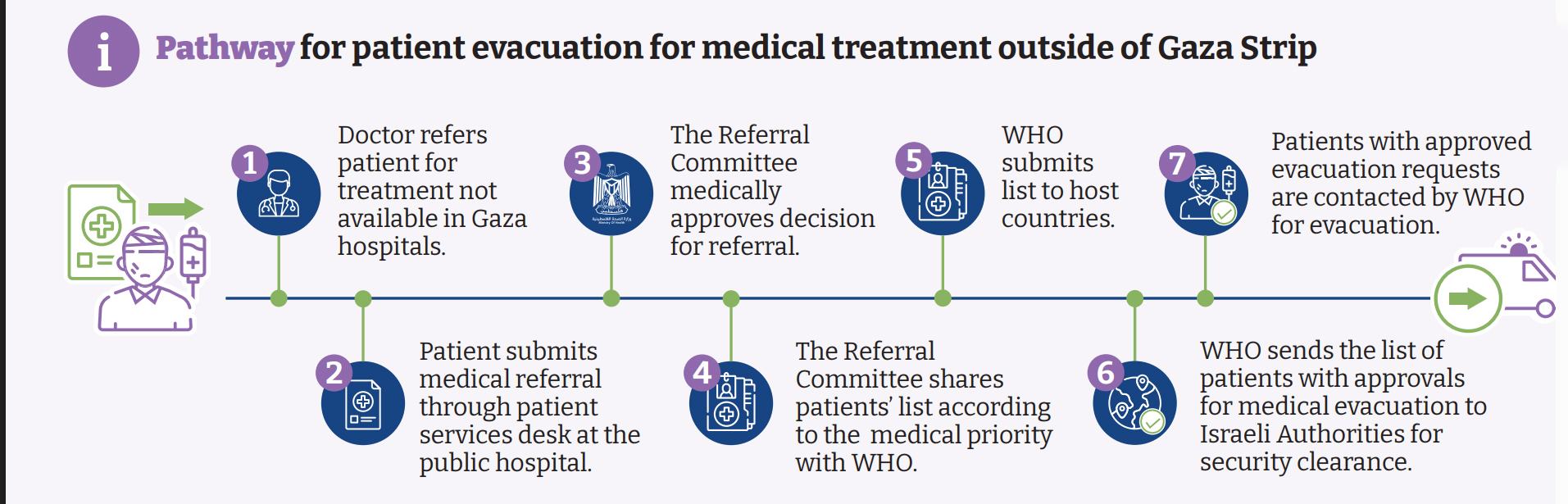
Medical evacuations (medevacs) from the Strip coordinated by WHO follow a strict seven-step protocol, from the initial patient referral by a doctor to evacuation by the UN health agency, based on a list submitted to host countries which is then approved by the Israeli authorities.

Latest WHO medevac data indicates that 7,841 patients have been helped to leave Gaza since war erupted there on 7 October 2023, following Hamas-led terror attacks on Israel. More than 5,330 of these patients were children. Approximately 15,600 patients still need medical evacuation out of Gaza.

The UN health agency's patient evacuation protocol for medical treatment outside of Gaza Strip (medevac)..

The UN health agency’s patient evacuation protocol for medical treatment outside of Gaza Strip (medevac)..

On 29 September, WHO supported the evacuation of 14 patients and 38 companions from Gaza to Jordan and 15 patients and 65 companions to Italy, from a field hospital run by UN partner the Palestinian Red Crescent Society on the Coastal Road in Al-Mawasi.

“Patients, companions and caregivers will start from here with ambulances, buses, and escort from WHO so that they get safely through the combat zones to Kerem Shalom,” explained Dr Athanasios Gargavanis, WHO trauma surgeon and acting Gaza Team Lead.

He explained that from Kerem Shalom, the Palestinians would leave the Strip before being transported to Ramon Airport in southern Israel, then on to host countries.

“This is just the tip of the iceberg,” Dr Gargavanis said. “Many more medevac missions are needed, and many more receiving countries are needed. The World Health Organization is committed to supporting such missions.”

WHO continues to call for the restoration of medical referrals to the West Bank and East Jerusalem and for more countries to accept patients.

Source link

Remarks by President António Costa at the press conference following the informal meeting of heads of state or government of 1 October 2025

0
Remarks by President António Costa at the press conference following the informal meeting of heads of state or government of 1 October 2025

During the press conference held at the end of the informal meeting of heads of state or government of 1 October 2025 in Copenhagen, President António Costa presented the main results of the discussions.

Source link

Scientologists give life to the Universal Declaration of Human Rights through Europe

0

Kingnewswire // press release // The members of the Church of Scientology are active through Europe to promote the Universal Declaration of Human Rights (DUDH), inspired by the vision of the founder of their religious community, L. Ron Hubbard. Through non -profit organizations Youth for Human Rights International (Yhri) And United for Human Rights, Scientologists volunteer their time and resources to publicize the 30 rights registered in DUDH in schools, communities and during events for young people. Thanks to brochures, audiovisual supports and course plans translated into many languages, the program makes these rights accessible to young people from all walks of life.

This work dates back to the insistence of Mr. Hubbard on the fact that human rights education is essential to the survival of societies. In 1969, he reprinted dudh in a church magazine, stressing that the very survival of governments depended entirely on the adoption of such reforms. For Scientologists, these words remain a guiding principle. They consider education to rights not only as a public service, but also as an essential element to promote understanding between people and guarantee the dignity of each human being. In this sense, their commitment is the direct continuity of the founder’s ideal, which was to transform the rights, of noble declarations, into a living reality.

Denmark is a European country whose action in this area cannot be ignored. Since 2006, the religious community and various activists, through Youth for Human Rights Denmarkorganized innovative projects that combine education and cultural expression. Students learn thanks to the screening of the film The history of human rightscreative workshops and class discussions, as well as the now traditional Walking for human rights which takes place every year on December 10, where hundreds of people gather in Copenhagen to celebrate and demand respect for the Universal Human Rights Declaration. The program was recognized by the City of Copenhagen and the National Ministry of Culture, which supported its activities. This official recognition illustrates how initiatives born from the religious inspiration of Scientologists also contribute to civic life in a concrete and measurable way.

And Denmark is just one example among others. Throughout Europe, Scientologists and their churches have helped to set up Youth for Human Rights programs in very varied contexts. In Brussels, the Church of Scientology for Europe co-organized the International Youth Summit, which brought together young delegates from dozens of countries in order to exchange strategies to raise public awareness of the DUDH. In Geneva, volunteers support the annual celebration of the DUDH’s anniversary in the UN premises, speaking to dozens of NGOs from all Europe who help make human rights a reality, often using the Youth for Human Rights International. Then there are the annual heights to the United Nationswhere young delegates present projects to diplomats, NGOs and human rights experts in UN seat in New Yorkthus offering a global platform to make the voice of young people hear who undertake to make rights a reality. In Madrid and other capitals, Scientologists associate themselves with schools, civic leaders and interconfessional groups to mark important events such as the day of human rights and the birthdays of the Universal Declaration of Human Rights. Together, these initiatives form a network of education and defense of rights which extends from local classrooms to the world scene.

What unites these efforts goes beyond civic commitment. For Scientologists, the defense of human rights is also a spiritual expression, deeply rooted in their faith. THE Creed of the Church of Scientology explicitly affirms human rights, emphasizing their central place in religious practice. Scientology teaches that life is better apprehensive as a progression through Eight dynamicsspheres or survival impulses that extend from self and family, including groups, humanity and the natural universe, to ultimately lead to spirituality and infinity, which corresponds to the way in which Scientologues generally describe the concept of God.

Taking care of others and protecting their rights is at the heart of the fourth, fifth, sixth and seventh dynamics, where the individual recognizes survival as part of humanity, nature and spiritual consciousness. Scientologists believe that it is only by strengthening and improving survival through these dynamics, defending the dignity of others, that we can gradually move towards the eighth dynamic, identified with theTo be supreme, God or infinity.

In this perspective, their work in favor of human rights is not an isolated project, but an integral stage of a broader spiritual journey.

As Ivan Arjona, Church spokesperson summed up: “The mission of Youth for Human Rights is to make human rights a reality, and not an idealistic dream. For Scientologists, each effort to teach and protect human rights reinforces the understanding of our place in the broader fabric of life – and, step by step, this is what brings us closer to the highest truths of existence. »»

From the sidewalks of Copenhagen to the Brussels conference rooms, from the annual youth summits to the United Nations in Geneva and New York to school and civil projects in Madrid, Amsterdam and beyond, Scientologues continue to honor the vision of Mr. Hubbard: that the Universal Declaration of Human Rights is known, experienced and protected. Their efforts show that when people are educated on their rights, societies are strengthened, individuals find common ground and the way towards greater spiritual consciousness remains open to all.

Originally published at Almouwatin.com

Scientologists Bring the Universal Declaration of Human Rights to Life Across Europe

0

KINGNEWSWIRE // Members of the Church of Scientology are active across Europe in promoting the Universal Declaration of Human Rights (UDHR), inspired by the vision of their religious community’s Founder, L. Ron Hubbard. Through the non-profit Youth for Human Rights International (YHRI) and United for Human Rights, Scientologists volunteer their time and resources to bring knowledge of the 30 rights enshrined in the UDHR to schools, communities and youth events. With booklets, audiovisuals and lesson plans translated into many languages, the program makes these fundamental rights accessible to young people of every background.

This work traces back to Mr. Hubbard’s insistence that human rights education is essential for the survival of societies. In 1969, he reprinted the UDHR in a Church magazine, highlighting that governments’ very survival depends utterly upon adopting such reforms. For Scientologists, those words remain a guiding principle. They see education on rights not merely as a public service but as an essential part of building understanding between people and ensuring dignity for every human being. In this sense, their commitment is a direct continuation of the Founder’s ideal of turning rights from a lofty declaration into a living fact.

A place in Europe whose activation on this field can’t be overlooked is Denmark. Since 2006, the religious community and diverse activists, through Youth for Human Rights Denmark, have organized innovative projects that combine education with cultural expression. Students learn through screenings of The Story of Human Rights film, creative workshops and discussions in classrooms, and the now-traditional Walk for Human Rights every December 10, where hundreds gather in Copenhagen to celebrate and demand respect for the UDHR. The program has earned recognition from both the City of Copenhagen and the national Ministry of Culture, which provided support for its activities. This official acknowledgment illustrates how initiatives born from Scientologists’ religious inspiration also contribute to civic life in concrete, measurable ways.

And Denmark is just one example. Across Europe, Scientologists and their churches have helped bring Youth for Human Rights programs to a wide variety of settings. In Brussels, the Church of Scientology for Europe co-hosted the International Youth Summit, gathering young delegates from dozens of nations to exchange strategies for spreading awareness of the UDHR. In Geneva, volunteers support annual UDHR Anniversary celebration at UN premises, giving voice to dozens of NGOs from accross Europe that contribute to make human rights closer to a fact, and often with the use of Youth for Human Rights International materials. Then there is the annual Summits at the United Nations, where youth delegates present projects to diplomats, NGOs and human rights experts. at the UN Headquarters in New York, providing a global platform for the voices of young people committed to making rights a reality. In Madrid and other capitals, Scientologists join with schools, civic leaders and interfaith groups to mark milestones such as Human Rights Day and anniversaries of the UDHR. Together, these initiatives form a network of education and advocacy that stretches from local classrooms to the world stage.

What unites these efforts is more than civic engagement. For Scientologists, championing human rights is also a spiritual expression, deeply rooted in their faith. The Creed of the Church of Scientology explicitly affirms human rights, underscoring their central place in religious practice. Scientology teaches that life is best understood as a progression through eight dynamics—spheres or urges of survival that extend from the self and the family, through groups, humankind and the natural universe, and ultimately toward spirituality and the infinite, which is how Scientologists commonly describe the concept of God.

Caring for others and safeguarding their rights lies at the heart of the Fourth, Fifth, Sixth and Seventh Dynamics, where the individual recognizes survival as part of humanity, nature and spiritual awareness. Scientologists believe that only by strengthening and improving survival across these dynamics—by upholding the dignity of others—can one gradually advance toward the Eighth Dynamic, identified with the Supreme Being, God or infinity.

In this light, their human rights work is not an isolated project but an integral step in a broader spiritual journey.

As a Church spokesperson Ivan Arjona summarized: “Youth for Human Rights’ mission is to make human rights a fact, not just an idealistic dream. For Scientologists, every effort to teach and protect human rights builds understanding of our place within the broader fabric of life—and step by step, this is what brings us closer to the highest truths of existence.”

From Copenhagen sidewalks to Brussels conference halls, from annual youth summits at the United Nations in Geneva and New York to classroom and civil society projects in Madrid, Amsterdam and beyond, Scientologists continue to honor Mr Hubbard’s vision: that the Universal Declaration of Human Rights should be known, lived and safeguarded. Their efforts show that when people are educated on their rights, societies grow stronger, individuals find common ground, and the path toward greater spiritual awareness remains open to all.

Source link

Rohingya plight in Myanmar, a ‘test for humanity’

0
Rohingya plight in Myanmar, a ‘test for humanity’

At the heart of the emergency are the Rohingya Muslims, denied Burmese citizenship, driven from their homes and forced into camps or exile.

More than a million now live as refugees in Bangladesh, while countless more remain displaced or trapped – alongside other minorities – inside Myanmar under conditions UN leaders described as “dire” and “unsustainable.”

The conference at UN Headquarters in New York, brought together top UN officials, heads of state and governments, to galvanise action alongside Rohingya activists.

Briefings and reports laid bare the daily realities since the February 2021 military coup: forced recruitment, sexual violence, airstrikes, starvation and mass displacement.

Humanitarian agencies warn that resources are running out, leaving refugees malnourished and pushing more people into taking dangerous sea journeys.

Conditions inside Myanmar’s Rakhine state – ancestral home of the Rohingya – are described as the worst in decades, with civilians caught between junta forces and ethnic armed groups.

General Assemby President Annalena Baerbock (at podium and on screens) addresses the high-level conference of the General Assembly on the situation of Rohingya Muslims and other minorities in Myanmar.

‘Human rights trampled’

The Secretary-General, in a statement read by his Chef de Cabinet Courtenay Rattray, said the crisis has “trampled on the human rights, dignity and safety of millions and threatens regional stability.”

He urged three immediate steps: protecting civilians in line with international law, guaranteeing humanitarian access, and reinvigorating investment to ease the strain on refugees and host communities.

The solution to this crisis lies ultimately in Myanmar,” the message stressed, calling for an end to persecution and recognition that “the Rohingya belong – as full citizens.

A crisis ‘that should put us to shame’

Assembly President Baerbock underscored the scale of suffering.

Over five million Rohingya men, women and children share some version of this story,” she said, noting that 800,000 children remain out of school in Bangladesh’s Cox’s Bazar camp alone.

Humanitarian funding is critically short, with the 2025 response plan just 12 per cent funded.

This should put us to shame,” she declared, urging states to boost aid and pursue a political solution that would enable safe, voluntary and sustainable return.

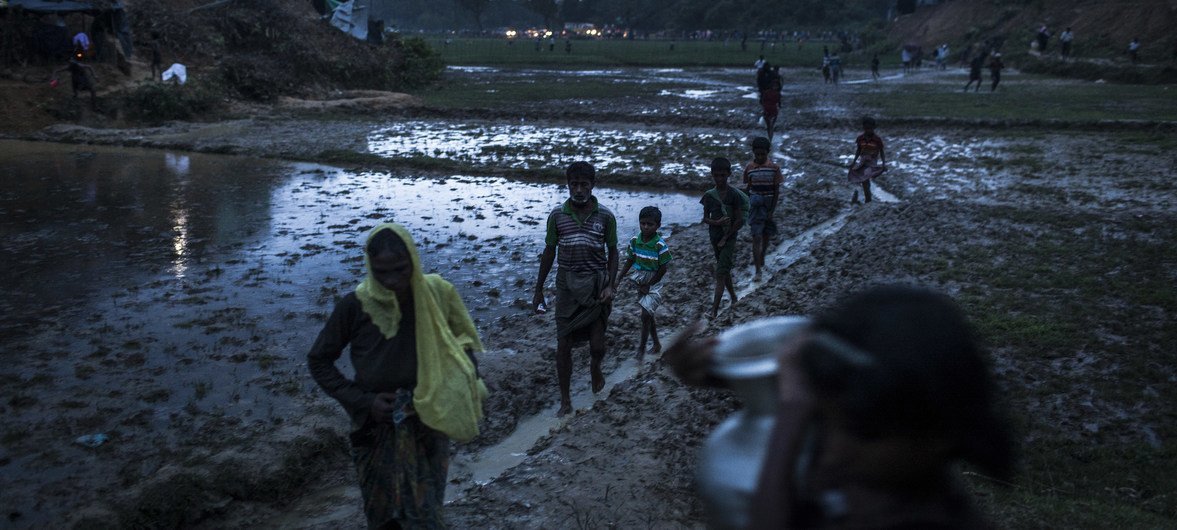
Rohingya refugees walk across a muddy field in southern Bangladesh, as fires burn in a distance. (file photograph)

Rohingya refugees walk across a muddy field in southern Bangladesh, as fires burn in a distance. (file photograph)

Demand for accountability

For Rohingya activists, the conference was not another moment of awareness but a demand for justice.

Wai Wai Nu, founder of the Myanmar Women’s Peace Network, told delegates that the atrocities did not end in 2017, when over 750,000 Rohingya men, women and children fled violence described as a “textbook example of ethnic cleansing” by then UN High Commissioner for Human Rights, Zeid Ra’ad Al Hussein.

“It has worsened,” she said, pointing to killings, forced conscription, sexual violence and starvation inflicted by both the Myanmar military and ethnic armed groups fighting the junta.

Without action, the Rohingya exodus will continue until there is no more Rohingya left in Myanmar,” she warned, urging cross-border humanitarian corridors, targeted sanctions and prosecutions for atrocity crimes.

‘A test for humanity’

Rofik Husson, founder of the Arakan Youth Peace Network, offered his own testimony of displacement and violence, recalling how the junta forced Rohingya men and boys into service, often as human shields. In one week alone, he said, at least 400 were killed.

He described village burnings and drone strikes, including a May 2024 massacre that displaced 200,000 people in a single day.

Ending the crisis of insecurity for the Rohingya community is a test for this Assembly and a test for humanity itself,” he told delegates, calling for an internationally supervised safe zone in northern Rakhine.

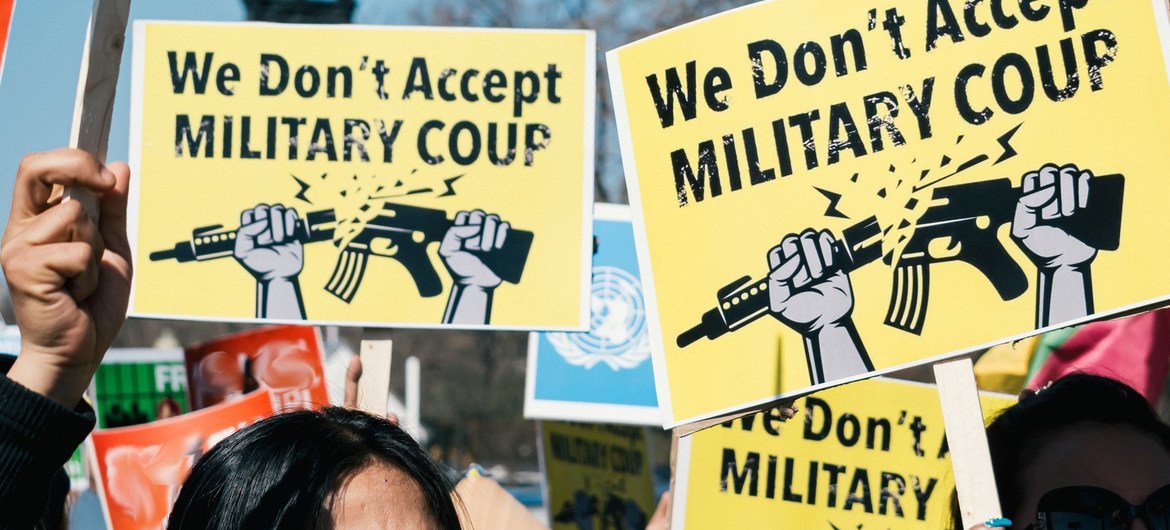
A demonstration against Myanmar's military coup takes place n Washington, DC, United States. (2021 photograph)

Unsplash/Gayatri Malhotra

A demonstration against Myanmar’s military coup takes place n Washington, DC, United States. (2021 photograph)

No agreed pathway to peace

Adding a wider lens, Special Envoy Julie Bishop stressed that Myanmar’s multifaceted crisis is inseparable from the political turmoil unleashed by the 2021 coup.

With no ceasefire in place and armed conflict spreading, she warned that planned elections later this year would fuel further violence rather than deliver legitimacy.

There is no agreed pathway to peace,” she said, cautioning that international condemnation of the junta has ebbed even as abuses persist.

A fragile hope

Despite the grim accounts, speakers emphasised that solutions remain possible if political will can be summoned.

Ms. Baerbock closed her remarks by noting: “The Rohingya people have survived eight years of hardship, displacement and uncertainty. Their resilience is extraordinary. Our response must match it.

For Rohingya activists, the message was equally clear: declarations are no longer enough.

Justice is not optional…It is the only deterrent, the only path to peace,” Ms. Nu said.

Source link

The world fails the hungry children in Gaza, warn the aid teams

0

In total, 150 children have perished by acute malnutrition in the Gaza Strip since the start of the war, according to the latest figures from the Palestinian health authorities.

Announcing Jana’s death in an online video message, Unicef Communication director Tess Ingram explained that she had been treated at the hospital twice for the condition and recovered each time to waste on September 17, in the midst of continuous Israeli aid restrictions.

“” The world has failed Jana so many times, she failed her on food, twice“Insisted Ms. Ingram. »»A little girl forced to endure so much pain because of the deliberate decisions that have been made to restrict the entrance to food in the Gaza Strip. “”

Mme Ingram explain that UNICEF originally evacuated Jana (In the above photo) for treatment in the south of Gaza over a year ago and that she had recovered. “I remember holding his fragile little hand and helping him in the ambulance,” she recalls.

Hunted

Once Jana was better and released from the hospital for the first time earlier this year, she and her mother, Nesma, returned to Northern Gaza during the ceasefire to be with their family.

But the help of the aid allowed hunger to return, claiming the life of Jana’s sister, two years old, Jouri, in August. At the time, Ms. Ingram warned that Jana was “barely hung” in a Gaza City hospital where she received treatment.

She Also pointed out that the health system broken by the Gaza War was unable to give the child the care she needed. “” His last hope, the medical evacuation of the Gaza Strip, failed it. No country has intervened and could come out Jana“Said the UNICEF worker.

The young people of Gazan who suffer from moderate and severe acute malnutrition receive ready to use therapeutic foods (RUTF) in the last remaining hospitals of the enclave, including at the Friends of the patient Society in Gaza City where Jana was treated.

No hospital capacity

There are only days, the United Nations World Health Organization (WHO)) warned That four other hospitals had been forced to close in the north of the enclave torn by the war this month only.

Through Gaza, there are only 14 hospitals left, said the United Nations Health Agency, while humanitarian workers have repeatedly warned that they are overwhelmed by trauma and fighting to cope.

“Children are punished”

UNICEF insisted that the story of Jana and Jouri was a “devastating reminder that the life of children in Gaza is in danger, not only by air strikes, but also by living conditions”.

He also pointed out that Gaza’s malnutrition crisis has reached catastrophic levels with the entire population of children under the age of five – more than 320,000 children – at risk of acute malnutrition.

In July, 13,000 children were seriously suffering from malnutrition, “the highest monthly figure ever recorded” and representing more than 500% since the start of the year, UNICEF said.

“This war must end now. Aid should be allowed to enter the Gaza strip, including food and nutritional supplies. Humanitarian workers must be allowed to do their job, “said Ms. Ingram.

“The children of Gaza are punished by these decisions and that kills them.”

How medical evacuations occur

The medical evacuations (Medevacs) of the coordinated band by who follow a strict protocol in seven stages, from the initial reference of the patient by a doctor to the evacuation of the United Nations Health Agency, on the basis of a list subject to the host countries which is then approved by the Israeli authorities.

The latest Omevac data indicates that 7,841 patients were helped to leave Gaza since the war broke out on October 7, 2023, after the terrorist attacks led by Hamas against Israel. More than 5,330 of these patients were children. About 15,600 patients still need medical evacuation from Gaza.

On September 29, which supported the evacuation of 14 patients and 38 companions from Gaza to Jordan and 15 patients and 65 companions in Italy, a field hospital led by the UN partner La Palestinien Red Crescent Society on the Al-Mawasi coastal road.

“Patients, companions and caregivers will start from here with ambulances, buses and escorters from who they pass safely through the combat areas at Kerem Shalom,” said Dr. Athanasios Gargavanis, who traumed surgery and the head of Gaza.

He explained that from Kerem Shalom, the Palestinians would leave the strip before being transported to Ramon airport in southern Israel, then in the host countries.

“This is only the tip of the iceberg,” said Dr. Gargavanis. “Many other Medevac missions are necessary, and many other receiving countries are necessary. The World Health Organization is committed to supporting such missions. ”

Who continues to call for the restoration of medical references to the West Bank and East Jerusalem and for more countries to accept patients.

Originally published at Almouwatin.com