Wednesday, April 1, 2026
Home Blog Page 200

UN guterres to world leaders: choose peace and cooperation rather than chaos

0

Each September, the heads of state and the government meet in New York for a high -level week, where managers present their global priorities. The secretary general’s opening address traditionally sets the tone.

This year, while the UN marks its 80th anniversary, António Guterres recalled the institution’s foundation after the Second World War, when the Nations created the United Nations “as a practical strategy for the survival of humanity”.

“Eighty years later-we will once again face the question of which our founders were confronted-only more urgent, more intertwined, more ruthless,” he told delegates.

Key points of the address

  • The world faces crises that overlap – Wars, climate change and disruptive technology.
  • International cooperation is not idealism – It is essential for survival.
  • The United Nations is crucial -It provides a global platform for dialogue, law and collective action.
  • Peace, human rights and dignity must guide decisions – They are the foundation of a just world.
  • Climate action and responsible technology are urgent – They determine the future of people and the planet.
  • The UN must be reinforced – Only a robust organization can take up challenges of the 21st century.

Complete remarks Available here.

A besieged world

The UN chief described a landscape marked by violence, hunger and climate disaster.

“” We have entered an era of reckless disruption and relentless human suffering,“He said, warning that” pillars of peace and progress are to complete under the weight of impunity, inequalities and indifference. »»

He cited military invasions, armed hunger, disinformation lower than truth, smoke rising from bombed cities, anger that is tearing out on the social fabric and the seas swallowing entire coasts.

Everyone was a warning – and a question about the choices that governments are now confronted.

The unit counts

In this context, Mr. Guterres argued that the UN remains essential.

“” To its best, the United Nations is more than a meeting place, it is a moral compass, a force for peace … A guardian of international law and a rescue buoy for people in crisis.“”

He noted that today’s multipolar world could bring dynamism, but without cooperation, this risks instability.

“Multipolarity without effective multilateral institutions runs chaos-as Europe has learned the hard way of the First World War,” he said.

International cooperation, he insisted, is not naive but a necessity.

“” No country can stop a pandemic alone. No army can stop growing temperatures. No algorithm can rebuild confidence once it is broken.“It is,” he said, “pragmatism with a hard head” in the face of shared global threats.

At this time of crisis, the United Nations has never been so essential, the Secretary General said.

“The world needs our unique legitimacy. Our competition power. Our vision to unite nations, bridge divisions and confront the challenges we are seized. ”

Five urgent choices

The secretary general set out “five critical choices” for governments:

Peace on war: Sudan’s conflicts in Ukraine in Gaza show the cost of ignorance of international law. “” The charter is not optional. It is our foundation,“He said, urging ceasefires, responsibility and diplomacy.

Dignity and rights: human rights are “the foundation of peace”, He continued. The protection of civic freedoms must go hand in hand with the financing of development so that countries can invest in health, education and opportunities.

Climate justice: “fossil fuels are a losing bet”, ” He declared, urging a faster investment in renewable energies, the promises of stronger national climates and more funding for vulnerable nations. “Science says that limiting the rise in temperature to 1.5 degrees is still possible … but the window is closing.”

Technology for humanity: Artificial intelligence and other tools must be regulated responsible. “” No machine should decide who lives or dies,He said, calling for global standards to maintain technology at the service of people.

One more strongly: The crises multiplying, Mr. Guterres said that the UN must adapt and that the member states should finance it properly. He criticized the imbalance where “For each dollar invested in the construction of peace, the world spends $ 750 in weapons of war.“”

‘We must never give up’

Mr. Guterres ended with a personal note, remembering to have grown “in the darkness of the dictatorship, where the fear of voices and hope would have been almost silent.

This experience that matures under the authoritarian regime of Portugal, taught him that “The real power rises from people – from our shared determination to maintain dignity.“”

His primordial message was simple: leaders cannot go to despair.

“In a world of many choices, there is a choice that we must never make: the choice to abandon. We must never give up, ”he swore. “It’s my promise to you.”

Audio: the full address of the secretary general Guterres in the general meeting.

Originally published at Almouwatin.com

UN’s Guterres to world leaders: Choose peace and cooperation over chaos

0
UN’s Guterres to world leaders: Choose peace and cooperation over chaos

Each September, heads of state and government gather in New York for high-level week, where leaders present their global priorities. The Secretary-General’s opening address traditionally sets the tone.

This year, as the UN marks its 80th anniversary, António Guterres recalled the institution’s founding after World War Two, when nations created the United Nations “as a practical strategy for the survival of humanity.”

“Eighty years on – we confront again the question our founders faced – only more urgent, more intertwined, more unforgiving,” he told delegates.

Key points from the address

  • The world faces overlapping crises – wars, climate change and disruptive technology.
  • International cooperation is not idealism – it is essential for survival.
  • The United Nations is crucial – it provides a global platform for dialogue, law and collective action.
  • Peace, human rights and dignity must guide decisions – they are the foundation of a just world.
  • Climate action and responsible technology are urgent – they determine the future of people and planet.
  • The UN must be strengthened – only a robust organization can meet 21st-century challenges.

Full remarks available here.

A world under siege

The UN chief described a landscape marked by violence, hunger and climate disaster.

We have entered an age of reckless disruption and relentless human suffering,” he said, warning that the “pillars of peace and progress are buckling under the weight of impunity, inequality and indifference.”

He cited military invasions, weaponised hunger, disinformation silencing truth, smoke rising from bombed-out cities, anger tearing at the social fabric and seas swallowing whole coastlines.

Each was a warning – and a question about the choices governments now face.

The UN matters

Against this backdrop, Mr. Guterres argued that the UN remains indispensable.

At its best, the United Nations is more than a meeting place, it is a moral compass, a force for peace…a guardian of international law and a lifeline for people in crisis.

He noted that today’s multipolar world could bring dynamism, but without cooperation it risks instability.

“Multipolarity without effective multilateral institutions courts chaos – as Europe learned the hard way resulting in World War One,” he said.

International cooperation, he insisted, is not naïve but a necessity.

No country can stop a pandemic alone. No army can halt rising temperatures. No algorithm can rebuild trust once it is broken.” It is, he said, “hard-headed pragmatism” in the face of shared global threats.

In this moment of crisis, the United Nations has never been more essential, the Secretary-General stressed.

“The world needs our unique legitimacy. Our convening power. Our vision to unite nations, bridge divides and confront the challenges before us.”

Five urgent choices

The Secretary-General set out “five critical choices” for governments:

Peace over war: Conflicts from Sudan to Ukraine to Gaza show the cost of ignoring international law. “The Charter is not optional. It is our foundation,” he said, urging ceasefires, accountability and diplomacy.

Dignity and rights: Human rights are “the bedrock of peace,” he continued. Protecting civic freedoms must go hand in hand with development finance so countries can invest in health, education and opportunity.

Climate justice: “Fossil fuels are a losing bet,” he declared, urging faster investment in renewables, stronger national climate pledges and more finance for vulnerable nations. “Science says limiting temperature rise to 1.5 degrees is still possible…but the window is closing.”

Technology for humanity: Artificial intelligence and other tools must be governed responsibly. “No machine should decide who lives or dies,” he said, calling for global standards to keep technology in service of people.

A stronger UN: With crises multiplying, Mr. Guterres said the UN must adapt and Member States must fund it properly. He criticized the imbalance where “for every dollar invested in building peace, the world spends $750 on weapons of war.

‘We must never give up’

Mr. Guterres ended on a personal note, recalling growing up “in the darkness of dictatorship, where fear silenced voices and hope was nearly crushed.

That experience coming of age under Portugal’s authoritarian regime, taught him that “real power rises from people – from our shared resolve to uphold dignity.

His overriding message was simple: leaders cannot surrender to despair.

“In a world of many choices, there is one choice we must never make: the choice to give up. We must never give up,” he vowed. “That is my promise to you.”

AUDIO: Secretary-General Guterres’ full address to the General Assembly.

Source link

Celebrating 10 years of the European Week of Sport

0
Celebrating 10 years of the European Week of Sport

This year we celebrate the 10th anniversary of the European Week of Sport, an EU initiative that has helped millions of Europeans discover the physical, mental and social benefits of sport and physical activity. The week runs from 23 to 30 September after an opening ceremony in Copenhagen.

Source link

New EU4Health calls for proposals under the 2025 Work Programme

0
New EU4Health calls for proposals under the 2025 Work Programme

On behalf of the European Commission, HaDEA has published new open calls for proposals covering nine topics outlined in the 2025 EU4Health Work Programme and based on DG SANTE policy priorities: 

  • EU4H-2026-SANTE-PJ-01 – Call for proposals to pilot and implement cancer screening programmes for gastric cancer (CR/CV&NCD -g-25-12)
  • EU4H-2026-SANTE-PJ-02 – Call for proposals to pilot and implement cancer screening programmes for lung cancer (CR/CV&NCD -g-25-13)
  • EU4H-2026-SANTE-PJ-03 – Call for proposals to pilot and implement cancer screening programmes for prostate cancer (CR/CV&NCD-g-25-14)
  • EU4H-2026-SANTE-PJ-04 – A European flagship initiative leveraging AI and health data for cardiovascular health and related non-communicable diseases: Advancing Risk Prediction, Prevention, Treatments, Personalised Care and Rehabilitation (CR/CV&NCD-g-25-16)
  • EU4H-2026-SANTE-PJ-05 – Call for proposals on lifelong prevention for a healthy life with focus on cardiovascular diseases (CR/CV&NCD-g-25-18)
  • EU4H-2026-SANTE-PJ-06 – Call for proposals to support the development of a medicine pricing, reimbursement and access tracker through the EURIPID database (HS-g-25-20)
  • EU4H-2026-SANTE-PJ-07 – Call for proposals for a programme on orphan medical devices, in particular targeting paediatric patients (HS-g-25-24)
  • EU4H-2026-SANTE-PJ-08 – Call for proposals for health data for biotech innovation leveraging the European Health Data Space (DI-g-25-31)
  • EU4H-2026-SANTE-PJ-09 – Call for proposals to contribute to the organisation of conferences (OA-g-25-33) 

Indicative budget for all the calls: €56 816 810 

Interested parties are invited to learn more and apply by 6 January 2026, 17:00 CET, on the EU Funding and Tenders Portal

Info session: recording available 

An online info session open to all potential applicants and stakeholders took place on 9 October, highlighting the key steps for preparing a successful proposal and provide valuable insights into the specific objectives and requirements for each topic.  

The recording and presentations are available on the info session page

Background 

EU4Health is the fourth and largest of the EU health programmes. The EU4Health programme goes beyond an ambitious response to the COVID-19 crisis to address the resilience of European healthcare systems. The programme provides funding to national authorities, health organisations and other bodies through grants and public procurement, contributing to a healthier Europe. HaDEA manages the vast majority of the total EU4Health budget and implements the programme by managing calls for proposals and calls for tenders.     

Source link

EU and Indonesia conclude negotiations on free trade agreement

0
EU and Indonesia conclude negotiations on free trade agreement

The EU and Indonesia have finalised negotiations on Comprehensive Economic Partnership and Investment Protection agreements. Both create new export opportunities for EU companies and more secure supply chains for energy and raw materials.

Source link

New targets for clinical trials in Europe

0
New targets for clinical trials in Europe

The European Commission (EC), the Heads of Medicines Agencies (HMA) and EMA have jointly developed two new targets for clinical trials, to monitor progress against the ambition to make the European Union (EU) a more attractive destination for clinical research and improve timely access to innovative medicines for patients. In five years, the aim is that:

  • An additional 500 multinational clinical trials are added to the current average of 900 that are already authorised each year (i.e. an estimated 100 per year).
  • Two thirds (66%) of clinical trials should begin recruiting patients within 200 calendar days or less from the date of application submission. This is in comparison to only 50% of clinical trials today.

These ambitious goals build on ongoing efforts to create a more supportive environment for clinical research. A key part of this is the Accelerating Clinical Trials in the EU (ACT EU) initiative, a collaboration between EC, HMA and EMA, which seeks to optimise how clinical trials are designed and run.

ACT EU focuses on several key areas to strengthen clinical research in Europe. These include a trial map to help patients find clinical trials recruiting in their area; pilots of advice to clinical trial sponsors to help them design impactful trials and make successful applications for authorisation, including for marketing authorisation applications; support to the implementation of the revised Good Clinical Practice guideline (ICH E6 R3); and, help for non-commercial sponsors to carry out more multinational trials. At the heart of ACT EU is a multi-stakeholder platform that fosters ongoing dialogue with stakeholders to better understand their challenges and needs.

Several complementary network initiatives are also contributing to the achievement of the new targets:

  • The Clinical Trials Regulation (CTR) Collaborate initiative aims to foster interaction between national authorities and ethics committees to promote harmonised procedures and reduce administrative burden.
  • The COMBINE programme addresses the intersection of three separate legal frameworks governing clinical trials of medicinal products, clinical investigations of medical devices, and performance studies of in-vitro diagnostics. A first pilot (see EC news) to synchronise clinical and performance study assessments into a single streamlined process has been launched.
  • MedEthicsEU, a forum of national representatives from medical research ethics committees, established by the EC, to support discussion and mutual learning between EU/EEA Member States Ethics Committees.

Progress updates on the Clinical Trial targets will be published monthly on the ACT EU website, starting in early February 2026.

EU clinical trials report – analysis of three years of data

Together with the new targets, the European medicines regulatory network has published a report analysing clinical trial data from 31 January 2022 to 30 January 2025. This period marks the three-year transition of the Clinical Trials Regulation (CTR). The report shows that since the use of the Clinical Trials Information System (CTIS) became mandatory, an average of 200 new clinicals trials were submitted every month. Of these, around 80 applications per month were for multinational clinical trials.

The figures included in the report reflect a transitional period during which sponsors and stakeholders were adapting to the new legal and procedural requirements introduced under the clinical trial framework. The CTR and CTIS are now fully implemented, laying the foundations for a more integrated and responsive clinical trial ecosystem in the EU, with greater transparency, efficiency and collaboration to boost clinical research. The full report is available on the ACT EU website.

  1. On 24 September, EMA will host a LinkedIn live session LinkedIn live session to discuss the new targets for clinical research. Speakers include Marianne Lunzer, Clinical Trials Assessor at the Austrian Agency for Health and Food Safety, Corinna Hartung, Policy Officer at the European Commission and Ana Zanoletty, Head of the Clinical Trials Transformation workstream. Participants can submit questions in advance or during the event.

Source link

Your TV Just Learned to Have Real Conversations Thanks to Google’s Gemini AI

0


Google TV just ditched the robotic voice commands for something far more interesting: actual conversations with artificial intelligence.

Source link

Quotas law: Always more women on boards of directors, a slower dynamic in management committees

0

The quotas law requires that at least a third of the seats In Boards of directors of listed companiesautonomous public enterprises and the national lottery are occupied by a member of under-represented sex. Since the entry into force of the law in 2011, the proportion of women administrators has increased sharply.

In 2024, women occupied an average of 37.3% of seats, compared to only 9.2% in 2008, an increase of more than 28 percentage points in 16 years. This increase confirms that quotas are a powerful lever to develop female representation.

A positive but insufficient dynamic in the steering committees

Although the law of July 28, 2011 does not apply to management committees, their composition has also been analyzed to better understand the global development of corporate governance.

Between 2020 and 2024, the share of women in management committees From all the companies studied increased from 14.8% to 21.1%. At the same time, progression in listed companies is also very marked, with a rate that has almost doubled, from 13.9% to 20.6%.

This development is encouraging, but it remains insufficient to guarantee a balanced representation of women in decision -making processes. Michel Pasteel, director of the institute confirms: “Experience shows this: without binding framework, progress in equality remains limited and too slow. Quotas are not a purpose in itself but an effective tool to put into practice gender equality in companies. It is time to expand the scope of the law to management committees, so that management respects the principle of equality between women and men. »»

The Institute calls for an ambitious transposition of the “Women on Boards” directive

97.1% of companies already comply with the quotas law and there is an average of 37.3% of women on the boards of directors. Belgium therefore has a solid basis for transposing the objectives of the European directive ” Women On Boards By June 2026.

The Institute calls for an ambitious transposition of this European directive in order to bring the quota to 40% in the boards of directors and establish a quota of 33% in the management committees, which will cover all the executive and non -executive positions.

Originally published at Almouwatin.com

Offensive shutters nearly half of all malnutrition centres in and around Gaza City

0
Offensive shutters nearly half of all malnutrition centres in and around Gaza City

That’s according to the UN humanitarian aid coordination office, OCHA, and UN partners working to provide life-saving support to civilians in the face of continuing Israeli restrictions on aid.

The closure of nutrition services in Gaza governorate is hampering efforts to detect new famine victims and to keep treatment going for hundreds of children, UN Spokesperson Stéphane Dujarric told correspondents in New York on Monday.

More than 160 deaths due to starvation

“On Friday, the Ministry of Health said that 162 people – including 32 children – have died from starvation and malnutrition since famine was confirmed,” he said.

As Israeli military operations have continued across the Strip, Palestinian Civil Defence teams said that over the last 10 days, they have carried out more than 50 rescue or recovery missions.

“Health services are also under severe strain,” Mr. Dujarric continued. “Today, the Ministry of Health in Gaza called on people to donate blood amid severe shortages in hospitals.”

He stressed yet again that no civilians should ever be targeted and civilian infrastructure must always be protected.

Crowded beaches, sleeping in the open

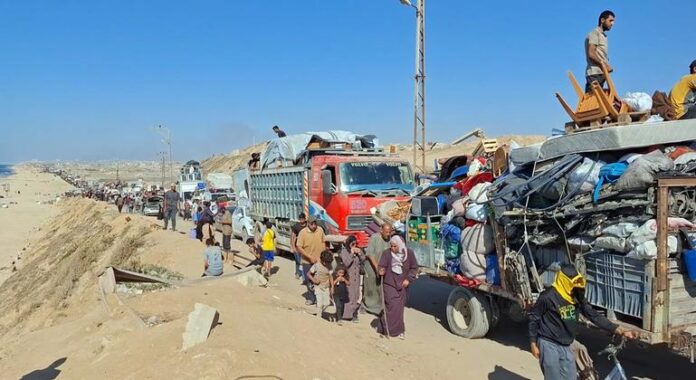
The growing number of civilians being forced to head south by Israel’s full-scale offensive to wrest control of Gaza City is putting mounting pressure on already strained services available in Khan Younis and Deir al Balah, where conditions are dire, Mr. Dujarric said.

Tens of thousands are having to squeeze into tents along the beach or cram into school shelters, while others are “sleeping in the open on the rubble of destroyed buildings and houses.”

The UN is continuing to serve those in need, as much as possible: on Monday, seven out of 12 humanitarian missions coordinated with Israeli authorities were facilitated. While UN teams managed to collect health supplies from Kerem Shalom. A further two missions to retrieve food cargo were denied. 

Source link

World News in Brief: Call New Haiti Force, Ukraine and Sudan updates, “disturbing” phrase for the blogger in China

0

Kenya president William Ruto, who directs the multinational security support mission (MSS), noted limited progress since the deployment of police forces 15 months ago with the UN Security advice approval.

“When we arrived, the airport was surrounded by gangs. Today, it works perfectly, “he said, also pointing to the security of the presidential palace and the reopening of key access roads to the capital Port-au-Prince.

However, gangs still control 85% of the city, he recognized. The MSS, hampered by insufficient resources, could not break their grip as its mandate approaches expiration.

The United States, echoing the concerns of Kenya, has urged a stronger uncommapable presence. “Haiti is at the crossroads,” warned Secretary of State Christopher Landau under Secretary of State.

Washington is pressure for the transformation of the MSS into a so -called gang suppression force of 5,500 members, operating under chapter VII of the Charter of the United Nationswhich authorizes military action to counter threats to peace.

“The moment to act is now. The Haitian people cannot wait, “he said, calling on the Member States to support a draft resolution submitted in Panama.

Haiti cannot go rider alone

For the Haitian authorities, international support is essential. “Haiti cannot and will not be able to face this security crisis, fueled by transnational criminal networks, alone,” said Laurent Saint-Cyr, president of the country’s presidential transition council.

The Security Council should shortly decide the future of international engagement in Haiti, where hunger, travel and sexual violence continue to worsen alongside insecurity.

Ukraine war: Russian forces “used drones to continue and bomb the victims”

The UN Human Rights Council In Geneva, on Monday, was informed of the continuous and devastating impact of the Russian invasion on a large scale on Ukraine.

In an update, independent investigators of the Commission of inquiry On Ukraine created by the Council, expressed a deep concern in the face of the growing number of civilian victims of the Russian attacks.

“Relacable attacks’

Erik Møse, president of the panel, said that “relentless attacks with long -range weapons … intensified” throughout Ukraine.

Civilians’ attacks have also increased, using short -range drones in front line areas: “The Russian armed forces have carried out position attacks on the left bank of the Dnipro river with drones that allow real -time observation and the monitoring of targets.

“They continued the victims with drones and dropped explosives on them, causing deaths and injuries. Drones have also struck ambulances and other emergency services, preventing them from reaching the victims. ”

Mr. Mose, who is not a member of the UN staff and works independently, said that the investigation had not been able to verify the Russian allegations of drone attacks by the Ukrainian armed forces, citing a lack of access to the affected territory and a lack of Russia’s commitment.

The Sudan crisis deepens: violence, famine and cholera threaten millions in Darfur

In Sudan, conditions quickly deteriorate in El Fasher, the besieged capital in northern Darfur.

Between September 17 and 19, more than 7,500 people fled the Abu Shouk travel camp and parts of El Fasher, according to reports from the United Nations International Migration Organization (Iom).

After an increase in deadly attacks in El Fasher, Secretary General António Guterres And the chief of the rescue Tom Fletcher has raised urgent concerns concerning the climbing of the crisis, warning that civilians remain trapped and that many face famine conditions.

The children sit next to makeshift tents in El Fasher, in northern Darfur, where intensified fights have left thousands of people trapped.

Over 70 killed in a mosque attack

Warnings follow the attack on the Mosque on Friday, which would have been led by the militia of the rapid support forces, which killed more than 70 people – including at least 11 children – according to the first reports of the United Nations Children’s Agency Unicef.

Humanitarian response efforts were also seriously disrupted by the increase in violence, a local organization would have been forced to suspend operations in the city of Darfuri held by the government of El Fasher.

These challenges are still aggravated by seasonal floods and an epidemic of cholera nationwide.

In the state of southern Darfur, “more than 5,200 alleged cases and 250 deaths have been reported since May,” said Dujarric. From Sunday, the UN and its partners launched a large -scale cholera vaccination campaign across Darfur, targeting around 1.9 million people in the region.

At the start of the high -level week, “Mr. Guterres once again calls for a concerted international action in support of the people of Sudan, “said the United Nations spokesperson.

Prison sentence for Chinese blogger Zhang Zhan “deeply disturbing”: ohchr

The United Nations Human Rights Office, Ohchr,, described The imprisonment in China of citizen journalist Zhang Zhan is deeply disturbing.

Development comes after Ms. Zhan was sentenced to four more prison on what the OHCHC calls “the vague and ill -defined accusation of” choosing quarrels and provoking problems “.

More details on this last charge have not been disclosed, but it is supposed to be based on its social media activity, said the United Nations Rights Office. This also expressed his concerns about the conduct of his trial, saying that independent observers were not allowed to attend his hearing.

According to Ohchr, this is the second time that Ms. Zhan has been condemned and imprisoned for this offense.

He called for his “immediate and unconditional release”.

Originally published at Almouwatin.com