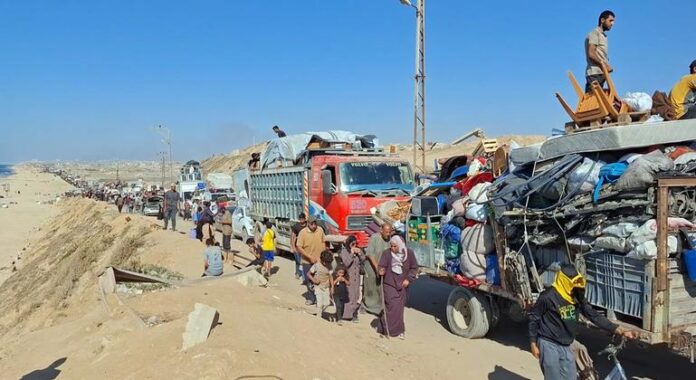
“Intensified strikes on Gaza City, including on tents, residential buildings, infrastructure continue to inflict heavy casualties,” the UN aid coordination agency, OCHA, said.
In an update, the UN agency also noted that several health facilities have shut in Gaza City in the north of the enclave this month along with community kitchens, which have also closed as the Israeli military operation continues.
The development followed an urgent warning about the catastrophic impact of the war on Gaza’s children – “killed while sleeping, playing, queuing for food and water, seeking medical care” – from the UN’s top aid official, Tom Fletcher.
“They’ve been bombed, maimed, starved, burned alive, buried in the rubble of their homes, separated from their parents…scraping through the rubble for food, enduring amputations without anaesthetic,” he said, at a scheduled event on the sidelines of the UN General Assembly in New York.
To address this crisis, the International Court of Justice (ICJ) provisional measures that require Israel to facilitate urgently assistance throughout Gaza must be implemented, insisted Mr. Fletcher, while also highlighting the Israeli children killed or taken hostage during Hamas-led terror attacks on 7 October 2023.
Other key UN updates from Gaza:
Among many reported attacks in the last week, on 19 September, a four-year-old boy and a five-year-old girl were killed and others injured when their tent was hit in Al Mawasi, Khan Younis, OCHA said.
Amid ongoing famine across the Strip, a two-kilogramme bundle of bread now costs more than $9, compared with 30 cents at UN-supported bakeries in early 2025.
In the week to 23 September, out of 94 attempts to coordinate aid missions planned movements with Israeli authorities across the Gaza Strip, only 35 went ahead.
No aid has been collected in northern Gaza since the Zikim crossing was closed on 12 September. This has forced aid partners who provide cooked meals to bring supplies from the south despite heavy congestion on Al Rashid Road and continuing security concerns.
This week in northern Gaza, there has been a reduction of about 50,000 daily meals compared with 109,000 meals last weekend, after some community kitchens closed as the military offensive escalates in Gaza City.
In southern Gaza, families shelter “squeezed into makeshift tents along the beach” or are packed into overcrowded schools. Others have to sleep out in the open and amid rubble, while basic services are ‘beyond capacity’.
Fighting between Palestinian armed groups and Israeli forces has also been reported in Gaza City in addition to rocket fire by Palestinian armed groups into Israel on 21 September.
Israeli strikes on residential buildings and tents sheltering internally displaced people and people seeking aid have been reported once again, with reports of controlled detonations.
In a 48-hour period between 19 and 20 September, at least 51 Palestinians were killed in 18 recorded attacks on residential buildings in Gaza City; almost all of those killed were civilians, according to the UN human rights office.
“Additional waves of displacement” particularly from Gaza City, have been caused by new evacuation orders by Israel, its ongoing military ground operations and bombardment, OCHA stressed.
The key Allenby Bridge crossing point for aid relief from Jordan via the occupied West Bank remains closed after a Jordanian truck driver shot and killed two Israeli soldiers.
In August, about a quarter of relief items entering Gaza through the UN 2720 mechanism came via Jordan, including food, tents, and other urgently needed supplies.
Latest data from the Gaza authorities indicates that in the week to 24 September, 357 Palestinians were killed and 1,463 were injured. Since 7 October 2023, more than 65,400 people have been killed in Gaza and 167,160 have been injured, the health ministry reports.
The number of casualties among those trying to access aid supplies has increased, with 2,531 fatalities and more than 18,531 reportedly injured since 27 May 2025, OCHA noted.
In addition, as of 19 September, 440 malnutrition-related deaths including 147 children have been documented, since October 2023.
As included in the product information for paracetamol in the EU, a large amount of data from pregnant women who used paracetamol during pregnancy indicates no risk of malformations in the developing foetus or in newborns.
In 2019, EMA reviewed available studies that investigated the neurodevelopment of children exposed to paracetamol in utero and found that the results were inconclusive and that no link with neurodevelopmental disorders could be established. Refer to footnotes: 1, 2.
When needed, paracetamol can be used during pregnancy. As with any medicine for acute treatment, it should be used at the lowest effective dose, for the shortest possible time and as infrequently as possible.
Pregnant women should speak to their healthcare professional if they have questions about any medication during pregnancy.
As for all medicines, EMA and the national competent authorities in the EU will continue to monitor the safety of medicines containing paracetamol and promptly evaluate any new data as they emerge. Regulatory actions will be taken as necessary to protect public health.
As included in the product information for paracetamol in the EU, a large amount of data from pregnant women who used paracetamol during pregnancy indicates no risk of malformations in the developing foetus or in newborns.
In 2019, EMA reviewed available studies that investigated the neurodevelopment of children exposed to paracetamol in utero and found that the results were inconclusive and that no link with neurodevelopmental disorders could be established. [1][2]
When needed, paracetamol can be used during pregnancy. As with any medicine for acute treatment, it should be used at the lowest effective dose, for the shortest possible time and as infrequently as possible.
Pregnant women should speak to their healthcare professional if they have questions about any medication during pregnancy.
As for all medicines, EMA and the national competent authorities in the EU will continue to monitor the safety of medicines containing paracetamol and promptly evaluate any new data as they emerge. Regulatory actions will be taken as necessary to protect public health.
[2] Ahlqvist VH, Sjöqvist H, Dalman C, et al. “Acetaminophen use during pregnancy and children’s risk of autism, ADHD, and intellectual disability” JAMA, 2024;331(14):1205–1214. doi:10.1001/jama.2024.3172
The EU has launched a new user-friendly app, ‘EU funding & me’, to help citizens access EU funding opportunities on the EU’s Funding and Tenders Portal. The new app acts as a complementary tool to the portal, where more than €38 billion in funding opportunities are offered each year.
“” Strikes intensified in the city of Gaza, including on tents, residential buildings, infrastructures continue to inflict heavy victims», The United Nations Coordination Agency, Ochhasaid.
In an update, the United Nations agency has also noted that Several health establishments have closed in Gaza City In the north of the enclave this month with community kitchens, which also closed when the Israeli military operation continues.
Development followed an urgent warning On the catastrophic impact of war on the children of Gaza – ” Killed during sleep, play, queue for food and water, search for medical care ”- High official of the UN help, Tom Fletcher.
“They were bombed, mutilated, hungry, burned alive, buried in the rubble of their houses, separated from their parents …Scratch through the rubble for food,, Lasting amputations without anesthesia“, He said, during an event planned on the sidelines of the United Nations General Assembly in New York.
To resolve this crisis, the Provisional measures of the International Court (ICJ) Who obliges Israel to facilitate urgent assistance in all Gaza must be implemented, insisted for Mr. Fletcher, while highlighting Israeli children killed or taken hostage during terrorist attacks led by Hamas on October 7, 2023.
Other UN Gaza Keys Updates:
Among many attacks reported last week on September 19, a four -year -old boy and a five -year -old girl were killed and others injured when their tent was hit in Al Mawasi, Khan Younis, Ocha said.
In the middle of the current famine through the strip, a bread of bread with two kilograms now costs more than $ 9, against 30 cents in bakeries not supported at the beginning of 2025.
During the week to September 23, out of 94 attempts to coordinate the movements provided for by the assistance missions with the Israeli authorities through the Gaza Strip, only 35 went forward.
No help has been collected in the north of Gaza since the zikim crossing closed on September 12. This forced help partners who provide cooked meals to bring supplies from the South despite strong congestion on Al Rashid Road and continuous security problems.
This week at Northern Gaza, There was a reduction of around 50,000 daily meals against 109,000 meals last weekendAfter some community kitchens closed while the military offensive degenerates to Gaza City.
In the south of Gaza, families house “tightened in makeshift tents along the beachOr are packed in overcrowded schools. Others must sleep in the open air and in the middle of the rubble, while the basic services are “beyond capacity”.
The fighting between Palestinian armed groups and Israeli forces have also been reported to Gaza City in addition to Fire of rocket by Palestinian armed groups in Israel on September 21.
The Israeli strikes on residential buildings and tents housing internal displaced people and people looking for aid have been reported once again, with controlled detonation reports.
In a period of 48 hours between September 19 and 20, At least 51 Palestinians were killed in 18 attacks recorded against the residential buildings of Gaza City; Almost all those who are killed were civilians, According to the United Nations Human Rights Office.
The “additional waves of travel”, in particular from Gaza City, were caused by new evacuation orders by Israel, its military operations and ongoing military bombardments, underlined OCHA.
The crossing point of the Allenby bridge for help for help with Jordan via the occupied West Bank remains closed after a Jordanian truck driver killed two Israeli soldiers.
In August, about a quarter aid entering Gaza through the UN mechanism 2720 came via Jordan, including food, tents and other necessary urgent supplies.
The latest data from the Gaza authorities indicate that in the week on September 24, 357 Palestinians were killed and 1,463 were injured. Since October 7, 2023, More than 65,400 people were killed in Gaza and 167,160s were injuredreports from the Ministry of Health.
The number of victims among those trying to access the aid supplies increased, with 2,531 deaths and more than 18,531 would have been injured since May 27, 2025, noted OCHA.
In addition, on September 19, 440 deaths related to malnutrition, including 147 children, have been documented since October 2023.
“Intensified strikes on Gaza City, including on tents, residential buildings, infrastructure continue to inflict heavy casualties,” the UN aid coordination agency, OCHA, said.
In an update, the UN agency also noted that several health facilities have shut in Gaza City in the north of the enclave this month along with community kitchens, which have also closed as the Israeli military operation continues.
The development followed an urgent warning about the catastrophic impact of the war on Gaza’s children – “killed while sleeping, playing, queuing for food and water, seeking medical care” – from the UN’s top aid official, Tom Fletcher.
“They’ve been bombed, maimed, starved, burned alive, buried in the rubble of their homes, separated from their parents…scraping through the rubble for food, enduring amputations without anaesthetic,” he said, at a scheduled event on the sidelines of the UN General Assembly in New York.
To address this crisis, the International Court of Justice (ICJ) provisional measures that require Israel to facilitate urgently assistance throughout Gaza must be implemented, insisted Mr. Fletcher, while also highlighting the Israeli children killed or taken hostage during Hamas-led terror attacks on 7 October 2023.
Other key UN updates from Gaza:
Among many reported attacks in the last week, on 19 September, a four-year-old boy and a five-year-old girl were killed and others injured when their tent was hit in Al Mawasi, Khan Younis, OCHA said.
Amid ongoing famine across the Strip, a two-kilogramme bundle of bread now costs more than $9, compared with 30 cents at UN-supported bakeries in early 2025.
In the week to 23 September, out of 94 attempts to coordinate aid missions planned movements with Israeli authorities across the Gaza Strip, only 35 went ahead.
No aid has been collected in northern Gaza since the Zikim crossing was closed on 12 September. This has forced aid partners who provide cooked meals to bring supplies from the south despite heavy congestion on Al Rashid Road and continuing security concerns.
This week in northern Gaza, there has been a reduction of about 50,000 daily meals compared with 109,000 meals last weekend, after some community kitchens closed as the military offensive escalates in Gaza City.
In southern Gaza, families shelter “squeezed into makeshift tents along the beach” or are packed into overcrowded schools. Others have to sleep out in the open and amid rubble, while basic services are ‘beyond capacity’.
Fighting between Palestinian armed groups and Israeli forces has also been reported in Gaza City in addition to rocket fire by Palestinian armed groups into Israel on 21 September.
Israeli strikes on residential buildings and tents sheltering internally displaced people and people seeking aid have been reported once again, with reports of controlled detonations.
In a 48-hour period between 19 and 20 September, at least 51 Palestinians were killed in 18 recorded attacks on residential buildings in Gaza City; almost all of those killed were civilians, according to the UN human rights office.
“Additional waves of displacement” particularly from Gaza City, have been caused by new evacuation orders by Israel, its ongoing military ground operations and bombardment, OCHA stressed.
The key Allenby Bridge crossing point for aid relief from Jordan via the occupied West Bank remains closed after a Jordanian truck driver shot and killed two Israeli soldiers. In August, about one quarter of relief items entering Gaza through the UN 2720 mechanism came via Jordan, including food, tents, and other urgently needed supplies.
Latest data from the Gaza authorities indicates that in the week to 24 September, 357 Palestinians were killed and 1,463 were injured. Since 7 October 2023, more than 65,400 people have been killed in Gaza and 167,160 have been injured.
The number of casualties among those trying to access aid supplies has increased to 2,531 fatalities and more than 18,531 injuries since 27 May 2025, OCHA noted.
In addition, as of 19 September, 440 malnutrition-related deaths including 147 children have been documented, since October 2023.
Madrid, September 19, 2025 – The headquarters of the Church of Scientology in Madrid hosted the twelfth edition of the Religious Freedom Awards, organized by the Foundation for the Improvement of Life, Culture and Society, pioneers in Spain and Europe in recognizing the work of those who defend religious freedom, freedom of conscience and interfaith dialogue.
These awards, unique in their kind, and drawing from precept 18th of The Way to Happinness by L Ron Hubbard, bring together academics, jurists, religious leaders, and representatives of civil society in an event that seeks to highlight the challenges and achievements in this field. The Foundation, which holds Special Consultative Status with the United Nations Economic and Social Council (ECOSOC), and which was proudly founded by the Church of Scientology, has brought the voice of Spanish religious communities to international forums, including Geneva, Vienna, and New York, consolidating its role as a relevant actor in the promotion of this fundamental right.
Among those in attendance were Mr. Daniel Pelayo, Deputy Director General for Religious Freedom at the Ministry of the Presidency, and representatives of the Diversity Management Unit of the Madrid Municipal Police, whose work was highlighted during the event. Other attendees were from the Bahai Community of Spain, the sisterhood of Vedruna Carmelita nuns of Charity, among others.
A message of dignity and freedom
The ceremony opened with remarks by Isabel Ayuso Puente, Secretary General of the Foundation, who recalled that religious freedom is essential even in times of war:
“In a world ravaged by war, it might seem a little frivolous to focus on freedom of belief or freedom of religion, because there are other needs that seem more pressing, and indeed they are, at present.”
Ayuso emphasized the centrality of freedom of belief to human dignity:
“Freedom of belief is like the freedom of freedoms. Without it, people would not have the status of human beings.“
Finally, he highlighted the need to make diversity of belief visible in order to strengthen coexistence:
”to give visibility to religion, because it can be a pillar, and in fact is a pillar, for laying the foundations for a future and a better society in which everyone can live in peace.”
Five awards, five approaches
This year, for the first time, the awards were expanded from three to five, incorporating awards that recognize the practical work of religious communities and their direct contribution to dialogue and coexistence.
Professor Salvador Pérez Álvarez – Positive secularism and culture of peace
The first award winner of the night was Salvador Pérez Álvarez, Professor of Ecclesiastical Law at the UNED, presented by Professor Fernando Amérigo-Cuervo, who highlighted his academic career and his commitment to freedom of conscience and bioethics.
In his speech, Pérez reflected on the constitutional principles that guarantee religious freedom:
“Positive state secularism is the institutional guarantee, the constitutional pillar that underpins the full enjoyment of religious freedom by all citizens in an increasingly pluralistic society, under conditions of real and effective equality.”
He warned of the growing risk of hate speech in society:
“This argument is becoming increasingly radicalized and, what is more worrying, in my humble opinion, it is becoming increasingly prevalent in different social sectors.”
He called for a collective commitment to address these threats:
“We cannot stand idly by in the face of this new form of threat to coexistence on the grounds of religious differences.”
Finally, he linked freedom of belief to the construction of a more just society:
“The fulfillment of this requirement has served as the basis for the implementation of a genuine culture of peace as a sustainable development goal.”
Professor Óscar Salguero Montaño – Diversity, respect, and dialogue
The second prize went to Óscar Salguero Montaño, professor and social anthropologist at the Complutense University of Madrid, presented by UAM professor Ana Isabel Planet, who highlighted his commitment to social change and the promotion of coexistence.
Salguero began by recalling the words of Jürgen Habermas after 9/11, which remain fully valid:
“Secular citizens must stop understanding religions as atavistic realities and, on the other hand, religious citizens and their representatives must open themselves to dialogue with modernity, far from any fundamentalist attitude.”
She explained how freedom of belief underpins social diversity:
“This freedom of belief enables each and every one of us to live according to our deepest convictions, whether political, religious, or non-religious, and always under the crystal-clear prism of respect and coexistence.”
He warned against the political exploitation of beliefs:
“We see how religious beliefs are increasingly being exploited to generate conflict or used as an excuse to limit rights.”
And he linked this challenge to the fragility of peace:
“Coexistence and interreligious respect are fragile values that we must protect and defend.”
Professor Javier García Oliva – An international perspective on rights
The third award recognized the work of Javier García Oliva, Professor of Constitutional Law and Dean of the Faculty of Law and Social Sciences at the University of Manchester (United Kingdom), presented by UCM Professor Santiago Cañamares.
García Oliva recalled the historical challenges to religious freedom and their current impact:
“It is disheartening to think that this person had to live in fear and hide their beliefs.”
Referring to the contemporary reality, he warned:
“In many parts of the world, including Western Europe, many citizens face serious problems, even death, in exercising their religious freedom.”
He emphasized the need for a balance between fundamental rights:
“Religious freedom is a fundamental and non-negotiable right in a democracy, but it can only be fully enjoyed if other fundamental rights are respected.”
Mr. Luis Morente Leal – Buddhism and equality in diversity
The fourth award was presented to Luis Morente Leal, representative of the Buddhist Union of Spain and a lawyer with decades of experience in defending equal treatment for minority faiths.
Morente spoke about the importance of knowledge as the basis for respect:
“Knowing and dealing with other people who think differently from me has not only enriched me, but has also made me understand in all its depth the phrase that to know is to love.”
He shared personal experiences of discrimination:
“I have experienced discrimination in my own country for two reasons. One, when I had an African girlfriend. And another, when some people found out that I was a Buddhist.”
He defended diversity as an enriching element of society:
“Diversity enriches us. And diversity is not only what is in line with our religion, it is also the person who has a code of ethics.”
And he expressed his desire for a peaceful future:
“May some generation in this world finally live without hatred, live without wars, and live knowing others and, above all, knowing themselves.”
Pandit Krishna Kripa Dasa – Recognition and interreligious dialogue
The last award went to Pandit Krishna Kripa Dasa, president of the Hindu Federation of Spain, for his work in representing and uniting Hindu communities, as well as his proactive participation in multiple interreligious spaces, such as the TRANSCENDENCE International Forum, among others.
Krishna Kripa Dasa recalled the daily coexistence in his hometown, Ceuta:
“In Ceuta, coexistence is not an academic exercise or a matter of diplomacy, but something that is lived on a daily basis.”
He defended the millennial status of Hinduism as a religion deeply rooted in the world and in Spain:
“Hinduism has 1.2 billion followers, a presence in 145 countries, and 130 years of history in Spain.”
He pointed out the need to avoid the fragmentation of communities and explained the inclusive vision of his tradition:
“The truth is one, but the sages call it by different names.”
Religious freedom: a living practice
To close the event, Iván Arjona Pelado, president of the Foundation and representative of Scientology to the European institutions and the United Nations, thanked the award winners and all those present, emphasizing that religious freedom is a collective effort:
“Today we have seen that religious freedom is not only a legal right, but a living practice that builds more just and peaceful societies.”
The ceremony concluded with a group photo and a call to continue working together for coexistence, cooperation, and respect among all beliefs.
A consolidated event on the religious freedom calendar
With this twelfth edition, the Religious Freedom Awards reaffirm their role as a meeting platform for religious communities, institutions, and human rights defenders. The Foundation’s international recognition, thanks to its status with the UN, has made these awards a European benchmark in the defense of freedom of belief, with a view to building societies where diversity is understood as a source of wealth and not as a threat.
The closing remarks of the evening also reflected on the origins and vision that made these awards possible. The Foundation for the Improvement of Life, Culture and Society, established by the Church of Scientology, draws inspiration from the teachings of its founder, L. Ron Hubbard, who emphasized that “religious freedom is the first freedom.” Under the leadership of David Miscavige, the Church has expanded its humanitarian and interfaith initiatives worldwide, fostering dialogue and understanding among communities of diverse beliefs. This global vision continues to guide the Foundation’s efforts to defend the rights of all individuals to practice their faith freely and to promote a culture of peace and coexistence.
The annual event brought together the heads of national police organisations, customs administrations, representatives from the European Commission, and international partners to discuss the most pressing threats to security in Europe.Catherine De Bolle, Europol’s Executive Director, and Lene Steen, Deputy National Commissioner of the Danish Police, opened the conference. Keynote addresses were delivered by EU Commissioner for Internal Affairs and…
This still represents less than a quarter of the 4.7 million Syrian refugees who, in August this year, still lived in Türkiye, Lebanon, Jordan, Iraq and Egypt after being driven from the country by years of brutal conflict, according to a Hcr Report earlier this month.
Although the country has seen a million refugees and 1.8 million people displaced internally return to their original areas, more funding are necessary to facilitate the transition – in the middle of the general destruction of houses and basic services, combined with a lack of employment possibilities.
The head of the UNHCR, Filippo Grandi, called the international community, the private sector and the Syrian diaspora to “meet and intensify their efforts to support the recovery”, guaranteeing voluntary yield is carried out in a worthy and sustainable manner.
Delay their return
“In my region of origin, there is nothing, no services, no electricity,” said one of the respondents of the UNHCR report. “The first thing we need is a roof above our heads.”
Citing the lack of adequate housing, limited access to employment and concerns about security and security, most refugees said they did not intend to return to Syria over the next year, even if 75% wanted to return one day.
“Preserve hope and support for stability”
The UNHCR has started to facilitate voluntary yields and increased its support, in particular by providing cash assistance and transport.
There are more than seven million Syrians still moved to Syria and 4.5 million people abroad.
“With a renewed commitment, the international community can help preserve hope and support stability and lasting solutions for one of the largest refugee situations of our time,” said Grande.