
Meta just initiated a complete AI organizational overhaul that industry insiders saw coming for months. The social media
Meta Launches Superintelligence Labs in Major AI Restructure
‘Our work is largely invisible’: Journey from outer space to frontline aid worker
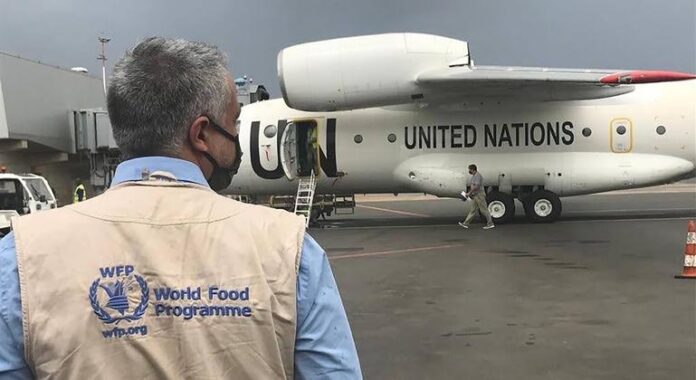
Ahead of donning a beige WFP vest and boots to face hurricanes, wars and refugee camps, the Portuguese scientist worked with satellite imagery and cartography, creating maps to support humanitarian missions, until he realised he didn’t want to stay behind a computer screen.
On the occasion of World Humanitarian Day, marked annually on 19 August, Mr. Matos shared his story with UN News.
Pedro Matos joined the WFP response team following the deadly Cyclone Idai in Mozambique in 2019. (file)
From hurricanes to war
“At a certain point, it just wasn’t enough,” he recalled about his space engineering job. “I didn’t want to be making maps for other people to go and do humanitarian responses. I want to take those maps and be the one to do the responding.”
That’s exactly what he did. At WFP, he first developed maps on the ground and then went on to coordinate the agency’s emergency operations.
Since then, he has visited dozens of countries often at the epicentre of crises, from Hurricane Idai in Mozambique to the outbreak of war in Ukraine.
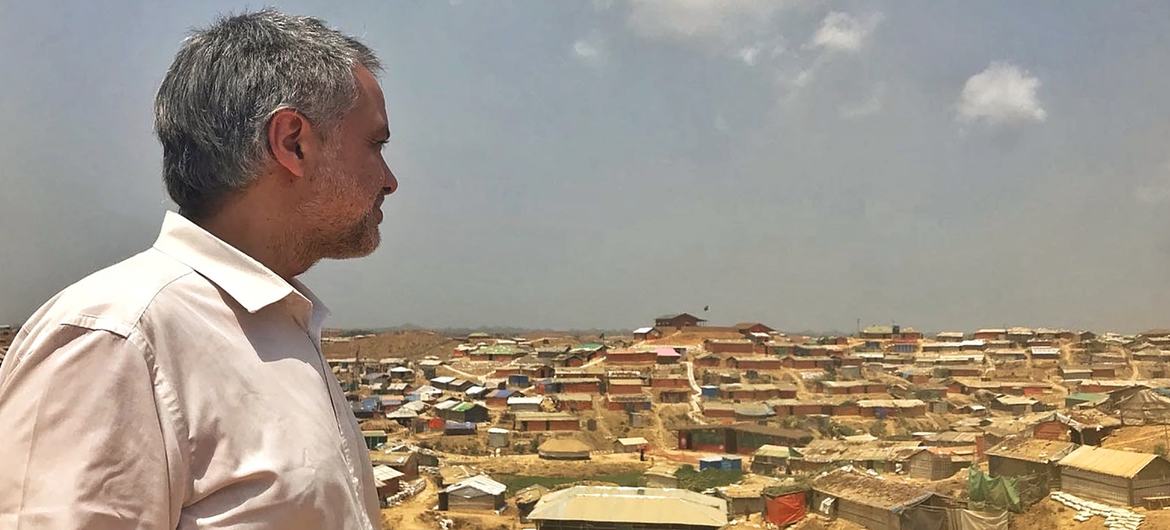
In 2018, Pedro Matos looks at the Kutupalong refugee camp where Rohingya refugees live. (file)
‘Like moving an entire government’
Coordinating in an emergency response is like “moving an entire government”, where each UN agency represents a “ministry” and the response only works when everyone comes together over the four essential areas in a crisis response: food, shelter, water and health.
Having just returned from a mission in Bangladesh, he described efforts to respond at Cox’s Bazar, the world’s largest refugee camp and home to 700,000 people who fled violence in Myanmar.
“We’ve been able to provide better conditions for people to live in this limbo with a little more comfort,” he said, also remembering his visit there in 2018 at the height of the crisis.
At the time, “a million people crossed the border in a month.” Today, although they remain in “limbo”, he pointed to improvements such as more monsoon-resistant homes and roads, gas stoves and reforestation.
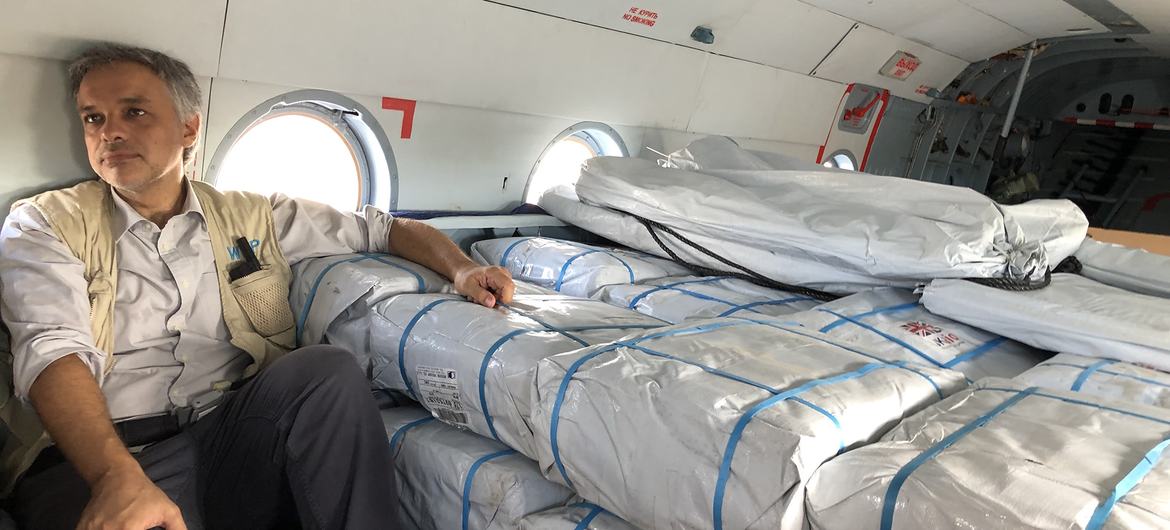
Pedro Matos on board a humanitarian aid flight after Cyclone Idai in Mozambique. (file)
Heart-shredding challenges and profound rewards
The job has meant both challenges and rewards.
“We’ve also had a few instances where we’ve been kidnapped, or come under fire, but it’s not the things that happen to us that impact us the most,” he said. “It’s the things that happen to others that have the most impact.”
Hurricane Idai in Mozambique was a Category 5 hurricane that hit Beira in 2019 was one of the biggest and most intense crisis, but also most rewarding, he said.
“There’s this mix of something that was very intense and hard because we couldn’t reach everyone, but at the same time, the fact was that there were many people – tens or hundreds of thousands of people – who would have died if we hadn’t been there,” he said. “That was the most impactful response in my 17 years at the United Nations.”
When he was in Yemen, “we were bombed 20 times a day” in the capital, Sana’a, he said, adding that “there’s a strange normalcy” that develops.
“We find ourselves saying things like, ‘no, that wasn’t very far; it was only 500 metres from here,’” he said. “It’s something I never thought I’d think or say before doing this work.”
When reaching central Ukraine several weeks after Russia’s full-scale invasion in early 2022, he called the situation “very intense”. Within a week, he and his colleagues began distributing money to people coming from the frontlines.
We couldn’t reach everyone, but there were tens or hundreds of thousands of people who would have died if we hadn’t been there.
“When we interviewed people and asked them what they were doing with the money we gave them, it was very gratifying,” he said. “It was beautiful.”
Those who had been wounded in the war were using the money to buy painkillers. Others used it to pay for gas to escape the frontlines. One mother had been able to buy her daughter a scoop of ice cream for the first time since the war began.
“Her daughter was delighted,” he said. “There are very rewarding moments.”
Feeding millions every day
“We all think we know what the humanitarian or aid sector is,” Mr. Matos explained, adding that the scale during a crisis is much, much larger.
“I thought we’d be rehabilitating schools, feeding 100 people,” he continued. “I never imagined I’d be feeding 13 million people a day in Yemen. The scale is absolutely incredible.”
However, humanitarian work is often seen as a separate job, he said. Almost every profession that exists in private and government sectors also exists in an aid landscape, from lawyers, those who work in procurement, like in supermarkets, and human resources.
“I basically do the same work as social workers or firefighters,” he said. “They do it here every day, and I do it elsewhere. But, our work is in the same field and very similar.”

A toddler eats a food supplement, as part of WFP’s nutrition programme, in Mokha, Taiz, in Yemen.
The value of a Nobel Prize
WFP was awarded the Nobel Peace Prize in 2020, a recognition that Mr. Matos received with humility.
“Our work is largely invisible, despite feeding 120 million people every day,” he said. “It gave us a platform to raise awareness about crises like Congo, Myanmar, Sudan and Gaza, which often go unnoticed.”
Our work is largely invisible, despite feeding 120 million people every day.
He said his job is to give voice to the voiceless when crises fade from news headlines. Despite the difficulties and risks across his career, Mr. Matos has no doubt about the most important lesson he learned.
“People are essentially good,” he said. “When faced with the imminence of tragedy, people are fundamentally good and want to help others, even if that other person is very different. It was good to realise this because it’s not always obvious when we’re far from these crises.”
Listen to science with these 10 podcasts

POST-TRUTH AND SOCIETY
The Post Truth be told podcast releases a new episode every month, exploring how post-truth politics impact modern societies. The podcast is produced by the RECLAIM project that studies disinformation and its negative effect on democratic discourses in Europe, providing insights to shape policy, education, and efforts to counter disinformation.
EUROPEANISATION
The MEDIATIZED EU project hosted a podcast series on the theme of Europeanisation. Through interviews with researchers in the field, the podcast explores the perception, public opinion, and media portrayal of the EU in various countries.
EXTREMIST NARRATIVES
The SmidgeCast podcast – by the SMIDGE project – explores the surge of extremist narratives in Europe through insightful conversations and expert perspectives. The series also examines issues surrounding extremism; from conspiracy theories online to the vulnerability of middle-aged people to misinformation.
CITIZEN SCIENCE
Citizen Science Champions is a podcast series from the CROPS project focusing on the communities who are connecting citizens and science in areas such as women health, biodiversity, ocean monitoring, education and more.
FRESHWATER RESTORATION
Bringing Europe’s Freshwaters Back to Life is the title – and the theme – of the MERLIN project’s podcast. As Europe’s freshwaters are in a dire state, the podcast follows the project’s journey, offering a behind the scenes look at some of the continent’s ambitious freshwater restoration projects carried out through cutting-edge aquatic science and conservation.
DEMOCRACY
The ‘Democratic innovations’ podcast from the INCITE-DEM project raises and attempts to answer key questions related to democracy: such as enhancing citizens’ trust, solving crises, changing bureaucracy, improving democracy.
CULTURAL HERITAGE
Through interviews with experts, professionals in the creative industry, and community voices, the HERIFORGE podcast explores the way we preserve and engage with cultural heritage. HERIFORGE project provides a research environment for the cultural and creative industries using extended reality technology.
CHINA’S ROLE IN THE WORLD
The DWARC project enhances Europe’s knowledge on China, while also building a network of expertise in the field to build research-based policy recommendations at EU level. The project’s podcast complements its research, informing experts and the public alike about China’s role in the world.
BIODIVERSITY GENOMICS
The Genomic connections podcast – by the BGE project – focuses on how the use of genomics can enhance understanding of biodiversity, monitor biodiversity change, and guide interventions to address its decline.
EU-PRODUCED PODCAST SERIES
The CORDIScovery podcast releases a new episode every month, touching on an EU-funded project, idea, or debate in science. The podcast is produced by CORDIS, the EU’s platform for sharing research results.
The Just Europe podcast series takes a closer look at the challenges we face on the path to a fair and inclusive Europe. It brings open conversations on how research, innovation and policymaking can support people and strengthen Europe’s social model.
ESMA and the European Environment Agency signed a Memorandum of Understanding to strengthen their cooperation in sustainable finance area
DISCLAIMER: Information and opinions reproduced in the articles are the ones of those stating them and it is their own responsibility. Publication in The European Times does not automatically means endorsement of the view, but the right to express it.
DISCLAIMER TRANSLATIONS: All articles in this site are published in English. The translated versions are done through an automated process known as neural translations. If in doubt, always refer to the original article. Thank you for understanding.
Gaza: Aid insufficient to avert ‘widespread starvation’ as Israeli military ramp-up forces more people to flee
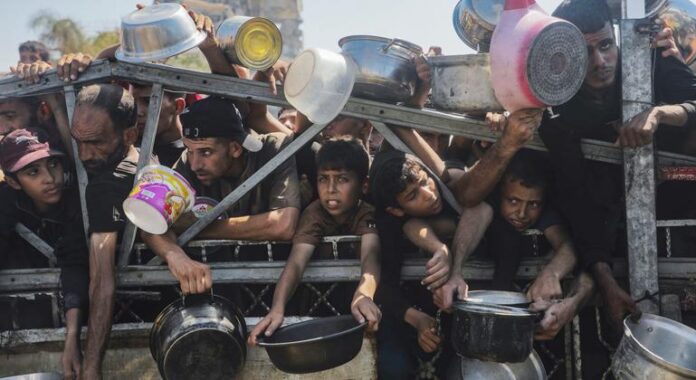
“The risk of starvation is everywhere in Gaza,” UN Human Rights Office spokesperson Thameen Al-Kheetan told reporters in Geneva.
“This is a direct result of the Israeli government’s policy of blocking humanitarian aid,” he said.
Mr. Al-Kheetan insisted that in the past few weeks, Israeli authorities have only allowed aid to enter in quantities that remain “far below what would be required to avert widespread starvation”.
The UN said on Monday that hunger-related deaths continue to be reported in the Strip, including among children.
More people displaced
As the Israeli army intensified its attacks in the north of the enclave, it has continued to issue displacement orders for Palestinians, Mr. Al-Kheetan said.
He noted that Gazans have been told to move to the Al-Mawasi area, despite continuing airstrikes and disastrous conditions there.
“Hundreds of thousands of Palestinians displaced to Al-Mawasi have little or no access to essential services and supplies, including food, water, electricity and tents,” he warned.
Deadly pursuit of aid
The OHCHR spokesperson stressed that reaching humanitarian aid “can be a deadly pursuit” with latest data indicating that 1,857 Palestinians were killed while seeking food from 27 May, when the US and Israel-backed militarized aid distribution scheme known as the Gaza Humanitarian Foundation started its operations.
Out of that number, he said that 1,021 were killed in the vicinity of the Gaza Humanitarian Foundation sites and 836 on the routes of supply trucks.
“Most of these killings appear to have been committed by the Israeli military,” Mr. Al-Kheetan said.
Asked how the situation could get even worse, Jens Laerke, the spokesperson for the UN humanitarian affairs coordination office (OCHA), said that “it has already gotten worse”, insisting on the devastating effects of the Israeli ban on the entry of shelter materials into the enclave.
While the Israeli authorities recently announced that they would lift the ban on shelter supplies, Mr. Laerke said that “the United Nations and our partners have as of last night not been able to bring in shelter materials following the Israeli announcement.”
“There’s a set of impediments that still needs to be addressed, including Israeli customs clearance,” he added.
Need for shelter
The UN said on Monday that according to partners’ estimations at least 1.35 million people in Gaza need emergency shelter.
Aid agencies have warned that tents being used in Gaza are worn out from prolonged sun exposure and frequent displacement.
Asked about the reasons given for the ban on shelter items, Mr. Laerke explained that in a conflict, some shelter items such as tentpoles can fall under the “dual-use regime” as they could be used for both civilian and military purposes.
“Shelter has been banned entry for about five months and in that period over 700,000 people have been displaced or re-displaced,” he said.
People forced to flee time and again often have to leave behind the tents that they have been provided, Mr. Laerke explained, which creates a challenge for aid workers “trying to respond to people where they are”.
The looming expansion of Israel’s military activities in Gaza City is another major concern for UN humanitarians, as it would again push thousands of people into a severely overcrowded area in the south of the Strip.
Asked about the impact of Israel’s plans to occupy Gaza City, Mr. Al-Kheetan underscored a “huge risk” for civilians.
“There are risks of mass displacement… more killings and more misery that we have already seen in the Gaza Strip,” he warned. “Among those who will be affected are the most vulnerable, people with disabilities, the injured, the children, women”, he concluded.
Response to prison video
In other developments, the human rights spokesman said that video footage showing Israeli National Security Minister Itamar Ben-Gvir berating and taunting Palestinian leader Marwan Barghouthi inside an Israeli jail was “unacceptable.”
He said the minister’s behaviour and the publication of the images constitute an attack on Mr. Barghouthi’s dignity.
He added that international law requires that all detainees be treated humanely, with dignity, and that their human rights be respected and protected.
“Such conduct by the minister responsible for the Israeli Prison Service may encourage violence against Palestinian detainees, enabling human rights violations in Israeli detention facilities,” he said
Mobility data matters: empowering cities for climate action
Data is a catalyst for informed action, enabling cities to design, implement, and refine their sustainable mobility strategies.
Cities across Europe are setting ambitious climate goals, many aiming for climate neutrality by 2030 or 2050. A significant part of this challenge lies in reducing emissions from urban transport, one of the most complex and impactful sectors to address. It depends on access to reliable mobility data and the ability to interpret and apply it effectively. Without consistent, transparent information on how people move and how much carbon their journeys produce, it is difficult for cities to assess the impact of their efforts or adjust their strategies.
Access to reliable transport emissions data can help validate assumptions, improve greenhouse gas inventories, and track the effectiveness of policies over time. Yet for many cities, collecting and using this kind of data remains a challenge.
Turning mobility data into action
Mobility-related emissions are often one of the largest contributors to a city’s overall carbon footprint. Metrics on areas such as modal share, travel distances, the ratio of inbound vs. outbound trips are essential for:
- Understanding behavioural trends and evolving travel patterns
- Targeting investments in public transport, cycling infrastructure, and low-emission zones
- Evaluating progress against local, national, and EU-wide climate targets
- Prioritising interventions with the greatest environmental and social impact
To make use of this mobility data, cities need tools that are accessible, reliable, and suited to their local context.
Supporting cities with Google’s Environmental Insights Explorer (EIE)
At the European Institute of Innovation and Technology (EIT), we empower our Knowledge and Innovation Communities (KICs) to develop solutions that tackle Europe’s most pressing challenges. One example of this is the work of EIT Urban Mobility, which in 2024 partnered with Google’s Sustainability team to help cities better harness the power of data in the transition to low-emission mobility.
The collaboration focused on raising awareness about the Environmental Insights Explorer (EIE), a free platform that provides up-to-date, modelled data on transportation emissions for thousands of cities worldwide.
Using anonymised and aggregated mobility data, drawn from sources such as Google Maps and refined through international methodologies like CURB, EIE delivers annual estimates of CO2 emissions from urban transport. Cities can explore their modal split, kilometres travelled, and year-on-year emission trends, as well as analyse inbound, outbound, and in-boundary travel. This evidence base can complement local inventories, strengthen climate action plans, and guide investment in sustainable mobility solutions.
Through its city network, EIT Urban Mobility engaged more than 60 municipalities, offering webinars, one-on-one meetings, and expert sessions to demonstrate how EIE can be applied in practice. Over 30 cities actively took part, sharing their needs and challenges. Their feedback confirmed a clear message: while cities recognise the value of data for driving climate action, many need tailored guidance and support to fully exploit these opportunities.
This collaboration illustrates how the EIT Community helps cities and citizens across Europe benefit from innovation and knowledge exchange, bringing together global partners and local stakeholders to accelerate the transition to a more sustainable future.
Mobility data in action
A highlight of this collaboration came at Tomorrow.Mobility World Congress 2024, where EIT Urban Mobility, together with Google’s Sustainability team, organised a session titled “The Power of Mobility Data for Cities.” More than 50 participants and representatives from 15 cities joined to discuss how emissions and mobility data can underpin effective urban strategies.
Speakers from Google, i2Cat, IMEC, and pioneering cities such as São Luiz do Maranhão (Brazil) shared how tools ranging from AI-powered modelling to real-time traffic management are enabling smarter decisions. The session fostered productive conversations and cross-city exchange on the use of emissions data to accelerate sustainable urban mobility.
Looking ahead
As Europe moves towards its climate neutrality goals, reliable and accessible data must become a cornerstone of urban policymaking. Transport emissions data, in particular, is critical for designing, implementing, and evaluating effective climate measures.
Through EIT Urban Mobility, the EIT Community will continue to support cities in this transition – not only by raising awareness of tools like Google’s Environmental Insights Explorer, but also by fostering collaboration, sharing knowledge across borders, and helping cities translate data into practical climate action..
Haptic technology adds the sense of touch to virtual reality
USC scientists have developed a wearable system that enables more natural and emotionally engaging interactions in shared digital
Dr Congo: The UN deplores deadly attacks in the east of the country

The attacks, which took place between August 9 to 16, in the localities of the territories of Beni and Lubero, cost the lives of at least 52 civilians, including eight women and two children, but the soldiers of peace on the ground say that the number of deaths could very well increase.
“These attacks targeting civilians, which add to the atrocities committed in the night of July 26 to 27 in Komanda (territory of Ituri, Ituri), are intolerable and constitute serious violations of international humanitarian law and human rights,” said Binto Keita, head of the United Nations Mission in the DRC, known as Monusco.
Call to armed groups
Violent attacks have been accompanied by kidnapping, looting and burning of houses, vehicles and motorcycles, as well as the destruction of goods belonging to the population already confronted with disastrous humanitarian conditions.
Monusco issued a declaration Calling for foreign armed groups, such as ADF, to lay arms unconditionally and to return to their country of origin.
The mission has also urged “the Congolese authorities to conduct in -depth investigations to identify those responsible for the massacre of civilians and translate them into justice”.
Stronger military presence
In response to this new wave of violence, the peacekeeping mission has strengthened its military presence and support for the Congolese authorities.
For example, on August 13 and 14 during Mayi-Moya incidents in northern Kivu, Monusco provided physical protection at 206 civilians, including 93 children and 70 women, who had taken refuge at the mission military base.
“Monusco remains fully determined to support the Congolese authorities and local communities to prevent new violence, protect civilians, reduce tensions and contribute to the stabilization of areas affected by armed conflicts,” he said.
Originally published at Almouwatin.com
UN honours fallen aid workers on World Humanitarian Day

The first eight months of 2025 show no sign of a reversal of this disturbing trend, with 265 humanitarian workers killed as of 14 August, according to figures released on World Humanitarian Day.
Attacks on humanitarian workers, assets and operations violate international law and undermine the lifelines that sustain millions of people trapped in war and disaster zones.
“Even one attack against a humanitarian colleague is an attack on all of us and on the people we serve,” said Tom Fletcher, head of the UN Office for the Coordination of Humanitarian Affairs (OCHA), speaking in Geneva.
At Headquarters in New York City, the UN hosted a commemoration ceremony for the victims of the bombing of the United Nations headquarters its office in Baghdad in 2003, which cost the lives of 22 people. Some of the survivors attended the event.
Protect aid workers
“Humanitarians carry hope where there is despair,” said Mr. Fletcher at the World Humanitarian Day 2025 Commemoration Ceremony in Geneva.
“They bring humanity where there is inhumanity.”
Yet, humanitarian workers are under attack.
In 2024, most of the aid workers killed were national staff serving their communities and were attacked in the line of duty or in their homes.
Since October 2023, 520 aid workers, mostly staff with UN Palestine refugee agency UNRWA, have been killed in Gaza — the deadliest place for humanitarians for the second year running.
OCHA demanded that Member States protect civilians and aid workers, and hold perpetrators accountable.
Despite the dangers, “humanitarians will not retreat”, said Mr. Fletcher.
Humanitarians in the Middle East
Across the Middle East, civilians, including humanitarian workers, “are being killed, injured, and attacked in shocking numbers,” said the UN Resident and Humanitarian Coordinators in the Occupied Palestinian Territory (OPT), Syria, Yemen and Lebanon in a joint statement this Tuesday.
Since August 2024, at least 446 humanitarian workers have been killed, wounded, kidnapped or detained in these locations. “The world is failing humanitarian workers and the people they serve,” the statement read.
Renewing their call for the respect of international humanitarian and human right laws, the officials called on the international community to “protect those who protect humanity.”
AI health startups lead Europe’s push for competitiveness in healthcare innovation

As Europe navigates an increasingly competitive global AI healthcare landscape, Spanish health tech startup Tucuvi is making headlines by becoming the first voice-based AI solution in Europe to gain Class IIb medical device certification.
Tucuvi is a Spanish health tech startup which developed a medical voice assistant, LOLA, that enables remote patient monitoring through conversational AI. Tucuvi’s breakthrough, backed by ISO 13485 certification and tailored support from EIT Health programmes, comes at a critical moment. A new AI skills report jointly released by EIT Health and EIT Digital highlights the urgent need for upskilling across Europe to remain competitive on the global stage in AI healthcare applications. The report calls for a coordinated European strategy to build human capital in AI and digital health.
Tucuvi’s rapid progress also exemplifies what the AI skills report stresses: combining deep sector expertise and interdisciplinary soft skills as a key differentiator for European AI companies. The company’s trajectory underscores the strategic role EIT Health plays in nurturing startups from ideation to internationalisation, with accelerator programmes offering access to mentors, regulators, and pharma partners across Europe. Impactful innovation happens when education, research, and business are brought together in applied, practical ways, and enabled to exchange skills fluidly across disciplines. The most impactful advances in AI and healthcare stem from this convergence of technical, scientific, and managerial capabilities.
A European wave of AI-driven health innovation
Tucuvi’s success is part of a pan-European wave of AI-enabled health innovation emerging from the EIT Health ecosystem. Their solution supports decision making when delivering diagnoses with reliable and safe data. Across Europe, start-ups are leveraging artificial intelligence to transform diagnostics, treatment, and patient care, with many achieving regulatory milestones and global commercial traction thanks to EIT Health’s multi-stage support model.
BrainTrip, based in Malta, has developed the NeuroAI platform, which interprets EEG data to deliver fast, non-invasive cognitive assessments. Its flagship tool, the BrainTrip Dementia Index (CogniScore), is CE‑marked and achieves roughly 95% diagnostic accuracy within a 30-minute test, compared to traditional neuropsychological evaluations that last over an hour. With over 2,000 tests performed, BrainTrip is scaling in Europe with EIT Health support in regulatory strategy, mentoring, and clinical integration.
These start-ups reflect a growing pan-European innovation movement, grounded in regulatory readiness, cross-sector integration, and patient-first design.
Their momentum aligns with key insights from the EIT Health and EIT Digital AI Skills and Occupations in the European startups ecosystem, which calls for a unified European strategy to combine technical excellence, ethical standards, and practical implementation. These start-ups show that such a strategy is not only possible – it’s already underway.
