Remarks by Eurogroup President Paschal Donohoe after the Eurogroup meeting on Bulgaria’s accession to the euro area, reinforcing security in Europe, removing barriers in the single market, the digital euro and the Eurogroup presidency.
World refugee day: tell their stories
While hotspots Include Sudan, Syria, Afghanistan, Ukraine and Palestine, the trip affects all regions of the world.
Forward for World Refugee DayFriday, the UN highlights the importance of solidarity with refugees by support, solutions and the power of narration.
Zahra Nader: Reports of exile
Before World Refugee Day, UN News spoke with Zahra Nader, refugee, journalist and militant of women’s rights in Afghanistan.
At six, Nader and his family fled to Iran after the Taliban first took power, where she was denied access to education and was confronted with racism.
Back in Afghanistan for years later, the striking contrast between life in exile and the opportunity to frequent school triggered his passion for journalism and plea.
In August 2021, when she was continuing a doctorate in Canada, the Taliban regained control, breaking her dreams to go home to teach and carry out work on the ground.
“” I felt as a journalist who grew up in Kabul, who became a journalist there, I have the right and the responsibility to tell these stories of women in Afghanistan“She said.” It is really inhuman, for half of the population of a country to undress from their fundamental human rights because they were born of women. »»
Channel this pain in action, she founded Zan TimesA editorial room led by Afghan women by documenting human rights violations in Afghanistan, in particular those that affect women.
Despite limited funding and growing risks for his journalists, Nader continues to work to ensure that Afghan women are seen and heard.
She described the situation in Afghanistan as “The most serious crisis in women’s rights of our time», Call insufficient international action and warn that inaction enhances the Taliban and its misogynist ideologies.
Despite his trauma and his current inability to come back, Nader remains optimistic and urges young Afghan women to resist by learning and preparing a better future.
“I hope and I also want to be part of this change, to imagine a better future for Afghanistan, and make my part for this future to happen.”
Barthelemy Mwanza: from survival to management
THURSDAY, United Nations video Presented the story of Barthelemy Mwanza, a refugee from the Democratic Republic of Congo (DRC) who is now a leader and defender of young people.
At 18, Mwanza was taken between the pressure to join an armed tribal group involved in the national conflict and his father’s plea to stay outside the fight, a decision that could have cost him his life.
To survive, he fled to the Tongogara refugee camp in Zimbabwe.
Emotionally overwhelmed to be moved from his country of origin, “it really made me cry to say” where am I? “,” Said Mwanza. “Later, I said to myself,” Until when will I continue to cry? ” Shouldn’t I look at the future? »»
He started to volunteer Hcrleading more than 5,000 young refugees thanks to initiatives to tackle sexist violence, young people and climate action.
Now reinstalled in Ohio, in the United States, Mwanza continues to collaborate with UNHCR to raise refugee voices, inspire climate action and share its history.
Empower and plead for refugees on a world scene “was one of my dreams, and now I can really see that it comes to life,” he concluded.
Barthelemy Mwanza Ngane is a refugee from the Democratic Republic of Congo and currently lives in Akron, Ohio, in the United States.
Originally published at Almouwatin.com

Long after the guns fall silent, conflict-related sexual violence leaves lasting scars
In 2024 alone, the UN verified around 4,500 cases of conflict-related sexual violence (CRSV), though the real number is likely much higher. An overwhelming 93 per cent of survivors were women and girls.
Under international law, CRSV is recognised as a war crime, a crime against humanity, and an act that can constitute genocide. Its long-lasting impact undermines efforts to build lasting peace.
On Thursday, the UN marked the International Day for the Elimination of Sexual Violence in Conflict, highlighting the enduring and intergenerational effects of this brutal tactic.
Tactic of war
In many conflicts, sexual violence is deliberately used to terrorise, punish and humiliate civilians.
“It is used to terrorise, to punish, but also to humiliate civilians, especially women and girls,” said Esméralda Alabre, coordinator of the UN reproductive health agency’s (UNFPA) response to gender-based violence in Sudan, speaking to UN News.
But the harm does not stop with the survivors. CRSV is often used to tear apart communities and undermine social cohesion. It fragments families, spreads fear and deepens societal divisions.
In Haiti, gangs have forced family members to rape their own mothers and wives, according to Pascale Solages, founder of a feminist organization in the country.
Women’s bodies are being turned into battlegrounds. Perpetrators aim to destroy community bonds, using rape as a tool of domination and control. Survivors are left to carry the burden of trauma, stigma and isolation, she told UN News.
Generational trauma
Many survivors are silenced by fears of reprisal and retaliation: “to break the cycle, we must confront horrors of the past,” said UN Secretary-General, António Guterres, in a statement marking the day.
Trauma is not only immediate, but also creates deep and lasting intergenerational wounds, as the cycle of violence often impacts multiple generations.
Shunned from their communities, many survivors are forced to raise children born out of rape, on their own. “It’s almost like their cries are being ignored by the world,” said Ms. Alabre.
Survivors of CRSV and their children, often excluded from education, employment, and other essential aspects of life, are pushed into poverty – further deepening their vulnerability.
“For too many women and children, war is not over when it’s over,” said the UN Special Representative who advocates for all those who experience sexual violence in conflict settings, Pramila Patten.
Need for accountability
Survivors not only have the right to safety and support, but also to justice and redress. Yet, “too often, perpetrators walk free, cloaked in impunity while survivors often bear the impossible burden of stigma and shame,” said Mr. Guterres.
The limited availability of support services, especially following recent aid cuts, stands in the way of survivors’ healing: not only is it becoming harder for survivors to hold their attackers accountable, prevention efforts are being stymied by funding cuts in many capitals since the start of the year.
“What happened to me could have been prevented,” survivors have told Ms. Patten time and time again.
Yet, in March alone, UNFPA’s Sudan office had to close 40 women and girls safe spaces, impeding efforts to provide both immediate and long-term care to survivors.
Community-based interventions, child-friendly support for child survivors’ education, and legislative policy changes play a crucial role in preventing CRSV.
“If we undermine investment in women’s recovery, we undermine investment in conflict recovery, and we all inherit a less safe world,” said Ms. Patten.
The UN warns of the rise in humanitarian toll while Iranian Israeli hostilities continue
The United Nations High Commissioner for Human Rights Volker Türk called on a “maximum deduction” on Thursday and reiterated that Israel and Iran are linked by international humanitarian law.
“The large -scale and continuous attacks of Israel through Iran, and missile and drone strikes launched in response by Iran, inflict serious human rights and humanitarian impacts on civilians, and Risk of fixing the whole region on fire“He said in a press release.
“” The only way to get out of this climbing spiral illogical is a maximum restraintFull respect for international law and return in good faith to the negotiating table, “he said.
Appalling collateral damage
The head of the Rights of the United Nations also expressed his deep concern about the impact on civilians.
“” It is appalling to see how civilians are treated as collateral damage in the conduct of hostilities“He said, adding that the threats and the inflammatory rhetoric of senior officials on both sides suggest a” disturbing intention “to inflict damage to civilians.
Air strikes, missiles and drone attacks – launched by Israel and Iran since June 13 – have caused heavy damage to civil infrastructure and have won hundreds of lives.
According to Iranian authorities, at least 224 people were killed, while human rights groups report significantly higher figures. In Israel, officials report 24 deaths and more than 840 injuries so far.
Generalized panic
Warnings from the two governments have also caused a widespread panic among civilians.
The call of Israel to civilians to evacuate Tuesday triggered panic through Tehran, causing heavy traffic jams on the motorways. The movement would have been hampered across the country by fuel shortages, causing queues for several hours in the service stations.
Refugee
The United Nations High Commissioner Office for Refugees (Hcr) expressed serious concerns about the deterioration of the humanitarian situation, adding that he was monitoring the reports that people are in movement in Iran and that some leave for neighboring countries.
UNHCR spokesperson Babar Baloch warned that the situation remained fluid and difficult to verify.
“” Iran has long welcomed the largest population of Afghan refugees in the world. Now, his own people have a devastation and fear“Added Mr. Baloch.
He also underlined the principle of non-refoulement, calling for neighboring countries to give protection to anyone fleeing violence and not to return them.
Iran welcomes around 3.5 million refugees and those of refugee type situations, including some 750,000 Afghans registered and more than 2.6 million undocumented people.
Regional concerns
There are already regional benefits, with missile launches from Yemen to Israel and the Palestinian territory occupied and increased tensions involving armed groups in Iraq, according to Ochha.
“” This escalation takes place while the region is already struggling with growing humanitarian needs, strongly reduced funding and an operational space forced to humanitarian action“Said the office in a Flash update Posted Wednesday.
“De -escalation is vital to prevent new suffering from civilians and the displacements of the population,” said OCHA.
Originally published at Almouwatin.com

Development is the first line of defense against conflicts ”, Guterres for the security of the Security Council said
The ambassadors gathered to debate the way in which poverty, inequalities and underdevelopment feed conflicts and instability, at a time when hostilities increase and the demand for humanitarian aid increases as resources decrease.
Each dollar spent on prevention could save up to $ 103 in conflict costsAccording to the International Monetary Fund (IMF).
Critical sustainable development
Conflicts proliferate and last longer, said Mr. Guterres. At the same time, the global economy slows down and trade tensions increaseBecause aid budgets are reduced while military expenditure soar.
He warned that if the current trends are continuing, two thirds of the world in the world will live in countries affected by conflicts or fragile countries by the end of this decade.
“The message is clear,” he said. “The more a country is far from sustainable and inclusive development, The more it is close to instabilityand even conflict.
Secretary General António Guterres stimulates the meeting of the Security Council on poverty, underdevelopment and conflicts.
Give peace a chance (fighter)
The Secretary General stressed how the UN worked to advance the three pillars of peace, development and human rights.
These efforts began with its creation 80 years ago and continue today, “guided by the simple principle that prevention is the best remedy for instability and conflicts, and there is no better preventive measure than investing in development,” he said.
“Development gives peace a chance to fight. It is the first line of defense against conflicts. But at the moment, we are losing ground“He said, noting that” the drummer engine “.
World fails
Currently, two thirds of the targets under the Sustainable development objectives (ODD) are late 10 years after adoption.
“The world is below more than 4 dollars per year in resources that developing countries must keep these promises by 2030,” he added.
In addition, “developing countries are beaten and bruised by limited budgetary spaces, crushing debt burdens and arrow prices”.
Correct the “engine”
The secretary general underlined the Fourth conference on development for development, Which starts next week in Spain, as an important moment “to repair and strengthen this essential engine”.
He called for a renewal of commitments to ensure public and private finance for the most necessary areas, to provide urgent relief to countries responsible for debt and to reform obsolete global financial architecture.
The Council debate “could not be more premonitory,” said Kanni Wignaraja, the United Nations Development Program (Predict) General deputy secretary and regional director for Asia and the Pacific.
Break the cycle
Global human development has blocked as well as violent conflicts have reached levels that are not seen in eight decades, she said, before presenting three priorities to invest to help break the cycle, including the protection of household economies.
“In fragile environments, where peace and security have been broken, The development directed towards the local level becomes the first line of defense and survival of people. And the hope of recovery“She said.
“From these local economies – when the means of subsistence are restored, water and electricity flow again, women’s companies reopens, farmers can exchange food and basic finance allows local businesses to stay afloat – from this, comes the resources to strengthen broken capacities and resilience.”
Approach systemic imbalances
The president of the African Union Commission (AU), Mahmoud Youssouf Ali, recalled how the continent loses billions of dollars a year in conflict, which could be channeled in schools, hospitals, infrastructure and innovation.
He said that the international community must also recognize that poverty and underdevelopment are global challenges that require a global response.
“If we want to maintain international peace and security, We must approach systemic, economic, political and institutional imbalances – which continue to supply deprivation, exclusion and instability Through the regions, “he said.
In this regard, the AU called for increased support for the peace operations led by Africans, in particular those deployed in regions where poverty and underdevelopment are deeply rooted.
The critical junction requires collective action
The debate was summoned by Guyana, which holds the presidency of the rotation council this month.
The country’s Minister of Foreign Affairs, Hugh Todd, pointed out that with the world “at a critical moment when the links between peace, security and development have never been more pronounced”, a collective and decisive action is necessary.
He warned against “the prioritization of political solutions only in conflicts where poverty and underdevelopment arise in a good place”, because the creation of conditions of socio-economic and well-being stability is also critical for peace.
Mr. Todd urged countries to solve problems such as lack of access to education, unemployment, exclusion and the greatest participation of women and young people.
“Currently, the world’s world population is the highest in history, most young people are concentrating in developing countries,” he said.
“So that we can exploit their full potential, they must have adequate economic opportunities and be involved in decision -making on peace and security.”
Originally published at Almouwatin.com
Gaza: While the last fuel supplies are exhausted, the aid teams provide a disaster
Speaking of Gaza City in the north of the occupied territory, Olga Cherevko of the United Nations Coordination Office, Ochhasaid that the water pumps had stopped on a site for people displaced there Wednesday “Because there is no fuel”.
“We are really – unless the situation changes – A few hours before a catastrophic decline and a closure of more installations if no fuel penetrates or more fuel is not immediately recovered, “she said News News.
In its latest emergency update, OCHA said that without immediate fuel entry or access to reserves, 80% of Gaza intensive care units for births and medical emergencies will close.
More killed by looking for help
Development comes as the Gaza authorities reported that 15 people had been killed near a help center for aid center on Thursday.
On Tuesday, not verified videos from another incident circulating on social networks have shown corpses in the street near a rescue center in the southern city of Khan Younis, which would have followed an artillery fire.
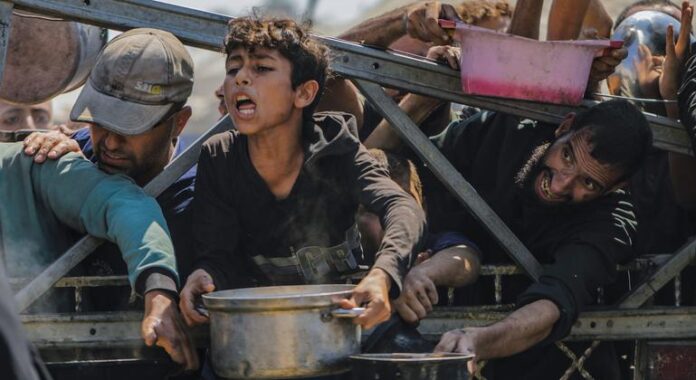
Finding food is a daily challenge for increasingly desperate Gazans who are “Just wait for food and hope to find something so as not to look at their children starving before their eyes“Said Ms. Cherevko.
She added: “I spoke with a woman a few days ago when she told me that she had gone with one of her friends who was nine months pregnant in the hope of finding food.
Of course, they did not succeed because they were too afraid of entering areas where there could be incidents like those who have been reported in the past few days. »»
Search for shelter
Back in Gaza City, Ms. Cherenko of Ocha said that the conditions in the shelters in Gaza are now “absolutely horrible” and more and more congested – “there are people who come constantly from the north,” added the veteran, while others are also going north, probably closer to the entry points for aid conveyors.
The quantity of help entering Gaza today remains extremely limited and well below the 600 trucks per day which reached the enclave before the start of the war in October 2023. In its last updateOcha reported that “famine and an increasing probability of famine” are still present in the enclave. It is estimated that 55,000 pregnant women are now confronted with miscarriage, mortincy and undernourished newborns following the food shortage.
The explosions smoke rises from the Shujaia district of Gaza City.
Famine regime
“With the very limited aid volume that has entered, Everyone continues to face famine and people are constantly risking their lives to try to find something“Continued Ms. Cherevko.
“” You eat or [you’re] left with the choice to die of hunger to death. “”
After more than 20 months of war, triggered by terrorist attacks led by Hamas in Israel, 82% of the Gaza territory is either a militarized Israeli area, or affected by evacuation orders.
Three months since hostilities re -granted on March 18, more than 680,000 people were newly moved. “Without a safe place, many people have sought refuge in all available spaces, including overcrowded travel sites, makeshift shelters, damaged buildings, streets and open areas,” said Ocha.
Originally published at Almouwatin.com

EU Ecolabel: small flower, big power
Since 1992, the EU Ecolabel has driven Europe towards a clean, competitive and circular economy and become a symbol that consumers trust. To get it, goods and services across 25 product groups must meet various environmental criteria like reuse potential and recyclability. Find out more. Source link
EU Ecolabel: small flower, big power
Since 1992, the EU Ecolabel has driven Europe towards a clean, competitive and circular economy and become a symbol that consumers trust. To get it, goods and services across 25 product groups must meet various environmental criteria like reuse potential and recyclability. Find out more.
Simplification: Council agrees position to ‘stop-the-clock’ on due diligence rules for batteries
Member states’ representatives (Coreper) approved today the Council’s position on one of the Commission’s proposals to simplify EU rules and thus boost EU competitiveness in the field of batteries. Source link
UN relief chief calls for solidarity, with humanitarians ‘literally under attack’
Tom Fletcher was speaking at the annual stock-take of his sector known as the ECOSOC Humanitarian Affairs Segment, which brings together UN Member States and organizations, humanitarian and development partners, as well as the private sector and affected communities.
He said this year’s theme – renew global solidarity for humanity – “could not be more urgent.”
“We need you right now,” he said. “We’re in a moment of conflict, of transactional politics, of selfishness, of division, of polarization. And global solidarity – the lifeblood of what we do – is in retreat.”
Moreover, “at this moment, when the needs are at their highest, the funding is also in retreat.”
Crises, climate and cutbacks
Mr. Fletcher reminded participants of “some uncomfortable truths,” noting that the Middle East currently “teeters on the edge of a wider war.”
At the same time, people in Gaza are starving as food aid rots at border crossings, girls in Afghanistan are banned from school, women in war-torn Sudan are experiencing horrific violence, and gangs are terrifying families in Haiti.
This is happening amid the climate crisis “which will drive more humanitarian needs in the coming years than any other factor that we discuss today,” he said.
“Meanwhile, our teams, our humanitarian staff, the bravest of us, are not hesitating to go towards the sound of gunfire, the sound of danger to drive those convoys through those checkpoints and they are being killed in record numbers, while those responsible for killing them roam free.”
‘Life and death decisions’
Just six months ago, Mr. Fletcher launched a $44 billion appeal to reach 190 million people worldwide this year.
In the wake of the deepest cuts ever to humanitarian operations globally, the plan was this week “hyper-prioritized” to focus on the most critical areas, with $29 billion in funding to support 114 million.
He acknowledged that “we’re left with the cruelest of equations when we make those life and death decisions, literally, about who to save.”
Humanitarians “will save as many lives as we can with the resources that you give us,” and they are asking world leaders to give only one per cent of what they spent on defense last year.
“This isn’t just a call for money, of course. It is a call for global responsibility, for a shared commitment to end the suffering,” he said.
New humanitarian pact
“We also make this call that all of us find a moment to come off our talking points and to find the individual moment of courage and creativity to support this effort.”
Mr. Fletcher said the humanitarian movement will continue and is being re-designed from the ground up.
“We’ll find new allies, we’ll find new sources of funding, we’ll find new ideas, we won’t just patch up the old model. We will also forge a new one. A bold humanitarian pact with the people we serve,” he said.
Women at the forefront
The pact will be “more local, more lean, more green,” and will include people on the frontlines of crisis who “know better than anyone what they need.”
Furthermore, the UN’s highest-level humanitarian coordination forum – the Inter-Agency Standing Committee (IASC) – has voiced unequivocal commitment that women and girls will lead this humanitarian reset and will back women humanitarian leaders in this work.
“These leaders, the real leaders of our movement, don’t work for the UN or international NGOs. They are not part of the logos, and egos, and silos of our systems,” he said.
“They have something much more powerful – they are rooted in their communities with the trust of their communities and an unshakeable belief that even in these darkest moments we can choose to help each other. They are there for us and we must be there for them.”
Boosting effectiveness
The Economic and Social Council (ECOSOC) is one of the six main UN organs.
Since 1998, it has held the Humanitarian Affairs Segment to strengthen the coordination and effectiveness of UN humanitarian efforts.
Previous meetings have focused on issues such as addressing food security and recovery from the COVID-19 pandemic.