The passage of time and a severe shortage of heavy equipment have made the search and recovery operations increasingly difficult and complex, those working on this mission told UN News.
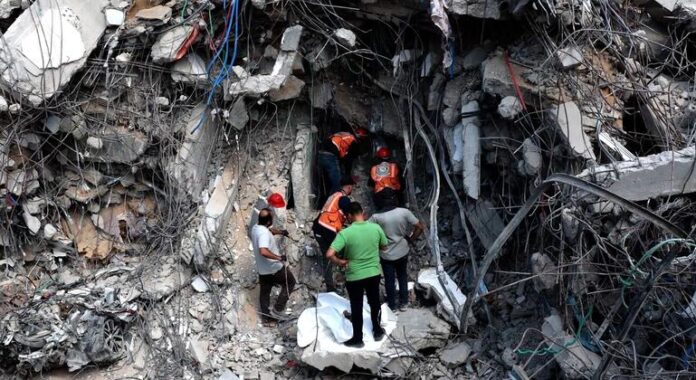
In one of Gaza City’s neighborhoods, a piece of heavy machinery continues to remove the rubble of a war-destroyed house.
Meanwhile, civil defence personnel and local teams continue digging and combing through debris for the remains of victims believed to still be buried under the rubble for more than two years.
“This building was believed to contain the remains of 44 victims,” said locally based team member Asaad Shreim. “So far, we have only been able to recover 13 of them while the residents and civil defence teams were able to recover the largest number during the first hours following the bombing.”
Waiting to find his family’s remains
Search and recovery operations are still being carried out with limited resources.
UN News Ramez Nabhan lost his wife, children and several family members during the Israel-Hamas war.
The UN confirms that the removal of millions of tonnes of rubble is hampered by Israeli restrictions on the entry of heavy equipment as well as the risks posed by unexploded ordnance scattered among the rubble, which slows down the process of reaching and recovering the remains of victims.
While he watches the excavation work, Ramez Nabhan is waiting to find the remains of his family members who were killed in a bombing that targeted the building where they were staying in the early days of the war.
“I was a father of three children, and I had a wife, and I lost them all at the beginning of the war,” Mr. Nabhan said. “Several missiles fell on this building, and the residents and civil defence teams were able to recover some bodies, including my son, my uncle and his wife.”
Long delayed burials
Mr. Nabhan says that the lack of heavy equipment and fuel during the first months of the war prevented the timely recovery of many victims.
“There was no equipment to extract bodies, no fuel or necessary resources were available, and the conditions were not safe for rescue teams to operate,” he said. “We waited a long time and today, we face a new ordeal: recovering the remains and then burying them.”
During the search operations, local teams were able to recover a number of his family members, and their remains were placed in designated bags in preparation for identification and completion of burial procedures.
UN News The remains of several members of Ramez Nabhan’s family, after local teams managed to recover them from beneath the rubble.
The wound reopens
For thousands of families in Gaza, the tragedy doesn’t end with the loss of loved ones, but extends to the long wait to recover and bury their remains. With each exhumation, the pain of loss is renewed, and the challenges of identifying the victims become ever more apparent.
“It is extremely difficult for the wound to reopen,” Mr. Nabhan said.
“We live between the pain of reliving the loss and the funeral rites. These are my children, and there are no words that can describe what I feel inside.”
Thousands remain missing
As time passes, identifying remains becomes increasingly complicated due to natural decomposition and the limited capabilities of forensic science and DNA testing, prolonging the suffering of families still waiting to learn the fate of their loved ones.
The war resulted in the deaths of more than 71,000 Palestinians and injuries to more than 171,000 others, according to the latest joint damage and needs assessment report issued by the UN and its partners in April 2026.
The UN indicates that thousands of people remain missing, and many are believed to still be buried under the rubble of destroyed buildings amid widespread destruction of infrastructure and residential areas throughout Gaza.
The warning comes in a new report, Beyond the Breaking Point, which finds that those providing essential services to women and girls are being forced to reduce or suspend programmes just as global humanitarian needs reach historic highs.
According to the latest figures, around 120 million women and girls worldwide now require humanitarian assistance and protection. Yet the local women’s organizations best placed to reach them are facing severe funding shortages, despite often operating in places where international agencies cannot.
Struggling to survive
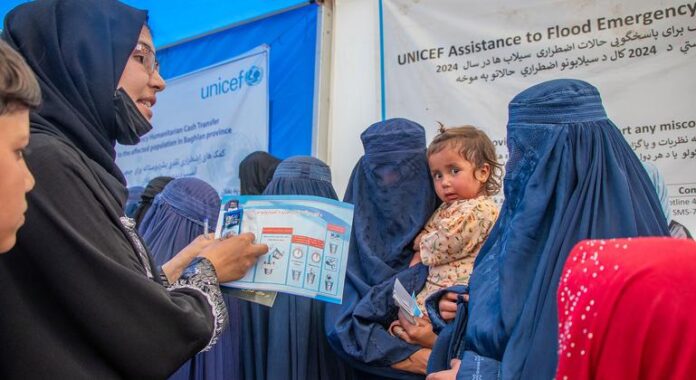
Playing a key role in some of the world’s most severe humanitarian emergencies, including Afghanistan, the Democratic Republic of the Congo and Haiti, they remain on the ground long after international attention has shifted elsewhere, supporting survivors of violence, displaced families and vulnerable communities.
“Every dollar withdrawn from women’s organizations is a dollar withdrawn from survivors of conflict-related sexual violence, displaced mothers, girls forced from school, and communities struggling to survive,” said Sofia Calltorp, UN Women Chief of Humanitarian Action.
UN Women warned that agencies and partners are being forced to cut programmes at precisely the moment they are needed most.
Key findings
The report, based on responses from 855 women-led organizations across 52 crisis- and conflict-affected countries, found that:
At least one million women and girls have lost access to critical support since January 2025 as a direct result of the steepest annual decline in aid on record.
Nearly nine in 10 organizations can no longer meet current levels of need, while 84 per cent report increased demand for their services.
Women and girls with the fewest alternatives are being affected first – 63per cent of organizations have reduced services in remote and hard-to-reach communities.
Gender-based violence is increasing. Eighty-six per cent of organizations report rising levels of gender-based violence, while 62 per cent say safe spaces have closed or been significantly reduced.
One in five organizations has already suspended work on women’s leadership and gender equality as funding cuts deepen a wider global backlash against women’s rights.
Working without pay
Many women leading humanitarian organizations are themselves living through conflict or displacement, yet continue working despite the lack of resources. Nearly two-thirds report staff working without pay to maintain essential services.
At the same time, almost half say staff burnout is increasing, while 88 per cent report worsening mental health among the women and girls they support.
Services evaporating
The impact of the funding crisis is already being felt across crisis-affected communities.
Half of the organizations surveyed have introduced waiting lists or are turning women and girls away because they can no longer meet demand.
Meanwhile, 92 per cent report growing poverty among the women they serve, and 82 per cent are seeing more girls leave school.
Behind the statistics are women arriving at shelters that have closed, pregnant women forced to travel for hours to access healthcare, and mothers unable to secure food for their children.
UN Women warns that the consequences extend beyond the immediate humanitarian crisis.
The loss of women’s organizations also weakens efforts to promote women’s leadership and participation in community decision-making. More than half of those surveyed report declining involvement of women in local leadership roles.
UN Women is calling for sustained investment in women’s organizations, describing them as indispensable first responders, defenders of women’s rights and essential partners in recovery and peacebuilding.
“Without immediate action, the organizations that have kept women and girls alive through the world’s worst crises risk becoming another casualty of war,” Ms. Calltorp concluded.
Payments remain tied to anti-corruption, transparency and judicial-independence milestones as Budapest faces an August deadline
The Council of the European Union has approved Hungary’s revised recovery and resilience plan, opening the way for up to €10 billion in EU funding while keeping actual payments conditional on reforms and investment targets. The decision gives Budapest a narrow financial window, but it also places rule-of-law delivery, public-procurement transparency and judicial independence at the centre of the next phase.
EU ministers on Friday approved a new recovery and resilience plan for Hungary, saying it should allow around €6.5 billion in grants and €3.5 billion in loans to be disbursed under the bloc’s post-pandemic recovery facility.
The approval is not an immediate transfer of money. Under the Recovery and Resilience Facility, payments are performance-based, meaning the European Commission releases funds only when agreed milestones and targets have been met. For Hungary, that condition is politically significant because earlier EU concerns over corruption, judicial independence and the protection of the Union’s financial interests had left major funding streams blocked or delayed.
A reset with conditions
The Council said delays in meeting the “super milestones” in Hungary’s previous plan had made that version no longer achievable, citing cost increases linked to energy-price volatility, geopolitical shifts, implementation challenges and time pressure. The revised plan is therefore both a rescue operation for projects that still need financing and a governance framework for a country trying to restore trust with Brussels.
According to the European Commission’s overview of Hungary’s recovery plan, the programme includes measures to strengthen anti-corruption bodies, improve the transparency and competitiveness of public procurement, expand access to public information and reinforce judicial independence. It also includes green, digital, education, health, transport and social-inclusion investments.
The timing is tight. Member states must fulfil the reforms and investments in their recovery plans by the end of August 2026 to fully benefit from the facility. That leaves Hungary little room for administrative delay, legal ambiguity or political theatre. It also gives the Commission and Council a clear responsibility to assess delivery carefully, not merely the passage of legislation.
Why the decision matters
For Hungarian citizens, the stakes are practical as well as institutional. Recovery funds are intended to finance public services, infrastructure, energy efficiency, digitalisation and social cohesion. If properly implemented, the money can support households, schools, healthcare and local development. If poorly supervised, it risks reviving the very concerns over opaque procurement and politicised state capacity that led to the funding dispute in the first place.
That is why the decision should not be read as Brussels simply turning the page. The new plan gives Hungary an opportunity to prove that reforms are measurable, durable and rights-respecting. But it also gives EU institutions a fresh accountability burden: they must show taxpayers across the bloc that financial solidarity is linked to credible safeguards.
The broader political context remains sensitive. Hungary’s institutional repair reaches beyond budget files, as The European Times has argued in coverage of Hungary’s wider rule-of-law reset. Restoring confidence requires more than unlocking money; it requires visible changes in the bodies that protect citizens from corruption, secrecy, weak remedies and state overreach.
The Council’s decision therefore creates a conditional opening rather than a clean conclusion. Hungary has gained a route back to recovery funding. Brussels has gained a renewed framework for leverage. The next question is whether the reforms attached to that money will be implemented in a way that citizens, courts, civil society and EU auditors can trust.
Deadly blaze in Los Gallardos raises questions over alerts, evacuation and Europe’s readiness for extreme summer fires
A fast-moving wildfire in Spain’s Almería province has killed at least 12 people and left others still unaccounted for, turning a local emergency into one of the country’s gravest recent climate-linked disasters. As firefighters work to contain the Los Gallardos blaze, the tragedy is sharpening scrutiny of public warnings, rural evacuation plans and Europe’s ability to protect people as heat, drought and wind make fires harder to predict.
The fire, which broke out near Los Gallardos in Andalusia, spread rapidly through dry scrubland and scattered rural settlements. Spanish public broadcaster RTVE reported that regional authorities had confirmed at least 12 deaths and 23 people not yet located, while officials urged caution over the provisional figures and said identification work was continuing.
Several people were also injured, including seriously burned patients transferred for specialist treatment. Search teams have been combing damaged homes and hard-to-reach areas where the fire has passed, while emergency crews continue to watch for reignition in terrain that officials have described as steep, dry and difficult for heavy machinery.
A Fire That Moved Too Quickly
Regional president Juanma Moreno said preliminary indications pointed to a broken electricity cable near a roadside as a possible starting point, though the cause remains under investigation. What turned a small fire into a deadly emergency, according to officials, was the combination of strong wind, dry vegetation and difficult access.
The blaze advanced with alarming speed, forcing local authorities to issue a mixture of evacuation and shelter-in-place instructions depending on the location. That distinction has become central to the public debate. In some dispersed homes and hamlets, residents were reportedly told to stay indoors; in others, they were told to leave. Authorities have said some victims may have died after trying to escape through unsafe routes.
The decision not to activate Spain’s ES-Alert mobile warning system has also drawn attention. Andalusian officials have defended the choice, arguing that a single mass message could have created confusion because different areas required different instructions and some zones had poor or damaged phone coverage. Critics are likely to press for a full accounting of whether alert procedures were adequate for a fast-moving fire in a fragmented rural landscape.
Preparedness Is Now A Rights Issue
The Almería fire is not only an environmental disaster. It is a public-safety and human-rights failure if vulnerable people cannot receive timely, understandable and practical instructions in a crisis. Rural residents, older people, foreign nationals, tourists, low-income households and people living in isolated homes may face higher risks when emergency communication depends on local knowledge, transport access or stable mobile coverage.
That matters because southern Europe is entering summers in which fire conditions are no longer exceptional. The European Times recently reported that Western Europe’s record heat is becoming a public-safety warning, with growing pressure on health systems, housing, infrastructure and civil protection agencies.
Public authorities will now face difficult questions. Were local warnings delivered quickly enough? Were evacuation routes clear and realistic? Did foreign residents and visitors understand official instructions? Were communities in scattered settlements adequately mapped and reachable? These are not abstract administrative questions; in a fire moving faster than people expect, they can decide who survives.
Europe’s Heat Warning
The wider climate context is stark. The EU’s Copernicus Climate Change Service said that June 2026 was the hottest June recorded for western Europe, with extreme heat contributing to health impacts, dryness and wildfire activity, particularly in the Iberian Peninsula and southern France.
Climate change does not remove the need to investigate the immediate cause of any individual fire. It does, however, alter the conditions in which sparks become disasters. Hotter air, drier soils, heavy vegetation growth followed by rapid drying, and stronger or shifting winds can make fires more explosive and less predictable.
For Spain, the challenge is especially acute. The country has long experience with wildfires, but the profile of risk is changing. Fires increasingly threaten not only forests but also peri-urban areas, tourist zones, isolated rural homes and infrastructure. Civil protection systems built around familiar seasonal patterns may struggle when extreme heat arrives earlier, lasts longer and overlaps with drought and wind.
The Test Is Protection
In the coming days, the immediate priority will remain humanitarian: identifying the dead, finding those still unaccounted for, supporting injured survivors and preventing further loss of life. Mourning must come before blame. But accountability should not be postponed indefinitely.
Europe’s climate debate often focuses on emissions targets, energy prices and industrial policy. The Los Gallardos fire shows another measure of climate governance: whether people receive protection when danger reaches their road, their home or their village.
That protection requires more than firefighters, however skilled and courageous. It requires clear alerts, multilingual communication, mapped evacuation routes, accessible shelters, resilient phone networks, land management, support for small municipalities and serious planning for people who cannot simply drive away at short notice.
The disaster in Almería is therefore both local and European. It is a tragedy for the families who have lost loved ones. It is also a warning to governments across the continent that preparedness is no longer a seasonal checklist. In a hotter Europe, it is a duty of care.
“Cholera is back and it’s affecting several states, mainly in the western part of the country, the Darfurs and the Kordofans,” said Dr Shible Sahbani, UN World Health Organization (WHO) Representative to Sudan.
Briefing journalists in Geneva, the official reported more than 1,330 confirmed cases and 114 deaths from the disease, which is preventable but can be deadly if not treated quickly.
Why this matters
114 confirmed deaths from highly infectious cholera so far
Conflict still blocking lifesaving healthcare and aid
Rainy season likely to make outbreak much worse
Millions still displaced and highly vulnerable
The true number of fatalities is likely much higher and aid agencies are deeply concerned that the disease could spread among the hundreds of thousands of people who’ve fled towns and rural areas in North Kordofan.
The Sudanese state located in the centre of the country is the epicentre of fighting between former allies the Sudanese Armed Forces (SAF) and the paramilitary Rapid Support Forces (RSF).
Vulnerable to disease
The cholera case fatality rate is already “extremely high” at 13.7 per cent and it is expected to worsen when the upcoming rainy season sets in, Dr Sahbani explained.
Sudan is the world’s largest humanitarian crisis with more than 33 million people in need; this includes 21 million who require health services. Since war erupted on 15 April 2023, at least 59,000 people have been killed.
Although some people have returned to states “where the situation is improving” including the capital, Khartoum, Dr Sahbani stressed that 13.4 million remain displaced; nine million within Sudan and 4.6 million in neighbouring countries. In addition to cholera, existing disease outbreaks include dengue, malaria, meningitis, hepatitis E and measles.
“We are particularly concerned about the spread [of cholera] to El-Obeid in North Kordofan, where the access is very limited and where the fragile health system is under increasing strain,” the WHO representative said. “Health facilities are overwhelmed there and access to care is very, very limited.”
Aid boost call
The agency has prepositioned enough health supplies for more than 25,000 people in El-Obeid “but I can admit that it’s not enough”, Dr Sahbani said. On Monday, WHO delivered 8.5 tonnes of medical supplies to Kadugli and Dilling in South Kordofan as part of an inter-agency convoy.
This was the first WHO shipment to reach Kadugli since December 2024 because of access blockages.
Dr Sahbani echoed recent appeals from UN human rights chief Volker Türk to the international community to prevent further atrocities in El-Obeid and a repeat of mass killings in El Fasher when RSF forces entered the city last October.
“We call for our partners and donors to help us to be able first to access and second to be able to send enough supplies and enough facilities in El-Obeid. But we know that the situation there is very, very bad and it’s worsening with higher risk of disease outbreaks, malnutrition, violence, including violence against women and children.”
Researchers at ETH Zurich have developed pixels that can not only create images, but also analyse them. In the future, this could lead to the development of devices that function as camera and display at the same time.
The coloured logo was created using the new ETH researchers‘ Fourier pixels. The letter “E” is roughly 1 millimetre tall on the camera. Image credit: Glauser YM, Vonk SJW, et al., Nature 2026
In 1927, the term „picture element“, later abbreviated to „pixel“, first appeared in the American technology magazine Wireless World. Today, pixels are everywhere: in computer screens and television sets, where they create colourful images; but also in cameras, where they capture images. In any case, however, they do one or the other—either they control light, as in the case of a display, or they analyse it in a camera sensor. Until now, there have been no pixels that could do both.
A research team led by David Norris, Professor at the Optical Materials Engineering Laboratory at ETH Zurich, has now developed such pixels for the first time. These pixels can both steer light and analyse it. Not only the intensity of the light, but also its oscillation phase and polarisation can be controlled and analysed. In the future, such so-called bidirectional pixels could lead, for instance, to the development of camera–displays that combine the two functions in a single device.
Patterns and images from overlapping light waves
The new results, which have recently been published in the scientific journal external pageNature, are based on a fundamental physical effect: the so-called interference of light waves. When light is scattered by a surface, the waves originating from different points on the surface overlap. The shape of the surface determines the oscillation phases with which the waves propagate further. If the phases are equal, the light waves reinforce each other, but if they are opposed, the waves cancel out.
Norris and his collaborators use this effect to precisely control light with wave-shaped sculpted surfaces. They developed this processing method, which is precise to within a few nanometres, already a few years ago. For steering, the pixel—that is, the area on the chip where the material has been processed—first transforms the incoming light into a surface wave (a so-called surface plasmon polariton) propagating along the surface of the chip.
At a different position within the pixel, the surface wave is scattered back out of the material as a light wave. Through interference of the light waves, patterns and images can be created. Using mathematical Fourier analysis, the researchers can calculate what these images will look like and what kind of surface pattern is needed for a specific image.
Fourier pixel use surface waves, which are scattered out as light waves. These light waves interfere with each other and thus create patterns and images. Conversely, the same pixel can be used to analyse the intensity, phase and polarisation of incoming light waves. Image credit: Glauser YM, Vonk SJW, et al., Nature 2026
Controlling phase and polarisation
“In addition to light intensity, meaning the bright and dark areas from which images are created, our Fourier pixels can also control other properties of the light waves, for example their polarisation”, says doctoral student Yannik Glauser. Polarisation indicates the direction in which the electric field of the light wave oscillates. To generate light with an arbitrary polarisation direction, they use surface waves with different polarisations, which overlap on the Fourier pixel. The polarisation of the scattered light then depends on the surface shape of the pixel.
They can also precisely control the oscillation phase and thus, for instance, create light beams that have a hole in the middle—doughnut-shaped light beams, as it were. All of this even works with light of different wavelengths, so that coloured images can also be generated.
“We can also, however, apply the principle of interference and Fourier analysis in the opposite direction to analyse light using the Fourier pixel”, says postdoctoral researcher Sander Vonk. For instance, the researchers can make the oscillation phase of the light visible by superimposing the light wave and a reference wave on the pixel. They capture the interference pattern of the scattered light from both waves with a camera. From this pattern, they can then calculate the phase of the light. In a similar way they can also analyse its polarisation state.
Several functions combined in a single pixel
“Thanks to the fact that the relevant surface profiles of the pixels can be determined using Fourier analysis, we can combine the control and analysis of amplitude, phase and polarisation on a single pixel”, says Vonk. Furthermore, Fourier analysis is mathematically simple and does not require complex models.
Light is used in many technologies ranging from television to mobile phone cameras to fibre-optic cables for the internet. “Our new pixels for control and analysis could, therefore, become a useful tool in many areas”, says Norris.
As the surface waves can be used to perform mathematical calculations directly on the pixel material, it is even conceivable that Norris’s pixels could react to a captured image and, without going through a computer, produce corresponding light patterns. According to Norris, a more short-term goal is the extension of the method to a matrix made of many Fourier pixels. Such a matrix could then be used to realise more complex cameradisplay devices that, just like conventional cameras or displays, operate with a multitude of pixels.
The UN World Food Programme (WFP) and the Government of South Sudan on Friday activated the country’s first-ever drought anticipatory plan targeting more than 65,000 people in Budi and Kapoeta North counties.
Anticipatory action is when humanitarian assistance is triggered before a crisis hits to protect lives, food security and incomes, WFP explained.
A transformative shift
The agency is now delivering cash transfers and early warning communications to families so that they can prepare for drought conditions, strengthen resilience and reduce the risk of worsening hunger.
“Anticipatory action is transforming the way we manage climate-related shocks,” said Mutinta Chimuka, WFP Country Director in South Sudan.
“Rather than wait for drought to deepen humanitarian needs, we are acting based on forecasts and evidence to support communities before livelihoods are disrupted.”
Helping families now
Under the plan, 52,751 people are receiving cash assistance to help meet their essential food and livelihood needs before conditions deteriorate. This support also aims to strengthen purchasing power and reduce the need for families to adopt negative coping mechanisms.
More than 65,000 people are also benefitting from early warning communication and awareness campaigns that provide essential information on drought preparedness and mitigation, livestock management, water use, and livelihood planning.
Agro-pastoral communities in Eastern Equatoria depend heavily on seasonal rainfall for their crops and livestock, WFP said. Prolonged dry spells can quickly lead to crop and livestock losses, reduced incomes and worsening food insecurity.
Forecasts, warning and financing
The anticipatory plan combines scientific forecasts, early warning information and pre-arranged financing, thus allowing WFP and partners to help vulnerable communities to withstand climate shocks, protect development gains and build resilience for the future.
It was made possible through $1.08 million from the Korea International Cooperation Agency (KOICA) and $1.37 million from Germany.
Previous investments from Ireland and KOICA helped establish South Sudan’s anticipatory action system, including the development of the drought anticipatory action plan and enhanced operational readiness for its activation.
At the same time, low and middle-income countries are projected to lose 30 per cent of aid to education between 2023 and 2027. Development assistance to education has decreased for several years after the US heavily scaled back foreign aid and other countries prioritized debt payments and military spending.
Because foreign aid for education is decreasing, UNESCO highlighted debt-for-education swaps as a potential alternative for developing countries.
A debt-for-education swap is a form of debt relief where a lender forgives a portion of a country’s debt. In exchange, the borrowing country must spend that amount of money on domestic education projects, allowing countries to protect education spending during periods of fiscal constraint.
“Education is the most powerful investment countries can make,” UNESCO Director-General Khaled El-Enany said.
Education aid plummets
Aid to education fell by eight per cent between 2023 and 2025, and aid to basic education fell by 15 per cent over the same period. The US cut total foreign aid by 57 per cent, the EU by 14 per cent and Japan by six per cent in 2025, according to UNESCO’s Counting the Loss report, released on Friday.
Much of the decrease can be attributed to the dismantling of the US’s main aid agency, USAID, ongoing consequences from the COVID-19 pandemic, energy price shocks and the prioritization of investments in clean energy, UNESCO said.
The countries most affected by the decrease in aid include Nicaragua, Vietnam, Afghanistan, Mauritania and Honduras, according to the report.
Although debt-for-education swaps may not be suitable in all contexts, UNESCO said they have been successful in Peru, Egypt and Côte d’Ivoire.
In addition to this financing method, UNESCO recommended lowering the costs of borrowing, building resilience in education systems and increasing domestic education spending whenever possible.
Sri Lanka prison violence must be investigated
The UN human rights office (OHCHR) on Friday urged a prompt, independent and transparent investigation into the recent outbreak of deadly violence at a jail in Negombo, Sri Lanka, which killed at least 23 people and critically injured at least 15.
“The families of the dozens killed and injured – both inmates and prison officers – deserve to know the truth and see accountability,” OHCHR spokesperson Ravina Shamdasani said in a statement.
The riots took place over two days beginning Sunday at Negombo city jail, around 22 miles north of the capital city, Colombo. According to reports, poor detention conditions such as overcrowding may have played a role in prompting the violence.
Calls to monitor conditions
OHCHR noted that the deadly incident highlights the need for Sri Lanka to address issues including prolonged pre-trial detention, overcrowding and other inadequate conditions in prisons.
Many people in Sri Lanka are detained for drug-related offences who would instead benefit from health-centred responses as opposed to incarceration, Ms. Shamdasani said.
OHCHR is encouraging Sri Lankan authorities to allow the independent Human Rights Commission of Sri Lanka to access Negombo and other detention facilities to monitor conditions, especially amid accusations of torture and ill treatment.
UN airlifts supplies to Venezuela
The UN migration agency (IOM) has airlifted relief supplies including jerry cans, solar lamps and indoor privacy partitions to Venezuela to support communities affected by the 24 June earthquake.
“For families dealing with the aftermath of an earthquake, whether and when they receive initial assistance can make a big difference for how they are able to recover,” said Kim Eling, IOM Senior Director for Strategy and External Engagement.
The devastating earthquake has killed 3,889, injured at least 16,740 and displaced 17,907, according to local authorities.
Collaboration with partners
The IOM worked with DHL’s Disaster Response Team, the UN’s Humanitarian Response Depot in Panama and the Venezuelan Government to coordinate the emergency relief shipment, which arrived in the capital Caracas on Tuesday.
“This operation highlights IOM’s continued commitment to preparedness, rapid emergency response, and effective humanitarian supply chain coordination, using strategic partnerships and global prepositioning capacities to deliver life-saving assistance to crisis-affected populations,” the IOM wrote in a press release.
The supplies, which will support emergency shelter operations, build on the UN’s efforts to mobilize relief to Venezuelans affected by the earthquake.
For most of the internet’s history, looking someone up meant reading a list. You typed a name, you got ten blue links, and you decided for yourself which ones mattered. The search engine ranked the sources. The reader did the synthesis.
That arrangement is quietly ending. Google now places an AI-generated summary above the results for many queries. Millions of people ask AI assistants direct questions instead of searching at all. In both cases the machine does the synthesis and hands over a conclusion. The links, when they appear, are footnotes to an answer that has already been written.
This is a genuine improvement for a great many questions. It is a strange and underexamined problem when the subject of the question is a person.
How these systems actually build an answer
The failure modes follow directly from the mechanism, so it is worth being precise about it.
Modern AI search generally works by retrieval augmented generation. When a user asks about a person, the system does not consult a curated dossier. It searches an index, pulls back a set of documents it judges relevant, and passes those documents to a language model with an instruction along the lines of: using these sources, answer the question. The model then writes fluent prose summarizing what the retrieved documents say.
Notice what the architecture assumes. It assumes the retrieved documents are accurate. It assumes they are current. It assumes a document’s prominence in the index correlates with its truthfulness. And it assumes that summarizing a set of sources produces something meaningfully like the truth about their subject.
For a question about the boiling point of water, these are safe assumptions. For a question about a human being, every one of them can fail at once.
The compounding problem
Consider what the open web actually contains about a typical professional.
It contains what they published themselves, usually accurate and usually old. It contains what institutions published about them, such as a university bio from a job they left in 2019. It contains whatever the local press wrote, which may be a single story from the worst week of their life. It contains aggregator sites that scraped court dockets or arrest records, republished them for traffic, and never checked whether the case was later dismissed. And it contains dozens of near-identical copies of all of the above, because syndication and scraping are cheap.
Now ask a retrieval system to summarize this person.
The system has no reliable way to know that the 2019 bio is stale, that the news story described charges that were dropped, or that eleven of the fourteen sources it retrieved are copies of one original. It sees a corpus, and it produces a fluent summary of that corpus.
Kevin Curran, founder of NewReputation, a firm that handles content removal and reputation repair, argues that this is where the deepest misunderstanding lies. “Repetition looks like corroboration,” he says. “When one arrest record gets scraped and republished across forty sites, a retrieval system encountering those copies is not seeing forty independent confirmations. It is seeing one document forty times. But the shape of that evidence is exactly the shape both ranking algorithms and language models have learned to treat as reliable.”
The internet’s copy-paste economy, on this account, manufactures the appearance of consensus. AI summarization then reports that manufactured consensus in a calm, authoritative voice with no visible seams.
Fluency is not accuracy, and readers cannot tell the difference
A ranked list of links wore its uncertainty on its face. Ten results, in some order, of varying quality, obviously assembled by a machine. The reader knew they were being handed raw material.
A paragraph of clean prose reads as a conclusion. It has no hedging, no visible sourcing hierarchy, no signal that source three contradicted source seven and the model quietly picked one. Research on human interaction with automated systems has long documented automation bias, the tendency to over-trust a confident machine output and under-verify it. Replacing a list with synthesized text is, among other things, an interface change that suppresses the reader’s instinct to check.
The stakes are asymmetric in a way that is easy to miss. If an AI summary of a restaurant is slightly wrong, someone has a mediocre dinner. If an AI summary of a job candidate leads with a dismissed charge from 2014, because that is what the retrievable corpus emphasized, the candidate never learns why the call did not come.
The subject is the one party with no seat at the table
Every other participant has some form of recourse. The publisher can correct an article. The platform can adjust its ranking. The model developer can tune the system.
The person being described has, in most cases, nothing. They typically do not know an AI system is summarizing them. They cannot see what it says without asking it themselves, and the answer may vary between users, sessions, and models. There is no appeals process, no correction mechanism, and often no way to identify which retrieved source produced the sentence that is costing them work.
“The people we work with almost never find out from the system,” Curran says. “They find out from a friend, or from a job that goes quiet. By then the summary has been repeating itself for months.”
This is a structural gap rather than anyone’s malice. The systems were built to answer questions about the world, and a person is a subject in the world. But people are the one category of subject that can be harmed by an inaccurate summary and that has a legitimate interest in accuracy about themselves.
What can actually be done
Approached as a systems problem, the leverage points are not where most people look.
No one can edit the model, and Curran is blunt about the vendors who imply otherwise. “Be deeply skeptical of anyone who tells you they can control what an AI system says about you. Model behavior is not a dial anyone exposes, and outputs vary in ways no third party can guarantee. What is tractable is the corpus.”
Retrieval systems can only summarize what they retrieve. If the accessible, well-structured, authoritative material about a person is thin, outdated, or dominated by a single bad episode, the summary will reflect that. If the accessible material is substantial, current, and accurate, the summary has better raw material to work with.
That reframes the work as something closer to data quality than public relations, and the interventions that matter are unglamorous. Getting genuinely false or unlawfully published material removed at the source, so it stops being retrievable at all. Attacking duplication, because forty copies of a scraped record are the thing manufacturing false consensus, and removing the original does nothing if the copies persist. Publishing accurate, current, well-structured information a retrieval system can find and parse. Monitoring what the systems say over time, since the corpus is not static.
There is a cynical reading of this, in which the answer to machine summarization is simply to feed the machine better propaganda. Curran rejects the framing. “When a system summarizes a person by retrieving documents about them, the accuracy of the summary is bounded by the accuracy of the retrievable record. Improving that record is not gaming anything. It is the only honest way to be described accurately by it.”
The design question nobody has answered
The engineering community has spent considerable effort on hallucination, the failure mode where a model invents facts that appear in no source. That work matters.
The failure mode described here is different, and in some ways harder. The model invents nothing. Every sentence is faithfully grounded in a retrieved document. The summary is a correct summary of an incorrect corpus, and no amount of grounding, citation, or retrieval fidelity fixes it. You cannot cite your way out of the problem that the sources were wrong.
Which leaves an open question for anyone building these systems. When the subject of a query is a living person, should the system treat the retrievable web as a reliable description of them? It plainly is not one. It is a partial, stale, duplicated, and adversarially seeded record that was never assembled with accuracy about individuals as a design goal.
The answer will probably not be a better retriever. It may be that queries about people warrant different treatment altogether, with more visible uncertainty, more explicit recency signals, or a lower threshold for declining to summarize at all. Those are product decisions rather than model decisions, and they are being made right now by a small number of teams.
Finance ministers urge targeted support as inflation, debt and investment pressures converge
Euro-area governments are being warned against another broad spending response to rising energy costs, as finance ministers try to protect vulnerable households and businesses without weakening public finances. The message, issued after Thursday’s Eurogroup meeting and ahead of Friday’s EU finance ministers’ talks in Brussels, reflects a harder economic trade-off for Europe: slower growth, renewed inflation, higher defence and energy-security costs, and the end of a major EU recovery fund.
The Eurogroup said the euro-area economy remains resilient, but that the outlook has deteriorated since the latest energy shock began feeding into prices, production costs and household confidence. In its statement on the euro-area fiscal stance, the group backed a neutral to mildly expansionary budget position for 2026, while warning that a more expansive stance would not be appropriate.
That wording matters because it narrows the space for governments to repeat the broad emergency subsidies seen during the 2021-22 energy crisis. Ministers said any measures to soften the impact of higher prices should be temporary, targeted at vulnerable households and affected businesses, and consistent with the EU’s fiscal rules.
A tighter line between support and discipline
The policy challenge is now less about whether governments should intervene than about who receives help, for how long, and at what fiscal cost. The Eurogroup noted that measures taken so far have remained limited in aggregate, at less than 0.1% of GDP. But the political pressure could grow if energy bills, food prices or transport costs remain elevated through the rest of the year.
The European Commission’s Spring 2026 Economic Forecast projected euro-area growth of 0.9% in 2026 and 1.2% in 2027. Inflation in the currency bloc is expected to reach 3.0% this year before easing to 2.3% next year, still above the European Central Bank’s target.
Public finances are also moving in the wrong direction. The Commission forecast the euro-area deficit at 3.3% of GDP in 2026 and 3.5% in 2027, with public debt rising above 90% of GDP. That leaves member states trying to fund investment, social protection and security priorities while also showing markets and EU partners that they can keep debt under control.
The Eurogroup’s answer is to protect investment rather than expand day-to-day spending. Ministers pointed to growth-enhancing public investment, energy-system resilience and decarbonisation as ways to reduce Europe’s exposure to future price shocks. That places the green transition not only in the climate file, but also at the centre of economic security.
The recovery fund deadline adds pressure
The timing is awkward. The EU’s Recovery and Resilience Facility, which has helped support public investment since the pandemic, is nearing its final phase. Its spending effect is still helping the euro-area fiscal stance in 2026, but the Eurogroup expects the fund’s end to have a contractionary effect in 2027.
That makes the next stage of EU economic policy more politically sensitive. Without recovery-fund support, governments will have to decide whether to finance more investment nationally, reprioritise existing budgets, or lean more heavily on private capital. The debate connects directly with Brussels’ wider effort to turn household savings into productive European investment, an issue already central to the EU’s savings and investments union agenda.
For citizens, the discussion can sound technical, but its consequences are immediate. If support is too narrow, low-income households, renters, pensioners and small firms may face the heaviest burden of higher prices. If support is too broad, governments may weaken their ability to fund health, housing, education and climate adaptation later. The Eurogroup’s position is an attempt to hold that line, though national politics will decide how it is applied.
Energy resilience becomes fiscal policy
Ministers also signalled support for further work with the Commission on extending fiscal flexibility to measures that strengthen the structural resilience of Europe’s energy system and accelerate the move away from fossil fuels. That proposal could become one of the more consequential parts of the debate, because it would treat energy independence as a budgetary priority rather than a separate environmental objective.
The risk is that flexibility becomes too broad and loses credibility. The opportunity is that it gives governments a clearer route to finance grids, storage, efficiency, renewables and other infrastructure that can lower future exposure to volatile fossil-fuel markets. The social test will be whether such investment reduces costs fairly, rather than shifting transition burdens onto poorer households.
Euro-area ministers will review budgetary policies again in December, after the Commission assesses national draft budgets for 2027. By then, governments should have a clearer view of whether the energy shock is easing or becoming a longer economic drag. For now, the message from Brussels is restrained but pointed: Europe can protect people from price pressure, but it cannot afford to confuse emergency relief with permanent spending.