Sunday, September 20, 2026
Home Blog Page 39

EU Sends Hybrid-Threat Mission to Armenia

0
EU Sends Hybrid-Threat Mission to Armenia

A civilian advisory team will support Yerevan on cyber threats, disinformation and illicit finance as Brussels deepens its role in the South Caucasus The E…

A civilian advisory team will support Yerevan on cyber threats, disinformation and illicit finance as Brussels deepens its role in the South Caucasus

The European Union has launched a new civilian Partnership Mission in Armenia, turning concern about cyber attacks, foreign information manipulation and illicit financial flows into a two-year advisory presence on the ground. The move strengthens Brussels’ security relationship with Yerevan at a sensitive moment for Armenia’s sovereignty, democratic institutions and place in Europe’s eastern neighbourhood.

The Council of the EU said on Monday that it had launched the EU Partnership Mission in Armenia under the Common Security and Defence Policy. The mission, known as EUPM Armenia, was formally established on 21 April 2026 at the request of the Armenian government.

Its mandate is civilian and advisory. It will not take decisions for Armenian authorities, but will provide strategic advice, technical expertise and institutional capacity-building to national bodies dealing with hybrid threats. The Council said the work will include cyber threats, foreign information manipulation and interference, and illicit financial flows.

A Security Mission With Democratic Stakes

The language of hybrid threats can sound technical, but its consequences are often felt in ordinary civic life. Disinformation campaigns can distort elections and public debate. Cyber attacks can weaken public services, media, courts and civil society organisations. Illicit financial flows can corrode institutions and make democratic accountability harder to enforce.

That is why the mission matters beyond the security community. For Armenia, resilience is not only a matter of state capacity, but of whether citizens can make political choices without external coercion, manipulation or intimidation. For the EU, the mission is another sign that democratic security in its eastern neighbourhood is being treated as a long-term public-interest issue rather than a short-term diplomatic file.

The appointment of Cosmin George Dinescu as head of mission also points to continuity in Brussels’ approach. Dinescu previously led the EU Partnership Mission in Moldova, another country where European institutions have framed resilience against interference as part of democratic reform and national sovereignty.

Armenia’s European Turn Becomes More Concrete

The launch follows a period of steadily closer EU-Armenia engagement. Earlier European Times coverage of Armenia’s Brussels-facing diplomacy highlighted how Yerevan has sought to turn European attention into practical partnerships on governance, connectivity and resilience.

The new mission is separate from the EU Mission in Armenia, established in 2023, which observes and reports on the security situation in border areas and contributes to confidence-building and human security. EUPM Armenia instead focuses on institutional resilience, including the less visible channels through which pressure can be applied to a state: digital systems, information spaces and financial networks.

The Council’s broader Armenia policy overview places the mission alongside humanitarian support, economic cooperation and the EU’s resilience and growth plan. It also notes that more than 121,000 Karabakh Armenians fled to Armenia after Azerbaijan’s 2023 military operation in Nagorno-Karabakh, a displacement crisis that continues to shape the country’s social and political pressures.

A Careful Balance for Brussels

For the EU, the challenge will be to support Armenia without treating the country merely as a chessboard in a wider confrontation. The mission’s credibility will depend on whether it strengthens Armenian institutions in ways that are transparent, rights-respecting and useful to the public, not only reassuring to European capitals.

That means practical outcomes will matter: better institutional coordination, stronger cyber preparedness, clearer responses to information manipulation, and safeguards that protect civil society and independent media rather than narrowing civic space in the name of security.

The mission also arrives as the South Caucasus remains politically delicate. The EU has welcomed progress toward an Armenia-Azerbaijan peace settlement, while continuing to support humanitarian relief and confidence-building. In that context, helping Armenia resist hybrid pressure is not a substitute for diplomacy, but it may help create conditions in which diplomacy is less vulnerable to coercion.

For Yerevan, EUPM Armenia offers expertise and European backing. For Brussels, it is a test of whether the EU can translate its language of resilience, sovereignty and democratic choice into careful, civilian support on the ground. The mission’s success will be measured less by its launch than by whether Armenian institutions and citizens are better protected when the next wave of pressure comes.

Source link

EU Locks In Stronger Flight Rights

0
EU Locks In Stronger Flight Rights

Final Council approval gives travellers clearer claims, rerouting and assistance rules after years of delay The European Union has formally approved revise…

Final Council approval gives travellers clearer claims, rerouting and assistance rules after years of delay

The European Union has formally approved revised air passenger rights rules that preserve compensation for long delays while adding clearer duties for airlines on claims, information, family seating, hand baggage and support for passengers with reduced mobility. The reform now turns a long institutional dispute into a practical question: whether passengers will actually find it easier to enforce their rights when travel breaks down.

The Council of the EU gave its final green light on Monday to a new framework designed to simplify and strengthen rules covering flight delays, cancellations, denied boarding and rerouting. The law will enter into force 12 months and 20 days after its publication in the Official Journal.

For travellers, the most visible point is continuity: compensation remains tied to delays of more than three hours, with payment levels broadly kept at €250, €400 and €600 depending on flight distance and route. That matters because earlier stages of the debate had raised fears that governments could raise delay thresholds or reduce the practical value of compensation.

What changes for passengers

The new rules are intended to make passenger rights less dependent on persistence, legal knowledge or luck at an airport desk. Airlines will have to acknowledge claims immediately and respond within 30 days, either by paying compensation or giving a clear reason for refusal. Where compensation may be due, passengers must receive electronic information after arrival explaining their rights and how to submit a claim.

The reform also strengthens the right to assistance during disruption. Passengers should receive clearer access to refreshments, meals, communications, accommodation when overnight stays are necessary, and transport between the airport and hotel. If airlines fail to provide required assistance, travellers may arrange it themselves and seek reimbursement.

Rerouting is another central change. When a flight is cancelled or boarding is denied without reasonable grounds, airlines must offer an alternative route within three hours. If they do not, passengers may organise their own rerouting and claim reimbursement, subject to limits in the new regulation.

As The European Times reported ahead of the parliamentary vote, the package also adds protections that go beyond compensation. Airlines will no longer be able to deny boarding on a return flight simply because a passenger did not use the outbound leg. Displayed fares must include an allowance for one piece of hand baggage before booking begins, making price comparisons less opaque.

Accessibility and family travel

The law gives particular attention to passengers who often face the greatest harm during disruption: people with disabilities or reduced mobility, children, unaccompanied minors and pregnant passengers. Families and passengers with reduced mobility, together with accompanying persons, should be able to sit together without extra charges.

Passengers with reduced mobility will also gain stronger rights around assistance, rerouting and mobility equipment. If equipment is lost or damaged, replacement or compensation rules should become clearer, addressing one of the most serious risks disabled travellers face when flying.

These provisions are more than consumer conveniences. Missed assistance, inaccessible rerouting or damaged mobility equipment can prevent people from working, studying, receiving medical care or participating in family life. In that sense, the reform sits at the intersection of transport policy, consumer protection and equal access to public life.

Enforcement remains the harder question

The final text has not satisfied everyone. Consumer groups and airline representatives have both described the compromise as imperfect, though for different reasons. Passenger advocates wanted simpler claim forms and stronger practical enforcement. Regional airlines have warned that flat compensation rules can weigh heavily on smaller carriers operating thinner routes.

That tension has defined the file for years. Europe’s air passenger regime is often described as one of the strongest in the world, but many travellers still struggle to turn rights on paper into refunds, rerouting or compensation in practice. Automated refusals, vague references to extraordinary circumstances and slow complaint systems can wear down even valid claims.

The new regulation tries to close that gap by clarifying duties, timelines and explanations. But much will depend on national enforcement bodies, airline compliance systems and the willingness of regulators to act when rules are ignored. A right that requires months of escalation may still be out of reach for many families, workers and disabled travellers.

For the EU, the final approval is a politically useful result at the start of the summer travel season. For passengers, the real measure will come later: in delayed terminals, cancelled connections and the first disputes under the updated rules. The promise is a simpler route from disruption to remedy. The test will be whether airlines and authorities make that promise ordinary.

Source link

Brussels Weighs Child Safety Online

0
Brussels Weighs Child Safety Online

Expert recommendations put privacy, platform design and young people’s wellbeing at the centre of Europe’s next digital debate The European Commission’s ch…

Expert recommendations put privacy, platform design and young people’s wellbeing at the centre of Europe’s next digital debate

The European Commission’s child-safety-online panel is handing its recommendations to Ursula von der Leyen today, moving a sensitive European debate from broad concern about young people’s screen use toward concrete policy choices on social media, age assurance and platform accountability.

The report, due on 13 July, follows months of work by a Commission-appointed group of young people and specialists in health, neuroscience, psychology, computer science, child rights and digital literacy. According to the Commission’s special panel on child safety online, the recommendations will now be considered before Brussels decides its next steps.

The issue has become one of the most politically charged questions in European digital policy: how to protect children from harmful design, harassment, addictive use and age-inappropriate content without building a system of intrusive identity checks or excluding young people from legitimate online participation.

A rights question, not only a technology question

The panel’s work comes after a Eurobarometer survey cited by the Commission found that young people across Europe spend an average of 4.5 hours online on school days and 6.1 hours at weekends. The same survey found that 14% of adolescents reported more than 10 hours a day on screens.

Those figures do not, by themselves, prove harm in every case. Online spaces can support learning, friendship, creativity and civic participation. But the Commission has linked excessive screen time and social media use to concerns about mental and physical wellbeing, including stress, exclusion, exposure to hate speech, body pressure and unexpected violence.

That makes the coming policy response difficult. A blunt age ban may be simple to explain but hard to enforce fairly. A more tailored model may better protect rights but could be slower, more technical and less politically satisfying. Either path will have to confront the same core problem: children are using systems designed by private companies whose commercial incentives often reward attention, recurrence and personalisation.

DSA enforcement shapes the background

The recommendations arrive just days after the Commission preliminarily found Meta in breach of the Digital Services Act over the addictive design of Instagram and Facebook. The European Times has reported that the case marked a shift from content moderation toward the regulation of platform architecture, including infinite scroll, autoplay, notifications and recommender systems.

That enforcement context matters. The Digital Services Act already requires very large online platforms to assess and reduce systemic risks, including risks to minors, public health and physical and mental wellbeing. It also bans targeted advertising to children and prohibits deceptive design practices.

The panel’s recommendations are therefore unlikely to land in a legal vacuum. They will interact with ongoing DSA enforcement, age-verification work, national debates in countries such as France and Spain, and civil-society warnings that child protection must not become a pretext for mass surveillance.

The hard part begins now

For families, educators and children’s rights advocates, the question is practical as much as legal. Parents are often expected to police services they did not design, algorithms they cannot inspect and commercial systems they cannot negotiate with. Schools face similar pressure as digital tools become part of ordinary learning while social media spills into classrooms, peer groups and mental health services.

Platforms, meanwhile, are likely to argue that they have already introduced teen settings, parental controls, time-management tools and content filters. Regulators will have to judge whether those measures are meaningful when the underlying product design continues to encourage prolonged engagement.

The Commission also faces a credibility test. If it moves too cautiously, it risks looking outpaced by national governments and public concern. If it moves too aggressively, it may trigger legal challenges over privacy, access to information and proportionality. A durable European approach will need to protect children as rights-holders, not only as users to be restricted.

The most important outcome may be whether Brussels can shift responsibility away from children and parents alone and back toward the companies shaping the online environment. The recent Meta DSA case shows that Europe is already asking whether digital harm is caused not only by individual posts, but by the architecture of attention itself.

Today’s handover does not settle that debate. It begins the next phase of it. The Commission must now decide whether child safety online becomes another advisory file, or a concrete test of Europe’s promise that fundamental rights should apply as clearly on a screen as they do in the physical world.

Source link

Gamer Wins Court Case to Restore Xbox Library

0
Gamer Wins Court Case to Restore Xbox Library


A Gamer’s Court Win Over Microsoft

A single Xbox player has won a court judgment against Microsoft that forces the company to restore a suspended account and its attached game library. A Brazilian court ordered Microsoft to reverse the suspension after the account was hacked, and to pay damages on top.

An Xbox Series X game console. Image credit: Billy Freeman via Unsplash, free license

Key Takeaways

  • A Brazilian court gave Microsoft 15 days to restore the account or face a daily penalty of about $30, capped at roughly $300.
  • The court also ordered Microsoft to pay about $400 in damages; the account had two-factor authentication enabled when it was suspended.
  • The ruling applies to one person under Brazil’s consumer-protection law, but it lands amid growing unease over digital-only game libraries.

The player, who posts as Ordo_Liberal, shared the outcome on Reddit. The trouble began months earlier, when Microsoft froze the account after detecting what it called “unauthorized access.” Support told the user the “only option we have is to permanently suspend this account to prevent any further use.” Rather than build a new library from scratch, the player sued.

Brazil’s stance on consumer cases made that possible at no cost. The player used public legal assistance and paid no court fees. Under the judgment, Microsoft has 15 days to restore access or pay 150 reais (about $30) a day until resolved, capped at 1,500 reais (roughly $300). The court also ordered 2,000 reais (around $400) in damages, with an added 10% penalty if Microsoft misses the payment window.

The scale of the fight caught attention. According to accounts of the case, Microsoft sent a dozen lawyers and a lengthy defense document to contest a small-claims matter. The suspension did not target a single game or console. A Microsoft account can hold Xbox purchases, Windows licenses, store apps, and cloud files, so a permanent block can lock a person out of years of purchases at once, even with strong security enabled.

A Warning Sign for Digital-Only Libraries

The ruling carries limited monetary weight, but it speaks to a larger worry as physical media fades. When a library lives entirely on a company’s servers, account recovery becomes the only route back to games a person already paid for. The timing is pointed, arriving as Sony prepares to end production of physical PlayStation discs for new games in 2028, though the company will still reprint discs for titles released before the cutoff.

Microsoft is drifting the same direction while hedging on preservation. The company is testing a disc-to-digital program that ties a digital copy to a physical disc, and it has not confirmed whether its next console will ship with a drive at all. Preservation advocates keep raising alarms as older libraries slip into legal limbo, a fear that grows each time a retro revival collapses.

The case has drawn wide notice because it cuts against the standard industry line that customers license digital games rather than own them. Coverage has stressed that Microsoft was compelled to hand back the library after telling the user to repurchase it, and analysts note that the decline of physical media could invite more legal challenges of this kind. Microsoft had not issued a public response to the ruling as reports emerged.

Written by Alius Noreika


Source link

Reviving communities home by home in Gaza

0
Reviving communities home by home in Gaza

“I hope my children’s future will be brighter than our present,” said Mayyada, who is originally from Jabalia refugee camp in Gaza and has lost count of the number of times her family has been forced to move during the Israel-Hamas war that started in October 2023.

Forced to flee their homes multiple times, families have sought refuge wherever they could, moving between schools, temporary shelters and makeshift tents while facing overcrowding, insecurity and the loss of privacy.

“From our home to another home, from school to school, from tent to tent,” she says. “We move from one place to another. Every time we faced many struggles.”

Now, she tends to a garden and prepares for the birth of her twins.

Rebuilding neighbourhoods

As early recovery efforts expand across Gaza, restoring neighbourhoods means more than providing temporary shelter because it requires rebuilding the conditions that allow communities to function again.

Families like Mayyada’s are being supported to return closer to their areas of origin through the Gaza Neighbourhood Approach project implemented by the UN Development Programme (UNDP) in coordination with the Palestinian Authority, UN sister agencies and other partners. 

The new housing units also come with debris removal, rehabilitation of essential services, emergency employment opportunities and the restoration of basic infrastructure, as part of UNDP’s Relief, Employment and Vital Infrastructure for the Vulnerable in Emergencies (REVIVE) initiative that is supporting communities across six countries.

© UNDP/PAPP
Transitional housing in Gaza.

A war-changed future

Before the war, Mayyada worked as a portrait artist, painting and selling her artwork.

“Painting was always the first thing I wanted to do wherever I lived,” she says. “But, since the war started, I haven’t touched my art.”

The war also changed the future she and her husband, Ahmed, had envisioned together, planning their marriage and looking forward to building a life of their own.

“I hoped that we would have everything,” she said. “I never expected that I would be living in tents for so long.”

Starting from scratch

Each displacement meant starting over from scratch, Mayyada said. Every new shelter brought new hardships, while the simple comforts of privacy, stability and routine became increasingly difficult to find.

“There were times when we lived in tents with my uncles and aunts,” she recalls. “It was very difficult. There was no privacy at all.”

Displacement also meant leaving behind more than a home. Across Gaza, countless people have lost not only their livelihoods, but also the routines and passions that once defined their daily lives.

“All of these tents are close together and men and women must stay separately, making family life even more challenging,” she said.

‘We had to stay in other people’s tents’

During the ceasefire in March 2025, the family briefly moved into Ahmed’s family home, which had remained standing. But, the relief was temporary. As displacement continued, they were once again forced to seek shelter wherever space was available, often sharing tents with other families.

“When we were displaced again, we had no chance to live by ourselves,” Mayyada explains. “We had to stay in other people’s tents.”

In the rubble of their home

Eventually, they returned to the place where their home once stood and built their own makeshift shelter using whatever materials they could find, including old clothes, pieces of wood and nylon sheets.

“We built it from whatever we had,” she says. “But, these materials wear out very quickly.”

Like thousands of displaced families across Gaza, they faced constant exposure to the elements, deteriorating shelter materials and lack of protection from insects and pests.

‘We were waiting for that moment’

When Mayyada recently learned that her family would receive a relief housing unit, she began counting the days until they could move in. 

“We were waiting for that moment,” she said. “Just having a small, private place meant so much.”

Today, these units provide the family with a safer and more dignified place to live. More than shelter, it has restored a measure of privacy and stability while allowing them to begin rebuilding a sense of home.

“I am trying to create a sense of stability for myself and for my family,” she said. “As an artist, I want to make it beautiful.”

© UNDP/PAPP
Mayyada and Ahmed with their daughter Mila.

Yearning for ‘my own home’

The family now carries out daily chores outside the unit, while Mayyada has planted greenery around it and started decorating the space.

While the housing unit has improved the family’s living conditions and restored some privacy, Mayyada’s hopes remain focused on the future where, like many displaced families in Gaza, she dreams of something more permanent, a place to call her own. 

“More than anything,” she says, “I still wish to have my own home to have peace in my mind and to have peace around me.”

Watch how relief housing is already changing lives across Gaza:

Here’s what you need to know:

The structures: UNDP is offering transitional weather-protected lockable shelters that can be assembled in several hours

Neighborhood approach: The units are part of a broader recovery strategy and are erected along with restored water wells, solid waste management, health centres and educational services

International support: Funding and resources are coming from Germany, Republic of Korea and Sweden

Housing rehabilitation: UNDP is also working to repair partially damaged homes

Challenges: Despite the installation of these units, the need remains overwhelmingly high, with widespread infrastructural damage, meaning these temporary shelters are an interim step prior to long-term reconstruction

Source link

EU Faces Settlement Trade Decision on Gaza

0
EU Faces Settlement Trade Decision on Gaza

Foreign ministers will discuss Gaza, the West Bank and possible trade measures as pressure grows for action on illegal settlements

EU foreign ministers are heading into Monday’s Brussels meeting under renewed pressure to decide whether the bloc’s long-stated opposition to Israeli settlements should now be matched by concrete trade measures. The debate, expected on 13 July, comes as the humanitarian and legal stakes around Gaza and the West Bank continue to test the EU’s credibility as a rights-based foreign policy actor.

The Foreign Affairs Council agenda confirms that ministers will discuss the Middle East, including Gaza, the West Bank and “options for further trade-related measures”. The wording is cautious, but politically significant: it places settlement trade directly before EU capitals after months of disagreement over how far the bloc should go.

From condemnation to possible trade action

The immediate question is whether the EU can move beyond statements of concern. The European Council has repeatedly condemned settlement expansion and settler violence, and has pointed to the International Court of Justice’s 2024 advisory opinion declaring Israel’s presence in the occupied Palestinian territory unlawful.

Until now, EU practice has largely relied on differentiation: goods from Israeli settlements are not meant to receive the same preferential treatment as products from Israel under the EU-Israel Association Agreement. Critics argue that this is no longer enough, especially if labelling, customs checks and rules of origin fail to prevent settlement-linked products from entering European markets as ordinary Israeli goods.

As The European Times reported in June, that technical distinction has become a human rights issue. If European consumers and businesses cannot clearly identify settlement-linked goods, campaigners say EU trade may indirectly support an economy built around an unlawful occupation.

Three routes, no easy consensus

According to Euronews reporting on the Commission options paper, Brussels has circulated possible approaches including a full or partial import ban on settlement-made products, stricter licensing, and prohibitive tariffs. The paper is not yet a legislative proposal, and no formal decision is expected immediately.

That distinction matters. A trade measure could, depending on its legal basis, be treated differently from a sanctions package, which normally requires unanimity among member states. Some governments therefore see trade restrictions as a more practical route. Others remain wary of the legal, diplomatic and commercial consequences of moving ahead without a broader consensus.

The timing also matters. The 13 July discussion is expected to be politically charged but may not produce a final outcome. If ministers fail to narrow their differences, the issue could drift toward later Council meetings, prolonging a pattern that rights organisations and several member states describe as delay at a moment of worsening civilian harm.

A test of EU consistency

For Palestinians in the occupied territory, the debate is not procedural. Settlement expansion affects land, movement, livelihoods, access to services and the prospects for any negotiated two-state settlement. For the EU, the question is whether its legal language can be made operational in customs policy, business guidance and market access.

The bloc is also trying to preserve a fragile diplomatic balance. Ministers are expected to discuss Gaza, Lebanon, Iran and wider regional security at the same meeting. Any settlement-trade move would therefore sit inside a broader effort to prevent further escalation while maintaining pressure over international humanitarian law and civilian protection.

Breaking consensus will be difficult. But the issue has now moved from advocacy papers and parliamentary pressure into the Council’s formal foreign policy calendar. That alone signals a shift: the EU is no longer only asking whether settlements are illegal, but whether continued trade with them can be reconciled with the bloc’s own obligations.

Monday’s meeting may not settle that question. It will show how seriously Europe is prepared to ask it.

Source link

Noskova Lifts Wimbledon Into Czech Hands

0
Noskova Lifts Wimbledon Into Czech Hands

A first Grand Slam title for the 21-year-old deepens one of European tennis’s most productive national stories Linda Noskova’s Wimbledon title has turned a…

A first Grand Slam title for the 21-year-old deepens one of European tennis’s most productive national stories

Linda Noskova’s Wimbledon title has turned a personal breakthrough into a wider statement about Czech women’s tennis, after the 21-year-old defeated Karolina Muchova 6-2, 5-7, 6-3 in an all-Czech ladies’ singles final on Centre Court.

By Daniel Mercer, Sports Correspondent, The European Times

Wimbledon often frames champions as solitary figures, standing alone with a trophy and a fortnight’s worth of pressure suddenly behind them. Noskova’s victory on Saturday was more layered than that. It was her first Grand Slam singles title, but it also belonged to a national tennis culture that has repeatedly turned modest population size into outsized influence.

The official Wimbledon ladies’ singles draw recorded Noskova as champion after a three-set final against Muchova, the No. 10 seed. Noskova, seeded ninth, had already beaten Marta Kostyuk in the semi-final and Elise Mertens in the quarter-final before holding her nerve in the match that mattered most.

A Final Between Familiar Flags

The scoreline told only part of the story. Noskova controlled the opening set, saw Muchova force the contest into a decider, and then found enough clarity to close out the match. For a player still early in her career, that recovery may prove as important as the title itself. Grand Slam finals do not only measure forehands and serves. They measure the ability to keep choosing clearly when the occasion begins to crowd the mind.

Muchova’s part in the final should not be reduced to defeat. She reached Centre Court after a demanding route through former major champions and carried the assurance of a player whose craft can unsettle more powerful opponents. Her run helped make the final not merely a national celebration, but a display of depth: two Czech players with different rhythms, different career arcs and the same capacity to survive the sport’s narrowest margins.

Before the final, the WTA noted that Wimbledon was guaranteed a first-time Grand Slam champion and that the match was the first final at the All England Club between players of the same nationality since Serena and Venus Williams in 2009. That context matters. It placed Saturday’s match within tennis history without making it feel like a museum piece.

Depth, Not Accident

Czech success in women’s tennis can sometimes be treated as a charming anomaly. It is better understood as a system of repeated visibility, coaching continuity and believable examples. Young players do not emerge into a vacuum. They grow up seeing compatriots win, lose, return from injury, change coaches, adapt surfaces and remain part of the same professional conversation.

Noskova’s title adds another name to that line, but it should also sharpen the question asked of European sport more broadly: how do national systems turn individual promise into durable opportunity? Wimbledon’s prestige can make breakthrough stories look sudden. In practice, they usually rest on years of small decisions, from junior access and travel budgets to the emotional resilience required by a ranking system that can be unforgiving.

That is why this final carried public meaning beyond Czech tennis. European sport is built on institutions as much as icons: clubs, federations, academies, schools, families and tournaments all shape who gets to keep going. As recent Wimbledon coverage in The European Times has argued, the treatment of emerging players matters because major events can either widen opportunity or simply consume it as spectacle.

A Champion With Room To Grow

Noskova now steps into a harder category. Winning a first major removes one pressure and creates another. She will be studied more closely, scheduled more prominently and judged less generously. That is the cost of arrival in elite tennis.

But Saturday’s final also gave her something sturdier than attention. It gave her evidence. She has won on grass, won under Centre Court scrutiny and won after a final that threatened to slip away. For a young champion, those are not decorative details. They are resources for the seasons ahead.

Wimbledon leaves with a Czech champion, a Czech finalist and a reminder that European tennis remains strongest when it is not reduced to a handful of global stars. Its deeper value lies in pathways that keep producing credible contenders, and in public stages where those contenders can become more than private talents. Noskova took that stage on Saturday and made it her own.

Source link

Researchers Discover a Smarter Way to Solve Vehicle Routing Problems Using Adaptive Swarm Learning

0
Researchers Discover a Smarter Way to Solve Vehicle Routing Problems Using Adaptive Swarm Learning


Combinatorial optimization problems are encountered often in various real-world applications, including logistics, scheduling, and network design. These problems involve finding the best possible solution from a finite set of discrete options by maximizing or minimizing an objective function subject to specified constraints. In such problems, the number of feasible solutions increases exponentially with the problem size, making it nearly impossible to find optimal solutions. To tackle these problems, many heuristic and metaheuristic algorithms have been developed to efficiently obtain approximate solutions.

Recent study proposes a novel approach that improves stability and solution quality of chaotic search algorithms to solve optimization problems. Image credit: Tokyo University of Science

Chaotic search (CS) is among such algorithms that utilize chaotic dynamics to search for solutions. Chaotic dynamics follow precise rules but can appear unpredictable due to their extreme sensitivity to minuscule changes in initial parameters. Unlike purely stochastic methods, CS generates deterministic yet highly irregular search trajectories that can promote thorough exploration of the solution space. This approach can help the search process avoid becoming trapped in local solutions.

Despite its strong global exploration ability, the performance of CS algorithms is highly sensitive to several control parameters. When the parameters match a problem’s characteristics, CS works well, but even a slight mismatch can lead to unstable behavior. To improve robustness, researchers have previously extended the CS method with a parameter-tuning approach (CST), introducing heuristic feedback mechanisms. However, in CST, all parameters are uniformly updated according to global statistics, limiting adaptability and stability in complex problems.

To overcome these limitations, a research team led by Professor Tohru Ikeguchi from the Faculty of Engineering at Tokyo University of Science (TUS), Japan, proposed a new learning-based adaptive tuning method that integrates CS with particle swarm optimization (CSPSO). The team included third-year doctoral student Mr. Fengkai Guo from TUS, Associate Professor Takafumi Matsuura from Nippon Institute of Technology, and Professor Takayuki Kimura from Tokyo City University, Japan. Their study was published in Nonlinear Theory and Its Applications, IEICE (NOLTA), on July 01, 2026.

“In Particle Swarm Optimization (PSO), which draws inspiration from flocks of birds and ant colonies, a group of particles—referred to as a “swarm”—moves collectively through the search space, converging on promising regions while maintaining diversity,” explains Prof. Ikeguchi. “Owing to its relatively simple implementation and computational efficiency, PSO has been applied to many optimization problems. In our approach, PSO is utilized to dynamically control parameters of the chaotic neural network during searching, enhancing solution quality and robustness.”

In the proposed CSPSO approach, parameter tuning of CS is achieved externally using PSO. First, a swarm of particles, where each particle represents a candidate parameter vector, is initialized. For each particle, CS is performed, and the fitness of each particle is evaluated based on the obtained solution at the end of the run. Next, PSO updates each particle based on the fitness results. These steps are repeated until a specific condition is satisfied.

This iterative interaction essentially forms a two-layer optimization framework where the outer PSO layer efficiently and adaptively tunes parameters, thereby regulating the strength of the chaotic excitation, while the inner CS layer improves the solution using the parameters. By continuously adapting the parameters during the search process, the framework aims to maintain useful chaotic activity while promoting stable convergence.

The researchers tested the CSPSO method on capacitated vehicle routing problems (CVRP), a fundamental logistics optimization problem in which a fleet of vehicles must serve customers with known demands while respecting vehicle capacity limits. The results showed that CSPSO consistently achieved better solution quality and higher robustness compared with conventional CS and CST methods.

Notably, the algorithm remained stable over a wide range of PSO settings. Although CSPSO required more computational time than CST, the researchers point out that it is not easy to configure the parameters of chaotic neural networks in conventional CS and CST to achieve efficient search. Furthermore, given the enormous computational cost of exhaustively searching the parameter space, CSPSO offers a practical means of improving the performance of CS and CST.

Proposed chaotic search with particle search optimization
Image caption: The proposed approach forms a two-layer optimization framework: the outer particle swarm optimization layer handles parameter tuning, while the inner chaotic search improves the solution using the tuned parameters.
Image credit: Professor Tohru Ikeguchi from Tokyo University of Science, Japan
Source link: https://www.jstage.jst.go.jp/article/nolta/17/3/17_1062/_article
License type: CC-BY-NC-ND 4.0Proposed chaotic search with particle search optimization
Image caption: The proposed approach forms a two-layer optimization framework: the outer particle swarm optimization layer handles parameter tuning, while the inner chaotic search improves the solution using the tuned parameters.
Image credit: Professor Tohru Ikeguchi from Tokyo University of Science, Japan
Source link: https://www.jstage.jst.go.jp/article/nolta/17/3/17_1062/_article
License type: CC-BY-NC-ND 4.0

Proposed chaotic search with particle search optimization: The proposed approach forms a two-layer optimization framework: the outer particle swarm optimization layer handles parameter tuning, while the inner chaotic search improves the solution using the tuned parameters. Image credit: Professor Tohru Ikeguchi from Tokyo University of Science, Japan/CC-BY-NC-ND 4.0

“In CSPSO, swarm-based learning absorbs the parameter tuning burden, reducing the need for careful manual calibration,” remarks Prof. Ikeguchi. “It provides an effective enhancement technique for CS, making it more flexible and adaptive to different scenarios, including shift scheduling, factory production planning and information technology networks.”

This approach could improve the efficiency and robustness of optimization methods used in applications such as logistics, transportation, and scheduling.

Source: Tokyo University of Science


Source link

First Bulk Ferromagnetic Icosahedral Quasicrystals Synthesized without Rapid Quenching

0
First Bulk Ferromagnetic Icosahedral Quasicrystals Synthesized without Rapid Quenching


Ferromagnetism has long been studied in a wide range of periodic crystals and amorphous materials. In quasicrystals (QCs), which possess long-range quasiperiodic order and unconventional rotational symmetries, such as ten-fold symmetry, ferromagnetism remained elusive until recently, when it was finally realized in gold (Au)-based icosahedral QCs. These discoveries establish QCs as a third platform for magnetism beyond periodic crystals and amorphous materials.

Image credit: Professor Ryuji Tamura from TUS, Japan

To date, ferromagnetic QCs have only been synthesized through rapid quenching, making them metastable and structurally imperfect scaffolds for detailed investigations of their intrinsic magnetic properties. Upon annealing, QCs transform into approximant crystals, closely related phases to QCs that share the same local atomic structure but possess periodic order. Owing to these limitations, intrinsic magnetic properties, particularly magnetic criticality, which describes the behavior of a material near a magnetic phase transition, have not yet been fully characterized in QCs. Addressing these questions requires bulk ferromagnetic QCs with high structural coherence and thermal stability.

In a breakthrough study, a research team led by Professor Ryuji Tamura from the Department of Materials Science and Technology and Dr. Farid Labib from the Research Institute of Science and Technology at Tokyo University of Science (TUS), Japan, has, for the first time, successfully developed bulk, annealable ferromagnetic icosahedral QCs without rapid quenching. “Using compositionally tuned multicomponent alloying and guided by a machine-learning-based phase classifier, we developed ferromagnetic icosahedral QCs with unprecedented structural quality, enabling the first systematic investigations of intrinsic magnetic properties, including critical behavior, in QCs,” explains Prof. Tamura. Their study was published online in the Journal of the American Chemical Society on July 7, 2026.

To identify favorable compositions for ferromagnetic icosahedral QCs, the researchers first employed a machine-learning-based phase classifier. Using the QC database HYPOD-X, along with other existing databases, the algorithm predicted candidate compositions for stable ferromagnetic icosahedral QCs. In total, 675 quinary alloy systems were generated. Among these, gold-copper-aluminum-indium-R (Au-Cu-Al-In-R) systems, where R represents either gadolinium (Gd), terbium (Tb), or dysprosium (Dy), emerged as the most promising candidates. The researchers subsequently synthesized three bulk quinary ferromagnetic icosahedral QCs, Au-Cu-Al-In-Gd, Au-Cu-Al-In-Tb, and Au-Cu-Al-In-Dy, using conventional arc melting followed by controlled annealing.

Long-time annealing of the newly synthesized icosahedral QCs at 723 Kelvin provided direct evidence that these QCs remain stable during prolonged annealing at elevated temperatures. As a result, X-ray diffraction studies revealed a significant improvement in quasiperiodic order compared to previously reported ferromagnetic QCs produced through rapid quenching.

Magnetic and specific heat assessments demonstrated clear bulk long-range ferromagnetic order within a temperature range of 9.7 ̶ 28.3 Kelvin, depending on the constituent R element (i.e., Gd, Tb, and Dy), providing clear evidence of intrinsic ferromagnetic order in these newly discovered QCs.

Interestingly, despite sharing an identical quasiperiodic lattice, the three compounds exhibited two markedly distinct types of magnetic critical behavior depending on the single-ion magnetic anisotropy of the R element. Specifically, Tb- and Dy-based icosahedral QCs showed critical parameters close to mean-field values, indicating mean-field-like ferromagnetism characterized by infinitely long-range interactions. In contrast, the Gd-based icosahedral QCs demonstrated a clear deviation from mean-field behavior toward shorter-range interactions. Such a distinction was made possible by the exceptional structural coherence of these newly synthesized QCs. The team attributed this difference in behavior to stronger spin fluctuations in the Gd system, where magnetic moments are less restricted in their motion and can fluctuate more easily. The results suggest that strong magnetic anisotropy in the Tb- and Dy-based systems suppresses spin fluctuations, leading to behavior closer to the mean-field model.

“These results indicate that magnetic criticality in QCs is determined by the combination of quasiperiodic order and spin symmetry,” remarks Prof. Tamura. “Understanding how quasiperiodicity influences magnetic fluctuations may ultimately enable the design of materials with tunable magnetic responses, potentially benefiting future sensing, energy-conversion, and information-processing technologies.”

Overall, this study provides important new insights into the magnetic criticality of QCs, revealing how quasiperiodic order and spin symmetry together influence magnetic phase transitions.

More broadly, this work transforms ferromagnetic QCs from rapidly quenched metastable phases into a new class of bulk magnetic materials that can be synthesized, annealed, and systematically investigated. The availability of high-quality bulk ferromagnetic QCs opens the door to exploring their intrinsic physical properties and establishes a new materials platform for future magnetic and quantum functional materials.

Source: Tokyo University of Science


Source link

‘We face a new ordeal’: Gaza’s search for the dead goes on

0
‘We face a new ordeal’: Gaza’s search for the dead goes on

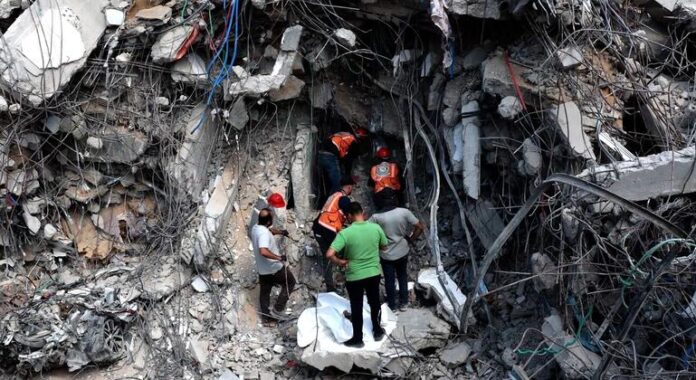
The passage of time and a severe shortage of heavy equipment have made the search and recovery operations increasingly difficult and complex, those working on this mission told UN News.

In one of Gaza City’s neighborhoods, a piece of heavy machinery continues to remove the rubble of a war-destroyed house. 

Meanwhile, civil defence personnel and local teams continue digging and combing through debris for the remains of victims believed to still be buried under the rubble for more than two years.

“This building was believed to contain the remains of 44 victims,” said locally based team member Asaad Shreim. “So far, we have only been able to recover 13 of them while the residents and civil defence teams were able to recover the largest number during the first hours following the bombing.”

Waiting to find his family’s remains

Search and recovery operations are still being carried out with limited resources.

UN News
Ramez Nabhan lost his wife, children and several family members during the Israel-Hamas war.

The UN confirms that the removal of millions of tonnes of rubble is hampered by Israeli restrictions on the entry of heavy equipment as well as the risks posed by unexploded ordnance scattered among the rubble, which slows down the process of reaching and recovering the remains of victims.

While he watches the excavation work, Ramez Nabhan is waiting to find the remains of his family members who were killed in a bombing that targeted the building where they were staying in the early days of the war.

“I was a father of three children, and I had a wife, and I lost them all at the beginning of the war,” Mr. Nabhan said. “Several missiles fell on this building, and the residents and civil defence teams were able to recover some bodies, including my son, my uncle and his wife.”

Long delayed burials

Mr. Nabhan says that the lack of heavy equipment and fuel during the first months of the war prevented the timely recovery of many victims.

“There was no equipment to extract bodies, no fuel or necessary resources were available, and the conditions were not safe for rescue teams to operate,” he said. “We waited a long time and today, we face a new ordeal: recovering the remains and then burying them.”

During the search operations, local teams were able to recover a number of his family members, and their remains were placed in designated bags in preparation for identification and completion of burial procedures.

UN News
The remains of several members of Ramez Nabhan’s family, after local teams managed to recover them from beneath the rubble.

The wound reopens

For thousands of families in Gaza, the tragedy doesn’t end with the loss of loved ones, but extends to the long wait to recover and bury their remains. With each exhumation, the pain of loss is renewed, and the challenges of identifying the victims become ever more apparent.

“It is extremely difficult for the wound to reopen,” Mr. Nabhan said.

“We live between the pain of reliving the loss and the funeral rites. These are my children, and there are no words that can describe what I feel inside.”

Thousands remain missing

As time passes, identifying remains becomes increasingly complicated due to natural decomposition and the limited capabilities of forensic science and DNA testing, prolonging the suffering of families still waiting to learn the fate of their loved ones.

The war resulted in the deaths of more than 71,000 Palestinians and injuries to more than 171,000 others, according to the latest joint damage and needs assessment report issued by the UN and its partners in April 2026.

The UN indicates that thousands of people remain missing, and many are believed to still be buried under the rubble of destroyed buildings amid widespread destruction of infrastructure and residential areas throughout Gaza.

The search will continue for some time to come.

Source link