Sunday, May 3, 2026
Home Blog Page 438

For every euro invested, Horizon Europe generates up to €11 in economic gains

0
For every euro invested, Horizon Europe generates up to €11 in economic gains

New figures reveal that Horizon Europe, the EU’s flagship research and innovation programme, is a major driver of economic and societal benefits. For every euro of costs to EU society, the programme is expected to generate up to six euros in benefits for EU citizens by 2045.

Source link

Europeans celebrate 75 Years of unity and solidarity on Europe Day 2025 | News

0
Europeans celebrate 75 Years of unity and solidarity on Europe Day 2025 | News

The Schuman Declaration laid the foundations for the European Union and paved the way for an unprecedented era of prosperity, peace, democracy, solidarity and cooperation in Europe.

To mark the occasion, many events will take place in EU Member States and around the world, bringing together citizens from all walks of life. The EU institutions will open their doors and invite citizens to visit their premises, discover their work and engage in a wide range of educational and entertaining activities.

Landmark buildings and monuments across the globe will be illuminated in the EU colours, while a special Europe Day programme is planned for Expo 2025 in Osaka, Japan.

In times of global uncertainty, Europe remains an anchor of stability – a place of opportunity and protection for its citizens. The EU and its institutions are working towards the common goal of ensuring prosperity and competitiveness, guaranteeing our security and defence, while upholding the fundamental values Europeans care about.

European Parliament

On 4 May, citizens of all ages will be able to attend the official Europe Day opening ceremony and take a seat in the hemicycle of the European Parliament in Strasbourg. The ceremony will begin with a video message from President Roberta Metsola, followed by a speech from Vice-President Younous Omarjee, and a musical performance by the Voix de Stras’ ensemble. Through various exhibits and interactive activities, visitors will learn how the Parliament works, how laws are made, and why European politics matters. Visitors will also be able to visit the “Changemakers” exhibition. On 10 May, the public will once again be given the chance to discover European democracy in action at the Parliament’s hemicycle in Brussels, with day-long activities emphasising the importance of citizen participation. In Luxembourg, special activities will mark the first anniversary of the Visitors’ Centre on 9 May, including the recently inaugurated Europa Experience. The following day, a rich cultural programme is planned in the Echternach Abbey courtyard. Full programme and events organised in the 27 EU countries.

European Council/Council of the European Union

On 10 May, the Council of the European Union will also open its doors, granting citizens an opportunity to follow in EU leaders’ footsteps. Guided tours throughout the day will offer visitors a rare look at where important European decisions are made. Each of the 27 Member States will host a stand, showcasing their culture, traditions, culinary specialties and more. Younger visitors can also expect tailor-made activities, including a treasure hunt and a “fun fact” quest designed specifically for kids. In honour of the Council’s 50th anniversary, the public will even be able to travel back in time and take a selfie with the leaders of 1974.

European Commission

On 10 May, citizens will also have the opportunity to visit the Commission’s iconic Berlaymont building in Brussels. Here, they will have the chance to learn about the Commission’s role and priorities, engage in series of activities, and find out more about initiatives and concrete benefits for their daily lives. Among others, visitors will have an opportunity to learn about the Commission’s efforts to boost European competitiveness both, promote social cohesion, protect democracy and protect fundamental rights, at home and abroad.

European Central Bank

As part of its Europe Day celebrations on 10 May, the European Central Bank (ECB) will bring the vibrant spirit of Europe to its hometown, Frankfurt am Main, by participating in the city’s Europa-Fest. Visitors will find the ECB at the “European Marketplace” on the Römerberg plaza, alongside Frankfurt-based European Insurance and Occupational Pensions Authority and the Authority for Anti-Money Laundering and Countering the Financing of Terrorism. In such a special year, celebrating 40 years of Schengen and the 75th anniversary of the Schuman Declaration, many themed activities have been organised, with the ECB even planning a lightshow, to be projected onto the west wing of the city’s Grossmarkthalle. In Brussels, the ECB will also host its own stand at the Commission’s Europe Day event.

European Investment Bank

The European Investment Bank (EIB) Group will welcome visitors to its stand at the Council of the European Union’s Justus Lipsius building as part of its Open Day on 10 May in Brussels. EIB Group staff will inform visitors of how its financing and advisory services improve lives and advance EU policy goals. This includes anything from innovation, security and defence to social and territorial cohesion, and the transition towards a net-zero economy. The stand itself will be enhanced by various activities and media, such as quizzes, games and audiovisual material showcasing EIB-financed projects.

European Court of Auditors

On 10 May, as part of the Europe Day celebrations in Echternach, EU auditors will host a series of interactive and engaging activities at the European Court of Auditors’ premises. Among other things, visitors will have the chance to partake in an engaging quiz to test their audit skills. Families and people of all ages are welcome to discover how the European Court of Auditors, the guardian of the EU’s finances, helps protect EU citizens’ money.

European External Action Service

The European External Action Service (EEAS) will open its doors to the public on 10 May for its “Travel the World in a Day“. Travel the World in a Day” event. Visitors to the EU’s diplomatic headquarters in Brussels will be given an opportunity to learn about the work of the EEAS and its 144 delegations and offices worldwide. Through interactive exhibits and activities, visitors will discover the EU’s role as a global leader and reliable partner for prosperity, peace, security, multilateralism, democracy, and a rules-based order. The event will also include a digital booth to help explore the EU pavilion at Expo 2025 in Japan, as well as live dance performances, workshops and family-friendly activities that celebrate global diversity.

European Economic and Social Committee

This year, the European Economic and Social Committee (EESC) will also host a special celebration of the Schuman Declaration’s 75th anniversary. To honour this seminal text, the EESC – the house of European organised civil society – is putting together a range of activities on its premises, through which it will inform and engage with citizens, while offering insights into its various Sections’ and Groups’ advisory work. The day itself will offer entertainment for all, with a real-time voting simulation allowing visitors to step into EESC members’ shoes and discover the process for themselves.

European Committee of the Regions

On 10 May, the European Committee of the Regions (CoR) – ideally located between the European Parliament and Council in Brussels – will open its doors to the public as well, showcasing how it represents regions and cities in the EU, and everything that regional and local elected politicians do for citizens. Visitors will learn how their region voices its interests in the EU, and they will have the chance to meet local and regional elected politicians and discuss European issues in a direct, informal atmosphere. The traditional Festival of Regions and Cities will treat visitors to a showcase of their preferred tourist spots, traditional music and dance, and various culinary specialties.

Background

Europe Day held on 9 May every year celebrates peace and unity in Europe. The date marks the anniversary of the ‘Schuman declaration’, a historic proposal made by Robert Schuman, French Foreign Minister, in 1950 that laid out the foundation of European cooperation. Schuman’s proposal is considered to be the beginning of what is now the European Union.

In 2025, Europe Day is a special occasion, as we are celebrating 75 years since the Schuman declaration. To learn more about each institution’s programme, visit the Europe Day 2025 website.

Source link

Ukraine: Ceasefire a critical first step on the road to durable peace

0
Ukraine: Ceasefire a critical first step on the road to durable peace

Under-Secretary-General Rosemary DiCarlo addressed ambassadors alongside UN deputy relief chief, Joyce Msuya, who updated on the dire humanitarian situation in the country amid ongoing Russian attacks.

Ms. DiCarlo said the meeting was taking place at a potential inflection point in the three-year war, as the past few weeks have seen intensified shuttle diplomacy towards a possible peace deal. 

‘Glimmer of hope’

These initiatives offer a glimmer of hope for progress towards a ceasefire and an eventual peaceful settlement,” she said.

“At the same time, we continue to witness relentless attacks on Ukrainian cities and towns.”

Russian forces have carried out recent deadly strikes, such as the massive, combined missile and drone attack last week on several regions, including the capital Kyiv.  

Multiple residential buildings in the city were hit. At least 12 people were reported killed and more than 70 others injured, including children, making it the deadliest attack on the capital in nine months. 

This followed several other deadly strikes, including one in Sumy city on Palm Sunday that reportedly killed 35 people.  Another in Kryvyi Rih killed 18, including nine children – the deadliest single strike against children since the start of the full-scale Russian invasion.

The UN human rights office, OHCHR, verified that as of 24 April, 151 civilians have been killed, and 697 injured so far this month in Ukraine. 

Verification is ongoing, but numbers are expected to surpass the March figures, which were already 50 per cent higher than in February.

She also noted recent media reports quoting local Russian authorities that indicate civilian casualties in the Kursk, Bryansk and Belgorod regions in Russia, including alleged Ukrainian strikes on 23 and 24 April that reportedly killed three people in the Belgorod region.

“We condemn all attacks against civilians and civilian infrastructure, wherever they occur,” she said.

Diplomatic efforts encouraged

Ms. DiCarlo noted that the UN Secretary-General has repeatedly called for de-escalation and a durable ceasefire in Ukraine.

“In this regard, we are encouraged by the diplomatic efforts underway,” she said.

“We take note of yesterday’s announcement by the Russian Federation of a 72-hour truce planned for the period from 8 to 10 May.”

It follows a similar Russian announcement on 19 April of a 30-hour Easter truce, “and Ukrainian authorities reportedly agreed to mirror any such steps, reiterating their earlier support for a 30-day ceasefire proposed by the United States,” she said.

“Regrettably, hostilities continued during Holy Week, with both sides accusing each other of violations.”

She recalled that a month earlier, the Secretary-General welcomed separate announcements by the US, Russia and Ukraine regarding a 30-day moratorium on strikes against energy infrastructure and the resumption of negotiations on the safety of navigation in the Black Sea.

Despite these commitments, however, attacks against energy infrastructure persisted,” she said. 

Political will valuable

Ms. DiCarlo said the continued exchange of prisoner of war by both sides – including the largest to date, when 500 people were swapped on 20 April – “shows that with political will, diplomacy can yield tangible results even in the most difficult circumstances.”

She concluded her remarks by pointing to the forthcoming 80th anniversary of the Second World War, which serves as a reminder “with even greater urgency” of the centrality of the UN Charter and international law in safeguarding peace and security.

“The Russian Federation’s full-scale invasion of Ukraine stands as an egregious challenge to these fundamental principles, jeopardizing stability in Europe and threatening the broader international order,” she said.

“What is needed now is a full, immediate and unconditional ceasefire as a critical first step towards ending the violence and creating the conditions for a just, comprehensive and sustainable peace.”

Joyce Msuya, UN Deputy Emergency Relief Coordinator, briefs the Security Council meeting on maintenance of peace and security of Ukraine.

Millions in need

Ms. Msuya reported that the humanitarian situation in Ukraine has worsened despite ceasefire opportunities. Overall, nearly 13 million people need assistance.

“So far this year, not a single day has passed without civilians being killed or injured in attacks,” she said. 

The operating environment also remains highly dangerous for humanitarians. 

Aid workers under attack

“From 1 January to 23 April, there were 38 verified security incidents impacting humanitarian staff within 20 kilometers of the frontline. This has left three aid workers dead and 21 injured while delivering life-saving assistance,” she said.

Ms. Msuya reiterated earlier calls for the Council to take urgent, collective action on Ukraine in three areas.

She urged ambassadors to ensure the protection of civilians – including humanitarian and health workers – and critical infrastructure. 

Her second point stressed the need to increase financial support for humanitarian operations as underfunding is forcing critical programmes to scale down. 

Finally, she called for a just peace: “Every effort, whether aimed at a temporary pause or a lasting agreement, must prioritize the protection and needs of civilians.” 

Source link

Europeans celebrate 75 Years of unity and solidarity on Europe Day 2025

0
Europeans celebrate 75 Years of unity and solidarity on Europe Day 2025

On Europe Day, 9 May, the EU celebrates its achievements of unity and long-term peace, commemorating the signing of the Schuman Declaration in 1950. Citizens will have the opportunity to visit the EU institutions in Brussels and beyond, learning more about what Europe does for and with them. Citizens will be invited to participate in debates, live performances, games and other activities.

Source link

Jan Figel’s Mission for Religious Freedom

0

Portrait in Faith – Jan Figel has the demeanor of someone who is neither in a hurry nor easily rattled. He carries with him the quiet assurance of someone who has spent decades working through intricate negotiations, shaping delicate frameworks, and quietly, but firmly, standing up for those whose voices have been silenced. As the European Union’s Special Envoy for the Promotion of Freedom of Religion or Belief, Figel has become a linchpin in the often contentious and challenging realm of international religious rights. His work, marked not by rhetoric but by pragmatic action, stands as a testament to the power of sustained, principled diplomacy in the face of the world’s greatest injustices.

Born in Slovakia, Figel grew up in a Europe at a crossroads, where the forces of history, religion, and politics collided and where the yearning for greater personal freedoms had only recently emerged from the shadows of Soviet control. It was in this environment that he developed an early interest in human rights, particularly religious freedom, a concern that would guide his professional life. Having studied at the University of Bratislava and earning a law degree, Figel’s path toward political and diplomatic work became almost inevitable, for his sense of justice and his belief in the fundamental right of every individual to follow their conscience were central to who he was.

In the late 1990s, Slovakia was emerging from decades of Soviet-dominated totalitarian rule, and Jan Figel became involved in the Slovak political system at a time when the country was navigating its newly gained independence. His early political career was shaped by a determination to help build a society where freedom of expression and freedom of belief were fundamental rights, rather than privileges or anomalies. Figel’s understanding of religious liberty was always broader than the narrow confines of one’s personal faith; to him, it was about the very architecture of a free society, about creating a public space in which all voices could speak without fear of persecution or discrimination.

Jan Figel’s deep commitment to these ideals took him to the European stage in 2004, when Slovakia joined the European Union. His ascent was swift, and soon he was appointed as Slovakia’s Minister for Transport, Posts, and Telecommunications. However, his devotion to human rights remained steadfast, even in a role that required him to focus on infrastructure. When the opportunity arose to advocate for greater religious freedoms on the EU stage, he found himself drawn once again to the global conversation on religious liberty.

In 2016, after serving as Slovakia’s Deputy Prime Minister and as a key figure in EU diplomatic circles, Figel was appointed as the European Union’s Special Envoy for the Promotion of Freedom of Religion or Belief. In this capacity, he has served as both a voice of advocacy and a mediator, navigating delicate international waters where religious freedoms are threatened by authoritarian regimes, radical ideologies, and growing intolerance.

At the heart of Figel’s work lies an understanding that religious freedom is inextricably linked to the health of democracy itself. In countries where religious rights are under attack, it is not only faith that suffers — it is the entire social fabric. Without the ability to believe freely, without the space to practice and express faith openly, individuals are deprived of a central aspect of their humanity. It is this conviction that has made Figel a tireless advocate for the rights of minority faith communities, particularly in regions where those communities are most vulnerable.

His approach to diplomacy is distinct. While others may shout or appeal to emotion, Figel’s method is more akin to the patient work of a mediator. He has always been someone who seeks common ground, looking for opportunities to build bridges rather than tear down walls. In the halls of the United Nations, at conferences of religious freedom advocates, or in meetings with foreign diplomats, Figel’s voice is calm but firm, composed but unwavering. He is not a politician who seeks to dominate the conversation, but rather one who understands that the best outcomes are often those reached quietly, through thoughtful negotiation and a commitment to shared values.

One of Jan Figel’s most significant achievements as the EU Special Envoy has been his advocacy for the persecuted religious minorities in the Middle East. The region has seen a rise in violence against religious groups, particularly against Christians, Yazidis, and other smaller sects, as extremist ideologies have taken root. Figel has been vocal in bringing these issues to the attention of the international community, urging European leaders to take a stand in support of religious minorities. In doing so, he has proven to be not just an advocate, but a translator of the world’s suffering — bringing it into the halls of power, ensuring that those who are often overlooked are not forgotten.

But Figel’s influence extends beyond the Middle East. He has also worked tirelessly to promote religious freedom within the European Union, ensuring that laws and policies within the EU respect the right of individuals to practice their faith without fear of discrimination. The rise of populism and nationalism in Europe has led to a growing climate of suspicion and intolerance, with religious minorities increasingly finding themselves marginalized. Figel’s work in this area has been instrumental in pushing back against these forces, reminding European leaders that religious freedom is not just an abstract concept but a foundational pillar of the EU’s values.

He has also played a critical role in establishing and advancing interfaith dialogues, recognizing that true religious freedom is not just about legal rights, but about fostering an environment of mutual respect and understanding. Figel has been a strong proponent of building relationships between people of different faiths, believing that through dialogue and cooperation, common ground can be found even among the most divergent beliefs. In a world increasingly divided by ideological and religious lines, Figel’s work is a reminder that peace does not emerge from the absence of disagreement, but from the willingness to engage and seek understanding despite it.

Despite the gravity of his work, Figel remains a deeply humble figure. His demeanor is far from the typical profile of a diplomat or political leader. There is no sense of grandiosity in his actions; rather, he appears more concerned with the results of his efforts than with their visibility. He is known for his deep listening, his ability to hear what is unsaid, and for his quiet persistence in the face of resistance. This humility, combined with his unshakable commitment to human rights, has earned him the respect and admiration of colleagues, even those who disagree with him on other issues.

In describing himself, Jan Figel once remarked, “I am a humble and weak man in service to my God and neighbour.” This statement encapsulates the essence of his character — a man whose service to others is not borne out of a desire for recognition or power, but out of a deep, unwavering belief in the importance of serving something greater than himself. It is this sense of humility that has shaped his entire approach to religious freedom — he does not view himself as a hero or a savior, but as a servant, quietly working for justice, without fanfare.

For Figel, religious freedom is not an abstract ideal but a matter of daily life. It is a cause that he has dedicated his life to, and one that he pursues with the kind of quiet intensity that is often overlooked in a world that favors spectacle over substance. His work is not about seeking glory or power, but about ensuring that people around the world can live their lives according to their deepest convictions — without fear, without repression, and without violence.

Today, Figel remains dedicated to the belief that religious freedom is essential not just for the flourishing of individuals, but for the future of society itself. His work continues to shape the contours of European policy on religious freedom, even as he quietly works behind the scenes to support those whose rights are under threat.

To engage with Jan Figel is to encounter someone whose values are not contingent on the current political winds, but on a deeper understanding of the world’s enduring struggles. His is a diplomacy of principle, not posturing; of conviction, not convenience. In a world filled with noise, Figel’s quiet resolve stands as a powerful reminder that the pursuit of truth, justice, and religious freedom is a path that requires patience, courage, and, above all, the unwavering belief that these values can, and must, be defended.

In the end, Jan Figel’s work is not about achieving personal success or recognition. It is about creating a world where people of all faiths, backgrounds, and beliefs can live in freedom and dignity. And in this quiet pursuit, he continues to build, brick by brick, a more just and peaceful world for future generations.

Source link

Children in Gaza ‘going to bed starving’ amid blockade

0
Children in Gaza ‘going to bed starving’ amid blockade

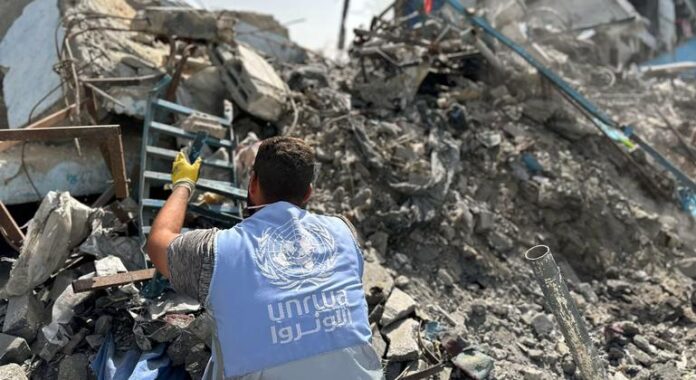
“The siege on Gaza is the silent killer of children, of older people,” said Juliette Touma, spokesperson for the UN agency for Palestine refugees, UNRWA.

“Families – whole families, seven or eight people – are resorting to sharing one can of beans or peas,” she told journalists in Geneva. “Imagine not having anything to feed your children. Children in Gaza are going to bed starving.

Today, thousands of trucks carrying relief supplies continue to be denied entry to Gaza. “We have just over 5,000 trucks in several parts of the region with lifesaving supplies that are ready to come in,”Ms. Touma continued.

“This decision is crippling the humanitarian efforts…and threatening the lives and survival of civilians in Gaza, who are also going through heavy bombardment day in, day out.”

Rafah levelled

Destruction to the southern city of Rafah has left it “obliterated”, UNRWA said. Formerly the largest entry point for aid into the enclave via Egypt, aerial videos purportedly of Rafah show buildings levelled as far as the eye can see.

“Rafah is nothing like the city it used to be…In every direction there is only destruction,” the UN agency said.

Forced displacement orders have been in place for 97 per cent of the city, uprooting around 150,000 people.

Almost 12 months ago, the Israeli military moved in displacing 1.4 million people, leaving homes, health facilities and shelters damaged or destroyed.

Starting from scratch

Across Gaza, more than 90 per cent of the population have been displaced “not once, not twice, some people have been displaced 12 times or 13 times…so they have to start from scratch.”

Before the war erupted in October 2023, Gazans relied on 500 trucks a day to deliver the food and other basic goods that they needed. But no humanitarian or commercial supplies have entered since 2 March.

This is by far the longest ban on aid moving into the Strip since the start of the war in October 2023, following deadly Hamas-led terror attacks on Israel that killed some 1,250 people and left more than 250 taken hostage.

The blockade has emptied warehouses of food, medical supplies, shelter materials and safe water – fuelling a black market “where prices have increased from 10 to 20, sometimes 40 times…You cannot give anything to your children and you’re seeing your children starving”, Ms. Touma said.

According to the UN World Food Programme (WFP) food prices rose 1,400 per cent increase in recent weeks compared to the ceasefire period from 19 January to 18 March 2025.

Last Friday, the UN agency delivered its last remaining stocks to community kitchens that provide hot meals of lentil soup and rice. The kitchens are expected to fully run out of food within days while another 16 closed over the weekend. In addition, all 25 WFP-supported bakeries have now closed.

“We’re likely to see more community kitchens closing down for the simple reason that they need supplies,” Ms. Touma explained.

Daily challenges for Gazans include finding food and fuel to cook, because of a lack of cooking gas. “Families are resorting to burning plastic to cook their meals,” UNRWA’s Ms. Touma said. 

Source link

Press release – “Flow” wins 2025 LUX Audience Award

0
Europeans celebrate 75 Years of unity and solidarity on Europe Day 2025

The film “Flow”, directed by Latvian Gints Zilbalodis, was awarded the 2025 LUX Audience Award at a ceremony on Tuesday in the European Parliament in Brussels.Committee on Culture and Education Source : © European Union, 2025 – EP

Source link

Press release – “Flow” wins 2025 LUX Audience Award

0
Press release – “Flow” wins 2025 LUX Audience Award

The film “Flow”, directed by Latvian Gints Zilbalodis, was awarded the 2025 LUX Audience Award at a ceremony on Tuesday in the European Parliament in Brussels.Committee on Culture and Education Source : © European Union, 2025 – EP Source link

Source link

MIDDLE EAST LIVE: Guterres tells Security Council two-State solution ‘near point of no return’

0
MIDDLE EAST LIVE: Guterres tells Security Council two-State solution ‘near point of no return’

The Security Council has been meeting on the Middle East, with Secretary-General António Guterres telling ambassadors that irreversible action must be taken to finally put a two-State solution in place for Israel and Palestine. Meanwhile, the humanitarian crisis in Gaza deepens, with reports from the UN Palestine refugee relief agency (UNRWA) that children are “going to bed starving” amid the two-month Israeli aid blockade and continuing bombardment. App users can follow coverage here.

Source link

New taskforce to investigate the hiring of youngsters to commit violence for a fee

0
New taskforce to investigate the hiring of youngsters to commit violence for a fee

Europol has launched a taskforce to tackle the rising trend of organised crime networks hiring youngsters to carry out threats, assaults, or killings for a fee. The taskforce brings together police from 8 European countries with Europol providing operational support and coordination. Source link

Source link