

Do you know what the reparability score labels mean? Repairability scores range from A (most repairable) to E (least repairable). How are they measured? They are based on 6 factors: Disassembly depth Fasteners Tools Spare part availability Software updates Repair information Source link
New EU labels to help consumers choose more repairable electronics

Do you know what the reparability score labels mean?
Repairability scores range from A (most repairable) to E (least repairable).
How are they measured?
They are based on 6 factors:
- Disassembly depth
- Fasteners
- Tools
- Spare part availability
- Software updates
- Repair information
Europe’s bathing waters safe for summer swimming

From Europe’s coastal waters to its inland bathing sites, a large majority of Europe’s waters are safe to swim in, according to the latest European bathing water assessment for the 2024 bathing season, published today. It found that over 85% of monitored locations met the European Union’s most stringent ‘excellent’ bathing water quality standards last year, while 96% of all officially identified bathing waters in the EU met the minimum quality standards.
The assessment and the interactive map, put together by the European Environment Agency (EEA) in cooperation with the European Commission, highlight where swimmers can find well managed bathing sites in Europe. The assessment inspects water suitability for bathing, focusing on monitoring bacteria which can cause potentially serious illnesses.
Overall, over 22,000 bathing water sites across all 27 EU Member States, plus Albania and Switzerland were assessed. In five countries — Cyprus, Bulgaria, Greece, Austria and Croatia — 95% or more of bathing waters were of excellent quality. Only 1.5% of the EU’s bathing waters were found to be of poor quality.
The quality of coastal bathing waters is generally better than that of rivers and lakes. In 2024, around 89% of coastal bathing waters in the EU were classified as excellent, compared with 78% of inland bathing waters.
Enjoying time at the beach or swimming in lakes and rivers is for many a symbol of holidays and relaxation, as we look forward to the approaching summer. The results published today show that Europeans can confidently bathe in the vast majority of the EU’s bathing sites that meet the EU’s bathing quality standards. I am committed to continuing to work to ensure high quality water for people and the environment, as part of our EU Water Resilience Strategy.
Jessika Roswall,
Commissioner for Environment,
Water Resilience and a Competitive Circular Economy
We can all be glad that a vast majority of our bathing waters are clean enough to swim in. This is thanks to systematic work under EU rules which has steadily improved the health of our waters. It shows that monitoring and coordination at the European level benefits every one of us. Of course, there is more to do to improve the cleanliness of our waters and their resilience to withstand new challenges posed by climate change and over-use.
Leena Ylä-Mononen,
EEA Executive Director
Steady improvements over recent decades
Bathing water quality in Europe has improved markedly over recent decades largely thanks to EU legislation. The combined effect of systematic bacteriological monitoring pursuant to the EU’s Bathing Water Directive and large investments in urban wastewater treatment plants led to a drastic reduction in pathogens that were previously being released. Thanks to these continued efforts, bathing is now also possible in many urban areas.
While most of Europe’s bathing waters are in excellent condition from a bacteriological perspective, chemical pollution of surface and groundwaters remains significant and may be exacerbated by the changing climate. Improving water resilience for people and for the environment is therefore crucial.
Other challenges to water quality like toxic cyanobacterial blooms, which are not part of monitoring prescribed by EU bathing water rules, frequently result in bathing warnings and restrictions.
Background
Overall water quality is monitored and assessed under the EU’s Water Framework Directive and covers a broad spectrum of chemical pollutants in surface and groundwater. Chemical pollutants are not covered by bathing water monitoring even when they exceed legal thresholds that are in place to prevent environmental damage.
The assessment for today’s briefing is based on the monitoring of bathing sites across Europe that were reported to the EEA for the 2024 season. This includes sites in all EU Member States, Albania and Switzerland.
Alongside this year’s Bathing Water Briefing, the EEA has also released an updated interactive map showing the performance of each bathing site. Updated country fact sheets are also available, as well as more information on the implementation of the Directive in assessed countries.
For more information
Our latest press releases
Europe’s bathing waters safe for summer swimming

From Europe’s coastal waters to its inland bathing sites, a large majority of Europe’s waters are safe to swim in, according to the latest European bathing water assessment for the 2024 bathing season, published today. It found that over 85% of monitored locations met the European Union’s most stringent ‘excellent’ bathing water quality standards last year, while 96% of all officially identified bathing waters in the EU met the minimum quality standards.
The assessment and the interactive map, put together by the European Environment Agency (EEA) in cooperation with the European Commission, highlight where swimmers can find well managed bathing sites in Europe. The assessment inspects water suitability for bathing, focusing on monitoring bacteria which can cause potentially serious illnesses.
Overall, over 22,000 bathing water sites across all 27 EU Member States, plus Albania and Switzerland were assessed. In five countries — Cyprus, Bulgaria, Greece, Austria and Croatia — 95% or more of bathing waters were of excellent quality. Only 1.5% of the EU’s bathing waters were found to be of poor quality.
The quality of coastal bathing waters is generally better than that of rivers and lakes. In 2024, around 89% of coastal bathing waters in the EU were classified as excellent, compared with 78% of inland bathing waters.
Enjoying time at the beach or swimming in lakes and rivers is for many a symbol of holidays and relaxation, as we look forward to the approaching summer. The results published today show that Europeans can confidently bathe in the vast majority of the EU’s bathing sites that meet the EU’s bathing quality standards. I am committed to continuing to work to ensure high quality water for people and the environment, as part of our EU Water Resilience Strategy.
Jessika Roswall,
Commissioner for Environment,
Water Resilience and a Competitive Circular Economy
We can all be glad that a vast majority of our bathing waters are clean enough to swim in. This is thanks to systematic work under EU rules which has steadily improved the health of our waters. It shows that monitoring and coordination at the European level benefits every one of us. Of course, there is more to do to improve the cleanliness of our waters and their resilience to withstand new challenges posed by climate change and over-use.
Leena Ylä-Mononen,
EEA Executive Director
Steady improvements over recent decades
Bathing water quality in Europe has improved markedly over recent decades largely thanks to EU legislation. The combined effect of systematic bacteriological monitoring pursuant to the EU’s Bathing Water Directive and large investments in urban wastewater treatment plants led to a drastic reduction in pathogens that were previously being released. Thanks to these continued efforts, bathing is now also possible in many urban areas.
While most of Europe’s bathing waters are in excellent condition from a bacteriological perspective, chemical pollution of surface and groundwaters remains significant and may be exacerbated by the changing climate. Improving water resilience for people and for the environment is therefore crucial.
Other challenges to water quality like toxic cyanobacterial blooms, which are not part of monitoring prescribed by EU bathing water rules, frequently result in bathing warnings and restrictions.
Background
Overall water quality is monitored and assessed under the EU’s Water Framework Directive and covers a broad spectrum of chemical pollutants in surface and groundwater. Chemical pollutants are not covered by bathing water monitoring even when they exceed legal thresholds that are in place to prevent environmental damage.
The assessment for today’s briefing is based on the monitoring of bathing sites across Europe that were reported to the EEA for the 2024 season. This includes sites in all EU Member States, Albania and Switzerland.
Alongside this year’s Bathing Water Briefing, the EEA has also released an updated interactive map showing the performance of each bathing site. Updated country fact sheets are also available, as well as more information on the implementation of the Directive in assessed countries.
For more information
Our latest press releases
EU calls for greater efforts to protect youngsters’ mental health in digital era

The Council is calling on EU countries and the Commission to better protect the mental health of children and adolescents, by promoting the safe and healthy use of digital tools. Inappropriate content, cyberbullying, or excessive screentime currently pose a threat to youngsters’ mental health. Source link
EU calls for greater efforts to protect youngsters’ mental health in digital era

The Council is calling on EU countries and the Commission to better protect the mental health of children and adolescents, by promoting the safe and healthy use of digital tools. Inappropriate content, cyberbullying, or excessive screentime currently pose a threat to youngsters’ mental health.
Recovery and resilience fund: Council gives green light to amended plans of Belgium, Cyprus, Croatia, Italy, Lithuania, Malta, Poland and Slovenia

The Council approved the Commission’s positive assessment of the amended recovery and resilience plans submitted by Belgium, Cyprus, Croatia, Italy, Lithuania, Malta, Poland and Slovenia. Source link
MIDDLE EAST CRISIS: Live updates for 20 June

One week since the Israel-Iran conflict erupted, diplomatic efforts to end the war are ramping up in Geneva today as foreign ministers from France, Germany, the UK and the European Union prepare to meet their Iranian counterpart. In New York, meanwhile, the UN Security Council is also set to discuss this latest worrying escalation, against the backdrop of the ongoing emergency in Gaza. We’ll be covering these developments and more across the UN system today. UN News app users can follow here.
Middle East crisis: live updates for June 20

A week since the Israeli-Iranian conflict broke out, diplomatic efforts to end the war is accelerating today in Geneva as foreign ministers in France, Germany, the United Kingdom and the European Union are preparing to meet their Iranian counterpart. In New York, on the other hand, the United Nations Security Council should also discuss this last disturbing escalation, in the context of the current emergency in Gaza. We will cover these developments and more in the United Nations system today. UN application users can follow here.
Originally published at Almouwatin.com
Gaza: As last fuel supplies run out, aid teams warn of catastrophe
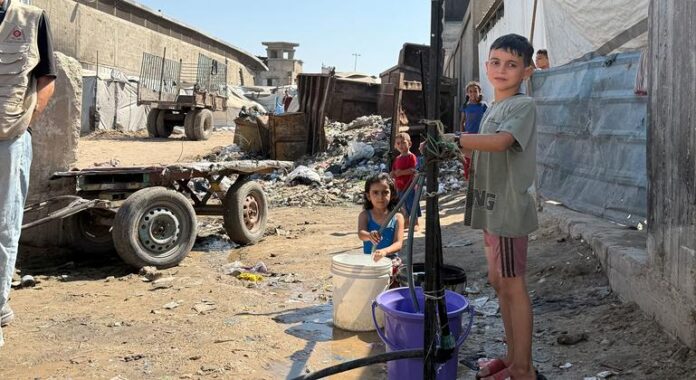
Speaking from Gaza City in the north of the occupied territory, Olga Cherevko from the UN aid coordination office, OCHA, said that water pumps had stopped at one site for displaced people there on Wednesday “because there’s no fuel”.
“We are really – unless the situation changes – hours away from a catastrophic decline and a shutdown of more facilities if no fuel enters or more fuel isn’t retrieved immediately,” she told UN News.
In its latest update on the emergency, OCHA said that without the immediate entry of fuel or access to reserves, 80 per cent of Gaza’s critical care units essential for births and medical emergencies will shut down.
More killed seeking aid
The development comes as Gaza’s authorities reported that 15 people had been killed near an aid distribution hub in the centre of the Strip on Thursday.
On Tuesday, unverified videos of another incident circulating on social media showed dead bodies lying in the street near a relief facility in the southern city of Khan Younis, reportedly following artillery fire.
Finding food is a daily challenge for increasingly desperate Gazans who are “simply waiting for food and hoping to find something in order not to watch their children starve in front of their eyes”, Ms. Cherevko explained.
She added: “I spoke with a woman a couple of days ago where she told me that she went with a friend of hers who is nine months pregnant in hopes of finding some food.
Of course, they didn’t manage because they were too afraid to enter areas where there could be incidents like the ones that have been reported over the past few days.”
Search for shelter
Back in Gaza City, OCHA’s Ms. Cherevko said that conditions in shelters in Gaza are now “absolutely horrific” and increasingly crowded – “there are people coming from the north constantly,” the veteran aid worker added, while others are also moving back northwards, likely to be closer to the entry points for aid convoys.
The amount of aid entering Gaza today remains extremely limited and far below the 600 trucks a day that used to reach the enclave before the war began in October 2023. In its latest update, OCHA reported that “starvation and a growing likelihood of famine” are ever-present in the enclave. An estimated 55,000 pregnant women now face miscarriage, stillbirth and undernourished newborns as a result of the food shortages.
Smoke from explosions rises from the Shujaia neighborhood of Gaza City.
Starvation diet
“With the very limited volume of aid that is entering, everyone continues to face starvation and people are constantly risking their lives to try to find something,” Ms. Cherevko continued.
“You eat or [you’re] left with the choice of starving to death.”
After more than 20 months of war, sparked by Hamas-led terror attacks in Israel, 82 per cent of Gaza’s territory is either an Israeli militarized zone or affected by evacuation orders.
Three months since hostilities re-escalated on 18 March, more than 680,000 people have been newly displaced. “With no safe place to go, many people have sought refuge in every available space, including overcrowded displacement sites, makeshift shelters, damaged buildings, streets and open areas,” OCHA said.
