

The EU has changed the level of protection of the wolf from “strictly protected” to “protected” to give EU countries more flexibility in managing wolf populations. The estimated population of wolves on the European continent almost doubled between 2012 and 2023 to more than 20 000. Source link
EU changes protection status of wolves in Europe

The EU has changed the level of protection of the wolf from “strictly protected” to “protected” to give EU countries more flexibility in managing wolf populations. The estimated population of wolves on the European continent almost doubled between 2012 and 2023 to more than 20 000.
Commission adopts Ocean Pact to protect marine life and strengthen blue economy

The ocean shapes our economies, our food systems, even the air we breathe. To better protect our ocean, the Commission has adopted a European Ocean Pact, which will help to promote a thriving blue economy and support the well-being of people living in coastal areas. This Ocean Pact brings together EU ocean policies under […]
Commission adopts Ocean Pact to protect marine life and strengthen blue economy

The ocean shapes our economies, our food systems, even the air we breathe. To better protect our ocean, the Commission has adopted a European Ocean Pact, which will help to promote a thriving blue economy and support the well-being of people living in coastal areas.
This Ocean Pact brings together EU ocean policies under one single and coordinated framework. It will do so through a collaborative approach between EU countries, regions, and stakeholders, including fishers, innovators, investors, scientists, and civil society. Six priority areas for action will define this work, namely
- protecting and restoring ocean health by supporting EU countries in their efforts to restore degraded coastal marine habitats
- boosting the competitiveness of the EU sustainable blue economy including by strengthening the EU’s maritime industry and by introducing a Blue Generational Renewal Strategy, to foster access to young professionals in marine research, ocean tech, and sustainable fisheries
- supporting coastal and island communities, and outermost regions by presenting new or updated strategies for these regions and communities
- enhancing maritime security and defence by strengthening EU coast guard cooperation and maritime border security
- advancing ocean research, knowledge, skills and innovation by proposing an ambitious EU Ocean Observation Initiative
- strengthening EU ocean diplomacy and international ocean governance by stepping up its fight against illegal, unreported and unregulated fishing
The European Ocean Pact will be complemented by an ocean act by 2027, which will help to ensure the implementation of the priorities of the pact. An EU Ocean Pact dashboard will be used to track progress.
For more information
The European Union and the Republic of Moldova confirm their strong partnership at the 9th EU-Moldova Association Council meeting

DISCLAIMER: Information and opinions reproduced in the articles are the ones of those stating them and it is their own responsibility. Publication in The European Times does not automatically means endorsement of the view, but the right to express it.
DISCLAIMER TRANSLATIONS: All articles in this site are published in English. The translated versions are done through an automated process known as neural translations. If in doubt, always refer to the original article. Thank you for understanding.
CCHR Encourages Italy to Complete Full Mental Health Reform After Court Ruling on Forced Treatment

KINGNEWSWIRE/ Press release / ROME — In what has been widely reported as a landmark decision, Italy’s Constitutional Court struck down portions of the nation’s decades-old psychiatric treatment laws in May 2025, declaring unconstitutional Article 35 of Law 833/1978. The ruling affects procedures for Trattamento Sanitario Obbligatorio (TSO), the legal framework governing compulsory psychiatric hospitalization. While many media outlets have hailed the move as progress, critics—including prominent human rights advocates and civil society organizations—warn that the ruling fails to fully align Italy’s mental health practices with modern international human rights law.
At the heart of the decision is the acknowledgment that individuals subjected to TSO must be notified of the order, granted access to legal counsel, and given the opportunity to present their case before the Tutelary Judge prior to judicial validation. However, the Court did not abolish TSO itself, instead choosing to preserve the practice with additional procedural safeguards.
This approach has drawn sharp criticism from those who argue that forced psychiatric treatment is inherently incompatible with human dignity and the right to autonomy.
A Bit Closer but not yet in Full Compliance with International Standards
The United Nations Convention on the Rights of Persons with Disabilities (CRPD), which Italy ratified in 2009, explicitly rejects coercive interventions in mental health care. General Comment No. 1 from the CRPD Committee affirms that all persons, regardless of disability status, have the right to legal capacity and must be supported—not substituted—in making decisions about their lives and bodies.
In recent years, the Office of the UN High Commissioner for Human Rights (OHCHR) and the World Health Organization (WHO) have echoed this stance, calling for the complete abolition of forced psychiatric interventions and urging nations to adopt support-based, rights-respecting alternatives.
An April 2025 WHO report titled “Countries move away from using coercive measures in mental health care” emphasized that seclusion, restraint, and involuntary treatment are not only harmful but also violate human rights under all international instruments, including the CRPD. The report concluded:
“Forcibly restraining or secluding someone who is experiencing a mental health crisis can lead to severe physical injury and even death. People who have experienced these coercive measures say that they are traumatic, detrimental to recovery and engender mistrust in mental health services. They are systemic failures of care.”
Despite these global developments, the Italian Constitutional Court’s ruling stops short of eliminating TSO. Instead, it upholds the legality of involuntary psychiatric treatment while introducing modest reforms to how such measures are applied.
CCDU: Longtime Advocates for Dignity and Autonomy
The Citizens Commission on Human Rights Italy (CCDU), the Italian branch of the organization founded by the Church of Scientology in 1969 and long active in exposing abuses within psychiatry, has consistently advocated for the full decriminalization of mental distress and the dismantling of institutionalized coercion in mental health care.
CCDU praised the procedural improvements mandated by the Court but warned that allowing any form of forced treatment remains a grave ethical and legal failure.
“Dignity cannot be conditional,” said a CCDU representative. “If we recognize people as equal citizens, then they must have the right to make choices—even when others disagree with them.”
Since its founding, CCHR worldwide has worked alongside survivors, whistleblowers, and international partners to document systemic abuses in psychiatric facilities and push for transparency in clinical settings.
In line with this CCDU in Italy has backed a legislative proposal introduced by the advocacy group Diritti alla Follia, which seeks to replace TSO entirely with voluntary, community-based care models grounded in informed consent.
This support draws directly from the principles laid out by L. Ron Hubbard, founder of the Church of Scientology. Hubbard was a fierce critic of coercive psychiatry, and his writings formed the philosophical foundation for CCHR’s global campaign to end involuntary mental health interventions.
Today, CCHR continues that legacy, working closely with international watchdogs like the European Committee for the Prevention of Torture (CPT) and the UN Special Rapporteur on Torture, the UN Office of the High Commission on Human Rights (OHCHR) and various UN Human Rights Treaty bodies.
Why TSO Remains a Violation—No Matter the Process
Human rights watchdogs, including the CPT and the OHCHR, have repeatedly condemned practices involving non-consensual psychiatric treatment. The CPT specifically have argued that even with due process, forced medication and detention violate Articles 7 and 9 of the European Convention on Human Rights. Article 7 is centered around the principle of No punishment without law while Article 9 provides a right to freedom of thought, conscience, and religion. The OHCHR and other UN Human Rights treaty bodies stress that coercion in psychiatry violations of human rights under all international instruments, including the United Nations Convention on the Rights of Persons with Disabilities.
The CPT has specifically called out Italy for its reliance on TSO and urged authorities to develop alternative models that respect personal autonomy and informed consent.
Moreover, the OHCHR and WHO all encompassing Mental Health, Human Rights and Legislation: Guidance and Practice emphasizes that countries should move away from institutionalization and coercion, and instead invest in peer support, crisis homes, and community-led services.
“The idea that someone can be forcibly hospitalized and medicated simply because they think differently is archaic,” said Ivan Arjona, Scientology’s Representative to the Europen institutions and the United Nations. “It’s a good opportunity for Italy to go all the way forward and ensure full embracement of the human rights model in Mental Health.”
What Comes Next?
With the Constitutional Court’s decision now in force, Parliament faces the task of drafting new legislation to replace the unconstitutional provisions. While some lawmakers have signaled openness to reform, others remain aligned with traditional psychiatric institutions and clinical interests.
Meanwhile, the Ministry of Health reports that over two million Italians lack access to adequate mental health care, and emergency departments have seen a surge in psychiatric crises—an alarming trend that underscores the need for systemic change.
The CCDU and allied groups warn that without a clear commitment to abolishing coercion, any new legislation will perpetuate the very violations the Court claims to address.
“We’ve seen this before,” said a spokesperson from the CCHR European office. “Governments add layers of procedure to give the illusion of protection, but the core violation—the denial of bodily integrity and freedom—remains intact.”
As Italy stands at this crossroads, the question is no longer whether the system needs to change, but whether it has the political will to break free from outdated paradigms of control and embrace a future rooted in human rights, dignity, and true healing.
References:
Constitutional Court of Italy – Decision on Article 35 of Law 833/1978 (May 2025)
United Nations Convention on the Rights of Persons with Disabilities (CRPD) UN CRPD Treaty Page
UN Committee on the Rights of Persons with Disabilities – General Comment No. 1 (2014)
Office of the UN High Commissioner for Human Rights (OHCHR)
World Health Organization (WHO) – April 2025 Report: “Countries move away from using coercive measures in mental health care”
**WHO/OHCHR Publication – “Mental Health, Human Rights and Legislation: Guidance and Practice” https://www.who.int/publications/i/item/9789240080737
CCHR Encourages Italy to Complete Full Mental Health Reform After Court Ruling on Forced Treatment
KINGNEWSWIRE / PRESS RELEASE / ROME — In what has been widely reported as a landmark decision, Italy’s Constitutional Court struck down portions of the nation’s decades-old psychiatric treatment laws in May 2025, declaring unconstitutional Article 35 of Law 833/1978. The ruling affects procedures for Trattamento Sanitario Obbligatorio (TSO), the legal framework governing compulsory psychiatric hospitalization. While many media outlets have hailed the move as progress, critics—including prominent human rights advocates and civil society organizations—warn that the ruling fails to fully align Italy’s mental health practices with modern international human rights law.
At the heart of the decision is the acknowledgment that individuals subjected to TSO must be notified of the order, granted access to legal counsel, and given the opportunity to present their case before the Tutelary Judge prior to judicial validation. However, the Court did not abolish TSO itself, instead choosing to preserve the practice with additional procedural safeguards.
This approach has drawn sharp criticism from those who argue that forced psychiatric treatment is inherently incompatible with human dignity and the right to autonomy.
A Bit Closer but not yet in Full Compliance with International Standards
The United Nations Convention on the Rights of Persons with Disabilities (CRPD), which Italy ratified in 2009, explicitly rejects coercive interventions in mental health care. General Comment No. 1 from the CRPD Committee affirms that all persons, regardless of disability status, have the right to legal capacity and must be supported—not substituted—in making decisions about their lives and bodies.
In recent years, the Office of the UN High Commissioner for Human Rights (OHCHR) and the World Health Organization (WHO) have echoed this stance, calling for the complete abolition of forced psychiatric interventions and urging nations to adopt support-based, rights-respecting alternatives.
An April 2025 WHO report titled “Countries move away from using coercive measures in mental health care” emphasized that seclusion, restraint, and involuntary treatment are not only harmful but also violate human rights under all international instruments, including the CRPD. The report concluded:
“Forcibly restraining or secluding someone who is experiencing a mental health crisis can lead to severe physical injury and even death. People who have experienced these coercive measures say that they are traumatic, detrimental to recovery and engender mistrust in mental health services. They are systemic failures of care.”
Despite these global developments, the Italian Constitutional Court’s ruling stops short of eliminating TSO. Instead, it upholds the legality of involuntary psychiatric treatment while introducing modest reforms to how such measures are applied.
CCDU: Longtime Advocates for Dignity and Autonomy
The Citizens Commission on Human Rights Italy (CCDU), the Italian branch of the organization founded by the Church of Scientology in 1969 and long active in exposing abuses within psychiatry, has consistently advocated for the full decriminalization of mental distress and the dismantling of institutionalized coercion in mental health care.
CCDU praised the procedural improvements mandated by the Court but warned that allowing any form of forced treatment remains a grave ethical and legal failure.
“Dignity cannot be conditional,” said a CCDU representative. “If we recognize people as equal citizens, then they must have the right to make choices—even when others disagree with them.”
Since its founding, CCHR worldwide has worked alongside survivors, whistleblowers, and international partners to document systemic abuses in psychiatric facilities and push for transparency in clinical settings.
In line with this CCDU in Italy has backed a legislative proposal introduced by the advocacy group Diritti alla Follia, which seeks to replace TSO entirely with voluntary, community-based care models grounded in informed consent.
This support draws directly from the principles laid out by L. Ron Hubbard, founder of the Church of Scientology. Hubbard was a fierce critic of coercive psychiatry, and his writings formed the philosophical foundation for CCHR’s global campaign to end involuntary mental health interventions.
Today, CCHR continues that legacy, working closely with international watchdogs like the European Committee for the Prevention of Torture (CPT) and the UN Special Rapporteur on Torture, the UN Office of the High Commission on Human Rights (OHCHR) and various UN Human Rights Treaty bodies.
Why TSO Remains a Violation—No Matter the Process
Human rights watchdogs, including the CPT and the OHCHR, have repeatedly condemned practices involving non-consensual psychiatric treatment. The CPT specifically have argued that even with due process, forced medication and detention violate Articles 7 and 9 of the European Convention on Human Rights. Article 7 is centered around the principle of No punishment without law while Article 9 provides a right to freedom of thought, conscience, and religion. The OHCHR and other UN Human Rights treaty bodies stress that coercion in psychiatry violations of human rights under all international instruments, including the United Nations Convention on the Rights of Persons with Disabilities.
The CPT has specifically called out Italy for its reliance on TSO and urged authorities to develop alternative models that respect personal autonomy and informed consent.
Moreover, the OHCHR and WHO all encompassing Mental Health, Human Rights and Legislation: Guidance and Practice emphasizes that countries should move away from institutionalization and coercion, and instead invest in peer support, crisis homes, and community-led services.
“The idea that someone can be forcibly hospitalized and medicated simply because they think differently is archaic,” said Ivan Arjona, Scientology’s Representative to the Europen institutions and the United Nations. “It’s a good opportunity for Italy to go all the way forward and ensure full embracement of the human rights model in Mental Health.”
What Comes Next?
With the Constitutional Court’s decision now in force, Parliament faces the task of drafting new legislation to replace the unconstitutional provisions. While some lawmakers have signaled openness to reform, others remain aligned with traditional psychiatric institutions and clinical interests.
Meanwhile, the Ministry of Health reports that over two million Italians lack access to adequate mental health care, and emergency departments have seen a surge in psychiatric crises—an alarming trend that underscores the need for systemic change.
The CCDU and allied groups warn that without a clear commitment to abolishing coercion, any new legislation will perpetuate the very violations the Court claims to address.
“We’ve seen this before,” said a spokesperson from the CCHR European office. “Governments add layers of procedure to give the illusion of protection, but the core violation—the denial of bodily integrity and freedom—remains intact.”
As Italy stands at this crossroads, the question is no longer whether the system needs to change, but whether it has the political will to break free from outdated paradigms of control and embrace a future rooted in human rights, dignity, and true healing.
References:
Constitutional Court of Italy – Decision on Article 35 of Law 833/1978 (May 2025)
United Nations Convention on the Rights of Persons with Disabilities (CRPD) UN CRPD Treaty Page
UN Committee on the Rights of Persons with Disabilities – General Comment No. 1 (2014)
Office of the UN High Commissioner for Human Rights (OHCHR)
World Health Organization (WHO) – April 2025 Report: “Countries move away from using coercive measures in mental health care”
**WHO/OHCHR Publication – “Mental Health, Human Rights and Legislation: Guidance and Practice” https://www.who.int/publications/i/item/9789240080737
US vetoes Security Council resolution demanding permanent ceasefire in Gaza
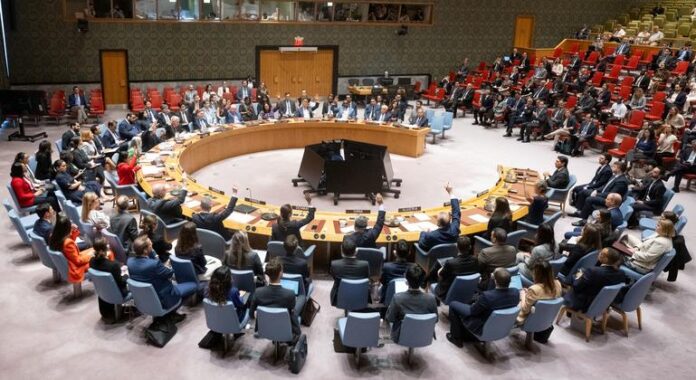
The text, co-sponsored by Algeria, Denmark, Greece, Guyana, Pakistan, Panama, the Republic of Korea, Sierra Leone, Slovenia, and Somalia – collectively known as the E-10 – received 14 votes in favour, with the US casting the lone vote against.
As one of the council’s five permanent members, the US holds veto power – a negative vote that automatically blocks any resolution from going forward.
Had it been adopted, the draft would have demanded “an immediate, unconditional and permanent ceasefire in Gaza” to be respected by all parties.
Release all hostages
The text reaffirmed the Council’s earlier call for the “immediate, dignified and unconditional release of all hostages held by Hamas and other groups.”
The draft also expressed grave concern over the “catastrophic humanitarian situation” in Gaza – following more than the months of almost total Israeli aid blockade – including the risk of famine, highlighted by recent international food security assessments.
It reaffirmed the obligation of all parties to comply with international law, including international humanitarian and human rights law.
Resume flow of aid
In addition to a ceasefire, the draft resolution demanded the “immediate and unconditional lifting of all restrictions” on the entry and distribution of humanitarian aid in Gaza, calling for safe and unhindered access for UN and humanitarian partners across the enclave.
It also urged the restoration of essential services, in accordance with humanitarian principles and prior Security Council resolutions.
The text voiced support for ongoing mediation efforts led by Egypt, Qatar, and the United States to revive the phased ceasefire framework outlined in resolution 2735 (2024), which envisions a permanent cessation of hostilities, the release of all hostages, the exchange of Palestinian prisoners, the return of all remains, full Israeli military withdrawal from Gaza, and the start of a long-term reconstruction plan.
Draft resolution unacceptable: United States
Speaking ahead of the vote, acting US Representative Dorothy Shea described the draft resolution as “unacceptable”.
“US opposition to this resolution should come as no surprise – it is unacceptable for what it does say, it is unacceptable for what it does not say, and it is unacceptable for the manner in which it has been advanced,” she said.
“The United States has been clear,” she continued, “we would not support any measure that fails to condemn Hamas and does not call for Hamas to disarm and leave Gaza.”
She added that Hamas has rejected numerous ceasefire proposals, including one over the weekend that would have provided a pathway to end the conflict and release the remaining hostages.
“We cannot allow the Security Council to award Hamas’ intransigence,” Ms. Shea said, stressing, “Hamas and other terrorists must have no future in Gaza. As Secretary [Marco] Rubio has said: ‘If an ember survives, it will spark again into a fire’.”
‘The world is watching’
The failure of the resolution comes as the humanitarian crisis in Gaza deepens, with UN agencies warning of the total collapse of health services, growing displacement, and a rising death toll around the new privatized US-Israel led aid distribution system which bypasses established agencies.
“The world is watching, day after day, horrifying scenes of Palestinians being shot, wounded or killed in Gaza while simply trying to eat,” said UN relief chief Tom Fletcher earlier on Wednesday.
Five humanitarians killed in ‘horrendous’ attack on aid convoy in Sudan

The World Food Programme (WFP) and the United Nations Children’s Fund (UNICEF) condemned the attack on the joint humanitarian convoy and reminded the international community that under humanitarian law, aid must be able to move securely.
“Aid convoys must be protected and parties have the obligation to allow and facilitate rapid and unimpeded passage of humanitarian relief for civilians in need,” the two agencies said in a joint statement.
UN Spokesperson Stéphane Dujarric reiterated this sentiment, saying that the United Nations condemns this “horrendous attack in the strongest possible terms.”
‘Devastating’ attack
The five aid workers killed were all Sudanese contractors working for WFP and UNICEF.
The convoy had travelled over 1,800 kilometres from the city of Port Sudan, located on the Red Sea coast, which has itself endured ongoing drone strikes.
The 15 trucks were carrying vital nutritional supplies to North Darfur, a region in which hundreds of thousands of internally displaced people are at high risk of malnutrition and starvation.
The agencies noted that all parties on the ground had been notified about the convoy and its movements.
“They were 80 kilometres from El Fasher, parked on the side of the road, waiting for clearance, and they were attacked,” said Mr. Dujarric.
This would have been the first convoy to reach El Fasher in over a year. In April, the city and the nearby Zamzam displacement camp were attacked, displacing hundreds of thousands, many of whom had already been displaced.
The attack on the convoy comes amidst a two-year conflict which has ravaged Sudan, displacing over nine million people. Famine has been declared in multiple places, including in El Fasher, and many more regions remain at risk.
Broader attacks on aid
The attack on the convoy comes amidst other attacks on humanitarian operations and civilians and civilian infrastructure in Sudan.
Last week, the WFP premises in El Fasher were bombed and damaged and an international hospital in Al Obeid also experienced a deadly drone strike.
Civilian infrastructure around the country continues to be targeted, including electricity infrastructure in Khartoum. The damage of this infrastructure in the capital has worsened an already spreading cholera outbreak in the city.
WFP and UNICEF reiterated that attacks on humanitarian activities and personnel are unacceptable and must stop immediately.
“Attacks on humanitarian staff, aid, operations as well as civilians and civilian infrastructure in Sudan have continued for far too long with impunity,” they said.
‘Our worst held fears are being confirmed’: Dozens of bodies discovered in Libya mass graves

“Our worst held fears are being confirmed: dozens of bodies have been discovered at these sites, along with the discovery of suspected instruments of torture and abuse, and potential evidence of extrajudicial killings,” Türk said.
The sites where bodies were discovered are run by the Stabilization Support Apparatus (SSA), an armed group tasked with increasing Government security in the capital, Tripoli. They have long been suspected by the UN Support Mission in Libya (UNSMIL) – and independent rights experts – to be sites of torture and enforced disappearance.
Mr. Türk called for these sites to be sealed for forensic investigations to support accountability.
Libya has endured turmoil since the fall of the Muammar Gaddafi regime 15 years ago and the emergence of rival administrations in 2014: the UN-recognized Government of National Unity (GNU) in Tripoli and the Government of National Stability (GNS) based in Benghazi.
The UN has supported many ultimately unsuccessful attempts to reunite the country and transition to democratic governance.
Over 80 bodies discovered
In May, the leader of the SSA – Abdul Ghani al-Kikli – was killed, triggering clashes between armed groups and state security forces. Protests also emerged, calling for an end to violence in Tripoli. Multiple civilians were killed and infrastructure – including hospitals – damaged.
In the wake of this violence, 10 badly charred bodies were discovered at the SSA headquarters in the Abu Salim neighbourhood. 67 more bodies were discovered at hospitals in Abu Salim and Al Khadra hospitals, all in refrigerators and in various states of decay.
The UN human rights office OHCHR also said that a burial site was discovered at the Tripoli Zoo, which is run by the SSA.
The identities of the bodies are not known at this stage.
Human rights abuses, at all levels
These were not the first mass graves discovered in Libya. In February, two mass graves were discovered in Jakharrah and Al-Kufra with 10 and 93 bodies respectively. Many of these bodies were migrants who are uniquely vulnerable to human trafficking, forced disappearance and killings.
The International Organization for Migration (IOM) recorded over 1,000 migrant deaths and disappearances in Libya in 2024 alone.
Mr. Türk expressed concern not only about the bodies discovered recently in Tripoli and the human rights abuses they confirm, but also about the force with which protests were met near the end of last month.
“We have received reports that these protests were themselves met with unnecessary force, raising serious concerns with respect to the guarantee of the fundamental rights of freedom of expression and assembly,” he said.
The High Commissioner for Human Rights also noted that images and videos of the bodies are circulating on social media, prompting him to call for preserving the dignity and privacy of victims.
Seal the sites, preserve the evidence
The Government of National Unity, the internationally-recognized administration based in Tripoli, announced the creation of two committees to investigate human rights abuses committed by State security forces, both in relation to the bodies and the protests.
While Türk noted this, he expressed concern that forensic authorities have not been allowed into the sites to examine and preserve related evidence.
He called on Libyan authorities to seal the recently discovered sites and promote immediate accountability efforts.
“Those responsible for these atrocious acts must be brought to justice without delay, in accordance with international standards,” he said.
Mr. Türk also urged all stakeholders to commit once more to transition attempts in order to move Libya towards an inclusive democracy once and for all, ending the “recurring cycle of transitional agreements.”
“The people of Libya have clearly expressed their demand for truth and justice, and their yearning for a peaceful and safe way of life with human rights and freedoms at the front and centre,” the High Commissioner added.
