
European Commission Press release Brussels, 04 Mar 2025 The President of the European Commission, Ursula von der Leyen, sent a letter to the members of the European Council ahead of the meeting of Thursday, 6 March 2…
Introductory remarks by Commissioner Kadis at the third Annual Forum of the EU Mission – “Restore our Ocean and Waters”

European Commission Speech Brussels, 04 Mar 2025 Dear friends, distinguished guests,
Thank you all for joining us for the third annual EU Mission Ocean and Waters forum.
It is a great honour to be here with yo…
Opening statement by Commissioner Jørgensen at the first meeting of the Special Committee on the Housing Crisis in the European Parliament
European Commission Speech Brussels, 03 Mar 2025 Good afternoon,
Let me first of all thank you for inviting me to your first meeting
Setting up a Special Committee like this, just as fact that President von…
President von der Leyen meets EU business leaders to present the Clean Industrial Deal
European Commission News Brussels, 27 Feb 2025
Following the adoption by College of Commissioners of the new Clean Industrial Deal, President Ursula von der Leyen was in Antwerp to present the details of th…
Opening remarks by Commissioner Roswall at the press point on COP16 on biodiversity (part 2) in Rome
European Commission Speech Brussels, 25 Feb 2025 Ladies and Gentlemen,
Declining biodiversity is a global problem. Ecosystems are degrading everywhere. It worsens the impact of climate change. It magnifies the…
EU-India: Towards a New Strategic Agenda
European Commission Factsheet Brussels, 25 Feb 2025 EU-India: Towards a New Strategic Agenda EU-India: Towards a New Strategic Agenda
President von der Leyen boosts ties with the Caribbean region during the CARICOM Summit in Barbados
European Commission News Brussels, 21 Feb 2025
This week, President von der Leyen visited Bridgetown, Barbados, where she was invited to participate in the CARICOM Summit of Caribbean Heads of Government. H…
Speech by the Executive Vice-President Raffaele Fitto at the 164th plenary Session and Inaugural plenary session of the 8th term of office of the European Committee of the Regions (CoR)
European Commission Speech Brussels, 20 Feb 2025 Dear President,
Dear Members,
Thank you for this opportunity to address you.
Let me start by congratulating President Tüttő, on her election.
Dear Kata, I am ho…
Humanitarians underscore need for urgent and sustained support in Gaza
OCHA cited Gaza’s Ministry of Health which stressed that oxygen supplies are critically needed to keep emergency, surgical and intensive care services running at hospitals, including Al Shifa and Al Rantisi hospitals in Gaza City.
“Health partners are engaging with the authorities to bring in generators, spare parts and equipment required to produce oxygen locally in Gaza,” the agency said.
Shelter and education
Over the weekend, humanitarian partners working in the shelter sector distributed tarpaulins to more than 11,000 families in the north.
In Khan Younis, some 450 families are receiving sealing-off kits to create short-term shelters, kitchen sets and hygiene kits at the displacement site of Al Mawasi.
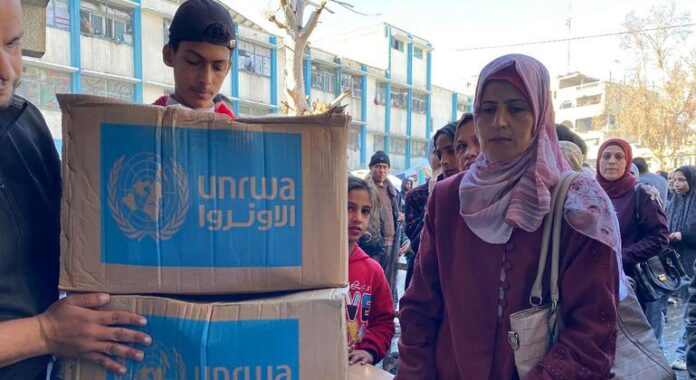
Educational activities also continue to expand, and more than 250,000 children have enrolled in distance learning programmes run by the UN Palestine refugee agency, UNRWA.
Some 95 per cent of school buildings across Gaza were damaged over the past 15 months of hostilities, according to UN partners working in the education sector. Students are currently attending classes in makeshift tents and open spaces, amid winter temperatures.
West Bank hostilities
OCHA also reported on the situation in the West Bank, where casualties continue to be reported due to the ongoing operations by Israeli forces in Tulkarm and Jenin.
“These are the most extensive Israeli operations in the West Bank in two decades, causing high casualties and significant displacement, especially in refugee camps,” the agency noted.
Critical infrastructure has also been severely damaged, driving humanitarian needs even higher.
OCHA once again warned that the use of lethal, war-like tactics during these operations raises concerns over the use of force that exceeds law enforcement standards.
Settler attacks against Palestinians and their properties also continue to be reported across the West Bank. Israeli settlers attacked residents in several villages in Nablus governorate over the weekend – in one instance, setting a house on fire.
Humanitarians are mobilizing resources to support affected communities, OCHA said.
Averting UNRWA collapse
The head of UNRWA warned on Monday that if the agency collapses it will create a vacuum in the occupied Palestinian territory and send shockwaves through neighbouring countries.
Commissioner-General Philippe Lazzarini was speaking in Cairo at the Fourth Meeting of the Global Alliance for the Implementation of the Two-State Solution.
He said Israeli legislation targeting UNRWA’s operations is now being implemented.
Last October, Israel’s parliament, the Knesset, adopted two bills banning UNRWA from working in Israeli territory and enforcing a no-contact policy between national authorities and agency representatives. The laws took effect in January.
Threat to peace and stability
Mr. Lazzarini warned against allowing UNRWA to “implode” due to the Knesset legislation and the suspension of funding by key donors.
“An environment in which children are deprived of education, and people lack access to basic services, is fertile ground for exploitation and extremism” he said. “This is a threat to peace and stability in the region and beyond.”
He said that alternatively, UNRWA could progressively conclude its mandate within the framework of a political process like that championed by the Global Alliance.
“The agency would gradually transition its public-like services to empowered and prepared Palestinian institutions. This is the future for which we are preparing,” he said.
F4E and EUROfusion share expertise for plasma heating

One of the key factors in the fusion formula is temperature. Devices like ITER will need to heat the plasma up to 150 million °C –ten times hotter than the core of the Sun – and keep it burning. To achieve these extreme conditions, ITER will rely on technologies like the Electron Cyclotron Resonance Heating (ECRH), designed to turn electricity into 1 MW electromagnetic waves and inject them in the tokamak.
Fusion for Energy (F4E) is providing key components for this system, such as high voltage supplies, gyrotrons or the launchers. In its unprecedented power and complexity, ITER’s ECRH draws on decades of cutting-edge research and development by European scientists. In this context, F4E and EUROfusion (the consortium of European fusion labs) are seizing new synergies to pool and advance knowledge for ITER and future fusion plants like DEMO.
An example of this collaboration is the ECRH community, a grassroots network of experts from F4E and the European laboratories, as well as Japan’s QST and ITER Organization. Since last year, they have been organising online seminars, training courses for new operators, or conduct joint studies on a variety of ECRH topics. The group met recently for a 3-day workshop, hosted by the Max Planck Institute for Plasma Physics (IPP) in Greifswald, Germany.
Besides this, F4E has recently partnered with the Karlsruhe Institute of Technology (KIT), a member of EUROfusion. The German research centre will provide support in engineering and physics for F4E’s projects in the area of ECRH, with the Swiss Plasma Center (SPC) and the National and Kapodistrian University of Athens (NKUA) as subcontractors. Their first tasks will be helping with the Final Design Review of the ITER gyrotrons, which Thales will manufacture for F4E. Crucially, KIT and SPC own two specialised test stands for gyrotrons, essential to qualify this critical heating technology.
“The European fusion labs have world-class expertise in ECRH technologies, as they have been developing, testing and analysing them for over 20 years. There is a clear complementarity between their experience and F4E’s work to supply components to ITER,” explains Paco Sánchez, Gyrotrons Project Manager at F4E.
“Through this contract we have an excellent opportunity to contribute to ITER and keep deepening our knowledge in key fusion systems like megawatt-class gyrotrons, EC launchers, transmission lines, matching optical units and diamond windows” celebrates Prof. John Jelonnek, Head of the Institute for Pulsed Power and Microwave Technology (IHM) at KIT.
This teamwork is in the spirit of the agreement recently signed between F4E and EUROfusion. In a new Memorandum of Understanding, both entities committed to keep collaborating to strengthen Europe’s scientific and technological leadership in fusion.
What are gyrotrons and how do they work? Read the article by EUROfusion.
