Monday, March 23, 2026
Home Blog Page 64

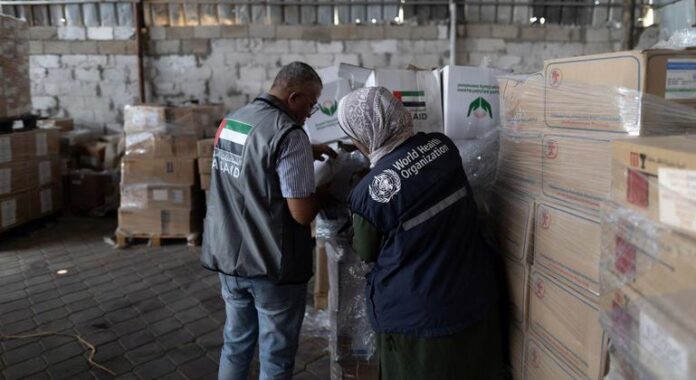
Gaza battered by heavy rains as humanitarian response continues

0
Gaza battered by heavy rains as humanitarian response continues

Heavy seasonal downpours are compounding an already dire humanitarian situation, as rainstorms cause war-damaged buildings to collapse, flood tents and soak people’s belongings, OCHA said.

To respond swiftly to flood alerts, a coordinated system bringing together UN agencies and non-governmental organizations is distributing tents, tarpaulins, warm clothes, blankets and dignity kits across Gaza.

The UN and its partners are also mobilising heavy equipment to pump overflowing sewage – which poses serious health risks – away from residential areas. OCHA warned that the conditions have increased the risk of hypothermia, particularly among babies, as well as illnesses linked to sewage flooding.

Separately, humanitarian teams are assisting hundreds of people newly displaced from the At Tufah neighbourhood in Gaza City, where ongoing military operations have forced many residents to flee.

People who remain in, or have returned to, the As Sanafour area of At Tufah – often due to a lack of space elsewhere – report significant challenges in accessing water, food and basic services.

Relief operations continue

Other relief operations under the UN-coordinated humanitarian plan for the ceasefire are continuing.

Between 23 and 26 December, partners working on water, sanitation and hygiene dispatched tens of thousands of dignity kits, hygiene kits and bottles of shampoo across Gaza, reaching some 150,000 people in need, according to OCHA.

As of Sunday, partners addressing food insecurity had reached more than one million people – about half of Gaza’s population — through 60 distribution points with December’s monthly general food assistance.

In parallel, humanitarian partners distributed veterinary kits and animal feed to more than 2,000 families with livestock between 9 and 26 December, helping support local production and reduce aid dependency.

Source link

UN, US sign $2 billion humanitarian funding deal for 17 crisis-hit countries

0

Speaking at the signing in Geneva, UN Emergency Relief Coordinator Tom Fletcher paid tribute to aid workers operating in increasingly difficult conditions, describing the past year as “a very, very difficult year for everyone engaged in humanitarian action.”

Despite the challenges, he said the agreement, known as a memorandum of understanding or MOU, offered reasons for optimism.

“Millions, millions more will receive much-needed support,” Mr Fletcher said, adding that this funding would help save tens of millions of lives over the coming year.

The agreement covers 17 crisis-affected countries: Guatemala, Honduras, El Salvador, Ukraine, Haiti, Nigeria, Ethiopia, South Sudan, Mozambique, Myanmar, Democratic Republic of Congo (DRC), Sudan, Bangladesh, Syria, Uganda, Kenya and Chad, as well as the UN. Central Emergency Response Fund (DEER).

Table of Contents

Save lives

Mr Fletcher said the real impact of this “historic deal” would be its impact on the ground. “One number that really matters…is that millions of lives will be saved,” he said.

He noted that the funding supports the UN’s 2026 plan to provide emergency assistance to 87 million people. This plan, he said, was “hyper-prioritized” to reduce duplication, streamline bureaucracy and maximize the efficiency of the entire humanitarian system.

The deal is a major vote of confidence in the “humanitarian reset” – announced by Mr Fletcher in March 2025 – aimed at delivering aid faster, smarter and closer to the people who need it most.

Responsibility

Reform and accountability featured prominently in his remarks.

Mr Fletcher stressed that donors expect results, saying accountability mechanisms would ensure “every dollar we spend” is tracked to confirm it is saving lives. He also stressed that the agreement does not imply alignment on all issues but reflects a common focus on urgent priorities that save lives.

He also highlighted the link between humanitarian action and diplomacy, calling for 2026 to be “a year of diplomacy and peacemaking.” Ending conflict, he said, remains the most effective way to reduce humanitarian needs.

“This life-saving announcement does not mark the end of the process,” concluded Mr. Fletcher. “This is the beginning.”

Originally published at Almouwatin.com

UN chief urges world leaders to ‘clarify priorities’ as New Year’s message calls for peace rather than war

0

“The world stands at a crossroads,” he said, warning that conflict, climate breakdown and systemic violations of international law are eroding trust in leaders around the world.

“People everywhere are asking: Are leaders listening? Are they ready to act?” he said.

Mr. Guterres highlighted the scale of global suffering, noting that more than a quarter of humanity now lives in conflict-affected areas. On 200 million people need humanitarian aid, while almost 120 million have been forcibly displaced by war, crises, disasters or persecution.

In this context, he highlighted what he described as a deep imbalance in global priorities.

“As we turn the page on a turbulent year, one fact speaks louder than words: global military spending soared to $2.7 trillion“, he said, almost 10 percent more than the previous year.

This figure, he pointed out, is 13 times greater than total global development assistance and equivalent to the entire gross domestic product (GDP) of the African continent. If current trends continue, military spending could more than double to $6.6 trillion by 2035, even as humanitarian needs continue to rise.

A path to hope

Despite these grim statistics, the Secretary-General stressed that solutions are within reach.

In September 2025, he launches the report The security we need: rebalancing military spending for a sustainable and peaceful future. The report shows how relatively modest changes in spending could produce transformative results.

Less than 4% of current military spending could end world hunger by 2030, while just over 10% could fully vaccinate all children. Redirecting 15 percent would more than cover the annual cost of climate adaptation in developing countries.

“It is clear that the world has the resources to save lives, heal the planet and ensure a future of peace and justice,” Mr. Guterres said.

Call to action

Looking ahead, he sent a direct message to leaders around the world.

“In this new year, let us resolve to clarify our priorities. A safer world begins by investing more in the fight against poverty and less in war. Peace must prevail,” he urged.

Addressing people around the world, he added: “Play your part. Our future depends on our collective courage to act.”

“In 2026,” he concluded, “I call on world leaders: get serious. Choose people and planet over pain. Let’s stand up together – for justice, for humanity, for peace.”

Originally published at Almouwatin.com

SECURITY COUNCIL LIVE: Briefing on threats to international peace and security

0

The UN Security Council meets today to hear a briefing on threats to international peace and security following Israel’s recent recognition of the northern region of Somalia as an independent and sovereign state. Follow live below and UN News app users can Click here and goes here for all our in-depth meeting coverage.

Originally published at Almouwatin.com

NY Requires Warning Labels on Social Media

0
NY Requires Warning Labels on Social Media


New York just became a battleground for children’s mental health. Governor Kathy Hochul signed legislation this week forcing social media companies to slap warning labels on features designed to keep young users glued to their screens.

Image credit: Yanalya, via Freepik, free license

Key takeaways:

  • Social media platforms must display mental health warnings before exposing young users to autoplay, infinite scroll, and similar features
  • Users cannot bypass these warnings, which will appear initially and periodically during use
  • The law follows the same logic as tobacco and alcohol warnings, treating certain platform features as public health concerns

The bill, S4505/A5346, passed the state legislature back in June. It targets what lawmakers call “addictive social media platforms”—services that rely heavily on addictive feeds, push notifications, autoplay, infinite scroll, or like counts. There’s one exception: platforms can avoid the requirement if the state attorney general determines these features serve “a valid purpose unrelated to prolonging use of such platform.”

Warning labels will appear when young users first encounter these features and continue showing up periodically. No skip button. No dismissal option. The approach mirrors existing requirements for tobacco products, alcohol, and media containing flashing lights.

Former Surgeon General Vivek Murthy called for exactly this type of intervention last year, arguing social media warranted the same treatment as other public health risks.

“Keeping New Yorkers safe has been my top priority since taking office, and that includes protecting our kids from the potential harms of social media features that encourage excessive use,” Hochul said in a statement.

Assemblymember Nily Rozic, one of the bill’s sponsors, emphasized transparency: “New York families deserve honesty about how social media platforms impact mental health. By requiring warning labels based on the latest medical research, this law puts public health first and finally gives us the tools we need to make informed decisions.”

California lawmakers have introduced similar legislation, suggesting this approach may spread beyond New York.

This builds on momentum from last year, when New York passed laws requiring parental consent before platforms could show children addictive feeds or collect and sell data from users under 18.

Hochul has been busy with tech regulation as 2025 closes out. She also recently signed the RAISE Act, focused on AI safety measures.


Written by Alius Noreika


Source link

NY Requires Warning Labels on Social Media

0

Image credit: Yanalya, via Freepik, free license

Key takeaways:

  • Social media platforms must display mental health warnings before exposing young users to autoplay, infinite scroll, and similar features
  • Users cannot bypass these warnings, which will appear initially and periodically during use
  • The law follows the same logic as tobacco and alcohol warnings, treating certain platform features as public health concerns

The bill, S4505/A5346, passed the state legislature back in June. It targets what lawmakers call “addictive social media platforms”—services that rely heavily on addictive feeds, push notifications, autoplay, infinite scroll, or like counts. There’s one exception: platforms can avoid the requirement if the state attorney general determines these features serve “a valid purpose unrelated to prolonging use of such platform.”

Warning labels will appear when young users first encounter these features and continue showing up periodically. No skip button. No dismissal option. The approach mirrors existing requirements for tobacco products, alcohol, and media containing flashing lights.

Former Surgeon General Vivek Murthy called for exactly this type of intervention last year, arguing social media warranted the same treatment as other public health risks.

“Keeping New Yorkers safe has been my top priority since taking office, and that includes protecting our kids from the potential harms of social media features that encourage excessive use,” Hochul said in a statement.

Assemblymember Nily Rozic, one of the bill’s sponsors, emphasized transparency: “New York families deserve honesty about how social media platforms impact mental health. By requiring warning labels based on the latest medical research, this law puts public health first and finally gives us the tools we need to make informed decisions.”

California lawmakers have introduced similar legislation, suggesting this approach may spread beyond New York.

This builds on momentum from last year, when New York passed laws requiring parental consent before platforms could show children addictive feeds or collect and sell data from users under 18.

Hochul has been busy with tech regulation as 2025 closes out. She also recently signed the RAISE Act, focused on AI safety measures.


Written by Alius Noreika

Source link

New European Scientific Advisory Board on Climate Change appointed

0

DISCLAIMER: Information and opinions reproduced in the articles are the ones of those stating them and it is their own responsibility. Publication in The European Times does not automatically means endorsement of the view, but the right to express it.

DISCLAIMER TRANSLATIONS: All articles in this site are published in English. The translated versions are done through an automated process known as neural translations. If in doubt, always refer to the original article. Thank you for understanding.

Source link

Brussels’ Drug Consumption Rooms: A Dangerous Surrender to Addiction

0
Brussels’ Drug Consumption Rooms: A Dangerous Surrender to Addiction

As Brussels expands its network of supervised drug consumption rooms—known euphemistically as “safe injection sites”—the city risks entrenching a failed policy that prioritizes harm management over true recovery, mirroring disastrous outcomes seen in New York City and reported by Freedom Mag​

Escalating Use, Not Recovery

Brussels’ first such facility, GATE, opened in 2022 near the Midi station, followed by LINKup on December 15, 2025, with a larger integrated centre planned for 2026 along the canal. Proponents claim these sites reduce street drug use by providing sterile needles, on-site medical intervention, and a “social” space for injecting heroin, snorting cocaine, or smoking crack. Yet New York City’s OnPoint centres, operational since 2021, reveal the reality: daily visits surged over 100%, overdoses rose 7% from 2022 to 2023 (636 to 683), and at least 46 users suffered life-threatening cardiac arrests, strokes, or heart attacks requiring ambulance transport—outcomes operators fail to track long-term. In Brussels, where over 1,000 users (half homeless) have flocked to GATE by mid-2024, this model normalizes addiction rather than dismantling it, boasting “thousands of uses off the streets” while ignoring sustained recovery rates.​

Threat to Public Health and Children

Far from safeguarding health, these rooms facilitate repeated exposure to destructive substances, undermining personal and public well-being. New York’s 3,156 users logged 61,184 visits in 2023 alone, including 177 daily “clients” (up 108% year-over-year), with staff intervening in over 1,700 overdoses amid tens of thousands of heroin injections, crack smokes, and speedball hits. Brussels’ sites, clustered near transport hubs and neighbourhoods like the halted Molenbeek project (suspended by the Council of State over safety and nuisance fears), expose children to drug paraphernalia, dealers, and overdoses in family areas with schools. US Representative Nicole Malliotakis calls them “heroin shooting galleries” that attract crime and erode quality of life, a warning echoed in Brussels’ narco-violence linked to Antwerp cocaine floods. Children’s security demands zero-tolerance zones, not state-sanctioned drug dens.​

Economic Drain on a Productive Nation

Belgium’s legal grey zone—under a 1921 law criminalizing premises for illegal drugs—allows these experiments via prosecutorial tolerance, but at what cost to taxpayers and society? Funding sterile booths, naloxone, and staff diverts resources from prevention, while fostering dependency that erodes workforce productivity: addicts cycle through welfare, missing education and jobs essential for a competitive Europe. Former DEA official Jim Crotty insists the goal cannot be mere survival; drugs’ destructiveness demands cessation, not facilitation. Manhattan Institute expert Charles Lehman notes operators ignore long-term outcomes, prioritizing visit counts over cures. For Brussels, a hub of EU institutions, this signals resignation, weakening the productive nation needed for innovation and growth.​

The Proven Alternative: Education Over Enablement

Supervised consumption confuses overdose patches with policy success, condemning users to endless highs in “safe” havens while Europe debates shutdowns amid rising crime. True progress lies in education campaigns exposing drugs’ full toll, as proven by initiatives like the Church of Scientology’s Truth About Drugs, distributed to 170 million worldwide and adopted by over 1,000 law enforcement agencies to prevent youth addiction. Liège’s room since 2018 and Brussels’ expansions lack federal backing or outcome data, urging a pivot to demand reduction: school programs, early interventions, and recovery-focused treatment. Policymakers must reject this surrender, protecting health, children, and Belgium’s future through proactive prevention, not permissive drug dens.​

Source link

Space weather: Monitoring near-Earth space environment to mitigate weather and security threats

0
Space weather: Monitoring near-Earth space environment to mitigate weather and security threats

The local weather forecast tells us if we need to bundle up or bring an umbrella. National and global reports alert us to instances of extreme weather – and the need for assistance in affected regions. But what about the weather in space? How do events like solar wind – originating at a distance of about 150 million kilometres – affect our daily lives?

Aurora borealis – illustrative photo. Image credit: Pixabay (Free Pixabay license)

“Studies show that solar storms can cause massive problems. The worry is that a big one will knock out the power systems that our modern society so highly depends on,” says Glenn Hussey, principal investigator and director at the Super Dual Auroral Radar Network (SuperDARN) Canada. “We could be in the dark for weeks or months.”

In addition to impacting power grids, solar activity like flares and coronal mass ejections can degrade pipelines, disrupt or damage satellites, interfere with navigation and communication signals and endanger high-altitude air travel, which makes predicting and mitigating these effects critical, says Dr. Hussey, adding that this is part of SuperDARN’s objective: to provide scientific insights into space weather to help guard against detrimental impact.

SuperDARN Canada, headquartered in the Institute of Space and Atmospheric Studies (ISAS) at the University of Saskatchewan (USask), is Canada’s contribution to the SuperDARN program, a global network of scientific radars monitoring conditions in the near-Earth space environment.

There is a clear link between “studying the physics interactions that happen at the boundary between the atmosphere and space – and understanding the outcomes,” says Daniel Billett, assistant director at SuperDARN Canada. “We’re ionospheric physicists who conduct fundamental research. We run the radars and gather the data. From there, we collaborate with people who use this information to model forecasting – or to mitigate effects like power outages or satellite signal disruptions.”

A legacy of leadership

2025 marks the 30th anniversary of the SuperDARN program, which officially started in 1995 with the signing of the principal investigators’ agreement. Two years prior to that event, in 1993, the first SuperDARN Canada radar was switched on in Saskatoon, which served as a meeting place for the original SuperDARN partners: Canada, France and the U.S.

While the SuperDARN network has grown significantly over the past three decades to now include 10 countries, Canada has continued to play a leadership role that builds on USask’s long history of atmospheric research.

In addition, Canada has the largest land mass under the auroral oval, making it an ideal place to study solar-terrestrial interactions, says Dr. Hussey, explaining the connection between solar wind and the colourful lights we experience as auroras.

Solar wind is the result of the sun streaming charged particles outward from its corona at high speeds. The resulting plasma travels through the solar system, interacting with planets and other celestial bodies. Coming up against the natural protection of the Earth’s magnetic field, these particles are channelled along magnetic field lines toward the polar regions. There, they collide with atmospheric gases, resulting in the glow of the aurora borealis in the north and the aurora australis in the south.

Ionospheric research is looking to understand “how the Earth’s atmosphere responds to the violent bombardment of charged particles from the sun, and where all that energy goes,” says Dr Hussey. “A pilot would refer to the range we’re looking at – about 200 to 300 kilometres up – as space. But if you ask us, we see it as part of our atmosphere. We want to know what the weather is in space – and how it affects us on Earth.”

Made-in-Canada technology advancements

Of the over 40 SuperDARN radars worldwide, Canada operates five, located in Saskatchewan, B.C., the Northwest Territories and Nunavut.

SuperDARN radars emit high-frequency radio waves that refract in the upper atmosphere, bounce off targets made up of dense spots of plasma and return to radar receivers. Also called over-the-horizon radars, they can travel long distances parallel to the curvature of the Earth.

“When SuperDARN first started, everything was analog. Even today, many radars still use such systems,” says Dr. Billett, adding that SuperDARN Canada’s move from analog to digital came through a shift from aging hardware to modern software-defined radios (SDR) and digital signal processing.

Resulting technology advances come with improved data quality and reliability – as well as the ability to perform sophisticated tasks like full-field-of-view imaging and simultaneous multi-frequency operations.

“Previously, the signals from the 20 antennas were collapsed into only two data streams,” says Dr. Hussey. “The new system, which we call Borealis, processes all raw data streams independently. This very modern version of SuperDARN was developed by Kathryn McWilliams.

“Kathryn was a great scientist, and it is her legacy we’re continuing,” says Dr. Hussey of his predecessor, a trailblazing engineering physics professor at USask, who took over from Dr. Sofko as principal investigator and led SuperDARN Canada from 2012 until earlier this year.

Since it was designed with user-friendliness in mind, the Borealis system makes it easier to write experiments and use data, further enhancing accessibility for researchers, says Dr. Hussey. “We also have this mode, where we can capture 16 times more data, from once per minute to once every 3.7 seconds. This makes us very popular: lots of people want access to this information.”

An open-data policy ensures that data from all radars worldwide are shared by all SuperDARN partners and available to the public, he explains. “Combining data from all these radars – along with information from other types of instruments that study the aurora – allows us to picture what is happening globally.”

From big picture to local impact

The collaborative nature of the work at SuperDARN Canada illustrates one of the major strengths of the University of Saskatchewan, the Canadian lead for the international network, says Baljit Singh, the university’s vice-president, research. “We’re known for extensive international collaboration – and we focus on leadership in areas that address major global challenges, such as water and food security, vaccine development, public health, defence and sustainability.”

Canada’s contribution to SuperDARN is considerable, with five radars each scanning more than three million square kilometres every minute, 24 hours a day, 365 days a year. This continuous surveillance not only offers granular insights into how electromagnetic forces in space affect the Earth but also carries significant implications for defence and security in the Arctic.

Radars play a key role in monitoring aircraft signatures. In the polar regions, however, space weather – along with other radar signals – can make identifying and tracking targets more challenging, says Dr. Hussey. This resulted in a collaboration with Defence Research and Development Canada a few years ago, which continued periodically in the intervening years. A long-term goal is to continue this collaboration and implement AI-tools that will help filter radar data and provide easier identification in the High Arctic.

For Dr. Singh, SuperDARN Canada research also has implications at the community level. “The technologically driven world we live in is vulnerable to the effects of space weather, which can damage power grids and pipelines, degrade satellite navigation – and disrupt communications,” he says. “All of this can impact our daily lives and lead to loss of business and livelihoods, even loss of life in extreme situations.”

Some impacts of space weather have been well-documented. An example is the geomagnetic storm that led to the extensive failure of electrical systems on March 13, 1989, in Quebec, an event accompanied by intense auroras that could be seen as far south as Texas and Florida.

Dr. Hussey also recalls recent consequences affecting agricultural processes. “Due to a geomagnetic storm, radio signal transmissions from satellites were being distorted. It meant that precision-farming equipment that relies on GPS didn’t function well,” he says. “This can cause major disruptions, especially during planting or seeding times.”

Such examples inspire the question, “What can we do to better protect the digital communication assets and other infrastructure our society depends on?” says Dr. Singh. “That’s where research can provide valuable answers.”

The goal is not only to monitor space weather – but develop predictive capabilities that can minimize negative consequences, according to Dr. Hussey. Collaborations with SuperDARN scientists can allow satellite operators and space missions to take preventative measures in preparation of storms, such as putting satellites into low-energy mode to prevent damage to the electronics, he says. “Once satellites are in space, they’re very hard to fix.”

Yet despite significant advancements, “prediction remains very difficult in our field,” notes Dr. Billett. “We’re about 40 years behind weather forecasting on the ground, because we have much less information.

“We all have to work together to improve and ingest the data to try to understand the near-Earth space environment better,” he adds. And in this mission, SuperDARN Canada is leading the way.

Source: University of Saskatchewan

Source link

Space weather: Monitoring near-Earth space environment to mitigate weather and security threats

0
Space weather: Monitoring near-Earth space environment to mitigate weather and security threats


The local weather forecast tells us if we need to bundle up or bring an umbrella. National and global reports alert us to instances of extreme weather – and the need for assistance in affected regions. But what about the weather in space? How do events like solar wind – originating at a distance of about 150 million kilometres – affect our daily lives?

Space weather: Monitoring near-Earth space environment to mitigate weather and security threats

Aurora borealis – illustrative photo. Image credit: Pixabay (Free Pixabay license)

“Studies show that solar storms can cause massive problems. The worry is that a big one will knock out the power systems that our modern society so highly depends on,” says Glenn Hussey, principal investigator and director at the Super Dual Auroral Radar Network (SuperDARN) Canada. “We could be in the dark for weeks or months.”

In addition to impacting power grids, solar activity like flares and coronal mass ejections can degrade pipelines, disrupt or damage satellites, interfere with navigation and communication signals and endanger high-altitude air travel, which makes predicting and mitigating these effects critical, says Dr. Hussey, adding that this is part of SuperDARN’s objective: to provide scientific insights into space weather to help guard against detrimental impact.

SuperDARN Canada, headquartered in the Institute of Space and Atmospheric Studies (ISAS) at the University of Saskatchewan (USask), is Canada’s contribution to the SuperDARN program, a global network of scientific radars monitoring conditions in the near-Earth space environment.

There is a clear link between “studying the physics interactions that happen at the boundary between the atmosphere and space – and understanding the outcomes,” says Daniel Billett, assistant director at SuperDARN Canada. “We’re ionospheric physicists who conduct fundamental research. We run the radars and gather the data. From there, we collaborate with people who use this information to model forecasting – or to mitigate effects like power outages or satellite signal disruptions.”

A legacy of leadership

2025 marks the 30th anniversary of the SuperDARN program, which officially started in 1995 with the signing of the principal investigators’ agreement. Two years prior to that event, in 1993, the first SuperDARN Canada radar was switched on in Saskatoon, which served as a meeting place for the original SuperDARN partners: Canada, France and the U.S.

While the SuperDARN network has grown significantly over the past three decades to now include 10 countries, Canada has continued to play a leadership role that builds on USask’s long history of atmospheric research.

In addition, Canada has the largest land mass under the auroral oval, making it an ideal place to study solar-terrestrial interactions, says Dr. Hussey, explaining the connection between solar wind and the colourful lights we experience as auroras.

Solar wind is the result of the sun streaming charged particles outward from its corona at high speeds. The resulting plasma travels through the solar system, interacting with planets and other celestial bodies. Coming up against the natural protection of the Earth’s magnetic field, these particles are channelled along magnetic field lines toward the polar regions. There, they collide with atmospheric gases, resulting in the glow of the aurora borealis in the north and the aurora australis in the south.

Ionospheric research is looking to understand “how the Earth’s atmosphere responds to the violent bombardment of charged particles from the sun, and where all that energy goes,” says Dr Hussey. “A pilot would refer to the range we’re looking at – about 200 to 300 kilometres up – as space. But if you ask us, we see it as part of our atmosphere. We want to know what the weather is in space – and how it affects us on Earth.”

Made-in-Canada technology advancements

Of the over 40 SuperDARN radars worldwide, Canada operates five, located in Saskatchewan, B.C., the Northwest Territories and Nunavut.

SuperDARN radars emit high-frequency radio waves that refract in the upper atmosphere, bounce off targets made up of dense spots of plasma and return to radar receivers. Also called over-the-horizon radars, they can travel long distances parallel to the curvature of the Earth.

“When SuperDARN first started, everything was analog. Even today, many radars still use such systems,” says Dr. Billett, adding that SuperDARN Canada’s move from analog to digital came through a shift from aging hardware to modern software-defined radios (SDR) and digital signal processing.

Resulting technology advances come with improved data quality and reliability – as well as the ability to perform sophisticated tasks like full-field-of-view imaging and simultaneous multi-frequency operations.

“Previously, the signals from the 20 antennas were collapsed into only two data streams,” says Dr. Hussey. “The new system, which we call Borealis, processes all raw data streams independently. This very modern version of SuperDARN was developed by Kathryn McWilliams.

“Kathryn was a great scientist, and it is her legacy we’re continuing,” says Dr. Hussey of his predecessor, a trailblazing engineering physics professor at USask, who took over from Dr. Sofko as principal investigator and led SuperDARN Canada from 2012 until earlier this year.

Since it was designed with user-friendliness in mind, the Borealis system makes it easier to write experiments and use data, further enhancing accessibility for researchers, says Dr. Hussey. “We also have this mode, where we can capture 16 times more data, from once per minute to once every 3.7 seconds. This makes us very popular: lots of people want access to this information.”

An open-data policy ensures that data from all radars worldwide are shared by all SuperDARN partners and available to the public, he explains. “Combining data from all these radars – along with information from other types of instruments that study the aurora – allows us to picture what is happening globally.”

From big picture to local impact

The collaborative nature of the work at SuperDARN Canada illustrates one of the major strengths of the University of Saskatchewan, the Canadian lead for the international network, says Baljit Singh, the university’s vice-president, research. “We’re known for extensive international collaboration – and we focus on leadership in areas that address major global challenges, such as water and food security, vaccine development, public health, defence and sustainability.”

Canada’s contribution to SuperDARN is considerable, with five radars each scanning more than three million square kilometres every minute, 24 hours a day, 365 days a year. This continuous surveillance not only offers granular insights into how electromagnetic forces in space affect the Earth but also carries significant implications for defence and security in the Arctic.

Radars play a key role in monitoring aircraft signatures. In the polar regions, however, space weather – along with other radar signals – can make identifying and tracking targets more challenging, says Dr. Hussey. This resulted in a collaboration with Defence Research and Development Canada a few years ago, which continued periodically in the intervening years. A long-term goal is to continue this collaboration and implement AI-tools that will help filter radar data and provide easier identification in the High Arctic.

For Dr. Singh, SuperDARN Canada research also has implications at the community level. “The technologically driven world we live in is vulnerable to the effects of space weather, which can damage power grids and pipelines, degrade satellite navigation – and disrupt communications,” he says. “All of this can impact our daily lives and lead to loss of business and livelihoods, even loss of life in extreme situations.”

Some impacts of space weather have been well-documented. An example is the geomagnetic storm that led to the extensive failure of electrical systems on March 13, 1989, in Quebec, an event accompanied by intense auroras that could be seen as far south as Texas and Florida.

Dr. Hussey also recalls recent consequences affecting agricultural processes. “Due to a geomagnetic storm, radio signal transmissions from satellites were being distorted. It meant that precision-farming equipment that relies on GPS didn’t function well,” he says. “This can cause major disruptions, especially during planting or seeding times.”

Such examples inspire the question, “What can we do to better protect the digital communication assets and other infrastructure our society depends on?” says Dr. Singh. “That’s where research can provide valuable answers.”

The goal is not only to monitor space weather – but develop predictive capabilities that can minimize negative consequences, according to Dr. Hussey. Collaborations with SuperDARN scientists can allow satellite operators and space missions to take preventative measures in preparation of storms, such as putting satellites into low-energy mode to prevent damage to the electronics, he says. “Once satellites are in space, they’re very hard to fix.”

Yet despite significant advancements, “prediction remains very difficult in our field,” notes Dr. Billett. “We’re about 40 years behind weather forecasting on the ground, because we have much less information.

“We all have to work together to improve and ingest the data to try to understand the near-Earth space environment better,” he adds. And in this mission, SuperDARN Canada is leading the way.

Source: University of Saskatchewan


Source link