
A major earthquake struck Herat, Afghanistan early Saturday killing at least 100 people and triggering a spate of rescue and assessment missions by UN agencies, partners, and the de facto authorities.
Earthquake kills at least 100 in Herat, Afghanistan

Afghanistan: Aid efforts rapidly expand as post-quake death toll rises

The death toll from the major earthquake that pummelled western Afghanistan soared over 1,000 overnight as rescue operations continued to fan out over affected villages, UN agencies said on Sunday.
Namur by bike: explore the city and its surroundings on two wheels

Namur by bike: explore the city and its surroundings on two wheels
Namur, located in the heart of Wallonia in Belgium, is a city full of charm and history. With its rich architectural heritage, green parks and picturesque landscapes, Namur is an ideal destination for cycling enthusiasts. Whether you are a resident of the city or a visitor passing through, exploring Namur by bike is an unforgettable experience that will allow you to discover all the hidden treasures of this magnificent region.
The city of Namur offers numerous cycle paths which will allow you to move around in complete safety and fully enjoy your bike ride. Along the Meuse, you can admire the boats sailing peacefully on the river and enjoy the breathtaking view of the citadel which overlooks the city. You can also go to the foot of the citadel by taking the cycle path which runs along the Sambre. Once at the top, you can visit this magnificent fortified castle which offers a panoramic view of the entire region.
Outside the city, the surroundings of Namur are full of picturesque landscapes and charming villages to discover by bike. For example, you can go to the Molignée valley, known for its hilly landscapes and its old railway tracks transformed into cycle paths. This region is also famous for its caves, castles and abbeys that you can discover during your bike ride.
If you are a nature lover, don’t miss the Flemish Ardennes Natural Park. Located a few kilometers from Namur, this park offers numerous opportunities for cycling through rural and wooded landscapes. You can also take a break in one of the many typical villages of the region and taste the local specialties.
Namur is also a cultural city full of museums and historical sites to visit. By traveling by bike, you can easily get from one place to another and fully enjoy your visit. Don’t miss the Félicien Rops museum, dedicated to this famous Namur artist, nor the Saint-Aubin cathedral which is one of the most beautiful religious buildings in the region.
For those who wish to extend their stay in Namur, it is possible to rent electric bikes which will allow you to cover longer distances without getting tired. This will give you the opportunity to discover more remote places such as the Eau d’Heure lakes, where you can practice water activities and enjoy the surrounding nature.
In conclusion, Namur by bike is an experience not to be missed. Whether you are a nature lover, a history buff or simply looking for new discoveries, the city and its surroundings offer many opportunities for bike rides. So, get on your bike, put on your helmet and set off to discover Namur and its hidden treasures.
Originally published at Almouwatin.com
Israeli-Palestinian conflict – UN engages parties ahead of Security Council meeting

Top UN officials engaged key actors amid the spiraling Israeli-Palestinian conflict while UN peacekeepers detected rocket and artillery fire exchanged across the Israel-Lebanon border ahead of Sunday’s Security Council emergency meeting on the unfolding crisis.
As the 15-member Council prepared to meet at 3 pm in New York, UN agencies were reporting that hundreds of people have been killed and thousands injured following the early Saturday morning rocket fire into Israel by Palestinian militants.
The ensuing Israeli response to the Hamas attacks included airstrikes in Gaza, where the UN agency operating there, UNRWA, had reported massive damages alongside rising death tolls.
New reports emerged of alarming food scarcity and clashes across the Israel-Lebanon border.
Israel-Lebanon border: Rocket, artillery fire
Early Sunday, the UN peacekeeping operation in Lebanon, UNIFIL, “detected several rockets fired from southeast Lebanon toward Israeli-occupied territory in the general area of Kafr Chouba and artillery fire from Israel to Lebanon in response”, according to the mission.
The UN Security Council-mandated mission, operating along an area known as the “Blue Line”, was deployed in 1978 to restore peace between Israel and Lebanon.
“We are in contact with authorities on both sides of the Blue Line, at all levels, to contain the situation and avoid a more serious escalation,” UNIFIL said in a statement. “Our peacekeepers remain in their positions and on task.”
UNIFIL said peacekeepers continued to work, “some from shelters, for their safety”.
“We urge everyone to exercise restraint and make use of UNIFIL’s liaison and coordination mechanisms to de-escalate to prevent a fast deterioration of the security situation,” the mission said.
In ‘close contact’ with key actors
At the same time, the UN chief of the Middle East Peace Process, Tor Wennesland, “is in close contact” with the United States, European Union, Qatar, Egypt, and Lebanon “to discuss the ongoing war” in Israel and Gaza, according to a social media post by his office, UNSCO.
“Priority now is to avoid further loss of civilian life and deliver much needed humanitarian aid to the Strip,” the UNSCO post said, adding that the “UN remains actively engaged to advance these efforts”.
Calls to protect civilians
Top UN officials have called for an immediate cessation of violence.
UN Secretary-General António Guterres on Saturday condemned “in the strongest terms” the attack by Hamas against Israeli towns, UN Spokesperson Stéphane Dujarric said, urging “maximum restraint” and that “all diplomatic efforts” are made “to avoid a wider conflagration”.
“Civilians must be respected and protected in accordance with international humanitarian law at all times,” the UN chief said in a statement.
UN agency raises alarm over food scarcity
As the conflict intensifies, civilians, including vulnerable children and families, face mounting challenges in accessing essential food supplies, with distribution networks disrupted and production severely hampered by hostilities, according to the World Food Programme (WFP).
“WFP urges safe and unimpeded humanitarian access to affected areas, calling on all parties to uphold the principles of humanitarian law, taking every necessary measure to safeguard the lives and well-being of civilians, including ensuring access to food,” the agency said.
International Force in Haiti to fight against gangs
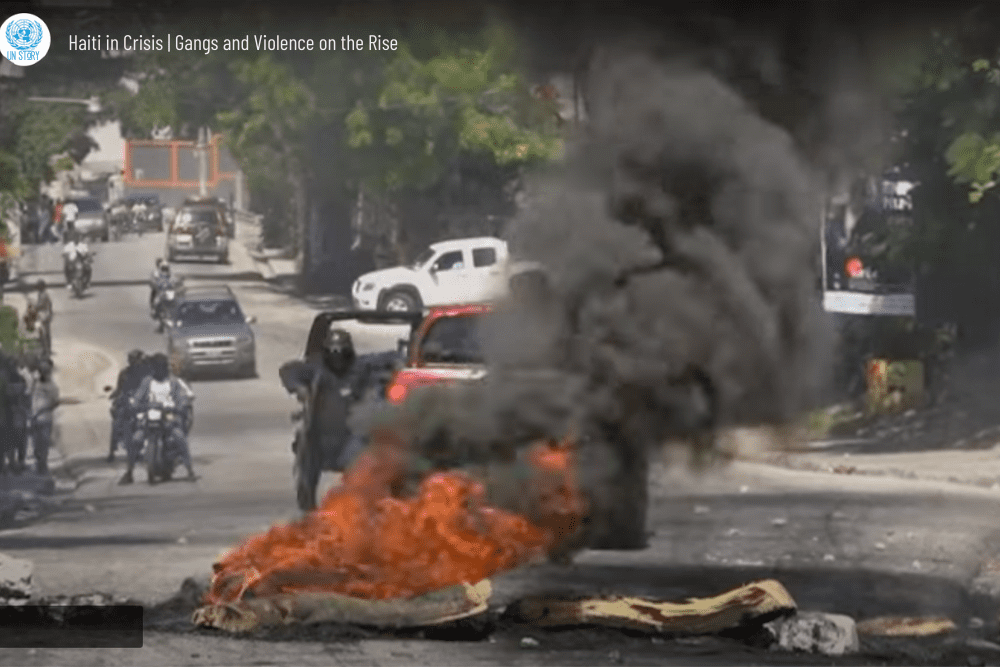
The Kenyan government has volunteered to lead an international force in Haiti and will deploy 1,000 troops to the Caribbean country
The United Nations Charter has authorized the deployment of the Multinational Security Support Mission (MSSM) to Haiti. The resolution, which was passed on Monday, October 2 2023 recognizes that the ongoing situation, in Haiti poses a risk, to peace, security and stability in the surrounding region.
The Haitian government has been asking for a mission to restore order for a year. Kenya has said it is ready to send 1,000 police officers, an offer welcomed by the United States and other countries reluctant to send their own troops to this risky terrain. Around 2,000 individuals are set to be deployed to Haiti by the end of January 2024 including 1,000 police officers from Kenya. Their primary objective will be to assist the Haitian National Police in dismantling gangs and restoring order throughout the country.
Additionally a thousand police and military personnel from Caribbean nations such as Jamaica, Bahamas, Suriname, Barbados and Antigua are expected to join forces with Kenyas contingent. Approved by the UN this international mission is significantly lower compared to previous peacekeeping efforts made in Haiti.
During the UN intervention in 1994 led by the United States there were up to 21,000 soldiers involved. The primary objective at that time was to reinstate Jean Bertrand Aristide as the elected president, after his overthrow three years prior.
In 2004 a multinational mission, under the leadership of Brazil consisted of 13,000 individuals. This mission concluded in 2017 following a series of scandals involving peacekeepers (such as incidents of rape, sexual assault and engagement with prostitutes). Accusations against a camp associated with the Nepalese contingent, for introducing cholera (which resulted in nearly 10,000 deaths) all while failing to achieve its intended goals. The primary objective was to dismantle gangs promote police and judicial system reform while maintaining peace and stability.
Fear of abuses by the international force
Many human rights groups are concerned, about violations as the Kenyan police have been accused of committing abuses, within their own nation.
NGOs, on the ground have been reporting instances of corruption, use of force arbitrary arrests and even summary executions. Amnesty International has expressed concern over the perceived methods employed by the Haitian police drawing parallels to those of the Kenyan police. They fear a violation of human rights.
This situation presents a risk since this mission while supported by the UN is not directly controlled by the body. Kenya holds authority in this regard.
Regarding this matter the United States seeks to provide reassurance. As a financier of the mission they propose implementing a monitoring mechanism to prevent any abuses. However further details on this mechanism have not been disclosed. Additionally Washington emphasizes Kenyas experience, in peacekeeping missions in Somalia and the Democratic Republic of Congo.
Fear of Gangs
The head of the G9 gang Jimmy “Barbecue” Chérizier, who used to be a police officer issued a statement stating that the international force would be received warmly only if it came “to arrest the Prime Minister and help us restore order”. Otherwise, the man considered one of Haiti’s most powerful men says he is ready to fight “to the bitter end”.
In order to effectively address the issue of armed groups, which reportedly have control, over 80% of the capital the mission will need to take action within working class neighborhoods and shantytowns. This will require cooperation with a police force that has experienced a considerably decrease, in its workforce in recent years.
Currently the number of police officers, on duty has dropped to less than 9,000 showing a decrease from the previous count of 16,000 officers in 2021. In populated areas like these any form of intervention carries risks due to criminals extensive knowledge of the terrain.
Considering these circumstances and taking into account the challenge international force in Haiti face in distinguishing between bandits and local residents it appears that the international mission is grappling with a power balance.
All the more so since the population is arming itself. As, per the United Nations there have been incidents where militias and groups claiming to be “self defense” have caused the death of over 350 individuals since April due, to the prevailing sense of insecurity. There have been extremely brutal acts of revenge, with gang members being burned alive in the street.
Read more:
Rights chief calls for international help to provide ‘way out of chaos’ in Haiti
An unprecedented invasion of jellyfish in the Black Sea

A horrible invasion of jellyfish is noticed in the waters of the Black Sea. The residing “compot” is off the coast of Constanta. This is what Romanian ProTV studies. Biologists reassure that they aren’t harmful, however advise folks to not contact them.
Jellyfish will be seen close to the seashores of Constanta and the resorts of Eforie, Kostinesti and Mangalia.
The lung jellyfish species can attain 60 cm in diameter. The higher half of the physique is bluish.
According to scientists, the enhance in inhabitants is because of increased temperatures. Jellyfish seem extra in autumn, when the north wind and storms carry them to the coast.
Illustrative Photo by Magda Ehlers: https://www.pexels.com/photo/glowing-pink-jellyfish-2832767/
Armenia: UN launches urgent appeal to help refugees fleeing Karabakh

The UN and its partners launched on Saturday an emergency response plan to help 136,000 refugees, appealing for $97 million to respond to urgent needs of those who fled the Karabakh region and their hosts in Armenia.
European Green Bond: MEPs approve new standard to fight greenwashing

MEPs on Thursday adopted a new voluntary standard for the use of a “European Green Bond” label, the first of its kind in the world.
The regulation, adopted by 418 votes in favour, 79 against and 72 abstentions, lays down uniform standards for issuers who wish to use the designation ‘European green bond’ or ‘EuGB’ for the marketing of their bond.
The standards will enable investors to direct their money more confidently towards more sustainable technologies and businesses. It will also give the company issuing the bond more certainty that their bond will be suitable to investors who want to add green bonds to their portfolio. This will increase interest for this kind of financial product and support the EU’s transition to climate neutrality.
The standards align with the EU’s taxonomy framework that defines which economic activities the EU considers environmentally sustainable.
Transparency
All companies choosing to adopt the standards and therefore also the EuGB label when marketing a green bond will be required to disclose considerable information about how the bond’s proceeds will be used. They would also be obliged to show how these investments feed into the transition plans of the company as a whole. The standard therefore requires companies to be engaging in a general green transition.
The disclosure requirements, set out in so-called “template formats”, can also be used by companies issuing bonds which are not yet able to adhere to all the strict standards of the EuGB but still wish to signal their green aspirations.
External reviewers
The regulation establishes a registration system and supervisory framework for external reviewers of European green bonds – the independent entities responsible for assessing whether standards are being adhered to. It also stipulates that any actual or potential conflicts of interest external reviewers may face are properly identified, eliminated or managed, and disclosed in a transparent manner.
Flexibility
Until the taxonomy framework is fully up and running, issuers of a European Green Bond would need to ensure that at least 85% of the funds raised by the bond are allocated to economic activities that align with the EU’s Taxonomy Regulation. The other 15% can be allocated to other economic activities provided the issuer complies with the requirements to clearly explain where this investment will go.
Quote
The rapporteur, Paul Tang (S&D, NL) said, “Businesses want to make the green transition. And the European Green Bond gives them the best tool yet to help them finance this shift. It provides a transparent and trustworthy tool to drive a company’s transition plan.
Today’s vote is the starting shot for business to get serious about their green bond issuances. Investors are eager to invest in European Green Bonds and from today onwards business can start developing them. This way European Green Bonds can boost Europe‘s transition to a sustainable economy.”
Background
The green bond market has seen exponential growth since 2007 with annual green bond issuance breaking through the USD half trillion mark for the first time in 2021, a 75% increase compared to 2020. Europe is the most prolific issuance region, with 51 % of the global volume of green bonds in 2020. Green bonds represent about 3-3.5% of overall bond issuance.
Responding to the concerns of citizens
With the adoption of this legislation, Parliament is responding to the demands of citizens made in the conclusions of the Conference on the Future of Europe, notably in proposals 3(9), 11(1) and 11(8).
Nobel Peace Prize choice of Narges Mohammadi highlights ‘courage and determination’ of Iranian women

The Nobel Committee’s decision to award the Nobel Peace Prize to imprisoned Iranian human rights activist Narges Mohammadi underscores the “courage and determination” of the women of Iran, the UN human rights office, OHCHR, said on Friday.
“I think what is absolutely clear is that the women of Iran have been a source of inspiration for the world. We’ve seen their courage and determination in the face of reprisals, intimidation, violence and detention,” Spokesperson Liz Throssell told journalists in Geneva.
“This courage, this determination, have been remarkable. They’ve been harassed for what they do or don’t wear, there are increasingly stringent legal, social and economic measures against them.”
Tribute to women activists
In a statement on the awarding of the Nobel Peace Prize to Ms. Mohammadi, UN Secretary-General António Guterres called it “an important reminder that the rights of women and girls are facing a strong pushback, including through the persecution of women human rights defenders, in Iran and elsewhere.”
“This Nobel Peace Prize is a tribute to all those women who are fighting for their rights at the risk of their freedom, their health and even their lives,” said the UN chief.
Welcoming the announcement to award the 2023 Nobel Peace prize to Mohammadi, UN experts urged the government of Iran to free all those imprisoned for promoting women’s human rights and protect the rights of women and girls in the country.
“The awarding of the 2023 Nobel Peace prize to a courageous journalist and woman human rights defender highlights the struggle of women against institutionalised systems of discrimination, segregation, humiliation and the exclusion of women and girls everywhere in the world,” the UN experts said.
About Narges Mohammadi
Ms. Mohammadi is currently serving a 16-year sentence in Tehran’s Evin Prison. She has worked for many years as a journalist and is also an author and Vice-Director of the Tehran-based civil society organization Defenders of Human Rights Center (DHRC).
In May she was awarded a prize that celebrates press freedom by the UN Educational, Scientific and Cultural Organization (UNESCO), along with two other imprisoned Iranian women journalists, in the context of the wave of protests surrounding the death of Mahsa Amini in police custody in September 2022.
More UN reaction to follow.
Human rights breaches in Afghanistan, Chechnya and Egypt

The European Parliament adopted three resolutions on the human rights breaches in Afghanistan, Chechnya and Egypt.
Human rights situation in Afghanistan, in particular the persecution of former government officials
European Parliament strongly denounces the severe human rights violations in Afghanistan and warns that since the Taliban takeover of the country the frequency of human rights abuses has risen exponentially in the country. This includes the staggering oppression of women and girls, a policy of gender apartheid and the targeting of civil society organisations and human rights defenders.
MEPs call on Afghanistan’s de facto authorities to fully enforce their publically announced commitment to a general amnesty of former government officials and former National Security Forces members who are being subjected to arbitrary detentions, extrajudicial killings, enforced disappearances and torture. They also demand reversing severe restrictions on the rights of women and girls in line with Afghanistan’s international obligations.
The Parliament also condemns the Taliban for their brutal persecution of Christians and other religious minorities as part of efforts to eradicate them from the country. MEPs call on the EU and member states to step up their support for Afghan civil society including by funding specific assistance and protection programmes for human rights defenders.
The text was adopted by 519 votes in favour, 15 against and 18 abstentions. It will be available in full here. (05.10.2023)
Egypt, in particular the sentencing of Hisham Kassem
MEPs demand the immediate and unconditional release of Hisham Kassem, sentenced in September to six months in prison and a fine on a charge of defamation and slander for an online post criticising former Egyptian minister Abu Eita. They urge Egyptian authorities to drop all politically motivated charges against him and call on the EU delegation and member states representatives to visit him in prison.
Ahead of the December 2023 presidential election in Egypt, Mr. Kassem has played a pivotal role in founding the Free Current, a coalition of liberal opposition parties and personalities.
MEPs underline the importance of holding credible, free and fair elections in Egypt and urge authorities to stop the harassment of peaceful opposition figures, including aspiring presidential candidates like former parliamentarian Ahmed El Tantawy,
MEPs also call on the Egyptian authorities to uphold the rule of law, freedom of expression, press, media and association and an independent judiciary. They demand the release of tens of thousands of prisoners arbitrarily detained for peacefully expressing their opinion.
The text was adopted by 379 votes in favour, 30 against and 31 abstentions. It will be available in full here. (05.10.2023)
The case of Zarema Musaeva in Chechnya
MEPs strongly condemn the kidnapping and politically-motivated detention of Zarema Musaeva, urging the Chechen authorities to immediately release her and provide her with proper medical care.
Ms. Musaeva, (the wife of former Chechen Supreme Court judge Saidi Yangulbaev and mother of human rights defender Abubakar and opposition bloggers Ibrahim and Baysangur Yangulbaev), was sentenced to five years in prison on charges of fraud and assaulting the authorities. MEPs consider this a retaliation for the legitimate human rights work and political views of her sons.
Condemning the brutal attacks on and repression of civil society, media and opposition in Chechnya, MEPs want the authorities to immediately end all forms of harassment. The Chechen government should conduct a transparent and thorough investigation into these attacks and hold those responsible accountable.
The resolution adopted by MEPs calls on the international community and the EU to respond to the extremely worrying human rights breach in Russia and in particular in Chechnya, and increase assistance to Chechen political prisoners and dissidents.
The text was adopted by 502 votes in favour, 13 against and 28 abstentions. It will be available in full here. (05.10.2023)
