MEPs will vote on plans to cut carbon emissions, boost gas storage and support for countries hosting Ukrainian refugees in the 22-23 June plenary session.
The “Fit for 55” package is part of the EU’s effort to fight climate change, it aims to help the EU lower emissions 55% by 2030 and reach net zero emissions by 2050.
EU gas reserves
Parliament will debate and vote on the plan to refill EU strategic gas reserves faster before winter, to ensure enough gas for heating and industry.
Ukraine
MEPs will discuss Wednesday and vote Thursday on measures aimed at supporting countries that host people fleeing Ukraine. They will also discuss Russia’s relations with extremist political parties in the EU.
EU summit; candidate status of Ukraine and Moldova
MEPs will outline their expectations for the 23-24 June European summit, including the question of whether Ukraine and Moldova should be granted EU candidate status.
EU Digital COVID certificate
Parliament is set to approve the extension of the EU Digital Covid Certificate for another 12 months, on Thursday. The aim is to help ensure free movement in the EU. The certificate expires 30 June.
Zambian president Hakainde Hichilema will address MEPs on Thursday.
Elsewhere in Parliament
On Monday, European Central Bank President Christine Lagarde will answer questions about the implications of the war in Ukraine and Eurozone inflation in the economic affairs committee.
If we look at most of the wars of the last 50 years, we can see that they are not becoming shorter. And even if we look at the full military history of the world, we can observe that wars of the magnitude that we are seeing in Ukraine are usually somewhat long.
Everybody is saying it: “The war in Ukraine will last for years”. The last person to do so was Jens Stoltenberg, the secretary-general of NATO, in an interview with the German newspaper Bild am Sonntag.
However, if we think about it, it’s pretty obvious that this war will last for years. And it isn’t even “because no party involved wants the war to be short”, as some people on the left are becoming used to saying. No, it’s not because of that, mainly since that reasoning has no logic.
For one thing, both parties involved in the conflict (Ukraine and Russia) prefer a brief conflict. Ukraine is fighting in order to limit the damage and suffering caused by this war as much as possible. As well as for many other strategic reasons regarding the war effort. And Russia because it wants to come out of this war as victorious as possible, and a long war doesn’t help that, but also for the reason that it wants to come out of this war with the army and the economy as least affected as possible.
And for the second part, nobody inside the NATO alliance is interested in the economic downfall that this war is causing. As much as some people claim that some countries may benefit from disruption in international commerce, that is simply not true. The cost of the disruption will always surpass the possible gains that one country could have had due to this war. The fact that the USA will start to export more oil and gas to Europe isn’t making Wall Street more confident in the future of the American economy, for example.
So no, I’m not talking about an NATO conspiracy here, to make the war last longer than it should. I will just compare this war with other wars in history. In an effort to explain why, we have no reason to think that this war will be short.
One example that has been brought up recently for obvious reasons is the USSR’s invasion of Afghanistan in 1979. Although this comparison is faulty, mainly because the mountainous Afghan terrain is almost an antithesis of the mostly flat Ukrainian terrain, we can also see why this war can have basically the same turnout as the one waged by the USSR in 1979. Where there are no mountains where Ukrainian soldiers can defend themselves from air and ground attacks, there are cities. Of course, this leads to a much higher human cost.
And if you want another major example, we have the US invasion of Iraq. This comparison is even a bit better regarding some aspects. One, both the Iraqi and the Ukrainian armies are, well, armies, and not just militias and guerrilla fighters. And second, regarding terrain, Iraq is much more similar to Ukraine than Afghanistan, which is also mostly flat. However, the US invasion played out much differently than the Russian invasion. Even with all the setbacks and mistakes, the US and British forces successfully invaded the country in about a month, fulfilling all their military objectives (regarding the invasion phase, of course). Russian forces have already failed in many of their military objectives. They have been trying to make a decisive offensive on enemy lines for almost 5 months now and have no idea of how this war is going to end.
Yes, most of the wars that I mentioned (Afghanistan and Iraq) were long because of the post-invasion/occupation phase, and now Russia apparently doesn’t have what’s necessary to effectively occupy Ukraine. But even so, if Russia manages a push in the Donbas region, it will have to then advance to Kiev and so on. And that, as we see, will take time (if it happens at all).
But I think that we don’t really need comparisons, or at least detailed comparisons. Because the main fact that I want to express—my main argument for this thesis—is simple: No war of similar magnitude to this one, has been brief. On the contrary, they are becoming longer and longer.
And it is my belief that this is true, at least as long as we don’t see a clear advantage on one side, or a successful offensive, etc.
New genetic study finds a direct link between dementia and a lack of vitamin D.
Dementia is diminished cognitive functioning with a loss of ability to remember, think, solve problems, or make decisions — if it has progressed to the point that it interferes with doing everyday activities. It is a broad term, rather than a specific disease. Alzheimer’s disease is a specific type of dementia and the most common, with 6 million Americans afflicted according to the Alzheimer’s Association.
Dementia is not a normal sign of aging, even though it primarily affects older adults at least 65 years of age. According to the Centers for Disease Control and Prevention, nearly 14 million Americans will be suffering from dementia by 2060 and there is a link with vitamin D deficiency.
It is one of the major causes of disability and dependency among older people worldwide, affecting thinking and behaviors as you age. But what if you could stop this degenerative disease in its tracks?
A world-first study from the University of South Australia could make this a reality as new genetic research shows a direct link between dementia and a lack of vitamin D.
Investigating the association between vitamin D, neuroimaging features, and the risk of dementia and stroke, the study found:
low levels of vitamin D were associated with lower brain volumes and an increased risk of dementia and stroke.
genetic analyses supported a causal effect of vitamin D deficiency and dementia.
in some populations, as much as 17 percent of dementia cases might be prevented by increasing everyone to normal levels of vitamin D (50 nmol/L).
Dementia is a chronic or progressive syndrome that leads to deterioration in cognitive function. About 487,500 Australians live with dementia and it is the country’s second leading cause of death. Globally, more than 55 million people have dementia with 10 million new cases diagnosed every year.
Supported by the National Health and Medical Research Council, the genetic study analyzed data from 294,514 participants from the UK Biobank, examining the impact of low levels of vitamin D (25 nmol/L) and the risk of dementia and stroke. Nonlinear Mendelian randomization (MR) – a method of using measured variation in genes to examine the causal effect of a modifiable exposure on disease — were used to test for underlying causality for neuroimaging outcomes, dementia, and stroke.
Senior investigator and Director of UniSA’s Australian Centre for Precision Health, Professor Elina Hyppönen, says the findings are important for the prevention of dementia and appreciating the need to abolish vitamin D deficiency.
“Vitamin D is a hormone precursor that is increasingly recognized for widespread effects, including on brain health, but until now it has been very difficult to examine what would happen if we were able to prevent vitamin D deficiency,” Prof Hyppönen says.
“Our study is the first to examine the effect of very low levels of vitamin D on the risks of dementia and stroke, using robust genetic analyses among a large population.
“Our study is the first to examine the effect of very low levels of vitamin D on the risks of dementia and stroke, using robust genetic analyses among a large population.
“In some contexts, where vitamin D deficiency is relatively common, our findings have important implications for dementia risks. Indeed, in this UK population we observed that up to 17 percent of dementia cases might have been avoided by boosting vitamin D levels to be within a normal range.”
The findings are incredibly significant given the high prevalence of dementia around the world.
“Dementia is a progressive and debilitating disease that can devastate individuals and families alike,” Prof Hyppönen says.
“If we’re able to change this reality through ensuring that none of us is severely vitamin D deficient, it would also have further benefits and we could change the health and wellbeing for thousands.”
“Most of us are likely to be ok, but for anyone who for whatever reason may not receive enough vitamin D from the sun, modifications to diet may not be enough, and supplementation may well be needed.”
Reference: “Vitamin D and brain health: an observational and Mendelian randomization study” by Shreeya S Navale, Anwar Mulugeta, Ang Zhou, David J Llewellyn and Elina Hyppönen, 22 April 2022, The American Journal of Clinical Nutrition.
DOI: 10.1093/ajcn/nqac107
UNESCO says that hate speech is on the rise worldwide.
Hate speech incites violence, undermines diversity and social cohesion and “threatens the common values and principles that bind us together,” the UN chief said in his message for the first-ever International Day for Countering Hate Speech.
“It promotes racism, xenophobia and misogyny; it dehumanizes individuals and communities; and it has a serious impact on our efforts to promote peace and security, human rights, and sustainable development,” underscored Secretary-General António Guterres.
Dangerous words
He explained that words can be weaponized and cause physical harm.
The escalation from hate speech to violence, has played a significant role in the most horrific and tragic crimes of the modern age, from the antisemitism driving the Holocaust, to the 1994 genocide against the Tutsi in Rwanda, he said.
“The internet and social media have turbocharged hate speech, enabling it to spread like wildfire across borders,” added the UN chief.
Fighting back
The spread of hate speech against minorities during the COVID-19 pandemic has further shown that many societies are highly vulnerable to the stigma, discrimination and conspiracies it promotes.
In response to this growing threat, three years ago, Mr. Guterres launched the UN Strategy and Plan of Action on Hate Speech – a new framework to support Member States in countering the scourge, while also managing to respect freedom of expression and opinion.
It was undertaken in collaboration with civil society, media, technology companies and social media platforms.
And last year, the UN General Assembly passed a resolution calling for inter-cultural and inter-religious dialogue to counter hate speech – and proclaimed the International Day.
“Hate speech is a danger to everyone and fighting it, is a job for everyone,” said the UN chief.
“This first International Day to Counter Hate Speech is a call to action. Let us recommit to doing everything in our power to prevent and end hate speech by promoting respect for diversity and inclusivity”.
Hate fuelling hostilities
In a sign of how the phenomenon is becoming an increasing problem, UN rights chief Michelle Bachelet and UN Special Adviser on the Prevention of Genocide, Alice Nderitu, expressed their “deep alarm” on Friday, over the hate speech that is fuelling violence against civilians, in long-running clashes between the M23 rebel group and Government forces in the Democratic Republic of the Congo (DRC).
The two top officials called for the uptick in attacks against civilians to stop immediately.
“We call on all parties to respect international human rights law and international humanitarian law,” they stressed.
The UN senior officials singled out that hate speech and “incitement to discrimination, hostility or violence nationwide” – directed specifically against Kinyarwanda speakers – was an important factor, as the DRC Government has accused Rwanda of supporting the M23.
“Hate speech fuels the conflict by exacerbating mistrust between communities,” they said.
“It focuses on aspects that have previously mattered less, incites a discourse of ‘us vs. them’, and corrodes social cohesion between communities that have previously lived together”.
Spreading hatred
So far, the UN has documented eight cases of hate speech and incitement to discrimination, hostility or violence and it has been spread by political party figures, community leaders, civil society actors, as well as the Congolese diaspora.
“Times of heightened political tensions and armed conflict tend to correlate with increased use of hate speech and incitement to discrimination, hostility or violence,” the two top officials stated.
“Hateful messages heighten the risk of violence, including atrocity crimes targeting specific groups of people [and] should be roundly condemned by the highest national authorities and curbed.”
Both women encouraged Parliament to expedite the adoption of the bill on “racism, xenophobia and tribalism” to strengthen the legal framework to address and counter hate speech.
University of Innsbruck researchers have identified the genetic origin of our senses
Researchers from the University of Innsbruck have determined the genetic origin of our senses. The findings reveal that vertebrate cranial Sensory Ganglia arise from a genetic program shared with their closest living relatives, tunicates.
Tunicates, commonly called sea squirts, are a group of marine animals that spend most of their lives attached to docks, rocks or the undersides of boats, they look like small, colored blobs.
They are actually more closely related to vertebrates like ourselves than to most other invertebrate animals.
It’s definitely beneficial to have a head. This may seem obvious, yet evolution underwent a long journey to test it: Invertebrates dominated the waters at first when animal life began to emerge. Although they already had head features, vertebrates ultimately succeeded because they developed a new, superior head. This “new head” enabled a widespread spatial dispersion and multiplication of sensory cells, leading to a much-improved perception of the surroundings. This was also crucial for the evolution of a predatory lifestyle.
Cranial Sensory Ganglia are critical for transmitting external sensations to the vertebrate brain. You can think of them as nerve nodes that are spread throughout the brain and collect information from the sensory organs. The precise process by which these ganglia were created was unknown to scientists up until this point. These questions have finally been resolved by a study that was published in Nature on May 18, 2022.
Prototype of the vertebrates
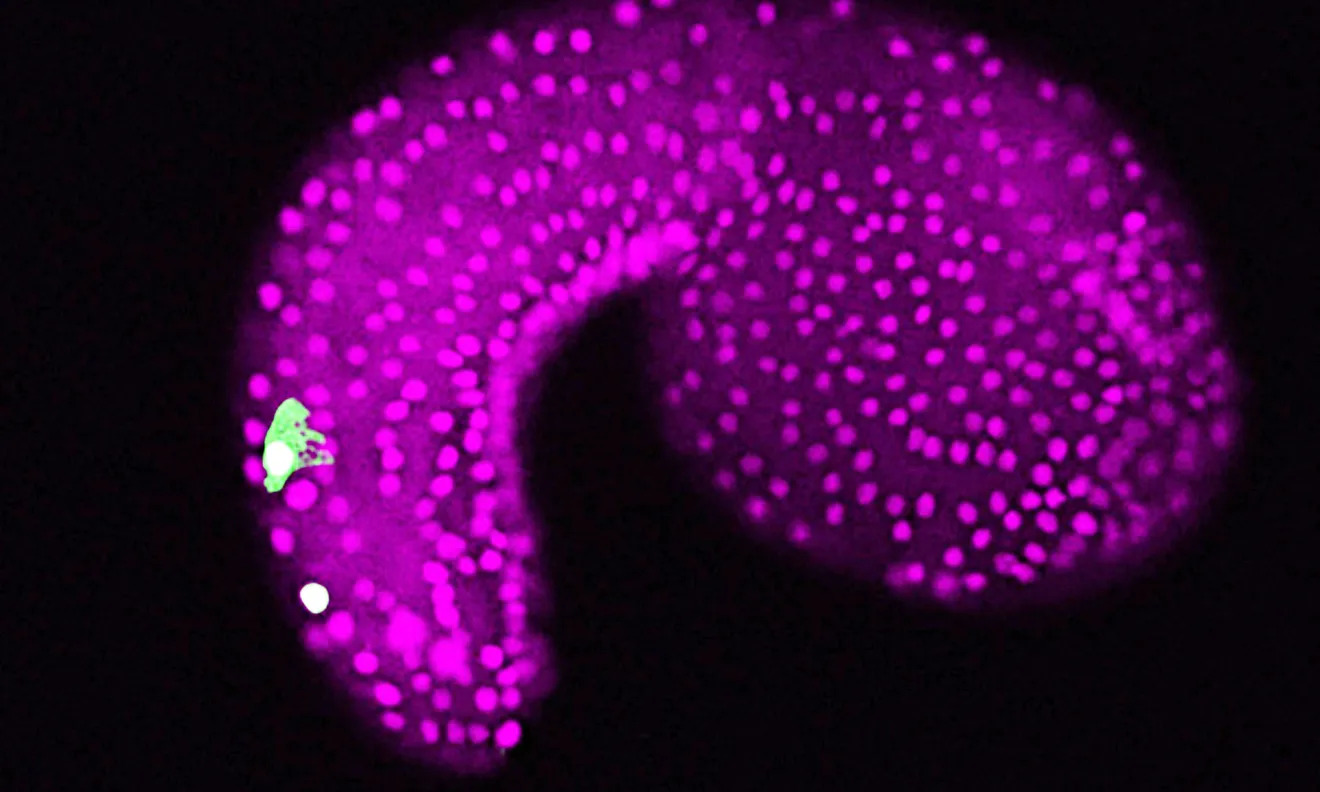
The research group of Ute Rothbächer from the Institute of Zoology at the University of Innsbruck was decisively involved in the last phase of the project, an international collaboration of several institutions, conceived by the University of Oxford. Their findings show that the Cranial Sensory Ganglia of vertebrates emerge from a genetic program that is also found in their closest living relatives, the tunicates. In tunicate larvae, certain sensory neurons, called Bipolar Tail Neurons, are located in the tail region. These process external stimuli, but are also responsible for the animal’s movement. In both animal subphyla, the respective structures are formed by the gene Hmx.
An embryo of the tunicate Ciona intestinalis. The microscope image shows Bipolar Tail Neurons in the tail region (green) and epidermal cells (magenta). Credit: Alessandro Pennati
“Tunicates are like an evolutionary prototype for vertebrates,” Rothbächer explains. “There is a large anatomical gap between the adults of these subphyla, as they are adapted to ecological niches. This complicates research on their evolution. Common structures and mechanisms can only be identified at the embryonic stage – our common ancestor was probably very similar to a tunicate larva.”
The study’s model organisms were the lamprey, a primitive fish that resembles an eel and is often referred to as a ‘living fossil,’ and the tunicate Ciona intestinalis, which is surrounded by a yellowish, tubular mantle that protects the animal and filters food.
The conserved gene
Alessandro Pennati, a doctoral student in Rothbächer’s research group, provided decisive data on the function of the gene Hmx in Ciona. He applied the gene technology CRISPR-Cas9 to selectively knock out genetic sequences, while the method of transient transgenesis was used to over-express genes.
The researchers found that Hmx controls the development of Bipolar Tail Neurons in tunicates, whereas in vertebrates, it does so for Cranial Sensory Ganglia. Surprisingly, lamprey Hmx gene segments inserted into Ciona DNA were similarly active as Ciona’s own Hmx.
“Hmx has been shown to be a central gene that has been conserved across evolution. It has retained its original function and structure and was probably found in this form in the common ancestor of vertebrates and tunicates,” Pennati explains. Cranial Sensory Ganglia and Bipolar Tail Neurons thus have the same evolutionary origin, Hmx was probably crucially involved in the formation of highly specialized head sensory organs in vertebrates.
Reference: “Hmx gene conservation identifies the origin of vertebrate cranial ganglia” by Vasileios Papadogiannis, Alessandro Pennati, Hugo J. Parker, Ute Rothbächer, Cedric Patthey, Marianne E. Bronner, and Sebastian M. Shimeld, 18 May 2022, Nature. DOI: 10.1038/s41586-022-04742-w
South African theologian and academic Rev. Jerry Pillay will take over as general secretary of the World Council of Churches (WCC)in January 2023, the WCC has announced.
He was elected on June 17 as the ninth general secretary in the WCC‘s history since the fellowship of 580 million Christian in 352 churches worldwide.
The World Council of Churches has in its fold most of the world’s Orthodox churches, Anglican, Baptist, Lutheran, Methodist, and Reformed churches, as well as many United and Independent churches.
“Our task here is not to play church. Our task is actually to follow God’s command,” said Pillay, a member of the Uniting Presbyterian Church in Southern Africa who is currently dean of the Faculty of Theology and Religion at the University of Pretoria.
The WCC general secretary-elect believes growing up in South Africa as a person of Indian origin will help his approach to conflict and suffering,
The general secretary-elect of the WCC believes that growing up during a period of conflict and suffering in South Africa will stand him in good stead when he takes up his position as the head of the ecumenical body in January as a leader who believes in dialogue.
He is the second African chosen to lead the WCC.
He will replace outgoing acting general secretary Rev. Ioan Sauca who began serving in that position in April 2020 when the previous general secretary, Rev Olav Fykse Tveit, was appointed as the presiding bishop of the Church of Norway.
The WCC’s central committee, the council’s main governing body, elected Pillay, leaving South Africans cheering that their theologian would be the first WCC general secretary from their country.
He held a hybrid press conference at which he was asked about his vision of the WCC when he takes up his post; and other questions, appearing at ease in answering them.
“Important for me is the idea of justice and unity. I think unity is the task of the WCC—to continue to work at visible unity, and Christian unity is so important. And I will say it again, that a divided church presents a very weak and feeble and fragile witness to a very fragmented world.”
He said that unity is essential, as is justice.
“Some people tend to favor one over the other. I hold both in equal terms.”
He said that the God of justice demands for us “to care for the poor and the neglected….and stand with the oppressed in their situations.
FIGHTING APARTHEID
“And the World Council of Churches has done this in the past. Me coming from South Africa, it’s bigger than my personal experience of how the WCC played a very vital role in dismantling apartheid, in standing with Christians in solidarity,” explained Pillay
“So we will continue to do with other parts of the world as we stand with the oppressed.”
Pillay was one of two candidates for election to the WCC’s highest administrative post. The other was Dr. Elizabeth Joy, the first woman to be shortlisted as a candidate for general secretary in the WCC’s history.
When Pillay studied at university in the 1980s, the institutions were segregated for undergraduates, and as an Indian South African, he attended the University of Durban Westville.
Later, he got a PhD from Rhodes University, which had been for whites.
One journalist asked Pillay about Moscow’s Patriarch Kirill “supporting Russia’s brutal war of aggression” in Ukraine and if it could result in the Russian Orthodox Church being suspended from the World Council of Churches.
“The World Council of Churches would advocate dialogue, conversations, bringing people across the table and asking, what is it that prompts and inspires as well?” said Pillay.
“We need the Patriarch; we need the Russian Orthodox Church with us in these conversations; we can’t have them without them. So, suspension is not on the cards at the moment, especially if we advocated things like dialogue.”
DEEPER UNDERSTANDING
Pillay said that is the way to get a “deeper understanding and appreciation of the issues and be able to make more calculated decisions based on incisive wisdom.”
He was asked about his origins in South Africa and said he was born and bred as a South African Indian – of Indian descent, “but I have had no connections whatsoever with India, My great-great-grandfather, probably five generations ago, came to South Africa.
“I have visited India many times; I’ve tried to look at some of these connections…But for myself, I’m really of South African descent, as an Indian.”
Asked about the South Africa of Demond Tutu and Gandhi, Pillay said one of the things about South Africa specifically that kept them sane amid the insanity of apartheid “was our spirituality.”
“In those dark days of apartheid, I would go into the (black) townships, and I would be so deeply inspired, and yet even sometimes troubled by the fact that I would see people laughing and praying and rejoicing and dancing on the streets.
“And I would ask myself, how in the world can you do this in the midst of suffering? And then I realized very quickly the spirituality in that suffering.”
Dr Agnes Abuom, moderator of the WCC central committee and Bishop Mary Ann Swenson, the vice moderator, also spoke to the journalists. Swenson said a new central committee would be elected at the World Council of Churches 11th Assembly.
Washington, DC – United States Commission on International Religious Freedom (USCIRF) Commissioner Frederick A. Davie along with USCIRF staff traveled to Abuja, Nigeria from June 4-11 to meet with Nigerian and U.S. government officials, religious communities, civil society representatives, and human rights defenders to assess religious freedom conditions and discuss threats facing Nigerians of a range of faiths and worldviews.
“Nigeria is home to diverse religious and belief communities, and we were fortunate to learn from an array of perspectives about the state of religious freedom in the country. Our meetings highlighted the complexity of the drivers of violence in Nigeria and the intersection of religious freedom and other security and human rights concerns,” USCIRF Commissioner Davie said. “USCIRF looks forward to incorporating the findings from this visit into our foreign policy recommendations to the President, the Secretary of State, and Congress relating to religious freedom in Nigeria.”
Leading up to and during USCIRF’s visit, several incidents of violence impacting Christians or Muslims took place in Nigeria. On May 12, a violent mob at Shehu Shagari College of Education in Muslim-majority Kano state stoned Christian university student Deborah Samuel to death and burned her body because they considered remarks she made in a WhatsApp thread insulting to Islam. On May 22, violent actors in the Christian-majority southeast killed pregnant Muslim Hausa woman Harira Jubril and her four children. On June 4, a violent mob in the capital city of Abuja beat, stoned, and burned Muslim local defense force member Ahmad Usman to death for alleged blasphemy. On June 5, armed assailants attacked worshippers celebrating Pentecost Sunday in a Catholic church in Owo, Ondo state, killing at least 40 people.
“USCIRF condemns these attacks and all violence that threatens religious freedom in Nigeria. These incidents were truly horrific and demonstrated the challenges facing Christians and Muslims in Nigeria,” USCIRF Commissioner Davie continued. “Our hearts go out to the families and communities impacted and we implore the Nigerian authorities to spare no expense in bringing the perpetrators of these heinous acts to justice.”
Since 2009, most recently in its April 2022 Annual Report, USCIRF has recommended that the U.S. Department of State designate as a “country of particular concern,” or CPC, for engaging in and tolerating systematic, ongoing, and egregious violations of international religious freedom. Local authorities have imprisoned and prosecuted several Nigerians on charges of blasphemy in recent years while pursuing at most only minor charges against individuals who incite violence against those who express opposing religious views. Government officials also continue to fail to provide justice to victims of attacks on worshippers and religious communities. USCIRF also catalogued these violations in other reports on Nigeria, including in an Issue Update on Kano State, an episode of the USCIRF Spotlight podcast, and during a hearing held in June 2021.
###
The U.S. Commission on International Religious Freedom (USCIRF) is an independent, bipartisan federal government entity established by the U.S. Congress to monitor, analyze, and report on religious freedom abroad. USCIRF makes foreign policy recommendations to the President, the Secretary of State and Congress intended to deter religious persecution and promote freedom of religion or belief.
Discovering new books online is a challenge, which several companies are trying to address.
By Shubhangi Shah
Amazon, the trillion-dollar multinational conglomerate that now deals with e-commerce, cloud computing, streaming services and artificial intelligence, started in 1994 as an online marketplace for books. Although Jeff Bezos wasn’t the first to set up a books market online, it won’t be an exaggeration to say that he enabled buying books at the fingertips of any individual in any part of the world. Three decades since, technology has come to define, to a huge extent, how books are published, marketed, bought, and even read. Although we might have solved these aspects, discovering new books still remain a challenge.
Best-sellers are everywhere, and so are books by celebrities. However, exploring titles by new and lesser-known authors can feel like finding a needle in a haystack. It seems there is no online experience that can replace a library or a bookstore where one can turn the pages of a title that appears interesting to zero down on the one that appeals. Now don’t get it wrong, there is a tonne of recommendations and reviews available on social media and newspapers, but the volume can be overwhelming. If only there was something to filter the noise and help us discover books we might like.
Just like there is a gap, there are companies striving to fill it. The latest is Tertulia, which literally refers to a social gathering with literary or artistic overtones, especially in Iberia or Latin America.
Drawing from its meaning, the company describes the app as: “inspired by the informal salons (‘tertulias’) of Spanish cafes and bars, Tertulia is a new way to discover books through all the lively and enriching conversations they inspire”. “Tertulia serves up book recommendations and book talk from across social media, podcasts, and the web, all in one app,” it says on its website. In simpler words, the app uses tech to aggregate book recommendations and discussion across platforms, such as social media, podcasts, news articles, etc, to come up with recommendations personalised as per a user’s liking. Not just that, users can also order books on the app. Presently, paperbacks and hardcovers are available, and the company plans to sell e-books and audiobooks in the coming months, the New York Times reported. The app has been recently launched and is available on the Apple app store in the United States. The services are yet to be made available in India.
Tertulia is the latest but not the only book discovery platform available. Bookfinity is a website that comes up with book recommendations based on a questionnaire you fill. Starting with a simple name and gender, it straight up asks you to ‘judge a book by its cover’. No, not the idiomatic way but by choosing among the book covers that appear on screen, which you find the most interesting. You go on answering some questions about yourself for the site to come up with recommendations.
Then there is the Cooper app, the social media platform for book lovers, whose beta version was recently released on iOS in the United States. The app brings readers and authors on the same platform striving for a direct interaction between the two. Evidently, it can aid new and lesser-known authors to find an audience and readers to discover new and little-known books.
These are the new ones, but Goodreads remains the oldest in the category. Founded in 2006 and bought by Amazon in 2013, it hosts a virtual library allowing you to discover your next read. You can also post reviews and recommend books to friends.
Another application is Litsy, which seems to be a cross between Goodreads and Instagram. On it, you can share what you think, like, or dislike about a book. A book-lovers community of sorts, it can help your friends to discover their next read given the views are from a credible source.
All these ideas seem great. However, the question still persists if apps are the way to solve the online book discovery problem. Not that there is a lack of information online, but it still remains short of the utility of sieving through books at a bookstore. Another issue here is the mental rush. While checking through books at a bookstore or a library can be a calming experience helping you slow down, the same might not apply to an online experience, which bombards you with a tonne of information at once, overwhelming you. Wouldn’t an app that filters all that and gets to the point be great? Or, we can try live in the physical world more. Better? Maybe.
Asteroid Bennu’s remarkable terrain. Credit: NASA’s Goddard Space Flight Center
Asteroid Bennu’s boulder-covered surface gives it protection against small meteoroid impacts, according to observations of craters by NASA’s OSIRIS-REx (Origins, Spectral Interpretation, Resource Identification, Security-Regolith Explorer) spacecraft. OSIRIS-REx traveled to near-Earth asteroid Bennu and is bringing a small sample back to Earth for study. The mission launched on September 8, 2016, from Cape Canaveral Air Force Station. The spacecraft reached Bennu in 2018 and will return a sample to Earth in 2023.
“These observations give new insight into how asteroids like Bennu respond to energetic impacts,” said Edward (Beau) Bierhaus of Lockheed Martin Space, Littleton, Colorado, lead author of a paper published in this month’s issue of Nature Geoscience.
Bennu is a “rubble-pile” asteroid, meaning that it formed from the debris of a much larger asteroid that was destroyed by an ancient impact. Fragments from the collision coalesced under their own weak gravity to form Bennu.
The team used unprecedented, high-resolution global data sets to examine craters on Bennu: images from the OSIRIS-REx Camera Suite and surface-height data (topography) derived from the OSIRIS-REx Laser Altimeter, a laser-ranging (lidar) instrument on the spacecraft.
This image shows asteroid Bennu’s boulder-covered surface. It was taken by the PolyCam camera on NASA’s OSIRIS-REx spacecraft on April 11, 2019, from a distance of 2.8 miles (4.5 km). The field of view is 211 ft (64.4 m), and the large boulder in the upper right corner of the image is 50 ft (15.4 m) tall. When the image was taken, the spacecraft was over the southern hemisphere, pointing PolyCam far north and to the west. Credit: NASA/Goddard/University of Arizona
“Measuring craters and their population on Bennu was exceptionally exciting,” said David Trang of the University of Hawaii at Mānoa, Honolulu, a co-author of the paper. “At Bennu, we discovered something unique to small and rocky bodies, which expanded our knowledge of impacts.”
Planetary scientists can estimate the age of surfaces by measuring the abundance and sizes of craters. Impact craters accumulate over time, so a surface with many craters is older than a surface with few craters. Also, the size of the crater depends on the size of the impactor, with larger impactors generally making larger craters. Because small meteoroids are far more abundant than large meteoroids, celestial objects like asteroids usually have many more small craters than large ones.
Bennu’s larger craters follow this pattern, with the number of craters decreasing as their size increases. However, for craters smaller than about 6.6 to 9.8 feet (around 2 – 3 meters) in diameter, the trend is backward, with the number of craters decreasing as their size decreases. This indicates something unusual is happening on Bennu’s surface.
The researchers think that Bennu’s profusion of boulders acts as a shield, preventing many small meteoroids from forming craters. Instead, these impacts are more likely to break apart the boulders or chip and fracture them. Also, some impactors that do make it through the boulders make smaller craters than they would if Bennu’s surface was covered in smaller, more uniform particles, like beach sand.
This activity causes the surface of Bennu to change differently than objects with fine-grained or solid surfaces. “The displacement or disruption of an individual or small group of boulders by a small impact is probably one of the most fast-acting processes on a rubble-pile asteroid’s surface. On Bennu, this contributes to making the surface appear to be many times younger than the interior,” said Bierhaus.
Reference: “Crater population on asteroid (101955) Bennu indicates impact armouring and a young surface” by E. B. Bierhaus, D. Trang, R. T. Daly, C. A. Bennett, O. S. Barnouin, K. J. Walsh, R.-L. Ballouz, W. F. Bottke, K. N. Burke, M. E. Perry, E. R. Jawin, T. J. McCoy, H. C. Connolly Jr., M. G. Daly, J. P. Dworkin, D. N. DellaGiustina, P. L. Gay, J. I. Brodbeck, J. Nolau, J. Padilla, S. Stewart, S. Schwartz, P. Michel, M. Pajola and D. S. Lauretta, 7 April 2022, Nature Geoscience. DOI: 10.1038/s41561-022-00914-5
More about the mission and team:
The research was supported by NASA under the New Frontiers Program and the OSIRIS-REx Participating Scientist Program, the Canadian space agency, the French space agency, the Italian space agency, the European Union’s Horizon 2020 research and innovation program, and the Academies of Excellence of the Initiative D’ Excellence Joint, Excellent and Dynamic Initiative of Université Côte d’Azur.
Dante Lauretta of the University of Arizona, Tucson, is the OSIRIS-REx principal investigator. The University of Arizona also leads the OSIRIS-REx science team and the mission’s science observation planning and data processing, and built the OSIRIS-REx Camera Suite. NASA’s Goddard Space Flight Center in Greenbelt, Maryland, provides overall mission management, systems engineering, and safety and mission assurance for OSIRIS-REx. Lockheed Martin Space in Littleton, Colorado, built the spacecraft and provides flight operations. The OSIRIS-REx Laser Altimeter was provided by the Canadian Space Agency. Goddard and KinetX Aerospace are responsible for navigating the OSIRIS-REx spacecraft. OSIRIS-REx is the third mission in NASA’s New Frontiers Program, managed by NASA’s Marshall Space Flight Center in Huntsville, Alabama, for the agency’s Science Mission Directorate at NASA Headquarters in Washington, D.C.
The full video of the 2nd session of the 2nd Catholic Youth Convention on the Future of Europe is now available on our YouTube channel. The event, entitled “Sharing our dreams on the Future of Europe”, was held on Thursday 15 June 2022 by COMECE and Konrad-Adenauer-Stiftung. Watch the video
It featured a dialogue meeting on ‘Youth and South-East Europe’ between young participants from all over Europe and Olivér Várhelyi, EU Commissioner for Neighbourhood and Enlargement, as well as Branislav Staničeck, Policy analyst for the European Parliamentary Research Service.
The complex reality of the countries in the region of South-East Europe, commonly referred to as “the Western Balkans”, and its aspirations to become part of the European Union, are seen by the young participants as an invitation to play their role in “writing a new page of history, a page full of hope, peace and reconciliation”.
Moreover, the question of future perspectives for peace, prosperity and stability on the European continent has regained greater relevance in the context of the ongoing war in Ukraine.
During the dialogue, Commissioner Varhelyì shared insights in the recent and future EU policy developments with regard to the region of South-East Europe and its European prospects.
A recurring theme was the need for a new, positive narrative for the region, which can contribute to overcome difficulties and look forward with hope and in a spirit of collaboration, solidarity and fraternity. It was also emphasised the crucial role Churches and civil society organisations have to play.
On the occasion of this meeting, the youth were also called to participate in the COMECE Youth Net, a new initiative to start in September 2022.