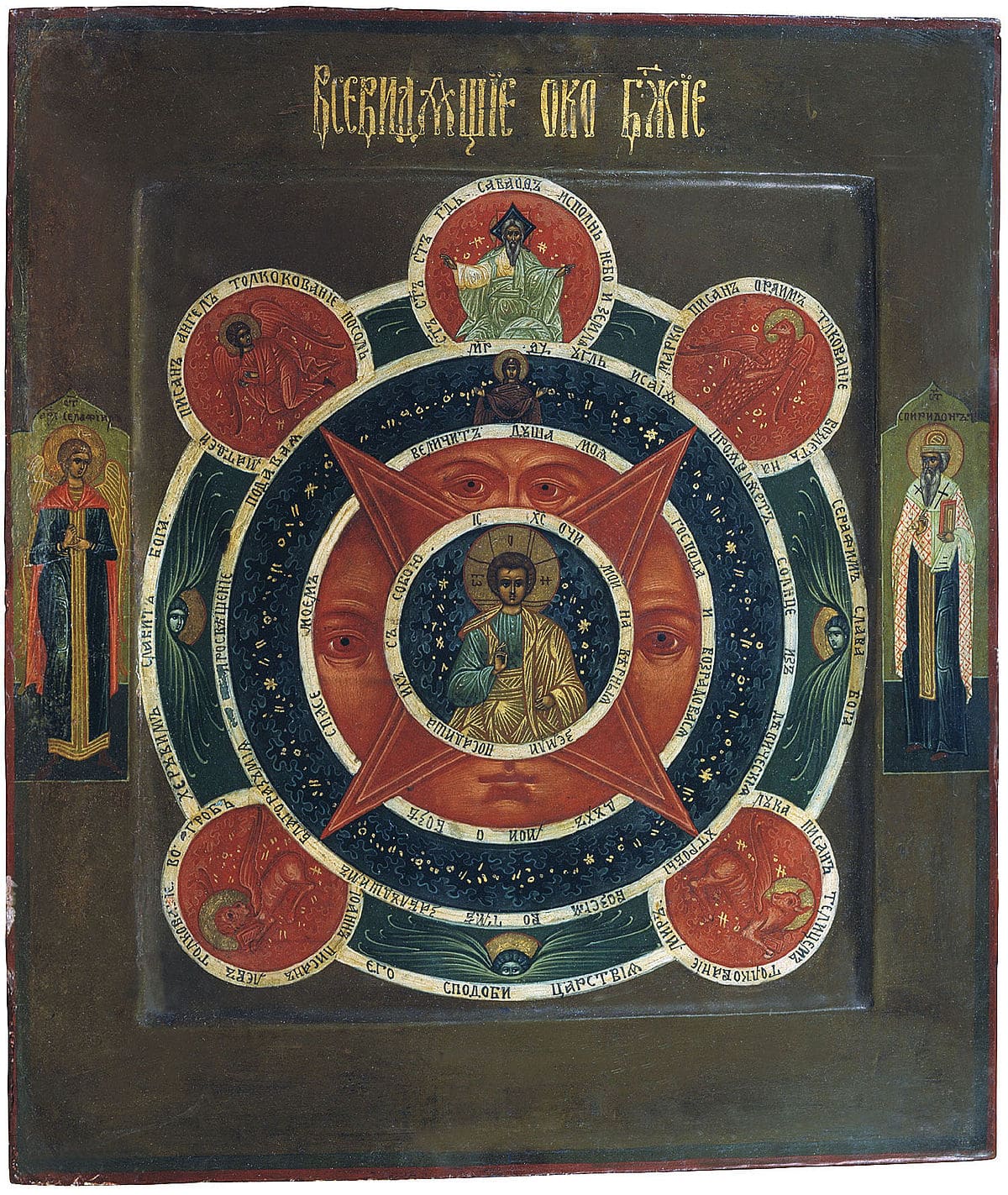
The All-Seeing Eye of God is a symbolic and allegorical composition based on the words of Scripture about the vigilant all-seeing and all-knowing Christ
From the end of the 18th – the first half of the 19th century the image of the All-Seeing Eye, inscribed in a triangle, appeared in the frescoes of the Orthodox Churches. Later in Russian iconography, mainly among the Old Believers, the icon “The All-Seeing Eye of God” is found.
Icon
This icon is a symbolic and allegorical composition based on the words of the Holy Scriptures about the vigilant omniscient and omniscient Christ. The idea of the icon goes back to the words of the Bible: “Behold, the eye of the Lord is upon those who fear Him and trust in His mercy” (Ps. 32:18).
The composition of such icons is based on the repeating circular motif. In the central circle, Jesus Christ is depicted in the iconographic image of the Savior Emmanuel with a blessing gesture. 4 rays are emitted diagonally from this circle. At the top there are 4 small circles, inside which there are allegorical symbols of the evangelists (see tetramorph) or less often images of the evangelists themselves.
In the segments of the next round are fragments of a human face – eyes, nose and lips (“mouth”). Above it on the central axis is depicted the Virgin with raised hands (Oranta).
The next circle is green or red, it can represent the sky (sometimes starry). Behind it – dark blue or red, in it on the sides and bottom are depicted seraphim or angels with scrolls. Above it, along the central axis, is a circle crossed at the bottom, which depicts “Heaven in Heaven”, in which are written seraphim surrounding God the Father (Savaot) with a gesture of blessing. From him comes the Holy Spirit descending in the form of a dove on the head of the Mother of God. The following inscriptions are on the icon:
Around the red face: “The charcoal of Isaiah is manifested, the sun rises from the womb of the Virgin to the lost prudent.”
• Around the green ring: “My soul glorifies the Lord; and my spirit hath rejoiced in God my Savior, seeing the humility of His handmaid ”(Luke 1: 46-48).
• Around the Blue Ring: “Heaven gives the kingdom of Your eyes to the faithful lands to judge them with cherubim glorifying God. Heaven gives glory to God ”(Ps. 49: 6).
• Around Savaot there is an outer ring with the text: “Holy, holy, holy, Lord of hosts is filled with heaven and earth of your glory”
• On the inner ring of the Christmas verse: “Glory to God in the highest, peace on earth” (Christmas verse).
Some modern clergy do not approve of the use of such icons. Metropolitan Hilarion (Alfeev) believes that such icons “are not canonical, do not correlate with any church text and should not be prayed to.”
The pre-Christian meaning of the symbol of the eye (the eye of Chorus, Isis, Ra, the all-seeing eye)
It is believed that the image of the all-seeing eye (eye in a triangle) symbolizes God. But is that so?
The eye (the big eye) is one of the symbols found almost at the very beginning of the oldest of the related texts that have come down to us (texts of the pyramid of Pharaoh Unis in the middle of the third millennium BC).
The fields located in Achet [Great Flood – Nile Spill] are planted with greenery. Unis planted grass on both shores of Achet so that he could bring faience [apparently as a sacrifice] to the big eye of the field.
One of the most famous ancient symbols of the eye is the Egyptian widget, the left eye of the god Horus. This god, by the way, is one of the main “characters” of the texts of the pyramid of Unas. The right eye of Horus in Egyptian mythology symbolizes the sun, the left – the moon, which in turn is one of the important attributes of Isis.
Rev. Christian Krieger, president of the Conference of European Churches, visited western Ukraine in April, where he met with Bishop Pavlo Shvarts of the German Evangelical Lutheran Church of Ukraine as well as other Ukrainian church leaders responding to humanitarian and spiritual needs.
“I found the churches I visited are in a very uncertain period,” reflected Krieger.
Churches are coping with members being displaced, some even without pastors, all while trying to meet massive humanitarian needs.
For some churches, these grave challenges are occurring amid fracturing affiliations woven into their identities.
“For some Orthodox churches, they are trying to change their affiliation, leaving from the Moscow Patriarchy,” he said. “This is very sensitive.”
Living in wartime, people may feel uncertain about their physical safety and their spiritual grounding as well. “But churches are committed to social work, and there is a huge increase in the demand for that, because the people are in much more difficulty,” said Krieger. “Churches are delivering massive humanitarian aid.”
Churches are helping the most vulnerable, he added—elderly people left alone, mothers with young children, and many people who simply don’t know where they will get their next meal. “This is really the biggest challenge for the churches,” he said. “They have so many things they need to think about.”
Finding a sense of hope at Easter-time was also its own special challenge for many people in Ukraine. Yet Krieger saw moments of unity amid the chaos of war.
“I saw a unity in all of Ukraine—not just a Christian unity but really a global unity,” said Krieger.
As he visited churches, one by one, he saw them praying together for peace. “This is a special situation in which churches are opening spaces in which to pray and to encounter all Christians,” he said.
Krieger also saw evidence of the solidarity churches across the world are showing for the people of Ukraine. “So many goods coming from churches across the world—hygiene materials, food, so much more put forth for people in need,” he said. “I witnessed a huge network of solidarity.”
Krieger said he is thankful for CEC Member Churches and for churches across the world that have reached out in whatever ways they can. “I saw so many volunteers who came from Europe, and from many countries across the world,” he said.
For those who can’t be physically present in Ukraine, Krieger urged them to keep praying and keep sharing the truth about the war—and to keep alive the horizon of reconciliation and peace.
What can we pray for Ukraine? “First, pray and call for justice and truth,” urged Krieger. “And then we need also to work for reconciliation and peace.”
He believes lasting peace will not be possible with the kind of reconciliation that requires incredibly hard work among the churches of Ukraine and the wider world as well.
“I discovered how much the huge work of reconciliation is needed among the families and the victims,” he said. “Their lives will change and the time for this work will come. We cannot be satisfied with peace that is a simple ceasefire—because such a peace will not last.”
A sense of truth is badly needed, Krieger added. “Truth is often the first victim of the war because there is so much propaganda on both sides,” he said. “Truth is also necessary to heal the wounded memories.”
Building a lasting peace means giving spaces in churches and in people’s lives to walk and work together to write the common story of what’s happened. “This is the work of truth and justice,” he said.
(*) Susan Kim is a freelance journalist from the United States.
Kisses stimulate the production of saliva, which washes away bad bacteria
An orthodontist recommends that people kiss for four minutes a day to keep their teeth healthy and their breath pleasant, MailOnline said.
According to Dr. Khaled Kasem, kissing stimulates the production of saliva, which washes away bad bacteria. However, they do not replace traditional brushing.
“Saliva is important because it makes it easier to chew, taste, swallow, fight bacteria in the mouth … This happens when kissing,” explains Dr. Kasem of the Impress dental chain.
Saliva also neutralizes acids and thus reduces the risk of tooth decay.
Single people can replace their partner with gum. However, kissing has an advantage – the exchange of saliva stimulates the immune system to produce more antibodies that protect against infection.
People with herpes and other infectious diseases should still refrain from kissing.
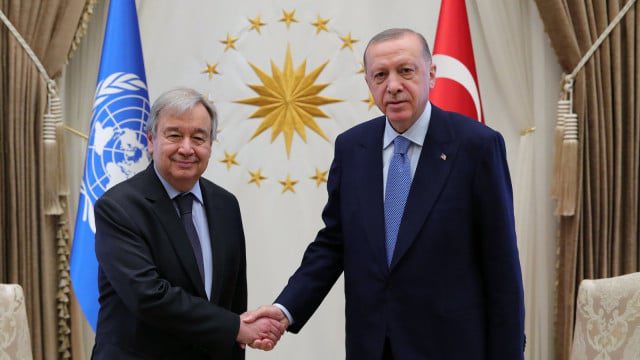
President Recep Tayyip Erdogan received UN Secretary-General Antonio Guterres in Ankara amid Turkey’s mediation efforts to end the war between Ukraine and Russia.
The closed-door meeting was just before Guterres’ visits to Russia and Ukraine.
Guterres and Erdogan reaffirmed their “common goal” of ending the war in Ukraine “as soon as possible,” the United Nations said on Monday.
The leaders “stressed the urgent need for effective access through humanitarian corridors to evacuate civilians and provide much-needed assistance to affected communities,” a UN statement said.
Guterres voiced support for “Turkey’s ongoing diplomatic efforts over the war in Ukraine”, noting that he and Erdogan “agreed to stay in touch to follow ongoing initiatives”.
Earlier on April 18, UN aid chief Martin Griffiths said Turkey had been a valuable host to humanitarian talks between Ukraine and Russia.
Today, Guterres traveled to Moscow to meet with Russian President Vladimir Putin. On Thursday, he will also visit Kyiv in an attempt to mediate an end to the Russian invasion, which has killed thousands and driven more than 10 million Ukrainians from their homes since February 24.
Guerres, an associate spokesman for Guterres, said the UN chief would go to Moscow today to meet with Russian President Vladimir Putin and have a working lunch with Russian Foreign Minister Sergei Lavrov, hoping to discuss what could be done to bring peace to Ukraine.
Guterres will meet with Ukrainian President Volodymyr Zelensky on Thursday, as well as with Foreign Minister Dmytro Kuleba and UN officials to discuss stepping up humanitarian aid efforts.
The voyage comes when the war enters its third month, with fierce fighting continuing in eastern Ukraine and dozens of civilian and Ukrainian soldiers trapped in the besieged port city of Mariupol.
Zelensky on Saturday criticized Guterres’ decision to head to Moscow before Kyiv, saying “there is no justice and logic in that order.”
“The war is in Ukraine, there are no bodies on the streets of Moscow. It would be logical to come to Ukraine first, to see the people there, as well as the consequences of the occupation, “Zelensky said.
Mexico has taken a step towards the nationalization of its lithium, the main metal for the production of electric batteries, which should replace internal combustion engines in electric vehicles as part of the fight against climate change, AFP reports. Lithium is part of Mexico’s legacy, which excludes any new concessions to private companies, according to a reform of the mining law passed by a majority of left-wing lawmakers Andres Manuel Lopez Obrador. Previous governments have granted eight concessions, which remain in force. Mexico has large reserves of lithium in the northern state of Sonora, announced in 2019 the specialized site Mining Technology. The projects are currently in the research phase. Approved by 298 votes in favor by a total of 500 deputies, the law must also be voted on by the Senate, where the ruling National Renewal Movement (MORENA) also has a majority.
Meanwhile, the House of Deputies on Sunday rejected a constitutional reform aimed at strengthening the state’s role in the electricity market. The lithium bill was passed by a simple majority, while constitutional reform required two-thirds of the votes the Mexican president did not have among lawmakers. The electricity market reform project has alarmed the United States, which has warned of endless litigation under the Mexico-US-Canada free trade agreement. President Lopez Obrador said opposition lawmakers who voted against the reform had committed an “act of betrayal” of Mexico.
Meanwhile, Chile and Argentina have cut off lithium supplies to Russia. This was stated by Deputy Director of the Department of Metallurgy at the Ministry of Industry and Trade Vladislav Demidov, UNIAN reported. “Lithium raw material is not extracted in Russia, it comes in the form of lithium carbonate mainly from Chile, Argentina, China and Bolivia. Supplies from Chile and Argentina have been suspended, only Bolivia has the opportunity to obtain the raw material,” Demidov said.
Russia has lithium processing facilities to meet domestic needs and export supplies. The problem is serious, because if Bolivia stops deliveries, there will be nowhere to get the raw material, Demidov added. He proposes to speed up the issuance of licenses to companies capable of extracting lithium in Russia. Lithium and its compounds and alloys are critical to the technological development of many industries in aviation, metallurgy, microelectronics, chemistry and others. Lithium is the most important for the production of rechargeable batteries.
Mass distrust in the economy is something that characterizes Argentina today. For Jeronimo Ferrer, this mistrust is shaped by memories of the devastating financial crisis in Argentina in the late 1990s, when bank accounts were frozen and people’s savings evaporated overnight. It’s not just Ferrer who thinks so. A student studying to become an engineer says he keeps all his savings in US dollars at home, fearing that the banking system could collapse again, leading to a devaluation of the money, writes the BBC. While many Argentines have inevitably become economic experts, following things like high inflation and the unofficial exchange rate between the local peso and the US dollar, Jeronimo Ferrer has gone even further. Since 2019, he has run a program called “Our Local Crazy Economy and Bitcoin Tour of Buenos Aires”, where he explains to tourists the level of restrictions that Argentines face in their daily lives – from a limit on foreign exchange transactions to a ban on paying contributions of reservations for international flights. He gives examples of cryptocurrencies, especially bitcoin, and why he believes they are a valuable alternative to the volatile and heavily controlled Argentine peso. “When you have restrictions, you need tools for freedom,” Ferrer said. For many crypto enthusiasts around the world, decentralization and virtual currencies are primarily an ideology and a means of profit. But for many Argentines, it is a means of meeting basic needs. “I trust math and software more than I trust politicians,” Ferrer said, adding that he said bitcoin was something Argentines should embrace without much thought. Various examples of strong government intervention in the economy are helping to strengthen cryptocurrencies in Argentina. For example, bitcoin mining operations are relatively cheap, as the price of electricity in the country is low. Bitcoin mining is a process in which new digital currencies are mined. It involves the use of computers to solve complex mathematical equations. When these calculations are completed, the miner receives reward in the form of bitcoin. It may seem easy in words, but the process requires investment in hardware, the consumption of a significant amount of electricity and the availability of stable cooling systems. The University of Cambridge’s Center for Alternative Finance estimates that the electricity used to dig up bitcoin worldwide reaches 137 terawatt hours a year. This is the same as the annual electricity consumption in countries such as Norway and Poland. The production of so much electricity for the purposes of cryptocurrencies increases the harmful carbon emissions, and so far there are no accurate estimates of how large the harmful footprint of this industry. However, in Argentina, such environmental concerns often give way to financial concerns. For some Argentines, even a relatively young and unpredictable currency is preferable to the extremely volatile peso. Bitcoin, which is the most popular cryptocurrency in the world, can also serve as a buffer against high inflation, as the number of currencies is pre-set – that is, there is no way to “print” an infinite number of bitcoins. Inflation in Argentina seems to be an eternal problem that is present in the daily lives of the people in the country. Annual inflation in Argentina exceeds 50%.
“During the pandemic, people noticed the situation and in order to protect their money, they chose to focus on assets that are limited,” said Maria Mercedes Etchegoen. She is a lawyer specializing in intellectual property, as well as a member of the executive committee of the NGO Bitcoin Argentina. Etchegoen is also part of the creation of the Cryptogirls movement, which emerged amid growing interest in cryptocurrencies during the pandemic. For now, the Argentine government is approaching the boom in virtual currencies in the country with caution. “There are no specific regulations for cryptocurrencies in Argentina,” said Etchegoen. However, the country’s central bank has issued warnings about cryptocurrency fraud. The regulator points out that despite the not very high level of use of cryptocurrencies, their use is growing rapidly – something that deserves attention. IMF to the world’s first bitcoin: Abandon plans The International Monetary Fund is pressuring El Salvador to abandon bitcoin as a legal tender, according to a statement from the organization … Read more Etchegoen is concerned about uneven access to cryptocurrencies in the country. So far, the people who use them are a minority – mostly young people, men, people with interests in technology and part of the wealthier population. “Nowadays, this is not a technology that anyone can adopt,” admits blockchain consultant Lucia Lizardo. However, in Argentina, efforts are being made to spread cryptocurrencies, mainly through financial products that serve as an intermediary between traditional and virtual currencies. Three Argentine startups offer debit cards specifically designed for blockchain-based transactions. Lemon, one of these companies, was founded in a city where 40% of stores accept bitcoin payments.
Some people in Argentina also use so-called stablecoins, which are pegged to the US dollar, making them less volatile. Of course, cryptocurrencies cannot offer a radical solution to the problems of the Argentine economy. They bring with them their own problems such as currency speculation, fraud and harmful carbon footprint. However, “I think it’s like a revolution for young people,” says Lizardo. For Jeronimo Ferrer, things are much clearer. “This is our money and it is the only thing that politicians cannot destroy,” he said.
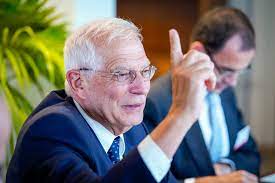
European Foreign Minister Josep Borrell told El Pais that all EU members must get rid of energy dependence on Moscow, but acknowledged that unanimity had not yet been reached between member states. Borrell proposes a renunciation of fossil fuels and stresses that wheat could be Russia’s next economic weapon. Alternatively, Borrell offers a voluntary waiver of fossil fuels. He also insisted on supporting Kyiv with weapons. “The way out of the conflict must be decided on the battlefield,” Borrell said in a virtual interview with the LENA media group, which includes El Pais. “Russia’s first blitzkrieg attempt failed. They failed to take Kyiv. They had to retreat, change their tactics and concentrate their forces in Donbass. So far they are losing. Ukrainians will have to pay a high price: they have a large number of victims, infrastructure has been destroyed, civilians are fleeing or dying. However, Russia’s plans failed. “Let’s see how the next battle goes,” Borrell said. “There are people who criticize us and say that giving weapons means prolonging the conflict and causing more casualties, and that we must stop. If we stop arming Ukraine, the conflict will end. But then what? Doesn’t matter how it ends? The question is not only when it will end, but also how. Regarding the imposition of new sanctions that will affect Russia’s oil and gas, Borrell said there are many options on the table: a tax, an import ban or perhaps the Iranian system.
“Many economists believe that it would be rational to raise gas and oil prices in order to demand alternative sources. None of these proposals enjoys unanimous support. This is an issue that needs to be addressed by the European Council. This is a high-level policy. No agreement has been reached so far. We talk to everyone and put pressure on action. When Germany said there would be no more Russian oil by the end of the year, it put strong pressure. But it will happen. Russia will lose money from the sale of oil and gas. If we can reach a unanimous decision, I will be happy. I insist on this, I present arguments, I study the possibilities, I look for alternatives. “
According to the diplomat, Europe lacks autonomy in many respects, but the most important at the moment is energy. “We are very dependent on supplies from a person with whom we now have a very bad relationship. It is clear that Europe must make an effort to become energy independent as a start. This is the most important thing right now. We can be criticized for failing to do so much earlier when Putin took over Crimea. Now we see the real danger. “Everyone is reducing their consumption and energy dependence on Russia,” he said. However, according to the head of European diplomacy, the world will be even more divided and this will lead to economic shocks. Wheat will become a kind of weapon. Russia is already saying, “Our wheat is for friends, and whoever is not our friend will not receive it.” A new political panorama will emerge in which Russia and China will be on one side and the West on the other. And many “Developing countries are leaning towards one country or the other, depending on the circumstances. Do you remember the Cold War, when there were non-aligned countries? We are now witnessing a resurgence of this phenomenon,” concluded Josep Borrell.
Modern photographic computer technology is applied in Bulgaria at a limited number of sites
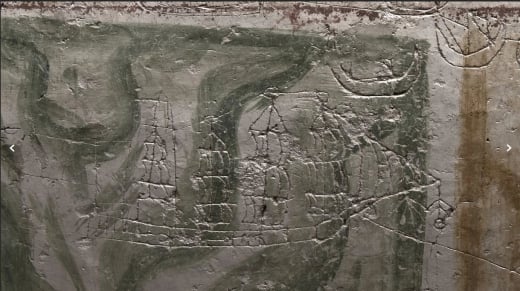
Almost 360 drawings of ships on the walls of four churches in Nessebar have been taken for more than 4 years. In addition to vessels, the drawings have names in Greek and animal motifs, bTV reports.
“This is a modern photographic computer technology, which we have been applying in Bulgaria for 10 years to a limited number of archeological sites. The main thing for her is the use of light so that the composition can be seen in detail “, explains Naiden Prahov.
“Professor Alexander Gabov was the first to apply this technology in documenting epigraphic monuments in Bulgaria,” said the marine archaeologist, who lives in Canada and created this technology for documenting epigraphic monuments.
These paintings are found in four of the churches in Nessebar, and in some places they literally cover entire walls.
Marine archaeologist Zdravka Georgieva explains that the paintings date from the 14th century, others from the 19th century, but there are also ships from the 18th century.
“These are drawings through which the man who made them wanted to beg for prosperity for the sailors, for the captain,” said the archaeologist.
Investors rush to return to the US, where rates are rising
China’s currency, the yuan, suffered its worst weekly drop since 2015 on Friday as investors fretted over the economy and the Federal Reserve’s policy of making Chinese bonds less attractive.
The offshore yuan traded at around $6.53 per dollar on Friday, according to Bloomberg prices.
It has fallen about 2.4% since opening at 6.38 per dollar on Monday. This resulted in the worst weekly drop since early August 2015, when the government surprised the markets by devaluing the currency.
The yuan came under pressure as the US Federal Reserve prepared to quickly raise interest rates in response to hot inflation. US bond yields soared as investors demanded higher returns on their investments to reflect rising interest rates.
Rising US yields, in turn, made Chinese securities less attractive, forcing investors to sell the yuan. The dollar index, which measures the US dollar against a basket of currencies, is up about 2.7% over the past month to 100.93.
“In China, the yuan sell-off threatens to be something of a rout,” said Geoffrey Halley, senior Asian market analyst at foreign exchange firm Oanda. “Price action this week suggests that foreign money leaving China’s stock and bond markets is at risk of becoming a flood.”
Analysts say China’s economy is also a concern. The government’s strict COVID-19 policy has led to lockdowns in cities like Shanghai, and the conflict between Russia and Ukraine has further clouded the outlook.
The International Monetary Fund lowered its forecast for China’s economic growth to 4.4% this year, while expecting growth of 4.8% in January. He cut his US growth forecast by 0.3 percentage points to 3.7%.
The Chinese yuan is strictly controlled by the country’s central bank. The People’s Bank of China sets a trading point for the yuan within the continent every day and allows it to move 2% in any direction. The offshore yuan is influenced by the continental currency, although it is considered to be free floating.
On Wednesday, the PBOC set a lower-than-expected fixing for the local yuan, which analysts say could boost Chinese imports, making them cheaper in relative terms.
Craig Botham, chief China economist at Pantheon Macroeconomics, said he expects the currency to weaken further as the economy slows in the second quarter.
“We expect the yuan to reach 6.8 per dollar by the end of the year, with risks mainly directed towards the depreciation,” he said.
“It was the best of times, it was the worst of times, it was the age of wisdom, it was the age of foolishness, it was the epoch of belief, it was the epoch of incredulity, it was the season of light, it was the season of darkness, it was the spring of hope, it was the winter of despair.” So famously wrote Charles Dickens in “A Tale of Two Cities,” and his words apply to our present situation as well.
It is the worst of times when the ghosts of aggression and war rear their ugly heads again. It is the age of foolishness when many believe propaganda aimed at blaming the victim rather than the aggressor. It is the epoch of incredulity when we lose faith that good can ultimately prevail. It is a season of darkness when cities are bombed and children are killed in an unprovoked war. It is a winter of despair when millions of refugees leave everything and come to European Union countries in tears.
But at the same time, it is the best of times when Europe and the world wake up and discover how precious is the fragile achievement of democracy. It is an age of wisdom when in Europe we all understand we have tolerated human rights violations for too long. It is an epoch of belief when we cherish the hope that we will overcome war and tyrants as we were able to overcome a pandemic. A season of light and a spring of hope will dispel darkness and despair if we, the Europeans, understand that it is our values that will carry the day in the end, and not in Europe only.
Taiwan is also at the center of global concerns, and they affect Europe as we saw when we all had to stand in solidarity with Lithuania after it was sanctioned for its friendship with the Taiwanese. Defending Taiwan is not about economic ties, as important as they may be, it is about values. Either Europe is a community founded on a shared heritage of defending democracy and human rights or there is no Europe.
SOME PROBLEMS OF TAIWAN’S DEMOCRACY
While we defend the right of the Taiwanese to freely choose their government and their model of international relations, as European friends we should also look at what in Taiwan’s democracy is still open to a dangerous criticism by its enemies. As the Bible says in the Book of Proverbs, “A truly good friend will openly correct you.”
As the current President of Taiwan has acknowledged, two main problems there are corruption and transitional justice. Although anti-corruption plans have been implemented, Taiwan still ranks comparatively high in global statistics about corruption. Among the most corrupt sectors of Taiwan’s bureaucracy is the National Taxation Bureau (NTB). One of the reasons is that tax bureaucrats receive high bonuses when they enforce tax bills against taxpayers. This creates a powerful incentive to issue high tax bills and quickly enforce them and pocket the bonuses, whether they are right or wrong.
Corruption is a typical problem of societies that transition from authoritarian to post-authoritarian political systems. Old habits die hard, and bureaucrats who were accustomed to be almost omnipotent are not happy to relinquish their power.
This is the problem of “transitional justice.” A true transitional justice implies that when an authoritarian regime is replaced by a democratic one, past violations of human rights are publicly acknowledged, perpetrators are brought to justice, laws are reformed, and victims are indemnified.
The experience of many European countries proves that the transition from an authoritarian to a democratic regime does not happen overnight. In Taiwan, Martial Law was abolished on July 15, 1987. But this did not mean that the next day Taiwan became a full-blown democracy. The party that was in power in 1987 remained in power and controlled the presidency or the Parliament until the first party rotation in 2000. This obviously made transitional justice difficult.
THE TAI JI MEN CASE
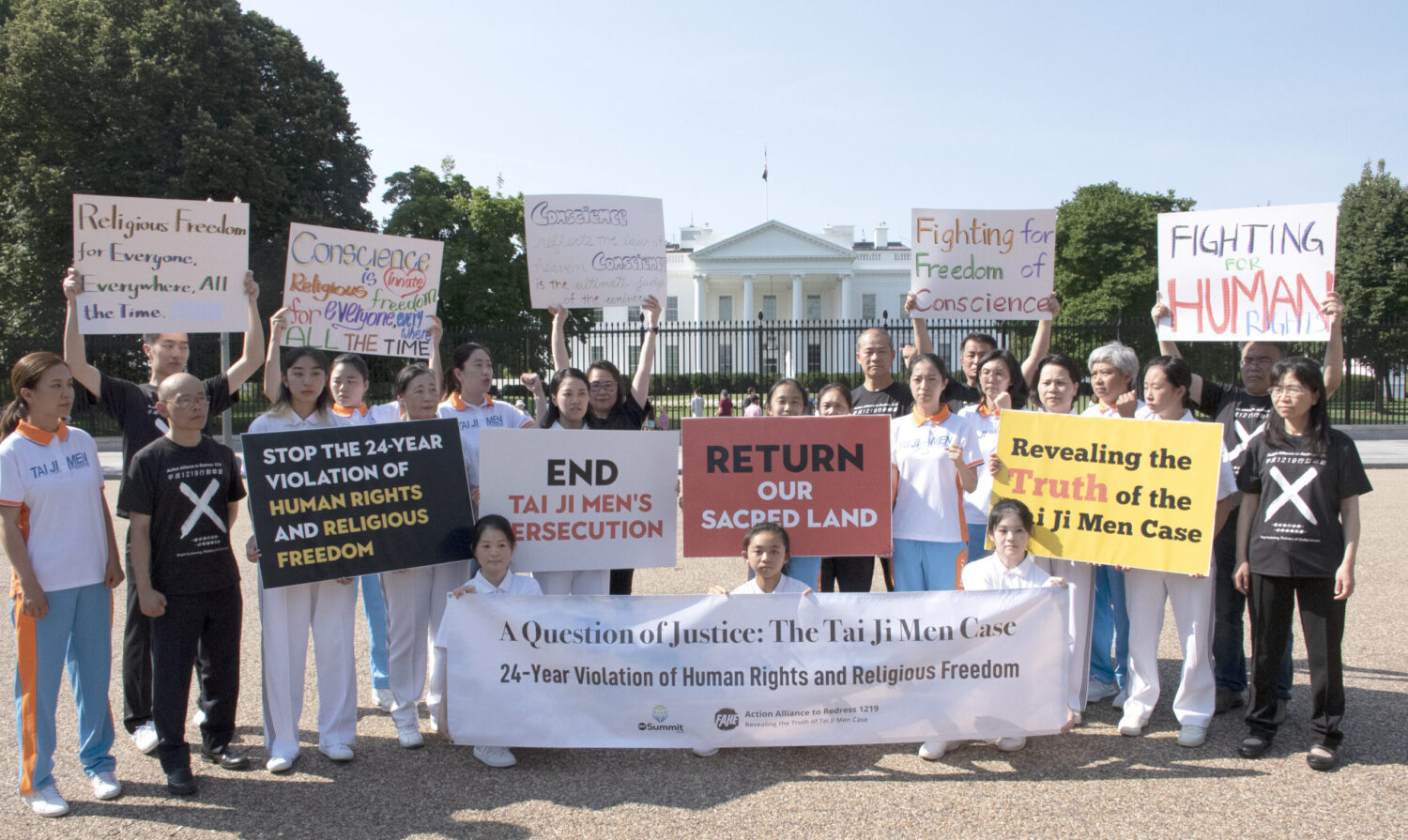
Those who have visited Taiwan recently may have noticed massive protests in the streets of Taipei, where thousands call for tax reform and transitional justice in a case concerning a spiritual movement, Tai Ji Men, a “menpai” (similar to a school) of qigong, martial arts, and self-cultivation rooted in esoteric Taoism but open to disciples (dizi) of all faiths, whose Grand Master (Shifu) is Dr. Hong Tao-Tze.
Dr. Hong also promotes high profile initiatives for a culture of conscience and world peace, and brought traditional Tai Ji Men culture abroad through over three thousand cultural events and martial arts performances, many of which were held in Europe. Tai Ji Men’s efforts have been highly praised by international political and spiritual authorities, including different Presidents of Taiwan.
Notwithstanding this praise, Tai Ji Men has been a victim of a campaign of repression that targeted in 1996 several spiritual movements in Taiwan, accused during the post-authoritarian phase of the island’s history of not supporting the candidate who won in that year the first Taiwanese presidential elections. Notwithstanding its caution in not taking political sides, Tai Ji Men was also involved in the crackdown, and Dr Hong was arrested together with his wife and two dizi.
Dr. Hong was falsely, and ridiculously, accused by a prosecutor, who violated the law and abused his authority, of “religious fraud” and even of “raising goblins,” a practice totally foreign to Tai Ji Men. To this, an accusation of tax evasion was added, with fabricated arguments.
On July 13, 2007, the criminal division of the Supreme Court of Taiwan pronounced the final acquittal of Tai Ji Men defendants, declaring them innocent of all charges, including tax evasion. National compensation for the wrongful detention was given to Dr. Hong and his co-defendants who had been detained.
This should have been the end of the Tai Ji Men case. However, some NTB bureaucrats decided to ignore the court decision and go on with their unjustified tax evasion action. They also knew that they could pocket significant bonuses by issuing tax bills against a large movement such as Tai Ji Men.
Even after the Supreme Court had concluded that Dr. Hong had committed no crimes, and there was no tax evasion, they tried to maintain their tax bills for the years 1991 to 1996, claiming that the money Dr. Hong had received from dizi in the so-called “red envelopes” should not be considered as non-taxable gifts but as taxable tuition fees—even if the highest courts in Taiwan had declared they were not tuition fees.
In 2019, the NTB, in accordance with the rulings of the Supreme Administrative Court and the Taipei High Administrative Court, agreed that tax bills for the years 1991 and 1993 to 1996 should be corrected to zero, but maintained the tax bill for 1992, including penalties. Logically, this did not make sense, as the content of the red envelopes in 1992 was not different from the other years.
The NTB relied on a technicality, i.e., that for the year 1992, and only for that year, a decision by the Supreme Administrative Court rendered in 2006 had become final. It is a general principle of law that even final decisions can and should be revised or not enforced when a new fact intervenes, in this case the verdict of the criminal section of the Supreme Court of 2007 that found Dr. Hong and Tai Ji Men not guilty of tax evasion. Nonetheless, the NTB refused to cancel the tax bill for 1992.
On May 5 and July 23, 2020, the Taipei High Administrative Court wrote twice to the NTB for the Central Area, asking them to treat 1992 as the other years were treated. This, also, was to no avail. In August 2020, land belonging to Dr. Hong that had been seized was auctioned by the National Enforcement Agency, then confiscated after two auctions were not successful. This property was important for Tai Ji Men, which planned to build a center for self-cultivation on what they consider a sacred land. Massive protests and an international campaign supporting Tai Ji Men followed.
The Tai Ji Men case is not about money. Tai Ji Men spent in legal fees only more than it should have paid had it settled with the NTB. It did not settle for a reason of conscience and values. While protests are gaining international momentum, it is time for the European friends of Taiwan to tell the Taiwanese authorities that we admire and support Taiwan but we expect it to solve its human rights, transitional justice, and freedom of religion or belief problems. The Tai Ji Men case would be a good starting point. The time is now, “the worst of times” and “the best of times.”. ■
It is time for the European friends of Taiwan to tell the Taiwanese authorities that we admire and support Taiwan but we expect it to solve its human rights, transitional justice, and freedom of religion or belief problems. The Tai Ji Men case would be a good starting point. The time is now, “the worst of times” and “the best of times”.