The European Parliament will vote on a proposal to have more common rules for EU elections and the addition of an EU-wide constituency.
The EU elections determine the representatives of Europeans at EU level, but how they are organised is largely decided at national level. This means that countries vote on different days, only national political parties appear on the ballots and voting age varies.
The report says it is essential to transform the EU elections “into a single European election, […] as opposed to 27 separate national elections, which is the way that European elections are organised today”.
Transnational electoral lists and lead candidates
MEPs propose the establishment of an EU-wide constituency to elect 28 MEPs in addition to the MEPs elected in national or regional constituencies.
European political parties or coalitions of national parties would be able to propose transnational lists of candidates headed by their preferred candidate for the president of the European Commission. There should be geographical balance in transnational lists by including candidates from large, medium-sized and smaller countries in alternating order.
The proposal also says that lead candidates should be able to stand in all member states on the EU-wide lists, allowing voters to vote for their preferred candidate for Commission president.
A proposal for transnational lists prior to the 2019 European elections did not receive support from EU heads of state and government. At a meeting in February 2018, they said they would come back to the issue “in the future, with a view to the 2024 elections”.
In 2014, the European Council nominated Jean-Claude Juncker, the lead candidate from the European People’s Party (EPP), the European political family that won the most votes, as Commission president. In 2019, however, EU leaders did not follow the same process.
MEPs argue that the establishment of an EU-wide constituency in which lists are headed by each political group’s candidate for Commission president would strengthen European democracy and further legitimise the election of the president of the Commission.
A recommendation for electoral lists from multiple member states was also made by a panel of European citizens in the Conference on the Future of Europe.
Common provisions for the elections
MEPs propose that the EU election day should be the same for all EU countries and that it should always take place on 9 May, Europe Day.
Currently, elections take place from Thursday to Sunday, with each country following its national electoral traditions.
The proposal seeks to harmonise the age from which EU citizens have the right to vote or stand for EU elections. MEPs recommend that all Europeans should have the right to vote from 16 and that every EU citizen over 18 should have the right to stand for election.
The proposal envisages that all EU countries should provide for postal voting in the European elections. It also says that gender equality in electoral lists should be ensured either through zipped lists, where men and women candidates alternate, or through quotas.
Special procedure for amending electoral rules
Updates of the European Electoral Act are subject to a special decision-making procedure. The proposal is prepared by the European Parliament. The Council can amend it and has to adopt the text unanimously after obtaining the consent of the Parliament. All EU countries have to approve the provisions before they can enter into force.
Since January 30, six Russian oligarchs close to the government have committed suicide in strange circumstances, fuelling various theories of settling scores against a backdrop of economic sanctions
Six multimillionaires or billionaires dead since January 30, less than a month before the start of Russian aggression in Ukraine. Curious suicides of Russian oligarchs in the UK, Spain and Russia are becoming increasingly bloody, reveals Newsweek: the last three, those of Vasily Melnikov (in Nizhny Novgorod, Russia, on March 23), Vladislav Avaev (in Moscow on April 18) and Sergey Protosenya (in Lloret de Mar, Spain, on April 19), were accompanied by the death of women and children, killed by gunshot or stabbing.
Before them, Mikhail Watford, an oil billionaire found hanged on February 28 in the UK. Alexander Tyulyakov, found in Saint Petersburg on the 25th. Finally Leonid Shulman, a senior Gazprom executive, was found dead in his bathroom at the end of January.
The fall of the USSR and the arrival of a market economy had enabled them to become rich, especially in the field of raw materials. Some of them, at the head of strategic companies, had even established important relations with the top of the State, benefiting from the leniency of Vladimir Putin. But since the beginning of the Russian invasion of Ukraine on February 24, the oligarchs seems to have begun its decline.l
Hard hit by sanctions First of all, it is a shower of economic sanctions that has fallen on them. The West, aware of the role played by this economic caste in keeping warlord Vladimir Putin in power, has hit them hard in the wallet. Goodbye financial assets, yachts, villas and cottages on European soil.
Since these six serial suicides, theories have flourished: a settlement of accounts between clans? Disguised purge at the top of the power? A macabre series of suicides that look like coincidences?
Each time, no trace of forced entry, doors locked from the inside, but some disturbing details, such as the eagerness of the Russian authorities to clean up the scenes of tragedy and validate the suicide thesis. Or the absence of blood traces on the body of Sergey Protosenya. The former CEO of Novatek, number 2 in the Russian gas industry just behind Gazprom, who lived in France, would have nevertheless, just before his suicide, killed his wife and daughter with an axe…
Murders disguised as accidents or suicides are a practice often mentioned in Russia, especially since the Soviet era, and its secret services have a strongly assumed know-how in this matter.
The UN published promising news in the global fight for gender equality and opportunity on Wednesday, showing that when it comes to mathematics, girls are now performing as strongly as boys in the classroom – although there are plenty of barriers holding them back.
The finding, from the UN agency UNESCO, followed analysis of primary and secondary education in 120 countries.
Although boys perform better than girls in the subject in the early years, this gender gap disappears in secondary school – even in the world’s poorest countries – researchers found.
Girls in the lead
Some countries even saw girls do better than boys in maths, including Malaysia, where by age 14, girls have a seven per cent lead on boys, Cambodia (three per cent) and the Philippines (1.4 per cent).
Despite this progress, the UN educational, cultural and scientific agency, warned that gender “biases and stereotypes” will continue to affect girls’ schooling, as boys “are far more likely to be overrepresented” at the top level of maths, in all countries.
The problem extends to science, with data from middle and high-income countries showing that although girls in secondary school score significantly higher in scientific studies, they are still less likely to opt for careers in science, technology, engineering and mathematics, the STEM subjects.
Girls’ chapter and verse
While girls perform well in maths and science, they show even greater proficiency in reading, with more of them achieving minimum proficiency in reading than boys.
The largest gap in primary education is in Saudi Arabia, UNESCO said, where 77 per cent of girls but only 51 per cent of boys in grade 4 (age 9-10), achieve minimum proficiency in reading.
In Thailand, girls outperform boys in reading by 18 percentage points, in the Dominican Republic by 11 points and in Morocco by 10 points.
Even in countries where girls and boys have the same level of reading in the early grades – as in Lithuania and Norway – by the age of 15, girls are roughly 15 percentage points ahead of boys.
“Girls are demonstrating how well they can do in school when they have access to education,” said Malala Yousafzai, co-founder of Malala Fund, cited by UNESCO. “But many, and particularly the most disadvantaged, are not getting the chance to learn at all. We shouldn’t be afraid of this potential.
“We should feed it and watch it grow. For example, it’s heart-breaking that most girls in Afghanistan do not have the opportunity to show the world their skills,”
“Although more data is needed, recent releases have helped paint an almost global picture of gender gaps in learning outcomes right before the pandemic”, said Manos Antoninis, Director of UNESCO’s Global Education Monitoring Report.
“Girls are doing better than boys in reading and in science and are catching up in mathematics. But they are still far less likely to be top performers in mathematics because of continuing biases and stereotypes. We need gender equality in learning and ensure that every learner fulfils their potential”.
Man’s eating habits can show luxury, extravagance or, conversely, simplicity and modesty, as well as surprise and even terrify, writes the Egyptian “NoonPost”. In an article, he reveals the dietary preferences of the world’s most famous leaders. As people’s taste preferences and eating habits differ, we all have our favorite foods. This also applies to the leaders of the states. Their eating behavior can show luxury, extravagance or, conversely, simplicity and modesty, as well as surprise and even terrify. Historical novels inform us a lot about the taste preferences of the palace aristocracy – they are full of descriptions of lavish feasts with chants and music and a wide variety of dishes. The interest in the study of food and literature on it in ancient societies gives a new perspective on history, can give us a clear idea of these eras from a social and cultural point of view. With the development of civilization and the social and cultural revival, the tastes and preferences of kings and sultans changed, and public feasts became available to a small circle of people who observed hygiene and etiquette. In addition, leaders have become more cautious than ever for fear of poisoning or disease. The meals of modern heads of state are sometimes top secret for reasons of national security.
From beef head, preferred by Jacques Chirac, to Vladimir Putin’s favorite pistachio ice cream – food remains an extremely sensitive topic in power circles. So when asked by Angela Merkel’s chef about her favorite recipes, he replied: “I can’t tell you what her preferences are, otherwise these dishes would be cooked all over the world.” Gilles Bragard, president and founder of the French Club of Chiefs chefs, commenting on the preferences of French leaders: “Food is a very sensitive issue in power.”
French presidents
Charles de Gaulle preferred peas, which speaks to the strict nature of the military leader, who does not spend much time at the table.
As for Francois Mitterrand, his eating habits are mixed. The socialist president loved caviar, a bourgeois delicacy that contradicted the ideology he was publicly promoting.
Jacques Chirac is known as a hospitable host who presents his favorite dishes to his guests. He likes Asian cuisine and non-traditional dishes like beef head.
The French are aware that former President Francois Hollande does not like artichokes and asparagus: they well remember the diplomatic blunder of May 2012, when he was served asparagus during a visit to Angela Merkel during the French president’s first visit to Berlin.
As for former President Nicolas Sarkozy, Bernard Vaucon, who has run the Elysee Palace kitchen for nearly 40 years, said: “The president hated artichokes and loved chocolate mousse, and he was also known for not liking wine and cheese and was addicted to chocolate. ” Sarkozy also preferred plain salads, white meat and, of course, the pasta of his Italian wife Carla Bruni.
The leaders of America
In 1990, Republican George W. Bush banned the consumption of broccoli at lunch at the White House, Air Force One and Air Force barracks, and was remembered for saying, “I don’t like broccoli; I never liked this vegetable. When I was little “My mother fed me with it. I am now the President of the United States and I will not eat broccoli anymore!” This scandalous incident, called BROCOLIGATE, prompted farmers to send 10 tonnes of green vegetables to the White House in protest.
Unlike Michelle Obama, who calls for the fight against obesity and encourages the eating of fruits and vegetables, Barack Obama appears in photos and videos as a regular visitor to fast food restaurants and is known for his love of Mexican chili con carne. .
Russia and Putin
Known for his fear of poisoning, Putin has hired a full-time man to try all the dishes prepared for him. With his penchant for pistachio ice cream, despite low temperatures in Russia, Vladimir Putin remains one of the most conservative presidents when it comes to food, and the details of his food rarely get publicity. In 2012, however, he appeared on NTV and revealed what he usually eats for breakfast. He usually eats oatmeal and cottage cheese with honey, raw quail eggs and a cocktail of beet and radish juice. In an interview with the TV channel, Putin said: “I don’t have much time to eat, I like tomatoes, cucumbers and salads. In the morning I eat oatmeal and cottage cheese with honey, and if I can choose between meat and fish, I prefer fish. I also like mutton.”
The British Queen
Queen Elizabeth II begins her day with a cup of green tea from her favorite brand, Twinnings, the world-famous English tea company, Kellogg’s Special K cereal with fruit and sometimes an omelet with smoked salmon. For lunch, he prefers Dubonnet wine, fish with spinach and zucchini or grilled chicken and avoids carbohydrates. The British Queen’s dinner is like lunch – just cooked meat and vegetables. If he wishes, he can ask for venison to be served, and for dessert – chocolate, strawberry or peach pudding.
Germany:
The Führer and Merkel Who would have believed that Adolf Hitler, who was close to conquering the world, did not eat meat and was a vegetarian? Hitler’s last meal was an accurate indication of his taste preferences. On April 30, 1945, a 25-year-old girl arrived at Hitler’s bunker, where she was asked to prepare his last meal – scrambled eggs with mashed potatoes. As Victoria Clark and Melissa Scott recount in their book Dictators’ Evenings, Hitler was more animal-friendly than human, but he was not a devout vegetarian. For example, there is much documentary evidence that he also preferred a dish called “poultry meat in Hamburg” – pigeons stuffed with liver, tongue and pistachios. The Nazi leader’s love for poultry was documented by a chef named Diona Lucas, who worked at a hotel in Hamburg in the early 1930s.
As for former German Chancellor Angela Merkel, she does not like to talk about her personal life, but with the election approaching, she did not bother to open the doors of her home to the media, usually appearing in front of the camera in the kitchen. According to her, she loves baked goods, potato soup and cabbage. In addition, the former German chancellor is famous for his love of sirens.
Fidel Castro and pasta
Cuban leader Fidel Castro is interested in cooking and his friend, Colombian writer Gabriel Garcia Marquez, describes him as “a tireless fisherman looking for new recipes and cooking with the diligence of a scientist”. He is known for his passion for reading cookbooks, collecting recipes and cooking so that his loved ones can taste the delicious dishes. According to his relatives, he loved making pasta and read more than 200 pages of newspapers during breakfast.
Saddam Hussein and Masguf
Saddam Hussein led Iraq between 1979 and 2003. He loved fresh, lean meat, as well as fresh shrimp and olives brought directly from the Golan Heights, and his favorite dish was masguf – he could eat it at any time. time of day. He also preferred the freshest fish possible, so he could wake the kitchen staff at 5:00 or 6:00 in the morning to prepare the fish he had caught. Among the Iraqi president’s other favorite dishes were mostly local dishes such as okra broth, lentil soup and fish soup, common in the Tikrit region where he was born and raised.
Camille for Gaddafi
The late Libyan colonel Muammar Gaddafi is known for his love of camel’s milk. Although he suffered from indigestion and stomach aches, he did not stop drinking it. His love for the drink was so strong that he insisted on offering camel’s milk to his guests. It is known that former British Prime Minister Tony Blair refused him during his visit to Tripoli on the advice of his advisers. Gaddafi loved to eat fish, especially Libyan, as well as some popular dishes such as couscous with camel meat and pastries – especially Italian.
Kim Jong Il
The leader of North Korea (1994-2011) is known for his taste preferences. His favorite dishes include shark fin soup and dog meat, and his rice was made by a group of women who chose rice grains of the same shape, color and length and cooked them on fire from trees cut down from a mountain peak near border with China. He loved sushi and was known to adore fresh fish so much that he began eating it while she was still alive. While his food was grown solely for him, the North Koreans starved.
Joseph Stalin
Considered the second leader of the Soviet Union, he is known for his cruelty and strength, the transformation of the agricultural country into an industrial society and his victory over the Axis powers during World War II. Among his favorite dishes was a traditional Georgian dessert of nuts and caramel soaked in honey. Stalin’s festivities often lasted about 6 hours, and Georgian dishes and products such as walnuts, garlic, peaches and pomegranates were often present at the table.
Benito Mussolini
Benito Mussolini is the leader of the Italian state and one of the founders of the fascist movement, and his hatred of France goes beyond politics. He once said, “French cuisine is useless, and Italian cuisine is the best in the world.” He loved to eat at home with his wife Raquel and his children at certain times, and preferred to have all his family members at the table when he returned home. The favorite dish of the Italian leader is a simple salad with minced raw garlic, butter and lemon. Apparently his diet later changed when, in 1945, he was diagnosed with an enlarged liver, high blood sugar, and colon disease. For this reason, he includes rabbit and chicken in his diet.
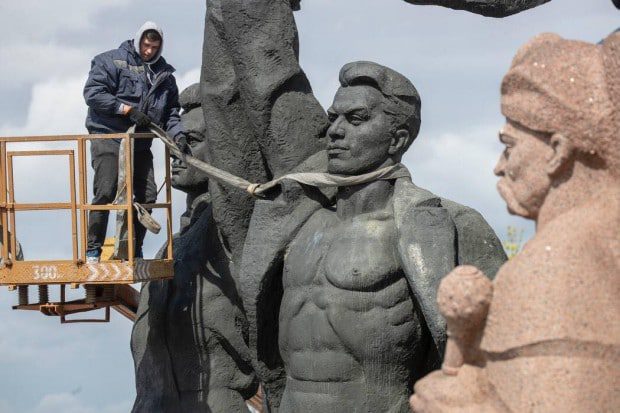
The mayor of Kyiv Vitali Klitschko announced on social media that a large-scale dismantling of dozens of monuments related to the Soviet Union is being prepared. He also added that 460 streets will be renamed.
Friends! Today began dismantling the removal of the bronze sculpture of two workers. It was installed in the center of the capital in 1982 on the occasion of the celebration of the unification of Ukraine with Russia.
It is about 8 meters of metal, the so-called “friendship of two peoples”. Something symbolic happened – when the crane tried to lift the sculpture, the head of the Russian worker fell
The second sculptural composition, placed nearby, will be closed with tax materials. As the procedure is more difficult it will take longer. And before that it can be used as a space for exhibitions.
In total, we plan to dismantle in the capital about 60 more monuments, bas-reliefs, signs related to the Soviet Union and Russia.
We have prepared a list for renaming over 460 streets and sites, he wrote on social networks.
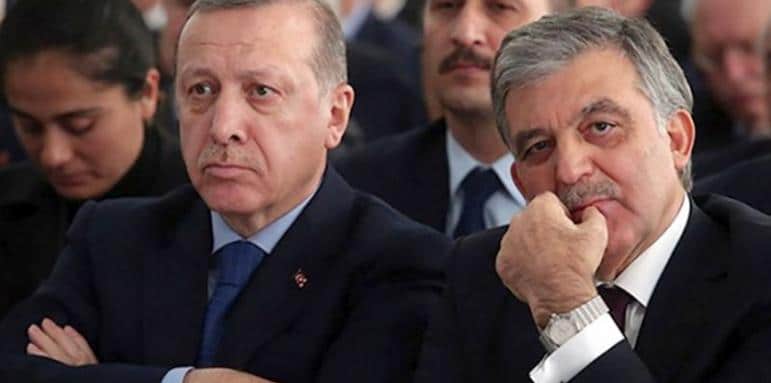
Former Turkish President Abdullah Gul (pictured right) has sharply criticized Istanbul court rulings in the Gezi Park case, which he said have deeply affected the public conscience.
“The sentences of Osman Kavala and the other defendants have deeply hurt the public conscience and upset me. It is very sad that these people will remain in prison until the Supreme Court rules and will be persecuted, which is very painful. At a time when “The observance of human rights and the independence of judicial practice in our country are under serious doubt and cast a shadow over its image in the world. This disgraceful trial and the people behind it have harmed Turkey as much as anyone else,” he said. Gul in front of T24 TV.
A court yesterday sentenced businessman and philanthropist Osman Kavala to life in prison under a strict regime, finding him guilty of trying to overthrow the government by funding anti-government protests over Gezi Park in 2013. Osman Kavala had previously been acquitted in another trial. However, another decision to detain him followed, and the businessman remained in prison for four and a half years. He denies the allegations against him.
Seven other defendants in the same case – Mujlala Yapaji, Chigdem Mater, Hakan Altanai, Jan Atalay, Mine Yozerden, Yigit Ali Ekmekci and Typhoon Kahraman – were sentenced to 18 years in prison each.
The demonstrations for Gezi Park began with a small protest in defense of a park in central Istanbul. Abdullah Gul, the current president, called on the government of Recep Tayyip Erdogan, then prime minister, to listen to the demands of young people. However, this did not happen and the events escalated into mass anti-government demonstrations that swept across the country, but were suppressed by force by the authorities, with casualties and injuries.
Osman Kavala and the other seven convicts have the right to appeal the sentences to the Supreme Court.
Russia has agreed “in principle” to UN involvement in the evacuation of citizens from the last remaining holdout in the Ukrainian city of Mariupol, following a meeting between Secretary-General António Guterres and President Vladimir Putin in Moscow on Tuesday.
The UN chief, who was in the Russian capital for talks on the war in Ukraine, also met with the country’s Foreign Minister, Sergey Lavrov.
During his “tête-a-tête meeting” with President Putin, Mr. Guterres reiterated the UN’s position on Ukraine, according to a readout issued by his Spokesperson, Stephane Dujarric.
They also discussed proposals for humanitarian assistance and evacuation of civilians from conflict zones, namely in relation to the situation in the besieged port city of Mariupol, where thousands of civilians and Ukrainian troops remain holed up in the Azovstal steel mill.
“The President agreed, in principle, to the involvement of the United Nations and the International Committee for the Red Cross in the evacuation of civilians from the Azovstal plant in Mariupol”, said Mr. Dujarric.
He added that follow-on discussions will be held with the UN humanitarian affairs office, OCHA, and the Russian Defence Ministry.
‘Frank discussion’
Mr. Guterres told reporters that he had held “a very frank discussion” with Mr. Lavrov “and it is clear that there are two different positions on what is happening in Ukraine.”
Russia has said it is conducting a “special military operation” in Ukraine, while for the UN, the 24 February invasion is a violation of the country’s territorial integrity and goes against the UN Charter.
“But it is my deep conviction that the sooner we end this war, the better – for the people of Ukraine, for the people of the Russian Federation, and those far beyond,” he said.
Underlining his role as a “messenger of peace”, the Secretary-General recalled that the UN has repeatedly appealed for ceasefires to protect civilians, as well as political dialogue towards a solution, which so far has not happened.
Referring to the “violent battle” underway across the Donbas in eastern Ukraine, he noted that many civilians are being killed, and hundreds of thousands are trapped by the conflict, adding that repeated reports of violations, as well as possible war crimes, will require independent investigation for effective accountability.
UN Russia/Yuri Kochin
UN Secretary-General António Guterres meets the Russian Foreign Minister Sergey Lavrov in the Russian capital, Moscow.
Humanitarian corridors
“We urgently need humanitarian corridors that are truly safe and effective and that are respected by all to evacuate civilians and deliver much-needed assistance.”
The Secretary-General has proposed establishment of a Humanitarian Contact Group – comprising Russia, Ukraine and the UN – “to look for opportunities for the opening of safe corridors, with local cessations of hostilities, and to guarantee that they are actually effective. “
Addressing the “crisis within a crisis” in Mariupol, where thousands are in dire need of life-saving assistance, and for many, evacuation, he underlined the UN’s readiness to fully mobilize its human and logistical resources to help save lives.
Mr. Guterres has proposed that the UN, the International Committee of the Red Cross, and Ukrainian and Russian forces, coordinate work to both enable the safe evacuation of civilians who want to leave Mariupol – both inside the last redoubt of the Azovstal steel plant, and in the city itself, and in any direction they choose – and to deliver humanitarian aid.
Global shock waves
Turning to the wider impacts of the war, the Secretary-General spoke of some of the “shock waves” being felt across the globe, such as the “dramatic acceleration” in food and energy costs, which particularly are affecting millions of the world’s most vulnerable people.
“This comes on top of the shock of the continued COVID-19 pandemic and uneven access to resources for recovery, that particularly penalize developing countries around the world. So, the sooner peace is established, the better – for the sake of Ukraine, Russia, and for the world,” he said.
“And it’s very important, even in this moment of difficulty, to keep alive the values of multilateralism,” he added.
The Secretary-General underlined the need for a world that is “multipolar”, that abides by the UN Charter and international law, and which recognizes full equality among States, in hopes that humanity will again unite to address common challenges such as climate change “and in which the only war we should have would be a war of those that put the planet at risk.
The Secretary-General will be in Ukraine on Thursday where he will have a working meeting with Foreign Minister Dmytro Kuleba, and he will be received by President Volodymyr Zelenskyy.
39-year-old Peter Leather from Eastham, Wirral, smashed both his personal best (PB) and fundraising goal when he completed the recent Brighton marathon for the British Tinnitus Association (BTA). The BTA is the only national charity that solely funds tinnitus research and supports people living with tinnitus.
Tinnitus is a debilitating condition where people hear noises in the head and/or ears which have no external source. There is currently no cure. Tinnitus affects 35,000 adults in the Wirral alone, and one in eight nationwide.
Peter shared, “My late mum, Beryl Leather, suffered with tinnitus most of her life, and struggled with this condition as it had an impact on her life every day”.
Peter completed the gruelling 26.2-mile race in a personal best of 5 hours and 50 minutes. He said, “The day was amazing: the atmosphere, the weather and the support was incredible!”
The British Tinnitus Association’s vision is “A world where no one suffers from tinnitus” which Peter fully supports. He said: “It’s a pleasure to be raising awareness that the BTA is there to help people like my mum who had this condition, and to raise as much as possible and to offer people support who are living with tinnitus right now.”
The BTA are looking for people to take part in a number of fundraising events, including the Virtual London Marathon. Please email fundraising@tinnitus.org.uk take part in your own challenge.
The British Tinnitus Association is an independent charity and the primary source of information for people with tinnitus. It helps to facilitate an improved quality of life for people with tinnitus through a range of support options including support groups, a helpline and its website, while also taking steps to bring forward the day when tinnitus is cured. The charity works to inform and educate medical professionals and the community on what tinnitus is and how to manage it. The British Tinnitus Association wants “a world where no one suffers from tinnitus”. It wants to find better ways to manage tinnitus and, ultimately, to help find a cure. In 2020, the publication of its Tinnitus Manifesto led to more than 130,000 people signing a petition for more funding for tinnitus research to find cures.
British Tinnitus Association, Unit 5 Acorn Business Park, Woodseats Close, Sheffield S8 0TB
The British Tinnitus Association is a registered charity. Registered charity number 1011145.
Press release distributed by Pressat on behalf of British Tinnitus Association, on Wednesday 27 April, 2022. For more information subscribe and follow https://pressat.co.uk/
Human activity and behaviour is contributing to an increasing number of disasters across the world, putting millions of lives in danger, together with a wide range of social and economic gains over recent decades, a new UN report published on Tuesday warns.
The Global Assessment Report (GAR2022), released by the UN Office for Disaster Risk Reduction (UNDRR) ahead of next month’s Global Platform on reducing risk, reveals that between 350 and 500 medium to large-scale disasters took place every year over the past two decades.
The number of disaster events is projected to reach 560 a year – or 1.5 each day, statistically speaking – by 2030.
The GAR2022 blames these disasters on a broken perception of risk based on “optimism, underestimation and invincibility,” which leads to policy, finance and development decisions that exacerbate existing vulnerabilities and put people in danger.
‘Spiral of self-destruction’
“The world needs to do more to incorporate disaster risk in how we live, build and invest, which is setting humanity on a spiral of self-destruction,” said Amina Mohammed, UN Deputy Secretary-General, who presented the report at the UN headquarters in New York.
“We must turn our collective complacency to action. Together we can slow the rate of preventable disasters as we work to deliver the Sustainable Development Goals (SDGs) for everyone, everywhere.”
The report entitled, Our World at Risk: Transforming Governance for a Resilient Future, found that the implementation of disaster risk reduction strategies, as called for in the Sendai Framework for Disaster Risk Reduction agreed in 2015, had reduced both the number of people impacted, and killed by disasters, in the last decade.
However, the scale and intensity of disasters are increasing, with more people killed or affected, in the last five years, than in the previous five.
Disasters disproportionately impact developing countries, which lose an average of one percent of GDP a year to disasters, compared to less than 0.3 per cent in developed countries.
Heavy toll in Asia-Pacific
The highest cost is borne by the Asia-Pacific region, which loses an average of 1.6 percent of GDP to disasters every year, while the poorest also suffer the most within developing countries.
A lack of insurance to aid in recovery efforts, adds to the long term impacts of disasters. Since 1980, just 40 percent of disaster-related losses were insured while insurance coverage rates in developing countries were often below 10 percent, and sometimes close to zero, the report said.
“Disasters can be prevented, but only if countries invest the time and resources to understand and reduce their risks,” said Mami Mizutori, Special Representative of the Secretary-General for Disaster Risk Reduction and Head of UNDRR.
Bankrolling destruction
“By deliberately ignoring risk and failing to integrate it in decision making, the world is effectively bankrolling its own destruction, she said. “Critical sectors, from government to development and financial services, must urgently rethink how they perceive and address disaster risk.”
A growing area of risk is around more extreme weather events as a result of climate change. GAR2022 builds on the calls to accelerate adaptation efforts made at COP26, according to the UN disaster risk reduction office, by showcasing how policymakers can climate-proof development and investments.
This includes reforming national budget planning to consider risk and uncertainty, while also reconfiguring legal and financial systems to incentivize risk reduction.
Funding climate fight
It also offers examples that countries can learn from, such as Costa Rica’s innovative carbon tax on fuel launched in 1997, which helped to reverse deforestation, a major driver of disaster risks, while benefiting the economy.
By 2018, some 98 percent of the electricity in Costa Rica came from renewable energy sources.
GAR2022 was drafted by a group of experts from around the world as a reflection of the various areas of expertise required to understand and reduce complex risks.
Its findings will feed into the Midterm Review of the implementation of the Sendai Framework, which includes national consultations and reviews of how countries are performing against the goal, targets and priorities for action.
With the review getting underway, “this report should be a wake-up call that countries need to accelerate action across the Framework’s four priorities to stop the spiral of increasing disasters”, said Ms. Mizutori
“The good news is that human decisions are the largest contributors to disaster risk, so we have the power to substantially reduce the threats posed to humanity, and especially the most vulnerable among us.”
The defunct Chernobyl nuclear plant, and the city of Slavutich – whose residents maintain the site, which needs constant monitoring to ensure radioactive material does not leak out – was occupied by Russian troops for over a month.
Bogdan Serdyuk, chairman of the union that represents plant workers, recalls the battle near the site, which marked the beginning of the Russian invasion, on 24 February.
“The station staff heard the roar of military equipment, and soon the site was surrounded by Russian tanks. The tracks threw up contaminated dust, which immediately increased the background radiation.
“The station has security units, specialized in counter-terrorist warfare, but they were no match for the Russian forces and, in any case, there are rules that prohibit combat operations on the territory of a nuclear power plant.”
Reactor 3 of the Chernobyl nuclear power plant, in Ukraine.
The main problem, according to the staff, was that as a result of the shelling, power lines were damaged and both Slavutych and the plant itself, lost power.
“The plant has four units, including the one that was destroyed in the 1986 accident. All the nuclear fuel from the three units that were still functioning after the explosion was removed and placed in a nuclear waste repository”, explains Mr. Serdyuk.
“The fuel rods are stored in water that is circulated to keep them cool. The moment the power went off, everyone was worried about whether the water would begin to heat up. Experts believe that, if it is not circulated, the water could boil, and the spent fuel would begin to melt, with unpredictable consequences”.
Another cause for concern was the safety of the protective sarcophagus which contains the destroyed reactor of the fourth power unit, and the remains of nuclear waste. Damage to the sarcophagus could lead to radioactive dust escaping.
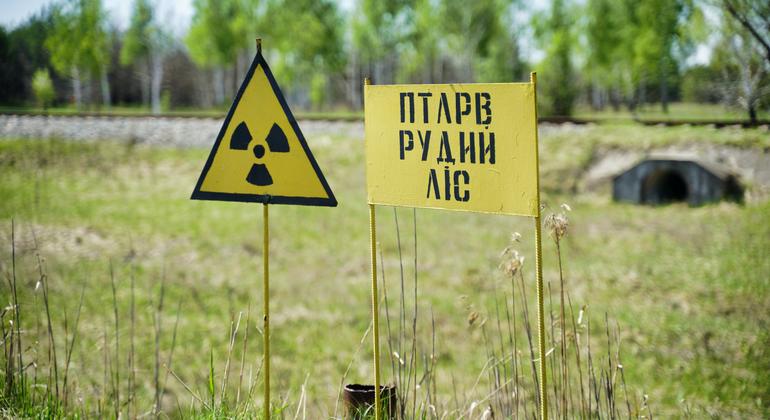
A sign warns of radiation danger at Chernobyl, Ukraine.
A concern for the whole world
Work at Chernobyl is carried out by some 2,700 people. Most live in Slavutych, a satellite city built immediately after the 1986 accident, around 50 kilometers away from the epicenter of the disaster.
Nuclear power plant workers with their families, as well as residents of the evacuated city of Pripyat, and the entire 30-kilometre zone around the station affected by radioactive contamination, were relocated there.
In peacetime, the plant employees in Slavutych commuted to work by train, which took about 45 minutes. However, when the railway lines were blown up, travel from Slavutych took eight hours, and staff now rotate, spending week-long shifts at the plant, which was not designed for people living on-site.
“Nuclear plants are designed to withstand an impact comparable in strength to an aircraft. But this is not the same as the shelling that took place at the Zaporizhzhya nuclear power plant”, warns Mr. Slavutych, in reference to another, still functioning, Ukrainian plant.
“The seizure of the Chernobyl nuclear power plant, and the shelling of the Zaporizhzhya nuclear power plant raise the question of nuclear safety not only for Ukraine. Nuclear power plants should not become targets for the military, because even partial destruction can lead to catastrophic consequences for the whole world”.
Courtesy of Vladimir Udovichenko
A recent photo of the city of Slavutich, Ukraine.
‘We cannot allow such a tragedy to happen again’
“We have a tradition in Slavutych. Every year, from April 25 to 26, at the same minutes when the Chernobyl accident occurred, we gather near for the Chernobyl victims”, says Vladimir Udovichenko, the town’s mayor.
“We silently honour the memory of those who protected Ukraine and the whole world from further terrible consequences of the accident. And today we will not break this tradition. We cannot allow such a tragedy to happen again.
“What happened at Chernobyl [following the Russian invasion] and continues now in Enerhodar [the town where the Zaporizhzhya plant is located] is unacceptable. This needs to be stopped and we now need to think about what can be done to strengthen the safety of nuclear power plants. We expect IAEA experts to work with us”.
IAEA
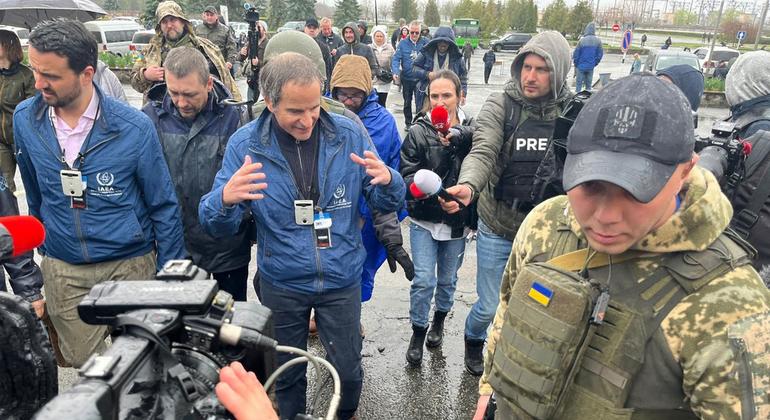
The Director General of the International Atomic Energy Agency (IAEA), Rafael Mariano Grossi (centre) spoke to journalists on Tuesday after arriving at the Chernobyl nuclear power plant in Ukraine.
IAEA team arrives in Ukraine
A team of IAEA staff, led by Director General Rafael Mariano Grossi, is visiting Chernobyl, to deliver equipment and conduct radiological and other assessments at the facility. Personal protective equipment will also be delivered.
In addition, IAEA specialists will repair the remote data control systems installed at the facility, which the occupying forcers disabled, resulting in IAEA staff at the Agency’s headquarters in Vienna being unable to receive online data from Chernobyl.
Since the beginning of the war, the IAEA has expressed serious concern about the safety and security of Ukraine’s nuclear facilities. According to Mr. Grossi, the physical integrity of nuclear power plants, the ability of personnel to work without excessive pressure, and access to external power sources should be ensured.
These rules have been seriously violated over the past two months. In March, communication with the Chernobyl nuclear power plant was lost. The station was left without external power supply, and for several days it was necessary to use emergency diesel generators.
“The IAEA’s presence in Chernobyl will be of paramount importance to our support activities for Ukraine, as it seeks to restore regulatory control over the nuclear power plant and ensure its safe and secure operation”, said Mr. Grossi. “This will be followed by additional IAEA missions to this, and other nuclear facilities in Ukraine”.