Sunday, September 20, 2026
Home Blog Page 112

Scientologists celebrate L. Ron Hubbard Birthday in 2026

0

International gathering in Clearwater spotlights the restored La Estrella site in the Canary Islands and launches illustrated Scientology books and courses for younger generations

KINGNEWSWIRE // PRESS RELEASE // BRUSSELS, Belgium — April 2, 2026 — The 2026 celebration of the birthday of Scientology Founder L. Ron Hubbard brought together more than 5,000 Scientologists from 74 countries at Ruth Eckerd Hall in Clearwater, Florida, on March 14. The event combined historical milestones, organizational growth and a strong emphasis on passing Scientology principles to the next generation. Among the central announcements were the presentation of a newly restored L. Ron Hubbard Landmark Site in La Estrella, Telde, Canary Islands, and the release of new illustrated Scientology children’s books and related courses now available in 25 languages.

For Europe, the presentation of the restored villa in La Estrella carried particular significance. The property, perched above the Atlantic on Telde, Gran Canaria, holds a distinct place in Scientology history. It was there in 1967 that L. Ron Hubbard advanced work on upper spiritual levels and announced the creation of the Sea Organization, the Church’s religious order formed that same year to assist with advanced research operations and supervise Church organizations around the world.

The restored La Estrella property was presented as the tenth L. Ron Hubbard Landmark Site worldwide. The villa has been restored to reflect how it appeared during Hubbard’s stay, preserving the atmosphere and physical setting of that period. Among the items associated with the site are the Aiwa recorder used for Ron’s Journal 1967, the British Mark V E-Meter connected to Hubbard’s research into advanced spiritual levels, a 16 mm motion picture camera and communications equipment used while working from the Atlantic location. The site extends the international network of places tied to the formative development of Dianetics and Scientology.

The presentation of La Estrella added a strong European dimension to an event that also reviewed broader developments across Scientology’s international network. The evening highlighted new executive teams returning to churches in North America, Europe and Australia after advanced training, with Padova in northern Italy among the locations specifically featured. The program also recognized the newly opened Ideal Church in San Juan, Puerto Rico, as part of the continuing expansion long associated with L. Ron Hubbard birthday commemorations.

The second major development of the evening focused on children’s education. Mr David Miscavige, ecclesiastical leader of the Scientology religion, introduced a new library of illustrated Scientology books designed to present the religion’s basic principles in an accessible way for younger readers and families. The new release includes two 10-volume sets: one for children from age seven and another for more advanced readers. All 20 books, together with their corresponding courses, are now available in 25 languages, forming a worldwide curriculum for the next generation.

The educational initiative was presented not as a side project, but as a structural development across Scientology Churches. Dedicated children’s course rooms have now been established in all 79 Ideal Churches worldwide, providing spaces designed specifically for young Scientologists. The announcement gave the evening a notably intergenerational character, linking preservation of heritage with the transmission of beliefs, values and study materials to children and adolescents, and everyone else, in a format tailored to their age.

The celebration also revisited the wider legacy of L. Ron Hubbard as an author, educator and founder whose work extended beyond theology into ethical and social programs. The event noted his recognition in January 2026 by the Independent Book Publishers Association as “Master of All Genres” and highlighted the continuing reach of initiatives inspired by his writings, including study methods, drug prevention and The Way to Happiness, described during the celebration as having surpassed 145 million copies distributed worldwide.

Founded in 1952, Scientology has long marked L. Ron Hubbard’s birthday as a moment to review progress, new projects and milestones in the religion’s development. This year’s celebration stood out for joining two themes that resonate strongly in Europe: historical preservation and responsibility toward future generations. In that sense, the restored site in the Canary Islands and the new children’s educational materials formed two parts of the same message — continuity anchored in heritage and sustained through learning.

Ivan Arjona, representative of the Church of Scientology to the EU, OSCE, Council of Europe and UN, said the 2026 celebration reflected a connection between Europe’s cultural heritage and the responsibility to transmit values responsibly to younger generations. “The presentation of the restored La Estrella landmark in the Canary Islands is meaningful not only for Scientologists, but also in a broader European sense and even the very people of the Canary Islands and specifically Telde, because it shows the importance of preserving places where ideas, decisions and history were shaped,” Arjona said. “At the same time, making core principles understandable to children in many languages reflects an enduring civic value in Europe: that a tradition remains alive when it can be studied, understood and carried forward by the next generation.”

The 2026 birthday celebration therefore unfolded not simply as a commemorative event, but as a statement of continuity. With a newly restored landmark in Spain, a visible European footprint in the program and a major educational initiative aimed at younger generations across many languages, the event presented Scientology’s past, present and future as part of one connected narrative.

The Church of Scientology, its churches, missions, groups and members are present across the European continent. Scientology Europe reports a continent-wide presence through more than 140 churches, missions and affiliated groups in at least 27 European nations, alongside thousands of community-based social betterment and reform initiatives focused on education, prevention and neighbourhood-level support, inspired by the work of Scientology founder L. Ron Hubbard.

Within Europe’s diverse national frameworks for religion, the Church’s recognitions continue to expand, with administrative and judicial authorities in Spain, Portugal, Sweden, the Netherlands, Italy, Germany Slovakia and others, as well as the European Court of Human Rights, having addressed and acknowledged Scientology communities as protected by the national and international provisions of Freedom of Religion or belief.
Source link

New Book Revisits the Khashoggi Murder

0

Isaac Hammouch’s new essay on the killing of Jamal Khashoggi approaches the case not only as a shocking murder, but as a revealing test of international power, justice and political responsibility.

A new book by journalist and author Isaac Hammouch is bringing renewed attention to one of the most consequential political killings of the past decade. Titled Le meurtre de Khashoggi, the work examines the assassination of Saudi journalist Jamal Khashoggi through a political and geopolitical framework, asking not only what happened in Istanbul in October 2018, but what the case continues to reveal about power, impunity and the fragility of accountability in international affairs.

Published by Code Humanité, the book is presented by the publisher as a 118-page essay that explores the responsibilities, international dynamics and mechanisms of power surrounding the killing. On its website, the publisher describes it as an effort to move beyond official narratives and to offer a documented analysis of a “state crime” whose consequences extend far beyond the murder itself. The full title presented there is Le meurtre de Khashoggi: La responsabilité de Mohammed ben Salmane.

According to the author’s own announcement, the book seeks to provide “an in-depth political and geostrategic analysis” in order to understand “the responsibilities, the international stakes and the truths surrounding this contemporary state crime.” He also describes it as a work of “truth, memory and analysis,” aimed at readers who want to understand the case beyond surface-level accounts.

The subject remains internationally significant. Khashoggi, a Saudi columnist known for his criticism of Saudi policies, was killed inside the Saudi consulate in Istanbul on 2 October 2018. The case led to major international investigations, including a United Nations inquiry that found the killing amounted to an extrajudicial execution under international human rights law, and a declassified U.S. intelligence assessment that concluded the operation was unlikely to have taken place without high-level authorization. Saudi authorities have rejected allegations of senior-level responsibility.

What distinguishes Hammouch’s book is its apparent decision to treat the Khashoggi case not simply as a diplomatic scandal or criminal file, but as a window into broader questions of state conduct. The argument, as outlined by the publisher and by commentary surrounding the release, is that the murder exposed the tensions between strategic alliances and human rights principles, between diplomatic immunity and criminal accountability, and between the language of international law and the reality of power politics.

That broader framing helps explain why the book may find readers beyond those already familiar with the Khashoggi affair. It speaks to concerns that remain current in 2026: transnational repression, the vulnerability of dissident journalists, and the difficulty democratic governments often face when confronting abuses committed by powerful partners. In that sense, the book enters not only a historical debate, but an ongoing one.

The book is currently available to order through the publisher and via Amazon. According to Code Humanité, it is also expected to reach bookstores next month, including Fnac, and to be made available in several libraries in France and internationally. English and Spanish editions are also said to be in translation.

The launch has been noted in several French-language outlets, including Politique Matin, Entrevue, Opinion Internationale and Infomatin. Earlier coverage in The European Times had already signalled the forthcoming publication.

Nearly eight years after Khashoggi’s killing, Hammouch’s essay arrives as a reminder that some crimes do not fade with time. They remain reference points for how the world measures truth, responsibility and the value it places on a free and independent voice.

Source link

Breaking the Gaza aid bottleneck: 106-tonne delivery arrives via new sea route

0
Breaking the Gaza aid bottleneck: 106-tonne delivery arrives via new sea route

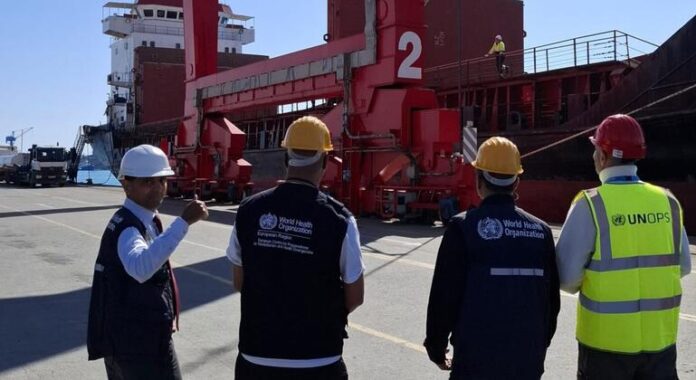
The consignment through the WHO Humanitarian Bridge Initiative in Cyprus arrived at Ashdod port in Israel and is being prepared for onward distribution to the devastated enclave. 

This shipment marks a significant operational milestone in strengthening WHO’s interregional humanitarian logistics capacity for a region affected by the ongoing conflict, particularly in Gaza,” the UN agency said

Scaling up delivery 

The Humanitarian Bridge Initiative is a coordinated effort between WHO offices in Cyprus and the Occupied Palestinian Territory. 

It is designed to enable the timely, scalable and efficient delivery of essential health commodities to the Gaza Strip by sea under the framework of Security Council resolution 2720 (2023), which called for establishing a UN mechanism to step up aid provision through countries that were not party to the conflict there. 

The Cypriot Government is taking the lead alongside the UN 2720 mechanism team implemented by the UN Office for Project Services (UNOPS).  

Together, they provide a neutral, transparent and internationally coordinated maritime corridor for humanitarian aid delivery to Gaza. 

Saving time, reducing bottlenecks 

“The mechanism further reinforces Cyprus’s role as a strategic humanitarian logistics staging point, leveraging its geographic proximity, approximately 370 kilometers from Gaza, and its position within the European Union single market to facilitate the rapid mobilization and dispatch of critical supplies,” WHO said. 

Moreover, “by complementing existing humanitarian corridors for Gaza and diversifying supply routes, the initiative has the potential to significantly reduce delivery timelines and mitigate operational bottlenecks that have constrained humanitarian access in the past.”  

Looking ahead, WHO said the bridge initiative will continue to support strategic prepositioning, consolidation and the rapid dispatch of essential supplies, thus strengthening the agency’s operational readiness for Gaza as well as health emergencies and disasters across the whole region. 

UN support continues 

The development comes as the UN and partners continue to deliver critical assistance to Gaza even as the Kerem Shalom/Karem Abu Salem border crossing with Israel remains the only one open for cargo

On Tuesday, they brought in over 270,000 litres of fuel to keep critical humanitarian services running, UN Spokesman Stéphane Dujarric told journalists at Headquarters in New York. 

The Food and Agriculture Organization (FAO) also collected animal fodder while UN child rights agency UNICEF retrieved more than 240 pallets of supplies including nutrition, medicines and kits containing personal care items such as sanitary pads, toothpaste and body wash.   

Reviving crop production 

FAO has announced a scale-up of its cash assistance to reactivate local crop production for an additional 1,000 Gazan farmers.   

“The assistance builds on a successful pilot from last year, when 200 farmers managed to grow more than 500 metric tonnes of fresh vegetables, with support received through the Humanitarian Fund for the occupied Palestinian territory,” said Mr. Dujarric. 

The UN agency estimates that farmers will be able to produce some 5,000 metric tonnes of vegetables – enough to feed roughly 95,000 people for a whole year – which will help address food insecurity in Gaza while promoting employment and income generation. 

Source link

Lebanon at ‘breaking point’ as displacement soars and strikes intensify

0
Lebanon at ‘breaking point’ as displacement soars and strikes intensify

Briefing ambassadors from Beirut, Emergency Relief Coordinator Tom Fletcher said he arrived to find “anxiety and tensions at levels I have not witnessed in many years”, as airstrikes and drone activity continue to shake the capital and surrounding areas.

“The situation on both sides of the Blue Line demands not only the Council’s closest attention, but also your collective action to avert an even worse crisis,” he stressed, describing the discussion as “urgent”.

Mr. Fletcher said the humanitarian toll has worsened sharply. “Over the past four weeks, more than 1,240 people have been killed… and another 3,500 injured,” he said, noting that women, children and first responders are among the dead.

‘Coercive displacement’

More than 1.1 million people were displaced in that time, including hundreds of thousands of children. “A cycle of coercive displacement is unfolding,” he warned, with families repeatedly forced to flee. “Displacement is not a solution, but a painful last resort… a temporary way to preserve dignity.”

He said civilians on both sides of the line are living in fear, as rockets continue to be fired into northern Israel while Israeli strikes devastate parts of southern Lebanon, Beirut’s southern suburbs and the Bekaa Valley. Entire villages have been flattened, and vital infrastructure destroyed, including most bridges south of the Litani river.

“Civilians, wherever they are, in Israel and in Lebanon, must be protected,” Mr. Fletcher said, underscoring that international humanitarian law requires distinction, proportionality and precaution. “Healthcare, water and electricity…must also and always be spared.”

Isolation grows

The impact on basic services is severe, with hospitals and clinics forced to close and schools turned into shelters. “Entire communities are becoming increasingly isolated,” he added.

Despite the crisis, humanitarian agencies have scaled up operations, delivering millions of meals and essential supplies. But funding remains short. Of a $308 million emergency appeal, only $94 million has been received so far.

Above all, Mr. Fletcher conveyed a direct message from those affected: “They want safety. They want dignity. They want this to stop.”

He urged Council members to act decisively, posing stark questions about how civilians will be protected, how the international community should respond to mass displacement, and how to prevent further political instability.

Turning to the Lebanese people, he offered a message of solidarity and resolve: “Don’t give up on the idea of Lebanon. If co-existence fails here, it stands to fail everywhere.”

“We have often said that we cannot let Lebanon fail,” he concluded. “Now is a real test of that promise.”

Peacekeeper killings ‘should not have happened’

The emergency meeting was called by France after three Indonesian peacekeepers serving with the UN Interim Force in Lebanon (UNIFIL) were killed this week, and several others seriously wounded, in two separate incidents that occurred within a 24-hour period and amid the wider war in the region. 

These tragic developments should not have happened,” said UN peacekeeping chief Jean-Pierre Lacroix, who briefed alongside Assistant Secretary-General Khaled Khiari and the UN relief chief. 

UNIFIL is conducting investigations to determine the circumstances of “the two abhorrent incidents” but peacekeepers are also facing “a worrying increase in denials of freedom of movement and aggressive behaviour,” Mr. Lacroix reported.

“We say it clearly, and there has been a need to say it far too often: Peacekeepers must never be a target,” he stressed. 

“All acts that endanger the peacekeepers must immediately stop…The inviolability of United Nations installations must be respected.”

In the interim, UNIFIL continuously reassesses its deployment to mitigate risks and strengthen force protection.  The mission remains in constant contact with the parties “to avoid misunderstandings, de-conflict and de-escalate where possible.”

Council backing, ‘indispensable’

He underscored the critical need to support the sides in fully implementing Security Council resolution 1701 (2006), which ended hostilities between Israel and Hezbollah two decades ago.

“In this exceptionally dangerous period, the Council’s strong and unified backing for UNIFIL and its peacekeepers is not merely important – it is indispensable,” he said.

“The women and men serving under this mandate must know that this Council stands firmly behind them.”

To see all our live coverage of the crisis in the Gulf from today, go here, and for full speaker-by-speaker coverage of this important emergency meeting on the Middle East crisis, visit our UN Meetings Coverage site here.

Source link

Gaza: Commitment to US-backed plan crucial for recovery, Security Council says

0
Gaza: Commitment to US-backed plan crucial for recovery, Security Council says

Gaza: Commitment to US-backed plan crucial for recovery, Security Council saysThe High Representative for Gaza, Nickolay Mladenov – a former senior UN official in the region – was speaking at a meeting on the implementation of Council Resolution 2334 (2016) which demands that Israel immediately cease all settlement activity in the occupied Palestinian territory. It was held approximately four months after […]

Originally published at Almouwatin.com

Fashion planning across seasons and collections

0


Effective fashion planning across seasons and collections is a cornerstone of the fashion industry, enabling brands and retailers

Source link

UN General Assembly adopts historic resolution to strengthen the work of the UN system

0
UN General Assembly adopts historic resolution to strengthen the work of the UN system

UN General Assembly adopts historic resolution to strengthen the work of the UN systemThe move marks a major milestone as part of the UN80 Initiative, a system-wide reform effort aimed at making the UN more effective, more coherent and better equipped to deliver results in a changing world. Speaking in the General Assembly Hall, Secretary-General António Guterres welcomed the adoption, calling it […]

Originally published at Almouwatin.com

MIDDLE EAST LIVE: Vital food aid blocked, Security Council meets in emergency session on Lebanon

0
MIDDLE EAST LIVE: Vital food aid blocked, Security Council meets in emergency session on Lebanon

More than a month since war erupted in the Middle East, UN agencies confirmed on Tuesday that huge numbers of people have returned to Syria from Lebanon “exhausted, traumatized and with very, very few belongings”. Meanwhile, the UN International Maritime Organization said that another vessel has been attacked in the Strait of Hormuz, increasing concerns of further delays in transporting lifesaving aid. The Security Council met in New York in emergency session on Lebanon. Stay with us for live updates. App users can follow coverage here

Source link

Lebanon: UN peacekeepers help communities left behind

0
Lebanon: UN peacekeepers help communities left behind

Lebanon: UN peacekeepers help communities left behind“It’s extremely unstable, extremely dangerous, and you know, we see the situation for us as peacekeepers, as well as for the civilians who remain in certain areas, because there are civilians who have chosen to stay and the peacekeepers support them in every way […]

Originally published at Almouwatin.com

Syria: Hundreds of thousands flee Lebanon, vital food aid blocked

0
Syria: Hundreds of thousands flee Lebanon, vital food aid blocked

Speaking from Damascus, the UN Refugee Agency (UNHCR)’s representative in Syria, Asseer Al-Madaien, said that the country has seen a “sharp rise” in people crossing the border from Lebanon – more than 200,000 between 2 and 27 March. 

“The vast majority, nearly 180,000, are Syrians, including Syrian refugees who had fled Syria seeking safety in the past in Lebanon and now forced to flee again,” she said.

 More than 28,000 Lebanese also have crossed into Syria. 

Fleeing with nothing

“Most are people fleeing the intense Israeli bombardments,” Ms. Al-Madaien told reporters in Geneva. “They arrive exhausted, traumatized and with very, very few belongings.”

The UNHCR representative said that the agency is preparing for as many as 350,000 to cross into Syria, depending on the course of the conflict.

As the humanitarian fallout continues to deepen over a month since Israeli and US airstrikes on Iran began, sparking a wider regional war, supply lines across the Middle East are already severely disrupted. 

The UN World Food Programme (WFP)’s Director of Supply, Chain Corinne Fleischer, said that the agency is concerned about “all [its] big operations”.

WFP currently has “70,000 metric tonnes of food that is impacted by the war…About half of them are on chartered bulk vessels and the other half are on in containers which are either on route or stuck in a port and don’t move,” she said.

Speaking from Rome, Ms. Fleischer clarified that WFP has no vessels in the Strait of Hormuz but is impacted “by the ripple effect of what’s happening there… vessels being stuck in ports, not berthing to ports, not leaving ports, containers not being offloaded”. 

COVID precedent

The WFP official warned that similar global supply chain disruptions seen during COVID took “four to five months to get back into place once the situation’s stabilized”. 

Shipping costs have surged as carriers avoid the Suez Canal linked to the Middle East war and have to re-route around the Cape of Good Hope. This adds up to 30 days to the journey and has driven rates up 15 to 25 per cent, with fuel price hikes also hitting firms’ bottom lines.

Speaking about mitigating measures, Ms. Fleischer explained that WFP has been “asking for priority cargo for humanitarian operations” as it is the only UN organization with its own shipping department directly engaging with shipping lines and vessel owners. 

She said that the agency has successfully negotiated a waiver for the surcharges that are being put in place by shipping lines and certain ports at risk in the Middle East, which represent between $2,000 to $4,000 per container – a saving of about $1.5 million so far. 

Afghanistan aid delays

WFP is also rerouting cargo, for instance to Afghanistan, where 17 million people are food insecure. 

Earlier this year, food aid sourced in Pakistan was impacted by the Pakistan-Afghanistan war and initially re-routed through Iran, Ms. Fleischer said. 

“While we were [rerouting] to get into Bandar Abbas port of Iran, the war broke out” she explained. “We had to put it in Jebel Ali [port] in Dubai and now we will truck it from Dubai through Saudi Arabia…That adds about 1,000 euros per tonne and of course another three weeks.”

The WFP official expressed further concern about Sudan, with 19 million people “acutely hungry”, as well as Somalia and South Sudan, where operations are buckling under longer lead times and higher costs.

“The financing of humanitarian operations has, since several years, not being where it should be,” she said. “We have eroded any buffer stocks. We’re living from hand-to-mouth in these operations.”

With famine in areas of Sudan “there is no time”, she insisted. “Our operations and pipelines don’t allow for a three-weeks-longer rerouting through the Horn of Africa.”

Source link