Sunday, September 20, 2026
Home Blog Page 1124

New religious movements based on Islamic ideas

0

One of the main Islamic-based NRMs is the Bahá’í Faith, whose founder Bahá’u’lláh affirms the spiritual and social equality of women. Moreover, the institutions of the Baha’i community have a moral obligation to support and encourage the full participation of women in leadership positions and in all kinds of decisions related to life in the Bahá’í community. Statistics from several consecutive years show that women play an important role in the management and leadership of the Baha’i community around the world. For example, women make up 30% of the elected members of the national governing boards or the so-called National Spiritual Councils, 40% of the elected members of the local councils or the so-called Local Spiritual Councils. Moreover, 47% of the so-called The members of the Auxiliary Councils, whose aim is to inspire and advise the community at the sub-national and regional level, are women.

Yet, although the woman is allowed to participate in the governing life of the community, she is encouraged to develop certain skills in line with the Bahá’í scriptures. For example, according to the Bahá’í Faith, every woman should be an example of “impeccable honesty and devotion,” “extraordinary piety,” “good spirits,” “recognized talent and experience,” and so on. As for the way of dressing, both women and men have equal rights and are free to dress according to their taste.

Holidays for the Bahá’í Community are March 21 – the No-Roose (Bahá’í New Year), the Rezwan Festival on April 21, the Bab Mission Announcement on May 23, and Bahá’u’lláh’s Birth on November 12.

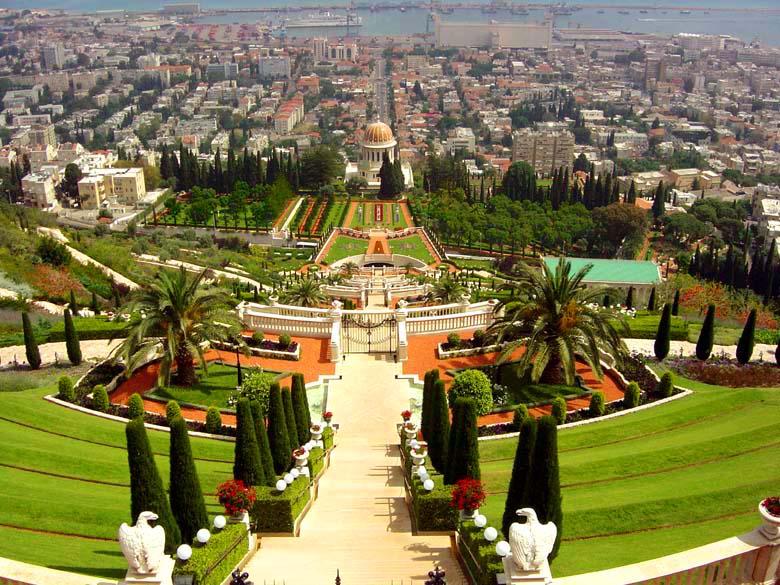
The central role of prayer and meditation in the Bahá’í community gives great importance to Prayer Houses as an institution. There are currently such Prayer Houses in Wilmet (USA), Frankfurt (Germany), Kampala (Uganda), Sydney (Australia), Panama City (Panama), Delhi (India) and Apia (Western Samoa). The services there consist of reading texts from the Bahá’í Scriptures, the Bible, the Qur’an, or the Talmud. Bahá’ís also pray in their homes or in nature without having to follow certain canons. In the future, each town and village will have its own Prayer Houses, which will serve as centers around which scientific, educational, cultural, humanitarian and administrative institutions will be set up.

     Spiritual League of Nations

     Plans for the first House of Prayer in the Western Hemisphere began in 1903, when a handful of Baha’is from Chicago, the first city in the United States to take an interest in the Bahá’í Faith, decided to embark on this endeavor. Many architects proposed plans, but the most unusual was the project of the French-Canadian architect Louis Bourgeois. Mr. Bourgeois began work in 1909 and for eight years worked diligently on his amazing idea. his yard.

     His project was adopted unanimously by delegates elected by Bahá’í communities from across North America. The New York Times commented, “America needs to stop and look to see how the artist has woven the idea of ​​a Spiritual League of Nations into it.”

     On May 23, 1978, the House of Prayer in Wilmett was registered in the National Historical Register as “one of the national cultural values ​​to be preserved.”

The Bahá’í Faith

     The Bahá’ís are followers of Bahá’u’lláh. These are people who come from different religious backgrounds or did not have their own religion at all. They live in over 200 countries and territories around the world and represent all human races and almost all nationalities and tribal groups in the world. Through the unifying influence of the teachings of Bahá’u’lláh, they have become part of a global family.

     Bahá’u’lláh was born in Persia and lived from 1817 to 1892. Among His teachings, expounded more than a century ago, are principles such as: the unity of God, the unity of religions, and the unity of the human race; the independent study of truth; the elimination of any prejudices; equality between men and women; general education; harmony between science and religion; eliminating extremes in poverty and wealth; world peace through world government.

     These principles alone will not solve the world’s problems. A basic spiritual reorientation is needed. It was for this change that Bahá’u’lláh came. Its goal is the transformation of society, the establishment of world peace and a new civilization, through the unity of humanity, as well as the renewal of human souls. “The purpose which underlies the revelation of every divine Book, moreover, of every verse of it, is to endow men with reason and righteousness, so that peace and tranquility may be permanently established between them … Use, O , friends, the opportunity that this Day gives you and do not deprive yourself of the generous outbursts of His (God’s) grace. “

What exactly is the Baha’i religion?

-The main goal of the Bahá’í community is to unite the world. The development of the world requires such unification. This is already a matter of choice. There were iron curtains some time ago, but they did not stop the consequences of the Chernobyl accident. The fact that the world is one is not in doubt today. If there is a danger of bird flu somewhere, we are all afraid to some degree. There is also an economic relationship between countries. If there is an economic collapse in one country, it affects others as well. The Bahá’ís view humanity as one body. If in a small country people have a serious problem, it affects the rest of the earth, just as if we hit our toe, the pain floods our whole body. People are very focused on material things and lose their sense of spiritual needs. Man is a material, spiritual and intellectual being and must maintain all his aspects.

What is your attitude to other religions?

-They believe that there is only one god and there are not many religions, but only one, but in development. According to Bahá’ís, a historical process clearly shows an educational process in the emergence of different religions. According to the latest beliefs, the beginning is 5000 years ago with Krishna, followed by Moses 3,500 years ago, Buddha, Christ 2000 years ago, Muhammad 1600 years ago and the last religious movements, including Bahá’u’lláh. The scriptures of the different religions also do not differ fundamentally. The differences are in the interpretation of the time in which they arose.

-What, according to the Bahá’ís, is the individual?

-According to the Bahá’í religion, one is a mine of precious stones, but only education can reveal this wealth. Thus, there is no crowd in front of us, but many bearers of inner beauty that must be shown. This is the place of education. At the heart of the Bahá’í religion is that there is one world, one god, and humanity. They are against extremes in every possible sense. Equality between men and women is also a basic Bahá’í law. To be a Baha’i, you must strive to know yourself.

– How widespread is Baha’i in the world?

-Bahia is the most widespread religion in terms of geography, not as a number of followers. There are Baha’is in the most remote parts of the world.

-What do Bahá’ís not believe in?

-They do not believe in superstition, in this sense, for example, they do not have priests.

The world is changing in two aspects. One is a process of disintegration – wars, catastrophes. Public opinion is also more concentrated here. At the same time, there is a very clear and positive building process on which the Bahá’í community is focused, an example of which is Europe‘s achievements. They believe that the world is ripe for a very big and positive change. The processes have so far been part of the maturation of humanity. This includes globalization. It has its negatives and the road the world will take is a long one. But the Bahá’í community believes that a truly great and positive change is ahead, which will be a golden age in human development.

Bahá’ís are being severely persecuted in Iran – we can trace this interest and care of the EU as far as 2009. As early as February 2009, the Council of Europe issued a Declaration by the Presidency on behalf of the European Union on the trial of seven leaders of the Baha’i community in Iran [Brussels, 6567/09 (Presse 42)]:

“The EU is deeply concerned about the serious allegations made against seven leaders of the Baha’i community in Iran. They have been detained by the Iranian authorities for eight months without charge, during which time they have had no access to justice.

The EU is concerned that, after being detained for such a long time without due process, the leaders of the Baha’i community may not receive a fair trial. The EU therefore calls on the Islamic Republic of Iran to allow independent monitoring of the proceedings and to review the charges against them.

The EU strongly opposes all forms of discrimination and oppression, in particular on the basis of religious practices In this regard, the EU urges the Islamic Republic of Iran to respect and protect the religious minorities in Iran and to release all persons deprived of their liberty for their faith or religious practices.

This Declaration is joined by the candidate countries Turkey, Croatia and the former Yugoslav Republic of Macedonia, the Stabilization and Association Process and potential candidate countries Albania and Montenegro, the EFTA States Iceland, Liechtenstein and Norway, members of the European Economic Area, and Ukraine and the Republic of Moldova.”
When should children go to bed?

0

Bad news for parents – young children are better at choosing to go to bed than adults. That’s according to a new study by American scientists.

Experts have found that young children often go to bed too early, long before their bodies are ready for sleep.

Going to bed early can mean a break for parents, but not for children. They lie awake for hours, which shatters the biological clock of the young, Colorado scientists have found.

A good night’s sleep depends on when young children experience elevated levels of the hormone melatonin, which rises in the evening.

Factors such as the level of light outside and in the room, as well as the physical arousal of children can determine when melatonin has reached the required level for sleep. But this time is not the same for all children.

Going to bed that is out of sync with your child’s watch causes sleepless nights for both children and their parents.

Experts warn that sleepless nights for young children can increase the risk of emotional and behavioral problems later in life.

The study found that melatonin levels began to rise around 7:40 p.m. If the child is put to sleep at this time, he will fall asleep for a maximum of 30 minutes, while children whose melatonin rises later will stay awake until late at night.

Magnetic particles in the inner ear of pigeons have been denied as magnetoreceptors

0

Biophysicists have found that cuticulosomes (small magnetic organelles in the inner ear of birds) are most likely not involved in the mechanism of magnetic reception. With the help of quantum magnetic microscopy, scientists have shown that the magnetic susceptibility of these particles is insufficient to transmit a signal through electromechanical channels. This means that cuticulosomes have a different physiological function in the body of birds, and other structures in the inner ear or on the retina are responsible for the susceptibility to the magnetic field, researchers write in the Proceedings of the National Academy of Sciences.

Many animals, such as birds, when traveling long distances, sense the earth’s magnetic field and use it for orientation in space. The presence of magnetoreception in birds is confirmed by numerous observations and behavioral studies, however, all manifestations of magnetoreception are rather weak, therefore, how exactly magnetic receptors work is still unclear.

Moreover, scientists not only do not fully understand the mechanism of the receptor, but do not even know exactly where it is located. Scientists believe that the main candidates for magnetoreceptors are cryptochromes in the retina (they contain pairs of correlated radicals with an unpaired electron), small inorganic magnetic particles in the inner ear (they create a torque in a magnetic field) and electroreceptors (they react to changes in the magnetic field due to the electromagnetic induction). Perhaps, in some cases, these systems can work in concert.

According to biologists, cuticulosomes, small spherical organelles several hundred nanometers in size, located in the hair cells of the vestibular apparatus, should be responsible for magnetoreception in the inner ear. These organelles mainly consist of particles of magnetic ferrihydrite, a crystalline form of iron oxide with inclusions of water molecules.

To investigate whether cuticolosomes could actually be part of the magnetic receptors in pigeons, biophysicists led by David A. Simpson of the University of Melbourne carefully studied their chemical composition, structure and magnetic properties using quantum magnetic microscopy. The researchers took tissue samples from two sections of the pigeon’s inner ear and looked at how the cuticulosomes in them respond to an external magnetic field ranging from 200 to 1400 gauss. For this, biophysicists used a magnetic sensor based on color centers in diamond. Having measured the energy difference between the ground and excited quantum states of the color center, the scientists calculated the value of the Zeeman splitting for each point of the analyzed slice, and based on this data, they built a map of the stray magnetic field in the cuticolosome.

 It turned out that there are indeed magnetic areas in the iron-containing areas of the cuticulosomes. According to the measurement data, these are superparamagnetic and ferrimagnetic ferrihydrite inclusions. The obtained values ​​of the magnetic susceptibility of all these areas were within the interval between 0.029 and 0.22. This is an order of magnitude less than, for example, magnetite – iron oxide Fe3O4.

According to the calculations of scientists, the maximum mechanical force that a magnetic element with such a susceptibility can create during rotation is only 10-18 Newtons. This is about five orders of magnitude less than in any receptor that works on the mechanoelectric principle of signal transmission. Thus, cuticolosomes cannot react strongly enough to the Earth’s magnetic field and, accordingly, cannot be part of the magnetosensitive receptor.

The main function of cuticulosomes, according to scientists, is not magnetoreception, but storage of excess iron and stabilization of stereocilia – mechanosensitive organelles in the vestibular apparatus. The authors of the work note that the method they developed specifically for this study is quite simple and will make it possible to study in a similar way other magnetic structures-candidates for the role of magnetic receptors.

The participation of cryptochrome receptors on the retina of the bird eye in the mechanism of magnetic reception is considered by many scientists to be more probable. For example, in 2019, chemists were able to show that molecular analogs of these receptors respond to fairly weak magnetic fields. A change in the direction of the field vector of only 50 microtesla already noticeably affects the response of such a chemical compass. And before that, Swedish biologists noticed that the magnetic sensitivity of birds is associated with the polarization of light: if the source of polarized light is directed perpendicular to the magnetic field, the birds completely lose their ability to navigate.

Coming up in plenary: Ukraine, disinformation, Women’s Day | News | European Parliament

0
Coming up in plenary: Ukraine, disinformation, Women’s Day | News | European Parliament
Members will discuss the situation in Ukraine, vote on recommendations to protect against foreign interference and mark International Women’s Day during March’s plenary session.

War in Ukraine

In the wake of Russia’s invasion of Ukraine, MEPs will discuss how to handle the increasing number of Ukrainians fleeing war on Tuesday.

On Wednesday morning, Estonian Prime Minister Kaja Kallas will discuss with MEPs the EU’s role in a changing world and security following the Russian invasion of Ukraine.

Foreign interference and disinformation

In June 2020, Parliament set up a special committee to look into foreign interference and disinformation. During this plenary session  MEPs will vote on the recommendations presented in the committee’s final report. The report says that a lack of EU measures and awareness allow malign foreign actors to interfere in EU democracy and it proposes countermeasures such as sanctions or revoking the licenses of organisations that distribute foreign state propaganda.

MEPs will also vote on giving the committee a new mandate and consider convening a special committee on Covid-19 and an inquiry committee to look into the Pegasus spyware affair.

International Women’s Day

On 8 March, the Parliament marks International Women’s Day with a special focus on gender equality, mental health and unpaid care work. Polish author and Nobel Prize for Literature Laureate Olga Tokarczuk will address MEPs, which will be followed by debates on the EU’s Gender Action Plan and gender mainstreaming.

Rule of law

The European Court of Justice decided recently to uphold the validity of EU rules providing that member states in breach of the rule of law can face suspension of EU payments and dismissed appeals by Hungary and Poland. MEPs will vote on a resolution assessing the implications of the decision.

Golden passports

MEPs are set to call for a ban on so-called golden passports, under which non-EU nationals can get nationality rights in exchange for investment, and the introduction of EU-wide rules for “golden visas” or ‘”esidence by investment”. The aim is to defend core EU values as well as common security.

Batteries

Batteries are becoming a strategic market as the number of electric vehicles and the share of renewable energy increases. Parliament will debate and vote on its position on new EU measures on the design, production and disposal of batteries to tackle related environmental, ethical and social issues.

Commission suspends cooperation with Russia on research and innovation

0

Following the Russian invasion against Ukraine and in solidarity with the people of Ukraine, the Commission has decided to suspend the cooperation with Russian entities in research, science and innovation. The Commission will not conclude any new contracts nor any new agreements with Russian organisations under the Horizon Europe programme. Furthermore, the Commission is suspending payments to Russian entities under existing contracts. All ongoing projects, in which Russian research organisations are participating, are being reviewed – both under Horizon Europe and Horizon 2020, the previous EU programme for research and innovation.

Margrethe Vestager, Executive Vice-President for a Europe fit for the Digital Age, said: “EU research cooperation is based on the respect for the freedoms and rights that underpin excellence and innovation. Russia’s heinous military aggression against Ukraine is an attack against those same values. It is therefore time to put an end to our research cooperation with Russia.”

Mariya Gabriel, Commissioner for Innovation, Research, Culture, Education and Youth, said: “Russia’s military aggression against Ukraine is an attack on freedom, democracy and self-determination, on which cultural expression, academic and scientific freedom and scientific cooperation are based. As a result, we have decided not to engage into further cooperation projects in research and innovation with Russian entities. At the same time, we are strongly committed to ensuring a continued successful participation of Ukraine in Horizon Europe and Euratom Research and Training programmes. Ukrainian scientists and researchers have been key participants in our EU Framework programmes for research and innovation for 20 years and have demonstrated excellence and innovation leadership. We have taken administrative steps to ensure that successful Ukrainian beneficiaries can receive funding from the EU research and innovation programmes.”

The full statement of Commissioner Gabriel is available here.

The assessment of the situation as regards Belarus is ongoing.

Background

Horizon Europe is the EU’s key funding programme for research and innovation with a budget of €95.5 billion. There no ongoing projects under Horizon Europe, in which Russian entities are participating. There have been preparations of grant agreement for four projects involving four Russian research organisations, which the Commission has decided to suspend. This means that signing of any new contracts will be put on hold until further notice.

Under Horizon 2020, which was the EU’s research and innovation funding programme from 2014-2020 with a budget of nearly €80 billion, there are still several ongoing projects. The Commission is suspending any payment to Russian entities under existing contracts. At present, there are 86 active projects under Horizon 2020, which involve 78 different Russian organisations. Out of these, 29 Russian organisations that are involved in 19 projects have been awarded €12.6 million of EU contributions.

For More Information

Statement by Commissioner Mariya Gabriel

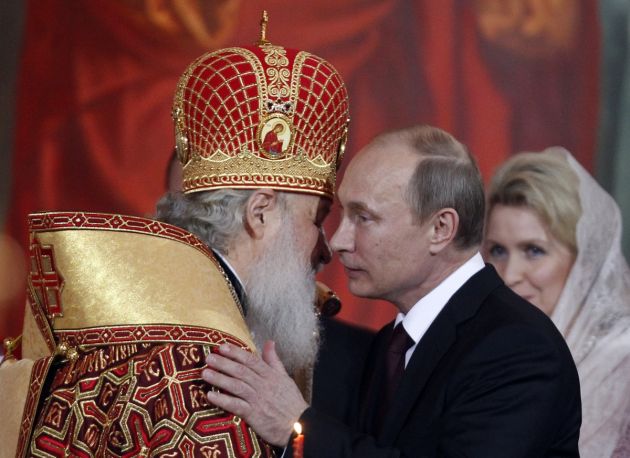
RUSSIA – “Evil forces” fight against Putin’s army in Ukraine, Patriarch Kirill says

0

Surprisingly and shockingly, Patriarch Kirill of Moscow and All Russia declared “about the events going on in Ukraine,” in his homily on Sunday 27 February, at the Cathedral Church of Christ the Saviour:

God forbid that the present political situation in fraternal Ukraine so close to us should be aimed at making the evil forces that have always strived against the unity of Rus’ and the Russian Church, gain the upper hand.”

The proximity between the Russian Orthodox Church (ROC) and the Kremlin is however not only physical, as they are only a few hundred meters from each other, but it is also political, geopolitical and spiritual.

In a long article titled “The Law, the Rights and the Rules,” and published in The Diplomat Magazine in July 2021, Sergey Lavrov, Russian Minister of Foreign affairs, criticized the “aggressive LGBT propaganda” by the “enlightened Europe”, the US interference in church affairs, openly seeking to drive a wedge into the Orthodox world, whose values are viewed as a powerful spiritual obstacle for the liberal concept of boundless permissiveness.”

Quite often, Patriarch Kirill has presented President Putin as the sole defender of Christianity in the world and even as the savior of Christians in Syria after he had sent his troops to save Bashar al-Assad and his regime.

Last but not least, on 23 February, one day before the invasion of Ukraine, Patriarch Kirill of Moscow and All Russia congratulated Russian President Vladimir Putin on Defender of the Fatherland Day and wished him peace of mind, health and God’s help in his ministry, according to the message published on the website of the Russian Orthodox Church:

“I cordially congratulate you on Defender of the Fatherland Day. <…> I wish you good health, peace of mind and abundant help from the Lord in your high and responsible service to the people of Russia.”

Calling afterwards for “the restoration of good fraternal relations between our peoples,” Patriarch Kirill clarified in his 28 February homely what he means by “fraternal relations” when he said:

“A guarantee of this fellowship is our united Orthodox Church represented in Ukraine by the Ukrainian Orthodox Church headed by His Beatitude Onuphry.”

Metropolitan Onufry of Kiev and All Ukraine is the Primate of the Ukrainian Orthodox Church, Moscow Patriarchate, but under President Poroshenko, a national Orthodox Church, the Orthodox Church of Ukraine affiliated to the Patriarchate of Constantinople has emerged and has challenged Moscow.

And for those who might not have understood the core message of his homily, Patriarch Kirill insisted that the Ukrainians are the attackers and part of the evil forces, when he said “We prayed that the Lord may give them strength and wisdom to repulse the attacks of the evil one.”

Further in his homily, he points at the West as the enemy of the Russian Orthodox Church and the Russian people:

It must not be allowed to give the dark and hostile external forces an occasion to laugh at us; we should do everything to preserve peace between our peoples while protecting our common historical Motherland against every outside action that can destroy this unity.

While the EU, the UK and the USA are not at war with the Russian Orthodox Church and the Orthodox believers, Patriarch Kirill is spiritually at war with the “so-called decadent values of the West” when he concludes:

Where from has the Russian land come”, the land which now includes Russia and Ukraine and Belarus and other tribes and peoples. That the Lord may protect the Russian land against external enemies, against internal disorders, that the unity of our Church may strengthen and that by God’s mercy all the temptations, diabolical attacks, provocations may retreat and that our devout people in Ukraine may enjoy peace and tranquillity – these are our prayers today.

In this warlike language, the Orthodox world and the Russian world end up overlapping and merging. They announce the final regional objective of the current war against Ukraine.

First published at HRWF.EU

Europe, tougher than it looks

0
white red and green map

As we have seen before our eyes, Putin makes his strategic decisions through a distorted view of history and people. He thought that the Ukranians with ties to Russia would welcome an invasion, but he forgot (or ignored) that these people would not put their friends and their families before an affiliation with a country, or with what it represents.

Putin has a stereotype of russophiles and russophones. He thinks that these people, by choosing Russia over the west (EU and NATO), will necessarily subscribe to Putin’s deranged imperialism. Putin sees the present as history, as big waves of people and political movements moving in various directions… But the present is not, as yet, history. Right now the present is composed of people. 

These russophiles inside Ukraine, for example, may even align politically with Putin’s regime. The people that they see every day do not all agree with their political view, they have a different view of the world from them, they just want a different project for their country. The question in Ukraine in 2013, in the Russo-Maidan Revolution, was not “do we join Russia or not?”, it was “do we join the west or not?”. Of course, to be part of this so-called “west”, Ukraine needed to leave Russia and its influence, but it seems to me that the alternative to this was not to join Russia, but to more or less continue to be neutral.

And so Putin made this strange association, that if people do not like the west they necessarily like him, this doesn’t say very much about what people think and more what Putin thinks of himself. Apparently this self-image doesn’t correspond to reality.

However, the most strange stereotype/assumption that Putin used to make one of his spectacular predictions (until now they have all failed spectacularly) is that Europeans would be too scared of the “Big Russian bear”, and would try to appease the situation with everything they could possibly can, running from any conflict, that only “tough Russians can take”.

Europeans are proud, they are not only proud of their nationalities but proud of what Europe represents: democracy, liberty and self-determination. Putin is an antithesis to these values. In Russia, all liberties are squeezed with an iron fist, and so, democracy is an empty word, if not a dirty one, and about self-determination… Putin sees entire nations as mere puppets; Belarus, Kazakhstan, Kyrgyzstan, and so on, only pawns on a chess board to the Russian autocrat.

I would say that it is true that people are not as attached with their nationalities in Europe, at least compared with past times. But if there is a thing that Europeans value is democracy and the freedom that comes with it, Europe will not be a puppet of anyone. Never again will Europeans obey or comply with a dictator’s wishes. Europe will fight back, for what it represents, whatever the cost.

In the XXth century the enemies of European democracy were fascism and communism. In the XXIst century the enemies are autocracy and authoritarian/totalitarian capitalism.

Also, Putin severely overestimated his position in relation to Europe. For starters, Russia is a drop in the ocean compared to Europe. Russia has a GDP comparable to Spain, the 4th biggest economy in the EU, but more importantly, Putin forgets that his precious natural gas will have no value for Europe in 10-20 years.

Yes, if the progress in renewable energy (wind, solar, etc.) maintains its current pace, it will not be long until the main source of energy in Europe will be renewable energy. This will happen as a consequence of a big investment in this type of technology in the last decades.  

Therefore, why would Europeans be scared of losing a thing that in 10 years will have half its current value? Why would we surrender our fundamental values and beliefs for a thing that we, together, would eventually surpass?

And just to show how small Putin is in reality, and how Europe and the Europeans are not afraid, German Chancellor Olaf Scholz announced that the military budget will be increased to 2% of the country’s economic output. 100 billion euros for Germany’s defense budget. I will remind you that this is comparable to Russia’s defense budget, and there are 26 other countries in the EU ready to show Putin his place…

The power of sport for societal change, part of the solution for a sustainable future?

0
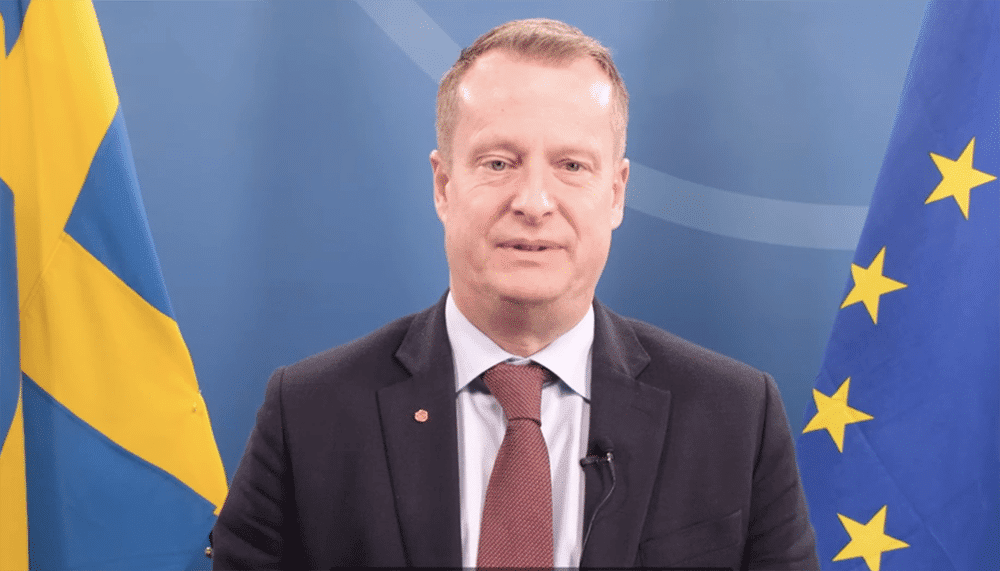
Anders Ygeman, Minister for Integration and Migration

Speech by Anders Ygeman, Minister for Integration and Migration with responsibility for sport

Towards a green and sustainable deal for sport, digital conference, 3 March 2022, European parliament, Strasbourg

Dear Ministers and participants,

Thank you for the opportunity to address this conference as a part of our common EU Trio-Presidency with France, Czech Republic and Sweden.

A special thanks to my colleague Roxana for inviting me to speak.

This conference is held in Strasbourg – the centre of respect for human rights and rule of law in Europe.

I think this is of great importance.

Because even though the topic of this conference is quite another, I first wish to address the current situation in Europe.

Participants, Russia’s invasion of Ukraine is unprovoked, illegal, and unjustifiable.

The Russian political leadership bears full responsibility for this.

The military aggression from Russia threatens international peace and security and is a flagrant violation of international law.

It is a serious breach of the European security order.

The Swedish Government supports European and International sport organisations boycott of sporting exchange with Russia.


However, we also need to discuss other issues simultaneously and the topic for today’s discussion is very important.

We all know the power of sport for societal change.

To inspire and to unite people.

Now, we – Governments, sports organisations, and their communities – need to find ways to use this power to limit our environmental impact.

We need to be a part of the solution for a sustainable future.

The Agenda 2030 requires changed at both individual and societal level.

The Sustainable Development Goals – both the economic, social and environmental – must be achieved for all people, in all parts of society.

To reach the goals, we need to establish stronger cooperation’s and partnerships.

And sport has the great power to bring these together.

People, networks and organisations that are committed to sport and sustainable development.

I would like to give two concrete examples from my country on how this can be translated into something concrete.

First, the Swedish Sports Confederation and its members has created a checklist for sustainable sport events.

This list consists of 40 aspects of sustainability with a number of inspirational action points.

The points include everything from choosing environmentally friendly team clothing to transports and waste management.

This initiative is an attempt to collect and share the knowledge on sustainability that already exist among sports federations and associations in Sweden.

The idea is simple – to inspire each other to do the right thing.

I am happy to see that this checklist has been created in close cooperation between the Swedish Sports Confederations partner organisations in Latvia, Lithuania, and Estonia.

Another inspiring example is a project funded by Sweden’s innovation agency.

The aim of the project is to reduce emissions of carbon dioxide for travel linked to organized sports.

This is to be done through mapping of current travel behaviours.

The data collected is then being analysed and form the basis for an action plan for every participating organisation to implement.

These are examples on how sport can be a progressive force for sustainability:

  • to combat climate change,
  • to strengthen cross border and generational solidarity,
  • to include the sport movement as a part of the transition.

I’m grateful for the work done by so many for a green and sustainable deal for sport.

I’m also hopeful that today’s conference will strengthen our joint efforts to fulfil our common goals.

Because I’m convinced, when we meet great challenges, we all need to work together.

Ministers’ statement on the 2022 Paralympic Winter Games

0
Ministers' statement on the 2022 Paralympic Winter Games

CANADA, March 3 – Melanie Mark, Minister of Tourism, Arts, Culture and Sport, and Ravi Kahlon, two-time Olympian and Minister of Jobs, Economic Recovery and Innovation, have released the following statement on the 2022 Paralympic Winter Games in Beijing:

“On Friday, March 4, the 2022 Paralympic Winter Games will begin in Beijing. Canada has assembled a strong team of competitors, who are poised to shine on the world stage with some amazing performances.

“B.C. athletes chosen to represent Team Canada at this month’s Paralympic Winter Games in Beijing include: Ina Forrest, from Vernon, a three-time medallist in wheelchair curling; Ethan Hess, Paralympic Nordic skier from Pemberton, who will compete in cross-country skiing as part of the nation’s formidable Paralympic Nordic team; and Tyler Turner, Paralympic snowboarder from Campbell River, who is fresh off his two gold- and one bronze-medal wins at the 2022 World Para Snow Sports Championships.

“Beyond the thrill and excitement of great competition, these Games represent stories of what it takes to become a world-class athlete. The Paralympics are filled with people who have beaten incredible odds to come out at the top of their respective sports. Many Paralympians have faced tremendous obstacles. By sheer determination, outstanding skill and undeterred drive they have emerged triumphant. Each has broken boundaries, shattered glass ceilings and pushed beyond limits to become one of the best in the world in their sport, all while displaying the true heart of a champion.

“It is also a great point of pride for all British Columbians that Josh Dueck, two-time B.C. Paralympian, has been named chef de mission of the 2022 Canadian Paralympic Winter Team. A pioneer in Paralympic alpine sit skiing, Dueck garnered international acclaim, not only for his gold- and silver-medal wins, but for making sport history by being the first para-alpine sit skier to complete a backflip.

“Our government knows first-hand the power of sport. That is why the Province commits over $800,000 annually to disability sport organizations to advance accessibility and increase equity throughout British Columbia. These investments create life-changing opportunities for people of all abilities and for high-performance athletes, such as B.C.’s Paralympians, so that they can shine and reach for the stars.

“Sport, especially in the Olympic and Paralympic arenas, brings forward shared values of respect, equality and excellence. Our thoughts are with the people of Ukraine and their athletes who are competing in a time of unimaginable strife. 

“On behalf of Premier John Horgan and our entire government, congratulations to Team Canada, and best of luck for a safe and successful Paralympic Winter Games. We know that all British Columbians join us in cheering you on at the Beijing 2022 Paralympic Winter Games.”

Learn More:

For up-to-date progress on B.C.-connected athletes at the 2022 Olympic and Paralympic Winter Games in Beijing, as well as a list of upcoming events and current medal wins, visit: https://www.bcmedals.ca

Việt Nam enjoys strong growth in agricultural trade surplus

0
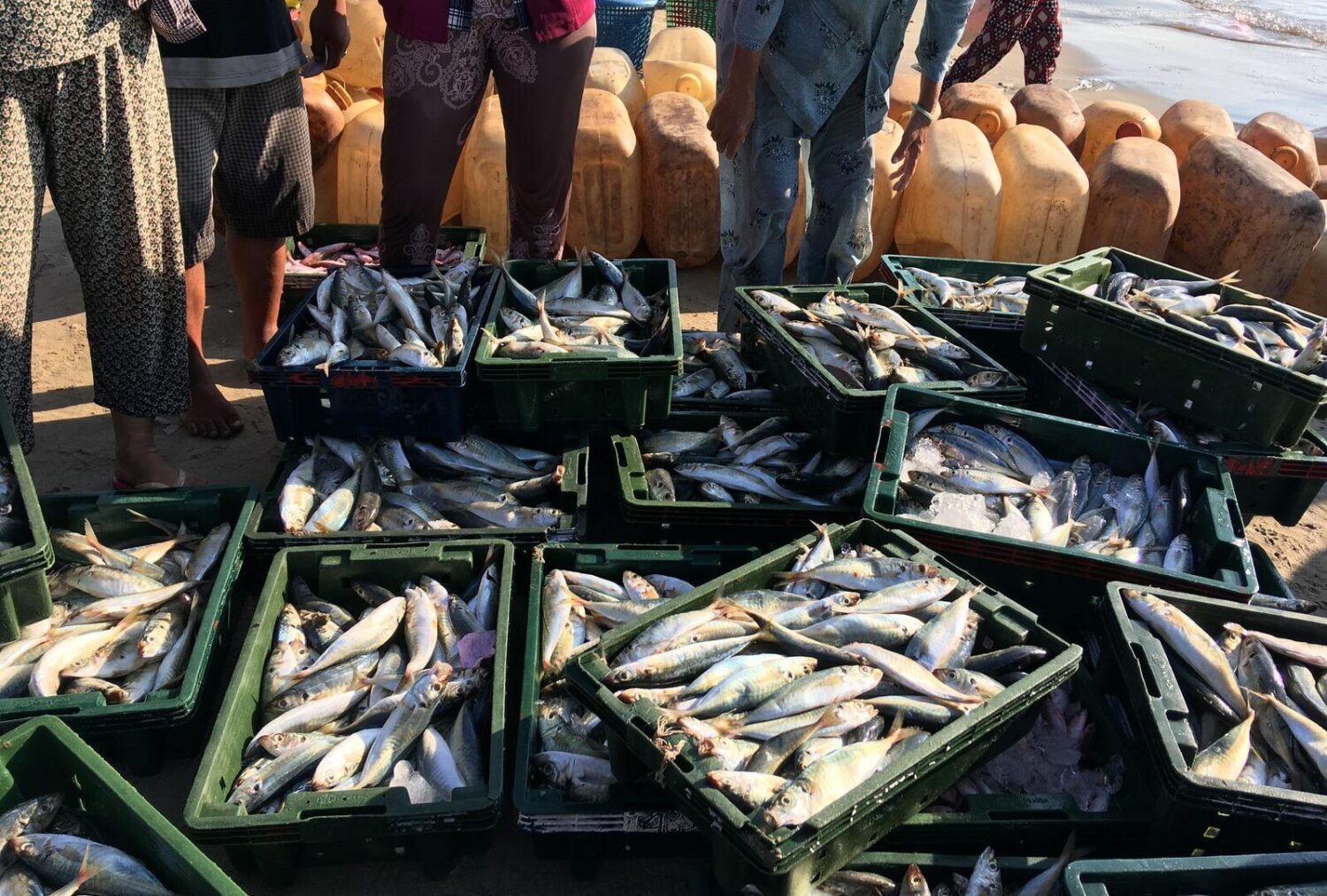
edible fish on crate lot

VIETNAM, March 7 –

Aquatic exports saw a significant surge of 47.2 per cent to $1.5 billion in the first two months of this year. Photo vov.vn.

HÀ NỘI — Việt Nam has enjoyed a trade surplus of US$1.8 billion from agriculture, forestries and fisheries during the first two months of the year, 86.7 per cent higher last year’s figure, according to the Ministry of Agriculture and Rural Development (MARD).

Foreign trade of agricultural, forestry and aquatic products reached $14.2 billion in the first two months of 2022, a year-on-year increase of 15.8 per cent. The revenue of these exports was estimated at $8 billion, up 20.9 per cent year-on-year, while imports exceeded $6.2 billion, up 10 per cent.

From January-February, shipments of key agricultural products totalled over $3.2 billion, up 10.2 per cent. Aquatic exports saw a significant surge of 47.2 per cent to $1.5 billion. Forestry exports also increased 17 per cent to nearly $2.9 billion during the period. Animal products, meanwhile, slid 3.5 per cent to just $54.1 million.

Commodities posting high export growth included coffee (36 per cent), rice (22 per cent), pepper (44 per cent), tra fish (83 per cent), shrimp (34 per cent), and wood and timber products (15.5 per cent).

The US remained Việt Nam’s biggest buyer, purchasing over $2.3 billion worth of the products, or 28.2 per cent of the total. Some 70 per cent of exports to the US where wood and timber products.

China followed in second place and Japan in third. China imported nearly $1.3 billion (16.2 per cent) from Việt Nam, some 33.3 per cent of which was rubber.

Shipments to Japan stood at $586 million (7.3 per cent), 44.8 per cent of which was wood and timber products.

In recent years, difficulties in exporting to China at border gates have led to a change in the structure of Việt Namese agricultural products exported to China.

For many years, vegetables and fruits have always been the most significant exports from Việt Nam to China, according to the MARD.

The Ministry of Industry and Trade’s Import and Export Department said that the pandemic is expected not to affect the global processed fruit and vegetable production industry.

The supply of processed fruits and vegetables has increased as exports of fresh or frozen products have decreased.

In 2022, with the increasing demand for processed fruits and vegetables on the world market due to COVID-19, Việt Nam’s fruit and vegetable industry would continue to promote processing and reduce exports of fresh products.

Businesses need to invest in technology for the post-harvest stage and logistics for transporting fruits and vegetables. The promotion of investment in the processing stage will help the local fruit and vegetable industry increase export value.

Along with promoting investment in processing, Việt Nam needs to take opportunities from new-generation free trade agreements such as EVFTA and CPTTP to boost exportation of Vietnamese vegetables and fruits, the department said.

China is still a potential market for Việt Nam’s fruit and vegetable products due to large demand, although China’s fruit and vegetable imports from Việt Nam have decreased.

Vietnamese enterprises should strictly comply with China’s import regulations to avoid interruption of export activities.

Official export contracts to China are doing well because official exports have more compulsory conditions for both sellers and buyers. This is encouraged among local businesses and traders when exporting vegetables and fruits to China.

Nguyễn Lâm Viên, general director of Vinamit Company, said that his company had maintained exports of agricultural produce to China due to planting areas, preliminary processing areas, and packaging meeting market requirements.

However, according to Viên, the organic food consumption in Europe and the US is forecast to increase by 30 per cent. This would be an opportunity for local enterprises to enhance exports of organic products to these markets.

Việt Nam’s fruit and vegetable exports in 2021 increased by 8.6 per cent compared to 2020 due to diversifying export markets and the quality of Việt Nam’s fruit and vegetable products.

The Ministry of Industry and Trade forecasts that Việt Nam’s fruit and vegetable exports in 2022 will increase by about 10-15 per cent on-year to $3.9-4.1 billion.

Meanwhile, MARD is focusing on expanding market share for Vietnamese agro, forestry and seafood exports at some major markets, such as Peru, Australia, Brazil and the US.

It has coordinated with other ministries and sectors to organise Việt Nam Agricultural Products Week at EXPO 2022 Dubai and has worked with several partners in India, Argentina and the UAE.

The ministry will continue to guide local businesses in implementing new regulations of China for exporting goods. So far, the General Administration of Customs of China has granted codes for 1,763 Vietnamese products.

The ministry will also update notices on the application of Sanitary and Phytosanitary (SPS regulations) of the World Trade Organisation member countries that could affect Việt Nam’s agricultural exports. — VNS