
Scanning ultrasound to potentially treat Alzheimer’s disease has been found to be safe and well tolerated in a
Human trial finds ultrasound treatment for dementia is safe
Keeping people warm amid hostilities and harsh winter weather in Ukraine
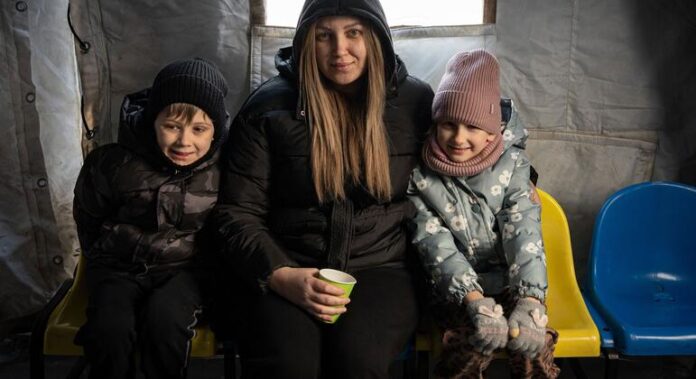
Russian forces continue to attack Ukraine’s energy grid, leaving families without electricity and heating as temperatures plummet to -20° Celsius.
Since 2022, the Government has established so-called “Invincibility Points” – located in tents or public buildings such as schools and libraries – where people can go to escape the cold, charge electronic devices and receive basic support.
Additional initiatives have also been launched, including mobile heating points operated by the State Emergency Services and Ukraine Red Cross Society. Humanitarian partners have supported these efforts with equipment, hot meals and technical assistance.
A ‘very tough’ winter
A UN team led by the Humanitarian Coordinator in Ukraine, Matthias Schmale, recently visited various heating points and mobile kitchens in Boryspil, a town in the Kyiv region.
They met residents, authorities, first responders, as well as aid organizations, at an Invincibility Point in a tent.
“This winter has been very tough for us,” said Kateryna, a mother of two young children who lives on the outskirts of the town.
“We have no electricity at home. We came here to warm up, charge our phones and the children’s devices. It was very cold in our house.”
UN Humanitarian Coordinator in Ukraine Matthias Schmale (left) meets with staff and volunteers of the Ukrainian Red Cross.
Food, warmth and support
A large food truck was set up near the tent where the NGO Food Without Borders prepared hot meals in a mobile kitchen so that people affected by the cold and power outages could get something to eat.
The group provided similar services after attacks last November in Shostka, located in the Sumy region.
“This is one of many remarkable initiatives supporting people across Ukraine during this harsh winter,” said Mr. Schmale.
“As attacks on energy infrastructure continue, many people face prolonged outages of electricity, heating and water, as well as limited ability to prepare hot food.”
Falling temperatures
Mr. Schmale also visited a heating point set up by the Ukrainian Red Cross in Boryspil town. Viktor, a volunteer at the site, described the harsh conditions many people there are facing.
“In some apartments, the temperature drops to as low as five degrees Celsius,” he said.
“People spend long hours in our warm tent, especially in the evenings, when temperatures fall even further at night.”
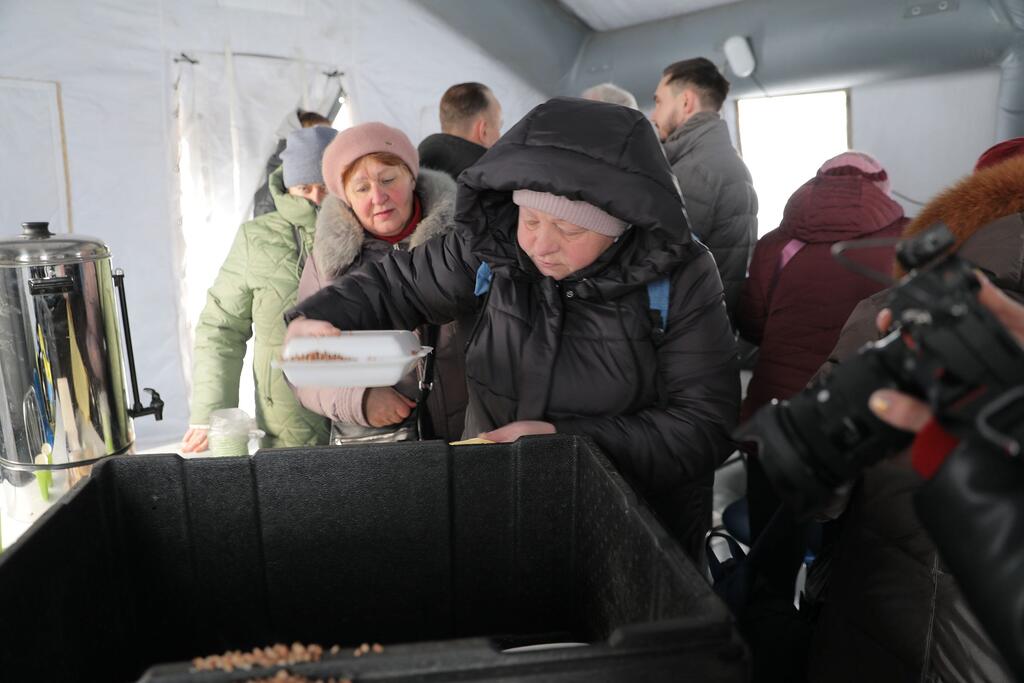
A woman helps herself to a hot meal in a heated tent in Boryspil.
Families left freezing
Humanitarians are also carrying out activities under a winter response plan launched last year which aims to reach 1.7 million people across Ukraine between October and March.
Despite these efforts, the rapidly evolving situation – including large-scale and sustained attacks on energy infrastructure – has caused service disruptions that far exceed the scenarios the plan anticipates.
Frequent power disruptions leave many families in freezing conditions. Many older persons and people with disabilities are often stuck in their homes, in high-rise apartment buildings, without electricity and heating, unable to cook hot meals or recharge their devices to stay connected.
Families with children are also left wondering how to keep them safe and healthy.
The UN and partners are seeking $2.3 million to help 4.1 million of the most vulnerable people in Ukraine this year.
For families contending with the harsh winter weather, having a place where you can warm up, eat a hot meal and recharge a phone can mean the difference between coping and serious health risks.
New European Scientific Advisory Board on Climate Change appointed
DISCLAIMER: Information and opinions reproduced in the articles are the ones of those stating them and it is their own responsibility. Publication in The European Times does not automatically means endorsement of the view, but the right to express it.
DISCLAIMER TRANSLATIONS: All articles in this site are published in English. The translated versions are done through an automated process known as neural translations. If in doubt, always refer to the original article. Thank you for understanding.
Keeping people warm despite hostilities and harsh winters in Ukraine

Russian forces continue to attack Ukraine’s energy grid, leaving families without electricity or heat as temperatures plummet to -20° Celsius. Since 2022, the government has established “invincibility points” – located in tents or public buildings such as schools and libraries – where people […]
Originally published at Almouwatin.com
سيتم الانتهاء من أكبر مصنع للصوف في أوروبا في رومانيا

 سيتم بناء أكبر مصنع لإنتاج الصوف في أوروبا في رومانيا من قبل الذين أكثر من 182 مليون ليو (36.8 مليون شخص سنويًا). المساعدات العامة، معلومات من وزارة الزراعة. سيتم استخدام المنتجات للمصنع لإنتاج الصوف والأسلاك ومنتجات العزل الحراري من الصوف. بالإضافة إلى ذلك، يتم علاج هذه […]
Originally published at Almouwatin.com
Limited access restored to Syria’s Al Hol camp amid security concerns
Briefing reporters in New York, Farhan Haq said the UN refugee agency, UNHCR, was able to access the camp on Friday together with Syrian Government officials and establish contact with some residents. Essential supplies have also resumed.
Al Hol is one of the region’s largest displacement sites, housing tens of thousands of people, mostly women and children, many with alleged family links to ISIL terrorist fighters.
UN agencies have long warned of dire humanitarian conditions there, including overcrowding, poor access to healthcare, water and sanitation, and persistent protection and security risks, while repeatedly urging durable solutions, including safe returns, reintegration and repatriation in line with international law.
“Trucks carrying bread entered the camp today, facilitated by UNHCR, following a three-day interruption caused by the volatile security situation inside the camp,” Mr. Haq said, adding that water trucks reached the camp on Thursday, helping to partially restore access to basic services for the camp population.
Al Hol camp, located in Syria’s northeast, hosts tens of thousands of people, including internally displaced Syrians and family members of suspected former fighters.
UN agencies have long warned that insecurity, overcrowding and limited services leave residents – many of them women and children – in extremely vulnerable conditions.
UN agencies and aid partners reaffirmed their commitment to supporting the Syrian authorities in delivering humanitarian assistance, while underscoring the critical need to ensure security inside the camp.
They also highlighted the importance of facilitating the movement of personnel and supplies between Al-Hasakeh and Qamishli.
Concerns in Aleppo
Beyond Al Hol, the situation in Kobani, in Aleppo Governorate, remains concerning.
According to the UN relief coordination office, OCHA, all roads connecting to the city are currently closed, while disruptions to electricity, water and internet services are hampering access to basic needs.
Partners have begun reporting shortages of food, essential items and medicines, although health facilities remain operational, Mr. Haq said.
Challenging outlook for meeting the EU’s long-term environment and climate objectives
Despite progress in key areas, the European Union (EU) remains likely off track for most 2030 environmental goals, according to the European Environment Agency’s (EEA) new 8th EAP assessment. Rising climate risks, slow transitions in production and consumption system and weakening enabling conditions highlight the urgent need for stronger, better financed and faster policy implementation. […]
Gaza reconstruction talks must not distract from massive needs, say UN aid agencies
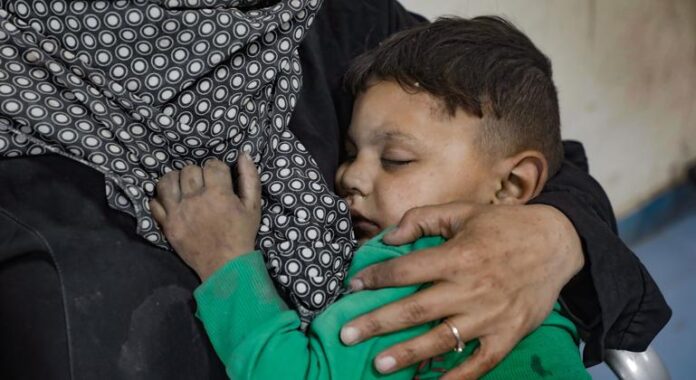
“It’s absolutely critical to unlock the congestion…at crossing points and to reopen critical lifelines like the Jordan corridor,” said Juliette Touma, Director of Communications at UNOPS, the United Nations Office for Project Services.
Briefing journalists, Ms. Touma highlighted that although the 3 October ceasefire agreement had brought some respite to families, “people continue to be killed, day in, day out”.
She said that Gaza’s highly vulnerable people simply “cannot wait” for a reconstruction plan to take shape – one of the stated aims of the US-led Board of Peace. “They need supplies at the same time, it’s not just the services,” she stressed.
UNRWA commitment
Echoing those concerns, the UN agency for Palestinians, UNRWA, underscored its key and longstanding role in the Occupied Palestinian Territories, including Gaza. This mission was entrusted to UNRWA by UN Member States at the global body’s General Assembly in December 1949.
“We are the largest United Nations agency operating in the Gaza Strip,” said Jonathan Fowler, UNRWA Senior Communications Manager. “We must be able to continue doing our work; that’s crystal clear.”
Board of Peace
While it has yet to be made clear exactly how the UN will support Board of Peace launched by President Trump at Davos on Thursday, last November’s Security Council resolution 2803 that welcomed its creation highlighted the importance of working with “cooperating organizations” including the United Nations.
“We are very strongly committed to do whatever we can to ensure the full implementation of Security Council Resolution 2803,” said Alessandra Vellucci, Director, UN Information Service, Geneva. “There is a role for the UN there about the UN leading on humanitarian aid delivery, which we have been doing for such a long time and we will continue to do the best of our capacities.”
Since Sunday, humanitarian partners providing emergency shelter assistance have reached over 13,000 households in Gaza, distributing hundreds of tents and thousands of tarpaulins, aid coordination office, OCHA, said in its latest update.
Gaza distribution obstacles remain
The UN office noted that “capacity and funding constraints” have limited support to only around 40 per cent of the existing 970 displacement sites across the Strip.
Healthcare needs remain enormous across Gaza, too, where providers such as UNRWA try to help around 15,000 patients a day, despite numerous challenges.
“We had 22 clinics operating across the Gaza Strip before the start of the war, we’re now down to half a dozen,” said Mr. Fowler. “And we have mobile health teams that operate, but in incredibly complicated circumstances.”
A number of UNRWA facilities are located behind the so-called Yellow Line – a series of concrete blocks installed by the Israeli authorities which separates Gazans from the Israel Defense Forces – envisaged in the three-step Gaza peace plan.
“That makes it incredibly difficult to do our work and so many of our locations have been heavily damaged or indeed completely destroyed,” Mr. Fowler continued. “On top of that, we remain banned by the Israeli authorities from bringing in any of our own supplies.”
UNRWA premises ‘stormed’
Turning to the destruction of UNRWA’s headquarters in East Jerusalem on Tuesday, Mr. Fowler described how visiting diplomats had been caught up in the dramatic events when Israeli forces “stormed and demolished” buildings in the compound and fired tear gas. “This is a United Nations compound, so this is an attack on the United Nations,” he told journalists.
Training centre threat
Highlighting concerns that the UNRWA-supported Kalandia Training Centre could be shut down “within days”, Mr. Fowler explained that it principally helped lower-income families to earn the skills they needed to earn a living: “If the centre were to be forcibly closed – and we do fear that this could happen within days – there is no educational alternative for these students.”
The UN agency remains deeply worried about developments in the occupied West Bank, one year since the Israeli forces launched operation Iron Wall.
“This led to the mass displacement of people from three camps in the north of the West Bank,” Mr. Fletcher explained, in reference to Jenin, Nur Shams and Tulkarem refugee settlements.
Demographic shift
“The camps are progressively being demolished by the Israeli military. So therefore, changing the facts on the ground, changing the topography and the demography of these large communities,” Mr. Fowler insisted.
UN warns of increasing internet shutdowns as digital outages spread around the world

In a statement released this week, UNESCO said governments are increasingly cutting off internet access during protests, elections and in times of crisis, despite the central role online connectivity plays in democratic participation and the exercise of fundamental rights. The agency noted that 2024 was […]
Originally published at Almouwatin.com
An old jeweler’s trick could unlock next-generation nuclear clocks
Last year, a UCLA-led team accomplished something scientists have been trying to do for 50 years. They made Source link
