
For weeks, Frontex monitored a fishing vessel that appeared determined to disappear. That sustained effort helped lead to the seizure of more than four tonnes of cocaine and the arrest of ten suspects linked to a Greek criminal network.
Gaza: humanitarian response continues despite restrictions

“As part of these efforts, the UN and its partners are unloading more essential supplies at crossing points around Gaza every day,” it said. said.
On Monday, humanitarian workers unloaded nearly 4,000 pallets of aid at two border crossings: Kerem Shalom/Karem Abu Salem, in the south of the Gaza Strip, and Zikim, in the north.
Food, water and other supplies
About 65 percent of the pallets contained food supplies, while 12 percent contained shelter items. Another 12 percent were water, sanitation and hygiene items, and 7 percent were health and nutrition products.
The UN also tried on Tuesday to coordinate five humanitarian movements with the Israeli authorities. While three of them were facilitated, one was initially approved but never received permission to proceed, and another was canceled by organizers.
“As a result, teams were able to redeploy their personnel and carry out part of the planned collection of food and medical supplies at the Kerem Shalom crossing point, alongside other missions in areas where coordination with Israeli authorities was not necessary. » OCHA said.
Winter kits for children
On the educational front, partners have distributed more than 2,000 winterization kits to children aged 12 to 14, as well as deployed and distributed 58 specialized tents in 16 learning centers.
The move aims to expand classroom space and is expected to accommodate nearly 25,000 children.
Other partners working in mine action continue to inspect key areas for possible explosion hazards. In this regard, two assessments intended to support the removal of rubble in Deir al Balah and Gaza City were carried out on Monday.
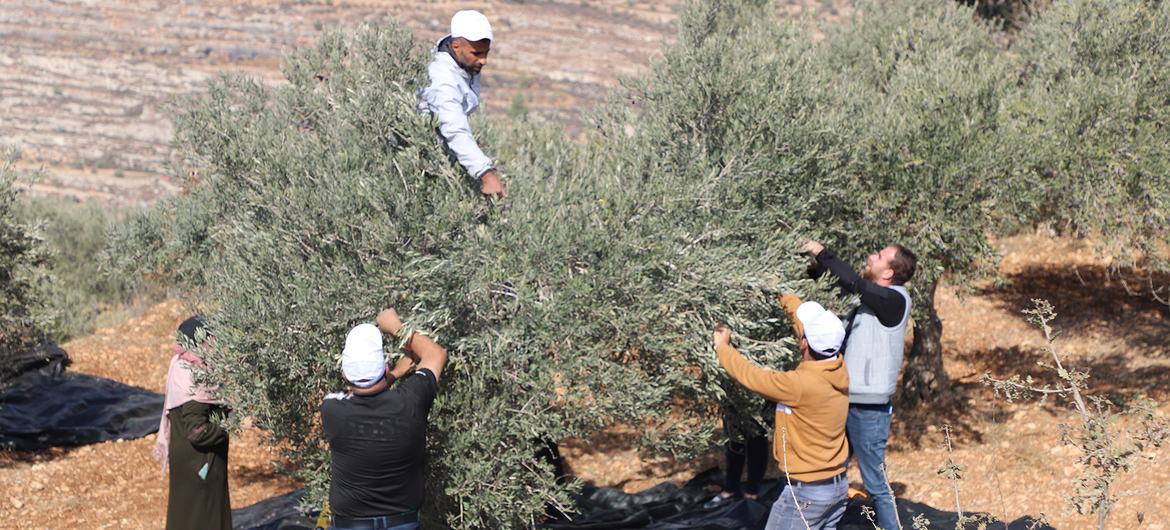
Olive harvest season in the occupied West Bank, October 2025.
West Bank: Farming families need support
Meanwhile, more than 72,000 families in the West Bank who farm or raise animals are in urgent need of emergency aid, according to a survey by the Food and Agriculture Organization of the United Nations (FAO).
It appears that about 90 percent of farming families have recently lost their income, mainly due to a sharp decline in crop and livestock production and sales.
FAO stressed that it was essential to support farmers and herders in the West Bank to produce food, support livestock and avoid a bigger crisis.
“Farming families urgently need assistance – in cash and in kind – to mitigate the impacts of widespread settler violence, a deepening economic crisis and near-pervasive loss of income. » said Rein Paulsen, Director of the FAO Office for Emergencies and Resilience.
Conflicts, rising costs and other challenges
Agriculture remains a vital lifeline in the West Bank. Of the approximately 700,000 families living there, around 115,000 depend on agriculture for their livelihoods, highlighting the importance of the sector for food security and income.
THE Data in Emergency Survey (DIEM) also reveals the growing pressures facing farm families. Nearly 9 in 10 households, or around 100,000, have recently experienced at least one acute “shock,” such as conflict and violence, rising costs of living, and job loss.
Other challenges they face include limited access to water, movement restrictions and land access constraints, and high fuel and transport costs.
The survey was carried out between July and August, this is the second time it has been carried out this year.
Originally published at Almouwatin.com
UN Security Council hears warnings of escalating US-Venezuela standoff

Ambassadors briefing Tuesday, UN Under-Secretary-General Khaled Khiari said that the US military presence and operations off the coast of Venezuela have grown since the last Council meeting discussed the issue in Octoberwhich further increases tensions.
The United States has described its expanded military deployment as part of what it calls a “non-international armed conflict” against cartels and drug trafficking, Mr. Khiari said.
“President Donald Trump said he would use ‘the full power of the United States to take on and eradicate these drug cartels, wherever they operate.'”
The Venezuelan government, including its permanent representative to the UN, has called the actions taken by the United States “a serious threat to international peace and security,” Khiari continued.
In a December 16 letter addressed to the President of the Council, Caracas accused Washington of violating “the principle prohibiting the threat or use of force in international relations.”
Strikes on suspected drug ships
U.S. strikes on ships allegedly carrying drugs in the southern Caribbean Sea and the eastern Pacific continue, Khiari said, citing U.S. officials who reported that 105 people had been killed in such strikes since September 2.
The exact locations were not disclosed, with U.S. officials saying they occurred in “international waters” or within the U.S. Southern Command area of responsibility.
The UN High Commissioner for Human Rights warned that the airstrikes violated international human rights law, Khiari added, emphasizing that the fight against drug trafficking is a matter of policing governed by strict limits on the use of lethal force.
Tensions continue to rise
Mr. Khiari further informed the Council that the United States has designated the Cartel de los Soles a “foreign terrorist organization” and declared Venezuelan airspace “closed in its entirety,” leading many international airlines to suspend flights.
Washington also announced that it has since seized oil tankers, imposed new sanctions and ordered what President Trump described as “a total and complete blockade” of sanctioned oil shipments.
Venezuela, in turn, denounced these actions as a “unilateral naval blockade” and a violation of international law, and in recent days its navy has reportedly begun escorting oil tankers.
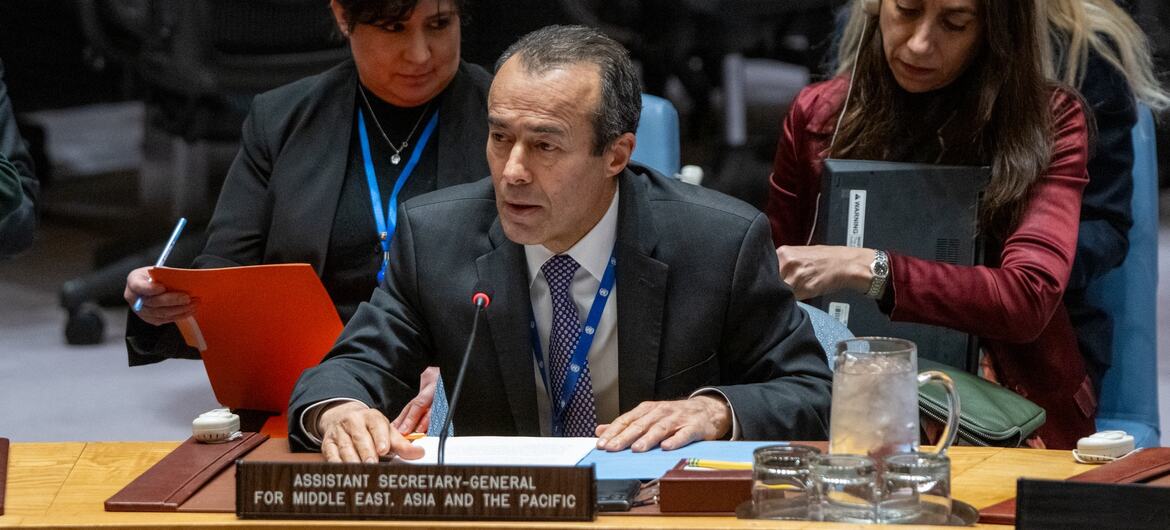
Khaled Khiari, Assistant Secretary-General for Political Affairs, briefs members of the Security Council.
Dialogue, the only viable path
Mr. Khiari reiterated the position of the United Nations on the need for all Member States to respect international law, particularly the United Nations Charterand exercise restraint and ease tensions to preserve regional stability.
The Secretary-General stands ready to support all diplomatic engagement efforts, he added, including through his good offices, if requested by both parties.
“Dialogue is the only viable path to lasting peace and preventing further instability and human suffering,” Mr. Khiari said.
Council members call for restraint
In the debate that followed, Security Council Members and participating countries have expressed concern about the situation, and many have warned of an escalation that could destabilize the region.
Michael Imran Kanu, Sierra Leone’s ambassador, said the UN Charter’s rules on the use of force are “essential to international stability” and aim to prevent escalation, miscalculation and illegal wars of choice.
French Ambassador and Deputy Permanent Representative Jay Dharmadhikari stressed that efforts to combat drug trafficking must be carried out in accordance with international law. Eloy Alfaro de Alba, Panama’s ambassador, urged all states to cooperate using “relevant international instruments” and called for respect for the United Nations Charter.
Regional participants expressed contrasting views, with some expressing solidarity with Venezuela in the face of external pressure: “Their fight is our fight,” said Jaime Hermida Castillo, Nicaragua’s ambassador. Others, however, warned that the Venezuelan people suffer as a “direct consequence” of the government, “and not as external or third factors,” according to Miguel Ricardo Candia Ibarra, Paraguay’s representative.
The United States commits to eradicating cartels
US Ambassador Michael Waltz stressed that his country would eradicate drug cartels, “which have operated with impunity in our hemisphere for far too long”.
Sanctions will be applied to the greatest extent possible to “deprive [Venezuelan President Nicolás] Maduro on the resources he uses to finance the Cartel [de los Soles]”.
This, he added, includes profits from the sale of oil, as these enable “his fraudulent claim to power and his narcoterrorist activities”.
Stressing that the “illegitimate Maduro regime” poses an “extraordinary threat to the peace and stability of our hemisphere,” Waltz said the United States “will do everything in its power to protect our hemisphere, our borders and the American people.”
Venezuela says US is looking for oil
“The United States seems destined by Providence to infest Latin America with misery in the name of freedom,” said Samuel Moncada, Venezuela’s ambassador, quoting Simón Bolívar, a 19th-century Latin American independence leader and statesman.
Stressing that it is not his country – but the current US government – that poses a threat, he added: “It is not drugs, it is not security, it is not freedom – it is oil, it is mines, it is land. »
Mr. Moncada demanded that the Security Council condemn the ongoing aggression and ensure that the United States withdraws its military.
“The world knows that if the scale of armed attacks continues, we will exercise, with determination, our inalienable right of self-defense,” he said.
Click here to additional coverage of the meeting coverage of UN meetings.
Originally published at Almouwatin.com
DR Congo: Displaced people in South Kivu close to ‘utter desperation’, WFP says
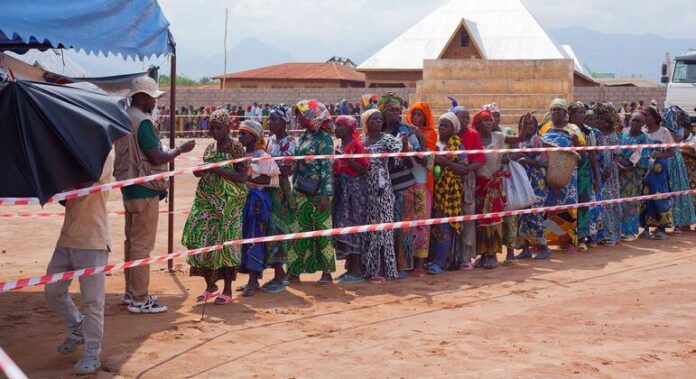
That’s according to the UN World Food Programme (WFP), which announced on Tuesday that it is scaling up to deliver aid to more than 210,000 people displaced by the violence after a new offensive by armed group M23 reignited hostilities earlier this month.
“This hunger crisis risks spiraling without urgent action,” said Cynthia Jones, WFP Country Director for the DRC.
She added that even the families who have provided shelter to those forced to flee are already living at emergency levels of food insecurity, “sharing their last food with displaced neighbors—pushing all of them closer to utter desperation.”
Deprived of water and medicine
Since the violence broke out in South Kivu, health facilities have been looted, medicines are unavailable and schools remain closed. Affected communities are deprived of safe water, medical care and livelihoods. Education has been severely disrupted, with more than 391,000 children out of school, according to WFP.
As a result, many have also fled into neighbouring countries in search of food and shelter. Teams are supporting 71,000 new arrivals from DRC in Burundi, and 1,000 in Rwanda, with hot meals.
Underfunding threatens aid
WFP is trying to reach the most vulnerable displaced families and host communities in South Kivu with a survival package of cereals, pulses, vegetable oil, iodised salt and specialised nutrition to prevent malnutrition for young children and pregnant or breastfeeding women.
While some food supplies are already pre-positioned in the conflict area, the agency says it is urgently seeking $67 million to continue assistance for three months for those forced to flee DRC and $350 million to keep operations running across all programmes in the country.
“Without urgent support and additional funding, we cannot respond to a crisis that is teetering on the brink of a hunger catastrophe,” said Ms. Jones.
Eurojust’s cross-border investigations in 2025 continued to fight organised crime

In 2025, the EU’s judicial cooperation hub worked together with national authorities from all over the globe to solve complex cross-border investigation and take action against organised criminal networks harming our societies every day. From drug trafficking networks, to large-scale credit card fraud and art trafficking, Eurojust was at the heart of combatting serious organised crime in 2025.
Paper and wood: forest products show signs of recovery, according to UN agency

The global forest products sector saw a recovery in 2024 after a sharp decline the previous year, according to a new study. report published Wednesday by the Food and Agriculture Organization of the United Nations (FAO).
FAO statistics cover 77 product categories, 27 product groups and more than 245 countries and territories. The report presents recent trends in trade data for each of the major forest product groups.
What are the main trends?
Global international trade in wood and paper products regained momentumwith modest growth recorded in most major product groups, according to FAO.
- This recovery comes after an overall decline of 14 percent in trade in wood and paper products in 2023.
- Industrial roundwood extractions, which refer to the total volume of wood harvested for non-energy purposes, increased by 2 percent in 2024, although their global trade declined by 1 percent.
- Global production of sawn timber such as boards, beams and other manufactured wood products remained virtually unchanged but varied by region. The sawn timber trade generally recorded no change compared to 2023.
- Wood-based panels increased for the second year in a row. Global production increased by 5 percent.
- Wood pulp production rose 3 percent to 189 million tonnes, while international trade rose 2 percent to a record 73 million tonnes.
- Wood pellets have experienced extraordinary growth in recent decades, driven primarily by bioenergy targets in Europe, the Republic of Korea and Japan. After a slight decline in 2023, global production returned to 48 million tonnes in 2024, i.e. the 2022 level.
Why it matters
Different types of trees can be used for housing, shelter, heating, food, medicine and even textiles or buildings.
“Forests support millions of livelihoods around the world, and this number is set to increase as they provide more economic opportunities in a growing range of industries, including sustainable timber production,” said FAO Director-General Dongyu Qu.
Promoting the sustainable use of forests is also part of Sustainable Development Goal 15, a vision that countries have agreed on.
When used sustainably, forests support life. Another recently published report FAO’s forest resources assessment showed that the net loss of forest area has been reduced by more than half since the 1990s and that more than 90 percent of forests are regenerating naturally.
Originally published at Almouwatin.com
Ferrara Drug-Prevention Story: Estense.com’s Double Standard

Ferrara’s debate about a drug-prevention initiative near schools should have been straightforward: the importance of such an activity. Instead, Estense.com’s coverage repeatedly shifted the focus to identity-based suspicion, relying on loaded framing and insinuation that risks stigmatising a religious minority and discouraging civic prevention work—without delivering the evidence-led scrutiny families actually need.
A routine civic initiative turned into a manufactured scandal
There was no special “case” here that needed exposing. Ferrara’s City Hall supported a straightforward drug-prevention activity, and the schools involved applied their normal procedures—exactly as they would for any external educational initiative. In a context where communities struggle to keep children away from drugs, backing prevention is not suspicious; it is responsible.
Estense.com nevertheless chose to frame this ordinary civic cooperation as a problem in itself. In its initial coverage (see here) and subsequent follow-ups, the reporting pivots away from what was actually done—what message was delivered, under what ordinary school conditions—and places the spotlight on identity-driven suspicion. The result is not clearer information for families, but a storyline designed to trigger alarm.
In practice, this approach discourages exactly the kind of civic participation local authorities should welcome: volunteers supporting public-health education. It shifts the reader’s attention away from drug prevention and toward discriminating others for their beliefs—without presenting concrete evidence of wrongdoing, and without any proportional justification for turning what should be a standard civic activity into a cultural confrontation.
Would you ask your surgeon’s religion before an operation?
Most people do not walk into a hospital and interrogate a doctor about being Catholic, Muslim, Jewish, Buddhist—or Scientologist—before consenting to a life-saving procedure. We judge competence, professional standards, ethics, and accountability.
Schools are not hospitals, and they require their own procedures. But the principle holds: a person’s faith, by itself, is not evidence of harm. What matters is whether external initiatives respect the law, avoid proselytism, and operate within established educational standards. In Ferrara, that baseline was met.
The “transparency trap”: damned if you disclose, damned if you don’t
This is where Estense.com’s framing becomes particularly weak. The Foundation for a Drug-Free World states openly on its official website that the campaign is “proudly sponsored” by the Church of Scientology and Scientologists worldwide. The connection is therefore not hidden.
Yet Estense’s coverage repeatedly implies that disclosure itself is evidence of covert recruitment, while any failure to foreground it at every step is treated as concealment. This creates a logical trap: transparency is reinterpreted as proselytism, while normal communication choices are reframed as secrecy.
That is not critical journalism. It is a framing choice that guarantees suspicion regardless of the facts.
City Hall and schools did what they were supposed to do
Ferrara’s schools and City Hall acted responsibly by supporting prevention rather than waiting for problems to escalate. Ordinary school procedures exist to ensure quality and appropriateness for minors—and that is exactly what applied to the activities carried out by Drug-Free World volunteers in Italy.
There was nothing exceptional to uncover. What is exceptional—and irresponsible—is a media framing that converts a routine public-health initiative into a cultural alarm simply because it dislikes the identity of some of the people delivering it.
A line crossed: from reporting facts to planting doubt
There was no mystery requiring exposure. City Hall supported a drug-prevention activity; schools applied their normal procedures; volunteers delivered a public-health message. That is the full factual framework.
Estense.com nevertheless reframed this straightforward situation using insinuating language that suggests hidden agendas without demonstrating them. By substituting evidence with atmosphere, the reporting manufactures doubt and invites fear where routine civic cooperation should have been reported plainly.
Keep the focus where it belongs: public health
Ferrara’s schools and City Hall deserve credit for supporting prevention. As with any external educational activity, the expectation is simple: the session stays on-topic, age-appropriate, and within school rules. That is standard practice in education—and it is all that was required here.
Estense.com’s reporting instead treats the organisers’ background as the main story and invites readers to view a prevention effort through suspicion rather than substance. Journalism should encourage clear, practical evaluation of what students receive—not transform public health into a cultural confrontation.
The double standard problem
Estense.com has reported on other anti-drug initiatives involving schools, professionals, and law enforcement—such as
police-led school programmes and education initiatives with institutional backing. In those cases, the frame is practical: what the programme is, how it works, why it matters.
In the Ferrara case, the frame shifts. Religious identity becomes the headline, insinuation becomes the engine of the story, and prevention becomes secondary. Readers notice that double standard—and it corrodes trust in media fairness.
Give credit where it’s due
Ferrara, like many European cities, faces a genuine challenge in keeping young people away from drugs. When volunteers distribute prevention materials and public institutions support awareness, it is reasonable—and responsible—to acknowledge the civic value of that effort.
Local media should be able to support prevention. What it should not do is turn volunteers into a “crime scene” because of ideological hostility toward a legally recognised religious minority.
What Estense.com could do now
If Estense.com wants to serve Ferrara’s public interest, it can still elevate the debate:
- Publish or link directly to the materials distributed.
- Separate reporting from commentary: facts first, opinions clearly labelled.
Ferrara does not need biased panic. It needs transparency that is not punished, ordinary safeguards that are respected, and every credible civic effort that helps keep children away from drugs.
Historic vote looms in Central African Republic as UN calls for peaceful participation

On the eve of the elections of December 28, Secretary-General António Guterres called on all Central Africans to participate peacefully in the vote and urged the authorities to ensure that the elections take place “in a peaceful, orderly, inclusive and credible manner”. according to a statement published Wednesday by its spokesperson.
He also called on all political actors and stakeholders to refrain from any actions that could incite violence or undermine confidence in the process, stressing the importance of safeguarding the rule of law, human rights and fundamental freedoms throughout the electoral period.
Historic vote
Sunday’s elections will be of unprecedented scale, combining four ballots – presidential, legislative, regional and municipal – across the country. Municipal elections, in particular, have not taken place in the Central African Republic (CAR) since 1988 and are a key provision of the 2019 Political Agreement for Peace and Reconciliation.
The Secretary-General described their conduct as “a historic step in the peace process” and a crucial step towards the consolidation of decentralization and the extension of state authority beyond the capital.
A complex landscape
The Central African Republic has long struggled with armed violence, weak institutions and limited state presence beyond the capital Bangui.
Despite the 2019 agreement, insecurity persists in parts of the country, while conflict, fragility of services and extreme weather conditions continue to fuel a humanitarian crisis, with more than two million people in need of assistance and almost a million displaced within the country or abroad.
Vast, sparsely populated and landlocked, the CAR is bordered by six countries and crisscrossed by dense forests, rivers and long, often impassable roads. Outside of Bangui, many communities are only accessible by plane or multi-day trips.
UN support for the electoral process
Mr. Guterres acknowledged the efforts of national authorities in preparing for the vote and highlighted the role of the United Nations peacekeeping mission. MINUSCAsupporting the process, in coordination with other UN agencies.
In recent weeks, MINUSCA mobilized significant logistical and security support to deploy electoral materials across the country.including in remote and difficult to access areas.
The mission transported ballot papers, indelible ink, electoral lists and other sensitive documents from Bangui to nearly 4,000 voting centers housing around 6,700 polling stations across the country.

A MINUSCA convoy transporting electoral kits to voting centers in the Central African Republic in preparation for the December 28, 2025 vote.
MINUSCA deployed all aircraft and helicopters in its fleet to transport electoral materials and staff, escorted secure ground convoys, and provided temporary storage facilities for sensitive materials in coordination with the National Electoral Authority (NEA).
He also supported civic education and voter awareness campaigns.notably on the prevention of electoral violence and the promotion of a code of conduct for political actors.
More than 2.39 million registered voters – including more than 1.14 million women – are expected to vote.
Originally published at Almouwatin.com
UN celebrates 10 years of progress on youth, peace and security
In 2021, after the Taliban took power, Nila Ibrahimi and her family fled Afghanistan. A staunch rights advocate since the age of thirteen, when she led a viral campaign that successfully overturned a government ban banning Afghan girls over the age of 12 from singing in public, she knew she risked being targeted by the new regime.

After spending time in hiding, she now lives in Canada, but she hasn’t given up on her activism. From her new home, she launched HerStory, an organization dedicated to documenting the experiences of girls in Afghanistan and across the diaspora.
“I do my best to tell the stories of girls who weren’t allowed to go to school. I was able to graduate but my friends are still stuck in time in ninth grade. It’s emotional labor, but I think if it motivates just one person to do something, then I think I’ve done enough.”
Active partners in peace
Ms. Ibrahimi was speaking to UN News at an event on December 15 to mark the tenth anniversary of Security Council Resolution 2250, which formally recognizes young people as active partners in the maintenance and promotion of international peace and security.
Around half of the world’s population is under the age of 30, making them the generation most concerned about our common future. However, they are often excluded from the spaces where solutions to our most intractable problems are shaped.
Since the adoption of the resolution, the UN has supported a multitude of initiatives implementing the recommendations it contains. For example, the Democratic Republic of Congo, Gambia and Honduras developed National and local action plans for Youth, Peace and Security (YPS); The African Union organized the first African continent-wide dialogue on the YPS, which culminated with the Bujumbura Declaration; and 11 countries, from Africa to the Middle East, Asia and Europe, have so far adopted YPS action plans aligned with Resolution 2250.
Afghanistan, still governed by the Taliban, is not one of them. However, Ms. Ibrahimi, who has often felt like she is plowing a lonely furrow, remains fearless and determined to continue the fight for women’s rights.
“At the conference, it really struck me to be in the same room with people I would never have had the opportunity to meet and learn about how they implemented strategies to empower young people in their countries,” she reflects. “Just being in their presence was a great privilege and an opportunity to not only speak about my own story and elevate the voices of Afghan women, but also to learn from others.”
Let’s act now for peace
The events of December 15 culminated with a Peace Circle bringing together Ms. Ibrahimi, several other young leaders, as well as senior UN officials, diplomats and academics. The Peace Circles were born from a major UN initiativeas part of the flagship Act Now campaign. These are informal dialogues on peace-related topics, which can range from topics as broad as education, gender equality, climate and technology. At least half of participants must be under 30, with a focus on young people who are often not at the table and new to UN spaces.
The Act Now for Peace campaign runs until September 2026, and discussions held in Peace Circles will directly feed into a number of UN projects, including the UN Secretary-General’s independent study on the contributions of young people to peace and a Global Youth Manifesto for Peace.
Find detailed information on how to create a peace circle here.
Originally published at Almouwatin.com
World News in Brief: Gaza aid restrictions, Syria humanitarian needs, lawyer reprisals in Burundi
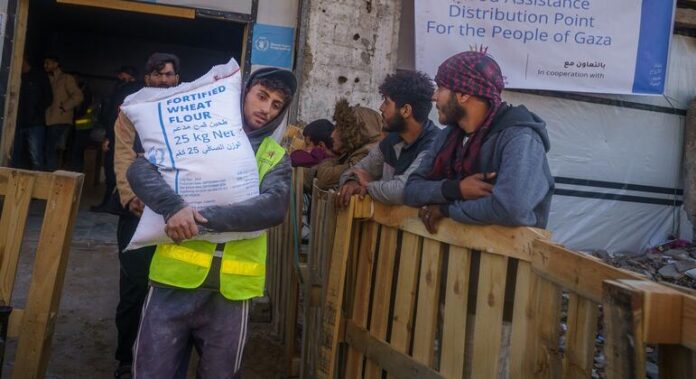
However, the humanitarian response has not been able to keep pace with needs due to ongoing restrictions imposed by the Israeli authorities, the UN aid coordination office OCHA said on Tuesday.
This includes restrictions on the entry of supplies, such as new materials needed to maintain and repair sewage networks.
Meanwhile, efforts are underway to improve water purification capacity at the Al Bassa desalination plant in Deir Al-Balah by transferring specialized equipment to the facility according to aid partners, while installation of the Al Manshia desalination plant in Gaza City has begun.
West Bank violence and displacement
OCHA also updated on the situation in the West Bank, where ongoing operations by Israeli forces and settler violence continue to put Palestinians at risk and deepen humanitarian needs.
Six Palestinians – four of them children – were killed over the past two weeks, including five by Israeli forces and one by an Israeli settler. Three Israelis were injured by Palestinians during the same period.
At the same time, OCHA also voiced deep concern over ongoing displacement across the West Bank, with more than 100 Palestinians uprooted due to demolitions.
This includes 50 people – among them 21 children – displaced in a single Israeli demolition of a four-story building in the Silwan neighbourhood on Monday for lacking an Israeli-issued building permit, which is nearly impossible for Palestinians to obtain.
Mothers in Aleppo, Syria, wait to have their children tested for malnutrition.
Millions in Syria require humanitarian assistance
Humanitarian needs remain severe across Syria, with 16.5 million people – or nearly two thirds of the population – still needing aid, according to OCHA.
The country continues along a path of political transition following the overthrow of the Assad regime last December.
Explosive ordnance contamination remains a major threat, OCHA said. Last month, 21 people were killed and more than 60 injured, half of them children.
Furthermore, some 2.5 million children remain out of school, and 40 per cent of schools are non-operational.
Since January, the UN and partners have reached more than three million people each month with humanitarian assistance.
OCHA and partners continue to coordinate with authorities and monitor developments in Aleppo City, where a ceasefire agreement was reached on Monday night following recent hostilities.
The fighting was related to tensions around incorporating the mostly Kurdish Syrian Democratic Forces (SDF) into the armed forces.
The fighting resulted in the shelling of multiple neighbourhoods, triggering new displacement. Two civilians were killed and several others injured, according to the health authorities
Burundi: Lawyers penalised for cooperating with UN, committee finds
A UN committee warns that Burundi has acted in violation of the Convention against Torture.
The UN Committee Against Torture (CAT) announced its decision on Tuesday after reviewing the petition case of four lawyers who were punished for engaging with the Committee in 2016 during its evaluation of the country’s compliance with the Convention.
They had contributed to a joint civil society report submitted to the Committee, and three of them travelled to Geneva for the review process.
The lawyers said they had participated in peaceful demonstrations in 2015 opposing then President Pierre Nkurunziza’s decision to seek a third term in office, which they considered unconstitutional.
The demonstrations were violently suppressed by the authorities, with security forces targeting protesters and political dissidents. The lawyers publicly condemned the violent suppression and, amid repression, fled Burundi and went into exile for fear of their safety.
In violation of international law
The Committee said the State party declined to participate in the second half of a scheduled two-day session to object to the Committee’s use of information submitted by civil society. On the same day, the Public Prosecutor of the Court of Appeal in Burundi’s capital, Bujumbura, formally sought the disbarment of the lawyers.
The experts found that Burundi’s actions were in violation of the Convention against Torture, and in particular, of article 13 which stipulates that complainants are protected against intimidation.
“The Committee reiterated that all States have an obligation to refrain from intimidation or retaliation against individuals who seek to cooperate with the Committee,” said Todd Buchwald, a member.
The 10 independent experts who serve on the Committee monitor implementation of the Convention Against Torture and were elected by the States Parties.
