Sunday, April 26, 2026
Home Blog Page 324

The UN envoy urges Colombia to “stay the course” while peace faces new strains

0

Briefing Security advice For the last time as head of the United Nations verification mission, the special representative Carlos Ruiz Massieu said that the peace agreement had provided a roadmap to approach the deep causes of the conflict.

“” The final peace agreement of 2016 stated the path to follow: a holistic and complete roadmap to tackle the deeply rooted structural problems which have led to violence in Colombia for decades“He told ambassadors.

He cited progress in agrarian reform, rural development, reintegration of more than 13,000 veterans, the beginning of a “complex journey” for truth and reconciliation and the opening of political space.

“” Today, Colombia is a country very different from what it was in the years preceding the signing of the peace agreement“, He added, noting, however, that gaps and challenges remain.

SRSG Ruiz Massieu informs the Security Council.

Violence persists

The main one is the limited presence of civilian and military state institutions in various regions of the country where existing dividends remain inadequate and violence persists, including against social leaders and ex-combatants.

At least 472 veterans have been killed since 2016 since the past few weeks, said Ruiz Massieu, urging measures to strengthen their protection and ensure responsibility.

“” It is also essential to achieve effective complementarity between peacebuilding policies, security strategies and efforts to combat illicit economies“, He added.

Solid moments relaunched

Mr. Ruiz Massieu underlined the progress of the opening of the political space, noting “a widespread rejection of political violence”, but warning that the attempted assassination of the presidential candidate Miguel Uribe in June relaunched painful memories and underlined the need to withdraw the violence of the electoral competition.

To combat persistent insecurity, he urged the complete implementation of security guarantees alongside rural development programs and strategies to combat illicit economies.

“The extended and sustained presence of the State remains essential,” he said, highlighting the need for coordinated investments in regions subject to conflicts.

A wide view of the Security Council meeting on the United Nations Verification Mission in Colombia (UNVMC).

Upcoming elections

The briefing also occurs while Colombia enters a sensitive period leading to the elections next year.

Mr. Ruiz Massieu called on all actors to maintain commitments for a peaceful campaign and to advance the global vision of the 2016 agreement, which includes provisions for women as well as Afro-Colombian and Aboriginal communities.

“” In their quest for peace, Colombians have a deep history rooted with resilience and persistence, “he said. Sometimes their efforts did not give the expected results, but other times, thanks to patience and perseverance, they have achieved significant progress.“”

The way to peace is never easy

“” The path to peace is never easy or without obstacles. But staying the course is always worth it“, He concluded.”The 2016 peace agreement is a striking example. »»

Mr. Ruiz Massieu, who has managed the mission for more than six years, will soon assume the functions of special representative of the UN Secretary General in Haiti.

He thanked the Council for his “coherent and crucial” support, adding that the role of the United Nations mission in Fostering Trust “will remain as important as ever in the coming period”.

Originally published at Almouwatin.com

On the road to Gaza torn by the war

0

Moving around Gaza has become increasingly difficult in the midst of the war during 21 months.

Mr. Saad, who was moved from the city of Beit Lahia in the north of Gaza, was waiting for the vehicle pulling the cart in which he was seated to move.

“Transport is very difficult and dangerous,” he said UN News. “The roads are exhausting. We pray to God to grant ourselves patience and go home. ”

It was on Rashid Street, west of the city, which connects the north and south of the strip. It is crowded with trolleys, cars and three -wheeled motorcycles that have also been converted into means of transport.

The area is interspersed with tents of displaced people, all surrounded by the rubble of buildings destroyed by the war on both sides of the road.

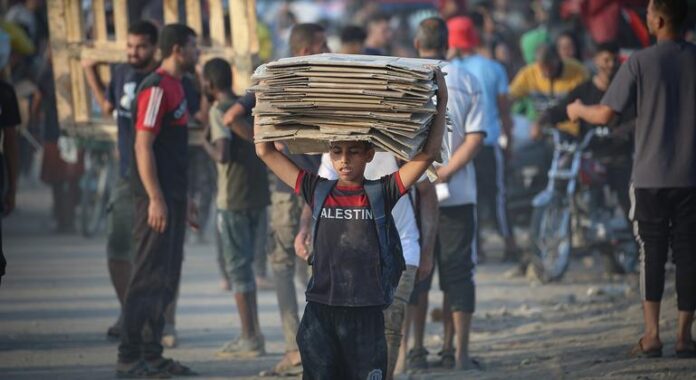
The war and evacuation orders have left many people in Gaza rushing for transport to safety.

A luxury not for everyone

“People can barely find enough to eat, so how will they pay for transport?” Umm Haytham al-Kulak asked while waiting in a compartment of passengers attached behind a motorcycle,

“We are mainly walking; We cannot take public transport, ”she said.

“May God help drivers. The fuel prices are high, and all people are exhausted and outdated. ”

In Gaza, many people have no choice but to use risky ways to move during the current war.

Heaven’s fuel cost

The drivers are soaring prices for fuel, which is a heavy burden, said Abdel Karim Abu as waiting for his car to be fully loaded with passengers.

“The price of a liter of diesel has reached 100 shekels [around $27]”, He said.” What should we do? We try to use fuel produced locally, but this causes significant damage to cars and many problems. »»

This is not the only problem facing drivers. Mr. Abu Asi said the prices of spare parts are very high. A part that cost approximately 100 shekels now sells around 2,000 shekels, or about $ 560.

“We also suffer from the destruction of the streets, and no matter how much the municipalities are trying to repair them, the problem is not solved because they require a large number of bulldozers to erase them,” he said.

“People must be helped at transport costs and many other aspects.”

Fuel suppliers sell their products at high prices, with a liter of fuel reaching around 100 shekels.

Only option

Despite all the challenges, people continue to spend their daily life, even if it takes all day to spend from one place to another. This is what happened to Hussein al-Hamarneh, who was waiting in a car to go to the band in the south of Gaza.

Mr. Al-Hamarneh believes that most of these means of transport are “uncomfortable, like the tuk-tuks [three-wheeled motorcycles] And carts driven by cars, which are mainly designed to transport goods or animals, not people. ”

“This is the only option for those who don’t have cars,” he said.

Tayayer Abu Asr, who suits the passengers to climb a cart pulled by a car, stood on the road section.

“We are trying to help people move,” he said. “These carts have become our only means of transport after the destruction of buses and taxis.”

In addition to these challenges during the current war, the Gaza Strip faces a fuel crisis.

The United Nations agencies warned earlier this week that the fuel shortage in Gaza had reached critical levels. They said that if the supplies are exhausted, it will grant an unbearable burden on the population.

Originally published at Almouwatin.com

Ukraine: UN and partners launch Winter Response Plan amid escalating hostilities

0
Ukraine: UN and partners launch Winter Response Plan amid escalating hostilities

Amidst escalating hostilities and continued strikes on critical infrastructure, Ukraine is once again bracing for another harsh winter.  

As the cold season brings heightened risks, especially for people near the frontline, displaced persons living in collective sites, and other vulnerable populations, the Winter Response Plan aims to deliver essential multisectoral humanitarian assistance to over 1.7 million people from October through March.  

Serving as a tool for advocacy, resource mobilisation and coordination with Government authorities, the plan caters to the most vulnerable groups, including older people, persons with disabilities, and children.  

Life-saving assistance

“As temperatures drop, millions across Ukraine will struggle to keep warm -especially in communities near the front line and among vulnerable displaced people,” said Mathias Schmale, the UN Humanitarian Coordinator for Ukraine.  

Humanitarian organizations will help insulate and repair damaged homes, provide heaters, fuel, blankets, and warm clothing, prepare shelters for extreme cold, deliver cash for heating and utilities, and coordinate services in high-risk areas.  

Additional strain

“Every winter puts additional strain on people already worn down by years of war,” Mr. Schmale said.  

Areas most affected by cold in the winter are predominantly concentrated in northern and eastern Ukraine along the frontline.  

People in these areas are exposed to harsh winter conditions, compounded by heightened vulnerability, and severely damaged infrastructure resulting from ongoing conflict and persistent airstrikes.

Displaced people residing in collective sites are also among the most vulnerable during winter, as recent monitoring of such sites indicates that nearly 60 per cent of these sites continue to face winter-related gaps.  

Source link

“ You must be able to govern your life ”: the Revolution of Care in Latin America

0

The workers we do not pay or see are grandmothers, mothers, girls-women who take care of children, take care of the members of the sick family and give dignity to the elderly.

To do this work of vital care, they abandon a formal job with pay checks.

“Our system is designed as if women did not care to work, which forces us to choose between raising children or working”, said Meredith Cortés Bravo, founder of a basic organization in Chile who supports these women.

But, in Latin America, it changes slowly – a Care Revolution is underway that asks governments and employers to consider what it would mean to recognize, protect and finance care work.

“Care is essential for each family and for each community. The revolution is to make it visible, to make it precious and to invest ”, María Noel Vaeza, United NationsThe regional director of Latin and Caribbean America, said News News.

The most off track

The high -level political forum (HLPF) on sustainable development Contesting at the UN headquarters in New York to discuss progress – or its absence – towards the whole agreed world Sustainable development objectives (ODD).

While 18% of goals are on the right track for 2030, Reach gender equality remains the most off track. Discriminatory laws and sex -based standards persist worldwide, women dedicating about twice more hours to unpaid care work than men.

“Gender equality is not a parallel problem. It is at the heart of peace, it is at the heart of justice and it is at the heart of sustainable development and the credibility of the multilateral system itself ”, Sima Bahous, Executive Director UN women, said for a forum session this week.

The revolution is underway

Before the start of the revolution, Latin America had to face a care crisis during COVID 19 Pandemic, according to Ms. Vaeza. There was not enough treatments available outside the house for patients, forcing society to recognize that taking care of others is work.

“Unpaid care work is what maintains economics on the move, but it is unfair because it is invisible, undervalued and sub-financed. We have to recognize it, ”said Vaeza.

In Latin America, a certain number of countries actively strive to rethink their savings in care, guaranteeing more protections and income for women and men who provide this work.

“The biggest change has been to take care at the center of public policies, not just university debates,” said Virginia Gontijo, leader in the United Nations Women’s Program in Brazil.

This work is already bearing fruit.

In Chile, one of the most ambitious care systems in the region already offers 151 municipalities, with the ultimate goal of reaching 75,000 people in the coming years.

The UN Women works with governments and civil society groups to ensure that these new systems, political and laws are shaped by and for caregivers.

A healthcare system in Brazil has worked closely with a network of activists to train caregivers in labor rights and promote long -term professional development.

“I never felt that my work was valued, but after this project, I feel better prepared to participate in political discussions and to make our voice heard”, ” said Lucileide Mafra Reis, activist for domestic workers in Brazil.

A woman and a young girl in Mexico.

Care is a human right

Mexico and Peru have adopted an approach more based on the rights of care, by codifying it as a fundamental human right.

While the international community has not yet made a similar guarantee, Ms. Vaeza said that the framework of human rights was exceptionally effective – it restores dignity and recognizes that care is a fundamental element of the trajectories of human life, from birth to death.

“If you say that care is a human right, it means that the government and the state must provide support,” said Vaeza.

It is just as important that employers protect the right of women to do care, said Helpéé Zamorano González, a mother who founded Mama Godin, an organization in Mexico who assesses the impact of health care policies.

This means ensuring that workplaces have policies that support mothers as workers, such as schedules that allow them to drop their children at school.

For her, these types of policies are crucial for women’s rights and in particular for their freedom and autonomy.

“You must be able to govern your life,” said Zamorano González UN News.

Beyond autonomy, however, it is also security. If a woman can earn her own money – and therefore her own decisions – she can leave abusive relationships and avoid economic exploitation.

“All other types of violence depend on the economic power you have. If you have the ability to make your own decisions and have money, you are safer, “said Zamorano González.

An economic investment

Changes in legal classifications and government support for care work not only benefit caregivers, but from the promotion of economic growth between companies.

“” [Care] is an investment, a strategic investment for social justice, gender equality and for sustainable development, “said Vaeza.

She noted that devoting public funds to pay the caregivers would make the investment tripo, both by increasing their purchasing power and generating tax revenues.

In Chile and Colombia, new healthcare systems are estimated at 25.6% and 19.6% respectively at their national GDP, according to UN women.

“When you invest in a female organization, you strengthen a living network, a tree with many branches that reach places, no program or institutional program could never,” said Ms. Bravo.

Export the revolution

The progress of Latin America on care is a model for other regions of the world and demonstrates the importance of changing legal frameworks for women and girls, according to Ms. Vaeza.

“It is extremely important that this revolution is exported. It is an investment, a strategic investment for social justice, gender equality and for sustainable development, ”she said.

While the revolution is underway, Ms. Zamorano González stressed the importance of economic empowerment for women as a means of protecting their own rights even when laws and policies fail.

“We are under capitalism, so while we change the system, play the game. Come on our own means of having freedom,” she said.

Originally published at Almouwatin.com

We need to value women in sport, UN rights chief says

0
We need to value women in sport, UN rights chief says

The playing field is still far from level,” Mr. Türk said.  

In the past few years, topflight women’s sporting competitions have achieved increased global prominence with around a billion people watching the FIFA Women’s World Cup in 2023. This visibility and attention have prompted important conversations about stereotypes and power dynamics in women’s sports.

He noted that certain groups face barriers and discrimination in the women’s sporting world — LGBTIQ+ women, women wearing headscarves, women with disabilities and women from marginalized ethnic and racial groups.  

We need to build up a world of sport in which women and girls, in all their diversity, are equally valuable, visible and paid.”

A ‘stark’ pay gap

While professional male footballers earn, on average, $1.8 million annually at the top clubs, women athletes at top clubs have an average income of $24,000. And the average woman athlete, not at top clubs, earns even less than that, rounding out to approximately $10,900 per year.  

“Without a stable income, women are forced to take other jobs, leaving them with less time and energy to focus on training and improving,” Mr. Türk said.  

The wage gap is made even more unsustainable by a lack of sufficient protections in the workplace – minimal, if any, maternity leave – and few places to​​ turn to for redress when harassment occurs.  

Women are also very underrepresented in leadership of professional clubs and federations. Of the 31 federations, women chaired only three.

Despite such sobering statistics, some federations have begun to institute changes, enshrining maternity and adoption leave and establishing pay equity agreements.  

Driving social change

Mr. Türk called on Member States to institute comprehensive anti-discrimination systems which promote pay equality and ensure that violence and harassment in sports is brought to justice.  

He also said that the media can and should be a “force for good” in portraying women’s success stories in sports and by ensuring that their coverage is accurate and ethical.  

Sports can drive social change … and inspire and promote fairness, respect and equal opportunities for all. Today let’s champion a sporting world where women and girls can thrive.” 

Source link

Help cuts leave the refugee agency incapable of shelter six in 10 by fleeing the war in Sudan

0

Worldwide, $ 1.4 billion in the agency’s programs are closed or suspended, Hcr said in a new report.

“We cannot stop water, you cannot stop sanitation, but we must make decisions when it happens, for example, to shelter,” said the director of UNHCR external relations, Dominique Hyde.

“We have people who arrive from Sudan daily, regions of Darfur … arriving in Chad, I cannot have shelter.”

In an urgent call for flexible funding from donors, Hyde noted that up to 11.6 million refugees and others are likely to lose access this year to direct the humanitarian aid of the UNHCR. The figure represents approximately a third of those affected by the organization last year.

On the border of Sudan-Chad, the United Nations agency is now unable to provide a “basic refuge” to more than six out of 10 refugees fleeing the conflict. Thousands of more vulnerable people have also been blocked in locations of remote borders in South Sudan. “If we just had a little more support, we could bring them to colonies,” She insisted.

Due to the financing cuts, basic activities have already been hardly affected. These include registration of refugees, child protection, legal advice and prevention and responses to sexist violence.

All sectors of help strike

In South Sudan, 75% of safe spaces for women and girls supported by UNHCR have closed. This means leaving up to 80,000 women and girls refugee without access to medical care, psychosocial support, legal aid, material support or income -generating activities. This includes survivors of sexual violence, noted the UNHCR.

“Behind these figures are a real life suspended in the scale”, ” Ms. Hyde said.

“Families see the support on which they leaning on Vanish, forced to choose between feeding their children, buying medication or paying rent, while hope for a better future slips out of sight. Each sector and operation have been affected and critical support is suspended to maintain rescue aid. ”

Afflux de Libya

Many of them affected by the war in Sudan have made the decision to pass from Chad and Egypt in Libya, in the hands of smugglers who dangerously overload boats with desperate people seeking to cross the Mediterranean Sea in Europe.

“What we observe now is that in terms of arrivals in Europe of … Sudanese refugees, [it] has has increased since the start of the year by around 170% compared to the first six months of 2024“Said the HCR spokesperson, Olga Sarrado.

Reduced support from Niger to Ukraine

In the camps welcoming the Rohingyas refugees from Myanmar to Bangladesh, the education of some 230,000 children could now be suspended. Meanwhile, in Lebanon, “the UNHCR health program may be closed by the end of the year,” continued Ms. Hyde.

In Niger and other emergency circles, reductions in financial aid for the refuge have left families in overcrowded structures or at risk of homelessness. In Ukraine, financial aid has also been reduced, “leaving the uprooted families unable to afford rent, food or medical treatment,” she noted.

Assistance to the return of the Afghans has also become another victim of the reductions in the world aid. About 1.9 million Afghan nationals have returned home or have been forced since the start of the year, “but financial assistance for returnees is barely sufficient to afford food, not to mention rent, undergoing efforts to ensure stable reintegration,” said UNHCR.

Legal aid has stopped

Overall, several UNHCR operations have struck by serious financing gaps had to reduce investments in strengthening asylum systems and promoting regularization efforts.

In Colombia, Ecuador, Costa Rica and Mexico, any lack of prolonged legal status means prolonged insecurity for people in moving, said the United Nations agency. The result is the deepening of poverty “because refugees are excluded from formal employment and greater exposure to exploitation and abuse,” said Ms. Hyde.

About one of the 550 out of three offices in the world was affected by the cuts, Ms. Hyde told journalists in Geneva:

“We are not able to do so much contingency planning; What we are able to do is make decisions on priorities and, at this stage, priorities as I mentioned are dramatic. ”

For 2025, UNHCR needs $ 10.6 billion. Only 23% of this amount was provided.

“In this context, our teams focus on efforts to save lives and protect those who are forced to flee,” said Ms. Hyde. “If additional funding becomes available, UNHCR has systems, partnerships and expertise to resume and increase assistance quickly.”

Originally published at Almouwatin.com

Pakistan reels under monsoon deluge as death toll climbs

0
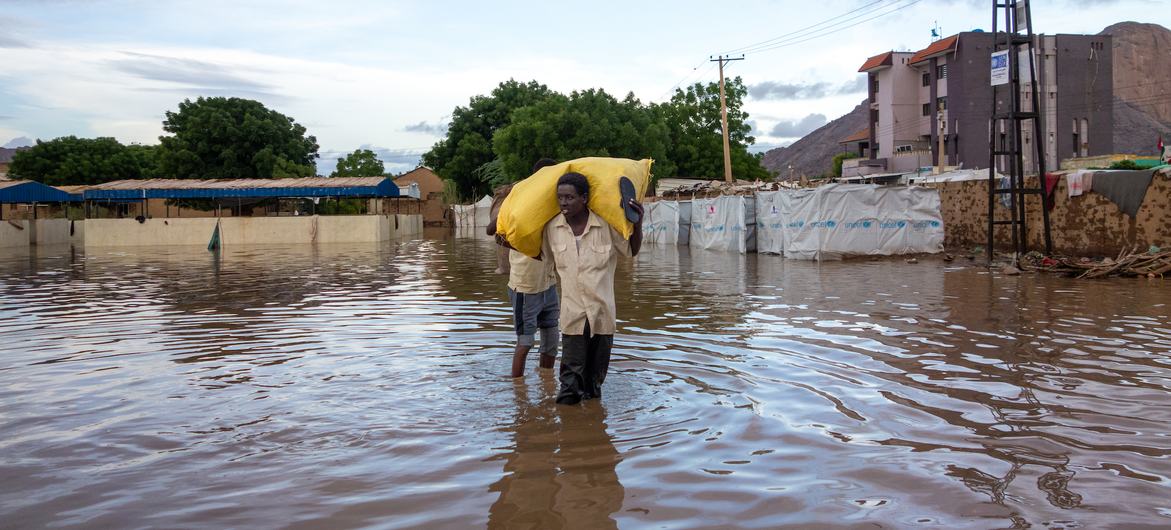
Pakistan reels under monsoon deluge as death toll climbs

Punjab, Pakistan’s most populous province, reported at least 63 casualties and 290 injuries in the past 24 hours, pushing the nationwide toll since the seasonal rains began on 26 June to over 120 fatalities, according to the National Disaster Management Authority.

The unfolding crisis – rising rivers, forecasts of further downpours, fragile rural homes collapsing and transport links severed – has revived stark memories of the catastrophic 2022 floods that submerged a third of the country and affected more than 33 million people.

More intense rainfall is forecast over parts of central and northern Pakistan in the next 72 hours. Weather forecasters have warned of “exceptional high” flood levels of up to 450,000 cusecs at some locations along the Jhelum River. One cusec equals one cubic foot of water – equivalent to 28.4 litres or 7.5 gallons – per second.

There are also fears of glacier lake outburst floods in the Khyber Pakhtunkhwa and Gilgit Baltistan regions.

Wider UN contingency – major stock gaps

Managed by the Office for the Coordination of Humanitarian Affairs (OCHA), the UN presence in Pakistan released an inter‑agency monsoon contingency plan earlier this month.

The plan lays out response triggers, sector roles and arrangements for floods, storms and landslides – under the leadership of the Government.

However, pre-positioned aid supplies remain far below projected need, with key sectors such as protection, nutrition, and shelter and non-food items facing severe gaps.

These shortfalls underscore the urgency of pre‑positioning relief items and securing rapid financing if the rains intensify.

Building resilience

Amid the emergency, the UN World Food Programme (WFP) and the Government of Pakistan this week launched a climate-risk project in Khyber Pakhtunkhwa’s Buner and Shangla districts.

The initiative will establish early warning systems, train communities in safe evacuation and strengthen local capacity for disaster response.

Recurring climate shocks are a driver of hunger and malnutrition, threatening lives, livelihoods and entire food systems,” said WFP Country Director Coco Ushiyama.

“This project represents a multi-layered investment in early warning systems and action.”

Flashbacks of 2022 devastation

The escalating disaster once again reveals Pakistan’s vulnerability to climate shocks.

In 2022, unprecedented monsoon floods killed more than 1,700 people, displaced millions and devastated water systems, leaving millions more in desperate need. The disaster also inflicted immense economic damage estimated at nearly $40 billion, and reversed years of development efforts.

Experts warn that erratic monsoon patterns, amplified by climate change, are hitting the country – and others across southern Asia – harder each year.

Source link

Syria crisis: Hundreds killed in ongoing violence, hospitals overwhelmed

0
Syria crisis: Hundreds killed in ongoing violence, hospitals overwhelmed

Briefing reporters in Geneva, UN human rights office, OHCHR, spokesperson Ravina Shamdasani highlighted “credible” reports of “widespread violations and abuses, including summary executions and arbitrary killings, kidnappings, destruction of private property and looting of homes” in the city of Suweida.

“Among the reported perpetrators were members of the security forces and individuals affiliated with the interim authorities as well as other armed elements from the area, including the Druze and Bedouin,” she said.

Many hospitals are struggling to cope with the influx of injured, the UN refugee agency UNHCR also noted.

Forced to flee

On Friday morning, OHCHR colleagues reported that clashes were continuing and that “a lot of people are trying to flee or have fled the area”, Ms. Shamdasani continued.

The latest updates from the UN humanitarian affairs coordination office, OCHA, on Thursday indicated that nearly 2,000 families had been displaced from areas affected by the fighting.

Hundreds have reportedly been killed since sectarian violence involving the Druze and Bedouin communities erupted on 12 July, triggering an intervention by Syrian security forces.

OHCHR’s Ms. Shamdasani highlighted an incident on 15 July in which at least 13 people were killed when “armed individuals affiliated with the interim authorities deliberately opened fire at a family gathering”.

Briefing an emergency meeting of the Security Council in New York on Thursday, UN Assistant Secretary-General Khaled Khiari also referenced reports of “civilians, religious figures and detainees being subjected to extrajudicial executions and humiliating and degrading treatment”. He urged all parties to protect civilians and civilian infrastructure.

Rumours and fact-checking

Ms. Shamdasani stressed that the UN human rights office has been trying to verify the information through “contacts on the ground…families of people who were killed, eyewitnesses”, but that obtaining reliable estimates of the death toll remains challenging.

“There are lots of videos circulating,” she said. “Some claim to be fighters who are in the area filming the abuses and violations they’re carrying out. We are trying to verify some of these videos, but there’s a lot of disinformation out there and a lot of it is being used to incite further violence to inflame tensions.”

The OHCHR spokesperson also expressed concern about reports of civilian casualties resulting from Israel’s airstrikes on Suweida, Dara’a and central Damascus.

“Attacks such as the one on Damascus on Wednesday pose great risks to civilians and civilian objects,” she warned, calling for the strikes to cease.

Israel had launched the strikes pledging to protect the Druze community.

The violence and displacement have sparked “considerable” humanitarian needs, with the health and aid systems struggling to keep up, said William Spindler of the UN refugee agency UNCHR.

“Many of the hospitals have been overwhelmed by the number of people who have been injured in the recent fighting,” he said.

According to OCHA, the UN World Health Organization (WHO) has dispatched enough trauma and emergency surgery kits for 1,750 interventions to the area, but many “remain undelivered due to access constraints”.

Since the displaced had to flee at very short notice, they are in desperate need of essentials – blankets, jerry cans, solar lamps – but providing these items has been a challenge.

Too risky to enter

“We have this in stock and we are ready to deliver them as soon as the security allows it,” Mr. Spindler said. “For now, this has not been possible.”

He also warned of water shortages due to electricity outages. He said people are unable to buy bottled water or food because of the insecurity.

UNHCR has an office in rural Suweida and Mr. Spindler expressed concern about the impact of the hostilities on the agency’s operations, infrastructure and personnel.

“We know that humanitarian infrastructure has been affected,” he said, describing an incident on 15 July in which a warehouse of the Syrian Arab Red Crescent was severely damaged by shelling.

The UNHCR spokesperson called on all parties to the conflict to respect and protect humanitarian premises, personnel and assets “in accordance with international humanitarian law”.

Source link

Protecting workers by limiting exposure to hazardous chemicals

0
Protecting workers by limiting exposure to hazardous chemicals

The Commission has recommended to set exposure limits for workers to several hazardous chemicals. This should prevent about 1,700 lung cancer cases and 19,000 other illnesses over the next 40 years. The new measures also cover welding fumes that can contain carcinogens.

Source link

EU ministers give green light to progressive start of Entry/Exit system

0
EU ministers give green light to progressive start of Entry/Exit system

The EU has adopted a new law that will see the progressive launch of the Entry/Exit digital border management system over six months. The system will digitally record entries and exits, including fingerprints and facial images, of non-EU nationals travelling for short stays in an EU country.

Source link