Saturday, September 26, 2026
Home Blog Page 345

Funding cuts could push 6 million more children out of school, warns UNICEF

0
Funding cuts could push 6 million more children out of school, warns UNICEF

Official Development Assistance (ODA) for education is projected to fall by $3.2 billion – a 24 per cent drop from 2023 – with just three donor governments accounting for nearly 80 per cent of the cuts.

Such a decline would push the number of out-of-school children worldwide from 272 million to 278 million, UNICEF said – the equivalent of shutting every primary school in Germany and Italy combined.

“Every dollar cut from education is not just a budgetary decision, it’s a child’s future hanging in the balance,” said UNICEF Executive Director Catherine Russell.

Children in crisis hit hardest

The heaviest impact is expected in regions that are already vulnerable. West and Central Africa could see 1.9 million children lose access to school, while 1.4 million more could be pushed out across the Middle East and North Africa.

In total, 28 countries stand to lose at least a quarter of the education aid they rely on. Côte d’Ivoire and Mali face some of the steepest risks, with enrolment projected to fall by 340,000 and 180,000 students respectively.

Primary education will be hit hardest, with funding expected to drop by one-third. UNICEF warns this could deepen the global learning crisis and cost those children affected an estimated $164 billion in lost lifetime earnings.

In humanitarian contexts, the cuts could be devastating. In the Rohingya refugee response, 350,000 children risk losing access to basic schooling permanently.

Displaced children in a classroom in Baghdad, Iraq.

Call to protect education

The crisis will also threaten vital services. School feeding programmes – sometimes a child’s only reliable meal – could see funding halved, while support for girls’ education is likely to shrink. At least 290 million children who remain in classrooms could also face a decline in learning quality.

UNICEF is calling on donors to direct at least half of all education aid to least developed countries, safeguard humanitarian funding, and prioritise early years and primary schooling. It also urges reforms to make financing more efficient and sustainable.

“Education, especially in emergency settings, often serves as a lifeline,” Ms Russell said. “Investing in children’s education is one of the best investments in the future – for everyone.”

Source link

Press remarks by President António Costa following the joint press point with Prime Minister of Slovenia, Robert Golob

0
Press remarks by President António Costa following the joint press point with Prime Minister of Slovenia, Robert Golob

Press remarks by President António Costa following the joint press point with Prime Minister of Slovenia, Robert Golob

Source link

Funding cuts could push 6 million more children outside the school, warns Unicef

0
Funding cuts could push 6 million more children outside the school, warns Unicef

Official development assistance (ODA) for education should fall by $ 3.2 billion – a drop of 24% compared to 2023 – with only three donor governments representing almost 80% of the cuts.

Such a decline Push the number of children excluding schooling around the world from 272 million to 278 million,, Unicef said – the equivalent of the closure of each primary school in Germany and combined Italy.

“Each reduced dollar of education is not only a budgetary decision, it is the future of a child in the balance,” said UNICEF director general Catherine Russell.

Children in crisis have struck the hardest

The heaviest impact is expected in the already vulnerable regions. West and central Africa could see 1.9 million children lose access to school, while 1.4 million more could be pushed through the Middle East and North Africa.

In total, 28 countries should lose at least a quarter of education assistance on which they count. Côte d’Ivoire and Mali face some of the steepest risks, inscriptions that should fall by 340,000 and 180,000 students respectively.

Primary education will be the hardest, funding should drop by a third party. UNICEF warns that this could deepen the global learning crisis and cost children affected about $ 164 billion in lifelong income.

In humanitarian contexts, cuts could be devastating. In the response of Rohingyas refugees, 350,000 children risk losing access to basic schooling permanently.

Children moved to a classroom in Baghdad, Iraq.

Call to protect education

The crisis will also threaten vital services. School food programs – sometimes the only reliable meal of a child – could see the funding of half reduced, while support for the education of girls is likely to shrink. At least 290 million children who remain in classrooms could also face a drop in the quality of learning.

Unicef ​​is Call donors to direct at least half of all education assistance in the least developed countriessafeguard humanitarian funding and prioritize the first years and primary schooling. It also urges reforms to make funding more efficient and lasting.

“Education, especially in an emergency, often serves as a rescue buoy,” said Russell. “Investing in children’s education is one of the best investments in the future – for everyone.”

Originally published at Almouwatin.com

The United Nations Refugee Agency urges support to end travel for millions of Syrians

0
The United Nations Refugee Agency urges support to end travel for millions of Syrians

This is the message from Kelly Clements, deputy high commissioner of the United Nations Agency for Refugees, HcrSpeaking Tuesday after concluding a five -day visit to Lebanon and Syria.

“The international community cannot afford to be simple observers, evaluating and judging developments in Syria”, it said.

“They must play an active role supporting stabilization and recovery efforts, helping Syrians rebuild and reshaped their country.”

Bound at home

More than 1.2 million people have returned to Syria since the fall of the Assad regime last December. About 850,000 crossed Lebanon and elsewhere in the region.

The UNHCR has increased its support to those who choose to return, including providing money and transport, in order to ensure that the process is worthy and lasting.

Meanwhile, yields continue inside Syria, with more than 1.7 million internal displaced people (PDI), including just over 880,000 people who left PDI sites in the North.

Commitment to cooperate

During her visit, Ms. Clements met with senior government officials, refugees who recently returned to Syria and newly arrived refugees in Lebanon.

During meetings with Lebanese Prime Minister Nawaf Salam and other members of the cabinet, she expressed her appreciation for generosity continues to welcome Syrian refugees and is committed to cooperating more to support voluntary yields.

Since January, nearly 200,000 Syrian refugees have returned from Lebanon. Many others have indicated that they were planning to follow in the coming months, especially after the authorities have deleted the exit costs for those who exceeded their residence.

Ms. Clements also met a group of Syrian refugees who have arrived in Lebanon in recent months after fled recent violence at home.

“It was a dynamic period when we see the two Syrians return, but also others becoming newly displaced,” she said.

“We are counting on the international community to continue supporting the work of Lebanon and the UNHCR here,” she added. “Millions of Syrian refugees are still in neighboring countries, and the world must not forget them.”

Return and rebuild

In Syria, Ms. Clements met the Minister of Social Affairs Hind Kabawat as well as the governors of Homs and Idleb. She also spoke to recently returned refugees who shared their hopes to rebuild their lives and their country.

“I saw closely how people have kept their willingness to come back, stay and rebuild despite the harsh reality of destruction and the lack of services after 14 years of war,” she said.

UNHCR and partners have expanded support for the regions of Syria who see a high number of yields.

Ms. Clements visited Rural Damascus and met repatriated who received assistance and support for the shelter to start small businesses. She also helped inaugurate a newly authorized civil register office in the governorate of Idleb, which the agency has supported.

She stressed that UNHCR and partners are on the ground in Syria by doing their part, “but there is so much more to do and that the commitment of the international community to support such efforts is essential. »»

Originally published at Almouwatin.com

The daily deaths of malnutrition continue while Israeli forces push further in the city of Gaza

0
The daily deaths of malnutrition continue while Israeli forces push further in the city of Gaza

“” Military activities continue in and around Gaza City, but also in the South, making a heavy price on civilians, including deaths, injuries and additional trips“Said UN spokesperson Stéphane Dujarric at Daily press conference In New York: “Our colleagues report that people continue to flee, mainly towards the coast.”

More than 76,000 people have been newly moved since mid-AugustMost of them performing in the North, he said, citing the last reports of the United Nations agencies on the ground that monitor the movements of the population. More than 23,000 people were moved from northern Gaza.

Coastal areas are also cluttered with tents, forcing many people to flee from Gaza City to the north to central regions, according to the United Nations Humanitarian Coordination Agency, Ochha.

Famine response: “We can redo this”

Daily malnutrition death reports are continuing, said UN spokesperson. Since the start of the almost two year war, more than 300 people, many of whom have died of malnutrition in the strip, according to local authorities.

The world gastronomic program (Wfp) said the situation “continues to deteriorate,” added the UN spokesman, adding that Families without valid members to seek food is faced with the highest risks.

As such, the United Nations agency resumed its good digital distribution system last week, reaching 22,000 people, including vulnerable groups, after a five -month break.

“We and our partners continue to transport help and other medical supplies to and from the passages [into Gaza]but Current situations on the ground have not yet allowed us to resume community distribution“Said Mr. Dujarric. Only a ceasefire will ensure the conditions necessary for a massive response to prevent famine from spreading more. “”

During the previous ceasefire from January to March, he said: “We reached almost all people in the Gaza Strip with rescue aid, and we can start again.”

Obstacles delay urgent help deliveries

PAM said obstacles include supply shortages and violent disorders around convoys that make distributions “almost impossible”.

According to the United Nations Humanitarian Agency, the movement of aid teams inside Gaza remains strongly restricted. The OCHA also indicated that around one missions planned out of three had been “hampered or decried by the Israeli authorities” between Friday and Monday, said the UN spokesman.

Consequently, many missions could not be completed, he said, noting also that strict Israeli inspections continue to considerably delay the assistance authorization at the port of Ashdod.

Visas for senior Palestinian officials blocked

The reports indicated that the United States announced last week that it would not deliver visas to the senior Palestinian leaders before high-level general meetings later this month at the UN headquarters in New York.

Which includes a conference September 22 when heads of state and government should Approve a political declaration Adopted by leaders participating in an international conference at the end of July, approving the solution to two states.

Answering the question of a journalist on the issue, Mr. Dujarric said ” The participation of a senior Palestinian delegation in the conference is essential. “”

UNRWA Loaring for “Scholasticide”

Philippe Lazzarini, general commissioner of the United Nations Agency for Palestine refugees, UNRWArecruited alarms on what would have been the start of the school year for more than 600,000 children in Gaza.

“” Gaza is in ruins; The same goes for his education system“, He said in a statement Monday. “Instead of returning to school, like most children around the world, around 660,000 girls and boys in Gaza will pass through the rubble, desperate, hungry, traumatized and above all bereaved.”

The more they stay outside the school with their trauma, the more the risk they become “a lost generation, sowing the seeds for more hatred and violence,” warned the chief of UNRWA.

“The ceasefire is the only way to follow to reverse famine and the” scholastide “hitting the children of Gaza,” he said.

Originally published at Almouwatin.com

Afghanistan quake: Aid teams still scrambling to reach survivors

0
Afghanistan quake: Aid teams still scrambling to reach survivors

The magnitude six quake has already left more than 800 dead and at least 2,000 injured, but the total impact could be in the “hundreds of thousands”, according to the UN’s top aid official in the country, Indrika Ratwatte.

Speaking from Kabul, Mr. Ratwatte said that mud and wooden roof structures were predominant in the affected mountainous provinces.

“When the walls collapse, the roof is what basically falls on individuals, kills them or suffocates them,” he said. “Since this happened in the night, everybody was sleeping,” the senior UN aid official explained, indicating that many more people may be trapped under the debris.

Massive loss of homes, livestock

Hundreds of thousands could be impacted, “as in houses destroyed, injured, casualties, livestock lost and any livelihood systems that they had”, Mr. Ratwatte explained.

In the first critical 24 hours after the earthquake hit, access was “very limited”, owing to landslides and rockfalls triggered by the tremors. Some roads were already blocked by previous rockslides caused by recent heavy rainfall.

“This has posed a huge challenge to us as we deploy right now,” Mr. Ratwatte said, stressing that 20 emergency assessment teams have been mobilized alongside 15 mobile teams “which will enhance the humanitarian flights from Kabul to Jalalabad”, capital of the affected Nangarhar province.

The UN Humanitarian Air Service has scheduled additional flights connecting Kabul and Jalalabad for personnel and cargo to scale up the response.

The aid official also said that the UN and others are trying to set up or repair damaged mobile networks as there is “zero connectivity” with some affected communities, “and even to bring in helicopters and land,” another challenge for the de facto authorities.

“It’s not easy to get to these areas and keep shuttling injured individuals,” he said.

Disease danger

Mr. Ratwatte underscored the importance of protection work, “including psychosocial support for individuals who lost family and loved ones”. He also stressed that it was urgent to dispose of bodies and dead livestock to prevent waterborne diseases, “which can happen very, very fast”.

One of the first responders in the affected areas was the Afghan Red Crescent. Joy Singhal, Acting Head of Delegation for Afghanistan of the International Federation of Red Cross and Red Crescent Societies (IFRC), said that more people could have been saved if road access were easier.

“Our staff and volunteers sometimes have to [walk] for about four to five hours to reach some of those remote villages,” he said. Once they reach their destination “they have to walk back and bring those affected and wounded people into the city centre…the two hospitals there are overwhelmed.”

Those staying in remote and mountainous quake-hit areas urgently need tents, tarpaulins and blankets to protect them from the cool weather in the highlands. They also need hot meals and food which is being made available, said Amy Martin, Head of the UN aid coordination office, OCHA, in Afghanistan. Mobile health teams have been sent to some of the affected districts but they are “going to be in short supply”, she noted. “That’s going to be a gap; making sure that we can do that trauma care and that initial first aid, which is critical.”

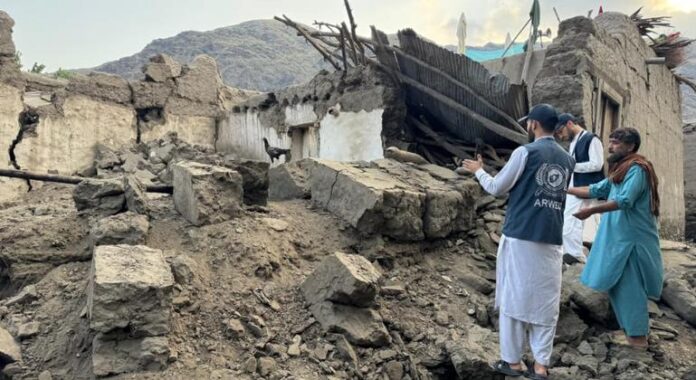
Families in Eastern Afghanistan have been devastated by the earthquake that hit the region on 31 August.

Disaster, time after time

Afghanistan has long faced what the UN’s Humanitarian Coordinator Mr. Ratwatte called “systemic humanitarian challenges”. Half of its population – or some 22.5 million people – need assistance, while food insecurity has been aggravated by recent drought. Sweeping funding cuts to humanitarian programmes since the beginning of the year have meant that “hundreds” of aid facilities have had to close.

“The earthquake comes at a time where vulnerable communities are going to be super-exposed to additional stresses,” Mr. Ratwatte said.

Another major challenge is the return in 2025 of 2.4 million Afghan refugees from Iran and Pakistan, whom communities in the country have been “struggling to integrate”, said UN refugee agency (UNHCR) spokesperson Babar Baloch.

“More than half of these are deportations, people who have been put on buses and other forms of transport and left at the borders to go home, and it has already put a further restraint on our ability to support,” Mr. Baloch said.

Deported regardless 

He also stressed that the majority of returnees are heading precisely to the earthquake-affected areas. In another “worrying” development, Sunday marked “the end of grace period for registered Afghan refugees in Pakistan” and UNHCR is preparing for “significantly more returns” in the coming days.

“These people already with very little resources are now returned to a disaster zone,” Mr. Baloch said.

“We are at breaking point in terms of response to the multiple humanitarian shocks in the country,” the UN’s Mr. Ratwatte insisted.

The $2.4 billion humanitarian response plan for Afghanistan for 2025 is only 28 per cent funded, “and here we have an emergency on top of the crisis situation”, he concluded.

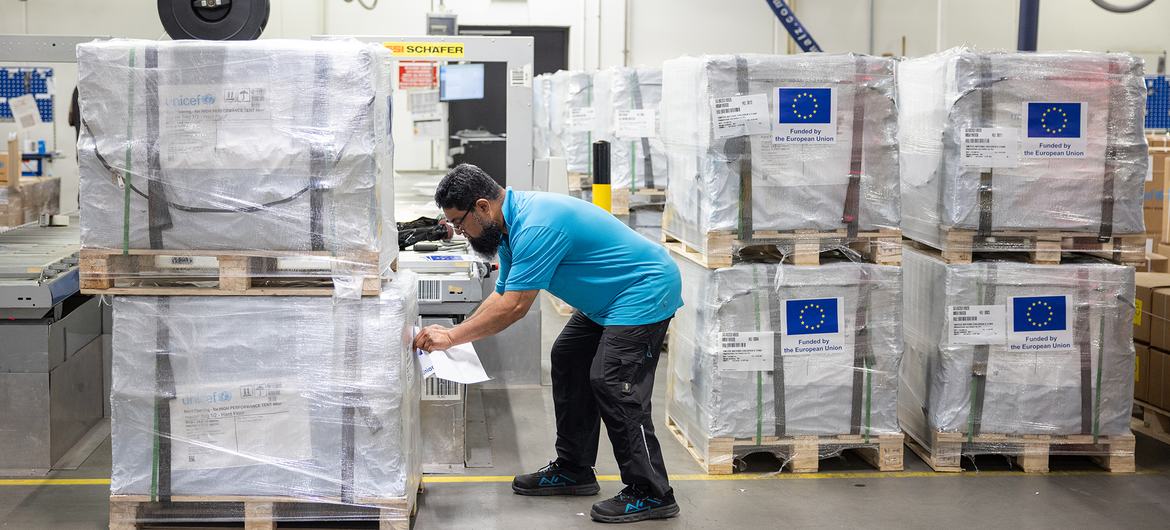
Life-saving supplies are being packed and shipped from the UNICEF Global Supply Hub in Copenhagen in Denmark to support the emergency response to the Afghanistan earthquake.

Life-saving supplies are being packed and shipped from the UNICEF Global Supply Hub in Copenhagen in Denmark to support the emergency response to the Afghanistan earthquake.

Source link

Press remarks by President António Costa following the meeting with Prime Minister of Croatia, Andrej Plenković

0
Press remarks by President António Costa following the joint press point with Prime Minister of Slovenia, Robert Golob

Press remarks by President António Costa following the meeting with Prime Minister of Croatia, Andrej Plenković in Zagreb, Croatia

Source link

Which seems alarm while mental health problems go up a billion in the world

0
Which seems alarm while mental health problems go up a billion in the world

Disorders such as anxiety and depression allow a heavy price on individuals, families and economies, but most countries do not provide adequate support.

Mental health problems are widespread in each company and age group and remain the second cause of long -term disability. They increase health care costs for families and governments while costing the global economy about 1 billion of dollars each year in loss of productivity, said United Nations health experts.

Far from the track

The results are detailed in two new reports: World mental health today and the Mental Health Atlas 2024.

Together, they show that although there has been progress since 2020, the world is still far from the track to tackle the crisis scale. Reports will help to clarify the debate at a United Nations high -level meeting on non -transmitted diseases and mental health, which are held at the end of the month in New York.

“” The transformation of mental health services is one of the most urgent public health challenges”Said WHO Director General Dr Tedros Adhanom Ghebreyesus.

“” Investing in mental health means investing in people, communities and economiesAn investment no country can afford to neglect. Each leader is responsible for acting urgently and ensuring that mental health care is treated not as a privilege, but as a basic right. »»

Disturbing gaps, unequal progress

The reports highlight several results struck:

  • Women are disproportionately affected by mental health problems, with the most common anxiety and depression in both sexes.
  • Suicide cost the estimated life of 727,000 people in 2021 and is a main death cause for young people. On current trends, the world will fall far from the United Nations objective to reduce the suicide deaths of a third by 2030, managing only a 12%reduction.
  • Mental median public spending remains only 2% of health budgets, unchanged since 2017. While high -income countries spend up to $ 65 per person in mental health, low -income countries spend as little as four hundred.
  • Mental health workforce is dangerously thin in many regions. There are only 13 mental health agents per 100,000 people worldwide.
  • Less than one in 10 countries has fully switched to community care, most of them always based strongly on psychiatric hospitals. Almost half of admissions to hospitalized patients are involuntary and more than one in five patients remain hospitalized for more than a year.

Despite these challenges, there have been positive developments. More and more countries integrate mental health in primary health care and expand early intervention programs in schools and communities.

More than 80% of countries now include mental health and psychosocial support in emergency interventions, compared to less than 40% in 2020. TV services are also more available, although access is always uneven.

Call to a systemic change

Who urges governments to intensify investments and reform, warning that the current rate of progress is too slow to achieve global goals. The main priorities include:

  • More equitable financing of mental health services
  • Stronger legal protection and rights based on rights
  • Greater investment in the mental health workforce
  • Accelerated continuation to community -centered community care

The United Nations Health Agency stresses that Mental health must be treated as a fundamental human right. Without urgent action, millions of people will continue to suffer without support, and companies will support growing social and economic costs.

Originally published at Almouwatin.com

Sudan: Hundreds feared dead in Darfur landslide

0
Sudan: Hundreds feared dead in Darfur landslide

Up to 1,000 people are feared dead in the tragedy, which occurred on Sunday in Tarsin village, located in the Jebel Marra range on the border of Central and South Darfur states.

The landslide was triggered by days of heavy rain.

“I extend my heartfelt condolences to the families of the victims and to the people of Sudan at this tragic time,” Luca Renda, interim UN Humanitarian and Resident Coordinator in the country said in a statement.

Meanwhile, the UN and partners are mobilizing to provide support to the affected population.

“The humanitarian community stands in solidarity with the people of Sudan and will spare no effort to ensure that aid can reach those in need without delay,” he said.

More to follow on this story…

Source link

Sudan: hundreds of fearing died in the Darfur field shift

0
Sudan: hundreds of fearing died in the Darfur field shift

Up to 1,000 people are fears of dead in the tragedy, which occurred Sunday in the village of Tarsin, located in the Jebel Marra chain on the border of the States of Central and South Darfur.

The landslide was launched by days of heavy rain.

“I hear my sincere condolences to the families of the victims and to the inhabitants of Sudan at this tragic moment,” said Luca Renda, acting coordinator of the humanitarian UN and resident in the country a declaration.

Meanwhile, the UN and the partners are mobilizing to provide support for the affected population.

“” The humanitarian community is in solidarity with the people of Sudan and will spare no effort to ensure that help can reach people in need without delay“He said.

More to follow on this story …

Originally published at Almouwatin.com