In a keynote speech at the event “Europe at the crossroads” on Tuesday, Parliament President Metsola outlined her vision for a smarter, stronger and safer Europe. Source : © European Union, 2025 – EP Source link
Number of internally displaced breaks new record with no let-up in conflicts, disasters
“These figures are a clear warning: without bold and coordinated action, the number of people displaced within their own countries will continue to grow rapidly,” said Amy Pope, Director General of International Organization for Migration.
The recent rise in conflicts worldwide – particularly in Sudan, the Republic of the Congo, Lebanon, Ukraine and Palestine has pushed millions more into displacement, adding to the tens of millions who already live in protracted displacement in countries such as Afghanistan, Colombia, Syria and Yemen.
Disasters surging
The number of displaced due to disasters has risen massively, climbing from last year’s 26.8 million to 45.8 million. “The number of disaster displacements in 2024 was nearly double the annual average of the past decade,” IOM said in a new report issued by the internal displacement monitoring centre (IDMC).
Almost 30 countries and territories have reported unprecedented disaster displacement – with cyclones accounting for more than one in two people forced from their homes. The United States alone makes up about one in four of those displaced globally by disasters.
With the frequency, intensity and duration of weather hazards continuously worsening owing to climate change, there is little to suggest that the trend will not continue.
“This report is a call for preventive action, to use data and other tools to anticipate displacement before it happens and for the humanitarian and development sectors to work together with governments to develop longer-term solutions to prevent displacement,” Ms. Pope stressed.
Conflict and violence
Displacement caused by conflict and violence remains high and continues to be a major cause for displacement, too – although it did decrease slightly in 2024, compared to the previous 12 months.
Over 20 million conflict-related displacements have been recorded and almost half of these stem from Sudan and the Democratic Republic of the Congo.
“These latest numbers prove that internal displacement is not just a humanitarian crisis; it’s a clear development and political challenge that requires far more attention than it currently receives,” said Alexandra Bilak, director of IOM’s Internal Displacement Monitoring Centre.
“The cost of inaction is rising, and displaced people are paying the price,” she added.
Remarks by President António Costa at the joint press conference with Presidency of Bosnia and Herzegovina
In the context of a visit to the Western Balkans, European Council President António Costa met with the Presidency of Bosnia and Herzegovina in Sarajevo. During the joint press conference, he reaffirmed the EU’s full commitment to Bosnia and Herzegovina’s accession process, while addressing concerns about the persisting challenges in the country, namely the need to accelerate progress on the necessary reforms and the recent developments in República Srpska.
Remarks by President António Costa at the joint press conference with Presidency of Bosnia and Herzegovina
In the context of a visit to the Western Balkans, European Council President António Costa met with the Presidency of Bosnia and Herzegovina in Sarajevo. During the joint press conference, he reaffirmed the EU’s full commitment to Bosnia and Herzegovina’s accession process, while addressing concerns about the persisting challenges in the country, namely the need […]
US deportations raise serious human rights concerns
His Office, OHCHR, has received information that over 100 Venezuelan deportees are being detained at a notorious prison in El Salvador.
OHCHR said 142,000 people were deported from the US between 20 January and 29 April, according to official data.
Harsh treatment in detention
In particular, the fate and whereabouts of at least 245 Venezuelans and some 30 Salvadorans sent to El Salvador remain unclear.
Many were deported under the US Alien Enemies Act as alleged members of criminal groups and have reportedly been detained at the Centre for Terrorism Confinement (CECOT) in the Central American country.
Detainees at the maximum-security prison are treated particularly harshly, without access to legal counsel or family members and have no contact with the outside world.
Serious rights concerns
OHCHR has received information from family members and lawyers regarding more than 100 Venezuelans believed to be held in CECOT.
The reports indicate that many were not informed of the US Government’s intention to deport them to be detained in a third country.
Furthermore, many had no access to a lawyer and were unable to challenge the lawfulness of their removal before being flown out.
“This situation raises serious concerns regarding a wide array of rights that are fundamental to both US and international law,” Mr. Türk said.
They include the rights to due process, protection from arbitrary detention, equality before the law, and protection from exposure to torture or other irreparable harm in other States.
Families feel powerless
Neither the US or Salvadoran authorities have published official lists of the detainees, and their legal status in El Salvador remains unclear.
Many family members interviewed by OHCHR voiced deep distress at not knowing where, and in what circumstances, their loved ones are being held. Some only became aware when they recognized their relatives from videos on social media of them in or being taken to CECOT.
“Families we have spoken to have expressed a sense of complete powerlessness in the face of what has happened and their pain at seeing their relatives labelled and handled as violent criminals, even terrorists, without any court judgment as to validity of what is claimed against them,” said Mr. Türk.
“The manner in which some of the individuals were detained and deported – including the use of shackles on them – as well as the demeaning rhetoric used against migrants, has also been profoundly disturbing,” he added.
The High Commissioner welcomed the essential role that the US judiciary, legal community and civil society are playing to ensure the protection of human rights in this situation.
“I have called on the US Government to take the necessary measures to ensure compliance with due process, to give prompt and full effect to the determinations of its courts, to safeguard the rights of children, and to stop the removal of any individual to any country where there is a real risk of torture or other irreparable harm,” he said.
GAZA LIVE: Security Council to meet on aid crisis amid ‘critical risk of famine’ due to Israeli blockade
The Security Council is set to meet this afternoon at 3 PM in New York to discuss the deepening crisis in Gaza, where humanitarians warn of “a critical risk of famine” and aid shipments have been blocked for over 70 days. Tom Fletcher, UN Emergency Relief Coordinator is expected to brief ambassadors. Follow live for key updates from UN Headquarters and reports from the region. App users can follow coverage here.
EU sets out steps towards introducing a joint European degree
EU education ministers have laid the groundwork for establishing a joint European degree label and set out the next steps towards introducing a joint European degree. This would boost the attractiveness and competitiveness of European higher education on a global scale.
EU sets out steps towards introducing a joint European degree
DISCLAIMER: Information and opinions reproduced in the articles are the ones of those stating them and it is their own responsibility. Publication in The European Times does not automatically means endorsement of the view, but the right to express it.
DISCLAIMER TRANSLATIONS: All articles in this site are published in English. The translated versions are done through an automated process known as neural translations. If in doubt, always refer to the original article. Thank you for understanding.
VAT rules: Council agrees position on directive simplifying tax collection for imports
The Council reached a general approach on the directive on value added tax (VAT) rules for distance sales of imported goods and import VAT.
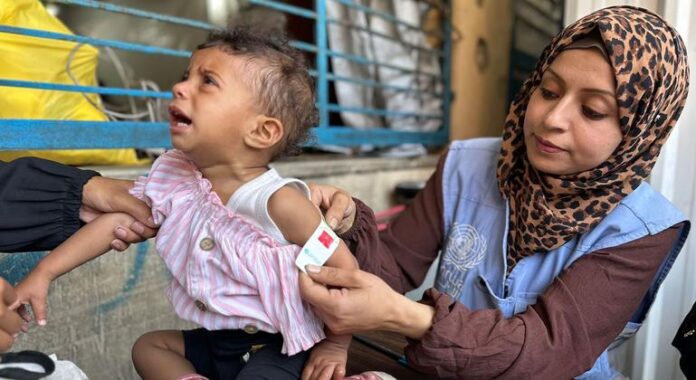
Gaza: Starvation looms for one in five people, say food security experts
“Goods indispensable for people’s survival are either depleted or expected to run out in the coming weeks…The entire population is facing high levels of acute food insecurity,” said the Integrated Food Security Phase Classification (IPC) platform.
In its latest update, the IPC estimated that one in five people in Gaza – 500,000 – faces starvation.
Prices have soared for basics such as a 25 kilogramme sack of wheat flour, which now costs between $235 and $520, representing a 3,000 per cent price spike since February.
“In a scenario of a protracted and large-scale military operation and continuation of the humanitarian and commercial blockade, there would be a critical lack of access to supplies and services that are essential to survival,” the IPC said.
Guterres voices alarm
UN Secretary-General António Guterres said he was alarmed by the findings, especially that most children are now facing extreme hunger.
The World Food Programme (WFP) and children’s agency, UNICEF, warned that hunger and malnutrition have intensified sharply since all aid was blocked from entering on 2 March.
WFP chief Cindy McCain said families are starving while the food they need is sitting at the border. “It’s imperative that the international community acts urgently to get aid flowing into Gaza again,” she said. “If we wait until after a famine is confirmed, it will already be too late for many people.”
Aid partners on the ground in Gaza report that the number of hot meals served by those community kitchens that are still operating is declining very quickly. Today, about 260,000 meals have been prepared and delivered across the Gaza Strip.
That marks a decrease compared to 840,000 meals last Wednesday – a 70 per cent reduction of 580,000 daily meals in just five days.
New strikes on UN shelters
The development comes amid continuing reports of Israeli bombardment across Gaza on Monday.
On Saturday, another school run by the UN agency for Palestine refugees, UNRWA was hit, this time in Gaza City at around 6.30pm, reportedly killing two people and injuring an unknown number.
A day earlier, four more people were reportedly killed when another UNRWA facility was bombed in Jabalia camp, north Gaza. The agency’s office was “completely destroyed” and three surrounding buildings sustained severe damage, including a distribution centre. There were no supplies in the distribution centre when it was hit, owing to the continuing Israeli blockade, UNRWA said, noting that it ran out of food for Gaza “more than two weeks ago.”
Echoing the wider aid community’s rejection of the Israeli plan to manage deliveries of food and non-food items across Gaza’s governorates, the IPC deemed it “highly insufficient to meet the population’s essential needs for food, water, shelter and medicine.”
IPC’s assessments help aid agencies decide where needs are greatest around the world. Food insecurity is measured on a scale of one to five, with IPC1 indicating no hunger and IPC5 denoting famine conditions.
According to the latest data, 15 per cent of people in the governorates of Rafah, North Gaza and Gaza are classified as IPC5. Most of the remainder are little better off.
Israel plan scepticism
Amid this disastrous and deteriorating situation, Israel’s proposed distribution plan will likely create “significant access barriers [to aid] for large segments of the population,” the IPC said.
And pointing to Israel’s recently announced large-scale military operation across the Gaza Strip and persistent obstacles impeding the work of aid agencies, it warned that there was “a high risk that ‘Famine (IPC Phase 5)’ will occur” between now and 30 September.
With hunger everywhere, a high number of households have reported having to resort to “extreme coping strategies” such as collecting rubbish to sell for food. But one in four of this number say that “no valuable garbage remains,” while social order “is breaking down” the IPC reported.