
On World Press Freedom Day, the EU issued a statement emphasizing the significant risks faced by the media in 2025 and reaffirming its resolute commitment to supporting and defending independent journalism globally.
Statement by the High Representative on behalf of the European Union

DISCLAIMER: Information and opinions reproduced in the articles are the ones of those stating them and it is their own responsibility. Publication in The European Times does not automatically means endorsement of the view, but the right to express it.
DISCLAIMER TRANSLATIONS: All articles in this site are published in English. The translated versions are done through an automated process known as neural translations. If in doubt, always refer to the original article. Thank you for understanding.
International aid: ‘The money isn’t coming back anytime soon’, Fletcher warns
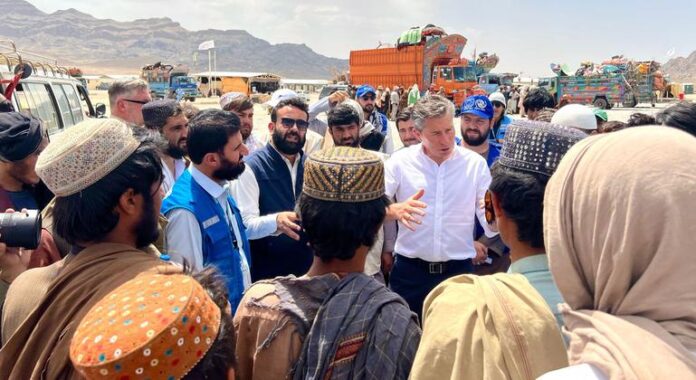
UN News: You have said that policymakers who signed off on aid cuts should come to Afghanistan to see the effect they’re having on the population. You said the effect of aid cuts is that millions die. Do you use this kind of blunt language when you’re talking to these policymakers in private?
Tom Fletcher: Yes, I do. Of course, there is a bit of a time lag before you really see the impact of the cuts, but here, 400 clinics closed in the last few weeks. That has a real-world impact and it’s become much more real for me on this trip.
I’ve just come from a meeting with NGOs, and they’re laying off half their staff. The local NGO’s that we’re keen to protect in the midst of all this, have been the hardest hit.
We try and find different ways to communicate this in slightly gentler terms, but ultimately, of course, people will die as a result of these cuts.
That’s the great tragedy at the heart of it now.
UN News: How do the politicians respond?
I think there are broadly two camps here. You’ve got politicians who are doing this really reluctantly, forced to make really tough decisions because their economies are struggling and because of pressures from taxpayers to do things differently. They know the importance of humanitarian efforts and they’re very sad about the choices they’re having to make.
Then there is another group of politicians who, I fear, celebrate, certainly in their public messages. They seem to boast about – and take credit for – aid cuts. That’s the group that I would love to bring to sit with a mother who has lost her child because she was forced to cycle pregnant to a hospital three hours away.
You show leadership on the world stage by being out there helping countries to deal with these challenges at source. I don’t know which of those arguments work with which constituencies, so we have to adapt and be creative in how we make the case.
We also have to be firm in defending what we do and take pride in the fact that the humanitarian community has taken millions out of poverty and saved hundreds of millions of lives.
UN News: You’ve become the UN emergency relief chief at a particularly tough time, in terms of ensuring the UN’s ability to help the most vulnerable. In February you announced 20 per cent cuts to your department. How will you make those cuts in a way that doesn’t make the job even harder?
Tom Fletcher: It’s rough. Really brutal choices are being made and the sector will probably shrink by one third. The money that’s been cut isn’t going to come back anytime soon, and there may be more funding cuts ahead.
We will be looking for new partners, and trying to convince the sceptics to bring the private sector in and change the public conversation around solidarity. We have to work with the money that we have, not the money that we need or the money that we wish we had.
I’m really positive about the way that Marco Rubio, the US Secretary of State, has talked about the need to protect life-saving aid
Dialogue is going on, I’m not giving up and I’m really positive about the way that Marco Rubio, the US Secretary of State, has talked about the need to protect life-saving aid. I really want to get into that conversation with him and see what his vision is for America’s role in saving lives around the world.
UN News: Given the current situation, are we going to have to completely rethink what aid entails and how it’s funded?
Tom Fletcher: We’re going to have to change. We have to preserve the best of what we’ve learnt and have confidence in what we’ve delivered so far, but we’re going through a process now that we call the “humanitarian reset”.
First of all, we’re becoming smaller and we’re trying to do that in a way that does as little damage as possible and minimises the hit to the essential life-saving work we do.
Alongside that, we’re becoming more efficient and smarter. I launched on my first day in office, a big efficiency drive across the sector.
The IASC, the body that coordinates our sector, has backed that up and actually taken it to the next level in terms of taking the layers out of the system and making sure we end the turf wars and focus on what we each do well, the extra value we bring, and ensure that we do much more at a local level, close to the communities we serve.
The UN relief chief Tom Fletcher, visits a hospital in Kandahar, Afghanistan.
UN News: Do many Member States still believe in the importance of international aid?
Tom Fletcher: Absolutely. A number of donors are staying solid despite the funding crises that they’re all facing. We’ve got new donors emerging and growing. I’ve been in The Gulf, and I was in China last week, and engagement there is deepening.
We’ve got new donors emerging, and engagement is deepening
We’ve got more innovative ideas about how to bring in the private sector and also I believe really strongly in the role of individuals in finding ways to ensure that we’re reaching wider movement beyond governments and Member States.
UN News: Returning to Afghanistan, the de facto authorities [The Taliban] have severely reduced access to education and employment prospects for women and girls. Are you able to have a constructive discussion about this with the regime?
Tom Fletcher: Yes, we are. There are two really core issues here for us. One is the role of women in humanitarian work: we simply cannot deliver without them. They are brilliant, brilliant colleagues, we rely on them completely and we couldn’t be here without them.
And the second is the wider issue around rights for women and girls, including education and the fact that millions of girls have had that right stolen from them over the last three years.
These are difficult conversations, but I come at this as a former diplomat, as someone who believes in dialogue, who believes in respect and trust and listening, and in recognizing that we have different cultures, different traditions, different heritages and different beliefs that I don’t hold.
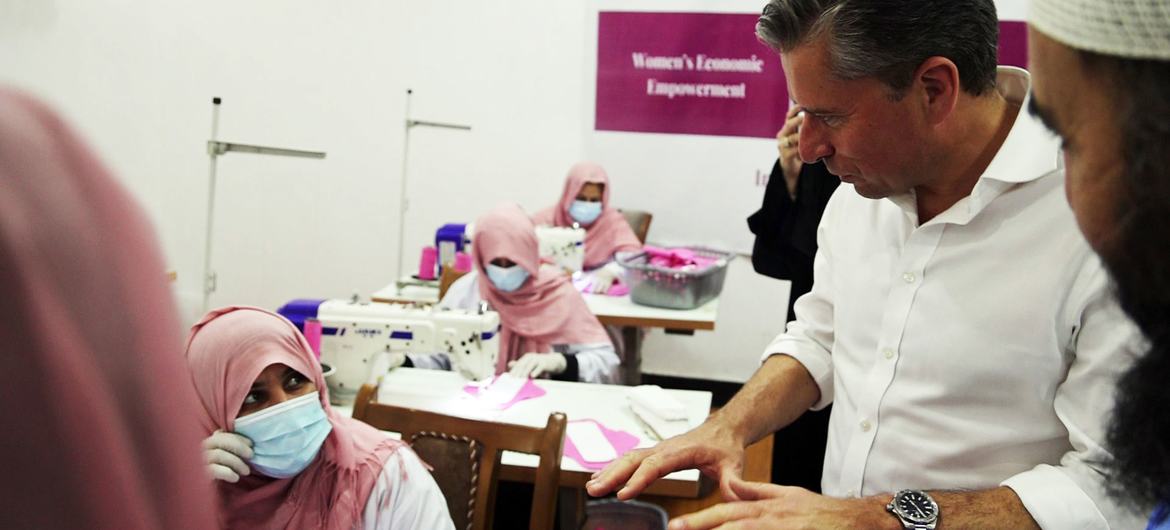
Tom Fletcher, the UN humanitarian meets women at an economic development programme in Afghanistan.
UN News: Before you began this job, did you have a goal in mind, that you want to achieve before the end of your mandate as the head of humanitarian affairs?
Tom Fletcher: The average head of OCHA lasts about three years, they burn through us pretty quickly. The travel schedule is very hectic and you’re dealing with the world’s worst crises so there’s a bit of wear and tear along the way.
It’s our job to save hundreds of millions of lives and to define everything we do against that yardstick
So, my number one objective was to survive as long as possible, because I think it’s traumatic for an organization to get new people in, train them and have them up and running. Being around for a period of time, learning from the organization and from those we serve, and then putting that into action is a serious objective in itself.
I did come into it with an objective around the reform of the humanitarian sector, well before Donald Trump, Elon Musk and others started talking about efficiency and prioritization and cuts. I do believe that we can do this much more effectively and much closer to those we serve and so I was already determined to deliver that.
And then thirdly, the big one is ultimately about saving lives. I believe it’s our job to save hundreds of millions of lives and to define everything we do against that yardstick.
Interview with Die Presse

Interview with Luis de Guindos, Vice-President of the ECB, conducted by Jakob Zirm on 28 April 2025
3 May 2025
Die Presse: Since June 2024 the ECB has already cut interest rates seven times. How long will this period of interest rate cuts last?
Luis de Guindos: This will depend on how inflation develops. But we can be optimistic because our latest forecasts show that, from the end of this year, inflation will be very close to our target of 2%. Moreover, inflation continues to fall thanks to three additional factors. First, the euro has appreciated. Second, energy and commodity prices are declining. And third, the current economic uncertainty about tariffs could lead to greater wage moderation than that already suggested by the latest survey results. All these elements contribute to bringing inflation further down. And this is the decisive factor in whether we continue to lower interest rates.
Where would you place the neutral interest rate, i.e. the rate which neither stimulates nor restricts economic growth? Is this a target for the ECB?
The discussion about the neutral rate is very interesting from an academic standpoint. However, it is not very helpful for monetary policy decision-making because the neutral rate cannot be directly observed. Our decisions are based on how inflation develops, our projections and how our monetary policy is transmitted to the real economy. And, as I said, we are optimistic that we will sustainably achieve our inflation target.
The US Federal Reserve is lowering interest rates much more slowly than the ECB. Is the large interest rate differential between the United States and the euro area a problem?
The situation in the United States and Europe is different. You should look not only at nominal interest rates, but also at real interest rates. In the United States, inflation and inflation expectations are higher than in Europe, due to a different economic outlook. So the interest rate differential is smaller in real terms. In addition, inflation is more persistent in the United States.
We have policy space to pursue our own monetary policy, but of course we are monitoring what is happening in the United States.
In 2022 the euro depreciated massively after the Federal Reserve hiked interest rates half a year sooner. Is there a similar risk again now?
Not necessarily at the moment. Despite all the uncertainties and contrary to expectations, the euro appreciated after the tariff announcements. Exchange rate developments depend on many factors. We do not have any exchange rate objective, but we monitor the exchange rate closely because it is an important macroeconomic variable in our assessment of the risks for price stability.
It is important to moderate exchange rate volatility.
But if the trend reverses and the dollar becomes significantly stronger again, could this fuel inflation in the euro area again?
We are closely monitoring exchange rate developments. But there are currently no signs of a weakening of the euro. Much will depend on how the current dispute over tariffs develops.
The average inflation rate in the euro area is currently 2.2%. However, some eastern European countries still have inflation rates of 3% or 4%. Is inflation really under control everywhere in the euro area?
Differences in inflation developments between countries are normal, it’s the average that is crucial. Our projections show that both headline and core inflation are on track to reach our 2% target. We are paying particular attention to monitoring services inflation, which is strongly influenced by wages. Here, too, we are seeing signs of a slowdown in wage dynamics.
Let’s talk about growth. In March the ECB predicted GDP growth of 0.9% for the euro area in 2025. Is this still realistic given the tariff debate?
You are right – this forecast was made before the announcement of US tariffs. Uncertainty we’ve seen since then has weighed on economic activity and is likely to delay investment and consumption. Uncertainty is always bad for the economy. We already pointed to such downside risks in our March projections. The risks are now materialising.
In Austria, we are in recession for the third year in a row now. Could the entire euro area slide into a recession?
No, our baseline continues to expect very low but positive growth. It’s well below potential growth, but I don’t think that the euro area is heading into a recession.
US tariffs are currently suspended. How bad would the damage be if the trade war were to escalate?
An all-out trade war would have a very serious impact on growth. I really hope it doesn’t come to that. It is also important to take the diversion effects that can occur in trade flows into account, making the consequences difficult to predict.
US President Donald Trump recently launched a mass attack on the Federal Reserve and its Chair Jerome Powell. What are the consequences of such an attempt to exert political pressure on the work of central banks?
The independence of central banks is crucial. It is key to their credibility and thus to combating inflation. Even when inflation was extremely high two years ago, inflation expectations in Europe remained anchored because the central bank was considered independent and credible. This credibility is essential to keep inflation expectations under control and, in particular, to avoid wage-price spirals.
There has been a discussion on whether the euro’s role as a reserve currency could be strengthened if confidence in the US dollar declines. Do you see that as possible?
The dollar is clearly leading as a reserve currency. The international importance of the euro is a lot less in comparison. Its future development depends on us, however. If Europe builds stronger capital markets and establishes itself as a true single market, the role of the euro at international level could be strengthened. Closer integration and a more pro-European approach are crucial.
What would be needed to create a true European capital markets union?
Three central pillars would be needed. First, we need a true single market – barriers and national legislation that impede further integration must be removed. Second, we need to complete the banking union. We already have single supervision and resolution, but we still lack a common deposit guarantee scheme. Third, we need to further develop the capital markets union itself. These three elements are interconnected – progress in one area is difficult without progress in the other two.
Many support the capital markets union but little progress has been made. Who is blocking it?
The problem is that without a true single market for goods and services, the capital markets union is also difficult to implement. The banking union is more advanced but there is still a lot to be done. Capital flows follow the real economy, which is why we need integrated goods and services markets.
In this situation, does it help if national governments block cross-border bank mergers – as is currently the case in Germany, where UniCredit wishes to buy Commerzbank?
I will not comment on any specific mergers. But in general, we support cross-border mergers because they are necessary to create truly European banks and complete the banking union.
Is there too much nationalism in the European financial system?
Sometimes there is too much national focus. But there is a growing awareness that Europe needs to become more independent. And the only way to remain relevant on the world stage is to be more European and a little less nationally focused.
The European Commission is now also pushing ahead with the simplification of European regulation. This also applies to the financial market of course. Where should economic activity be made easier for businesses?
The ECB has set up its own high-level task force, which I coordinate. It’s meant to draw up proposals by the end of the year, which will be passed on to the legislator. This may involve, for example, the implementation of Basel III or reporting, which could be streamlined, or the simplification of bank capital structure, to make it clearer and more understandable for investors. However, simplification does not mean de-regulation, it should not jeopardise banks’ solvency.
When inflation was high, many euro area countries steeply increased their debt and the ECB bought many government bonds, which amounted to some 30% of the outstanding volume in the case of some countries. Is that a problem?
Those measures were necessary in the context of the pandemic. But now we need to increase defence spending and preserve fiscal sustainability at the same time in order to avoid rising market interest rates and thus lower private investment. That won’t be easy.
The Austrian central bank has reported annual losses of more than €2 billion in the past two years. This was due to the purchase of low-yield government bonds. Is that the hidden price of expansionary monetary policy?
Our monetary policy is not determined by the profit and loss accounts of the central banks. Looking back, central banks have made significant gains over the past ten years. The current loss is a consequence of the high liquidity in the market, on which central banks have to pay higher interest rates. However, this liquidity is currently being reduced at a fast pace. The situation will improve in the future.
Are the high debt levels of euro area countries jeopardising future growth?
When markets have doubts about debt sustainability, market interest rates rise, which can reduce private investment. That is why a credible and sustainable fiscal policy is crucial.
Interview with Die Presse

Interview with Luis de Guindos, Vice-President of the ECB, conducted by Jakob Zirm on 28 April 2025
3 May 2025
Die Presse: Since June 2024 the ECB has already cut interest rates seven times. How long will this period of interest rate cuts last?
Luis de Guindos: This will depend on how inflation develops. But we can be optimistic because our latest forecasts show that, from the end of this year, inflation will be very close to our target of 2%. Moreover, inflation continues to fall thanks to three additional factors. First, the euro has appreciated. Second, energy and commodity prices are declining. And third, the current economic uncertainty about tariffs could lead to greater wage moderation than that already suggested by the latest survey results. All these elements contribute to bringing inflation further down. And this is the decisive factor in whether we continue to lower interest rates.
Where would you place the neutral interest rate, i.e. the rate which neither stimulates nor restricts economic growth? Is this a target for the ECB?
The discussion about the neutral rate is very interesting from an academic standpoint. However, it is not very helpful for monetary policy decision-making because the neutral rate cannot be directly observed. Our decisions are based on how inflation develops, our projections and how our monetary policy is transmitted to the real economy. And, as I said, we are optimistic that we will sustainably achieve our inflation target.
The US Federal Reserve is lowering interest rates much more slowly than the ECB. Is the large interest rate differential between the United States and the euro area a problem?
The situation in the United States and Europe is different. You should look not only at nominal interest rates, but also at real interest rates. In the United States, inflation and inflation expectations are higher than in Europe, due to a different economic outlook. So the interest rate differential is smaller in real terms. In addition, inflation is more persistent in the United States.
We have policy space to pursue our own monetary policy, but of course we are monitoring what is happening in the United States.
In 2022 the euro depreciated massively after the Federal Reserve hiked interest rates half a year sooner. Is there a similar risk again now?
Not necessarily at the moment. Despite all the uncertainties and contrary to expectations, the euro appreciated after the tariff announcements. Exchange rate developments depend on many factors. We do not have any exchange rate objective, but we monitor the exchange rate closely because it is an important macroeconomic variable in our assessment of the risks for price stability.
It is important to moderate exchange rate volatility.
But if the trend reverses and the dollar becomes significantly stronger again, could this fuel inflation in the euro area again?
We are closely monitoring exchange rate developments. But there are currently no signs of a weakening of the euro. Much will depend on how the current dispute over tariffs develops.
The average inflation rate in the euro area is currently 2.2%. However, some eastern European countries still have inflation rates of 3% or 4%. Is inflation really under control everywhere in the euro area?
Differences in inflation developments between countries are normal, it’s the average that is crucial. Our projections show that both headline and core inflation are on track to reach our 2% target. We are paying particular attention to monitoring services inflation, which is strongly influenced by wages. Here, too, we are seeing signs of a slowdown in wage dynamics.
Let’s talk about growth. In March the ECB predicted GDP growth of 0.9% for the euro area in 2025. Is this still realistic given the tariff debate?
You are right – this forecast was made before the announcement of US tariffs. Uncertainty we’ve seen since then has weighed on economic activity and is likely to delay investment and consumption. Uncertainty is always bad for the economy. We already pointed to such downside risks in our March projections. The risks are now materialising.
In Austria, we are in recession for the third year in a row now. Could the entire euro area slide into a recession?
No, our baseline continues to expect very low but positive growth. It’s well below potential growth, but I don’t think that the euro area is heading into a recession.
US tariffs are currently suspended. How bad would the damage be if the trade war were to escalate?
An all-out trade war would have a very serious impact on growth. I really hope it doesn’t come to that. It is also important to take the diversion effects that can occur in trade flows into account, making the consequences difficult to predict.
US President Donald Trump recently launched a mass attack on the Federal Reserve and its Chair Jerome Powell. What are the consequences of such an attempt to exert political pressure on the work of central banks?
The independence of central banks is crucial. It is key to their credibility and thus to combating inflation. Even when inflation was extremely high two years ago, inflation expectations in Europe remained anchored because the central bank was considered independent and credible. This credibility is essential to keep inflation expectations under control and, in particular, to avoid wage-price spirals.
There has been a discussion on whether the euro’s role as a reserve currency could be strengthened if confidence in the US dollar declines. Do you see that as possible?
The dollar is clearly leading as a reserve currency. The international importance of the euro is a lot less in comparison. Its future development depends on us, however. If Europe builds stronger capital markets and establishes itself as a true single market, the role of the euro at international level could be strengthened. Closer integration and a more pro-European approach are crucial.
What would be needed to create a true European capital markets union?
Three central pillars would be needed. First, we need a true single market – barriers and national legislation that impede further integration must be removed. Second, we need to complete the banking union. We already have single supervision and resolution, but we still lack a common deposit guarantee scheme. Third, we need to further develop the capital markets union itself. These three elements are interconnected – progress in one area is difficult without progress in the other two.
Many support the capital markets union but little progress has been made. Who is blocking it?
The problem is that without a true single market for goods and services, the capital markets union is also difficult to implement. The banking union is more advanced but there is still a lot to be done. Capital flows follow the real economy, which is why we need integrated goods and services markets.
In this situation, does it help if national governments block cross-border bank mergers – as is currently the case in Germany, where UniCredit wishes to buy Commerzbank?
I will not comment on any specific mergers. But in general, we support cross-border mergers because they are necessary to create truly European banks and complete the banking union.
Is there too much nationalism in the European financial system?
Sometimes there is too much national focus. But there is a growing awareness that Europe needs to become more independent. And the only way to remain relevant on the world stage is to be more European and a little less nationally focused.
The European Commission is now also pushing ahead with the simplification of European regulation. This also applies to the financial market of course. Where should economic activity be made easier for businesses?
The ECB has set up its own high-level task force, which I coordinate. It’s meant to draw up proposals by the end of the year, which will be passed on to the legislator. This may involve, for example, the implementation of Basel III or reporting, which could be streamlined, or the simplification of bank capital structure, to make it clearer and more understandable for investors. However, simplification does not mean de-regulation, it should not jeopardise banks’ solvency.
When inflation was high, many euro area countries steeply increased their debt and the ECB bought many government bonds, which amounted to some 30% of the outstanding volume in the case of some countries. Is that a problem?
Those measures were necessary in the context of the pandemic. But now we need to increase defence spending and preserve fiscal sustainability at the same time in order to avoid rising market interest rates and thus lower private investment. That won’t be easy.
The Austrian central bank has reported annual losses of more than €2 billion in the past two years. This was due to the purchase of low-yield government bonds. Is that the hidden price of expansionary monetary policy?
Our monetary policy is not determined by the profit and loss accounts of the central banks. Looking back, central banks have made significant gains over the past ten years. The current loss is a consequence of the high liquidity in the market, on which central banks have to pay higher interest rates. However, this liquidity is currently being reduced at a fast pace. The situation will improve in the future.
Are the high debt levels of euro area countries jeopardising future growth?
When markets have doubts about debt sustainability, market interest rates rise, which can reduce private investment. That is why a credible and sustainable fiscal policy is crucial.
Gaza: ‘Worst-case scenario’ unfolds as brutal aid blockade threatens mass starvation
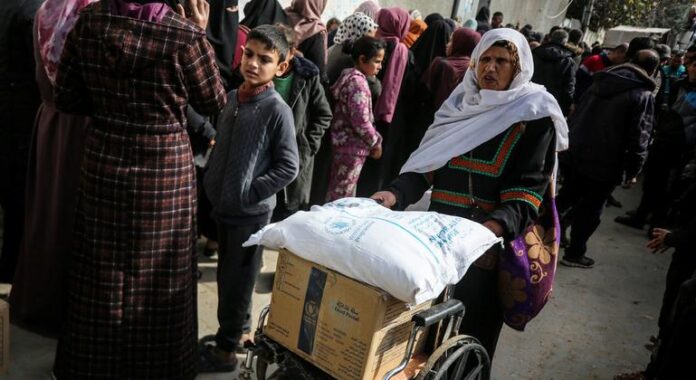
Speaking from Gaza City OCHA spokesperson Olga Cherevko told journalists in Geneva that a friend of hers “saw people burning a few days ago from the explosions – and there was no water to save them.”
Since all entry points into the war-torn enclave were “sealed by the Israeli authorities for the entry of cargo” in March, the “worst-case scenario” was triggered, Ms. Cherevko said: supplies are depleting while the conflict rages on.
“Food stocks have now mainly run out, water access has become impossible,” she told journalists in Geneva.
As the veteran aid worker spoke, she noted that a “very violent fight” for access to water was taking place downstairs from her, with people throwing rocks and firing shots at a water truck which was pulling away.
No childhood
The OCHA spokesperson said that every day she was seeing children “who have been deprived of their childhood for many months,” and elderly people “rummaging through piles of trash” in search of food and combustible material for cooking, in the absence of fuel.
During a visit on Thursday to Patient Friends Hospital, a paediatric hospital in Gaza City which had been attacked several times during the war, she heard reports of rising malnutrition rates.
“Hospitals report running out of blood units, as mass casualties continue to arrive,” Ms. Cherevko stressed, while precious fuel is being rationed.
Malnutrition cases among children in Gaza are increasing due to a lack of food.
Running on empty
“Gaza is inching closer to running on empty,” she added.
Ms. Cherevko said that UN humanitarians are “in constant contact” with the Israeli authorities and are advocating for border crossings to reopen. “We have mechanisms that mitigate diversion [and] ensure that aid reaches the people it’s intended to reach,” she said.
“We are ready to resume delivery at scale as soon as the crossings reopen, Ms. Cherevko insisted. “We stand by our pledge to remain principled and continue relieving people’s suffering, wherever they may be.”
In an appeal to the Israeli authorities on Thursday, the UN’s top humanitarian official and OCHA chief Tom Fletcher said, “Lift this brutal blockade. Let humanitarians save lives”.
Mr. Fletcher reaffirmed the urgent need for the release of hostages taken by Hamas on 7 October 2023, who “should never have been taken from their families” and stressed that “aid, and the civilian lives it saves, should never be a bargaining chip”.
Generational horror
Ms. Cherevko said that over the past one and a half months, 420,000 people have been “once again forced to flee, many of them with only the clothes on their backs, shot at along the way, arriving in overcrowded shelters, as tents and other facilities where people seek safety, are being bombed”.
“I worry that five, 10, 20 years from now, we will look at our children and grandchildren in shame and we will not be able to explain to them why we could not stop this horror,” she concluded.
“How much more blood must be spilled before enough becomes enough?”
UN rights chief urges international action
The UN High Commissioner for Human Rights appealed on Friday for the world to prevent the total collapse of life-saving support in Gaza.
“As the complete blockade of assistance essential for survival enters its ninth week, there must be concerted international efforts to stop this humanitarian catastrophe from reaching a new unseen level,” said Volker Türk.
War crimes warning
Bakeries have ceased operations as flour and fuel have run out, and remaining food stocks are being rapidly depleted.
“Any use of starvation of the civilian population as a method of war constitutes a war crime, and so do all forms of collective punishment,” he warned.
Against proposed Rafah ‘humanitarian zone’
The High Commissioner and head of human rights office OHCHR denounced a reported Israeli plan to declare Rafah governorate in southern Gaza as a new “humanitarian zone.”
Palestinians would be required to move there to receive food and other aid.
“Such a plan will almost certainly mean large parts of Gaza and those who cannot easily move – including people with disabilities, those who are sick or injured, and women supporting entire families – will be forced to go without food,” he said.
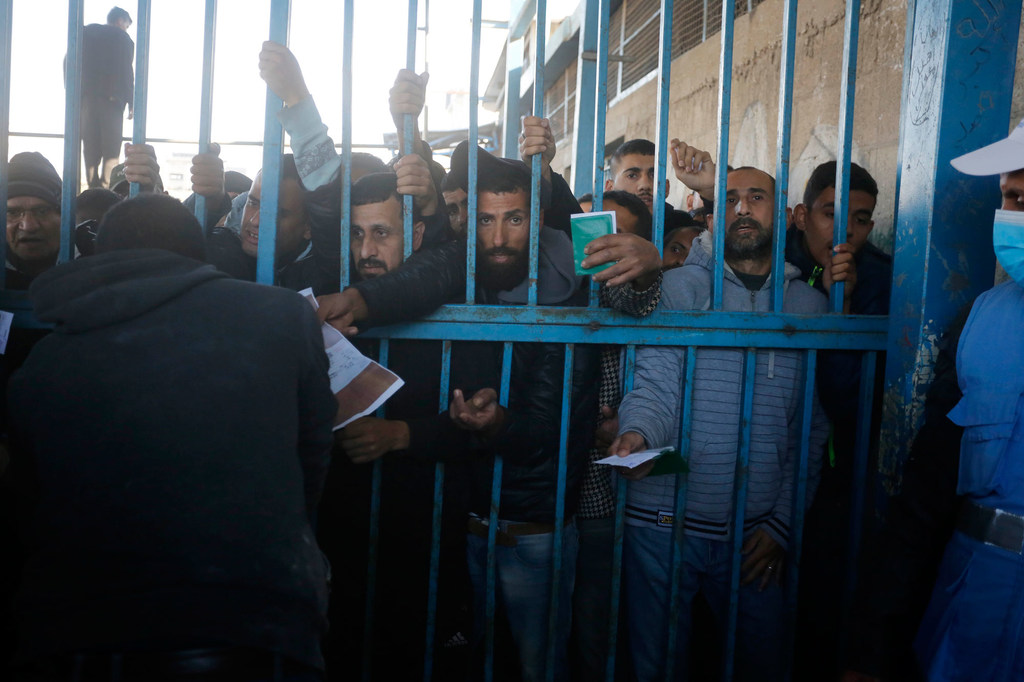
Gazans queue for food in January 2025 when it was more widely available in the enclave.
Strikes on shelters
Meanwhile, Israel continues to strike locations in Gaza where Palestinian civilians are sheltering. Between 18 March and 27 April, OHCHR recorded 259 attacks on residential buildings and 99 on tents of internally displaced persons (IDPs).
Most attacks resulted in fatalities, including of women and children. Among the strikes on IDP tents, 40 reportedly took place in Al-Mawasi area, where the Israeli army repeatedly directed civilians to seek refuge.
Georgia: Statement by the Spokesperson on Russia’s latest violation of the sovereignty and territorial integrity of Georgia

Georgia: Statement by the Spokesperson on Russia’s latest violation of the sovereignty and territorial integrity of Georgia
Georgia: Statement by the Spokesperson on Russia’s latest violation of the sovereignty and territorial integrity of Georgia
Georgia: Statement by the Spokesperson on Russia’s latest violation of the sovereignty and territorial integrity of Georgia Source link
A Bold Shift for the MCU’s Future

In a twist that redefines Marvel’s cinematic roadmap, the studio’s latest film Thunderbolts *—long shrouded in mystery surrounding its titular asterisk—has revealed itself as a Trojan horse for a seismic rebrand: the birth of the New Avengers . The film, directed by Jake Schreier, culminates in a meta-narrative that not only reshapes its ragtag team of antiheroes but also positions them as the successors to the Avengers’ legacy, leaving fans and cast alike grappling with the implications.
From Thunderbolts to New Avengers: The Title Twist Explained
As teased in trailers, the film’s infamous asterisk serves as a narrative punchline turned serious. Early on, Yelena Belova (Florence Pugh) and her crew adopt the name “Thunderbolts” as a mocking nod to her disastrous childhood soccer team. But after thwarting the Void (Lewis Pullman), the team’s would-be handler Valentina Allegra de Fontaine (Julia Louis-Dreyfus) hijacks their victory, rebranding them as the New Avengers during a televised spectacle. The end credits punctuate the shift by literally tearing down the Thunderbolts * title card to unveil the new name—a move Schreier confirms was baked into the script from day one.
“This wasn’t a last-minute gimmick,” Schreier told Entertainment Weekly . “The core idea was always to subvert expectations and land in a place where these damaged characters inherit the Avengers’ mantle. It’s about filling the void left by Earth’s Mightiest Heroes, both for the characters and the audience.”
Cast Reactions: Honor, Terror, and Skepticism
For the ensemble cast, the title change evoked a mix of pride and apprehension. Pugh described her initial disbelief: “I thought it was another joke—like, ‘Sure, call us the New Avengers, then cut to a tag scene where they say, ‘Nah, never mind.’’” But as the weight of the moment sank in, she recognized the honor of aligning her character with Marvel’s pantheon. “It’s massive. To think the studio sees us as worthy of that name? Thrilling,” she said.
Sebastian Stan (Bucky Barnes) echoed the duality of the moment. “It’s terrifying because we’re so different from the original Avengers. But this movie is its own thing, and that’s what excites us.” Wyatt Russell (John Walker) concurred, joking, “Terrified. Three times over.”
Valentina’s Machinations and the MCU’s Future
Louis-Dreyfus, whose Valentina masterminds the rebrand, hinted at her character’s manipulative longevity. Facing impeachment for her shady tactics, Valentina leverages the team’s victory to reclaim power—a move the actor calls “a lifeline, figuratively and literally.” While Louis-Dreyfus remains coy about her future in the MCU, she teases, “Anything is possible. I’m ready to play more.”
Yelena’s Redemption and the Team’s Purpose
For Pugh, the New Avengers label symbolizes Yelena’s hard-won redemption. After confronting trauma and mental health struggles in the film, the team becomes her lifeline. “This family keeps her alive,” Pugh said. “She’s learned to rely on others—and be relied on.”
What’s Next for the MCU?
The rebrand isn’t just symbolic. Schreier embedded “breadcrumbs” throughout the film, such as references to the Battle of New York and the repurposed Avengers Tower (now the Watchtower), to ease audiences into the transition. Post-credits scenes further suggest the team’s rocky road ahead, teasing tensions with Valentina and unresolved dynamics.
With Thunderbolts * now New Avengers , Marvel has set the stage for a fractured but determined team to navigate the post-Avengers era. As Schreier puts it, “This isn’t a perfect fit—it’s meant to be fun, messy, and human.”
For MCU fans, the message is clear: The age of heroes is evolving. Whether the New Avengers will rise to the occasion—or crumble under the weight of legacy—remains the universe’s most tantalizing question.
Overview
Marvel Studios assembles an unconventional team of antiheroes—Yelena Belova, Bucky Barnes, Red Guardian, Ghost, Taskmaster and John Walker. After finding themselves ensnared in a death trap set by Valentina Allegra de Fontaine, these disillusioned castoffs must embark on a dangerous mission that will force them to confront the darkest corners of their pasts. Will this dysfunctional group tear themselves apart, or find redemption and unite as something much more before it’s too late?
Funding crisis increases danger and risks for refugees
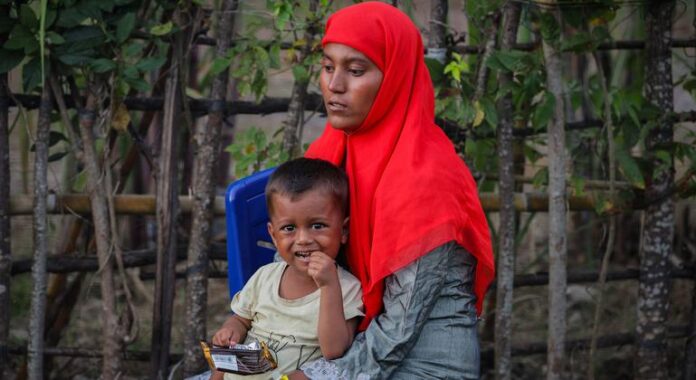
With humanitarian resources running dry, critical support for millions of forcibly displaced people is under threat.
UNHCR said that two-thirds of countries hosting refugees are already severely overstretched and urgently need support to continue providing education, healthcare and shelter.
Global solidarity with those fleeing conflict and violence is weakening, the agency added.
‘No one wants to be a refugee for life’
“The safety that refugees seek in neighbouring countries is at risk,” said Elizabeth Tan, Director of International Protection at UNHCR.
“Without international solidarity and burden-sharing, the institution of asylum is under threat.”
Ms Tan noted that some 12,000 Central African refugees in Chad and Cameroon have expressed a desire to return home but cannot do so safely without transport and reintegration assistance.
“No one wants to be a refugee for life,” she said.
Lifesaving services
Marking the agency’s 75th anniversary, Ms Tan reminded journalists that refugees – unlike migrants – have lost the protection of their home countries.
“They arrive across borders traumatised, often after experiencing torture or persecution, and they need specialised support – including mental health care,” she said.
Children separated from their families face especially grave risks, including recruitment by armed groups, exploitation and trafficking.
Protecting them, Ms Tan stressed, “is not a luxury – it is lifesaving.”
Refugees from Sudan arrive in Adre on the border with Chad.
