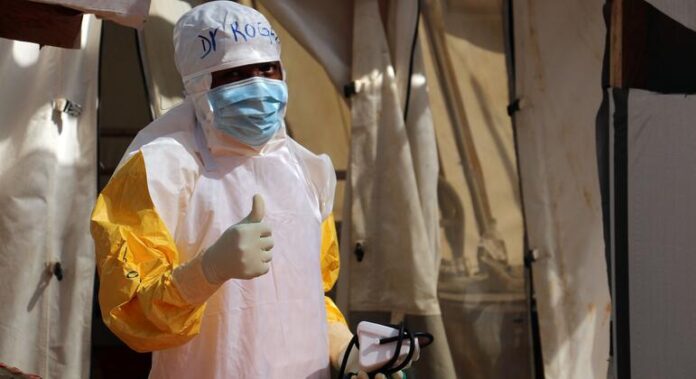
WHO has expanded isolation capacity for suspected cases and upgraded treatment facilities, including the construction of individual isolation rooms that meet latest infection prevention and control standards and the installation of a 10,000-litre water tank to support patient care.
Addressing a high-level meeting of African leaders on Tuesday, WHO head Tedros Adhanom Ghebreyesus described community mistrust as a “major barrier” to the response.
“These communities feel – perhaps rightly – that the outside world only wants to protect itself from Ebola and doesn’t truly care about them,” he said.
Following a visit to the outbreak’s epicentre in Ituri province, Tedros said insecurity, displacement and population movements continue to complicate response efforts. He also criticised broad travel restrictions, saying they are “an unnecessary overreaction that do more harm than good”.
No vaccines or therapeutics
The outbreak is being fought without approved vaccines or therapeutics for Bundibugyo virus disease, although clinical trials of “promising medicines” are expected to begin in the coming weeks.
“The bigger question is what we will do to prevent the 18th Ebola outbreak, and the 19th,” Tedros said.
He stressed that ending the outbreak will require strong community engagement, cross-border cooperation and investment in broader health services.
“If we protect these communities from Ebola, but not from malaria or unsafe childbirth, or measles or malnutrition, or from a conflict that is not of their making, we have not really helped.”
Practical guide to managing deadly viruses
Meanwhile, WHO released its first comprehensive clinical management guidelines for all filovirus diseases, including Ebola and Marburg virus diseases.
They set out 16 evidence-based recommendations focused on early supportive care, which WHO says can significantly improve survival, particularly where vaccines and treatments are unavailable.
“These new guidelines are a perfect example of how WHO leverages science to better protect and care for people during outbreaks and health emergencies,” Dr Tedros said. “The current Bundibugyo virus outbreak is a stark reminder of the need for diligent, holistic and person-focused medical care, to save lives and preserve human dignity.”
Key recommendations include rapid treatment of dehydration and shock, laboratory monitoring, prompt treatment of bacterial infections and structured follow-up care for survivors.
WHO said early recognition, rapid referral and optimised supportive care remain the foundation of effective treatment.
Ministers back fast-track CAP flexibility as high input costs sharpen Europe’s food security debate
EU governments have moved to accelerate emergency support for farmers hit by rising fertiliser prices, giving the Council presidency a mandate to seek a swift first-reading deal with the European Parliament. The measure is designed as short-term relief, but it also exposes a deeper policy problem for Brussels: Europe’s food system remains vulnerable to fossil-fuel prices, import disruption and geopolitical shocks far beyond the farm gate.
The Council of the EU agreed its position on 17 June, accepting the Commission’s proposal to let member states deploy more flexible support under the Common Agricultural Policy. The move follows a sharp increase in fertiliser costs linked to energy volatility and disruption around the Middle East crisis.
Under the Council mandate, member states would be able to provide temporary, targeted financial support to farmers most affected by higher fertiliser costs. The proposal would also allow CAP advance payments to be made earlier and at higher rates in 2026, giving farms faster access to cash before the next production cycle.
A fast procedure for a slow-building problem
The institutional handling is unusually compressed. The European Parliament has already agreed to treat the file under urgent procedure, allowing lawmakers to bypass the ordinary committee stage and move faster toward a plenary decision. The Council presidency will now seek an agreement with Parliament that could allow the regulation to enter into force shortly after publication in the EU’s Official Journal.
That speed reflects political pressure from rural Europe. Fertilisers are not a marginal input: they shape planting decisions, yields, farm liquidity and, eventually, consumer food prices. The European Commission says fertiliser costs account for 7 to 8 percent of input costs across EU agriculture, but the burden is far heavier in some crop sectors.
The Commission’s broader Fertiliser Action Plan says overall nitrogen fertiliser prices in April 2026 were 71 percent above the 2024 average. It also points to Europe’s structural reliance on imported mineral fertilisers and raw materials, including urea, ammonia, phosphates and potash.
The planned support would be financed within the existing CAP budget. That makes it faster to deploy, but also politically sensitive. Member states are trying to ease immediate pressure without reopening the wider fight over EU farm spending, environmental conditions and the shape of the next long-term budget.
Relief without losing sight of reform
For farmers, the case for liquidity support is straightforward. Many cannot pass higher fertiliser costs directly to buyers, especially when cereal prices are weak or supply contracts are fixed. Reducing fertiliser use may preserve cash in the short term, but can lower yields and weaken food supply later.
For EU institutions, the harder question is whether emergency aid becomes another patch on a system exposed to repeated shocks. Natural gas remains central to nitrogen fertiliser production. Global commodity disruptions can raise prices even where Europe’s direct dependence on a region is limited. The Commission says the Middle East accounts for about 35 percent of global nitrogen fertiliser exports, meaning regional disruption can tighten supply and lift prices across world markets.
That is why the current package sits between crisis management and industrial strategy. Brussels wants to help farmers buy fertiliser now, while also encouraging more efficient nutrient use, domestic production, nutrient recycling, bio-based fertilisers and lower-carbon alternatives. Those longer-term goals are less immediate than a CAP advance payment, but they are central to whether the EU can avoid repeating the same emergency cycle.
European environmental organisations have also warned that the crisis should not be treated only as a price shock. They argue that dependence on fossil-fuel-based fertilisers creates risks for farmers, climate policy, water quality and public health. Their preferred answer is a faster shift toward agroecology, legumes, crop rotation, nutrient recovery and regional biofertiliser production.
That agenda is already present in parts of Europe’s innovation debate. Earlier reporting by The European Times on low-carbon fertiliser production showed how new technologies are being framed not only as climate tools, but also as food-security infrastructure.
Food security moves up the EU agenda
The fertiliser file also lands at a politically delicate moment for the Union. EU leaders are meeting in Brussels this week with competitiveness, the next multiannual budget, Ukraine, migration, defence and the Middle East all competing for attention. Agriculture is increasingly tied to each of those debates: energy dependence, trade exposure, climate adaptation, rural income and social trust.
Fast-tracked support may reduce immediate pressure before autumn planting decisions. But it will not settle the broader institutional question of how far the EU should go in reshaping fertiliser markets, building reserves, backing domestic production or changing farming practices.
For now, the Council’s message is that the Union can move quickly when farm viability and food supply are under strain. The next measure of credibility will be whether emergency relief is matched by a durable plan to make Europe’s agricultural system less exposed the next time global energy or shipping routes are disrupted.
Press ReleaseThis article is based on a press release or official communication. The European Times republishes it as a public service.
KINGNEWSWIRE // PRESS RELEASE
At a family-focused community festival in west Dublin, volunteers from the Scientology Community Centre Dublin shared “Truth About Drugs” educational materials and held conversations on prevention, resilience and community responsibility.
CLONDALKIN, Ireland — 18 June 2026 — Volunteers from the Scientology Community Centre Dublin took part in the Clondalkin Festival in west Dublin, bringing drug-prevention education to a public community setting through the Truth About Drugs initiative, a campaign supported internationally by Scientologists and community volunteers.
The outreach, held during the local festival in Clondalkin, included an information tent, educational displays and free drug-prevention booklets made available to families, young people and local residents attending the event. Photographs from the day show volunteers speaking with members of the public, parents, young adults and local service personnel in a busy festival environment marked by family activities, civic engagement and summer weather.
The Scientology Community Centre Dublin described the day as “brilliant,” noting that although the subject of drugs is not an easy one, the conversations held during the festival included “hope, resilience and kindness.” The centre also publicly thanked the volunteers who helped make the outreach possible.
The initiative formed part of the broader drug-prevention programme supported by the Church of Scientology, developed to provide factual, plain-language information about commonly used substances and their effects. The materials are widely used by volunteers, educators and community groups as prevention tools in schools, neighbourhoods and public events. The campaign’s emphasis is educational rather than punitive: to place understandable information in people’s hands before harm occurs.
At the Clondalkin Festival, the Drug-Free World tent created a space where residents could approach the subject informally. Booklets were displayed on substances including cannabis, cocaine, alcohol, synthetic drugs and prescription drug abuse, while volunteers spoke with visitors about the importance of early prevention, informed choices and community awareness. One photograph from the event shows children signing a pledge board, while others show adults reviewing materials and asking questions at the stand.
The participation of the Scientology Community Centre Dublin reflects a wider pattern of local social-betterment activities carried out by Scientology churches, missions and affiliated groups across Europe. In Ireland, the Dublin centre has hosted and supported community initiatives ranging from volunteer recognition to educational events, interfaith meetings and social outreach. In this case, the focus was on drug prevention in a public festival setting where families and young people were already gathered.
The Foundation for a Drug-Free World works through secular educational resources, public service announcements and booklets designed to communicate the effects of drugs in accessible language. The campaign has been supported by members of the Church of Scientology as one of several humanitarian initiatives inspired by the work of L. Ron Hubbard, who placed emphasis on education, personal responsibility and practical help to improve social conditions.
The subject remains significant in Ireland and across Europe, where public authorities, educators and community organisations continue to address the social consequences of drug use, addiction, exploitation and youth vulnerability. Community-based prevention efforts, particularly those that reach families in ordinary public spaces, are often viewed as one element in a wider response that also includes health services, law enforcement, education and social support.
For volunteers at the Clondalkin Festival, the central aim was to make information available in a non-confrontational setting. The images from the event show a range of conversations: a volunteer explaining materials to a visitor, others speaking with public safety personnel, and families passing by the stand during the festival. The visible presence of children and parents at the event underlined the importance of prevention being addressed before problems become entrenched.
Ivan Arjona, representative of the Church of Scientology to the European Union, the OSCE, the Council of Europe and the United Nations, said the Clondalkin outreach reflected the kind of civic responsibility that strengthens communities.
“Drug-prevention education is most effective when it is brought close to people, in places where families, young people and neighbours already meet,” Arjona said. “What took place in Clondalkin is a simple but meaningful example of European civic values in practice: people volunteering their time, speaking respectfully about difficult subjects, and helping others with information that can protect lives and futures.”
Arjona added that community initiatives of this kind should be understood as part of a broader culture of prevention. “Across Europe, public institutions cannot carry every social burden alone. Civil society, faith communities, educators, parents and volunteers all have a role to play. When this is done with respect, factual information and care for human dignity, it contributes to healthier and more resilient communities.”
The Church of Scientology traces its social-betterment work to the writings and initiatives of L. Ron Hubbard, whose works inspired programmes in drug prevention, human rights education, literacy, disaster response and moral education. In the case of drug prevention, Scientology churches and volunteers support the dissemination of factual materials intended for use by people of any background, without regard to religious belief.
The Clondalkin Festival outreach also illustrates how local religious and community organisations can contribute to public life without making the activity the subject of religious instruction. The visible focus of the stand was educational: booklets, displays, conversations and information. In that sense, the initiative was consistent with many European models of community service, where faith-inspired organisations participate in civic spaces through practical social programmes.
Councillor Francis Timmons, main organiser of the Clondalkin Village Festival, welcomed the team and their drug education and prevention efforts.
The Dublin volunteers’ participation in the festival placed the campaign in a real-life setting: a local street, families moving between festival attractions, parents with children, local services nearby and residents taking a few minutes to discuss a subject that affects communities across social and economic lines. The tone of the outreach, as reflected in the centre’s public statement, was not alarmist but constructive, centred on hope, resilience and kindness.
The Church of Scientology, its churches, missions, groups and members are present across the European continent. Scientology Europe reports a continent-wide presence through more than 140 churches, missions and affiliated groups in at least 27 European nations, alongside thousands of community-based social betterment and reform initiatives focused on education, prevention and neighbourhood-level support, inspired by the work of Scientology founder L. Ron Hubbard.
Within Europe’s diverse national frameworks for religion, the Church’s recognitions continue to expand, with administrative and judicial authorities in Spain, Portugal, Sweden, the Netherlands, Italy, Germany Slovakia and others, as well as the European Court of Human Rights, having addressed and acknowledged Scientology communities as protected by the national and international provisions of Freedom of Religion or belief.
Parliament is set to decide on new vehicle design, recycling and export obligations
The European Parliament is expected to give final approval on Thursday to new EU circularity rules for the automotive sector, moving a major environmental and industrial file toward adoption as Brussels seeks to cut waste, recover more materials and make vehicle design less disposable.
MEPs are due to vote at noon in Strasbourg on legislation covering the full vehicle lifecycle, from design and production to end-of-life treatment. The rules were already agreed by Parliament and Council negotiators late last year and are designed to push Europe’s car industry toward a more circular model.
According to the European Parliament briefing, the law would improve vehicle design, set targets for recycled materials in new vehicles, reinforce producer responsibility for collecting and treating end-of-life vehicles, and tighten rules on used-vehicle exports.
From green ambition to factory rules
The vote matters because it turns circular-economy language into practical duties for manufacturers, dismantlers, recyclers and exporters. Carmakers would have to think earlier about how vehicles can be repaired, dismantled, reused and recycled, rather than treating end-of-life management as a problem that begins only after a car leaves the road.
The reform also responds to a large material challenge. Parliament says the EU produced 14.8 million motor vehicles in 2023, with 12.4 million registered, while 285.6 million motor vehicles are on EU roads. Around 6.5 million vehicles reach the end of their lives each year.
That volume makes cars a strategic source of plastics, metals and critical materials. It also makes them a test of whether Europe can reduce waste without weakening an industry already under pressure from energy costs, global competition, technology shifts and tighter climate rules.
Recycled materials and missing vehicles
The legislative file has evolved since the Commission proposed the regulation in July 2023. Parliament’s legislative train says the provisional agreement would phase in recycled-plastic targets over 10 years, reaching 25%, with at least 20% of that recycled plastic coming from material recovered from end-of-life vehicles.
The broader package also aims to tackle the persistent problem of “missing vehicles” that disappear from official treatment systems. Stronger traceability and export controls are intended to prevent cars that are no longer roadworthy from being shipped abroad in ways that transfer pollution, safety risks and waste burdens to other countries.
For consumers, the effects may be less immediate than a headline ban or subsidy. But over time, design rules could influence parts availability, repairability and the market for reused components. For smaller repair and recycling businesses, implementation will depend on whether obligations are clear and whether access to vehicle information is fair.
Industry policy meets environmental policy
The measure arrives as the EU is using law more actively to shape industrial supply chains. Recent moves on steel protection, covered by The European Times, show how Brussels is trying to defend production capacity while steering it toward greener standards.
Vehicle circularity sits in the same difficult space. Recycled-content targets can reduce demand for virgin materials and strengthen European recycling markets, but they also require reliable supply, investment and technical standards that manufacturers can meet at scale.
If Parliament gives its final approval, the focus will quickly shift from the Strasbourg vote to implementation. The central question will be whether the rules can make Europe’s car sector cleaner and more resource-efficient while keeping the transition workable for workers, consumers and businesses across the supply chain.
Leaders in Brussels face a crowded agenda where Ukraine, migration, the Middle East and the next long-term budget all compete for political room
European Union leaders are meeting in Brussels on 18 June with an unusually dense agenda that brings together Ukraine, the bloc’s 2028-2034 budget, competitiveness, migration, the Middle East, defence and organised crime. The summit is not only about what Europe wants to say in a volatile moment, but what it can afford, enforce and sustain.
The two-day European Council comes as governments try to turn broad political commitments into practical decisions. According to the Council’s official summit agenda, leaders will hear from Ukrainian President Volodymyr Zelenskyy, review the EU’s competitiveness work, discuss the next multiannual financial framework and take stock of migration and illicit drug policy.
The range of issues is striking, but the underlying question is familiar: whether the EU can match its public ambitions with political unity, money and legal safeguards. Ukraine requires long-term support and a credible enlargement path. Migration policy requires enforcement that does not weaken asylum rights. Competitiveness requires investment without hollowing out social protections. The Middle East requires diplomacy that can speak clearly about civilians, energy risks and international law.
A Budget Argument Beneath The Agenda
The next EU long-term budget is likely to shape much of what leaders can credibly promise. The 2028-2034 framework must cover traditional priorities such as cohesion and agriculture, while also responding to enlargement, competitiveness, climate pressures, border management and security needs.
A European Parliament research service outlook for the summit notes that a negotiating box with figures is now on the table, but that progress on revenue, including possible new EU own resources, remains central. That matters because the budget debate is not an accounting exercise. It is a political map of what the Union considers essential.
Net contributors are expected to press for restraint, while countries relying more heavily on cohesion and agricultural funding will resist cuts that could deepen regional divides. At the same time, pressure for new spending on competitiveness, Ukraine and external challenges is growing. The harder the choices become, the more clearly the summit will reveal whether European solidarity is treated as a slogan or as a financing principle.
Ukraine And Enlargement Stay At The Centre
Ukraine’s presence at the summit gives the meeting a strong geopolitical edge. EU leaders are expected to discuss the opening of the first accession negotiation cluster with Ukraine and Moldova, a step that moves both countries into the more demanding institutional phase of the membership process.
The symbolism is powerful, but accession cannot be reduced to symbolism. The fundamentals cluster covers courts, fundamental rights, public administration, procurement, statistics and financial control. These are the areas that determine whether citizens can trust institutions, whether corruption is contained and whether public money is subject to scrutiny.
For Ukraine, the process is unfolding under the pressure of war. For Moldova, it advances in a fragile regional setting marked by reform demands and external pressure. For the EU, enlargement is becoming both a security commitment and a governance challenge: the bloc must show that it can open the door without lowering the standards that give membership its meaning.
Migration, Rights And Public Trust
Migration will also return to the leaders’ table, shortly after major EU asylum and return reforms moved into a new implementation phase. Governments want faster procedures and more predictable responsibility-sharing. Rights groups warn that speed can become dangerous when people face detention, removal or decisions made under pressure.
As The European Times has previously reported, the budget dispute already intersects with questions of cohesion, democratic legitimacy and the cost of Europe’s next priorities. Migration adds another dimension: public confidence depends not only on whether rules are enforced, but whether they remain lawful, humane and transparent.
The same is true of the summit’s discussion on illicit drugs. Leaders are expected to look at drug trafficking as a direct threat to citizens and European societies. That framing is important, but it should not narrow the response to policing alone. Ports, corruption, money laundering, public health and community resilience are part of the same policy field.
A Summit About Capacity
The Brussels meeting is therefore less a single-issue summit than a measure of EU capacity. The Union is being asked to support Ukraine, manage enlargement, protect civilians in external crises, regulate migration, defend its economic base and finance a new strategic cycle.
Those goals are not mutually exclusive, but they compete for attention and resources. The most consequential outcome may not be one headline agreement. It may be whether leaders can make the connections clear: between money and rights, security and accountability, competitiveness and social cohesion.
Europe’s institutions often speak in long timelines. Citizens tend to experience policy in shorter ones: energy bills, housing pressure, border procedures, local jobs, public services and the credibility of democratic promises. That is the real weight of this summit. It asks whether the EU can remain ambitious without becoming abstract.
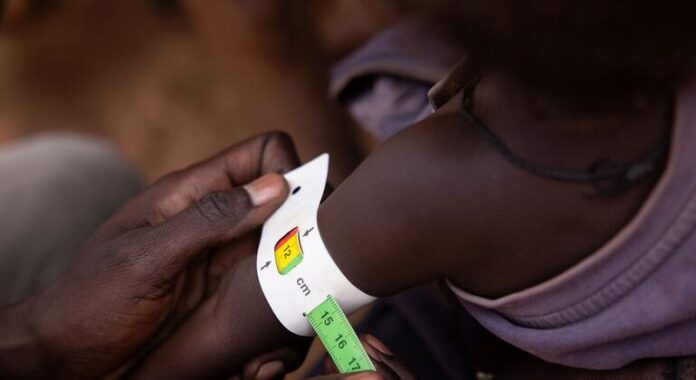
Sudan, South Sudan, Yemen and Palestine remain the most critical hotspots, while Nigeria and Somalia have moved into the highest-risk category amid growing concerns over famine.
Conflict remains the main cause of hunger, affecting 12 of the 13 hotspots.
“Conflict, shocks, and disasters are forcing families to make impossible decisions about who gets to eat and who goes to bed hungry,” said WFP Acting Executive Director Carl Skau.
Hunger worsens as aid dries up
The warning comes as humanitarian funding continues to decline.
Support for food assistance, emergency farming programmes and nutrition responses in crisis settings dropped by an estimated 59 per cent between 2022 and 2025 – levels not seen in nearly a decade.
At the same time, about 266 million people across these countries are facing severe food insecurity.
“The challenge is whether we act early enough and at the necessary scale,” said FAO Deputy Director-General Beth Bechdol.
FAO noted that emergency support for agriculture remains one of the most effective ways to help families keep producing food and reduce reliance on aid.
Most severe crises
Sudan remains the world’s worst hunger crisis, with famine risks across parts of Darfur and South Kordofan expected to continue into early 2027. Nearly 20 million people faced crisis-level hunger or worse earlier this year.
Yemen continues to experience one of the world’s most serious hunger crises, with earlier estimates showing more than 18 million people could face severe food shortages.
In Palestine, conditions in Gaza remain fragile despite some improvements after the October 2025 ceasefire. More than 1.6 million people were previously assessed as needing urgent food support.
Nigeria has entered the highest-risk category after forecasts showed parts of Borno State could face catastrophic hunger.
Somalia was also upgraded due to drought, conflict and poor harvests, with famine risks identified in Burhakaba District.
Deteriorating conditions
The report warns that new crises could make conditions worse.
“Economic shocks are compounding food insecurity, and climate change and climate variability are also further intensifying the situation,” Jean-Martin Bauer, Director of the World Food Programme’s (WFP) Food Security and Nutrition Analysis Service.
Conflict in the Middle East and the latest Ebola epidemic in eastern Democratic Republic of the Congo may further disrupt markets and humanitarian access.
Climate risks are also growing, with a possible El Niño event expected to bring drought and flooding to already vulnerable areas.
FAO and WFP urged governments and donors to increase support now to prevent conditions from worsening.
“As of June 2026 only about a third of the hyper prioritized requirements for food security funding and activities globally has been met, forcing extremely difficult choices,” said FAO Director, Rein Paulsen, briefing reporters at UN Headquarters.
The agencies stressed that acting early saves both lives and resources and warned that without stronger political commitment and more reliable funding, hunger is likely to deepen across some of the world’s most vulnerable communities.
Parliament backs faster procedures, longer detention and return hubs as safeguards move to the centre of the migration debate
The European Parliament has approved a new EU-wide system for returning third-country nationals who have no legal right to stay, giving political momentum to one of the most contested parts of Europe’s migration overhaul. The reform is intended to make return decisions faster and more enforceable, but its provisions on detention, investigative powers and transfers to “return hubs” outside the bloc are already sharpening concerns over due process, legal accountability and protection from unsafe removals.
MEPs endorsed the reform on Wednesday by 418 votes to 218, with 30 abstentions, after an informal agreement with EU governments earlier this month. According to the European Parliament’s account of the vote, the regulation will require people subject to a return decision to cooperate with national authorities and leave the relevant member state immediately or within a set period.
A harder edge to return policy
The measure forms part of the EU’s wider effort to make the Migration and Asylum Pact operational after years of political argument over arrivals, responsibility-sharing and border pressure. Governments supporting the reform argue that asylum and migration systems lose credibility when return decisions are not carried out.
The new rules allow detention, based on an individual assessment, where a person is not cooperating, is considered likely to abscond, or is deemed a security risk. Detention may last up to 24 months, with a possible extension of up to six months if circumstances change, new information emerges or cooperation with a third country improves.
Member states will also be able to impose alternatives such as regular reporting, residence in a designated place, electronic monitoring or a financial guarantee. National authorities may carry out searches of people, homes or relevant premises, and may seize personal belongings or electronic devices, subject to judicial or administrative authorisation and remedies under EU and national law.
For supporters, these tools are meant to reduce fragmentation between national systems and prevent people moving between member states after receiving a return decision. For critics, they mark a significant expansion of coercive powers in an area where people may already face language barriers, limited access to lawyers and difficulty proving risks in their country of origin.
The return hub question
The most politically sensitive element is the possibility of transferring people under return decisions to facilities in third countries. Unaccompanied minors are excluded, but other people could be sent to a non-EU country that agrees to accept them under an arrangement with a member state.
EU institutions say such agreements may only be concluded with countries that respect human rights, international law and the principle of non-refoulement, which prohibits sending people to places where they face persecution, torture or other serious harm. Member states will have to inform the Commission and other EU countries before such arrangements apply.
Yet the practical question is not only what the agreements say, but who can enforce them when rights are breached. If a person is moved outside EU territory under an EU-linked system, responsibility could become blurred between the sending member state, the host country, EU agencies and international monitors.
That danger has been at the centre of rights-group criticism. Amnesty International has warned that offshore return arrangements and longer detention powers could weaken due process and expose people to serious rights violations. Other civil-society organisations have raised similar concerns about access to legal assistance, independent monitoring, complaint mechanisms and protection for vulnerable people.
What happens next
The regulation still needs formal adoption by the Council and publication in the EU’s Official Journal before entering into force. Some provisions, including those concerning return hubs, age assessment of minors and the external dimension of returns, are expected to apply immediately. Others requiring national preparation will apply 12 months after entry into force.
The debate is therefore moving from legal design to implementation. The EU can lawfully return people who have no right to stay, but only through individual decisions, effective remedies and safe procedures. The harder question is whether a system built for speed can remain attentive to the person standing before it.
As The European Times has previously reported, return hubs have become a central symbol of Europe’s migration shift: governments describe them as a practical enforcement tool, while rights advocates see the risk of legal distance becoming human invisibility.
The final measure will be judged less by its promise of efficiency than by the safeguards that survive under pressure. For the people affected, the difference between an orderly return system and an abusive one may depend on access to a lawyer, a translator, a medical assessment, a functioning appeal and a decision-maker willing to treat non-refoulement as a binding rule rather than a phrase in a press release.
Évian leaders back a new maritime security network as Europe pushes organised crime higher on its political agenda
G7 leaders meeting in Évian have agreed to create a new port-security network against drug trafficking, giving European concerns over cocaine routes, criminal infiltration and public health a wider international platform. The move links global maritime enforcement with the European Union’s own efforts to protect ports, follow illicit money and reduce the social harm caused by increasingly adaptive organised crime groups.
The pledge was included in the G7 leaders’ declaration on drug trafficking, adopted during the 16-17 June summit in France. It commits members to set up a G7+ Ports Network to Combat Drug Trafficking, coordinated with the European Ports Alliance and other related initiatives, with ministers tasked to implement the network by November 2026.
The declaration reflects a growing recognition that ports are no longer only logistical gateways. They have become pressure points where commercial supply chains, customs authorities, police, private operators and criminal groups collide. For Europe, that is especially sensitive: Antwerp, Rotterdam, Hamburg, Valencia, Algeciras, Le Havre and other major hubs are essential to trade, but their scale and complexity also create openings for intimidation, corruption and concealed shipments.
From container checks to institutional resilience
The new G7+ network is intended to reinforce cooperation among major ports, including information-sharing, joint field visits and best-practice exchanges between port authorities and law-enforcement bodies. The declaration also calls for an inventory of G7 initiatives and practical methods to counter drug and precursor chemical trafficking in ports.
That may sound technical, but the political meaning is larger. Drug trafficking is increasingly treated as a threat to democratic resilience, not only as a customs or policing problem. Criminal groups exploit dock workers, logistics companies, transport routes, encrypted communications, financial intermediaries and vulnerable young people recruited for risky tasks. In cities affected by cocaine violence, the damage reaches far beyond users or seizures: it can erode trust in public institutions and make ordinary neighbourhoods feel exposed to criminal power.
The EU had already moved in the same direction. Earlier this month, the Council approved an EU action plan against drug trafficking for 2026-2030, emphasising the maritime dimension, the European Ports Alliance, the expansion of the Maritime Analysis and Operations Centre (Narcotics), and a “follow-the-money” approach to illicit finance.
The same Council text says EU leaders are expected to discuss drug use and trafficking at their 18-19 June meeting for the first time. That timing matters. It places drug policy beside Ukraine, migration, competitiveness, the Middle East and the long-term EU budget, rather than leaving it as a specialist justice-and-home-affairs topic.
A security policy with a public-health edge
The danger for governments is to frame the issue too narrowly. A port crackdown can intercept shipments and disrupt criminal logistics, but it cannot by itself reduce demand, treat addiction, protect exploited workers or address the social conditions that make recruitment easier. That is why the strongest strategies combine enforcement with prevention, treatment, education, labour protection and financial investigation.
This is also where Europe’s internal debate connects to global responsibility. Cocaine consumed in Europe carries costs across the Atlantic and along transit routes: violence in producing regions, corruption in transport corridors, environmental damage, intimidation of local communities and the laundering of profits through legitimate economies. Treating the problem only at the moment a container reaches a European quay misses much of the chain.
As The European Times reported from Vienna earlier this year, the most credible drug policy debate is no longer a simple argument between prohibition and legalisation. It is about whether states can reduce demand, protect vulnerable people and dismantle the financial and logistical architecture that allows criminal networks to operate across continents.
Europe’s ports are a public-interest frontier
The G7 declaration is therefore important less because it creates a new forum than because it acknowledges where the fight is moving. Maritime trade is vast, fast and mostly legitimate. Security policy has to protect that openness without turning ports into permanently militarised zones or placing ordinary workers under suspicion. The hardest task is precision: targeting criminal infiltration while preserving lawful commerce and workers’ rights.
For European governments, the next measure of seriousness will be implementation. A ports network will matter if it improves intelligence, protects threatened staff, strengthens customs capacity, uncovers money flows and helps prosecutors reach organisers rather than only couriers. It will matter even more if public-health policy keeps pace with enforcement.
Évian has put drug trafficking on the G7’s security agenda. Brussels is now moving it toward the European Council table. The question is whether this convergence produces a durable strategy, or another layer of declarations around a market that has repeatedly shown it can adapt faster than the state.
Wagering has always been a game of information asymmetry. Historically, the house held all the cards—and the computing power. However, Artificial Intelligence and Machine Learning have hugely impacted data analysis, turning betting from a game of intuition into one of high-level data science. Today, casual bettors and professional syndicates use AI tools to complement their own wagering strategies. From predictive modeling in team sports to calculating various table games in casino environments, algorithms are rewriting the rules of finding an edge.
Image credit: Magnific, free license
Beyond Basic Accuracy in Betting
In sports betting, the primary duty of AI lies in its capacity to ingest and process massive, multi-structured datasets that would easily overwhelm you, me, or anyone in the Gambling Forum. Advanced machine learning architectures evaluate hundreds of granular features simultaneously—including player tracking metrics, real-time health telemetry, historical matchup dynamics, and even ambient weather conditions.
However, the true breakthrough in AI-driven sports betting isn’t just predicting who will win a game; it is about doing it with the utmost precision. Recent research demonstrates that for a machine learning model to be highly profitable in a live market, optimizing for calibration is significantly more vital than optimizing for raw accuracy.
Accuracy vs. Calibration: A model with high accuracy might correctly predict a match winner, but if it miscalculates the exact probability of that victory, a bettor cannot reliably identify mispriced bookmaker lines. For instance, if a bookmaker offers odds implying a 50% probability, but an accurately calibrated AI model calculates a 58% probability, the bettor possesses an exact metric of their expected advantage.
Finding Value: Well-calibrated AI tools provide precise mathematical probabilities for an event’s outcomes. When an AI determines a team has a 70% chance of winning, but the bookmaker’s odds imply only a 60% probability, a positive expected value (+EV) opportunity is revealed.
Empirical testing on real-world sports data, such as English Premier League matches across a multi-year horizon, indicates that combining these well-calibrated machine learning outputs with dynamic capital allocation frameworks—like the Fractional Kelly Criterion—yields compound returns that drastically outperform traditional flat-betting systems (Bao, 2026). By automatically adjusting stake sizes relative to the scale of the model’s perceived edge, AI acts as both an analytical engine and a disciplined risk manager.
Cracking the Casino Code
While sports betting deals with chaotic, real-world variables, traditional casino games operate within strict, mathematically closed environments. Here, AI tools complement player strategies through Reinforcement Learning (RL) and game theory.
In games of imperfect information like poker, AI has completely transformed the strategic landscape through Game Theory Optimal (GTO) play. Rather than relying on psychological “reads” or gut instincts, modern players train extensively with AI “solvers.” These tools utilize reinforcement learning algorithms to simulate millions of hands against themselves.
Poker Solvers: Players use AI tools post-session to analyze their choices, mapping human execution against mathematical perfection to eliminate strategic leaks. By studying these simulations, humans internalize highly complex decision trees across thousands of potential card combinations, elevating their real-time decision-making to near-computational accuracy.
Blackjack and Advantage Play: In blackjack, AI models run massive Monte Carlo simulations to optimize basic strategy modifications based on exact card compositions, factoring in complex multi-deck subsets that manual card-counting strategies simplify.
Concurrently, the integration of Generative AI and telemetry mining allows players looking at traditional and crypto casino discussions to study behavioral profiling. While online casinos use these identical tools to detect automated bots or flag suspicious advantage play, elite players analyze historical telemetry data of opponents to uncover subtle structural patterns in how human players deviate from optimal strategies under pressure.
The House vs. The Better: An Algorithmic Arms Race
The emergence of consumer-facing AI betting tools has triggered an inevitable technological arms race between bettors and operators. Casinos and digital sportsbooks are not passive observers; they utilize advanced cognitive automation and business intelligence systems to safeguard their mathematical margins. Bookmakers deploy AI to track winning accounts, analyze betting velocity, and adjust odds dynamically across global markets to mitigate their liability instantly.
Consequently, modern AI-complemented strategies focus heavily on bypassing detection. Sharp bettors utilize AI tools to mask their activity, using anti-home frameworks or distributing their wagers across varying thresholds to prevent their accounts from being flagged or restricted by sportsbooks’ automated risk systems (Bao, 2026). The strategy is no longer just about beating the game; it is about out-maneuvering the automated gatekeepers of the betting ecosystem.
Conclusion: The Synthesized Bettor
Ultimately, AI tools are not magic bullets capable of guaranteeing risk-free wealth. Instead, they serve as the ultimate cognitive amplifier. By stripping away emotional biases—such as the “loss aversion” or “hot-hand fallacy” that plague human gamblers—AI instills a regime of cold, empirical discipline. The most successful modern betting strategies are hybrid frameworks: systems where human contextual nuance guides the initial parameters, and artificial intelligence executes the heavy mathematical lifting. In the contemporary wagering landscape, the ultimate edge belongs to those who know how to cooperate with the machine.
From the Atlantic to the Mediterranean, the vast majority of bathing waters in Europe met the European Union’s most stringent ‘excellent’ bathing quality standards in 2025, according to the latest annual bathing water package published today. This represents 85% of Europe’s bathing sites, with 96% of all EU sites monitored meeting the minimum quality standards and only 1.5% rated as ‘poor’. These data also show that the overall quality of bathing waters across Europe has remained stable compared to the previous year.
The highest share for excellent quality bathing waters is found in Austria, Bulgaria, Cyprus and Greece — with a total of 95% or higher. The bathing quality of coastal waters is generally better compared to rivers and lakes. In 2025, 88% of coastal bathing waters in the EU were classified as excellent, compared to 78% of inland bathing waters.
The assessment and interactive map, put together by the European Environment Agency (EEA) in cooperation with the European Commission, show where swimmers can find the safest bathing sites in Europe. The assessment inspects water suitability for bathing, focusing on monitoring bacteria that can potentially cause serious illnesses.
Europe’s bathing water results once again demonstrate the value of EU environmental legislation and decades of investment in wastewater treatment and water management. Thanks to these efforts, Europeans can enjoy some of the world’s highest bathing water standards. At the same time, protecting our waters requires continued action on wider challenges such as pollution, biodiversity loss and the impacts of climate change, which are at the heart of our work to strengthen Europe’s water resilience.
Commissioner for Environment, Water Resilience and a Competitive Circular Economy
This summer we can all reap the benefits of solid implementation of EU bathing water rules, which have made a vast majority of our bathing waters clean enough to swim in. This is proof of how European coordination brings real value to all of us in improving our environment and health and goes a long way also to boost our water resilience in the face of climate change.
Water quality improvements over recent decades
The excellent quality of Europe’s bathing waters is supported by the sustained impact of EU law. Thanks to the EU’s Bathing Water Directive and other EU water legislation, the quality of Europe’s bathing waters has steadily improved over recent years. This includes improved monitoring and management practices, investment in urban wastewater treatment plants, better wastewater collection, and improved assessment of the cyanobacterial algal blooms that can be harmful for human health and nature.
Thanks to these continued efforts, people can now also swim in many formerly heavily polluted urban waters and rivers. At the same time, achieving healthy and resilient water systems requires continued progress in addressing broader pressures on surface and groundwater, including chemical pollution and climate-related impacts. Advancing water quality for both people and nature is a key component of EU Water Resilience Strategy.
Background
The assessment for today’s report is based on the monitoring of over 22,200 bathing sites across Europe that were reported to the EEA for the 2025 season. This includes sites in all EU Member States, Albania and Switzerland.
Alongside this year’s Bathing Water Report, the EEA has also released an updated interactive map showing the performance of each bathing site. Updated country fact sheets are also available, as well as more information on the implementation of the Directive in assessed countries.