Sunday, September 20, 2026
Home Blog Page 64

Is Moral Rectitude An Antiquated Virtue In Modern Society?

0
Is Moral Rectitude An Antiquated Virtue In Modern Society?

Many question whether moral rectitude still holds value in a world driven by speed, convenience, and shifting norms. You face daily choices where integrity competes with expediency. While some dismiss steadfast ethics as outdated, those who uphold them often shape lasting trust and societal stability. The real danger lies not in holding firm principles, but in abandoning them.

The New Theocracies of Consensus

You now live in a world where moral authority has shifted from sacred texts to social feeds. Public opinion, amplified by digital echo chambers, functions like doctrine, demanding conformity. Dissent is not debated-it is excommunicated. These new theocracies don’t burn heretics, but they cancel them, enforcing a rigid orthodoxy of consensus that brooks no deviation.

The death of absolute dogma

Tradition once anchored morality in unchanging principles, but that foundation has eroded. You no longer accept commandments simply because they were handed down. Authority is questioned, not obeyed, and certainty is treated as suspicion. In rejecting blind faith, you’ve dismantled not just flawed systems, but the very idea of fixed truth.

The rise of situational ethics

Context now dictates right and wrong more than rules do. You judge actions by their consequences, not their conformity to doctrine. Moral flexibility is praised as wisdom, yet it risks becoming a license for inconsistency. When every choice is justified by circumstance, integrity becomes negotiable.

Situational ethics appeals because it feels compassionate and realistic. You use it to excuse a friend’s lie to protect feelings or justify whistleblowing despite legal risks. But when applied universally, it undermines accountability. Without shared standards, each person becomes their own moral arbiter, and justice shifts with the wind. What starts as empathy can end in moral drift.

The Vanity of the Digital Square

You perform goodness where it’s seen, not where it matters. Phony Virtue is Ruining Western Society, replacing integrity with visibility. Authentic moral action is private, not posted, yet you trade conviction for clout, mistaking applause for righteousness.

Virtue signaling as currency

Social approval now flows to those who broadcast morality, not practice it. You’ve learned to speak the right words at the right time, treating ethics like a status symbol, not a standard. This performance isn’t virtue-it’s transactional, shallow, and ultimately hollow.

The erosion of private conscience

Inner moral judgment fades when behavior is shaped by public reaction. You begin to measure right and wrong by engagement metrics, not reflection. The quiet voice of conscience loses authority when every choice is filtered through audience expectation.

When your sense of right is constantly bent by digital feedback, the self dissolves into performance. You stop asking, “Is this true?” and start asking, “Will this be liked?” This shift isn’t subtle-it’s spiritual surrender. The erosion of private conscience doesn’t happen in a day, but through a thousand compromises, each one justified by visibility.

The Commercialization of Conscience

You see moral language everywhere now-on product labels, in ad campaigns, even in corporate mission statements. What was once a personal compass is now a sellable trait. Brands wrap themselves in ethics not always to do good, but to be seen doing good. Your trust becomes their currency, and conscience, stripped of depth, becomes just another feature on the shelf.

Corporate cynicism

Companies claim to champion justice while quietly funding policies that undermine it. This contradiction isn’t accidental-it’s strategic. You’re meant to admire their public pledges while their private actions tell a different story. When profit and principle clash, profit almost always wins, revealing how shallow their ethics truly are.

The marketability of vice

Indulgence sells better than restraint, and brands know it. Greed, envy, and impatience are no longer condemned-they’re engineered. From luxury hauls to instant gratification apps, vice is repackaged as freedom. You’re not just buying a product; you’re buying permission to abandon self-control.

What makes this shift so dangerous is how seamlessly vice is rebranded as empowerment. Excess becomes self-expression, addiction becomes loyalty, and manipulation becomes marketing. You’re led to believe you’re making free choices, but the options were designed to profit from your weaknesses. The moral cost is buried beneath layers of slick messaging and emotional triggers, leaving you complicit without awareness.

The Smugness of Moral Relativism

You assume neutrality when you claim all morals are equal, but that stance isn’t humility-it’s a quiet arrogance. By refusing to judge any value system, you elevate your own skepticism above conviction, treating belief as naïve. This detachment feels enlightened, yet it often masks a deeper refusal to engage with hard truths or defend what might actually be right.

The subjective trap

Truth shrinks when you reduce morality to personal preference. You begin to see ethics as mere opinion, and in doing so, you surrender the power to challenge injustice. If kindness is just your “take,” then cruelty is just someone else’s-leaving no ground to stand on when harm is done.

The loss of communal standards

Society frays when shared values dissolve. Without common moral reference points, trust erodes and cohesion vanishes. You no longer ask, “What kind of world do we want?” but only, “What do I want?”-turning community into a collection of isolated wills.

When communal standards fade, public life loses its moral grammar. You stop appealing to shared principles because none are assumed. This isn’t freedom-it’s fragmentation. Children learn there’s no “right way” to treat others, only negotiated convenience. Institutions, from schools to courts, begin to reflect this drift, prioritizing procedure over principle, leaving citizens adrift in a world without moral anchors.

The Heresy of Private Integrity

You once believed doing the right thing in private mattered, even when no one was watching. This quiet conviction now seems suspect in a world that rewards performance over principle. When integrity is reduced to personal preference, it loses its binding force, becoming just another lifestyle choice rather than a moral anchor.

Integrity in isolation

Living by your principles in solitude may feel noble, but integrity untethered from community impact risks becoming self-congratulatory. You can uphold truth in your own life, yet if it doesn’t challenge injustice or inspire change, it may serve comfort more than conscience.

Reclaiming the moral compass

Choosing to act rightly despite cost restores moral courage as a public virtue. This recommitment defies the notion that ethics are negotiable. You are not merely avoiding wrongdoing-you are actively shaping a world where integrity influences outcomes.

Reclaiming the moral compass means refusing to accept that compromise is inevitable. It demands that you align actions with enduring principles, even when inconvenient. Such consistency disrupts apathy and redefines what society dares to expect. You become a living argument against moral resignation, proving that character still shapes culture when lived without apology.

To wrap up

Considering all points, you recognize that moral rectitude is not outdated but challenged by shifting social norms. You face constant choices between convenience and integrity, and your decisions define the character of modern society. Moral clarity remains possible when you choose honesty, accountability, and fairness-even when no one is watching.

Source link

Is Algorithmic Bias The New Ethical Quagmire?

0
Is Algorithmic Bias The New Ethical Quagmire?

Many automated systems you interact with daily make decisions based on algorithms that can reflect and amplify deep-seated societal biases. These biases may lead to discriminatory outcomes in hiring, lending, and law enforcement. Yet, when properly designed, algorithms also hold the power to enforce greater fairness and consistency than human judgment alone.

The Ghost in the Code

You encounter bias not in overt decisions but embedded within lines of code written with good intentions. These algorithms absorb historical patterns, including society’s inequities, and replicate them at scale. What appears objective often carries the weight of past discrimination, silently shaping outcomes in hiring, lending, and policing.

Mathematical Prejudice

Data shapes model behavior, and flawed inputs produce skewed results. When training sets reflect systemic disparities-like underrepresentation or biased labeling-the math learns to treat them as truth. Equations don’t lie, but they faithfully repeat the injustices they’re fed, making discrimination look like logic.

The Illusion of Neutrality

Code feels impartial because it operates without emotion or intent. This perception masks the human choices behind feature selection, data curation, and outcome definitions. The belief in algorithmic objectivity prevents scrutiny, allowing biased systems to function unchecked under a veneer of fairness.

Neutrality in algorithms is a myth you’re taught to accept. Developers design models using assumptions about what matters and what doesn’t-decisions rooted in subjective judgment. Even when code executes perfectly, its outcomes reflect the values and blind spots of its creators, proving that objectivity is not coded but claimed.

Data as Destiny

You absorb patterns from the world, and so do algorithms. But when data reflects centuries of inequality, what feels like prediction becomes predestination. Your loan, job, or medical care may hinge not on merit, but on biased correlations buried in code. Data doesn’t just describe reality-it begins to dictate it.

Historical Echoes

Centuries of discrimination live on in today’s datasets. Redlining maps from the 1930s still influence housing algorithms, reinforcing segregation under the guise of neutrality. You inherit a past you never chose, encoded as objective truth. History isn’t just remembered-it’s recalculated.

Flawed Foundations

Garbage in, gospel out-that’s the quiet danger of flawed data. Biased samples, missing populations, and skewed labels become invisible rules shaping your opportunities. You trust the output, unaware the foundation was cracked from the start. Accuracy masks injustice when the model learns the wrong lessons.

These foundations aren’t just incomplete-they’re actively misleading. When training data overrepresents one group and erases another, the algorithm treats disparity as natural law. A facial recognition system failing darker skin isn’t an anomaly; it’s the expected outcome of a dataset built on exclusion. You become less visible not because of technology’s limits, but because of its assumptions. The model doesn’t see bias-it inherits it, normalizes it, and scales it without question.

Automated Injustice

You’re already trusting algorithms to make decisions that shape lives, yet few see the hidden inequities embedded in code. We’re proud to share that Raquel Benitez-Rojas, Associate highlights how automated systems often amplify systemic bias under a veil of neutrality.

The Faceless Judge

Decisions about your freedom, employment, or credit now often come from systems you can’t question. This judge has no face, no empathy, and no accountability-only data that may misrepresent who you are.

Erasure of the Individual

Patterns replace people when algorithms reduce you to data points. Your unique circumstances vanish, and errors become invisible because the system wasn’t built to see you-only your category.

When identity is flattened into inputs, the algorithm ignores context-like why you missed a payment or changed jobs. These systems treat deviation as risk, not reality, and penalize complexity rather than understand it. You’re not a profile. You’re a person-yet the machine doesn’t know the difference.

The Opaque Authority

You interact daily with systems whose logic remains hidden, even to those who deploy them. These algorithms shape decisions in hiring, lending, and policing, yet their inner workings are shielded by layers of complexity and legal protection. The most dangerous aspect is not just their secrecy, but the unquestioned authority they’ve gained-authority granted without consent or clarity.

Corporate Secrecy

Companies guard algorithmic designs as proprietary assets, blocking public scrutiny. This secrecy prevents oversight, allowing biased patterns to persist under the guise of innovation. You accept these tools as neutral, but their hidden rules often reflect skewed priorities masked as objectivity.

Accountability in the Void

No clear责任人 emerges when an algorithm denies you a loan or job. The absence of accountability creates a governance vacuum-decisions are made, yet no one takes responsibility. You’re left appealing to systems that don’t explain themselves, let alone correct their errors.

When an automated system misclassifies your application, you face a wall of silence. Engineers claim they can’t explain the model’s reasoning, legal teams cite trade secrets, and executives defer to “technical processes.” This diffusion of responsibility means no single party owns the outcome, leaving you without recourse. The algorithm becomes an unchallengeable arbiter, not because it’s accurate, but because it’s unreachable.

Reclaiming the Human

You hold the power to restore judgment where code falls short. When algorithms shape lives, human oversight becomes non-negotiable. Machines reflect patterns, but only people can interpret fairness, context, and consequence. Reclaiming agency means insisting on accountability at every level-because ethics cannot be automated.

Radical Transparency

Data trails should never be black boxes. Radical transparency demands that you know how decisions affecting your life are made. Open models, auditable code, and clear documentation expose hidden assumptions. When systems reveal their logic, power shifts back to the individual, reducing manipulation and building genuine trust in automated outcomes.

Moral Oversight

Algorithms must answer to more than engineers. Moral oversight requires diverse voices-ethicists, sociologists, and community representatives-to review AI impacts before deployment. Without this check, systems risk reinforcing inequality under the guise of neutrality. Your protection lies in deliberate, human-led review of automated decisions.

Designing moral oversight isn’t about slowing innovation-it’s about preventing harm. You need independent review boards with real authority to halt or modify systems that threaten equity. These bodies must assess not just accuracy, but social consequence, especially for marginalized groups. When profit or efficiency drives AI unchecked, ethical erosion follows. Your future depends on embedding conscience into the machine.

To wrap up

With these considerations, you recognize that algorithmic bias is not a technical glitch but a reflection of deeper societal inequities embedded in data and design. You are responsible for questioning assumptions, auditing outcomes, and demanding transparency. The ethical challenges are immediate, and your engagement shapes whether these systems reinforce harm or advance fairness.

Source link

Can Ethical Equanimity Survive In A Hypercapitalist World?

0
Can Ethical Equanimity Survive In A Hypercapitalist World?

Capitalism drives innovation and growth, but its hypercharged form prioritizes profit over people. You face constant pressure to compete, consume, and conform. Unchecked greed erodes moral balance, while ethical equanimity demands detachment from material excess. Can inner stability endure when every value is monetized?

The Grinding Gears of Profit

Every day, your attention is mined, repackaged, and sold before you finish your morning coffee. Algorithms optimize not for truth or well-being, but for engagement-because engagement equals revenue. You are not the customer in this equation; you are the product. The machine runs on endless growth, and ethical boundaries are the first sacrifice when margins are at stake. Profit doesn’t pause for conscience-it accelerates through it.

The Myth of the Moral Market

You’ve been told the market rewards fairness, that ethical choices naturally align with profit. This is a myth. In hypercapitalism, moral compromises are often prerequisites for survival, not exceptions. Systems prioritize growth over integrity, pressuring you to accept exploitation as standard practice. There is no self-correcting virtue in the market-only incentives to cut corners, silence dissent, and commodify conscience.

The Cost of Inner Peace

You pay for stillness with silence, and silence has become a luxury good. In a world that profits from your attention, choosing not to react is an act of resistance. Every breath drawn in calm is a withdrawal from the economy of urgency. Inner peace does not fit neatly into a monetized existence-it cannot be tracked, scaled, or sold. You are not broken for seeking it; you are dangerous to the system that needs you anxious, consuming, and always on.

Resistance Through Stillness

You resist not by shouting, but by refusing to move-by holding space where speed is expected. In a world that profits from your urgency, stillness becomes dangerous. Your silence disrupts algorithms built on reaction. When you pause, you reclaim attention, presence, and ethical clarity. This is not passivity; it is deliberate refusal. You choose depth over distraction, and in doing so, you undermine hypercapitalism’s greatest tool: your exhaustion.

The Fragility of Virtue

You feel the pressure daily-each decision pulled between integrity and survival. Capitalism rewards speed, not stillness; output, not reflection. In this imbalance, ethical equanimity becomes a quiet casualty, eroded not by malice but by routine compromise. What feels like personal failure is often systemic design. Virtue falters when the cost of holding it is isolation or ruin.

Final Words

The balance between ethical equanimity and hypercapitalist pressures rests in your choices. You confront profit-driven systems daily, yet you retain the capacity to act with integrity, fairness, and restraint. Survival of ethical clarity does not depend on sweeping change but on consistent, personal commitment to principle over gain.

Source link

Leafy vegetables identified as potential metal mining tools

0
Leafy vegetables identified as potential metal mining tools


Leafy vegetables could be used to extract toxic metals from contaminated soil for use in medical technologies and energy projects.

Kale – illustrative photo. Image credit: Pixabay (Free Pixabay license)

University of Queensland geochemist Dr Amelia Corzo-Remigio said powerful X-rays confirmed crops in the Brassicaceae family had strong ‘phytomining’ potential because of the mechanisms they evolved to extract traces of the metal thallium from polluted soil.

Dr Corzo-Remigio said kale, cabbage, broccoli, cauliflower, mustard, and Brussels sprouts were already known to ‘accumulate’ thallium and were therefore closely monitored for potential consumer and environmental health risks.

Despite this awareness, Dr Corzo-Remigio said there was a distinct lack of research into the mechanisms of thallium uptake and the potential for this trait to be used in mineral extraction.

“Thallium is extremely toxic, but it is also a valuable and industry critical metal used in medical technologies, optical glass, and semiconductors,” Dr Corzo-Remigio said.

“So, while posing a significant health risk to humans, many of these same Brassicaceous plants could present a clear opportunity in sustainable mining.”

Using advanced analytical techniques, Dr Corzo-Remigio and researchers at UQ’s Sustainable Minerals Institute (SMI) found the Brassica oleracea – or kale – accumulated thallium in crystallised form, and therefore may be compatible with metallurgical extraction methods.

“Simultaneous use of micro-X-ray fluorescence (μXRF) and X-ray diffraction mapping (XDM) on live kale plants gave us an unprecedented view of how and where thallium is located in these plants,” Dr Corzo-Remigio said.

“In particular, we found thallium chloride crystal deposits along the veins inside the leaves.

“This indicates potential for phytomining and, potentially, a sustainable thallium supply.”

Phytominig and bioremediation experts at SMI’s Centre for Environmental Responsibility in Mining said non-conventional mining methods such as phytomining will become key to securing certain metals needed to advancing medical technologies and transitioning our economy to a renewable energy supply.

Dr Corzo-Remigio said phytomining with Brassicaceous plants also has the potential to help tackle emerging environmental problems arising from mining activities.

“There’s a dual need to remediate and rehabilitate soils while also supplying critical elements in the most sustainable way possible,” Dr Corzo-Remigio said.

“It looks like plants in the Brassicaceae family can be part of the answer.”

The research is published in the journal Metallomics.

Collaboration and acknowledgements

Dr Corzo-Remigio’s work was supported by Dr Antony van der Ent, an Honorary Senior Fellow at SMI’s Centre for Environmental Responsibility in Mining who is based at the Wageningen University and Research Laboratory in The Netherlands.

Other collaborators were based at the University of Adelaide, Queensland University of Technology, and at the Deutsches Elektronen-Synchrotron (DESY) in Germany.

Source: University of Queensland


Source link

Top aid official urges young people to ‘serve humanity’, support the UN |

0
Top aid official urges young people to ‘serve humanity’, support the UN |

“It has been the privilege of a lifetime to serve humanity,” said Joyce Msuya, who spent the past four years as the Assistant Secretary-General and Deputy Emergency Relief Coordinator in the UN Office for the Coordination of Humanitarian Affairs (OCHA). 

In an exclusive interview with UN News, she highlighted the critical role played by humanitarians in a “collapsing” world and the challenge of advocating before a divided Security Council for safe access to civilians in the Gaza Strip. 

Ms. Msuya, who is from Tanzania, was also inspired by her interactions with young people over the years – even when they asked “uncomfortable” questions about the UN’s response in conflict situations. 

She encouraged them to lend support to the world body and the principle of multilateralism which are so under threat. 

“What has kept me grounded is to always think about the internally displaced people, the persons we are trying to serve,” she said.  “And that is a very noble cause – a gift of service to humanity that I hope especially the young generation will aspire to do.”  

This interview has been edited for clarity and length 

Joyce Msuya: Three things come to my mind as I’ve had a bit of time to reflect. One is the privilege I’ve had to serve humanity in this role. I joined OCHA six days before the Ukraine war started in February 2022 and even then, I thought gosh, the world was collapsing. So, just being in this role and seeing three major wars – Ukraine, Gaza, and then more recently, Iran – has been quite a humbling experience, but also very motivating to see the power and the contribution that the United Nations and the humanitarian community at large, including NGOs, can play.  

The second is being in this role as someone from the Global South.  I didn’t know what that meant as a platform, and that has been incredibly, a gift of service for me personally, and I really hope that has opened doors and will open doors for others.  

Lastly, is just seeing the investments that funding partners are putting in, but also the suffering of people in all the countries where I’ve travelled. I used to take some things for granted and now I have a very deep appreciation of what suffering really means for people.  

UN News: You have visited 30 countries, probably more. Is there a particular story or encounter that has remained in your mind?  

Joyce Msuyua: I remember visiting an internally displaced camp in the northern part of Yemen. I met a woman, a mother of four, who was in her thirties.  

She told me that she had never had a stable life. She’s been moving from one place to another because of the war. But what struck me was how kind and giving she was, despite the incredible pain that I could not imagine as a mother that she went through.  

In talking to her, I realised her own aspirations for her children were very similar to my own aspirations for my own children – peace, education and stability. For me, that was the lesson, that we as human beings have more in common than in difference. And I’ve always carried that and will always carry that message with me as I exit this particular role.  

UN Photo/Loey Felipe
Joyce Msuya (right) UN Deputy Emergency Relief Coordinator, briefs the Security Council meeting on the Middle East.

UN News: You have also briefed the United Nations Security Council more than 40 times, an average of almost once every month. Which briefing was the most difficult for you, and why? 

Joyce Msuya: The Security Council is an absolute central body for the United Nations. When I joined OCHA, it was a Monday, and then the following day I was asked to brief the Security Council on Syria, my first briefing. I remember pinching myself sitting in that chamber thinking, ‘Wow, what a privilege, what an honour.’ 

I would say probably the most difficult part of my briefings to the Security Council were around the humanitarian crisis in Gaza.  

We were advocating for operational humanitarian space in the context where there was a global fracture of the big powers. And whenever I was in the chamber to advocate for humanitarian work and to report on the progress, I carried the perspectives of humanitarians who had lost their lives while trying to save others; OCHA staff who were still sacrificing a lot, especially national staff.  

Some of them I knew through the interactions who had lost family members, children separated from their families, and yet they showed up every single day to serve others.  

I think third is the lack of respect for international humanitarian law. Even though we advocated – and the Secretary-General, the Emergency Relief Coordinator and the whole sector were very clear, but really to see the impunity that came with that.  

What gave me hope was the whole multilateral [system] supporting humanitarian work, speaking up even when it was tough to do so. 

UN News: Records also show that you held nearly 20 meetings with students in different countries. What is one message or insight from those students that has stayed with you and that you believe the international community should hear?  

Joyce Msuya: I always strive to engage with students. I find their thinking, their curiosity and their questions very refreshing, very difficult, and very uncomfortable because they are not tainted by some of the organisational stuff that older people have.  

I overprepared when I met with the students because I felt you just don’t know what question they have. 

I remember being in Tokyo at a university and some of the students were saying ‘Why should we believe in the United Nations whilst you said ‘x’ in this war, and you stayed quiet on another?’ For me, it was an opportunity to engage in a very open and candid way with the young generation.  

Second for me was to unpack the journey of being an international civil servant. There were lots of questions, including from girls, about how did I get to where I am and how do I stay grounded, and some very personal questions, for example, on family.  

So, using my platform to inspire the younger generation – to join in with multilateralism – to support the United Nations. 

And the third is I’ve learned that because of technology, young people are more connected than we thought. Whether I’m speaking in Tokyo or in Mozambique or in Kenya, there’s some commonality, common threads, thanks to social media, to news, et cetera, which is good and bad: good because they get a lot of information from social media and the networks, but also bad as sometimes there is misinformation and disinformation.  

Our role is to help them filter what is reality, what is not, using data and evidence.  

© UNOCHA
UN Assistant Secretary-General for Humanitarian Affairs Joyce Msuya sitting with Al Naser School students inside a tent during her visit to Al Sumya IDP Camp in Marib, Yemen.

UN News: Finally, what is your personal message to the world?  

Joyce Msuya: I would say three personal messages, and one is also inspired by the Secretary-General.  

The United Nations has an important role to play, so please support multilateralism – get engaged, be informed. This is your body as much as it is for us who are serving. 

I always say – including to the critics – think about if the United Nations was not there, what would happen, whether it’s in Gaza, in the humanitarian sector, the Democratic Republic of the Congo, Sudan, Yemen, Syria, on and on. The power of multilateralism as our collective organization is key.  

Second, let’s not forget what service is, especially in the humanitarian sector. What has kept me grounded is to always think about the internally displaced people, the people we are trying to serve.  And that is a very noble cause – a gift of service to humanity that I hope especially the young generation will aspire to do.  

And lastly, deepest thanks to every person, every government, every community, the whole sector, strangers whom I’ve met who have prayed for me, who have supported me. It has been the privilege of a lifetime to serve humanity. 

Source link

‘A disease you get when you care for someone’: WHO on the Ebola frontline

0
‘A disease you get when you care for someone’: WHO on the Ebola frontline

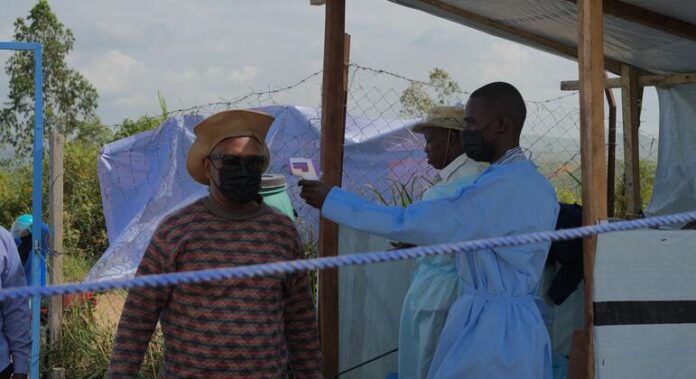
Early detection and community mobilisation remain critical to saving lives, as potential treatments and vaccines are being still being assessed, the UN health agency said on Friday.

Since 15 May, UN agencies have been supporting both the DRC and neighbouring Uganda to contain the outbreak caused by the rare Bundibugyo strain of the Ebola virus, which spreads through close contact.

“It’s a disease that you get when you care for someone, for your husband or your partner or your child or your mother,” Anaïs Legand, a WHO Technical Officer told reporters in Geneva.

You get it when you want to help someone with symptoms, and this is terrible,” she said, explaining that families and friends must be instructed not to touch loved ones who are falling sick.

30 to 50 per cent chance of death

Ms. Legand highlighted the critical importance of prevention and early access to care, in the face of this particularly deadly disease. Based on previous outbreaks the lethality “ranges between 30 and 50 per cent,” she said – “it’s huge.” 

While “five out of 10 people are likely to die,” more can be done to promote recovery, according to the WHO expert. 

“We can scale up optimized intensive care,” she said. “We can support the communities to recognize the symptoms early to get early diagnostics, so that they can receive the level of care they need.”

Experience shows that Ebola flare-ups can only be controlled when communities are “fully involved” in the response, Ms. Legrand insisted — highlighting a recent case in the DRC where a patient fully recovered and was discharged from the hospital.

Detective work

WHO has gathered experts to review potential treatments and vaccines against the virus, with several products now identified for further assessment. 

For confirmed cases, three candidate therapeutics for treatment  have been prioritised for clinical trials, Ms. Legand revealed: the monoclonal antibodies MBP 134 and maftivimab, and the antiviral remdesivir. 

© WHO/Joël Lumbala
A shipment of essential medical supplies for the Ebola response arrives at Bunia airport in Ituri province, DR Congo.

For prevention, the oral antiviral obeldesivir is being prioritised within a clinical study as a post-exposure measure for those who have been in contact with confirmed cases.

The WHO expert added that two candidate vaccines have been identified for evaluation once doses become available.

The agency is working closely with the governments of DRC and Uganda while at the same time “urgently scaling up care capacities.”

Access issue

“This outbreak is happening in a very complex context,” she stressed, recalling that in the affected Ituri province alone, 1.2 million people require humanitarian assistance, while ongoing conflict and food insecurity are hampering the response.

“The issue that we have in the field is not necessarily an issue of resources,” Ms. Legand insisted. “It’s an issue of access.”

The airport in Ituri province’s capital Bunia has been closed, and while the DRC Government has allowed humanitarian flights to proceed, operational constraints remain. “One day I got a call from my team telling me there is no fuel,” the WHO expert said.

Tedros on the ground

The WHO chief Tedros Adhanom Ghebreyesus arrived in DRC on Friday, telling reporters in the capital Kinshasa that he was there to show the community is “not alone”.

He appealed to the multiple armed groups who act with impunity in the war-ravaged eastern region to declare a ceasefire so that health workers can reach people in need and halt spread of the disease.

The DRC notified WHO of an outbreak of Bundibugyo virus disease on 15 May and as of Thursday, 125 confirmed cases have been reported, including 17 deaths across Ituri, North Kivu and South Kivu provinces. 

In addition, 906 suspected cases including over 223 deaths are under investigation and are being reviewed as testing capacity improves.

In Uganda, as of Thursday there were seven confirmed cases, including one death. WHO said that there is no evidence of community transmission in the country at this stage.

No travel restrictions, for now

While indicating that people from the affected areas who may have been exposed to Ebola should not travel, the UN health agency does not recommend any restriction on travel or trade with the DRC or Uganda based on the current information.

© WHO/Joël Lumbala
The Rwampara General Referral Hospital in Ituri Province, DR Congo.

Source link

Gaza children trapped ‘in an endless cycle of suffering’: UNICEF

0
Gaza children trapped ‘in an endless cycle of suffering’: UNICEF

“The experiences of the desperate parents I met this past week can illustrate this better than I could,” UNICEF Communication Specialist, Salim Oweis told journalists attending the bi-weekly humanitarian briefing at the UN in Geneva. 

Among them is Hind who hasn’t slept ever since her daughter Masa, 4, was bitten by a rat during the night.

They are sheltering in a building “where sewage water leaks through the ceilings, and rodents crawl through the cracks in the building and climb the exposed pipes.” 

Agony and defeat 

Another mother, Amani, is caring for her daughter Lemar, 7, who has lesions and sores on her head, back and legs from a bacterial infection. 

“Amani tries to clean her wounds each day with the little, hard-to-get, clean water she has, as her daughter screams in agony,” he said. 

Meanwhile, Abdel Aleem and his family have layered sandbags around the outside of their tent to ward off rats who “simply chew through it” as “stopping them is futile.”    

Both he and his eight-month-old son Ahmad, as well his pregnant sister-in-law, were already bitten in recent weeks. 

Parents feel helpless 

“The common thread running through every one of these conversations is the sheer heartbreak of parents who no longer feel able to do the thing most innate to them – protect their children’s health and safety,” said Mr. Olweis. 

The situation is easy to understand just by looking at the conditions in Gaza, he added, which was already among the most densely populated places in the world.   

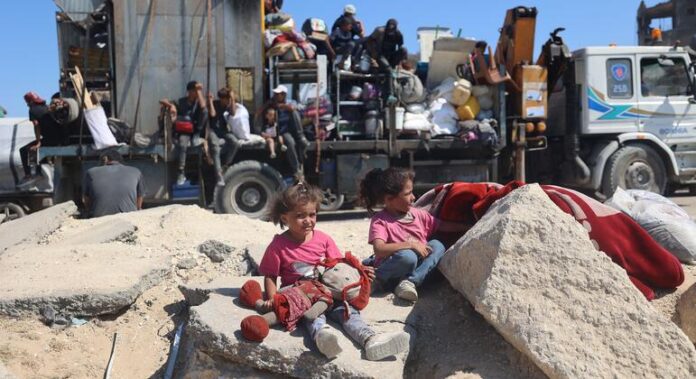
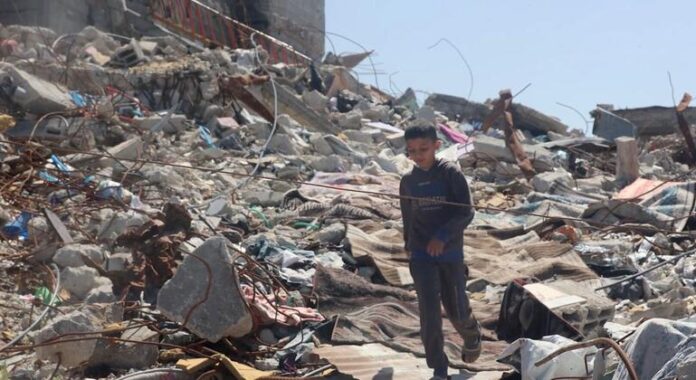
“Now, people have been crammed into around 40 per cent of the space left to them – sheltering among broken buildings, rubble and mounting solid waste,” he said. 

“Families across Gaza do not have enough clean water, they are forced to choose between drinking, washing and cooking with what little they have.” 

Obstacles and restrictions 

UNICEF is working to reach up to 1.5 million people a month with clean water but continues to face significant obstacles. 

Last month, two UNICEF-contracted truck drivers were killed while trying to collect water at Al Mansoura filling point. The water filling station – which more than a quarter of million people rely on – is now inaccessible.  

At the same time, critical items needed to sustain water systems and repair damaged water infrastructure – such as oil, water treatment chemicals and spare parts – are not being allowed into Gaza at the scale needed. 

Furthermore, solid waste is piling up by the day, alongside rubble, and both need to be cleared away.   

Disease, diarrhea and infections 

“The effects of this are now widely apparent: children with respiratory infections, acute watery diarrhoea, and more than half of all households reporting skin diseases,” said Mr. Olweis. 

Fleas, lice, and scabies are commonplace. Increasing numbers of children are requiring hospitalization. All without a single fully functioning hospital across Gaza.” 

Moreover, even though humanitarians have managed to reverse famine conditions, “the number of malnourished and vulnerable children remain extremely serious.” 

He warned that “without enough clean water and fuel to cook proper meals, even children who recover with treatment will quickly fall back in a cycle of malnutrition – the effects of which can last a lifetime.”  

An ‘entirely unconscionable’ situation 

Mr. Olweis stressed that “no parent should be in a position where they cannot provide their child with the basic needs to keep them healthy.” 

They also should not have to watch their children suffer pain from lesions or weakness due to preventable diarrhoea. 

“That this is happening should be – to everyone – entirely unconscionable,” he said. “Access to water, adequate nutritious food, and healthcare should not be conditional for any child, anywhere.” 

To break the cycle of suffering in Gaza, UNICEF calls for unfettered access for humanitarian operations, lifting restrictions on items needed to repair and sustain water and sanitation systems, and for international humanitarian law to be upheld.

Source link

Quantum metallurgy: Electron crystals deform and melt

0
Quantum metallurgy: Electron crystals deform and melt


Electrons can arrange into crystalline patterns that accumulate defects as they melt; controlling the degree of melting may advance superconductors and artificial neurons. 

A gradient of defects in an electron crystal structure. The top of the image, in blue, represents cooler temperatures in which the spacing between electron clusters (white dots) is more uniform. The structure becomes less uniform moving down towards the hotter temperatures at the bottom of the image, shown in pink. Image credit: Jeremy Shen, Suk Hyun Sung and Robert Hovden, University of Michigan Engineering.

  • Electron crystals, also called charge density waves, are clusters of electrons neatly arranged with uniform spacing, similar to the atomic structure of crystals.
  • Researchers at University of Michigan Engineering found that electron crystals can accumulate defects as they melt, similar to the melting process of physical solids. The researchers think that controlling the degree of melting may enable devices with neuromorphic computing and superconductors.
  • There is evidence of melting electron crystals in many kinds of materials, suggesting that it could be leveraged in a variety of systems.

In a process analogous to how solids melt into liquids, the electrons in many different metals form crystal-like patterns that can deform and melt, opening new pathways for neuromorphic computing and superconductors, University of Michigan Engineering researchers have found.

“Our work shows that these quantum structures, which are often thought to have a highly ordered structure, actually span a continuum of disorder that could be leveraged to engineer and control these materials,” said Robert Hovden, associate professor of materials science and engineering and corresponding author of the study published in Matter. The study was funded by the U.S. Department of Energy and the National Science Foundation.

“Metallurgists often control defects, or disorder, in metals to produce specific properties,” Hovden said. “A similar approach might help us harness the potential of quantum materials in future devices. Quantum metallurgy could be the future.”

The ability to precisely edit the structure of these electron crystals, also called charge density waves, could open new pathways for controlling superconductors—materials that transport electric current without resistance—since superconducting states can coincide with defects in charge density waves.

Controlling the structure of electron crystals could also allow engineers to rapidly turn metals into insulators, since charge density waves disrupt the flow of electricity in some conductors. Precisely switching between conductor and insulator mirrors the way brain cells transmit electrical signals, and some scientists think such materials could advance neuromorphic computing, which can process and transmit large amounts of data with little energy.

Electron crystals explained: Crystals within crystals

In a conductor, free electrons are typically distributed evenly throughout the metal. Sometimes, however, they form uniformly spaced clusters that create a wave-like pattern of alternating high and low electron density called a charge density wave.

This periodic clustering of charge resembles the atomic structure of crystals. When that order degrades, crystals physically melt, and it can happen in stages, especially when the crystal is only one or two atoms thick. Before the crystal melts completely, the distance between the atoms becomes more irregular and the rows of atoms dislocate. As a result, the sequential pattern breaks, creating tell-tale hexagonal motifs that repeat throughout the crystal lattice.

When scientists found the same intermediate melting state in charge density waves, some started to wonder if charge density waves could also melt completely. The structure wouldn’t flow like a physical liquid, but it would be a liquid in the sense that the ordered, periodic arrangement of electron clusters disappeared.

A time series of the electron diffraction patterns of the charge density wave in tantalum sulfide as it is heated. The large point represents a metal atom, and the points on the perimeter represent clusters of free electrons. The points representing the charge clusters fade and flatten out as the metal is heated. Image credit: Suk Hyun Sung and Nishkarsh Agarwal, Hovden Lab, University of Michigan Engineering.A time series of the electron diffraction patterns of the charge density wave in tantalum sulfide as it is heated. The large point represents a metal atom, and the points on the perimeter represent clusters of free electrons. The points representing the charge clusters fade and flatten out as the metal is heated. Image credit: Suk Hyun Sung and Nishkarsh Agarwal, Hovden Lab, University of Michigan Engineering.

A time series of the electron diffraction patterns of the charge density wave in tantalum sulfide as it is heated. The large point represents a metal atom, and the points on the perimeter represent clusters of free electrons. The points representing the charge clusters fade and flatten out as the metal is heated. Image credit: Suk Hyun Sung and Nishkarsh Agarwal, Hovden Lab, University of Michigan Engineering.

Melting the electron crystal

The electron diffraction pattern of a fully melted electron crystal, based on predictions made by a computer model. Image credit: Jeremy Shen, Hovden Lab, University of Michigan Engineering.The electron diffraction pattern of a fully melted electron crystal, based on predictions made by a computer model. Image credit: Jeremy Shen, Hovden Lab, University of Michigan Engineering.

The electron diffraction pattern of a fully melted electron crystal, based on predictions made by a computer model. Image credit: Jeremy Shen, Hovden Lab, University of Michigan Engineering.

Hovden’s team succeeded in melting a charge density wave inside a 2D sheet of the metal tantalum sulfide—although they couldn’t achieve a fully liquid charge density wave before the physical crystal started to change. As the electron clusters dislocated from their neat rows, the spacing between each row grew. The expanding structure increased the wavelength of the charge density wave pattern, which determines the conductivity of the material.

The researchers detected the melting by firing an electron beam at the metal as it was heated to 568 degrees Fahrenheit. When the fired electrons pass through the metal, they deflect off the atoms before hitting a camera. A spot is created at the impact site, and the arrangement of spots corresponds to the position and arrangement of atoms in the crystal.

When a metal has an electron crystal, the points that represent atoms in the diffraction pattern are surrounded by extra points that represent the positions of electron clusters. Hovden’s team found that these points smear into ovals and fade as the number of deformations in the electron crystal increases.

The researchers recreated the smearing pattern in a computer simulation that described how the melting electron crystal should diffract an electron beam. The simulation also described how the electron crystals could melt within an otherwise solid metal—the electron clusters disappear as the electronic pressure builds. Once a cluster vanishes, its composite electrons rejoin the background field.

The simulations also predicted that when the melting process completes, the diffraction ovals smeared into a faint halo surrounding the points that represent the metal’s atoms. This same halo pattern was found by researchers at UCLA after they created a liquid electron density wave.

Suspecting that the evidence for melting might have been hiding in older studies of charge density waves, Hovden’s team looked for the electron diffraction patterns in 28 studies of other metals with charge density waves. They found evidence of melting in nearly every 2D metal that they reviewed, as well as several 3D metals.

“When you look at these materials, they can have very different electrical and magnetic properties, but we can describe the core underlying physics of most of their charge density waves with this rather simple framework,” said Jeremy Shen, U-M master’s student in electrical and computer engineering and one of the study’s co-first authors. “The fact that we have one universal knob across all these systems that we could use to access different properties is very exciting.”

The charge density waves were studied at the Michigan Center for Materials Characterization, which is operated and maintained with support from indirect cost allocations in federal grants. The simulations were made with servers at U-M Advanced Research Computing.

Source: University of Michigan


Source link

Gaza: 26 killed over Eid holiday, UN rights investigators report

0
Gaza: 26 killed over Eid holiday, UN rights investigators report

The information was provided by its monitors in the Occupied Palestinian Territory (OPT) who condemned the increase in Israeli attacks as families prepared to observe Eid al-Adha. 

They said 12 Palestinians were killed in three airstrikes on 26 May, while a teenage girl died of injuries sustained in a strike the previous day that also killed a woman and a young girl, initial reports indicated.

One airstrike killed four men in a camp in Middle Gaza, reportedly after they resisted attempts to search their homes by armed gangs allegedly supported by the Israeli military. Two other men were killed when a strike hit a car in Khan Younis.

The third airstrike, against an apartment in Gaza City, killed a newly appointed commander of the Hamas Al Qassam Brigades, his wife and three children, as well as a woman passerby.

Ten people allegedly affiliated with Al Qassam Brigades were reportedly killed in a strike on 27 May.

Death, displacement and deprivation 

The office noted that Israeli forces have killed 922 Palestinians in attacks since the announcement of the ceasefire in October, bringing the overall death toll since the 7 October 2023 Hamas-led attacks to nearly 73,000, according to local authorities. 

At least 32 children and eight women have been killed in attacks since the truce. 

Meanwhile, Palestinians are still being deprived of adequate shelter, essential medicines, food and other necessities as the blockade on Gaza continues, it said.  

Nearly the entire population remains displaced and concentrated “into a progressively narrower strip of land”, with multiple displacement orders issued in recent days. 

Dire conditions, ‘unthinkable’ attacks 

The rights investigators also addressed the announcement on Thursday by Prime Minister Benjamin Netanyahu who has directed Israeli forces to expand their deployment to cover 70 per cent of Gaza’s territory. 

They said the continued contraction of areas available to civilians raises questions around access to humanitarian assistance and finding safety. 

Ajith Sunghay, head of the human rights office in the OPT, said its concern over the commission of war crimes in Gaza has not stopped. 

“It is difficult enough to navigate life in chronic displacement in the ruins of Gaza, under blockade, and after Israeli attacks virtually destroyed every essential system: healthcare, education, food production, law enforcement and civil order,” he said. 

Continuing military attacks on a population living under these conditions is unthinkable.”  

Airstrike near aid facilities 

Separately, UN aid coordination office OCHA said that an airstrike on Thursday hit a residential area near five humanitarian facilities in Deir al-Balah, central Gaza.  No casualties were reported. 

The development followed an order from the Israeli military to shelter in place shortly before the strike. 

OCHA continues to call for the opening of more crossings into Gaza for humanitarian aid and commercial supplies to be let in as only one, Kerem Shalom, remains operational. 

Humanitarian partners provided mental health and psychosocial support, as well as other protection, to more than 10,000 people between 11-17 May.     

These services – including recreational activities, art and drama sessions, counselling and parenting support – were provided in shelters, camps, schools and displacement sites.   

“Partners reiterate that to continue these services – particularly for children and adolescents – fuel, safe spaces, staff and other basic resources are needed,” OCHA said. 

Source link

The future of personalization: how AI and automation are reshaping the web-to-print industry

0
The future of personalization: how AI and automation are reshaping the web-to-print industry


Web 2 print.png scaled The future of personalization: how AI and automation are reshaping the web-to-print industry

The global market for personalized goods is evolving at a breakneck pace, driven by rapid advancements in artificial intelligence and a shift in consumer behavior. Today, success in the web-to-print sector requires more than just offering custom products; it demands an agile business model that seamlessly links a high-converting digital storefront with a hyper-efficient production line. This article explores the dominant trends defining the future of personalization and outlines how a unified technical ecosystem can help businesses capture market share and scale sustainably.

Rising customer expectations and the shift toward intelligent personalization

The global personalized goods market is undergoing a profound structural shift. For years, simply offering consumers the ability to add custom text or photos to a product was enough to secure a competitive advantage. Today, however, customization has become commoditized. As the market matures, consumer loyalty is no longer won by the mere availability of personalized options, but by the speed, ease, and quality of the entire design and purchasing experience.

A major catalyst for this change is the “Amazon effect.” Modern consumers have been conditioned to expect frictionless digital interactions, instant gratification, and ultra-fast fulfillment. This expectation has extended directly into the personalized photo and print sector. Buyers are no longer willing to spend hours wrestling with rigid, unintuitive design templates to create a custom product, nor are they willing to tolerate weeks of production delay.

Furthermore, this demand for speed is heavily amplified by a generational shift toward mobile-first commerce. Younger demographics capture their entire lives on smartphones. They expect to curating, designing, and purchasing high-end personalized items while on the go, utilizing the native capabilities of their devices. If a brand’s mobile storefront feels like an afterthought or introduces technical friction, these consumers will instantly migrate to a competitor that offers a more streamlined experience.

Giving consumers creative power through artificial intelligence

To thrive in this hyper-competitive landscape, brands must fundamentally rethink how they approach the user journey. The future of personalization lies in removing the “work” from the creative process. This is where artificial intelligence acts as the ultimate industry differentiator, shifting the burden of layout design from the consumer to intelligent software.

By leveraging advanced machine learning algorithms, modern e-commerce systems can instantly analyze user data—such as image quality, facial recognition, timestamps, and compositional balance—to automatically curate and compile a stunning product layout in a matter of seconds. This turns what used to be a daunting, multi-hour chore into an interactive, high-speed experience. For the business, this drastic reduction in friction leads directly to significantly higher conversion rates, increased average order values, and stronger brand loyalty.

To capitalize on these growing macro trends, brands must move away from static, rigid templates and embrace dynamic, adaptive interfaces. Staying ahead of the competition requires investing in an advanced, responsive web to print design software that utilizes smart layout generation and automated image curation. By removing the friction from the design phase, businesses can significantly increase engagement and drive higher average order values. To explore how cutting-edge front-end technology can elevate your brand’s digital presence, visit https://www.getprintbox.com/features/web-to-print-software 

The backend revolution: why operational agility is the ultimate competitive advantage

While capturing consumer attention through an AI-powered storefront is a massive achievement, it represents only the first phase of a successful modern web-to-print strategy. In the high-velocity world of personalized e-commerce, an exceptional frontend user experience means very little if your manufacturing floor lacks the operational agility to keep pace with demand. The real battle for profitability is fought and won in the backend.

Traditional print business models were built on predictability and volume—large runs of identical items with generous lead times. Disconnected systems, where the e-commerce platform, the prepress station, and the production floor operate in independent silos, simply cannot handle the fragmentation of modern personalization. When every single order is a unique, one-off job, manual intervention at any stage creates catastrophic bottlenecks. To meet today’s market standard of near-instant fulfillment, print service providers must undergo a backend revolution.

The strategic objective for forward-thinking enterprises is to build a completely interconnected software stack. In this unified ecosystem, production data flows organically and instantaneously from the customer’s shopping cart directly to the printing hardware. By eliminating the friction of manual file handling, sorting, and pre-flighting, businesses can transform their print shop into a high-speed, agile fulfillment network capable of scaling effortlessly during peak seasonal demands.

Building a resilient ecosystem from clicks to delivery

Achieving this level of technical synergy requires looking beyond individual software features and focusing on end-to-end integration. When the frontend design tool and the backend production system are perfectly aligned, the transition from a digital click to a physical product becomes completely seamless.

This integration not only reduces operational overhead and material waste but also protects your business from the chaos of handling thousands of bespoke orders, turning your logistics and production into a highly predictable, repeatable science.

Ultimately, the future of the print industry belongs to businesses that successfully bridge the gap between creative user intent and technical execution. True market leaders understand that an automated print workflow is the engine that converts digital storefront traffic into actual bottom-line revenue by eliminating human error and cutting fulfillment cycles down to a minimum. To read an in-depth, strategic analysis of how to implement these robust automation solutions in your own enterprise, check out the comprehensive guide available at https://www.getprintbox.com/blog/what-is-web-to-print-workflow-comprehensive-guide-to-print-workflow-solutions-and-software/ 

Winning the future of personalization through total integration

The future of the web-to-print industry does not belong exclusively to the best marketing campaigns or the most advanced printing hardware. Instead, it belongs to the companies that view front-end consumer artificial intelligence and back-end production automation as two sides of the exact same coin. True market leadership is achieved only when these two forces operate in total technical harmony.

As consumer demand for highly personalized, on-demand products continues to rise, businesses can no longer afford to operate with fragmented, siloed systems. By bridging the gap between a friction-free browser experience and an error-free, automated production floor, you create a highly resilient business model built for long-term growth. Embracing this integrated ecosystem is how you turn a customer’s creative spark into a high-quality physical product on their doorstep in record time, ensuring your brand remains profitable, scalable, and ahead of the curve for years to come.


Source link