Friday, May 1, 2026
Home Blog Page 643

Gehenna as “Hell” in Ancient Judaism = The Historical Basis For A Powerful Metaphor (1)

0

By Jamie Moran

1. The Jewish Sheol is the exact same as the Greek Hades. No loss of meaning occurs if, on every occasion when Hebrew says ‘Sheol’, this is translated as ‘Hades’ in Greek. The term ‘Hades’ is well known in English, and thus might be preferred to the term ‘Sheol.’ Their meaning is identical.  

Neither Sheol nor Hades are the same as the Jewish ‘Gehenna’ which should only be translated as ‘Hell.’

Sheol/Hades= abode of the dead.

Gehenna/Hell= abode of the wicked.

These are two qualitatively different places, and should never be treated as the same. The King James Version of the Jewish and Christian Scriptures translates all occurrences of Sheol and Gehenna as ‘Hell’, but this is a huge mistake. All modern translations of the Jewish and Christian Scriptures only use ‘Hell’ when Gehenna occurs in the original Hebrew or Greek text. When Sheol occurs in Hebrew, it becomes Hades in Greek, and if Hades is not deployed in English, then an equivalent expression is found. The English term ‘prison’ is sometimes preferred in relation to ‘the departed’, but this is ambiguous, because in different senses, Hades and Gehenna are both ‘imprisoning.’ To speak of persons in the afterlife as in some sense in jail does not adequately differentiate Sheol/Hades from Gehenna/Hell. It is important to note the difference, because Hades as Deadness and Hell as Evil carry very different implications in any text where they occur. Modern Jewish scholars speak with one voice – very unusually for them – in asserting that only Gehenna should be translated as ‘Hell.’ [An old Anglo-Saxon word, claims one writer, meaning ‘hidden.’]   

It is the qualitative difference in human experience, and difference in symbolic meaning, that sets out a clear contrast.

[1] Sheol/Hades=

A place of forgetfulness, ‘deadness’, ghost-life= half-life.

Dark and gloomy= ‘insubstantial’; a nether-world, the mythical ‘Underworld.’

David in the Psalms refers to Sheol as a ‘Pit.’

[2] Gehenna/Hell=

A place of unquenchable fire and the worm that does not die; the place of torment.

Those in Gehenna feel pain and weep. The worm gnawing away at the dead corpse= remorse. The burning flames that do not let up= self-reproach.  

Abraham saw Gehenna as a ‘Fiery Furnace.’

Thus, Hades/Sheol= a Pit of Deadness underground, whilst Gehenna/Hell= a Furnace of Evil [equated with a Valley that has become like a furnace].

2. Around 1100 AD, the Jewish Rabbinical tradition identified Gehenna as the rubbish dump outside Jerusalem, where ‘filth’ was cast away. Though Gehenna is a symbol, a figurative expression, the equation of the symbol with the ‘Valley of Hinnom’ is very plausible.

 ‘Gehenna’ is Greek, yet it could very well come from the Hebrew for the Valley of Hinnom= ‘Ge Hinnom’ [thus= Gehinnom].’ In the Talmud, the name is ‘Gehinnam’, and in the Aramaic spoken by Jesus= ‘Gehanna.’ In modern Yiddish= ‘Gehenna.’

If the Valley of Hinnom below Jerusalem is indeed the origin both for the symbol and linguistic terminology of Gehenna passed on from Judaism into Christianity, that would make sense of the ‘unquenchable fires’ and ‘worms that do not die’.. Both these images are from Isaiah, and Jeremiah, and when Jesus uses Gehenna 11 times in the New Testament, he means Gehenna, not Hades or Sheol, because he borrows that exact prophetic imagery.

3. The story about Gehenna as a literal topographical place at a certain moment in time is very meaningful in regard to why it symbolically became Hell.

The valley began as a place where worshippers of the Canaanite pagan religion sacrificed their children [Chronicles, 28, 3; 33, 6] to the pagan deity called Moloch [one of several pagan ‘lords’, or Ba’als= St Gregory of Nyssa links Moloch to Mammon]. These worshippers of Moloch burned their children in fire, in order to get worldly gain= worldly power, worldly riches, comfort and luxury, ease of life. Already this gives a profound meaning= Hell is the sacrificing of our children for religious reasons, when religion is used idolatrously to grant us an advantage in this world. That links to a saying of Christ, which asserts that, though offences against children must come, it would be better for the person committing them if he had been thrown into the ocean and drowned to prevent him from doing such a grave crime. It is better to die and end up in Hades, in the afterlife, than to commit hellish crimes against the innocence of children in this life. To be in Hell, in this life or beyond it, is far more serious than simply expiring.. Yet, which of us has not, in ways blatant or subtle, harmed the children entrusted to our care by God? Killing off the child-like spark, before it can be ignited, is a key strategy by the devil for blocking the redemption of the world.

To the Jews, this place of idolatry and pagan cruelty was an utter abomination. Not only followers of the Canaanite religion but apostate Jews ‘practiced’ child sacrifice in this place, for religious reasons [Jeremiah, 7, 31-32; 19, 2, 6; 32, 35]. No worse place on earth could be imagined for any Jew following Yahweh. [This throws the story of Abraham into a very different light.] Such a place would attract evil spirits and evil forces in real numbers. ‘This is hell on earth’ we say, referring to situations, events, happenings, where evil power seems to be concentrated, so that doing good, or loving sacrificially, is particularly opposed from ‘the surrounding atmosphere’, and therefore becomes very difficult, if not virtually impossible.  

Over time, the Jews used this numinously hideous valley as a rubbish dump. It was not merely a convenient place to throw away unwanted debris. It was regarded as ‘unclean’, religiously. Indeed, it was regarded as a place utterly ‘accursed’ [Jeremiah, 7, 31; 19, 2-6]. Thus for the Jews, it was a place of ‘filth’, literally and spiritually. Things regarded as ritually unclean were dumped there= the carcasses of dead animals, and the bodies of criminals. The Jews buried people in tombs above ground, thus for the body to be cast away in this manner was considered horrendous, almost the worst that could befall someone.

The ‘unquenchable fires’, and the ‘worms gnawing away without ever stopping’, as two images which are taken as definitive of what happens in Hell, come from a reality, then. They are not purely metaphorical. The Valley had fires burning in it all the time, to burn up the filthy trash, and especially the rotting flesh of animals and criminals, and of course, legions of worms found the corpses delicious= they literally became worm food. So= the ‘Hell’ derived from the Valley of Gehenna is a place of ever burning fires – with sulphur and brimstone added to make that burning more efficacious – and hordes of worms always eating.

Though Judaism before Jesus already had a multiplicity of differing interpretations, one point stands out, and should be flagged up as necessary to any understanding of Hell – as distinct from Sheol/Hades. Ending up in Hell is a kind of debacle, a disgrace, a loss of honour, a sign of no integrity, a ‘destruction.’ In Hell, all your plans, works, aims, projects, end up ‘destroyed.’ Your life work, what you ‘did’ with your time in the world, comes to catastrophic ruin.

4. The Rabbinic method of teaching, which Jesus deployed in the same manner as earlier Jewish rabbis, blends the historical and the symbolic ‘as one.’ The rabbis, and Jesus is the same, always choose some literal historical reality, and then add heights and depths of symbolic meaning to it. This means that two converse kinds of hermeneutic are false to this method of storytelling to teach life lessons to listeners of the stories.

On the one hand=-

If you interpret the sacred text only literally, as fundamentalists and evangelicals, or the religiously conservative do, you miss the point. For there is a wealth of symbolic meaning latent in the literal historical ‘fact’ which gives it more meaning that its sheer factuality can transmit. Starting with the literal historical, the meaning takes you into other dimensions at a remove from that particular time and place, and not confined to it. This extra meaning can be mystical or psychological or moral; it always expands the ‘ostensible’ meaning by bringing mysterious spiritual factors into play. The literal is never simply literal, because the literal is a metaphor for something beyond it, yet incarnate in it. The literal is a poem– not a computer print-out, or a set of rational-factual statements. These kinds of literalism have a very limited meaning. They mean little, because their meaning is limited to only one level, a level not rich in meaning, but deprived of meaning.

Studying Hasidic Jewish interpretations of the Hebrew text of the Jewish Bible is very instructive. These interpretations use the historical narrative as spring-boards to symbolic meanings quite far from any literalist reading. Very subtle layers and levels of meaning are uncovered. Yet it is these subtleties which inhere, indwell, ‘what really happened.’  

On the other hand=

If you interpret the sacred text only metaphorically, or symbolically, denying that the particular embodiment in which it is couched matters, then you proceed more in a Greek Hellenic, not a Jewish, manner. You go too fast to disembodied universals of meaning, or generalities that supposedly apply across the board, anywhere at any time. This anti-literalist approach to the Rabbinical method of meaning-making also falsifies it. For Jews, the particular place and the particular time matters in the meaning, and cannot be shed as if it were merely an ‘outer suit of clothing’, not the ‘inner reality.’ The true meaning is incarnate, not disincarnate= not floating in some space, whether that non-physical domain is seen as psychological or as spiritual [or a mixture of the two= the ‘psychic matrix’]. The true meaning therefore has a body, not just a soul, for the body is what ‘anchors’ meaning in this world.

Such incarnateness of meaning is asserting that the extra symbolic meanings are ‘situated’ in a given historical context, and the sheer fact they are contextualised, and how they are contextualised, is important to interpreting them. Even if he had subsequent generations in mind, Jesus was teaching first century AD Jews living in a very definite setting, and much of what he says to them has to be interpreted in terms of those people, in that time and in that place.

Yet, given how often Jesus quotes from the Psalms and Isaiah, often echoing them directly in his words [echoes that his audience would have picked up], implies that he saw analogies between past events and present events. He used a form of what is called ‘types’ in his meaning-making= certain symbols recur, in different forms, not because they are ‘archetypes’ in Plato’s or Jung’s sense, but because they refer to mysterious spiritual meanings and energies repeatedly intervening in historical circumstances, always doing something similar as in the past [creating continuity] and always doing something new different from the past [creating discontinuity]. In this way, Jesus upholds an ongoing ‘progressive revelation’ with both ongoing themes and new departures, leaps forward, not foreseeable. New occurrences of types, in altered circumstances, bring new meanings, but often throw additional meaning on the old types. They mean more, or mean something different, when seen retrospectively. In this way, tradition never stalls, simply repeating the past, nor does it just break off from the past.

Gehenna/Hell has to be read in this complex Rabbinical way, understanding both its historical context and the hidden meanings latent in its potent symbolism. Only if are aware of both aspects do we use an interpretation which is ‘existential’, not the metaphysical on its own, nor the literal on its own. Neither is Jewish.

5. “Two rabbis, three opinions.” Judaism has always, to its credit, tolerated multiple interpretations of sacred texts and indeed had different streams of interpretation of the whole of religion. This is very evident in regard to the interpretation of Gehenna/Hell. Judaism does not speak with one voice on this significant matter.

There were Jewish writers even before the time of Jesus who saw Hell as punishment for the wicked= not for those who are a mix of righteousness and sin, but for those given over, or given up, to real wickedness, and likely to go on forever; other Jewish writers thought of Hell as purgational. Some Jewish commentators thought of Sheol/Hades as purgational.. It is complicated.

Most schools of thought believed that Hades is where you go after death. It is ‘The Land of the Dead’ in many mythical systems. It is not annihilation, or complete obliteration of the human personhood or its consciousness. It is where, once the body is dead, the soul goes. But the soul, without body, is only half alive. Those in Hades/Sheol are ghostly in a strong symbolic sense= they are cut off from life, cut off from people alive in the world. They continue, as it were, but in some reduced state. In this respect, the Jewish Sheol and Greek Hades are very much the same.

Sheol/Hades was regarded an ante chamber where you go after death, to ‘wait’ for the general resurrection, in which all people will regain body as well as soul. They will not be, ever, ‘purely’ spirit.

For some Jewish commentators, Sheol/Hades is a place of atoning for sins, and as such, is definitely purgational. People can ‘learn’, they can still face their life and repent, and let go of the ‘dead wood’ they clung on to in life. Hades is a place of regeneration, and healing. Hades is restorative, for those who avoided inner wrestlings with inner truth in their time in this world.

Indeed, for certain Jews, Sheol/Hades had an upper chamber and a lower chamber. The upper chamber is paradise [also ‘Abraham’s bosom’ in the parable of the rich man who shuns the leper at his gate], and is where people having attained sanctity in their life on earth go once it ends. The lower chamber is less salubrious but holds out the possibility of shedding past mistakes. It is not an easy place, but its outcome is very optimistic. The ‘lower’ people are less advanced, and the ‘higher’ people are more advanced, but once Hades does its work, they are all equally ready for the entry of all humanity into the ‘everlasting.’   

For other Jewish commentators, Gehenna/Hell — not Sheol/Hades — was the place of purgation/purifying/cleansing. You atoned for your sins, and thus sin itself was burned out of you, like fire consuming rotten wood. At the end of that ordeal in the furnace, you were ready for the general resurrection. You spent only 1 year in Hell! Moreover, only 5 people were in Hell forever! [The list must have increased by now..]

For modern Hasidism, once purged — wherever that occurs — the soul that is resurrected with its body proceeds on to heavenly happiness in the unceasing [olam to olam] kingdom of God. These Hasids tend to dismiss the idea of a Hell where wicked people remain eternally, and are punished eternally. If a Hasidic Orthodox Jew uses the symbol of ‘Hell’, it invariably has a purgational effect. The Fire of God burns out sin. In that sense, it readies the person for eternal bliss, and hence is a blessing, not a curse.

6. For many Jews before the time of Jesus, however, there is a markedly different interpretation which is entirely Dualistic= this stream of Jewish tradition resembles the belief in ‘Heaven and Hell’ as eternal principles in the afterlife held by Fundamentalist and Evangelical Christians of today. But, many Jews and Christians down the ages have held to this Dualistic belief about the split eternity awaiting humanity. On this view, the wicked ‘go to Hell’, and they go there not to be purged, or regenerated, but to be punished.  

Thus, for Jews of this perspective, Sheol/Hades is a sort of ‘half-way house’, almost a clearing-house, where people who have died await the general resurrection of everyone. Then, once everyone is raised in body and soul, the Last Judgement occurs, and the Judgement determines that the righteous will go to Heavenly bliss in God’s presence, whilst the wicked will go to Hellish torment in Gehenna. This Hellish torment is eternal. There is no let up, no change possible.

7. It is easy enough to locate places in both the Jewish Bible and the Christian Bible where this long-standing Dualism seems to be supported by the text, though often that is ‘open to interpretation.’

None the less, it is more truthful to acknowledge that at times, Jesus sounds Non Dualistic, even Anti Dualistic, whilst at other times, he sounds Dualistic. As is his way, he confirms older tradition even as he upends it by introducing new elements into the ongoing tradition. If you accept it all, a very complex dialectic of severity and universality emerges.

Hence the paradox of both Jewish and Christian Scriptures is that Dualistic and Non-Dualistic texts both exist. It is easy to pick one kind of text, and ignore the other kind. This is either a clear-cut contradiction; or, it is a tension that has to be accepted, a mysterious paradox. Justice and Redemption co-inhere in Judaism, and Jesus does not disturb that two-faceted manner in which the Fire of Spirit, the Fire of Truth, the Fire of Suffering Love, functions. Both horns of the dilemma are necessary..

A certain strictness [truth] is what, paradoxically, leads to mercifulness [love].

8. For the Jews prior to the time of Jesus, sins likely to put a person in Gehenna included some obvious things, but also some things we might or might not question today= a man who listened too much to his wife was headed for Hell.. But more obviously= pride; unchastity and adultery; mockery [contempt= as in Mathew, 5, 22]; hypocrisy [lying]; anger [judgementalism, hostility, impatience]. The Letter of James, 3, 6, is very Jewish in claiming that Gehenna will set the tongue on fire, and the tongue then sets on fire the entire ‘course’ or ‘wheel’ of life.

Good Deeds that protected a person from ending up in Hell= philanthropy; fasting; visiting the sick. The poor and the pious are especially protected from ending in Hell. Israel is more protected than the pagan nations all around her and always threatening her..

The worst of all sins= the idolatry of ‘sacrificing our children for religious reasons’, in order ‘to get on’ in this world. When we idolise a false ‘god’, it is always to get worldly benefits, it is invariably to profit from whatever we sacrifice to please this deity’s demands= ‘if you give me your children, I will give you the good life.’ This sounds more like a demon than a god. A deal is struck, you sacrifice something genuinely precious, then the devil will bestow upon you all manner of earthly rewards.

A literal interpretation protests that such things do not happen in our modern, enlightened, progressive, civilised, society! Or if they do, only in backward corners of that society, or only among backward uncivilised peoples.

But a more symbolic-historical interpretation concludes that these very civilised peoples are all engaged in sacrificing their children to the devil, for the worldly gain it will bring them. Look more closely. Look more subtly. This most hellish of all actions is something many parents are doing to their children as a matter of routine, for it reflects the unacknowledged reality of society as a system where, in order to fit in, violence must be done to the person= they can never be true to their native humanity. Leonard Cohen has an amazing song about this, ‘The Story of Isaac’=

The door it opened slowly,

My father he came in,

I was nine years old.

And he stood so tall above me,

His blue eyes they were shining

And his voice was very cold.

He said, “I’ve had a vision

And you know I’m strong and holy,

I must do what I’ve been told.”

So he started up the mountain,

I was running, he was walking,

And his axe was made of gold.

Well, the trees they got much smaller,

The lake a lady’s mirror,

We stopped to drink some wine.

Then he threw the bottle over.

Broke a minute later

And he put his hand on mine.

Thought I saw an eagle

But it might have been a vulture,

I never could decide.

Then my father built an altar,

He looked once behind his shoulder,

He knew I would not hide.

You who build these altars now

To sacrifice these children,

You must not do it anymore.

A scheme is not a vision

And you never have been tempted

By a demon or a god.

You who stand above them now,

Your hatchets blunt and bloody,

You were not there before,

When I lay upon a mountain

And my father’s hand was trembling

With the beauty of the word.

And if you call me brother now,

Forgive me if I inquire,

“Just according to whose plan?”

When it all comes down to dust

I will kill you if I must,

I will help you if I can.

When it all comes down to dust

I will help you if I must,

I will kill you if I can.

And mercy on our uniform,

Man of peace or man of war,

The peacock spreads his fan.

Then, in reading ‘the sacrifice of our children for profit’ more metaphorically, extend the crime against children into, quite simply, the sacrifice of the most vulnerable humans for the sake of Mammon. The ‘crime against humanity’ is widespread; it has many takers today, as it always did.

The Valley of Gehenna, as a Hell on earth, a Hell in the world, is a typology much the same today as in the past. Hell is one of the constants in human existence over all of time.

Why? That is the real question.

(to be continued)

How is the UN helping civilians in Gaza?

0
How is the UN helping civilians in Gaza?

How is the UN helping civilians in Gaza?

Source link

Putin‘s personal gerontologist, who worked to extend life to 120 years, has died

0

Vladimir Havinson, one of the most famous Russian gerontologists, member of the Russian Academy of Sciences and founder of the Institute of Gerontology, died at the age of 77, The Moscow Times reports.

Havinson has been called “Putin’s personal gerontologist” in the press and has spent decades researching the aging process and ways to extend active life, developing 13 drugs and 64 nutritional supplements. In 2017, Putin awarded Havinson with the “Order of Friendship” medal for significant achievements in medicine. In an interview with the publication “Fontanka” before the ceremony, Havinson stated that the endurance of the human organism can reach 120 years, but not less than 100 years. “In the Old Testament, it says that God gave man so many years to live,” Havinson explained.

“The Guinness Book record is 122 years, held by Anna Kalman of France. In Russia, the record is 117 years, held by Varvara Semenyakova. So 100 years is the minimum. Havinson promised Putin “at least another 20 years” active life and called the Russian president a “role model” with “tremendous potential”.

In the past, Havinson has also emphasized that medicine should extend the life of leaders in the state apparatus, because “no one can ever replace an experienced leader.” “And without him, a political crisis will begin in the country,” Havinson added.

Illustrative Photo of the Russian Academy of Sciences by Arthur Shuraev: https://www.pexels.com/photo/russian-academy-of-sciences-15583213/.

Getting older doesn’t make you wiser, a scientific study has shown

0

Aging does not lead to wisdom, a scientific study has shown, reported “Daily Mail”. Dr. Judith Gluck of the University of Klagenfurt, Austria, conducted research linking age to mental capacity.

The link between aging and getting wiser cannot be proven statistically, the study finds, despite popular culture.

Getting older won’t necessarily make you smarter, Dr. Gluck said. Life experience is not enough. “There is no universal trajectory of intellectual development, in other words, people around the world don’t get wiser over the years,” she added.

Life experience can only be a basis. But many elderly people are not particularly wise, writes BTA.

Characteristics of wisdom include the ability to empathize, control emotions, openness. Wisdom is the source of the ability to cope with challenges such as loneliness, especially in old age, Dr. Gluck said. However, it can even “decrease” with age.

Illustrative Photo by Pixabay: https://www.pexels.com/photo/woman-praying-post-236368/

France melts down 27 million coins due to faulty design

0

France has melted down 27 million coins after the European Union declared that their designs did not meet requirements. The Monnaie de Paris, the country’s mint, produced the 10, 20 and 50 cent coins with a new design in November, but later found that the way the stars of the EU flag were depicted did not meet the exact requirements of the European Commission. Under EU law, countries can change the design of the “national” face of euro coins every 15 years, but they need the green light from the Commission, as well as other eurozone governments, who must be informed and have seven days. to raise objections. France informally contacted the Commission in November before making a formal request for design approval, but the mint went ahead without waiting for EU approval. It then received an informal warning from the Commission, which emphasized that the new design was not in line with EU rules, according to a French economy ministry official with direct knowledge of the matter. A Commission spokesman confirmed to Politico that the French finance ministry formally presented the revised design on December 12, which received EU approval on December 21. The new coins were to be unveiled during the visit of French Economy and Finance Minister Bruno Le Maire to the Monnaie’s prestigious headquarters in Paris. Not surprisingly, it didn’t end up happening. Secret Design Now a blame game has begun between Monnaie and the government. The same economy ministry official stressed that Monnaie is an autonomous public company and not part of the French administration. This means that the Monnaie will fully cover the costs of re-minting the coins. “There will be no cost to the French taxpayer as the company will bear it,” the official said. The case was first reported by French media outlet La Letre, which quoted the head of Monnaie de Paris, Marc Schwartz, as saying that the “French state” was responsible for what happened. The design of the new coins, proposed by the French government and approved by the Commission, is still a secret and will be revealed before spring, the French economy ministry said.

Illustrative Photo: 1850 20 French Francs gold coin. This version has the image of Ceres – the Goddess of agriculture and the reverse has the value and year surrounded by a wreath. The reverse has the value and year surrounded by a wreath. The text reads LIBERTE EGALITE FRATERNITE and REPUBLIC FRANCAISE.

Gaza ceasefire ‘more urgent than ever’ as conflict approaches 100-day mark

0
Gaza ceasefire ‘more urgent than ever’ as conflict approaches 100-day mark

Speaking ahead of Sunday’s grim milestone, Spokesperson Liz Throssell reiterated the need for OHCHR staff to have access to Israel and all parts of the Occupied Palestinian Territory to investigate human rights violations by all parties.

Fourteen weeks have passed since Hamas and other Palestinian armed groups carried out bloody attacks against Israel on 7 October 2023, killing 1,200 people and taking roughly 250 others hostage, 136 of whom are still believed to be in captivity in Gaza.

End the suffering 

In response, Israel launched a massive and destructive military response. More than 23,000 Palestinians have been killed to date, mainly women and children, while civilian infrastructure including homes, hospitals, schools, bakeries, places of worship, water systems, and UN facilities, have been damaged or destroyed. The majority of Gaza’s 2.2 million population are now displaced.

Ms. Throssell recalled that UN High Commissioner for Human Rights Volker Türk has repeatedly called for an immediate ceasefire “to end the appalling suffering and loss of life, and to allow the prompt and effective delivery of humanitarian aid to a population facing shocking levels of hunger and disease,” adding “this is more urgent than ever.”

Addressing the conduct of hostilities, she said OHCHR have repeatedly highlighted Israel’s recurring failures to uphold the fundamental principles of international humanitarian law, namely distinction, proportionality, and precautions in carrying out attacks.

War crimes risk 

“The High Commissioner has stressed that breaches of these obligations risk exposure to liability for war crimes and has also warned of the risks of other atrocity crimes,” she said. 

She noted that intense Israeli bombardments from air, land and sea are continuing across much of the Gaza Strip, particularly in the Deir al Balah and Khan Yunis governorates, where tens of thousands of people had previously fled in search of safety.

Meanwhile, Palestinian armed groups have continued to launch indiscriminate rockets towards Israel, some of which have been intercepted, she said.  

Obligation to protect 

Ms. Throssell urged the Israeli Defence Forces (IDF) to take immediate measures to protect civilians, in line with international law.

“Ordering civilians to relocate in no way absolves the IDF of its obligations to protect those who remain, regardless of their reasons, while carrying out its military operations,” she said. 

Israel also must immediately end arbitrary detention, torture, ill-treatment and enforced disappearance of Palestinians in Gaza, she added, noting that hundreds of people are reportedly being held in several unknown locations both within and outside the enclave. 

Desperation and dire shortages 

OHCHR also highlighted the “desperate scenario” in northern Gaza, where people face dire shortages of food, water and other basic items.

“Access to humanitarian aid remains extremely difficult, despite repeated pleas by the UN to the IDF to facilitate movement of humanitarian aid convoys,” said Ms. Throssell, before turning to the situation in the south, where over 1.3 million displaced people are now crammed into the city of Rafah, which previously had 300,000 inhabitants.

Situation in the West Bank 

Moving to the West Bank, she said OHCHR has verified the deaths of 330 Palestinians, including 84 children, since the start of hostilities. The majority, 321, were killed by Israeli security forces, while eight were killed by settlers.

She added that entire herding communities have been forcibly displaced due to settler violence, which may amount to forcible transfer.

Last month, OHCHR issued a report on the West Bank which stressed the need for an immediate end to the use of military weapons and methods during law enforcement operations.  It also called for an end to arbitrary detention and ill-treatment of Palestinians, and the lifting of discriminatory movement restrictions.

“Lack of accountability for unlawful killings remains pervasive, as does impunity for settler violence, in violation of Israel’s obligations as the occupying power to ensure safety of Palestinians in the West Bank,” said Ms. Throssell. 

OHCHR’s office in the Occupied Palestinian Territory, which continues to monitor and document the human rights situation in Gaza and the West Bank, will submit two reports to the UN Human Rights Council during its next session in February in Geneva.

In Gaza, children wait to receive food as the bombardments on the enclave continue.

‘Triple threat’ for children 

Meanwhile, the UN Children’s Fund, UNICEF, warned against the “triple threat” of conflict, disease and malnutrition “stalking” boys and girls in Gaza. 

The suffering has been too much, said UNICEF Special representative on the situation of children in the State of Palestine, Lucia Elm, speaking to journalists in Geneva. 

“With every passing day, children and families in the Gaza Strip face increased risk of death from the sky, disease from lack of safe water, and deprivation from lack of food.  

“And for the two remaining Israeli children still held hostage in Gaza, their nightmare that began on 7 October continues,” she said, appealing for their unconditional release. 

She also spoke about how the bombardment is hampering delivery of desperately needed assistance.  

“When I was in Gaza last week, we tried for six days to get fuel and medical supplies to the north and for six days movement restrictions prevented us from travelling. My colleagues in Gaza endured this same challenge for weeks before my arrival,” she said. 

Ms. Elm said thousands of children have already died in the conflict and thousands more young lives are at risk unless action is taken to address the “urgent bottlenecks” of safety, logistics surrounding humanitarian aid delivery and distribution, and increasing the volume of commercial goods for sale in Gaza.

Birth amid bombardment 

A senior official with the UN’s sexual and reproductive health agency, UNFPA, said on Friday he was “terrified” on behalf of the one million women in effect trapped in Gaza, including scores of expectant mothers.

Dominic Allen, UNFPA Representative for the State of Palestine, recently visited the enclave, where around 5,500 pregnant women are due to give birth in the coming month – at a time when 15 out of 36 hospitals are only partially functional, according to the World Health Organization (WHO).

Mr. Allen said he cannot stop thinking about the women he met, many of whom suffer from thirst, malnutrition, and lack of health.

“If the bombs don’t kill them; if disease, hunger and dehydration don’t catch up with them, simply giving life will.  And we can’t let this happen,” he said, speaking from Jerusalem.

Local hospitals overwhelmed 

Mr. Allen visited several hospitals in southern Gaza, including Nasser Hospital in Khan Younis, where UNFPA, WHO and UNICEF have supported maternal health services for years.   

The hospital was unrecognizable from his last visit, just six months ago, as 8,000 internally displaced people (IDPs) are now sheltering there.  Trauma cases are “overwhelming” the maternity and other wards, forcing patients to be transferred to another nearby facility.

Meanwhile, doctors at the Emirati Hospital in Rafah are performing up to 80 births daily, 20 by Caesarean section. Capacity constraints mean that pregnant women “have to rotate in and out” of the five birthing suites.

“Women who are in their final stages of labour having to step out of that room to enable another pregnant woman to step in,” he said.

New mothers are being discharged mere hours after giving birth. Those who delivered by C-section are leaving hospital after one day, if they are able.

Scale-up aid 

UNFPA assistance to Gaza includes provision of reproductive health kits, which contain various components including for emergency obstetric care. Although doctors at some hospitals said this aid is helping to save lives, Mr. Allen was told that supplies provided through the Emirati Hospital “are barely touching the ground”. 

An estimated 18,000 babies have been born since the start of the conflict, based on the supplies UNFPA was able to get into Gaza “but much more is needed”, he said, appealing for safe, unhindered and rapid access to north.

He praised the UN agency that assists Palestinians, UNRWA, which is hosting more than a million people in its facilities across the Gaza Strip.

At one site that he visited – a technical college in Khan Younis housing 40,000 IDPs, including two UNFPA staff and their families – people have to queue for an hour just to use the bathroom.

The UN humanitarian affairs office, OCHA, reported that new evacuation orders issued by Israel on Thursday could impact thousands in southern Gaza.

Residents of the Al Mawasi area and several blocks near Salah Ad Deen Road – covering an estimated 4.6 square kilometres – have been ordered to move to Deir al Balah ahead of Israeli military operations.

More than 18,000 people and nine shelters accommodating an unknown number of IDPs are expected to be affected. 

OCHA also repeated its call for access to northern Gaza.  Since 1 January, only five of 24 planned deliveries of food, medicine, water and other aid has gone through, according to its latest update.


Source link

360 Feedback Software: The Science Behind Its Intricate Design

0
360 Feedback Software: The Science Behind Its Intricate Design


In the realm of performance management and nurturing employee development, there’s a tool called 360 feedback software. Organizations worldwide have come to realize the advantages it brings in fostering employee growth and driving performance enhancements. This blog post aims to explore the science behind the design of this software, shedding light on its features and effectiveness.

Human resources management - artistic interpretation.

Human resources management – artistic interpretation. Image credit: 8photo via Freepik, free license

Understanding 360 Feedback Software

To kick things off, 360 feedback software is specifically crafted to provide individuals with feedback about their skills, competencies, and behaviors from sources. In the past, performance evaluations were typically limited to assessments given by a manager from a down perspective. However, with the introduction of 360-degree feedback, this concept underwent a transformation by incorporating inputs from peers, subordinates, superiors, and even external stakeholders. Thanks to this software’s advent, it has become easier than before to gather insights from a diverse group of people who interact with an employee on various levels.

The Multi-Rater Approach

One standout feature of 360 feedback is its adoption of a rater approach. It can collect data from colleagues across an organization—individuals who may closely collaborate with an employee or have observed them in roles. By incorporating inputs from perspectives, this software offers a rounded view that surpasses mere assessments from a single source. Additionally, the multi-rater approach helps uncover blind spots and areas for improvement that may go unnoticed in traditional performance evaluations. By involving multiple perspectives, it promotes a more inclusive and accurate representation of an individual’s strengths and areas requiring development. 

The Influence of Peers

Studies highlight the significance of peer input in driving employee growth. Peers possess knowledge of an individual’s performance and behavior within the organization. Integrating peer feedback through 360 evaluations provides employees with insights into how their colleagues perceive them.

Promoting Open Communication

Dialogue is crucial for fostering growth and development in any organization. Instead of limiting evaluations to isolated incidents or annual appraisals, continuous two-way communication ensures alignment between goals and individual development plans. By offering channels for conversations between employees and evaluators within the software platform itself, 360 degree feedback cultivates a culture of transparency and accountability, thus strengthening the relationship between individuals and their organizations.

Setting Goals and Planning Development

Another feature of 360 feedback software is its ability to consolidate data into insights. It becomes more effective for employees to identify areas for growth when they can analyze their performance across competencies while comparing self-perceptions with others’ perceptions. This comprehensive understanding enables goal setting, development planning, and targeted skill enhancement.

Making Data-Informed Decisions

One of the aspects of 360 feedback software is its capacity to generate data-driven insights.

The software’s metrics provide evidence to support decision-making regarding performance improvements, training programs, succession planning, and identifying potential employees. With available data, organizations can make informed choices that impact employee development.

Boosting Self Awareness

One of the benefits of 360 feedback software is its ability to enhance individuals self-awareness. Employees gain a deeper understanding of their strengths and weaknesses by receiving feedback from sources that shed light on spots and areas for improvement. Armed with this knowledge, they can proactively address existing challenges by seeking targeted coaching or relevant training opportunities. This helps them become contributors in their respective roles.

Conclusion

When strategically implemented as part of an organization’s performance management framework, 360 feedback software delivers advantages that foster growth and improve organizational effectiveness. By incorporating input from sources through a designed platform rooted in scientific principles of human behavior and learning preferences, this software empowers employees to actively take charge of their development journeys. The result is increased performance outcomes, stronger collaborative relationships, and a culture focused on improvement.

If your company is looking for a solution to enhance employee growth by combining technology and principles, consider incorporating powerful 360 feedback software into your performance management procedures. This software is designed meticulously to gather insights from sources and has the potential to transform how you foster growth and development among your workforce.


Source link

Senegal February 2024, When a statesman steps down in Africa

0
President Mackey Sall (Senegal), widely praised for his democratic decision to stand down
President Mackey Sall, widely praised for his democratic decision to stand down (PhotoLic.Shutterstock)

The presidential election in Senegal is already noteworthy before it even happens on 25 February 2024. This is because President Macky Sall told the world last summer that he would be stepping down and would not run in the election, thereby fully respecting the end of his constitutional term. As he put it, he has great faith in the country and its people to continue after his presidency. His stance is in striking contrast to the current trend on the continent for military coups and presidents clinging on to power long after their constitutional terms have ended.

In an interview with Africa Report, President Sall said:

“Senegal is more than just me, it’s full of people capable of taking Senegal to the next level. Personally, I believe in hard work and keeping one’s word. It may be old-fashioned, but it’s worked for me so far and I don’t see why I should change my nature.”

He added,

“The real issue is the conditions under which African countries are forced into debt, at high rates. Above all, unlike other countries, we are unable to obtain loans for more than 10 or 12 years, even when we want to build a hydroelectric power station to combat global warming … That’s the real struggle for Africans.”

As for his own resignation, he said,

“You have to know how to turn the page: I’ll do what Abdou Diouf did and retire completely. Then I’ll see how I can redeploy my energies, because I still have a bit [of that] left, by the grace of God.”

There is speculation that he will be offered several prestigious roles, especially around giving an international voice to Africa. In particular, his name has been associated with the African Union’s newly acquired seat at the G20.

He is active in debates about global governance, including financial governance, and vocal about what he believes are necessary reforms of the Bretton Woods institutions. He is also a powerful voice on climate change, emphasising that Africa’s share of global pollution is less than four percent and that it is unjust to tell the African continent it cannot use fossil fuels or have them financed. 

He is expected to be called upon for peace-making roles and is considered a favourite for the prize of $5m that Mo Ibrahim awards to an Africa leader who has demonstrated good governance and respect for term limits. Some of these roles are already being granted.

The OECD and France named him in November 2023 as the 4P’s (Paris Pact for People and Planet) special envoy from January. The statement said President Sall’s personal commitment will play a decisive role in mobilising all the players of goodwill and signatories to the 4P.

President Sall’s legacy on the international stage, including his former role of Chair of the African Union, is well-respected. He has championed the cancellation of African debt and strengthening the fight against terrorism. He has also been influential in his rejection of the military coups that have taken place in Africa since 2020 and the efforts to reverse them.

Of course two of the earlier coups were in Mali, Senegal’s biggest trading partner. These were followed by a coup in another neighbour, Guinea, and a failed attempt in next-door Guinea-Bissau. President Sall was chair of the African Union when a coup struck in Burkina Faso for the second time within 2022. He played a leading role in the response of the Economic Community of West African States (ECOWAS) to every coup, including one in Niger in July.

As head of the African Union last year, he drove efforts to broker the Black Sea grain deal that has allowed crucial shipments of Ukrainian grain to reach African countries despite the Russian invasion. He is also appreciated for his role in forcing out dictator Yahya Jammeh in neighbouring Gambia in 2017.

As for Senegal’s future, President Sall said,

“We are on the right track, despite the crisis linked to the Covid-19 pandemic and the effects of the war in Ukraine. After spending the last decade filling in the gaps in infrastructure, electricity, and water, we need to encourage the private sector to invest more in our country so that, in the future, the state can focus more on social issues, agriculture and food sovereignty.”

Senegal’s reputation as a democracy has only been further cemented by President Sall’s willingness to step down and his instruction to his government to ensure free and transparent elections on 25 February 2024 and a smooth transition. It is to be hoped that this example will inspire a better year ahead across the continent, in terms of democracy and respect for the rule of law and term limits.

Gaza: ‘One door’ insufficient as aid lifeline for 2.2 million people |

0
Gaza: ‘One door’ insufficient as aid lifeline for 2.2 million people |

At least 200 truckloads each day are needed and despite the “outstanding” efforts of national and international partners, UN humanitarians are stuck having to bring all supplies through a single choke point on Gaza’s southern frontier with Egypt, built as a pedestrian crossing, said Jamie McGoldrick.

The veteran UN aid official spoke exclusively to UN News on Saturday, in his first interview since becoming the interim Resident Coordinator in the Palestinian Occupied Territory late last month.

The Irish national served in the same role, where he is also UN Deputy Special Coordinator for the Middle East Peace Process, between 2018 and 2020.

Prior to that, he was the UN’s Humanitarian and Resident Coordinator in Yemen at the height of the brutal civil conflict there which began in 2015. He has also worked with the International Red Cross.

Mr. McGoldrick recently returned from Gaza, and spoke to Ezzat El-Ferri from Jerusalem, where the UN Special Coordinator’s office (UNSCO) is headquartered, with other offices in the West Bank city of Ramallah and the Gaza Strip. 

The interview had been edited for length and clarity:

UN News: You just came back from Gaza, and you’ve been in this role before. You’ve described the situation there as dire in previous years. What was your initial reaction when you first entered Gaza during this war? 

Jamie McGoldrick: Well, clearly, the situation has changed dramatically since I was last there.  The thing that strikes you most is the numbers. As soon as you arrive through Rafah, what hits you straight away is the immensity of the people who are displaced: every street, every pavement. 

They also have these makeshift tents built onto the side of buildings encroaching on the roads. It’s very hard to move around. The place is really, really packed.

The second thing I think is the fact that this crowded nature causes the lack of services that people have. Because this has happened so quickly, that number of people coming to the south (of Gaza). They reckon 1.7 or 1.8 million people in Rafah, which used to have a population of around 250,000.

People have taken up space in hospitals, taken up space in UNRWA schools…and you go to these places, and you see the conditions people live in, the squalor, the crowded nature, the makeshift nature of it. 

No one had the time to plan anything. People ran from where they came from: the middle area, the north area, and they came with very little. They’ve had to try and set up a place for themselves in a very difficult, chaotic environment. And the fact that it’s the winter there as well. So, all of that makes it very, very difficult. 

It has overwhelmed us because we have a very limited role there for this type of work, and we’ve had to try and scale up, trying to address the needs. And even when I was there eight days ago – I came back just two days ago – the difference in that time was the fact that the crowds still keep coming…The desperation is getting deeper, the human suffering is more intensified.

People clamour for food in the city of Rafah in the southern Gaza Strip

But more importantly we would need to do more to scale up, to get more people, get more access, bring in more material. But it is a mammoth task.

UN News: I’m sure you also met colleagues that were there when you were in this role previously. What experiences have they shared with you? 

Jamie McGoldrick: The first one is that of human dimension: people tell you what they’ve left behind. Some tell you they’ve left their houses which have been destroyed, and others tell you of the family members that died. You know, the life they’ve once had is gone and probably gone for such a long time.

There’s a degree of shock and a degree of despair. And I think there’s a sort of hopelessness there as well, because they don’t see any answers to what it is that they face ahead. It’s amazing also that there is resilience and the steadfastness of some of these colleagues who have been in that situation, who have come to the south fleeing as a displaced person, but still standing up to do work.

It’s quite incredible that the people in Gaza have that spirit…and they still keep going on. The fact that there’s been 146 UN colleagues killed. Others have lost parts of the families, yet they still deliver.

It’s not as though you were running away to safety, because where you are right now is unsafe. Where you are right now is getting more and more cramped and crowded. And it’s not as though you’ve arrived somewhere as a displaced person and that’s it. There’s more to come…

UN News: Like you just said, UN humanitarians have been raising their voice about the challenges of being able to get aid into Gaza at scale. On the ground, what does that mean for the population? How much of their needs are being met right now? 

Jamie McGoldrick: Before this started, what you had was around 500 trucks per day coming in as commercial transport. And the UN served those who were unfortunate, not able to buy those things commercially. We, the humanitarians, need to have about 200 trucks in a day. And that all covered the population – the humanitarian and the commercial [goods]. 

What you have now is that the commercial [sector] has stopped. So, the people who were being served by the commercial sector are now squeezing what’s in the humanitarian sector and everybody’s in need. What we’ve got is a situation where the key issues for us are better shelter, more food supplies, better water, sanitation, sewage and the health needs.

Protection concerns all round

At the same time, there’s a lot of protection concerns: gender-based violence, child protection issues as there are a lot of unaccompanied children.

And then also, we need to ourselves, as humanitarians, the ability to do that work. That means protection for us as well. Which means having good communication systems, having the ability to move around. And deconfliction in terms of our humanitarian movements [so they] are actually safeguarded.

And unfortunately, that hasn’t been the case. There’s been a number of incidents. We are trying to bring in more trucks. Yesterday, we had 200 trucks, the most we’ve ever had to crossing into Rafah. There’s nothing coming in from the north. It’s all coming in from the south. We’re trying to save the population, but we know there’s probably all of the population of 2.2 million need some assistance of some kind.

And we are right now facing an uphill struggle to just address the needs of those who we reach. We need to reach far farther, far deeper and far for other places like the north. But there’s ongoing conflict and military operations prevent us from either moving in some of the central zones. So, we’re kind of stuck where we are, and it’s very hard to move convoys, the convoys going north to serve those 250,000 – 300,000 estimated population there.

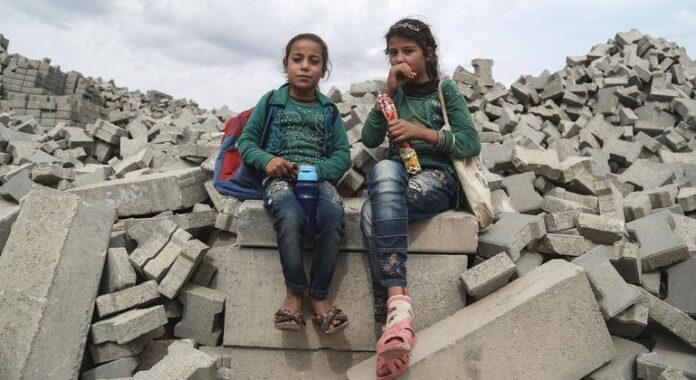
Two children sit in the rubble of what is left of their house in Rafah city, in the southern Gaza Strip.

Two children sit in the rubble of what is left of their house in Rafah city, in the southern Gaza Strip.

We don’t have the ability to do that quickly. There’s only one road. It’s the coast road, because the major road in the middle is actually under military operations at the moment. So, we’re squeezing all of our efforts to the north while we’re trying to struggle to save the south. We have to scale up and the commercial supplies have to start again. 

We also have to get more support from donors who have been very willing to let us buy more trucks, rent more trucks, to bring aid in. But it is the struggle that we face. And those four key sectors I just mentioned to you are where the lifesaving will take place.

UN News: We’ve heard several UN officials saying that we need commercial shipments to start coming back into Gaza. But if the economy is in shambles and there’s military activity going on, how can people go on about commerce and go on about their lives, a normal economy? 

Jamie McGoldrick: What we would like to do eventually is that, if the commercial sector starts up again, we can actually start supplying the shops that are closed because there’s nothing in them. All the stocks have gone. We have to replenish those stocks.

And once we have that up to a certain scale, we can then start to use cash cards, cash voucher systems. 

‘Long, long struggle’ just to keep aid flowing

But we’re a long way off that right now. We’ve got a long, long struggle of just keeping the supply of humanitarian assistance, especially food and medical supplies in there. 

Because if we don’t do that, these things, these items are going to be very rife for the black market, and we’ll start to see this exploitation taking place. We’ve already seen that happening

UN News: Some Israeli officials have said that the only thing hindering the entry of aid into Gaza is the limitations of the UN. How would you respond to them? 

It’s a difficult environment because we’ve been able to do limited aid distributions and the Rafah Governorate, where half of the population is now estimated to be, and the rest of the Gaza Strip, it’s been largely stopped due to the intensity of the hostilities and the restrictions on our movements: we’ve had only five out of 24 planned convoys for food and medicine have been allowed to go to the north, for example. 

Reliance ‘on one crossing point’

We are trying to increase our operations. Our operations have been sort of hampered by the insistence of the government of Israel to use a pedestrian crossing in Rafah to bring truckloads of supplies. And while it’s working well, we can’t rely on all of Gaza – 2.2 million people – on one crossing point. We have to open up elsewhere. 

Aid convoys enter the Gaza Strip through the Rafah border crossing. (file)

Aid convoys enter the Gaza Strip through the Rafah border crossing. (file)

The humanitarian operations are kept on a very light availability of fuel. This is a lifeline for the operations of the hospitals to keep the oxygenation, to keep the various parts of the actual hospitals working, the desalination plants to keep drinking water going there.

The ongoing humanitarian operation, I’ve got to say, is absolutely outstanding. The work that’s been done by our national colleagues there, supported by the internationals.

So, we are really struggling. I don’t think it’s because we are against getting more in, or [that] we are not taking up our challenges.

We are at this 100 per cent-plus, but there are restrictions in there…It has to be so that that we can actually bring in what we need and more and more places where there are populations – and not serving 2.2 million through one door – and that’s something that has to change. 

UN News: With the situation in Gaza right now, sometimes the West Bank can fall off the radar. Do you have any updates on the situation there?

Jamie McGoldrick: I think we all see the situation in the West Bank. There have been flashpoints in the West Bank since early last year and then since 7 October, the tragic issue, I think that’s accelerated. And we’ve seen over 300 Palestinians have been killed and some 80 children have been killed.

We’ve seen from OCHA and the report’s it’s done that there’s an increase obviously in settler violence against Palestinians. And I think that’s something that we see as a constant trend. There were around 200,000 work permits in Israel but that’s now been suspended…I think that many of them probably lost their jobs now.

No revenue transfer from Israel

And there’s all the civil servants that were there and they’re now getting reduced wages because the actual Palestinian Authority is struggling, because the transfer of revenues from Israel hasn’t happened for some time.

The humanitarian community, many parts of it, are inside, part of the West Bank…We’re trying to address the crises that comes up. It’s very, very hard to keep those two things going at the same time, the concentration on Gaza but then not trying to forget the size of the ongoing problem, that’s happening in the West Bank. 

UN News: 57 years now of occupation, the issue is over 75 years old. People are really starting to lose hope in the peace process. So, what can be done to restore that hope and revitalize the office of the Special Coordinator [for the Middle East Peace Process], to reach a settlement? 

The Special Coordinator’s office is still full on trying to address all of these crises which are interlinked, which is the humanitarian linked with the governance challenges, so that’s something that will have to happen.

More pressure needed to free hostages

But I think at the same time, we have to push harder and strengthen the negotiations on the immediate, unconditional release of hostages by Hamas. That has to happen. 

We have to scale up assistance going into Gaza, taking into account Israel’s own internal security concerns, and we have to increase the humanitarian crossings to allow aid into Gaza, such as Kerem Shalom in addition to Rafah. But we also have to look at northern crossing points. 

Jamie McGoldrick - Interim Resident and Humanitarian Coordinator in the occupied Palestinian Territory meeting Palestinian Red Crescent Representatives in Rafah, Southern Gaza

Jamie McGoldrick – Interim Resident and Humanitarian Coordinator in the occupied Palestinian Territory meeting Palestinian Red Crescent Representatives in Rafah, Southern Gaza

We have to restore these basic services, medical, humanitarian, which have been impacted by this conflict and then start to build new ones to resume the lifesaving operations. 

And we have to allow more injured patients and those people to get treatment outside Gaza, because Gaza is devoid of the full range of services required for people who have been caught up in this crisis. We have to allow more and more services into those areas.

‘At some time, we have to get back to the peace process’

I think the peace process can’t be understood or considered at this time. We’re almost 100 days of war – how is it going to end and if and when it does, how can the parties, the different parts of the Palestinian parties come together, and how can then the Palestinians and the Israelis sit round the negotiating table, given the depths of what’s happened in that time?

So, I think that there’s a lot of healing to go through and there’s a lot of circumspection to go through, a lot of understanding what all this means. But at some time, we have to get back to that peace process, some way of pulling out an understanding of how people are going to live together. 

UN News: That was exactly going to be my last question to you. How is it possible that after all of this, parties can actually sit back down at the table? How can we explain this to the layperson who doesn’t know?

Jamie McGoldrick: I think peace is more normal than war. I think that’s the fundamental and I think that all people want to live in peace and have a life. They want to have a future. The want their dreams, they want to be able to know what’s coming next. They want to be able to socialize and have families, and you can’t have that in the situation where you’ve got this conflict and you’ve got this insecurity, and I think that has to disappear.

Understanding, appreciation, accommodation

And then you can start the mending process, the healing process. You have to then think for yourself, how do you link to your neighbour? How do you link to the people that you are going to have to live side by side with? And it’s an understanding and appreciation, an accommodation. 

And we see it in many, many conflicts around the world. And unfortunately, this one is one of the most longstanding and the most deep rooted.

Source link

War against Hamas in Gaza is act of self-defence, Israel tells world court

0
War against Hamas in Gaza is act of self-defence, Israel tells world court

On the second and final day of preliminary hearings at the International Court of Justice (ICJ), Israel’s legal team insisted that the twin military objectives were to eradicate the existential threat posed by Hamas militants and to free some 136 hostages still held in the war-shattered enclave.

Israel is in a war of defence against Hamas, not against the Palestinian people” in the aftermath of Hamas-led terror attacks on 7 October, Israel co-agent Tal Becker told judges in The Hague.

There had been “tragic” and “heartbreaking” civilian suffering “in this war, like in all wars”, Mr. Becker said, as he read out the last anguished text messages sent by the father of one Israeli farming family, burned to death in their home by presumed Hamas fighters who “tortured children in front of parents and parents in front of children”.

Defence ‘obligations’

Mr. Becker also rejected South Africa’s petition to the court under the provisions of the Genocide Convention to issue “provisional measures” to order Israel to immediately suspend its military campaign in Gaza.

This amounted “to an attempt to deny Israel its ability to meet its obligations to the defence of its citizens, to the hostages and to over 110,000 displaced Israelis unable to safely return to their homes”, he said.

The issue of justified self-defence featured prominently in Israel’s presentation.

When a State is attacked, it has the right to defend itself and its citizens, Israel’s legal team insisted, before underscoring the deep trauma resulting from the 7 October terror attacks by Hamas and other Palestinian militants who rampaged across southern Israel, slaughtering some 1,200 people and taking around 250 captive.

“There is no genocidal intent here; this is no genocide,” said Israel counsel Malcolm Shaw. Hamas atrocities “do not justify violations of the law in reply – still less genocide – but they do justify…the exercise of the legitimate and inherent right of a State to defend itself as enshrined in the UN Charter“.

‘Weaponizing genocide’

Rejecting South Africa’s “profoundly distorted” description of the war in Gaza, Israel’s legal team accused that country’s legal team of attempting to “weaponize” the term genocide, which it insisted was a better description of Hamas’s “annihilationist language” about “cleansing” Palestine of Jews.

The armed group which controls Gaza had diverted billions of dollars of aid and turned the Strip into “perhaps the most sophisticated terrorist stronghold in the history of urban warfare” embedded in communities, the court heard.

“Urban warfare will always result in tragic deaths, harm and damage, but in Gaza these undesired outcomes are exacerbated because they are the desired outcomes of Hamas,” said Galit Raguan, for Israel.

Asserting that “every single hospital” searched by Israeli Defense Forces had found evidence of military use by Hamas, the Israel legal counsel also alleged that weapons had been found hidden inside a hospital incubator.

The world court also heard how the Israeli military had demonstrated “the precise opposite” of any possible genocidal intent by restricting its targeting to military personnel or objectives “in accordance with international humanitarian law in a proportionate manner in each case”.

Israel’s efforts “to mitigate harm” during military operations and to alleviate suffering through humanitarian activities had gone “relatively unnoticed” amid the “unprecedented and extensive” use of telephone calls and leafletting to warn populations of impending conflict, the Israel legal team noted.

Next steps in the case

Now that initial representations from both South Africa and Israel have concluded at the ICJ, one of the justices’ first tasks is to assess whether there are sufficient grounds to approve the South African application for provisional measures against Israel, to “protect against further, severe and irreparable harm to the rights of the Palestinian people under the Genocide Convention”. 

These measures are expected in weeks, legal commentators have said.

They are designed “to ensure Israel’s compliance with its obligations under the Genocide Convention not to engage in genocide, and to prevent and to punish genocide”, according to an earlier ICJ press release.

If this results in a ceasefire call which is not implemented, the matter would then need to be taken up by the UN Security Council, which could then agree on a resolution aimed at enforcing an end to hostilities.

Next month, the world court is also due to consider a separate case concerning Israel and Palestine, requested by the UN General Assembly in a resolution adopted on 30 December 2022, before the current conflict.

In that resolution, the General Assembly requested an advisory opinion from the ICJ on the legal consequences of “Israeli practices and affecting the human rights of the Palestinian people in the Occupied Palestinian Territory, including East Jerusalem”.

The procedure will involve a public hearing on 19 February 2024, after the court takes receipt of written reports from numerous States.

Source link