Press ReleaseThis article is based on a press release or official communication. The European Times republishes it as a public service.
Engaging in public space ‘a calling of the church’
Visiting the LWF Communion Office on 13 May, the group took stock of the many challenges and pains of the world today – war and violence, poverty, gender injustice and an escalating climate crisis, to name a few – and the church’s role in speaking out for justice, peace and working for reconciliation.
“It is very important for the church to engage in the public space, in order to be relevant to these multifaceted challenges in the world,” said Enobong Etim Ikang of the Lutheran Church of Nigeria. “We are in the world, and we must be solution providers,” he said.
Ingrid Monjencs of the Evangelical Church of the Augsburg Confession in Austria, continued to describe public engagement as part of “the task to fulfill as churches what is given to us as a call.”
Reflecting on the prophetic role of the church she said: “I think the church is truly prophetic when it doesn’t wait to be appreciated all along. It is prophetic when there is resistance, when you feel that it is not so easy to get through with your message.” Still, Monjencs emphasized, “We have to stand up against injustice. We have to stand up for equal rights.”
“We all need to humble ourselves, to understand that at the end of the day we are not always the correct ones, but the church should be there to stand for those who are downtrodden, and to make sure that the voice of those who are downtrodden is heard, that there is equality for those who are oppressed and to be courageous, to be open, to speak out to the authorities,” reflected Anna Godwin Kaduma of the Northeastern Evangelical Lutheran Church in South Africa.
Mark Hustedt of the Evangelical Lutheran Church in America concluded: “The message of the gospel, the message of Jesus, Jesus’ work, is about inclusion, is about love. To nurture hope in our communities means to learn who we are in community with, learn the things that they are dealing with, the struggles, the aches, the pains, the complexities in our society, to learn with them, to walk with them through these struggles and to work together for collective happiness, for solidarity and to seek peace.”
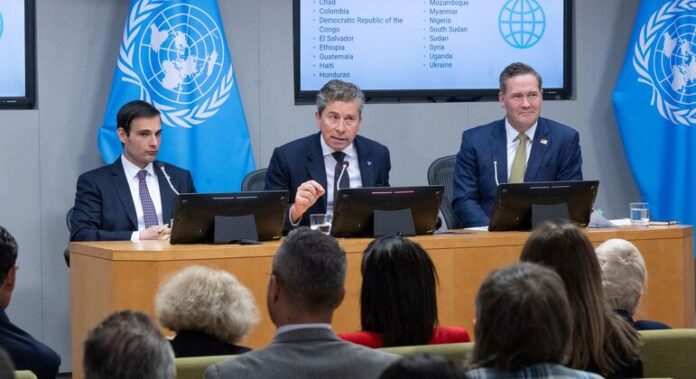
The funding announcement, made on Wednesday by the United States, brings total recent US humanitarian support channelled through the UN-coordinated system to $3.8 billion following an earlier $2 billion allocation announced in December.
UN Secretary-General António Guterreswelcomed the latest contribution, saying it “will allow humanitarians to reach millions of people in the most urgent crises with lifesaving support.”
Emergency Relief Coordinator Tom Fletcher described the funding as critical at a time when humanitarian agencies are “overstretched, under resourced and literally under attack.”
“This support will help save millions of lives,” Mr. Fletcher said at UN Headquarters in New York, where he appeared alongside US Ambassador Mike Waltz and Jeremy Lewin, US Under Secretary for Foreign Assistance, Humanitarian Affairs and Religious Freedom.
The funding comes as humanitarian agencies face mounting pressure from conflict, displacement, climate shocks and shrinking donor budgets. According to estimates, about 239 million people worldwide currently need humanitarian assistance.
Funding helping millions
Mr. Fletcher said the first $2 billion tranche announced in December had already enabled aid agencies to deliver life-saving support to 14.4 million people during the first four months of 2026.
“That’s a headline that we should all be proud of and that we should celebrate,” he said.
The earlier funding package targeted 18 crises across multiple regions and, according to the UN relief coordination office, OCHA, tripled the funding available through pooled humanitarian funds in those countries.
Six of the crises had started the year with no pooled funding at all.
As of this week, $1.71 billion of that allocation was already under implementation, with UN agencies and partners aiming to reach more than 22 million people through the US allocation alone.
A crucial lifeline
Mr. Fletcher said the funding had provided “a lifeline at a crucial moment” when humanitarian operations risked collapse because of severe funding cuts and disrupted supply chains.
Among the assistance already delivered, more than six million people received food aid, while 10.4 million people gained access to safe water. The funding is also supporting more than 690 health facilities and direct assistance to over 779,000 households.
In addition, around 300,000 girls and 266,000 boys are receiving support for severe malnutrition, while funding has also been directed towards protection services for women and girls, including survivors of sexual violence.
‘We can deliver’
Mr. Fletcher said the humanitarian system was accelerating reforms aimed at improving efficiency, accountability and local decision-making.
Agencies had reduced bureaucracy, shortened allocation timelines and increased transparency through an online tracking system showing where funds are being spent, he said.
“We have shown that we can deliver – even under the most challenging conditions,” he said.
Mr. Fletcher also stressed that humanitarian needs continue to outpace available resources, with the UN’s 2026 humanitarian response plan seeking $23 billion to reach 87 million people worldwide with critical assistance.
“Our focus going forward,” he said, “is to secure the rest of the funding we need to deliver this ambitious plan, and then to get out there and deliver it.”
While most people use the internet for rather unimportant business, a lot of our daily lives are actually internet-dependent. Think of all the banking processes, including most card payments, security cameras on Wi-Fi networks, the internet of things devices, school and hospital systems. A lot of our civilization is taking advantage of the internet. And yet, it can be completely blocked.
B-1B Lancer firing afterburners on its way to Iran. Image credit: Wikimedia
Operation Epic Fury, in which the US and Israel are bombing Iran with unprecedented intensity, began on the 28th of February 2026. While the US has been accumulating forces in the region for quite a while, the beginning of these attacks was actually a surprise to Iran. The US and Iran were pushing through active negotiations, and it seemed like diplomacy might take its course. However, the war started instead.
And Iran immediately introduced a near‑total internet blackout. All major forms of connectivity are disrupted – from mobile to fixed‑line connections. Even Iran’s governmental systems are breaking down. It is clear that it is not some strange coincidence, because so many systems would have to collapse for the internet to be completely shut down throughout the different access points. The Iranian regime did this deliberately. And not even for the first time.
Why? Well, they are trying to disrupt communications. Iran doesn’t want its locals to post videos online, showing the movement of their military assets or the results of American-Israeli strikes. More importantly, Iran understands that this is a time where rebellious groups can organize and try to overthrow the theocratic regime, which has been in power since the 1979 revolution. In fact, previous internet blackouts were introduced specifically during protests to starve the activists from a space where they can organize their activities.
While Iran had several internet blackouts before, this one seems to be the longest so far. It’s been pushing on since the 28th of February, 2026. However, at one point, the internet was briefly restored.
It was reported that at hour 444 of Iran’s nationwide blackout, there was a brief restoration of internet connectivity. Some Iranian internet users had a brief chance to access the internet before it was swiftly cut off again. What happened? Well, no one knows. Maybe they were doing some kind of testing, or the government needed the internet for some kind of activity of their own. There is also a possibility that the blocking system somehow broke down for a bit, maybe following a strike or something.
Some people in Iran do seem to have access to the internet, because they are posting footage of American-Israeli attacks. It is unclear how it is possible, but Starlink satellite internet is not the answer, as it is not enabled there. Maybe some people are just lucky or have some kind of government-granted access.
KINGNEWSWIRE // PRESS RELEASE // On Europe Day, volunteers distributed 1,500 educational items on human rights and their history, drawing steady public attention in the French capital.
PARIS, France — 9 May 2026 — A mobile human rights exhibit held in central Paris on 9 May brought a visible public education initiative to one of the city’s busy pedestrian areas, where residents and visitors were invited to learn more about the Universal Declaration of Human Rights and the long history of human rights ideas.
The exhibit, set up in a highly visible tent, drew the attention of passers-by throughout the day. Around 15 volunteers took part in the initiative, distributing approximately 700 flyers inviting people to visit the stand and 800 educational booklets presenting human rights and their historical development in accessible language.
The activity coincided with 9 May, widely marked across the European Union as Europe Day, a date associated with peace, cooperation and the civic values that shaped post-war Europe. In that context, the Paris exhibit placed human rights education at street level, offering short conversations, printed materials and visual displays to people of different ages and backgrounds.
The mobile exhibit presented human rights not as an abstract legal concept, but as a practical subject connected to daily life, dignity and civic responsibility. Visitors were able to view panels, receive booklets and speak with volunteers about the origins and meaning of fundamental rights, including the importance of education in making those rights understood by younger generations.
The initiative forms part of the broader human rights education work supported by members and groups of the Church of Scientology, inspired by the writings of Scientology founder L. Ron Hubbard, who placed strong emphasis on human dignity, moral responsibility and the role of education in improving society. In France and across Europe, Scientology volunteers have taken part in public information activities focused on human rights, drug prevention, literacy, moral values and community support.
The Paris event also reflected the wider civic education approach promoted through Scientology Europe’s EU Values campaign, which presents European values such as human dignity, freedom, democracy, equality, rule of law and human rights as principles that require understanding and practical application in daily life. By placing educational materials directly in a public space, the Paris exhibit connected the universal language of human rights with the European civic framework in which those rights are protected and discussed.
“Human rights become meaningful when they are understood by ordinary people, not only by institutions,” said Ivan Arjona, representative of the Church of Scientology to the European Union, the OSCE, the Council of Europe and the United Nations. “An exhibit like this in Paris reflects a very European idea: that dignity, freedom of conscience and responsibility belong in public life. It is also fully aligned with the spirit of Europe’s values, which depend on citizens who know their rights, respect the rights of others and take responsibility for building more inclusive communities.”
The Paris volunteers reported that the tent’s visibility helped bring a constant flow of people past the exhibit. Some stopped briefly to take a flyer, while others entered the tent, asked questions or received booklets. The format allowed the materials to reach both local residents and international visitors passing through the area.
The booklets distributed during the day presented the development of human rights through history, including the modern understanding reflected in the Universal Declaration of Human Rights, adopted by the United Nations General Assembly in 1948. By using simple language and visual presentation, the exhibit aimed to make the subject accessible to people who may not usually engage with formal legal or institutional documents.
For the volunteers, the activity was also a practical expression of civic participation. Human rights education campaigns often depend on direct contact with the public, particularly in urban spaces where people from many cultures, languages and social backgrounds meet. In Paris, a city closely associated with the history of rights, citizenship and public debate, the mobile exhibit provided a setting where those themes could be presented in a direct and approachable way.
The Church of Scientology has long supported educational and social betterment campaigns carried out by its churches, missions and volunteers. These initiatives include human rights awareness, drug prevention, disaster response through Volunteer Ministers, and moral education based on common-sense principles. While each activity is adapted to local circumstances, the common emphasis is on prevention, education and individual responsibility.
The Paris exhibit reflected that approach. Rather than focusing on ceremony or speeches, the event relied on visibility, printed educational materials and one-to-one engagement. The presence of volunteers throughout the day allowed people to receive information at their own pace, ask questions and continue on their way with materials they could read later.
The Church of Scientology, its churches, missions, groups and members are present across the European continent. Scientology Europe reports a continent-wide presence through more than 140 churches, missions and affiliated groups in at least 27 European nations, alongside thousands of community-based social betterment and reform initiatives focused on education, prevention and neighbourhood-level support, inspired by the work of Scientology founder L. Ron Hubbard.
Within Europe’s diverse national frameworks for religion, the Church’s recognitions continue to expand, with administrative and judicial authorities in Spain, Portugal, Sweden, the Netherlands, Italy, Germany Slovakia and others, as well as the European Court of Human Rights, having addressed and acknowledged Scientology communities as protected by the national and international provisions of Freedom of Religion or belief.
World Falun Dafa Day, marked on May 13, has become both a spiritual celebration and a human-rights reminder. For practitioners of Falun Dafa, also known as Falun Gong, the day honors the public introduction of the practice in China in 1992. But more than three decades later, the anniversary also draws attention to the continuing pressure faced by adherents in the country where the movement began.
Across continents, Falun Dafa practitioners marked this year’s anniversary with meditation, public gatherings, cultural events and messages of gratitude. The date, known as World Falun Dafa Day, commemorates the public introduction of the practice by Li Hongzhi in Changchun, China, on May 13, 1992.
For followers, the anniversary is primarily a day of faith, discipline and thanksgiving. Falun Dafa’s official materials describe the practice as rooted in Buddhist tradition and centred on the principles of truthfulness, compassion and forbearance. Its website says the practice is now followed in more than 100 countries and that its teachings have been translated into more than 50 languages through FalunDafa.org.
A celebration with a shadow
The public joy of the anniversary is inseparable from the political and human-rights context surrounding Falun Gong. The Chinese authorities banned the movement in 1999 and have since treated it as a threat to state authority. That official hostility has shaped the way the anniversary is observed: openly in many countries, cautiously or privately inside mainland China.
The UK Home Office country policy note on Falun Gong states that practitioners in China may face harassment, arrest, detention, long prison sentences and pressure to renounce their beliefs. The same document underlines the difficulty of verifying the number of practitioners, a challenge common in closed civic and religious environments.
Human-rights monitors have also continued to raise wider concerns about religious control in China. Freedom House reported in its 2025 China assessment that several religious and belief communities, including Falun Gong practitioners, Tibetan Buddhists, Muslim groups and Christian house churches, face harsh persecution under policies aimed at tightening state control over religious life.
Faith, identity and freedom of conscience
World Falun Dafa Day therefore carries two meanings. It is a celebration of a spiritual path for those who practise it. It is also a public test of whether freedom of belief can be lived without fear.
In democratic societies, practitioners may gather in parks, walk in parades, practise meditation in public spaces and share their beliefs openly. In China, according to Falun Gong-linked reports and international human-rights documentation, association with the practice can still carry serious risks. This contrast has turned May 13 into a global symbol of a community that remains visible despite pressure.
The issue is not limited to one movement. It raises a broader question for governments and international institutions: how should the world respond when a state treats independent spiritual organisation as a political danger? Freedom of religion or belief protects not only major historical religions, but also smaller, newer and less understood communities. Its test is often found at the margins.
Organ-harvesting allegations remain a grave concern
One of the most serious dimensions of the Falun Gong case is the long-running allegation of forced organ harvesting from prisoners of conscience. China denies such allegations. However, international concern has not disappeared.
In 2021, UN human-rights experts said they were alarmed by reports that detainees from ethnic, linguistic and religious minorities, including Falun Gong practitioners, had allegedly been subjected to medical testing and organ removal without consent. In 2022, the European Parliament adopted a resolution on reports of continued organ harvesting in China, calling for EU institutions and member states to address the issue and prevent complicity in unethical transplant practices.
These allegations have made Falun Gong not only a religious-freedom case, but also a question of medical ethics, international accountability and the responsibility of states to prevent abuses linked to detention systems.
Why the day still matters
May 13 is not only an anniversary on a religious calendar. It is a reminder that belief communities survive through memory, practice and public witness. For Falun Dafa practitioners, the day affirms gratitude and continuity. For human-rights observers, it highlights the fragility of conscience when governments restrict spiritual identity, association and expression.
The continued global visibility of World Falun Dafa Day shows that repression does not erase belief. It may silence public expression in one place, but it can also strengthen solidarity elsewhere. That is why the anniversary remains significant beyond Falun Gong itself. It speaks to a universal principle: the right to believe, practise, gather and speak without coercion.
As celebrations continue around the world, the central message is both simple and demanding. Freedom of belief is not fully protected when it is reserved only for approved communities. It is protected when even unpopular, misunderstood or politically inconvenient groups can live their faith openly and peacefully.
Summary: A criminal trial in Madrid over alleged animal mistreatment at the Vivotecnia testing laboratory has revived a wider European question: how quickly can the EU move from promises on animal welfare to enforceable change? The case, based on undercover footage first made public in 2021, concerns two technicians who deny wrongdoing. But for animal-protection groups, the hearings have become a test of whether Europe’s rules on laboratory animals are strong enough, transparent enough and ambitious enough to match public expectations.
A Madrid courtroom has placed one of Europe’s most sensitive scientific and ethical debates back under public scrutiny: the use of live animals in laboratories. The immediate case is narrow. Two workers at Vivotecnia, a contract research laboratory based in Tres Cantos, near Madrid, have faced criminal proceedings over alleged mistreatment and serious injury to animals. Both deny the accusations.
Yet the political meaning of the case is much broader. Cruelty Free Europe, one of the organisations involved in the case, has described the hearings as a moment in which the “entire animal testing industry” is effectively under examination. That is an advocacy position, but it captures the depth of the unease now surrounding Europe’s system of authorising, supervising and reducing animal experiments.
A case born from undercover footage
The case stems from footage recorded between 2018 and 2020 by a worker who later gave the material to Cruelty Free International. The videos were made public in 2021 and triggered public outrage, protests and a judicial investigation.
According to reporting by El País, the Madrid trial was ultimately limited to two specific episodes: one involving a rabbit and another involving blood extraction from rats. The defendants told the court that they acted according to protocol and suggested that the footage did not reflect criminal conduct. The trial has been heard and is awaiting judgment.
The company itself is not on trial. El País has reported that Vivotecnia was left outside the criminal responsibility examined in this proceeding. That legal limit is precisely what has frustrated animal-protection organisations, which argue that the public interest goes beyond individual acts and touches the broader system of oversight inside laboratories.
Europe’s law already recognises animals as sentient beings
The European Union is not starting from a blank page. The European Commission notes that Article 13 of the Treaty on the Functioning of the European Union recognises animals as sentient beings. EU policy also follows the “3Rs” principle: replacing, reducing and refining the use of animals in science.
Directive 2010/63/EU sets the goal of phasing out animal use for research and regulatory purposes as soon as scientifically possible. In practice, however, that phrase has left Europe in a difficult middle ground. Animal testing is officially treated as something to be reduced and eventually replaced, while millions of animals continue to be used each year.
The latest figures underline the gap. European Commission statistics for 2023, reported through the ALURES system, provide the official basis for tracking animal use in science across EU Member States and Norway. Cruelty Free Europe says those figures show around 9.1 million uses of animals in the EU and Norway in 2023, only a small fall from 2022.
The Madrid trial meets a Brussels policy moment
The Vivotecnia case arrives as Brussels is preparing a major policy step: the Roadmap Towards Phasing Out Animal Testing for Chemical Safety Assessments. The Commission says the roadmap is intended to accelerate the move towards replacing, reducing and refining animal testing in chemical safety assessments.
The roadmap was promised in response to the European Citizens’ Initiative “Save Cruelty Free Cosmetics – Commit to a Europe Without Animal Testing”, which gathered more than 1.2 million statements of support. That level of mobilisation shows that animal testing is not only a technical regulatory issue. It is a democratic issue, too.
At the same time, the European Parliament has moved to strengthen the role of non-animal approaches in the future work of the European Chemicals Agency. In late April, MEPs backed Parliament’s position on a new basic regulation for ECHA, with Cruelty Free Europe highlighting that the vote included stronger support for the development, validation and regulatory acceptance of non-animal methods.
The science debate cannot ignore accountability
Supporters of animal research argue that some procedures remain necessary for medicines, safety testing and public health. Vivotecnia’s own institutional statement says animal experimentation has played a role in developing medical treatments and that animal welfare is central to research quality.
That argument cannot simply be dismissed. Europe’s challenge is to protect human health, environmental safety and scientific progress while also respecting the ethical status of animals. But the Vivotecnia case shows why public trust depends on more than scientific necessity. It depends on inspection, transparency, accountability and the credible enforcement of welfare standards.
If painful procedures are truly unavoidable, the public has a right to know that they are strictly controlled. If non-animal methods already exist, the public has a right to ask why animal use continues. And if laboratory abuses occur, the public has a right to expect consequences that reach beyond symbolic punishment.
A test of Europe’s credibility
The EU often presents itself as a global leader in animal welfare and ethical regulation. That leadership now depends on implementation. A roadmap without deadlines will not be enough. A database without enforcement will not be enough. A commitment to alternatives will not be enough unless regulators, research institutions and companies are required to use them whenever they are scientifically valid.
The Madrid court will decide the criminal responsibility of two individuals. Brussels must answer a larger question: whether Europe’s animal-testing system is moving fast enough from harm reduction to real replacement.
The distinction matters. The first is a legal case. The second is a test of European values.
Keywords
animal testing Vivotecnia Madrid trial Cruelty Free Europe Cruelty Free International EU animal welfare non-animal testing methods ECHA European Commission roadmap chemical safety assessment animal experiments Europe EU research ethics
The Hague ruling challenges permit-free bottom trawling in one of the North Sea’s most important protected areas.
A Dutch court has ruled that bottom trawlers may no longer operate in the Dutch Dogger Bank protected area without a permit and environmental assessment. The decision, welcomed by environmental groups, could increase pressure on EU governments and the European Commission to turn marine protected areas from legal designations into real ecological safeguards.
A ruling with North Sea consequences
The District Court of The Hague has delivered a significant ruling for marine protection, finding that Dutch bottom trawlers cannot continue fishing in the Dutch Dogger Bank protected area without a permit and environmental assessment.
The decision concerns the Dutch part of the Dogger Bank Natura 2000 site, often described by conservationists as the “nursery of the North Sea”. The area is a shallow sandbank system that supports marine habitats, fish spawning grounds and feeding areas for species including harbour porpoises, seals and seabirds.
According to the environmental organisations that brought the case, the Dutch Ministry of Agriculture, Fisheries, Food Security and Nature had allowed Dutch fishers to carry out bottom trawling in the protected area through a general exemption, without individual permits or site-specific environmental checks. The court rejected that approach as incompatible with nature protection law.
What the court decision changes
The ruling does not simply debate the environmental harm caused by bottom trawling. It addresses a more basic rule-of-law question: can a marine area be called protected if a damaging activity is allowed to continue without proper assessment?
Bottom trawling involves dragging heavy fishing gear across the seabed to catch species living near the sea floor. Conservation groups argue that the practice damages seabed habitats, disturbs marine life, releases stored carbon and causes by-catch of non-target species.
The organisations behind the case — Doggerland Foundation, ARK Rewilding Nederland, ClientEarth and Blue Marine Foundation — say the judgment confirms that Dutch authorities must place the burden of proof back where EU nature law requires it to be: on demonstrating that fishing activity will not harm the protected site.
Emilie Reuchlin, director of Doggerland, called the ruling “fantastic news for the North Sea” and said the Dutch government must now discuss the future with fishers. If operators cannot show that trawling causes no harm within the protected area, she said, they should no longer be allowed to use trawls there.
Protected on paper, or protected in practice?
The ruling comes at a sensitive moment for EU ocean policy. The European Commission’s Marine Action Plan, adopted in 2023, links fisheries reform with the EU’s 2030 biodiversity targets, including the goal of protecting 30% of EU seas.
The Commission has also opened consultation on a forthcoming European Ocean Act, which is intended to strengthen ocean governance and provide a clearer framework for economic, environmental and climate objectives at sea.
In that context, the Dogger Bank ruling could become more than a national legal dispute. It may sharpen the question facing Brussels and national capitals: whether marine protected areas should remain flexible management zones, or whether they must exclude activities that cannot be shown to be compatible with conservation objectives.
The Natura 2000 framework does not automatically ban all human activity. But it does require Member States to manage protected sites so that habitats and species can be conserved or restored. For conservation lawyers, the Dutch case underlines that exemptions cannot become a substitute for evidence.
A decision likely to echo beyond the Netherlands
John Condon, a senior lawyer at ClientEarth, described the judgment as “a landmark legal ruling for ocean protection” and said it sends a message to European decision-makers that “protected means protected”.
That message is already part of a wider European debate. The UK closed its part of the Dogger Bank Special Area of Conservation to bottom-towed fishing gear in 2022 through a byelaw designed to protect the area from seabed damage. The European Commission has also introduced measures restricting mobile bottom-contacting gear in specified zones of the Dogger Bank in German and Dutch waters.
Environmental groups argue that these steps are still partial and that Europe needs a clearer deadline for phasing out destructive bottom fishing in marine protected areas. The Dutch ruling, they say, strengthens the legal case for moving from broad promises to enforceable protection.
The fisheries question cannot be ignored
For fishing communities, however, tighter restrictions can mean uncertainty, added costs and pressure on livelihoods already affected by fuel prices, market volatility and changing regulations. Any transition away from damaging practices will need to be managed with clarity, fairness and practical support.
But the court’s decision also suggests that economic difficulty cannot justify ignoring the legal purpose of a protected area. The ruling does not frame conservation and fishing as permanent enemies. Rather, it insists that activities inside a protected site must be tested against the ecological reasons for which the site was protected in the first place.
Karel van den Wijngaard, programme leader for the North Sea at ARK Rewilding Nederland, said nature can recover “but only if we genuinely give it the peace and space to do so.” The Dogger Bank, he argued, is protected on paper, but protection only has meaning if the seabed is actually left undisturbed.
A test for the European Ocean Act
The ruling now lands in the middle of Europe’s broader attempt to build a more coherent ocean policy. The European Ocean Act, still in preparation, is expected to become a key test of whether EU institutions can connect biodiversity targets, climate policy, fisheries management and the blue economy in one credible framework.
The European Times has previously reported on EU-level concern over marine governance and seabed protection, including the European Parliament’s position on deep-sea mining in the Arctic. The Dogger Bank case adds another dimension: the challenge is not only to protect remote or deep waters, but also to enforce conservation law in Europe’s own crowded seas.
Tom Appleby, Head of Governance and Legal Affairs at Blue Marine Foundation, said the case matters for the UK as well as the EU. Marine species, he noted, do not recognise national boundaries. For the North Sea, this is more than a legal phrase. Seabirds, seals, fish stocks and marine mammals move across jurisdictions, while the ecological effects of seabed disturbance do not stop at national lines.
The Dutch judgment therefore raises a wider question for Europe: whether the next phase of marine protection will be measured by maps and promises, or by what is actually allowed to happen on the seabed.
Summary: The Chancery Lane Project and WRAP have updated a model contract clause designed to help businesses measure, reduce and report food waste across supply chains. The initiative shows how legal documents, often seen as administrative formalities, can become practical tools for climate action, cost reduction and corporate transparency.
London, 14 May 2026 — Food waste is usually discussed in terms of households, supermarkets, logistics or consumer behaviour. But a new collaboration between The Chancery Lane Project and WRAP places a less visible instrument at the centre of the debate: the commercial contract.
The two organisations have updated Runa’s Clause, a practical legal tool intended to help companies reduce food waste in their supply chains. The clause is designed for use in agreements between customers and suppliers, requiring parties to measure food waste, record reduction efforts, report progress and cooperate on practical steps to prevent avoidable waste.
The initiative comes at a time when governments, retailers, manufacturers and food-service businesses are under increasing pressure to address the environmental and financial cost of waste. According to the European Commission, more than 58 million tonnes of food waste are generated annually in the EU, with an estimated market value of around €132 billion. The EU has also introduced binding food-waste reduction targets for Member States by 2030, including a 10% reduction in processing and manufacturing and a 30% per capita reduction across retail, restaurants, food services and households.
Turning sustainability promises into contract obligations
The significance of Runa’s Clause lies in its attempt to move food-waste reduction from broad corporate aspiration into day-to-day commercial practice. Rather than relying only on sustainability reports or voluntary commitments, the clause embeds measurement, cooperation and reporting duties directly into supply-chain contracts.
The updated wording encourages businesses to measure the tonnage of food waste linked to a contract, identify causes where possible, maintain records of reduction initiatives and share data with the other contracting party. It also provides for regular meetings between the parties and the use of annual food-waste reports, with reference to WRAP’s data-capture tools and recognised food-waste guidance.
That approach reflects a wider shift in climate and sustainability governance. Businesses are increasingly being asked not only to set environmental targets, but to show how those targets are implemented through procurement, logistics, supplier management and internal controls.
Ben Metz, Executive Director at The Chancery Lane Project, said contracts are “one of the most powerful levers businesses have to drive change across supply chains.” By building food-waste reduction into agreements, he said, companies can move “from good intentions to measurable impact.”
Why food waste is also a business cost
WRAP’s involvement gives the clause added practical weight. Its Food Waste Reduction Roadmap promotes a “Target, Measure, Act” approach: setting reduction targets, measuring food-waste data and using that information to take corrective action. The Roadmap is open to businesses across the food and drink sector, from retailers and manufacturers to hospitality, food service and suppliers.
Caroline Conroy, Senior Specialist Food System Transformation at WRAP, said food waste carries a heavy financial burden for businesses. According to figures cited in the announcement, the average cost incurred by a company for every tonne of food waste generated ranged from £1,638 to more than £4,200 across various sectors. Reducing a tonne of food waste, WRAP added, can also prevent nearly four tonnes of CO2e from being produced.
This makes the issue both environmental and operational. Waste means unnecessary production, transport, storage, labour, disposal and emissions. In a sector already exposed to inflation, energy costs, climate disruption and changing consumer expectations, food-waste prevention is increasingly a matter of resilience as well as responsibility.
A supply-chain transparency tool
The updated clause also addresses a recurring difficulty in sustainability work: companies may control their own operations, but much of their environmental footprint sits in the supply chain. Without contractual structures for sharing data and cooperating on improvements, businesses can struggle to understand where waste occurs and who is best placed to prevent it.
Runa’s Clause seeks to create that structure. It encourages both parties to identify causes of waste, avoid unnecessary food loss, handle rejected goods in time to prevent them becoming waste, and develop a continuous-improvement plan linked to a defined reduction target.
English Provender Company, part of The Billington Group and a supplier of sauces, dressings, condiments and marinades to major UK retailers and food businesses, has already received board approval to adopt the clause. Carl Steckerl, Business Lead for Environmental, Social and Governance at the company, said the business wants to increase transparency in cases of avoidable waste and work collaboratively with suppliers and customers.
A European relevance beyond the UK
Although the clause has been developed in a UK legal and policy context, its broader relevance is clear. Across Europe, food-waste prevention is becoming a stronger regulatory and commercial priority. The EU’s revised waste framework now places measurable reduction targets at the centre of Member States’ obligations, while businesses face growing expectations to document sustainability performance across their value chains.
For European companies, the lesson is not simply that one model clause should be copied into every contract. Legal templates must always be adapted to the relevant jurisdiction, sector and commercial relationship. The deeper message is that sustainability commitments are more likely to succeed when they are reflected in the legal architecture of business itself.
This is part of a wider food-systems debate that The European Times has previously covered, including calls for stronger action to transform food systems, reduce waste and build more resilient supply chains.
From policy language to practical enforcement
Runa’s Clause is not a law, and it does not replace public regulation. But it demonstrates how private law can support public climate and sustainability goals. Where legislation sets broad targets, contracts can translate those targets into operational duties between specific businesses.
That may prove important as food-waste policy moves from awareness campaigns to implementation. Companies will increasingly need evidence of what they are doing, where waste occurs, how suppliers are involved and whether reductions are measurable. Contract clauses can help create that evidence trail.
Food waste remains one of Europe’s most visible contradictions: vast quantities of edible and inedible food are discarded while households face rising living costs and food insecurity. Tackling it will require regulation, technology, consumer change and better logistics. But this initiative suggests another practical lever: the documents companies already sign every day.
In that sense, the updated Runa’s Clause is more than a legal drafting exercise. It is a reminder that sustainability is not only written in climate strategies. It is also written in procurement terms, supplier obligations, reporting duties and the small contractual mechanisms that shape how businesses behave.
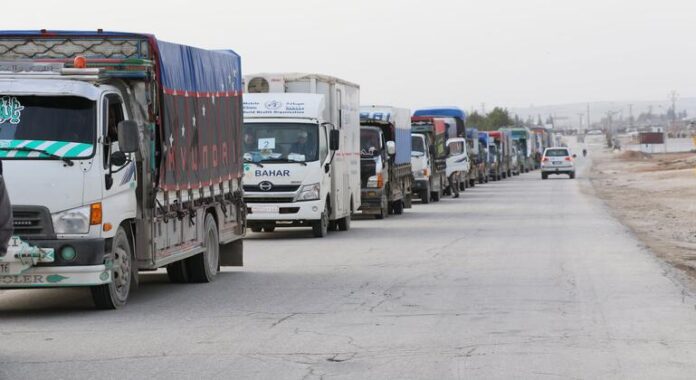
UN officials warn that the cuts come at a dangerous moment, as families – already struggling to survive – are now forced to skip meals, reduce portion sizes and rely on less nutritious food. Children are particularly vulnerable, with prolonged food deprivation sharply increasing the risk of malnutrition.
“We are being forced to withdraw a vital safety net at a time when people need it most with serious implications for food security, social cohesion, and stability, leaving the most vulnerable of families with even fewer options to cope” said Marianne Ward, WFP Country Director in Syria.
Food insecurity across Syria
Last year, the agency reached 5.8 million people across all 14 governorates through emergency food assistance, nutrition support, livelihoods programmes and social protection initiatives. But ongoing funding shortages are now forcing operations to shrink from 14 governorates to just seven.
“The reduction in WFP’s assistance is driven solely by funding constraints, not by a decrease in needs,” said Ms. Ward.
Across Syria, more than seven million people are acutely food insecure, including 1.6 million facing emergency conditions, according to agency estimates.
Bread lifeline disappears
WFP has also halted its nationwide bread subsidy programme, one of the country’s last remaining large-scale safety nets that previously helped millions of Syrians afford daily bread.
The initiative supported more than 300 bakeries, providing them with fortified wheat and helping subsidized bread reach up to four million people every day in some of Syria’s most fragile areas.
Aid officials warn that the loss of affordable bread could rapidly worsen hunger and force families into increasingly desperate coping mechanisms.
Regional impacts
The funding crisis is also affecting Syrian refugees in neighbouring countries, where many families remain dependent on humanitarian aid.
In Jordan, WFP has halted cash-based food assistance for 135,000 Syrian refugees living in host communities, while reduced support continues for around 85,000 refugees in camps.
Without urgent and sustained funding, we risk reversing years of progress and pushing millions deeper into food insecurity, both inside Syria and in neighbouring countries hosting refugees.
— Samer Abdeljaber
In Lebanon, refugee families continue struggling with rising costs and limited income opportunities. In Egypt, assistance for 20,000 Syrians has been reduced.
“Across the region, vulnerable families are facing the cumulative effects of prolonged crises, rising costs, and shrinking assistance,” said Samer Abdeljaber, WFP Regional Director for the Middle East, North Africa and Eastern Europe.
Funds to restore operations
WFP says it urgently requires $189 million over the next six months to sustain and restore critical operations inside Syria.
Timely funding would allow it to reach 1.6 million of the most vulnerable people, preserve nutrition programmes and help maintain access to affordable bread at a pivotal moment for the country’s fragile recovery.
“Without urgent and sustained funding, we risk reversing years of progress and pushing millions deeper into food insecurity, both inside Syria and in neighbouring countries hosting refugees, risking broader prospects for stability and recovery,” Mr. Abdeljaber warns.
Germany’s modern “Scientology declarations” cannot be equated with the Nazi persecution of Jews. But they do raise a serious rule-of-law warning: when public authority uses forms, eligibility conditions or administrative language to single out a disfavoured belief community, the state moves from judging conduct to judging identity. That is precisely the danger Germany’s post-war constitutional order was built to prevent.
There are historical comparisons that must be made with care. Germany in 2026 is not Nazi Germany. Scientologists today are not Jews under National Socialism. No serious observer should confuse administrative discrimination with genocidal persecution. But there is a narrower, legitimate and urgent comparison: the way a state can use legal and bureaucratic language to turn a minority identity into a reason for exclusion.
That is why a page of the Reichsgesetzblatt from 14 November 1938 still matters. On page 1580 of Part I, No. 189, the Nazi state published the Verordnung zur Ausschaltung der Juden aus dem deutschen Wirtschaftsleben — the “Ordinance for the Exclusion of Jews from German Economic Life.” Its language was dry, legal and administrative. Its purpose was not. It barred Jews from retail businesses, mail-order companies, crafts, markets, fairs and exhibitions. The United States Holocaust Memorial Museum describes the decree as part of the post-Kristallnacht legal escalation that almost completely removed Jews from German economic and social life.
This is not raised to accuse modern Germany of repeating 1938. It is raised because Germany, of all countries, should understand that rights can be destroyed not only by violence, but also by forms, declarations, exclusions and official categories.
The modern “faith-breaker” declaration
That is the uncomfortable context in which Germany’s modern Scientology Schutzerklärung should be examined. These declarations, sometimes described by critics as “sect filters,” ask applicants, contractors or beneficiaries to distance themselves from Scientology, the teachings of L. Ron Hubbard, or related methods and organisations. In practice, they can condition access to public benefits, grants, tenders, employment-related opportunities or contractual participation on a statement of ideological non-affiliation. The mechanism is not a ban. It is more subtle: sign the declaration, or risk exclusion.
A better English name for such a form would be a “faith-breaker declaration.” It does not simply ask whether someone has complied with the law. It asks a person to separate himself or herself from a belief, a teaching, a religious or philosophical association. That is exactly where a liberal constitutional state should stop.
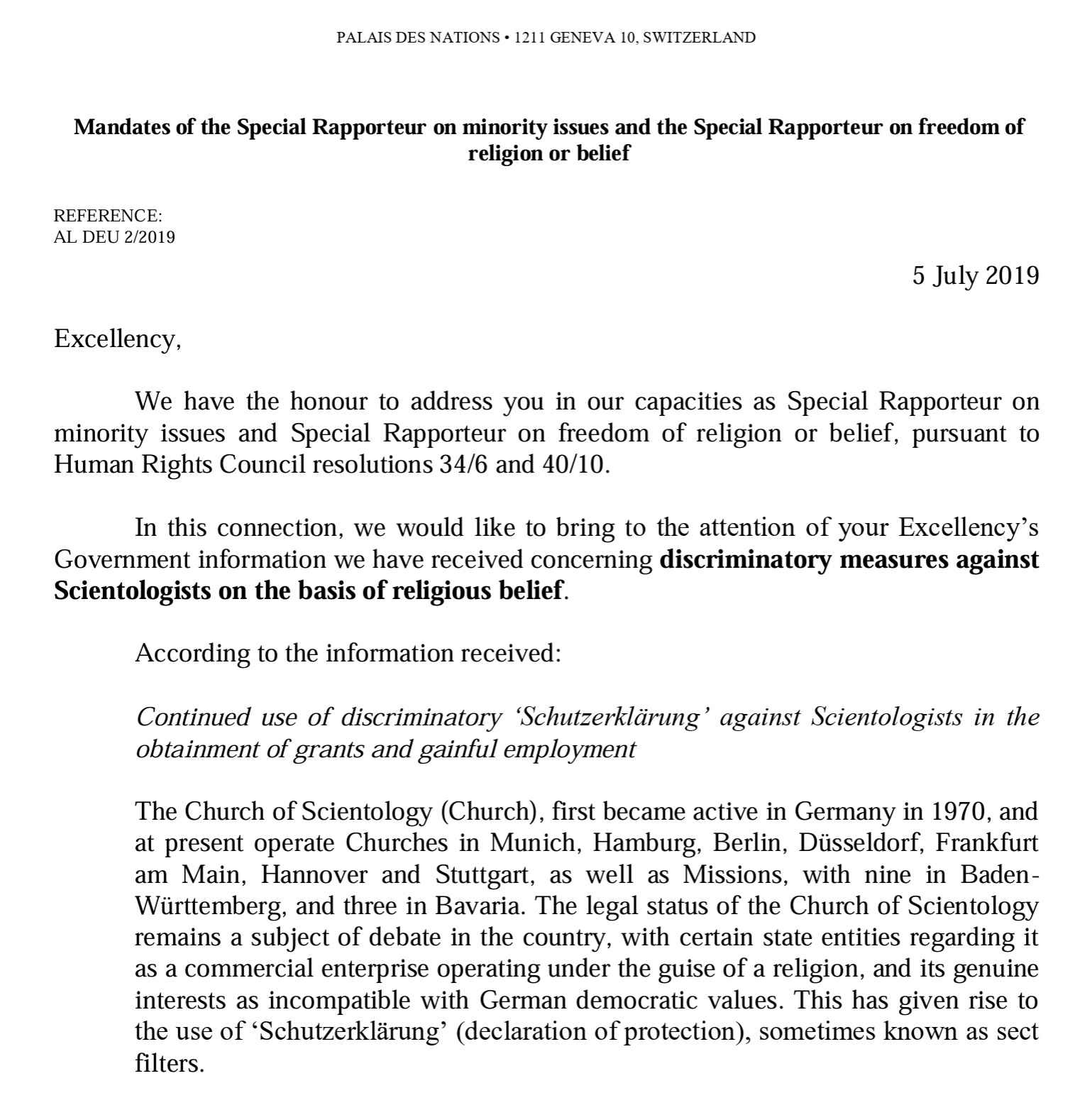
In 2019, two United Nations Special Rapporteurs — Fernand de Varennes, then Special Rapporteur on minority issues, and Ahmed Shaheed, then Special Rapporteur on freedom of religion or belief — formally asked Germany to explain the compatibility of these “sect filters” or Schutzerklärungen with international human rights law.
Their communication to the German government warned that, if the allegations were accurate, excluding individuals from opportunities on the basis of religion or belief would raise serious concerns under international human-rights standards.
The UN Special rapporteurs told the German gobvernment:
“…we would like to express our concern about the continued use of measures that explicitly prevent individuals from obtaining grants and employment opportunities otherwise extended to the general population, on the basis of religion or belief. Regardless of the official state position on the status of Scientology as a religious organisation, group, sect, or otherwise, religion or belief is a matter of personal conscience rather than government designation. Individuals identifying as Scientologists should not have to endure undue scrutiny nor disclose their beliefs unless a legitimate, substantiated reason can be provided, for which the burden of proof falls upon the State. By continuing to uphold measures that reinforce negative stereotypes about Scientologists, the State may cultivate an environment not fully conducive to the enjoyment of the right to freedom of religion or belief particularly for religious minorities. By allegedly operating from a negative presumption as to the aims of the Church, these measures may also constitute a conflict with the State mandate of neutrality, which requires a fundamental attitude of tolerance and equitable treatment of all religious groups within the context and limits of public interest, and in conformity with the provisions of international human rights law. The State does not have the responsibility of judging the intrinsic value or truth of religion or belief. (E/CN.4/1998/6/Add.2)
Mandates of the Special Rapporteur on minority issues and the Special Rapporteur on freedom of religion or belief // REFERENCE: AL DEU 2/2019 // 5 July 2019
A constitutional problem already recognised by Germany’s highest administrative court
The German Federal Administrative Court later reached a conclusion that should have ended the practice, at least in public administration. In its 2022 judgment concerning Munich’s refusal of an environmental subsidy for an electric bicycle, the Court held that a municipality could not make public funding dependent on a declaration distancing the applicant from Scientology.
The Court stated that demanding such a worldview declaration, and linking refusal to exclusion from the benefit, interfered with freedom of religion and worldview under Article 4 of the German Basic Law and violated equality principles under Article 3. Legal commentators also noted that the declaration had no proper connection with the purpose of the subsidy, which was environmental, not ideological.
That judgment is devastating for the logic of the “faith-breaker” form. The subsidy in question had an environmental purpose. Whether the applicant accepted or rejected Scientology had no rational connection to that purpose. Public authorities may not use an unrelated public programme as an occasion to identify, expose or disadvantage people because of their religious or worldview convictions.
The warning from 1938 is not equivalence, but administrative logic
This is where the comparison with 1938 becomes legally and morally relevant — not as an equivalence of crimes, victims or regimes, but as a warning about administrative logic.
The 1938 ordinance said, in substance: because you are Jewish, you may not participate normally in economic life.
The modern Schutzerklärung says, in substance: unless you distance yourself from Scientology, you may be excluded from certain public opportunities, and find yourself a living for you and your family.
The scale, ideology and consequences are radically different. But the legal danger belongs to the same family: the state stops judging conduct and begins judging identity, belief or association.
Germany’s post-war constitutional order was built precisely to prevent this. Article 4 of the Basic Law protects freedom of faith, conscience and creed. Article 3 prohibits unequal treatment, including on grounds of faith or religious opinions. These guarantees are not decorative. They are the constitutional answer to a past in which bureaucracy became an instrument of exclusion.
Rule of law means judging conduct, not belief
The defenders of Schutzerklärungen may argue that Scientology is controversial, that public authorities have concerns, or that the state has an interest in protecting the constitutional order. But constitutional democracy is tested precisely when the minority is unpopular. If there is unlawful conduct, the state may investigate and act. If there is fraud, coercion, abuse or criminality, the law already provides remedies. What the state may not do is create a loyalty test against a named belief community and attach it to ordinary civic, economic or administrative participation.
That is the difference between rule of law and suspicion by category.
The most dangerous bureaucratic acts often arrive in neutral language. They do not announce themselves as persecution. They appear as eligibility criteria, declarations, compliance forms, procurement clauses, administrative safeguards. But a form can still be discriminatory. A declaration can still coerce conscience. A condition can still punish belief.
The “faith-breaker” declaration is particularly troubling because it forces a person into a constitutional trap. To obtain access to a public opportunity, the person must either deny a connection with Scientology, distance themselves from a worldview, or refuse and risk exclusion. That is not a normal administrative requirement. It is a compelled ideological statement.
The Federal Administrative Court recognised this problem. It treated the demand for a Scientology declaration not as harmless paperwork, but as an intrusion into the protected sphere of religion and worldview. The Court also made clear that a public authority cannot invent such a condition without a proper legal basis and without a concrete connection to the public purpose at stake.
The principle should extend beyond one subsidy case
That principle should apply far beyond one electric-bicycle subsidy. It should apply to procurement. It should apply to public grants. It should apply to access to publicly supported opportunities. It should apply wherever a German public body is tempted to ask: “Are you, or have you been, connected to Scientology?”
Germany has worked for decades to become a state of constitutional memory. It teaches, commemorates and legislates from the premise that the dignity of the person must never again be subordinated to collective suspicion. But memory is not only about condemning the past. It is about recognising smaller, modern forms of exclusion before they harden into accepted administrative practice.
The lesson of 1938 is not that every discriminatory form is Nazism. That would be historically false and morally irresponsible. The lesson is that exclusion becomes far easier when it is translated into bureaucracy.
A democratic Germany does not need to be accused of repeating the past. It needs to be reminded of the promise it made after the past: never again should public authority single out a disfavoured minority and make normal participation in economic, civic or administrative life depend on identity, belief or forced distancing.
The question, then, is simple.
If Germany’s highest administrative court has already said that a public benefit cannot be conditioned on a declaration against Scientology, why do such “faith-breaker” practices still survive in public life?
And if Germany rightly asks other countries to protect freedom of religion or belief, why does it tolerate bureaucratic instruments at home that ask people to break faith with their own?