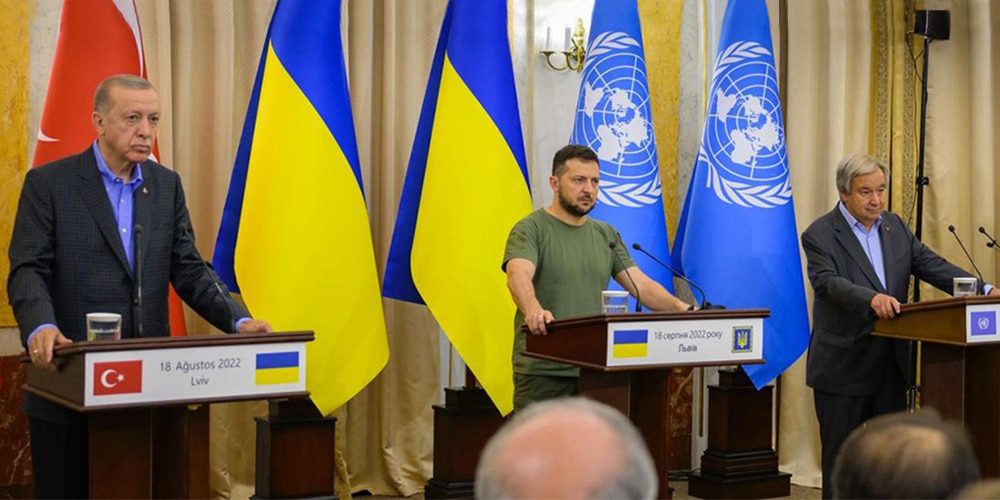
Describing Ukraine as “an epicenter of unbearable heartache and pain”, the UN chief took to the podium alongside its president in Kyiv on Thursday, vowing to increase support for the people amidst the suffering, and the millions displaced in the wake of Russia’s invasion.
“I am here to focus on ways on how the UN can expand support for the people of Ukraine, saving lives, reduce suffering and help find the path of peace”, Secretary-General António Guterres told reporters from across the world gathered in a stately room, with curtains drawn.
Shortly after the press conference, two missile strikes reportedly rocked the capital, a reminder that the war is far from over, despite the Russian withdrawal from the surrounding suburbs.
At least one person was killed, and several injured – with some buried beneath rubble as two high rise buildings caught fire – according to news reports, in the northwest of the city
“I want the Ukrainian people to know that the world sees you, hears you, and is in awe of your resilience and resolve”, declared the UN chief.
“I also know that words of solidarity are not enough. I am here to zero in on needs on the ground and scale up operations.
“This war must end, and peace must be established, in line the charter of the United Nations and international law. Many leaders have made many good efforts to stop the fighting, though these efforts, so far, have not succeeded.
“I am here to say to you, Mr. President, and to the people of Ukraine: We will not give up.”
‘Crisis within a crisis’: Mariupol
Mr. Guterres said the tens of thousands of civilians and fighters believed to be left in the besieged and destroyed coastal city of Mariupol, were in “desperate need” of a humanitarian corridor to escape the horrors of the last redoubt against the Russian invaders, of the Azovstal steel plant complex.
“Mariupol is a crisis within a crisis. Thousands of civilians need life-saving assistance. Many are elderly, in need of medical care or have limited mobility. They need an escape route out of the apocalypse.”
He recalled that in his meeting with President Vladimir Putin in Moscow on Tuesday, there had been an agreement “in principle” to involve the UN and Red Cross, to aid the evacuation of civilians.
“Today, President Zelenskyy and I had the opportunity to address this issue”, he said, adding that “as we speak, there are in intense discussions to move forward on this proposal to make it a reality.”
Failure in New York
Bearing in mind that Moscow’s invasion of Ukraine was a clear violation of Ukraine’s territorial integrity and the UN Charter, Mr. Guterres expressed his categorical view, that the Security Council had failed to live up to its primary purpose to prevent or end the war.
“This is a source of great disappointment, frustration and anger”, he said.
“But the men and women of the United Nations are working every day for the people of Ukraine, side by side with so many brave Ukrainian organizations. I salute the more than 1,400 staff of the UN — the vast majority of whom are Ukrainian nationals. They are on the ground in nine operational hubs and 30 locations.”
He said the complex aid mission had been “one of the fastest scale-up operations we have ever undertaken, and we are very much aware that not everything is perfect. Whatever we can provide pales in comparison to the needs.”
He pledged more action “across the board – coordinating with the Ukrainian Government every step of the way.”
UN Photo/Eskinder Debebe
UN Secretary General António Guterres addresses the media in Kyiv, Ukraine.
Support for millions
He said life-saving humanitarian aid had reached 3.4 million people inside Ukraine, adding that the UN was aiming to more than double that number to 8.7 million by the end of August.
Mr. Guterres said cash assistance was being expanded, and the UN is distributing $100 million per month, aiming to reach 1.3 million people by the end of May, and covering two million by August.
“This is not a typical humanitarian UN operation in a developing country, with lots of problems of governance and lots of difficulties. Ukraine is a country with a government and a system of support to its citizens, and so the role of the UN is not to replace that system, it is to support the Government to support the people of Ukraine.”
Food aid has reached 2.3 million people, said the Secretary-General, with the aim to help four million by May and six million by June.
He said the UN would increase capacity to meet the needs of the 7.7 million that have been displaced inside Ukraine, while the World Health Organization (WHO) is delivering medical supplies for trauma and emergency care for more than seven million.
“And we are advancing the work of accountability and justice by monitoring and reporting on human rights violations wherever they are detected.”
Ground zero for the future
“Finally”, he told reporters in Kyiv, “in many ways, we are at ground zero for the world we need to build – a world of respect for international law, the UN Charter and the power of multilateralism, a world that protects civilians, a world that advances human rights, a world where leaders live up to the values that they have promised to uphold.
Dock2Dock, the unique open water swimming event in the heart of London, is back on 3 September 2022 with an exciting new fundraising challenge! After the success of last year’s fundraising event, Dock2Dock promises to be another action-packed day of open water swimming. Tickets to this iconic event are selling faster than ever before with the 3k and epic 15k sold out of general tickets already.
For the first time, organisers are also offering a limited number of charity tickets to participants who plan to fundraise for the Sea Cadets as part of the race. In exchange for committing to raise money for the charity, swimmers taking on any of the distances on offer can access a 40% discount on their entry fee – so long as they act quickly.
The Sea Cadets Royal Docks Boat Station is one of the standout landmarks along the swim routes, and cadets have helped out in previous years by providing safety cover for swimmers. Now Dock2Dock is looking to return the favour by turning the event into a massive fundraising opportunity in their benefit.
Funds raised by charity ticket holders will go directly to the Royal Docks Sea Cadets, helping them support and teach life skills to local 10- to 18-year-olds through the traditions of the Royal Navy.
Supporting teenagers who are financially disadvantaged, the organisation relies on donors and fundraisers. Cadets are also encouraged to volunteer and fundraise as part of the group’s commitment to social action.
“The businesses and companies around the London Royal Docks form a wonderful community,” said Dock2Dock event organisers. “Hosting an event in the area is a privilege and we couldn’t do this without the support of this community. The Sea Cadets are one such neighbour who work tirelessly to help young people not only locally, but throughout the UK.“
Fundraising together – or alone
To maximise fundraising at the event, Dock2Dock organisers have teamed up with non-profit fundraising platform GivenGain, preferred fundraising platform of some of the world’s highest-profile mass participation events, including the Boston Marathon.
GivenGain allows participants to start individual fundraising projects in aid of Sea Cadets, giving them an easy way to track their progress as well as their position on the overall event fundraising leaderboard. This always inspires a bit of friendly competition before the big day, as swimmers feel part of something bigger than themselves.
Charity ticket holders can start making a difference straight away by registering a free account on GivenGain, starting a fundraising project and then sharing it with friends, family and supporters around the world.
“We’re really excited to be working with the Sea Cadets and Dock2Dock to help make the event more meaningful through participant fundraising,” says Clara Miret Carbonell, Regional Manager: Europe at GivenGain. “After a difficult couple of years for mass participation fundraising events, it’s great to once again see people turning out in numbers to make a difference and support the Sea Cadets. Don’t miss this chance to take on an incredible sporting challenge and give back!”
The power of many (participants)
Online crowdfunding leverages individual networks to contribute far more than a single person can, and to ensure the success of each charity, event, fundraiser and donor, GivenGain is always on hand to provide excellent moral support, tips, resources and white glove service. Beyond just providing Dock2Dock with a fundraising platform, GivenGain offers a fully outsourced support service, backed by expertise going back more than 20 years. The platform’s team of fundraising experts are on hand to build events’ social impact campaigns, create their online pages, design a communications plan to engage their participants and provide them with fundraising resources and content to keep them engaged.
“Online fundraising is the most powerful way for event participants to support the charities they care about,” says Clara Miret Carbonell. “It’s great to see major events like Dock2Dock enabling participant fundraising. We can’t wait to see what a difference it makes!”
Swim for a cause
Charity tickets for Dock2Dock in the 1.5K, 3K, 5K, 10K and 15K distances are now available from their website, but hurry up if you want to swim for the Sea Cadets: charity ticket numbers are strictly limited! Participants with regular priced tickets can also fundraise for the Sea Cadets or a charity of their choice by starting a project on GivenGain. Get involved in this unique open water challenge and start making a difference today!
Press release distributed by Pressat on behalf of GivenGain Foundation, on Friday 29 April, 2022. For more information subscribe and follow https://pressat.co.uk/
With six in 10 people expected to be living in cities by the end of the decade, the UN General Assembly met on Thursday to examine progress towards implementing a 2016 framework on sustainable urbanization.
The New Urban Agenda presents a shared global vision for how to build, manage, and live in cities, through urbanization that is well-planned and well-managed.
Sustainable urbanization can drive change across a variety of interconnected issues including poverty eradication; climate action; migration; land degradation; economic prosperity; & creation of peaceful societies.
It was adopted just one year after countries agreed the Sustainable Development Goals (SDGs), the blueprint for a better future, for people and the planet, by 2030.
In his opening remarks, General Assembly President Abdulla Shahid spoke of how sustainable urbanization can drive change across a variety of interconnected issues, including poverty eradication, climate action, migration, land degradation, economic prosperity, and creation of peaceful societies.
Yet, he said the New Urban Agenda has often been “under-appreciated”, despite its far-ranging implications.
“While sustainable urbanization is related to the achievement of all the Sustainable Development Goals, only a few countries can truly claim that they have in place the governance, and the necessary policies, including on inclusive urban planning, capacity development, technology access, and financing necessary to ensure sustainable urbanization,” said Mr. Shahid, adding “we need to change this trend.”
The high-level meeting brought together Government representatives, city mayors, business leaders, youth, and other constituencies.
Full implementation of the New Urban Agenda is at the core of the SDG principle of “leaving no one behind”, said Collen V. Kelapile, the ECOSOC President, who reported on its meeting held last week.
Among the key messages coming out of the discussions was the need for financing to address “urban inequalities”, including around access to housing.
“Housing has become a commercial commodity, and urban land markets are captured by the political elite. Therefore, Member States are urged to position housing above all as a human right,” said Mr. Kelapile.
He also encouraged countries to view the challenge of unlocking financing for affordable housing as both an opportunity to create jobs and a catalyst to enhance revenues raised by cities.
Leave no one behind
The imperative around housing is included in the Secretary-General’s quadrennial report, the document guiding deliberations at the one-day meeting, said Maimunah Sharif, Executive Director of UN-Habitat, the agency that is the “custodian” of the New Urban Agenda.
She recalled that the report recommends countries integrate provision of adequate and affordable housing as a driver of equitable development, adding that housing is central to social protection systems, along with healthcare, jobs, education and digital access.
“Member States can achieve this by making urban policy a central feature to comprehensively address climate mitigation and adaptation. By aligning spatial and economic development we can protect biodiversity and reduce pollution. We must ensure no one, including the smallest of God’s creations, is left behind,” she said.
Ocean Image Bank/Srikanth Mannep
Urban expansion is contributing to Indonesia’s significant mangrove loss.
Under pressure
The New Urban Agenda is critical at a time when cities are grappling with numerous pressures, for example on food, water and energy resources – a point made by the UN Deputy Secretary-General, Amina Mohammed.
The framework sets out a clear pathway for developing truly sustainable cities, centred around resilient economies, a clean environment, and the health, well-being, culture, and security that residents need. It also offers lasting solutions to tackle the climate crisis.
“When planned well, built in a compact urban form, and supported with high quality public transport, cities offer the most sustainable form of human settlement,” she said.
“Investing in sustainable urbanization can also catalyze important transitions across food and energy systems.”
Ms. Mohammed also highlighted UN initiatives to assist countries in implementing the New Urban Agenda.
Urbanization will be integrated more systematically into development cooperation frameworks, for example, while Governments will also receive tailored support for the development of national urban policies and inclusive urban planning.
There has been much written about Ukraine and what’s happening but little about how important phones are in this crisis. There has been one European wide announcement but so far that hasn’t translated much to what’s happening on the ground.
theunconnected.org (charity number 1198420) is a UK charity focused on ensuring people who need it have a connection to the internet. We have been working hard to keep communication channels open between people who have fled Ukraine and those who remain behind.
By raising funds and donations in kind theunonnected.org firstly went out to the Ukrainian border in Siret to distribute SIM cards, power banks, chargers and devices in addition to seeing first hand the necessity for this telecom equipment. As suspected the demand for this was huge and our stand was the first port of call for most people crossing the border. Keeping their phone working was the top priority for people fleeing the crisis. We made a second visit to Berlin as it’s a major destination and transition hub for refugees delivering more equipment to the people in need and there were a great many of them.
Since returning to the UK we have been raising funds to top up the phones of Ukranian’s left behind in Ukraine. 92% of the mobile phone market in Ukraine is prepaid, requiring a balance to be on the phone to make it function. As the situation deteriorates it has become more and more difficult to purchase this credit in Ukraine but it’s something we can do from the UK.
We have been communicating with the people we met on the border, in Germany, NGO’s and other Ukrainian organisations both in the UK and Ukraine to collect numbers and this is now going viral with more being added every minute.
We have been posting credit on thousands of phones to ensure that people in Ukraine can continue to communicate and keep their life functioning as normally as possible. We have been doing this with both corporate and individual sponsorship but funds are now low just as the need is growing and the situation getting worse.
If you think you can help please go to https://donorbox.org/connecting-ukrainian-refugees
Press release distributed by Pressat on behalf of theunconnected.org, on Friday 29 April, 2022. For more information subscribe and follow https://pressat.co.uk/
Churches in South Africa responded strongly to the flood disaster in KwaZulu Natal province, and hich at least 440 people are known to have died in what many said is the worst inundation in living memory.
The floods were the strongest to hit the province in recent times and inundated the province following a week of heavy rainfall in the area on the Indian Ocean in the east of the country.
The South African military deployed more than 10,000 troops to help with relief and rescue operations following the devastating floods that swept through parts of KwaZulu-Natal, the BBC reported.
The devastating floods lashed on April 11 displacing thousands of people, especially those living in makeshift homes and scores more were reported missing.
The weather event started April 11 when more than 300 mm (nearly 12 inches) of rainfall was recorded in 24 hours.
Some reports suggest this is equal to about 75 percent of South Africa’s annual precipitation.
Scientists warn that floods and other extreme weather events are becoming more powerful and frequent as the world gets warmer because of climate change, AFP reported.
The ensuing floods and mudslides left thousands of people homeless, and knocked out power and water services, as they destroyed scores of hospitals and hundreds of schools in the region.
Floods have also disrupted operations in the coastal port of Durban, with a population of 3.5 million people and one of Africa’s busiest harbors.
“It’s a tragedy of overwhelming proportions—hundreds have died, thousands of homes destroyed and probably tens of thousands displaced,” Anglican Archbishop Thabo Makgoba of Cape Town said on April 16, after visiting the flood-stricken region, appealing for support and prayers, the World Council of Churches reported.
Earlier in an April 14 statement, Bishop Malusi Mpumlwana, general secretary of the South African Council of Churches, said: “The devastation we have seen – the destruction of homes, schools and churches and the loss of lives – brings us to our knees as we pray for the safety of the people of KwaZulu Natal.”
President Cyril Ramaphosa declared the floods in the province a national state of disaster to allow the freeing of more resources to boost government capability and technical expertise in providing relief.
The announcement came as rescue teams continued to search for 63 people, who were reportedly swept away by flooded rivers and mudslides.
Officials said nearly 4,000 homes were destroyed and more than 8,000 damaged – most of them in Durban City.
On the ground, churches have actively responded to the loss of life, property and the devastation caused by the floods.
The KwaZulu Natal Christian Council, the provincial chapter of the South African Council of Churches and the KwaZulu Natal Church Leaders Group together with regional ecumenical offices in the province, have partnered with other organizations such as the Red Cross to provide disaster relief.
“It is rare for it to be over 15 carats. Its color is bright blue. And he is internally flawless. And one of its most distinctive and rare qualities is polishing.
The largest and most valuable bright blue diamond was sold for $ 57.5 million at an auction in Hong Kong, organized by the Sotheby’s auction house, CBS reported.
The identity of the buyer is not reported.
De Beers’ blue diamond, which is over 15 carats, was mined in 2021 at the Cullinan mine in the Republic of South Africa, one of the few sources in the world of extremely rare stones of this color. Its initial estimate was $ 48 million.
He received the highest possible color diamond rating from the American Institute of Gemology, which has so far been given to less than 1 percent of blue diamonds.
Sotheby’s Senior Vice President Frank Everett, who is also the sales director for jewelry, said the stone is remarkable in many ways.
“It is rare for it to be over 15 carats. Its color is bright blue. And he is internally flawless. And one of its most distinctive and rare qualities is polishing, “he said.
The South African Cullinan mine is known for the discovery of the world’s largest diamond. The Cullinan stone is 3106 carats and was found in 1905.
What basic things do you need to know about driving an electric car?
In Europe, electricity is transmitted through a three-phase network, which means that three power transmission lines are used.
• For smaller electrical appliances, such as most household appliances, one phase is sufficient, so all household contacts are single-phase (single-phase).
• Larger appliances used in industry, but sometimes kitchen ovens, are connected to all three lines, allowing more power (and higher voltage).
• In some markets (eg France) private households are usually connected to one phase. In others (eg Germany) they are linked to all three phases. In such markets, it is also recommended to use three-phase technology (wall box, on-board charger), allowing faster charging.
Conversion from AC to DC
• To charge the battery of your electric car, the AC must be converted to direct current (DC). Otherwise it will flow to and from the battery and the battery will not be able to charge.
• This conversion can be done via the on-board charger (OBC) or outside the vehicle with DC DC fast charging stations that have a higher charging capacity (up to 100 kW or 80% of the capacity in 30 minutes).
• OBC is part of your electric car and includes from a single-phase – up to 3.7 kW – to a three-phase device with 11 kW. However, keep in mind that the charging capability is determined by the weakest link in the chain (the mains socket, cable or wall box used). In order to ensure maximum charging power, it is necessary to connect a corresponding charging device. Therefore, the most efficient and best way to charge at home is always a wall box.
Battery-powered electric cars have:
• Electric motor and battery
• Battery charged with charging station cable (private / public)
When the car is moving, the battery is also charged by the recovered energy: in practice, part of the energy when braking is converted back into electricity from the moment you lift your foot off the accelerator pedal or apply the brakes.
The average mileage largely depends on the model, driving style, external conditions and battery capacity. Some models can travel more than 300 km, based on a specific driving cycle.
Plug-in hybrid electric cars are equipped with:
• Electric motor and battery, as well as with internal combustion engine
• The battery is charged with a charging station cable (public / private) or from the petrol engine
During operation, the battery is also charged by the recovered energy:
• Braking energy is converted back into electricity the moment you lift your foot off the accelerator pedal or apply the brake.
• The average mileage in all-electric mode largely depends on driving style, external conditions and battery capacity. Some models can travel more than 40 km, based on a specific driving cycle.
• There are locally zero CO2 emissions when driving in fully electric mode.
How does charging an electric car work?
In the early days of electrification, the standard for the transmission of electricity was direct current (DC), which flows in one direction. Nowadays, the electricity grid in Europe operates with alternating current (AC), in which the current is constantly changing its direction – more precisely 50 times per second. Thus, the transmission of electricity is more efficient over long distances.
While most of our household appliances are powered by alternating current (AC), any device with a built-in battery can be charged with direct current (DC). This also applies to electric cars. That’s why it’s a good idea to know more about AC and DC if you’re planning to drive an electric car.
When charging an electric vehicle with a normal AC AC mains, AC is converted to DC in the vehicle. However, this way of charging takes time. You can speed things up by installing an AC Wall box. With its help, charging will be faster than with normal household contact, because it offers a higher capacity for energy transmission (up to 11 kW power). The ability to charge the fastest is provided by the DC charger. The reason for this is that the alternating current from the mains has already been transformed into direct current outside the car and can be directed directly to the battery. DC chargers are currently only used for public stations, but are an extremely convenient and easy form of charging when in a hurry.
With this basic knowledge, it will be easier for you with your electric car and charging it – whether it is at home, on the road or on long trips.
More and more young women and girls are highlighting the importance of access and safety in the digital world. Marking International Girls in ICT Day, on Thursday, UN agencies have issued a call to action to ensure equal access to digital learning opportunities.
The International Girls in ICT Day is observed annually during the last week of April, and this year the focus is on ‘Access and Safety’ as key elements to engage the next generation with information and communication technology (ICT).
According to the UN International Telecommunication Union (ITU), this year’s theme “reflects the world’s shared interest in empowering youth and girls to safely benefit from an active digital life.
The UN agency recognizes the need to ensure girls and women enjoy equal access to digital learning opportunities, particularly in least developed countries.
Girls continue to face systemic barriers, cyber bullying and threats, and a lack of access due to the digital divide.
Furthermore, if women are unable to access the Internet and do not feel safe online, they are unable to develop the necessary digital skills and engage in digital spaces, which diminishes their opportunities to pursue careers in science, technology, engineering, and mathematics (STEM) related fields, ITU continued.
Inspire the next generation
“Girls in ICT Day is a call to action to inspire the next generation of young women and girls to enter STEM careers,” said ITU Secretary-General Houlin Zhao.
Calling on all government, business, university leaders and others, to do their utmost to support young women and girls, Mr. Zhao said that is essential to “give them the chance to achieve their dreams.”
Girls’ access to STEM is crucial
Joining the call, UN Women reiterated the importance of ensuring every girl has safe and meaningful access to digital technology and ICTs.
In a statement marking the Day, the agency said they were inspired by young activists such as 18-year-old Ana Vizitiv from the Republic of Moldova, whose work promotes gender equality in ICT and STEM, and by role model and entrepreneur 20-year-old Yordanos Genanaw from Ethiopia, who participated in the African Girls Can Code initiative and is now developing a website and coaching others.
“These young women are using their skills to inspire other girls to pursue coding and basic IT skills, regardless of gender biases”, the statement continued.
Reminding that girls’ access to, and engagement in STEM subjects, is more crucial now than ever – especially after the COVID-19 pandemic and multiple crises in countries across the world have created repeated challenges to young women and girls to learn, earn and connect – UN Women reiterated the importance of technology as a solution to access essential services and information.
Adolescent girls use cellphones and tablets in the Za’atari camp for Syrian refugees (file).
Technology also helps them communicate in school, keep in touch with friends and relatives and as a key aspect of their autonomy and future prospects.
Persistent negative stereotypes
A recent study by UN Women and ITU shows that girls access digital technology at a later age than boys, and that their use of this technology is more often curtailed by their parents.
In addition, young women and girls are disproportionately exposed to online and ICT-facilitated violence and harassment, which can negatively impact their physical, mental, and emotional well-being, and influence how they access and use digital tools for the rest of their lives, UN Women added.
Built upon the idea that “every girl has the right to be connected and safe, and to play her partin shaping a more equal, green and tech-driven future”, the UN Secretary-General has called for a global digital compact for improved digital cooperation.
Marking the Day, UN Deputy Secretary-General Amina Mohammed called for an end to systemic barriers: “Girls continue to face cyber bullying and threats, and a lack of access due to digital divide”, she said on Twitter, asking for a transformation in tech and innovation, to be “equitable, safe and accessible”.
Across the UN system, agencies spoke up for gender equality in STEM. The UN cultural agency UNESCOcalled for the empowerment of young girls in ICT, so they can have a future lead in the workplace. The UN refugee agency mentioned the importance of not forgetting the digital access for refugees, and the Food and Agriculture Organization (FAO) reiterated the need to guarantee better access to digital technologies, for rural women and girls.
Join the digital revolution
The global celebration and associated worldwide Girls in ICT Day events underline ITU’s commitment to encourage girls and young women everywhere to consider pursuing STEM career paths.
To date, over 600,000 girls and young women have taken part in more than 12,000 celebrations of Girls in ICT Day in 195 countries worldwide.
“All over the world, girls and young women want to join the digital revolution. When we remove barriers of access and safety, women and girls can make remarkable contributions to, and be empowered by, ICTs. To put it simply: tech needs girls, and girls need tech,” said Doreen Bogdan-Martin, Director of ITU’s Telecommunication Development Bureau.”
In early April, 29 countries pledged more than $5 billion to the UN-backed Global Environment Facility (GEF). The Fund said this was “record support, providing a major boost to international efforts to protect biodiversity and curb threats to climate change, plastics and toxic chemicals”.
But why this fund? Well, the GEF is a multilateral fund and serves as a financial mechanism for several environmental conventions including the UN Framework Convention on Climate Change and the UN Convention on Biological Diversity.
It has its own Small Grants Program(SGP) which grants of up to $50,000 directly to local communities including indigenous peoples, community-based organizations and other non-governmental groups investing in projects related to healing our planet.
The initiative is implemented in 127 countries by the UN Development Program (UNDP) which provides technical support to these selected local projects that conserve and restore the environment while enhancing people’s wellbeing and livelihoods.
Here at UN News, we want to highlight just five of the over 25,000 projects implemented since 1992, the year the GEF started working. Though the Fund’s projects span the globe, this list features a few initiatives currently improving the future of humankind and wildlife in Latin-America and the Caribbean.
1. Indigenous women solar engineers bringing light to rural Belize
UNDP/SGP Belize
The three Mayan solar engineers who are bringing electricity to rural villages in Belize.
For people living in cities is sometimes hard to believe that in 2022 there are still communities that don’t have electricity, but more than 500 million people worldwide don’t have access to this kind of service that many consider ‘basic’.
This is the reality for people in the District of Toledo, in Belize, where several rural villages lie far away from the national electricity grid making it hard – and costly – to electrify their communities.
However, thanks to a partnership funded by the GEF’s Small Grants Program (SGP), three Mayan women solar engineers are installing solar energy systems and contributing to sustainable development in small indigenous communities in Southern Belize.
Florentina Choc, Miriam Choc and Cristina Choc, were trained by the Barefoot College in India to build and repair small household solar systems as part of a South-South cooperation exchange (Countries from the Global South sharing technical knowledge with their counterparts, without a developed country involved).
“These women are shattering the glass ceiling! They have installed solar systems to four indigenous communities impacting over 1000 residents,” says Leonel Requena, SGP Belize National Coordinator.
In 2021, despite the ongoing COVID-19 pandemic, these solar engineers, along with national authorities and partners installed these solar energy systems to two of Belize’s most remote communities.
With the work in just one of these villages, Graham Creek, they powered 25 homes benefiting over 150 residents, as well as a primary school with 30 children.
The best of all, UNDP estimates they have helped avoid 6.5 tonnes of carbon emissions.
“Women are outstanding leaders in Belize driving the sustainable development agenda fostering harmony between nature and people for the benefit of both,” adds Mr. Requena.
2. Turning Barbados into a champion of Hawksbill turtles’ conservation
Unsplash/Jakob Owens
Sea turtle slowly swiming in blue water through sunlight.
Did you know that extreme temperatures during heatwaves fuelled by climate change are literally cooking baby turtles in their nest?
Hawksbill sea turtles are classified by the International Union for Conservation of Nature as critically endangered as their population is decreasing around the world.
For ages, they have been hunted for their eggs and meat and now they are also at risk from coastal development and our changing climate, among other threats.
But a small grant 20 years ago turned into a big opportunity for this species to thrive in the Caribbean Island of Barbados.
The Barbados Sea Turtle Project, based at the University of the West Indies’ Campus, is the home of the regional Marine Turtle Tagging Centre and the wider Caribbean Sea Turtle Conservation Network.
Tagging turtles helps scientists and conservationists to track their movements, calculate their growth rates, survival and reproductive output.
Barbados is currently home to the second-largest Hawksbill turtle nesting population in the wider Caribbean, with up to 500 females nesting per year. Turtle nesting occurs on most of the beaches around the island, which, like many in the region, is heavily developed with tourism infrastructure.
The Barbados Sea Turtle Project tags these creatures, measures them and archives and analyses the data for over 30 coordinated projects in the region. These research projects inform their conservation activities.
Each August when the baby turtles hatch, the project runners are on call seven days a week to respond to emergencies that might include hatchlings wandering off in the wrong direction or preparing for swells that can wash away nests during hurricane season.
The project runners also help communities promote ecotourism based on best practices, which provides a source of income for local communities.
Barbados is now well known for the success of its sea turtle conservation activities. The degree to which the Hawksbill population has recovered thus far allows trainees to work with large numbers of turtles and experience the challenges posed by extensive coastal development.
The widely renowned project recently received a new small grant from the GEF of $46,310.
“Thanks to this grant [this project has] been able to offer persons from other sea turtle projects in the region the opportunity to be trained alongside BSTP volunteers in a South-to-South Exchange… The ongoing work of the Project is integral to the conservation and protection of threatened and endangered sea turtles, their terrestrial and marine habitats,” said Karen Harper, Programme Assistant of SGP in Barbados.
3. Helping Venezuelan indigenous families mitigate the degradation of the Amazon Forest
UNDP/SGP Venezuela
Indigenous displaced families in Venezuela are learning to restore native forests while using their products to improve their livelihoods.
Puerto Ayacucho is the capital and largest city of the State of Amazonas in the south of Venezuela, its inhabitants include a number of local indigenous tribes, including the Yanomami, the Panare, the Bari, Piaroa and Guajibo (also known as Jibis).
Many of these populations have been displaced from their lands due to the socioeconomic crisis in the country, as well as the presence of armed groups and illegal mining activities.
The project Amazonas Originaria is currently training a group of indigenous displaced families to sustainably use and care for the tropical forests in the vicinity of Puerto Ayacucho. They are learning how to manage crops of cocoa, cupuaçu, manaca and túpiro (all amazon native plants) as well as how to transform their fruits into pulp, chocolates, baskets and other products.
“This project, in particular, is interesting and inspiring, as it is led by women… it supports the fight against climate change, since its purpose is to conserve the Amazon Forest as the main carbon sink in southern Venezuela, working hand in hand with native communities, valuing their traditions and protecting their ancestral habitat,” explains national SGP coordinator Alexis Bermúdez.
According to the UN Environment Programme, or UNEP, in the Amazon, the world’s largest remaining tropical rainforest, deforestation is reducing carbon stocks and altering the regional climate. The effects of climate change, forest degradation and more forest fires could result in 60 per cent of the Amazon rainforest disappearing by 2050.
The SGP-supported initiative not only trains members of the community to make Amazon-derived products and ecological packaging helping them to diversify their livelihoods, but at the same time it works to restore parts of the degraded tropical forest by re-planting native trees and other species.
“When families pass on this knowledge, we make indigenous communities gain the necessary strength and confidence to face the conservation of their culture and their environment, organize the community for the production and marketing of their products in more select markets and contribute directly to creating a sustainable economy,” Kenia Martinez from Amazonas Originaria notes.
4. Exchanging ideas to make tourism more eco-friendly and sustainable
UNDP/SGP Costa Rica
Leaders of community tourism in Mexico, Colombia, Panama and Costa Rica got together to exchange good practices.
Clearly, climate change and environmental degradation can´t be tackled by a single community, instead, unity is strength when we talk about exchanging ideas that have already proven successful.
Tourism is the backbone of some economies and the source of livelihood for many people, especially those living in developing countries, but if mismanaged, it often puts pressure on natural resources through overconsumption, induces stress on local land use, as well as increases pollution and natural habitat loss.
Community tourism, on the other hand, is an economic alternative that allows local communities to generate complementary income to their main productive activities and at the same time protect and value the natural and cultural wealth of their territories.
“Alone we go faster, but together we go further,” Beatriz Schmitt, SGP Panama National Coordinator highlights.
The SGP-supported dialogues consisted virtual trainings and good practices exchanges with 23 rural organizations focusing on local development, collaborative working networks, marketing, institutional perspective and biosafety protocols.
At the end of the virtual training, participants visited community tourism experiences in Costa Rica where the programme has been promoting rural tourism for 20 years and has established a robust institutional framework.
“Community tourism is a local strategy that brings income to rural communities. This project is important because tourism is not approached only as a business but instead, it is derived from experiences of land conservation where these communities live,” Viviana Rodriguez, SGP Programme Assistant in Panama tells UN News.
She adds that by conserving these areas for tourism and reducing other activities such as large-scale agriculture, small communities are also contributing to the fight against climate change.
5. Saving the water-rich Colombian Paramos, with a gender twist
Unsplash/Michael Lechner
Páramo is a type of alpine moorland—cold, wet and windy—concentrated in the northern Andes above the treeline from Venezuela through Northern Peru.
Colombia’s paramos, tundra ecosystems in the Andes mountains that are above the forest line but below the snowline, occupy just 1.7 per cent of the national territory, yet they produce 85 per cent of its drinking water.
Guardianas de los Páramos (Paramos Women Guardians) is an Alliance between the GEF Small Grants Program and two other organizations that are supporting a variety of community projects focused on conservation and climate change adaptation in the Paramos Pisba and TotaBijagual-Mamapacha, about 280 km to the northeast of Bogotá.
The alliance puts special emphasis on women’s participation since historically, the intervention of women in environmental management has been diminished because of discrimination and inequitable access to resources.
A total of 37 projects were selected benefiting 2,400 families who had been working since 2020 to restore native plants, thus strengthening biological corridors and maintaining protected areas.
The initiatives also include aqueduct adaptation, as well as the implementation of homemade agroecological gardens to reduce the use of traditional productive systems that are harmful to the environment.
“It is necessary to implement actions aimed at controlling or reducing pressures on the paramo and to mitigate negative actions by extractive activities in the area, establishing conservation areas and measures to reduce risks associated with climate change”, says Catalina Avella, the alliance field coordinator.
Paramos are a unique Andean ecosystem, only found in high mountains of the north of South America, they are strategic not only due to their plant and animal biodiversity but also of their ecosystem services, including carbon sequestrations in the soil and water regulation.
The increase in temperatures and changes in rain patterns due to climate change poses a threat to these ecosystems, as well as mining and infrastructure projects.
UN News/Laura Quiñones
Young climate activists take part in demonstrations at the COP26 Climate Conference in Glasgow, Scotland.
Great projects, right? So, how can you get involved?
If you have a project related to climate change mitigation, reversing land degradation, sustainable forest management, or protecting biodiversity, visit the Small Grants Program website where you can find out how to apply depending on your country.
SGP grants are made directly to community-based organizations and non-governmental organizations in recognition of the key role they play as a resource and constituency for environment and development concerns. The maximum grant amount per project is $50,000 but averages around $25,000.
The European Parliament will vote on a proposal to have more common rules for EU elections and the addition of an EU-wide constituency.
The EU elections determine the representatives of Europeans at EU level, but how they are organised is largely decided at national level. This means that countries vote on different days, only national political parties appear on the ballots and voting age varies.
The report says it is essential to transform the EU elections “into a single European election, […] as opposed to 27 separate national elections, which is the way that European elections are organised today”.
MEPs propose the establishment of an EU-wide constituency to elect 28 MEPs in addition to the MEPs elected in national or regional constituencies.
European political parties or coalitions of national parties would be able to propose transnational lists of candidates headed by their preferred candidate for the president of the European Commission. There should be geographical balance in transnational lists by including candidates from large, medium-sized and smaller countries in alternating order.
The proposal also says that lead candidates should be able to stand in all member states on the EU-wide lists, allowing voters to vote for their preferred candidate for Commission president.
A proposal for transnational lists prior to the 2019 European elections did not receive support from EU heads of state and government. At a meeting in February 2018, they said they would come back to the issue “in the future, with a view to the 2024 elections”.
In 2014, the European Council nominated Jean-Claude Juncker, the lead candidate from the European People’s Party (EPP), the European political family that won the most votes, as Commission president. In 2019, however, EU leaders did not follow the same process.
MEPs argue that the establishment of an EU-wide constituency in which lists are headed by each political group’s candidate for Commission president would strengthen European democracy and further legitimise the election of the president of the Commission.
A recommendation for electoral lists from multiple member states was also made by a panel of European citizens in the Conference on the Future of Europe.
Common provisions for the elections
MEPs propose that the EU election day should be the same for all EU countries and that it should always take place on 9 May, Europe Day.
Currently, elections take place from Thursday to Sunday, with each country following its national electoral traditions.
The proposal seeks to harmonise the age from which EU citizens have the right to vote or stand for EU elections. MEPs recommend that all Europeans should have the right to vote from 16 and that every EU citizen over 18 should have the right to stand for election.
The proposal envisages that all EU countries should provide for postal voting in the European elections. It also says that gender equality in electoral lists should be ensured either through zipped lists, where men and women candidates alternate, or through quotas.
Special procedure for amending electoral rules
Updates of the European Electoral Act are subject to a special decision-making procedure. The proposal is prepared by the European Parliament. The Council can amend it and has to adopt the text unanimously after obtaining the consent of the Parliament. All EU countries have to approve the provisions before they can enter into force.