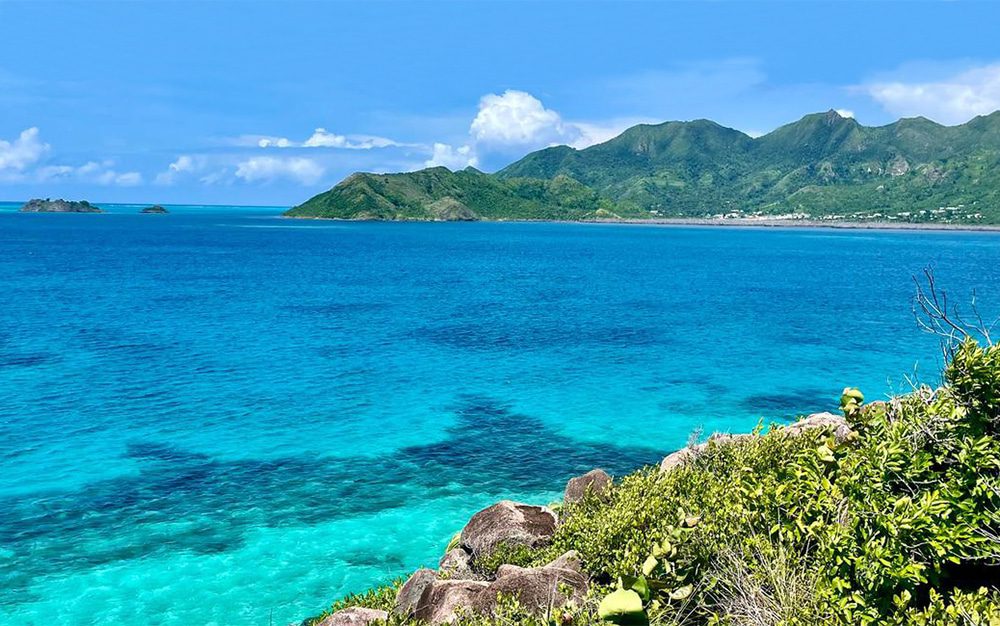
A tiny Caribbean Island known as 'the flower of the ocean' was decimated by Hurricane Iota in 2020. Although the loss of human life was minimal, the impact on precious ecosystems deeply changed the perspective of its inhabitants. Two years after the storm, they’re still working to restore their environmental treasures and preparing for whatever curveballs climate change might throw at them next.
The mountainous Colombian island of Providencia – which lies midway in the extension of the Caribbean Sea that separates Costa Rica and Jamaica – is home to stunning colours of the sea, lush underwater landscapes, extensive mangrove forests, and even tropical dry forests.
The diversity of marine ecosystems and surrounding natural wonders, including the yearly spectacle of thousands of rare black crabs descending from the mountains and heading to the sea to lay their eggs, and one of the world’s largest barrier reefs, which supports a stunning array of marine life, has led to its declaration as part of the Seaflower UNESCO Biosphere Reserve.
However, as with all islands in the world, Providencia’s unique natural treasures are highly threatened by climate change and sea level rise, threats that are not ‘theories’ looming on the horizon, but that are instead terrible facts already impacting every facet of life there.
Its 6,000 inhabitants will never forget the night of November 16th, when Iota, the last and strongest hurricane of the 2020 Atlantic storm season— deemed then a Category 5* — decimated their beloved land.

“The most shocking thing was the sound. Our people say that the hurricane came with the devil because the sound was so strange and scary,” recalls Marcela Cano, a biologist and long-time resident who has made it her life’s work to preserve Providencia’s environmental treasures.
But that night, she would spend hours fighting to survive the storm.
She was at her home sleeping when at around midnight, she started hearing strange noises. This turned out to be wind gusts of over 155 miles an hour tearing across the island.
Power and communication were shortly lost.
“I stood up and noticed that my ceiling lights looked as if they were higher than usual. That’s when I realized that part of my roof had flown away,” Ms. Cano recalls now, adding that minutes later she heard two loud bangs from her guestroom and saw water pouring down the walls.
Her immediate reaction was to get out of the house, a decision that looking back now was definitely the best one, she says, because not only the roof but most of the walls of her house collapsed in the darkness under the force of the pounding rains and the wind.
“It was raining very hard; I almost couldn’t make it out of my house because the wind wouldn’t let me open the door. I made it just where I had parked my Mula [her motorized golf cart]. I was completely soaked, and I just sat there.”
She spent over 10 hours sitting in her golf cart hoping that the wall next to it and a big pine tree would hold up.
“Every time I would hear loud bangs, I would point my flashlight towards the tree. If it had broken, that would’ve been it for me.”
It was the longest night Providencia had ever experienced. And even after sunrise, the hurricane let barely any light come through.
“Very strong wind gusts would come and go for hours and hours, and all I could think was ‘please God make it stop, it’s been too long, please stop’. It felt like the longest time of my life. At about 11 am it finally got a bit better, but it was still raining pretty hard.”
It was then that she saw her neighbours up the road calling her. She gathered the courage to walk up the debris-strewn little hill towards them and realised their house had also been lost.
But for Marcela, the loss was about to become even bigger and more painful.
Personal archive
Marcela Cano’s house after the hurricane.
A life protecting nature
Ms. Cano is the Director of Old Providence McBean Lagoon Natural National Park, a unique and highly important protected site on the island and the Seaflower UNESCO Biosphere Reserve. She has worked for over 30 years to protect it, and with her team, has been a pioneer in ecosystem restoration and ecotourism.
“I looked around and all the vegetation on the island was gone, everything was black, and all the trees no longer had leaves. It was as if everything had been burnt, and the sea was up high. I could see Santa Catalina Island from there; I couldn’t see it before. And I could see how destroyed it was,” she remembers, telling UN News that every time she tells this story she can barely hold back the tears.
That night, she took refuge with 10 families under a concrete ledge that hadn’t given an inch to the winds and the rain. It was actually the second floor of a house under construction.
“We made a common makeshift bed. It was also the middle of a COVID-19 peak in Colombia, but no one could care about that at that moment,” Ms. Cano says.
It was still raining, and the island had been without communication for over eight hours. The whole mainland of Colombia wondered for almost a day if Providencia had survived hurricane Iota or not.
In the following days, as help arrived, other locals described how people were walking around like “zombies” searching for food and shelter. Miraculously, only four people lost their lives that night, but over 98 per cent of the island’s infrastructure was destroyed and 6,000 people were left homeless.
“I went walking to ask about my team at the National Park. We were all fine, but we lost everything we had worked for. Our office, our library, the research data stored in our computers, everything was lost.”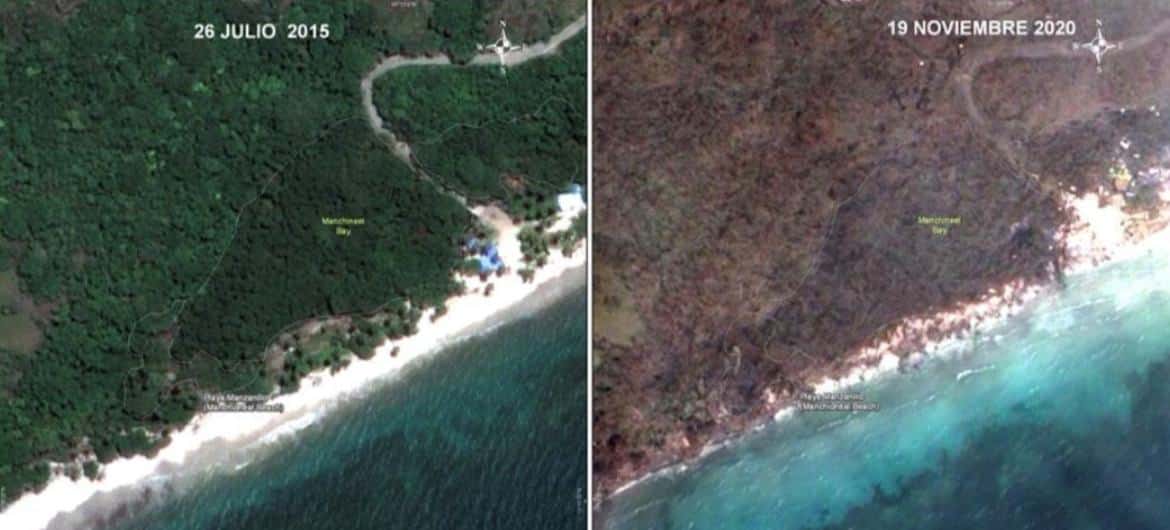
Invemar
Satellite images show how mangroves and vegetation at Manchineel Bay in Providencia were affected after hurricane Iota.
An environmental tragedy
Sometime later, Ms. Cano was able to return to Providencia after spending time with her family in Bogotá and working to gather household items and basic necessities for some families affected by the storm.
It was then that she was able to evaluate the environmental damage inside the National Park.
“I’ve spent most of my life here in Providencia and to see that all our efforts to maintain the National Park had vanished from one day to the next, was heartbreaking.”
According to Colombia’s National Natural Parks, around 90 per cent of the Park’s mangroves and forests were affected, as well as the coral reefs in shallow waters, many of which had been in nurseries as part of an ongoing restoration effort.
“We are working to restore vegetation and saline formations. We also carried out rescue and replanting of coral colonies that were uprooted by the hurricane,” Ms. Cano explains while standing in what’s left of the pier of Crab-Cay, once the most visited attraction in Providencia.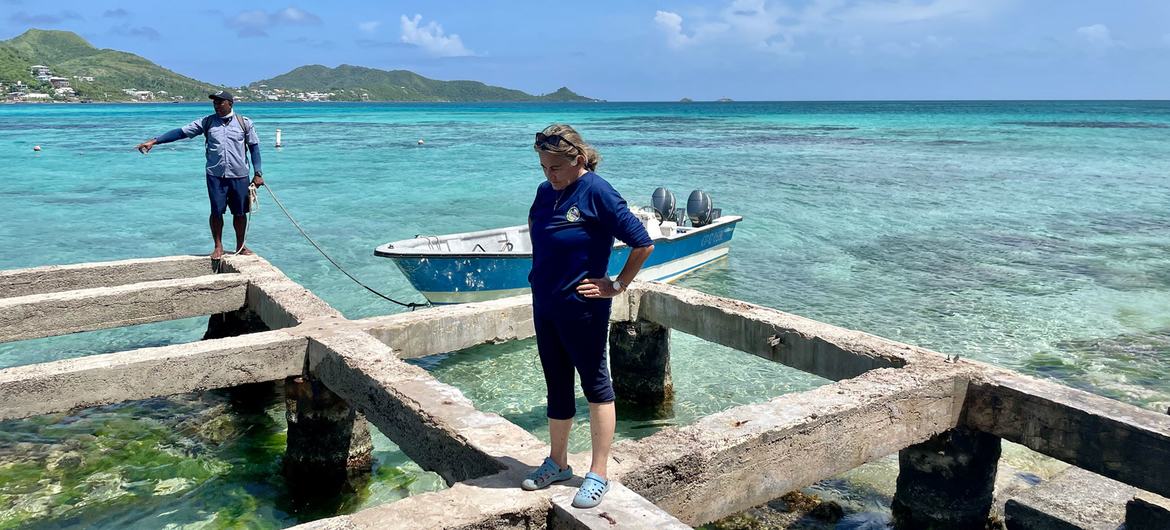
UN News/Laura Quiñones
Marcela Cano stands over the remnants of the pier that once stood over Crab Cay, McBean Lagoon National Park.
The small island rises sharply and dramatically off the coast surrounded by turquoise waters. Tourists used to climb to the top for 360-degree views of the park. Now a new viewing deck and pier are being built**, and some vegetation planted last year, has begun to sprout.
“Was this here before the hurricane?” she asks her team, pointing to some algae-covered metal debris.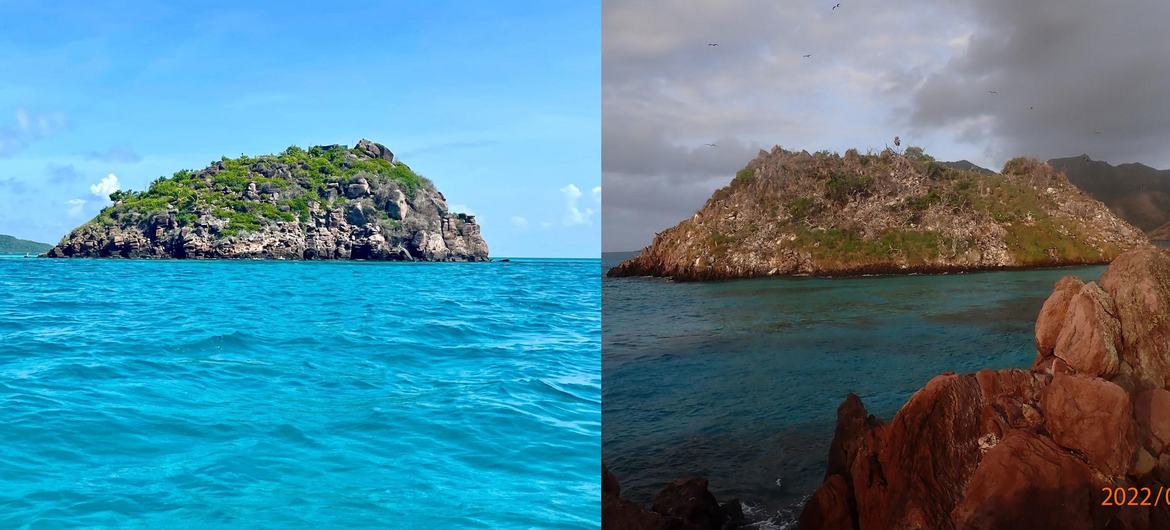
UN News/Laura Quinones/PNN Colom
(Left) Crab Key in June 2022 (right) Crab Cay right after Hurricane Iota.
Coral reefs
Thanks to its field work and reef restoration experience over the past decade, McBean Lagoon National Park is currently the largest contributor to the nationwide project One Million Corals for Colombia to restore over 200 hectares of coral reef, with over 55,000 coral fragments in nurseries and over 6,000 transplanted.
UN News visited some of the transplanted colonies and witnessed the miracle of coral fragments fusing together and attracting young fish, bringing life back to the sea currently threatened by warming seas and extreme weather events.
“The water is getting warmer, so algae colonies are getting bigger and fighting coral reef for its resources,” explains young Marine Biologist Violeta Posada, a member of Ms. Cano’s team at the Park.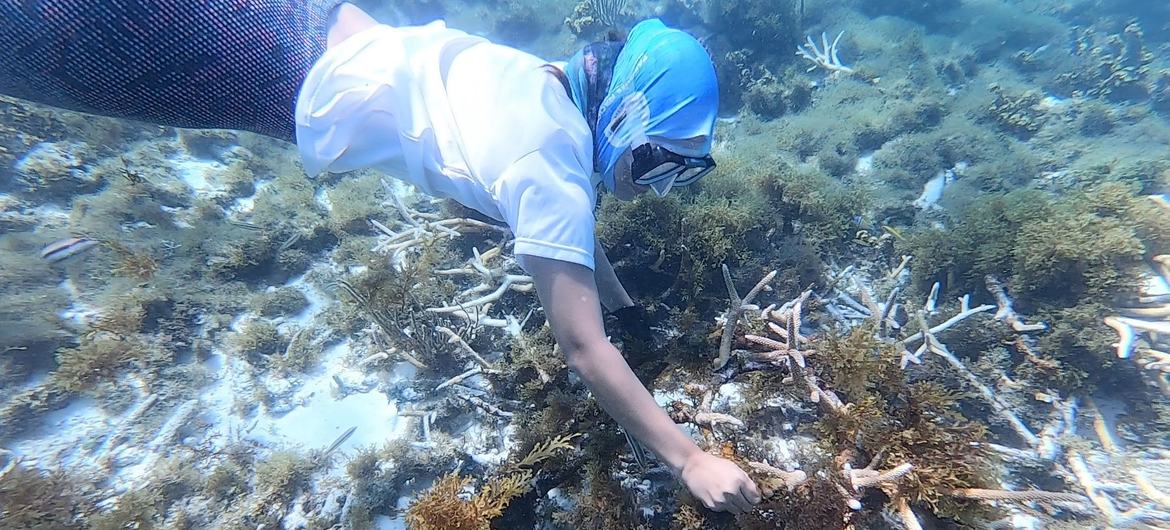
UN News/Laura Quiñones
Marine Biologist Violeta Posada cleans a transplanted coral colony.
She underscored that ecosystem restoration work is a daily effort, as the team must constantly clean the colonies of the algae and other dangers that might hinder their growth.
Ms. Posada, born and raised in Providencia, has been able to witness the pay-off of the restoration efforts.
“My dad also worked at this park. These new colonies that you see here were built with fragments that my own father planted in nurseries 12 years ago,” she says, adding that as an islander, caring for the ecosystems is a responsibility.
“They give us food, shelter and protection. They also attract tourists, which this island depends on,” she emphasizes.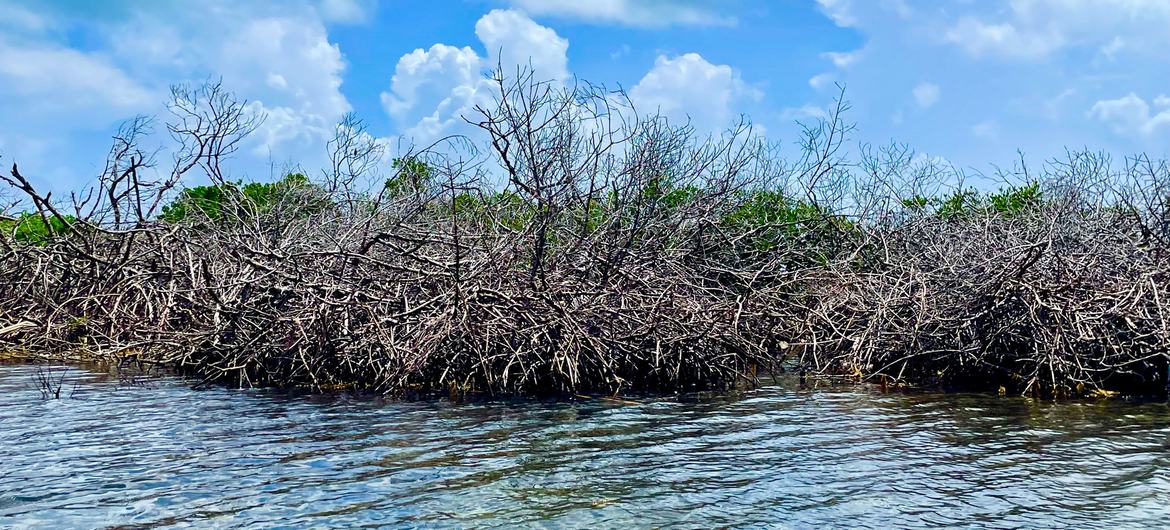
UN News/Laura Quiñones
Dead mangrove at the shores of Santa Catalina Island.
The mangrove that saved lives
But while corals are starting to thrive again and the dry forest has also seen recovery, the almost 60 hectares of mangroves that are impossible to miss while visiting Providencia represent a bigger trial for the community.
“We have a big challenge specifically with the Red Mangrove, the one that grows by the coast. Over 95 per cent of this species died during the hurricane, and it does not regenerate naturally,” describes Marcela Cano.
According to the UN Environment Programme (UNEP), mangroves support rich biodiversity and provide a habitat for fish and shellfish, as well as a landing strip and nesting area for large numbers of birds. Their roots are also a refuge for reptiles and amphibians.
Their ecosystem can capture up to five times more carbon than tropical forests and their soils are highly effective carbon sinks, making them important ‘lungs’ for our heating planet.
Mangroves also act as a natural coastal defence against storm surges, tsunamis, sea level rise and erosion – something the inhabitants of Santa Catalina, a small island connected to the north of Providencia by a bridge, witnessed first-hand.
“The mangroves along the coast of Santa Catalina Island saved the lives of this community during Iota. Without mangroves and their ecosystem services, there is going to be a decrease in fish and biodiversity [affecting livelihoods], and if we don’t restore it, it also won’t be around to protect us again,” Ms. Cano underlines.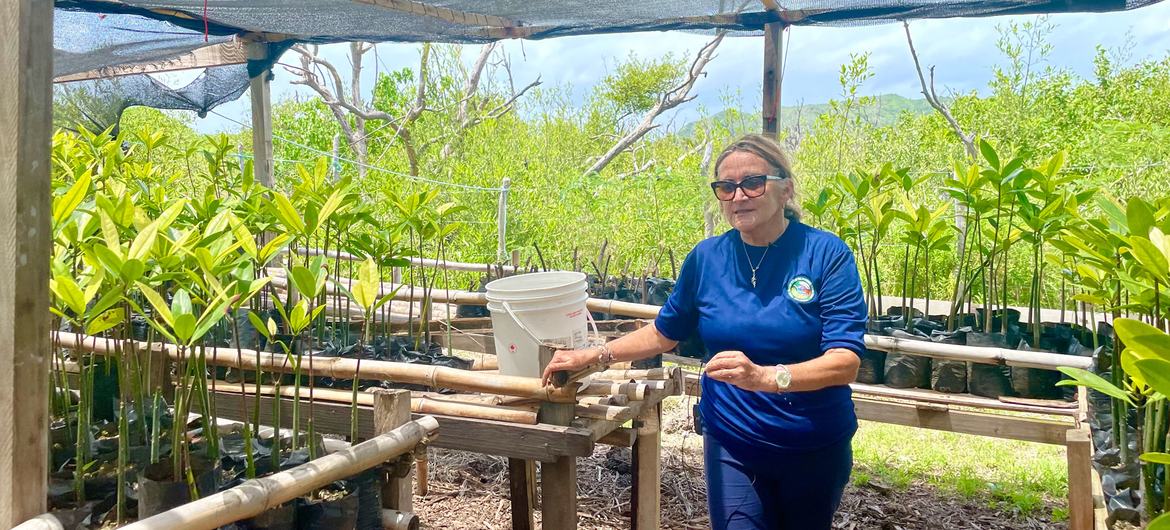
UN News/Laura Quiñones
Marcela Cano at the mangrove nursery of McBean Lagoon National Natural Park.
In the same golf cart that saved her life during the hurricane, Marcela Cano drove the UN News team to the Park’s Mangrove Nursery, where over 4,000 seedlings are growing.
“We have red and black mangroves here. We go and find all the seeds we can and put them in water buckets. When they grow roots, we then put them in sandbags. After four to five months, we can transplant them to their natural habitat,” she explains.
The restoration does not come without challenges. Along with the general scarcity of red mangrove seeds, Ms. Cano says that two species of crabs like to eat the young plants, and some iguanas chew their leaves.
“So, we have had to come up with creative ideas to protect them,” she says, mentioning water bottles, and baskets as some of the makeshift solutions.
The National Park restoration strategy also involves the community, and the Park is teaching young children who live near the mangroves how to grow and care for these ecosystems.
“It is going to take us about 10 years to be able to have the mangroves with the structure and function they had before the hurricane. These are long-term restoration processes, it is important for governments to understand this,” the expert urges.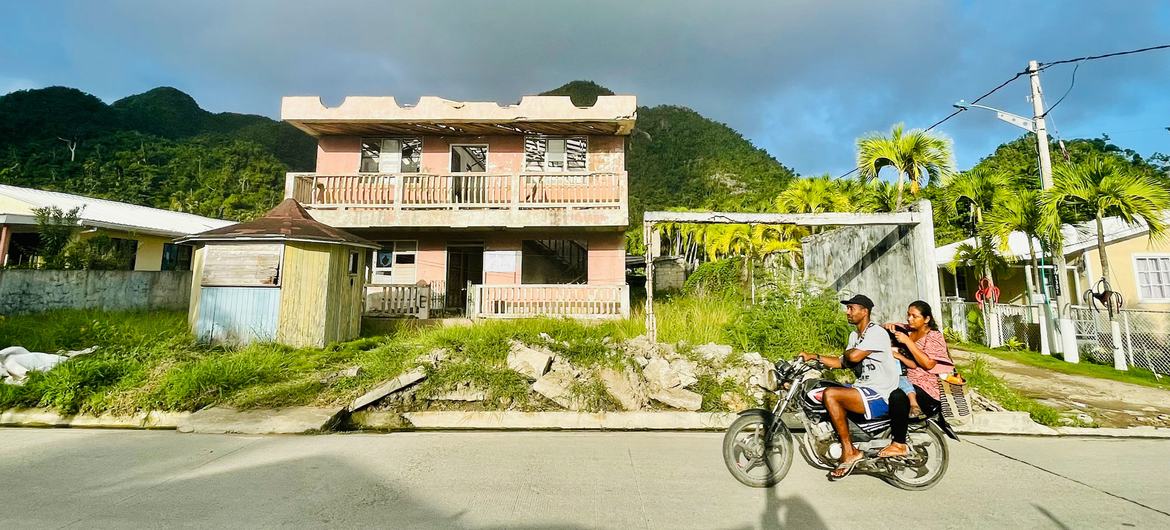
UN News/Laura Quiñones
98 per cent of the infrastructure of the island of Providencia was damaged after hurricane Iota, including impacts on infrastructure, loss of property, belongings and road blockages.
Tourism and local businesses
The local population of the island comprises Raizals, descendants of African Slaves and British Sailors, who speak English Creole, although most speak Spanish as well. There is also a smaller population of “migrants” from the mainland, who call Providencia their home.
The local economy revolves around tourism and traditional fishing and hunting. Due to COVID-19 restrictions and the devastation wrought by the hurricane, the tourism sector has been sluggish for the past two years.
It wasn’t until mid-2022 that the island opened back to the public but, to this date, it still doesn’t have the capacity to receive the average of 3,000 visitors monthly that flocked there in 2019.
A few of the still-standing hotels and businesses have been able to continue functioning thanks to the arrival of Government officials, contractors and volunteers who have been participating in reconstruction efforts.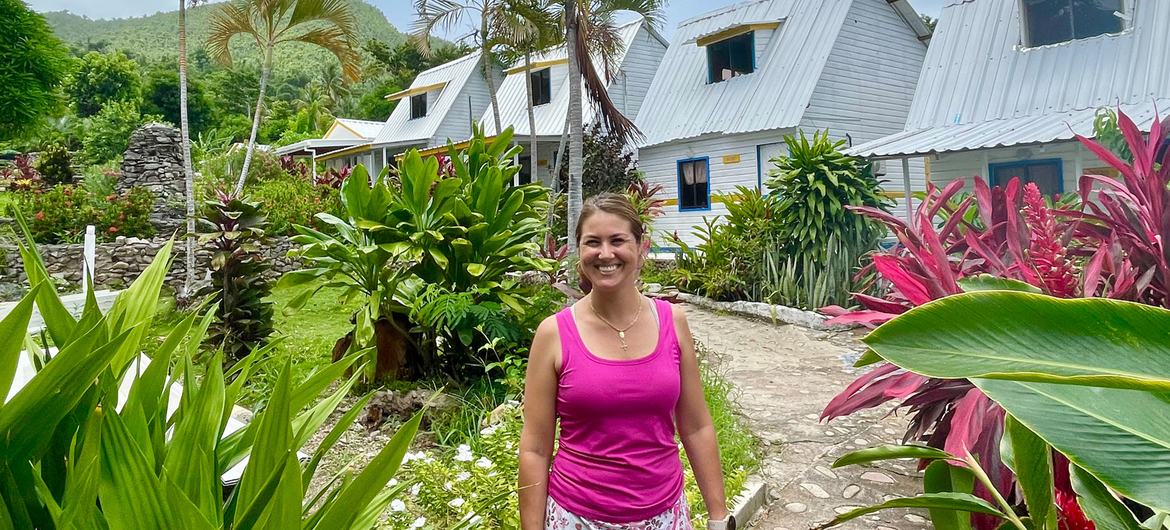
UN News/Laura Quiñones
Juanita Angel, hotel owner in Providencia, is working to restore her family property to its former glory.
Juanita Angel, co-owner of the hotel Cabañas de Agua Dulce, saw her family business destroyed by the hurricane.
“At first, I thought, ‘no one is going to put this back together’. We were closed for a year [due to] the pandemic and had put in loan to repair the roofs. Every time I saw a roof tile flying during the hurricane all I could think was ‘there goes our money, and our hope.’”
Ms. Angel says that no one on the island expected Iota to cause such devastation because they had all made it through other hurricanes.
“That is why no one took this seriously, we never thought something like this could happen to us… We are such a small island, a dot in the map, but we need to be prepared for the future,” she adds.
According to experts on the Intergovernmental Panel on Climate Change (IPCC), there are many ways in which climate adaptation can be undertaken in small islands, including reducing socioeconomic vulnerabilities, building adaptive capacity, enhancing disaster risk reduction, and building longer-term climate resilience.
Recently, the UN Secretary-General described the Caribbean region as “ground zero for climate emergency,” and called on developed countries to match climate action to the scale and urgency of the crisis.
This would mean providing financial support to small islands so that they can build stronger adaptation capacity, and ultimately, reduce carbon emissions, one of the main culprits heating our planet and driving the climate changes that are making hurricanes more powerful and more frequent.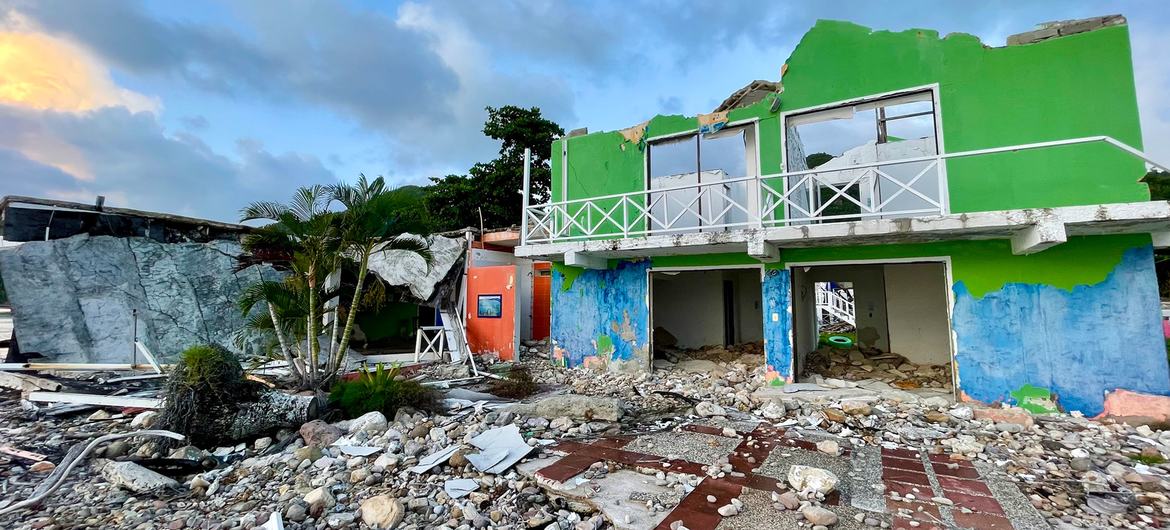
UN News/Laura Quiñones
By June 2022, some structures remained in ruins in Providencia such as this former hotel.
Why go through all this?
One way to build resilience and adaptation is by investing in ecosystem restoration, Marcela Cano underscores.
“A healthy ecosystem is more resilient. We must guarantee this so that when disaster comes the ecosystems can keep offering the environmental goods and services that contribute to a better quality of life for our population,” she explains.
Ms. Cano reminds us as well that one of the most effective strategies to tackle climate change is the declaration of Marine Protected Areas.
These areas provide reduced stress on ecosystems and species, allowing them to carry on the natural processes that mitigate climate impacts, such as carbon storage.
For example, according to UNEP, protecting whales is a nature-based solution against climate change. Whales accumulate carbon in their bodies during their long lives, some of which stretch to 200 years. When they die, they sink to the bottom of the ocean, taking the carbon with them.
“We need more of these protected areas, and we also need more resources to manage them well, always involving and giving value to the knowledge of the local community,” she underscores.
The McBean Lagoon National Park chief underlines that restoring and protecting the ecosystems in Providencia is not only a self-serving task, but it benefits the whole planet.
“We thought that climate change was something that was happening in other places, but this hurricane created a common conscience, and we are working on mechanisms to be more prepared for the future because we know that the risk of extreme weather events is only going to grow.”
The mountainous Colombian island of Providencia – which lies midway in the extension of the Caribbean Sea that separates Costa Rica and Jamaica – is home to stunning colours of the sea, lush underwater landscapes, extensive mangrove forests, and even tropical dry forests.
The diversity of marine ecosystems and surrounding natural wonders, including the yearly spectacle of thousands of rare black crabs descending from the mountains and heading to the sea to lay their eggs, and one of the world’s largest barrier reefs, which supports a stunning array of marine life, has led to its declaration as part of the Seaflower UNESCO Biosphere Reserve.
However, as with all islands in the world, Providencia’s unique natural treasures are highly threatened by climate change and sea level rise, threats that are not ‘theories’ looming on the horizon, but that are instead terrible facts already impacting every facet of life there.
Its 6,000 inhabitants will never forget the night of November 16th, when Iota, the last and strongest hurricane of the 2020 Atlantic storm season— deemed then a Category 5* — decimated their beloved land.
“The most shocking thing was the sound. Our people say that the hurricane came with the devil because the sound was so strange and scary,” recalls Marcela Cano, a biologist and long-time resident who has made it her life’s work to preserve Providencia’s environmental treasures.
But that night, she would spend hours fighting to survive the storm.
She was at her home sleeping when at around midnight, she started hearing strange noises. This turned out to be wind gusts of over 155 miles an hour tearing across the island.
Power and communication were shortly lost.
“I stood up and noticed that my ceiling lights looked as if they were higher than usual. That’s when I realized that part of my roof had flown away,” Ms. Cano recalls now, adding that minutes later she heard two loud bangs from her guestroom and saw water pouring down the walls.
Her immediate reaction was to get out of the house, a decision that looking back now was definitely the best one, she says, because not only the roof but most of the walls of her house collapsed in the darkness under the force of the pounding rains and the wind.
“It was raining very hard; I almost couldn’t make it out of my house because the wind wouldn’t let me open the door. I made it just where I had parked my Mula [her motorized golf cart]. I was completely soaked, and I just sat there.”
She spent over 10 hours sitting in her golf cart hoping that the wall next to it and a big pine tree would hold up.
“Every time I would hear loud bangs, I would point my flashlight towards the tree. If it had broken, that would’ve been it for me.”
It was the longest night Providencia had ever experienced. And even after sunrise, the hurricane let barely any light come through.
“Very strong wind gusts would come and go for hours and hours, and all I could think was ‘please God make it stop, it’s been too long, please stop’. It felt like the longest time of my life. At about 11 am it finally got a bit better, but it was still raining pretty hard.”
It was then that she saw her neighbours up the road calling her. She gathered the courage to walk up the debris-strewn little hill towards them and realised their house had also been lost.
But for Marcela, the loss was about to become even bigger and more painful.

A life protecting nature
Ms. Cano is the Director of Old Providence McBean Lagoon Natural National Park, a unique and highly important protected site on the island and the Seaflower UNESCO Biosphere Reserve. She has worked for over 30 years to protect it, and with her team, has been a pioneer in ecosystem restoration and ecotourism.
“I looked around and all the vegetation on the island was gone, everything was black, and all the trees no longer had leaves. It was as if everything had been burnt, and the sea was up high. I could see Santa Catalina Island from there; I couldn’t see it before. And I could see how destroyed it was,” she remembers, telling UN News that every time she tells this story she can barely hold back the tears.
That night, she took refuge with 10 families under a concrete ledge that hadn’t given an inch to the winds and the rain. It was actually the second floor of a house under construction.
“We made a common makeshift bed. It was also the middle of a COVID-19 peak in Colombia, but no one could care about that at that moment,” Ms. Cano says.
It was still raining, and the island had been without communication for over eight hours. The whole mainland of Colombia wondered for almost a day if Providencia had survived hurricane Iota or not.
In the following days, as help arrived, other locals described how people were walking around like “zombies” searching for food and shelter. Miraculously, only four people lost their lives that night, but over 98 per cent of the island’s infrastructure was destroyed and 6,000 people were left homeless.
“I went walking to ask about my team at the National Park. We were all fine, but we lost everything we had worked for. Our office, our library, the research data stored in our computers, everything was lost.”
An environmental tragedy
Sometime later, Ms. Cano was able to return to Providencia after spending time with her family in Bogotá and working to gather household items and basic necessities for some families affected by the storm.
It was then that she was able to evaluate the environmental damage inside the National Park.
“I’ve spent most of my life here in Providencia and to see that all our efforts to maintain the National Park had vanished from one day to the next, was heartbreaking.”
According to Colombia’s National Natural Parks, around 90 per cent of the Park’s mangroves and forests were affected, as well as the coral reefs in shallow waters, many of which had been in nurseries as part of an ongoing restoration effort.
“We are working to restore vegetation and saline formations. We also carried out rescue and replanting of coral colonies that were uprooted by the hurricane,” Ms. Cano explains while standing in what’s left of the pier of Crab-Cay, once the most visited attraction in Providencia.
The small island rises sharply and dramatically off the coast surrounded by turquoise waters. Tourists used to climb to the top for 360-degree views of the park. Now a new viewing deck and pier are being built**, and some vegetation planted last year, has begun to sprout.
“Was this here before the hurricane?” she asks her team, pointing to some algae-covered metal debris.
Coral reefs
Thanks to its field work and reef restoration experience over the past decade, McBean Lagoon National Park is currently the largest contributor to the nationwide project One Million Corals for Colombia to restore over 200 hectares of coral reef, with over 55,000 coral fragments in nurseries and over 6,000 transplanted.
UN News visited some of the transplanted colonies and witnessed the miracle of coral fragments fusing together and attracting young fish, bringing life back to the sea currently threatened by warming seas and extreme weather events.
“The water is getting warmer, so algae colonies are getting bigger and fighting coral reef for its resources,” explains young Marine Biologist Violeta Posada, a member of Ms. Cano’s team at the Park.
She underscored that ecosystem restoration work is a daily effort, as the team must constantly clean the colonies of the algae and other dangers that might hinder their growth.
Ms. Posada, born and raised in Providencia, has been able to witness the pay-off of the restoration efforts.
“My dad also worked at this park. These new colonies that you see here were built with fragments that my own father planted in nurseries 12 years ago,” she says, adding that as an islander, caring for the ecosystems is a responsibility.
“They give us food, shelter and protection. They also attract tourists, which this island depends on,” she emphasizes.
The mangrove that saved lives
But while corals are starting to thrive again and the dry forest has also seen recovery, the almost 60 hectares of mangroves that are impossible to miss while visiting Providencia represent a bigger trial for the community.
“We have a big challenge specifically with the Red Mangrove, the one that grows by the coast. Over 95 per cent of this species died during the hurricane, and it does not regenerate naturally,” describes Marcela Cano.
According to the UN Environment Programme (UNEP), mangroves support rich biodiversity and provide a habitat for fish and shellfish, as well as a landing strip and nesting area for large numbers of birds. Their roots are also a refuge for reptiles and amphibians.
Their ecosystem can capture up to five times more carbon than tropical forests and their soils are highly effective carbon sinks, making them important ‘lungs’ for our heating planet.
Mangroves also act as a natural coastal defence against storm surges, tsunamis, sea level rise and erosion – something the inhabitants of Santa Catalina, a small island connected to the north of Providencia by a bridge, witnessed first-hand.
“The mangroves along the coast of Santa Catalina Island saved the lives of this community during Iota. Without mangroves and their ecosystem services, there is going to be a decrease in fish and biodiversity [affecting livelihoods], and if we don’t restore it, it also won’t be around to protect us again,” Ms. Cano underlines.
In the same golf cart that saved her life during the hurricane, Marcela Cano drove the UN News team to the Park’s Mangrove Nursery, where over 4,000 seedlings are growing.
“We have red and black mangroves here. We go and find all the seeds we can and put them in water buckets. When they grow roots, we then put them in sandbags. After four to five months, we can transplant them to their natural habitat,” she explains.
The restoration does not come without challenges. Along with the general scarcity of red mangrove seeds, Ms. Cano says that two species of crabs like to eat the young plants, and some iguanas chew their leaves.
“So, we have had to come up with creative ideas to protect them,” she says, mentioning water bottles, and baskets as some of the makeshift solutions.
The National Park restoration strategy also involves the community, and the Park is teaching young children who live near the mangroves how to grow and care for these ecosystems.
“It is going to take us about 10 years to be able to have the mangroves with the structure and function they had before the hurricane. These are long-term restoration processes, it is important for governments to understand this,” the expert urges.
Tourism and local businesses
The local population of the island comprises Raizals, descendants of African Slaves and British Sailors, who speak English Creole, although most speak Spanish as well. There is also a smaller population of “migrants” from the mainland, who call Providencia their home.
The local economy revolves around tourism and traditional fishing and hunting. Due to COVID-19 restrictions and the devastation wrought by the hurricane, the tourism sector has been sluggish for the past two years.
It wasn’t until mid-2022 that the island opened back to the public but, to this date, it still doesn’t have the capacity to receive the average of 3,000 visitors monthly that flocked there in 2019.
A few of the still-standing hotels and businesses have been able to continue functioning thanks to the arrival of Government officials, contractors and volunteers who have been participating in reconstruction efforts.
Juanita Angel, co-owner of the hotel Cabañas de Agua Dulce, saw her family business destroyed by the hurricane.
“At first, I thought, ‘no one is going to put this back together’. We were closed for a year [due to] the pandemic and had put in loan to repair the roofs. Every time I saw a roof tile flying during the hurricane all I could think was ‘there goes our money, and our hope.’”
Ms. Angel says that no one on the island expected Iota to cause such devastation because they had all made it through other hurricanes.
“That is why no one took this seriously, we never thought something like this could happen to us… We are such a small island, a dot in the map, but we need to be prepared for the future,” she adds.
According to experts on the Intergovernmental Panel on Climate Change (IPCC), there are many ways in which climate adaptation can be undertaken in small islands, including reducing socioeconomic vulnerabilities, building adaptive capacity, enhancing disaster risk reduction, and building longer-term climate resilience.
Recently, the UN Secretary-General described the Caribbean region as “ground zero for climate emergency,” and called on developed countries to match climate action to the scale and urgency of the crisis.
This would mean providing financial support to small islands so that they can build stronger adaptation capacity, and ultimately, reduce carbon emissions, one of the main culprits heating our planet and driving the climate changes that are making hurricanes more powerful and more frequent.
Why go through all this?
One way to build resilience and adaptation is by investing in ecosystem restoration, Marcela Cano underscores.
“A healthy ecosystem is more resilient. We must guarantee this so that when disaster comes the ecosystems can keep offering the environmental goods and services that contribute to a better quality of life for our population,” she explains.
Ms. Cano reminds us as well that one of the most effective strategies to tackle climate change is the declaration of Marine Protected Areas.
These areas provide reduced stress on ecosystems and species, allowing them to carry on the natural processes that mitigate climate impacts, such as carbon storage.
For example, according to UNEP, protecting whales is a nature-based solution against climate change. Whales accumulate carbon in their bodies during their long lives, some of which stretch to 200 years. When they die, they sink to the bottom of the ocean, taking the carbon with them.
“We need more of these protected areas, and we also need more resources to manage them well, always involving and giving value to the knowledge of the local community,” she underscores.
The McBean Lagoon National Park chief underlines that restoring and protecting the ecosystems in Providencia is not only a self-serving task, but it benefits the whole planet.
“We thought that climate change was something that was happening in other places, but this hurricane created a common conscience, and we are working on mechanisms to be more prepared for the future because we know that the risk of extreme weather events is only going to grow.”
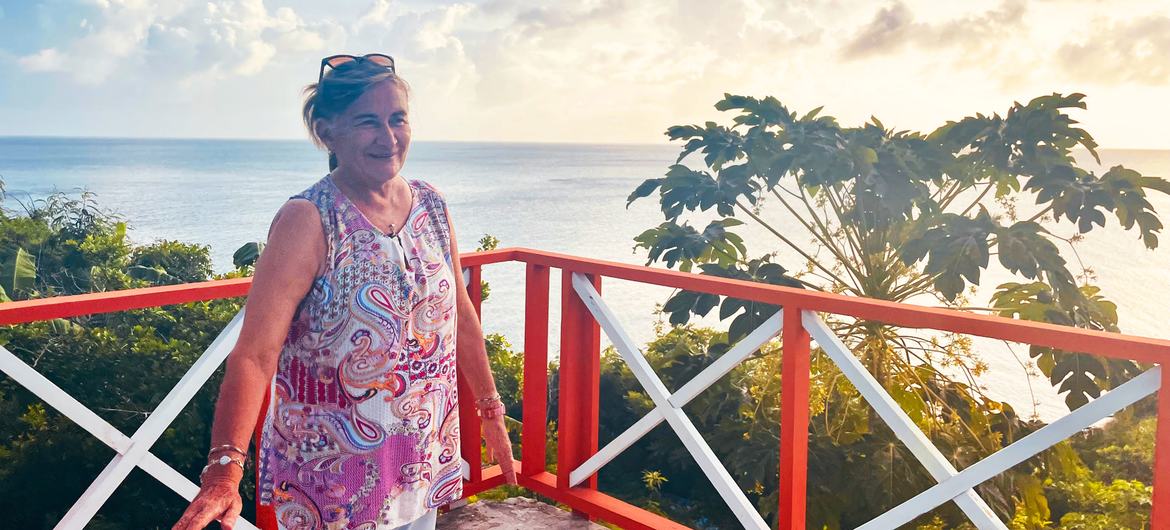
Standing on the deck of her recently rebuilt house as part of a Government programme that has built back most of the homes in the community, Ms. Cano recalled that before the hurricane, she could not so easily see the ocean.
“All the tall trees were swept away, and now I get this beautiful view, but I am replanting those [trees] too. Just imagine how much we lost.”
She wants to make sure that the world knows that rebuilding houses is just a start.
“We also need to prepare our people for stronger events, and we have to include climate change in the development policy of our island so that we can prepare and adapt for what’s coming.”
McBean Lagoon National Park was awarded a Blue Park Award for its exceptional marine wildlife conservation during the recent UN Ocean Conference in Lisbon, Portugal.
“Before the hurricane, I was about to retire, but now I can’t. I can’t just leave my post without making sure this Park is strong and ready for future generations,” the biologist highlights, admitting that she once thought she would never spend another November in Providencia, and with the 2022 peak hurricane season looming, the frightening memories of Iota are slipping back.
Ecosystems support all life on Earth. The healthier our ecosystems are, the healthier the planet – and its people. The UN Decade on Ecosystem Restoration aims to prevent, halt and reverse the degradation of ecosystems on every continent and in every ocean. It can help to end poverty, combat climate change and prevent mass extinction. It will only succeed if everyone plays a part.