Two hundred and seven years ago, on June 18, 1815, Napoleon’s last battle took place – the Battle of Waterloo, in which the French troops were defeated by a coalition of allies under the command of Wellington and Blucher. The course of hostilities is thoroughly analyzed in numerous sources, it makes no sense to repeat it in detail. But the analysis of the results of the battle is still a difficult question.
Disputes over the number of casualties in a particular battle are always going on, and the Battle of Waterloo is no exception. But most scientists agree that Napoleon lost about 24-26 thousand killed and wounded, and Wellington and Blucher – about 23-24 thousand. In addition, about 15 thousand Frenchmen were missing (most likely, most simply fled to France) and about five thousand coalition soldiers.
But no matter how detailed historians analyze the course of the battle, no matter how reliable sources contemporary to the event are, there is almost always a question, the answer to which must be sought for centuries. In the case of the Battle of Waterloo, this is the absence of military graves around the battlefield.
The tradition of carrying the bodies of the fallen back to their homeland had not yet been established: as a rule, only those who distinguished themselves in battle or those who had wealthy relatives were awarded such an honor. In any case: who would take care of transporting the bodies of the soldiers of the losing army? That is, the French who died and died from wounds were to be buried not far from the battlefields.
Director of the Scottish Center for the Study of War and Conflict Archeology at the University of Glasgow (UK) Tony Pollard (Tony Pollard) studied private letters, memoirs, and sketches of people who visited the vicinity of the Belgian village of Waterloo shortly after the battle. The results are presented in a paper published in the Journal of Conflict Archeology.
It is well known that Waterloo attracted its first visitors almost as soon as the smoke from the cannons cleared. They were both marauders and ordinary onlookers. Both those and others hoped to grab something on the battlefield as a keepsake – by that time in Europe there was even a resale of such “souvenirs”.
The Scottish merchant James Ker lived then in Brussels and was among the first at the battlefield. He left memoirs in which he described both the people who died in his arms and the places of burial. These memoirs speak of three mass graves, which together can contain up to 13,000 bodies.
Pollard, relying on the testimony of local residents (from private letters from the first visitors to Waterloo), compiled a map on which he noted not three, but many more places where the dead were buried. Apparently, in the first days and months (Walter Scott, for example, visited Waterloo two months later), it was the locals who served as guides for visitors. They showed not only the places of the most intense fighting, but also the graves.
But here’s the problem: archaeological research conducted by Waterloo Uncovered, including geophysical surveys and excavations, has not yet revealed any burial sites.
In 2015, during the construction of a new museum and car park near Waterloo, a human skeleton was discovered. Then in 2019, while excavating the main Allied field hospital, archaeologists from Waterloo Uncovered found amputated human leg bones. The museum at Waterloo also houses a skeleton of uncertain provenance. And that is all. Where are the rest of the bones?
“The bodies of the dead were apparently disposed of in numerous places across the battlefield,” writes Pollard. Who and how disposed of the remains of the fallen?
“At least three newspaper articles dating back to the 1820s mention the importation of human bones from European battlefields to make fertilizer. These battlefields could serve as a convenient source of bones, which were then ground into bone meal, an effective form of fertilizer. One of the main markets for this raw material was the British Isles,” the paper says.
Pollard suggests that some of the early visitors may have been agents of the bone supplier. Their main purpose would be mass graves, since the more bones they contain, the easier it is to pay off the effort of excavation. In addition, Waterloo is one of the closest major battles of the Napoleonic era to Britain, and transport costs in this case would be minimal. It is possible that local residents indicated the places of mass graves to agents.
This is a bold hypothesis, but it requires confirmation. Tony Pollard and Waterloo Uncovered are planning a comprehensive archaeological survey of the Waterloo battlefields. If human remains have been removed on the proposed scale, then at least in some cases there must be archaeological evidence of the pits from which they were recovered, however truncated and ill-defined they may be.
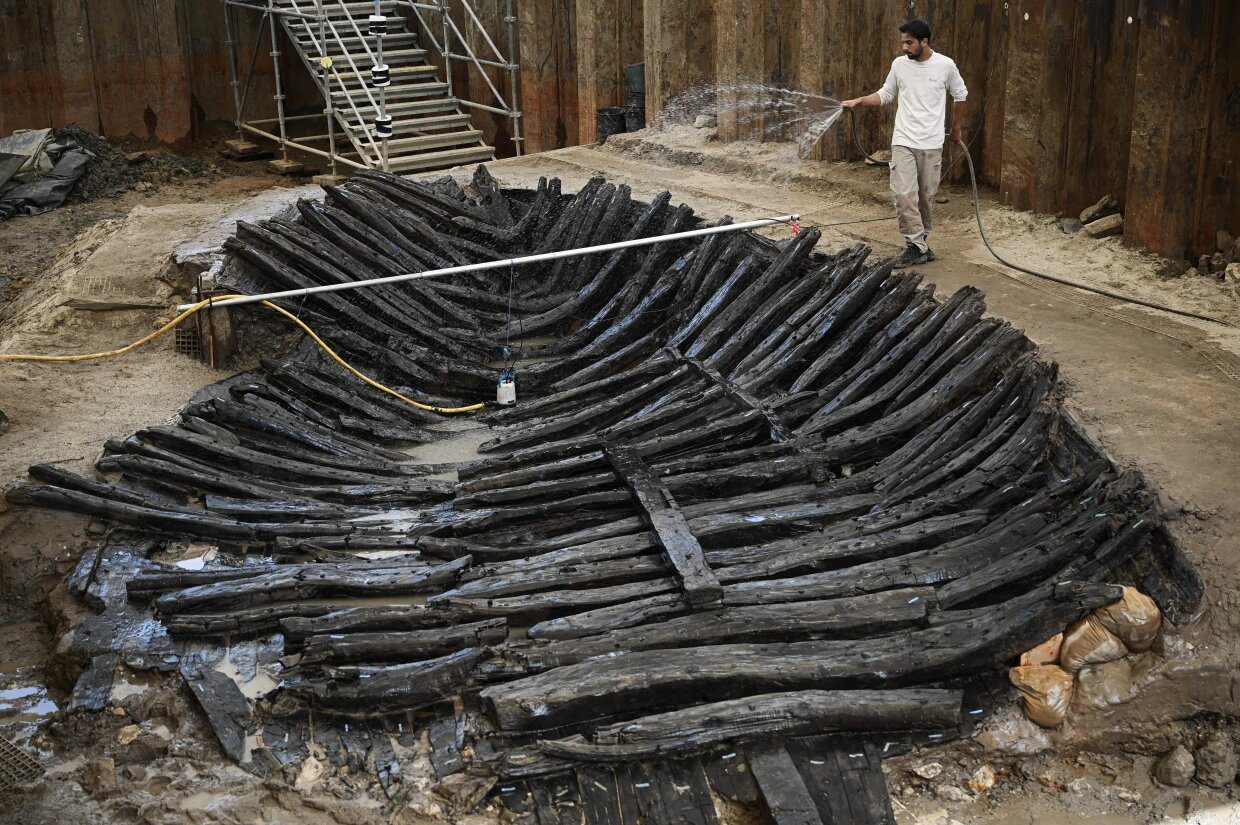
In the south of France, archaeologists have discovered a sunken 1300-year-old ship.
It is reported by NBC News.
Partial remains of an “extremely rare” vessel, 12 meters long, radiocarbon dated to between 680 and 720 BC. AD, found in Villenave d’Ornon near Bordeaux.
The French National Institute for Preventive Archaeological Research said the boat was “an exceptional example of the maritime architecture of the High Middle Ages” and was able to navigate the rivers as well as the Atlantic coasts of France.
“In order to limit the destruction of the wood of the sunken ship, especially now that it is in the south-west of France, it is extremely hot, we pour water on it every 30 minutes. Excavations and dismantling of the sunken ship should be completed by mid-September. At the moment, we are on schedule, and each piece of wood dismantled allows us to learn more about the shipbuilding techniques of the early Middle Ages, ”said Laurent Grimbert, who leads the excavations at the institute.
The ship was discovered in 2013 in a silty creek bed. But only now it is being carefully examined piece by piece to find out its true nature and purpose.
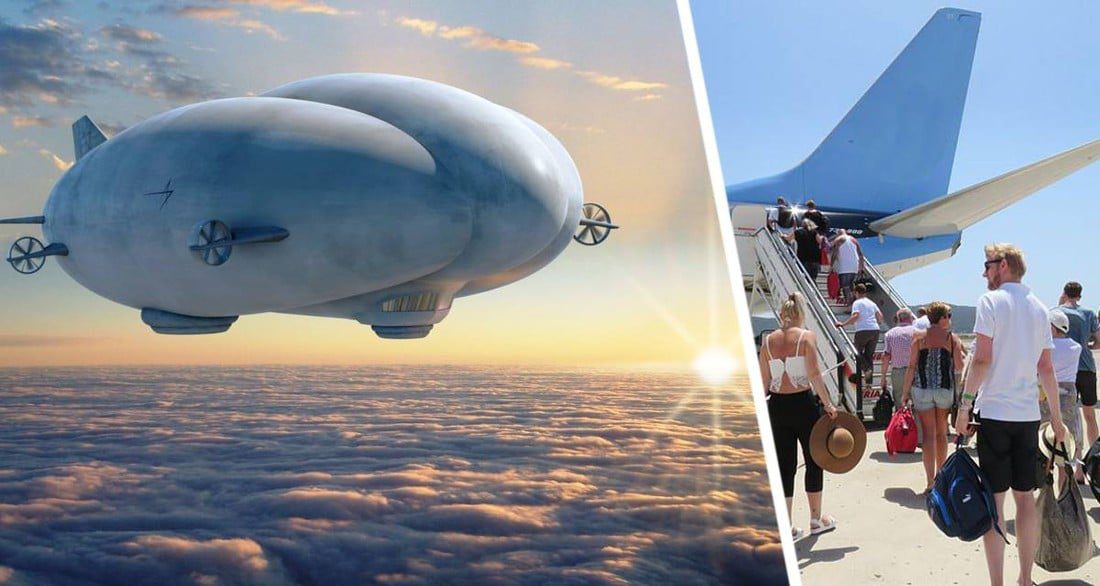
A British company has signed a contract to supply a Spanish airline with helium-powered airships. In the future, these airships will carry tourists to resorts in Spain instead of planes, although the ship was originally intended to monitor intelligence gathering in Afghanistan, Hybrid Air Vehicles said.
A small company based in Bedford, Hybrid Air Vehicles (HAV), announced that it has closed a deal to provide ten of its unique helium airships to the Spanish airline. It was clarified that each aircraft can carry 100 passengers. A new ‘green’ manufacturing aerospace facility is expected to be built in South Yorkshire, which could provide an incentive for green aviation.
“Hybrid aircraft can play an important role as we move towards cleaner forms of aviation and it’s great to see the UK at the forefront of technology development. This agreement enhances the flight capabilities of the revolutionary British-made and designed Airlander 10 aircraft in the skies of Spain,” said Business Secretary Kwasi Kwarteng.
A company spokesman noted that the airship would have a carbon footprint of about 4.5 kg per tourist compared to a jet aircraft’s 53 kg per passenger.
Spanish carrier Air Nostrum hopes to have airships in the air by 2026. This could be an exciting innovation for air travel. The head of the carrier, Carlos Bertomeu, said in this regard: “Airlander 10 will significantly reduce emissions, and for this reason we have entered into an agreement with HAV. Sustainability, which is good news for everyone, is already an indisputable fact in the daily operations of commercial aviation.”
The airline has not specified which routes it will use the airships on, but they could be used on domestic Spanish routes as well. For example, trips from Barcelona to Palma de Mallorca, which HAV says will take about four and a half hours. However, HAV said that its model is suitable for intercity travel and can be used for travel between Belfast and Liverpool or intercity routes in the US.
“Airlander is designed to provide a better future for sustainable aviation services, create new transportation networks and enable rapid growth opportunities for our customers. Our partnership with Air Nostrum Group as the airline launching the Airlander 10 paves the way for this future,” CEO Tom Grundy said hopefully.
The company hopes to sell 265 Airlanders over the next 20 years. The calculation is simple: the world is fighting climate change, many airlines are looking for greener options.
Air travel is one of the world’s major sources of pollution and accounts for about 2% of all carbon dioxide emissions. Many airlines have made commitments to cut their carbon emissions over the next decade, but progress has been extremely slow. Moreover, tourists in first-class seats emit an average of four times more emissions than an economy seat on the same plane.
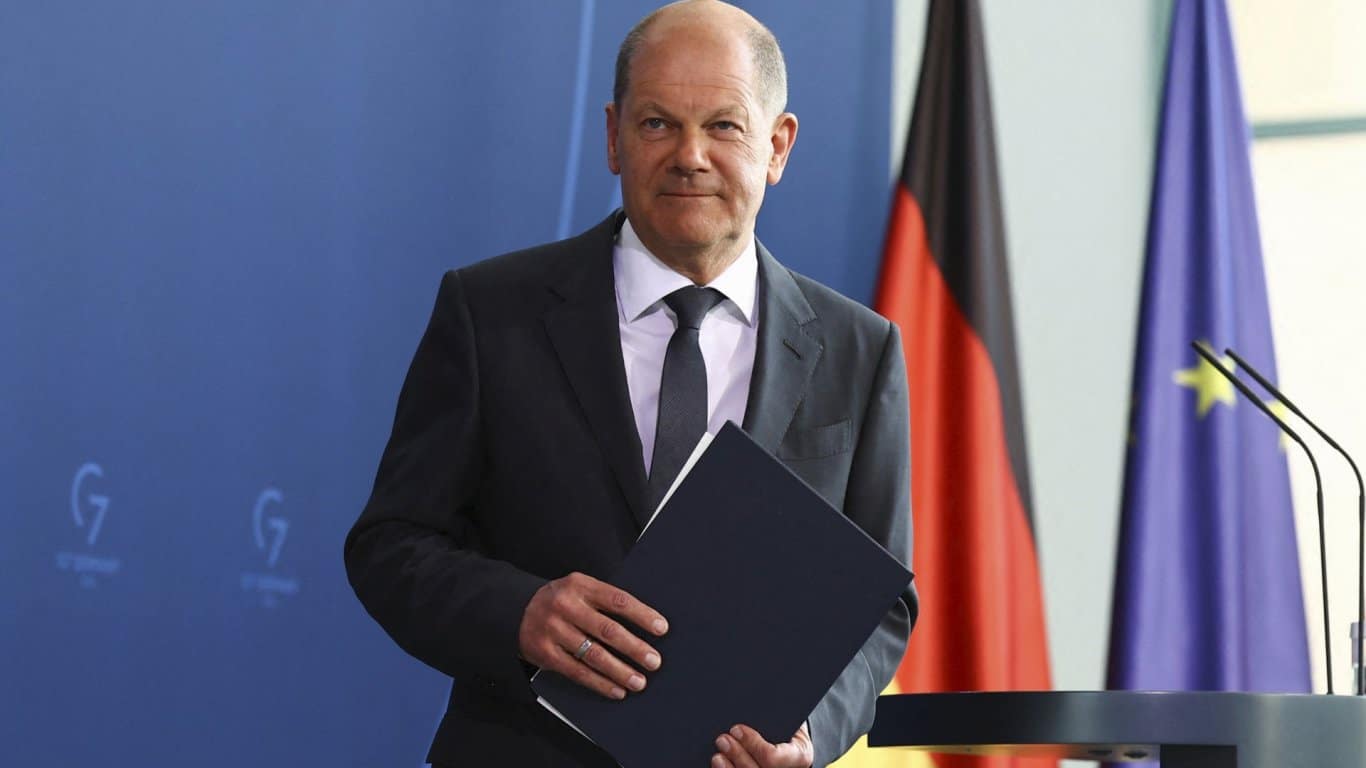
German Chancellor Olaf Scholz voiced support for plans to modernize EU structures and decision-making. Ten days ago, the European Parliament activated a process to amend the EU Treaties, including the “abolition of the right of veto”.
“It will not be possible to solve everything that is decided today with unanimity, again with unanimity in the future,” the German chancellor said in an interview with DPA, quoted by BTA. He said he hoped to present his proposals at the EU summit on Thursday and Friday, at which the candidacies of Georgia, Moldova and Ukraine will be discussed.
According to him, the European Union should make it easier for new countries to join. It is time not only for the candidate countries, but for the European Union itself to prepare for the club’s expansion, Scholz said.
In the interview, Scholz called on Russia to alleviate the global food crisis by helping secure grain supplies from blocked Ukrainian ports.
“Russia must provide safe transport while giving assurances that it will not use the invasion corridor,” Scholz said.
On Thursday, after meeting with Scholz and other European leaders in Kyiv, Ukrainian President Volodymyr Zelensky criticized Russia for causing a food crisis in parts of Africa and Asia by blocking grain exports with its naval blockade. Russia, for its part, says exports have been suspended due to sea mining and sanctions.
In an interview, the German chancellor supported UN Secretary-General Antonio Guterres’ efforts to create an export corridor, but declined to comment on the possibility of a UN mission to provide access to Ukrainian ports such as Odessa.
According to the European Parliament’s press office, Parliament has adopted a resolution calling on the European Council to agree to launch a process of revising the EU Treaties.
Given the many ongoing and recent crises, MEPs have taken advantage of their prerogatives to call for amendments to the Treaties by:
• reforming the voting procedures in the Council in order to increase the European Union’s capacity to act, including the transition from unanimity to qualified majority voting, in areas such as sanctions, the so-called “Transition clauses” as well as in the event of an emergency;
• adapting the EU’s powers, in particular in the field of health and cross-border health threats, to the completion of an energy union based on energy efficiency and renewable energy and established in accordance with international agreements on climate change mitigation , as well as in the field of defense and social and economic policies;
• ensuring the full implementation of the European Pillar of Social Rights and inclusion in the Treaties of social progress under Article 9 TFEU, linked to a protocol on social progress;
• strengthening the resilience of the EU economy, with a special focus on small and medium-sized enterprises and competitiveness checks, and encouraging investment in a fair, green and digital transition;
• giving Parliament the right to initiate, amend or repeal legislation, and full co-decision rights on the EU budget; and
• strengthening the procedure for the protection of the values on which the EU is founded, clarifying the identification and consequences of violations of fundamental values (Article 7 TEU and the Charter of Fundamental Rights of the European Union);
The resolution was adopted by 355 votes to 154, with 48 abstentions, following a debate earlier in the day.
Next steps
The Heads of State and Government of the 27 Member States will be able to decide on the establishment of a Convention by a simple majority during the European Council. Many MEPs called for this to happen as soon as possible, ie. at the EU Summit on 23-24 June to ensure that citizens’ expectations are met and that the results of the Conference on the Future of Europe are put to good use as soon as possible. The Convention should include Members, Commissioners, Members of the Member States’ parliaments and EU leaders.
The European Commission is expected to announce in mid-June how it intends to take further action on the Conference. The Committee on Constitutional Affairs of the European Parliament (AFCO) will continue to work on the changes that Parliament will seek to make to the Treaties, pending the Convention.
Context On 9 May in Strasbourg, EP President Roberta Mezzola, French President Emmanuel Macron on behalf of the EU Council Presidency and European Commission President Ursula von der Leyen received her final report from the Co-Chairs of the Conference’s Executive Board. It includes 49 proposals, including more than 300 measures on 9 topics, based on 178 recommendations from European Citizens’ Panels, contributions from national panels and events, ideas from the European Youth Event and 43,734 opinions on 16,274 ideas recorded on the multilingual digital platform.
On Monday, thousands of people gathered at Altice Arena in Lisbon, Portugal, for the first day of the long-awaited UN Ocean Conference. Riding on the global momentum generated by the event, experts are pushing for a new international commitment to combat pollution, including at sea.
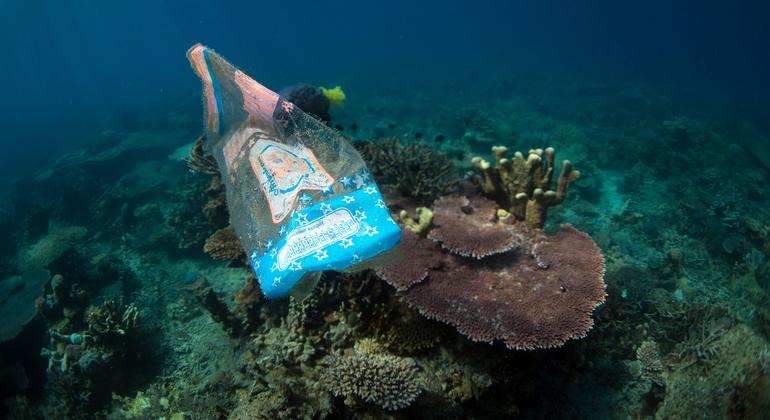
According to the UN Environment Programme (UNEP), the amount of marine litter and plastic waste, has been growing rapidly. And without meaningful action, emissions of plastics into aquatic ecosystems, are projected to nearly triple by 2040.
Pollution cuts across several sectors and is strongly interconnected with the other planetary crises of climate change and biodiversity loss. Combatting marine pollution is a global challenge, that needs a global approach if it’s to be mitigated, experts remarked.
“Sea-based pollution, including discharges and spills from vessels and the presence of abandoned, lost, or otherwise discarded fishing gear, continues to be of concern, with plastics and microplastics from numerous sources, untreated wastewater and nutrient run-off still polluting the oceans”, said a statement published by organizers of the event.
Speaking in Lisbon, Janis Searles Jones, Chief Executive Officer at the Ocean Conservancy, in Portland, Oregon, stressed that “life below water is essential to life above water”, and underlined the urgency of reducing single-use plastic, and faster action.
‘Scream loud’: ban single-use plastic
On the sidelines of the Conference, the UN educational and scientific agency (UNESCO) named giant-wave surfer and two-time Guinness World Record holder, Maya Gabeira, Champion of the Ocean and Youth.
Maya Gabeira is a Brazilian big-wave surfer, best known for setting the 2020 World Record for the biggest wave ever surfed by a woman.
Speaking at an event in the SDG Media Zone – “Empowering youth for the Ocean we need” – the Brazilian athlete shared that even in her most remote surfing spot – which she can only reach after travelling for 55 hours – she finds plastic surrounding her when she is catching the waves.
“It is very sad when you are surfing and the tide turns and all that plastic moves into you, and you are trying to make space, or put whatever you can in your pockets to bring to a recycling trash, but we know that’s not even a dent, and that is not the solution.”
Speaking to UN News, Ms. Gabeira reiterated the importance of educating herself and of learning ways of creating less of a footprint – not just by using less plastic, but also by using her platform to “scream as loud” as possible, to drive change, adding that every single one of us, can make a difference.
At the event, UNESCO’s Director-General Audrey Azoulay reiterated the commitment to integrate ocean education into national curricula of all Member States by 2025, underlining the importance of ocean literacy.
Changes in consumption patterns needed
According to UNEP’s most recent data, and despite current initiatives and efforts, the amount of plastic in the ocean is now estimated to be 75-199 million tons.
Population increases, changes in consumption patterns and other types of behaviour, and greater market accessibility lead to higher waste generation, while the resources and technical capacity for sound waste management are limited in some countries which decide they have more pressing public spending needs.
All these pollution challenges require national and regional cooperation and knowledge-sharing among diverse stakeholders, experts warned.
For fashion designer and UNESCO Goodwill Ambassador, Oskar Metsavaht, fashion is also a way of changing attitudes and behaviour, just like any other art form, such as cinema and music, he told UN News.
Marine plastic debris has impacted over 600 marine species.
Youth is essential
A major concern among environmentalists is what happens during the breakdown of plastics in the ocean, chiefly in the form of microplastics – which are small pieces of plastic less than 5 mm in diameter – and chemical additives, which are known to be toxic and hazardous to human and wildlife health, as well as ecosystems.
“Youth [needs] not only to question the system, but changing their behaviours of consumerism, and using nature, conservancy, and sustainable development, oceans and forests, to be inspirational”, the creator of the lifestyle brand Osklen added.
“New fabrics, new materials, and new technologies need to be implemented in a sustainable way – we still need to find a solution to avoid the microplastics in fashion”, Mr. Metsavaht concluded.
CEC General Secretary Dr Jørgen Skov Sørensen commended the EU-initiated Conference on the Future of Europe (CoFoE). However, he stressed that European churches and faith-based communities would have liked to see their concerns, especially related to freedom of religion and belief, featured in the final report that articulates results from the CoFoE.
Dr Sørensen made an online intervention at the EPP Working Group Intercultural and Religious Dialogue on 22 June, addressing the theme “Outcome of the Conference on the Future of Europe”.
The aim of the meeting was to deepen the understanding of the role of religions in Europe, as well as to exchange views with academic experts in the fields of religion, history and culture.
“A democratic and just future for Europe is a concern for all our 114 Member Churches,” said CEC General Secretary. “This is the basic reason why CEC was among the first to mobilise when the Conference on the Future of Europe was launched by the European Institutions in 2021.”
In early March, CEC informed all Member Churches about the Conference, encouraging them to take an active part in the deliberations ahead, he shared. The foundation for this move was the view that the CoFoE offered a great opportunity for CEC and its Member Churches to bring forward a Christian perspective in the debate on the future of Europe and European societies.
Sørensen reminded the participants that churches’ engagement with CoFoE is rooted in the longstanding Article 17 tradition in the European Institutions, signifying that churches are recognised as credible dialogue partners to the EU.
“In line with the provisions of Article 17, we would have appreciated an explicit concern for churches and other faith-based organisations as legitimate voices in a European discourse on our future societies,” he said.
He went on to say that European societies are moving towards an increasingly secular and more pluralistic nature. This allows for more voices to be heard. However, secularity and plurality also mean that established authorities of former times are being challenged.
“In dialogues with our Member Churches, we experience that, in recent years, strong signs of ‘religious illiteracy’ are emerging throughout Europe. Religion is regarded with suspicion. Therefore, CEC with its Member Churches will continue working to secure and maintain a Christian and other faith-based voices in the future of Europe,” he added.
The meeting was opened by the co-chairmen of the EPP Working Group Mr Jan Olbrycht MEP and Mr György Hölvényi MEP. Among others who presented were Fr. Manuel Barrios Prieto, General Secretary of the Commission of the Bishops’ Conferences of the EU (COMECE), Very Rev. Archimandrite Fr. Aimilianos Bogiannou, director of the Brussels Office of the Ecumenical Patriarchate (CROCEU), Ambassador Ms Ismat Jahan, Permanent Observer of the OIC Mission to the EU and Rabbi Avi Tawil, director of the European Jewish Community Centre.
Morocco-Spain border – Following the tragic incident that occurred on 25 June 2022, when around 2,000 migrants crossing from Morocco tried to break through the Melilla border fence, Fr. Manuel Barrios Prieto, General Secretary of the Commission of the Bishops’ Conferences of the European Union (COMECE), releases on Monday 27 June 2022 the following statement (EN – ES).
“COMECE laments the death of dozens of migrants and asylum seekers near Morocco’s city of Nador, while trying to cross the fence into the Spanish city of Melilla, as well as the loss of two policemen’s lives.
We pray for them and for their families. COMECE calls for the identification of the victims and the return of their remains to their families, and for an independent and trustworthy investigation of what happened in this tragic episode.
The EU and its member states’ management of migration cannot consist in giving a blank check to neighbouring countries that don’t respect the inalienable dignity of migrants and refugees.
COMECE also condemns the use of violence by people trying to cross borders and calls for a proportionate use of force by law enforcement agents and the absolute respect of the human dignity and the fundamental rights of migrants and refugees, as well as the facilitation of an appropriate screening of persons that are legitimate asylum seekers.”
Hundreds of delegates from across the globe will be attending the World Urban Forum, which opened on Sunday in the southern Polish city of Katowice.
WUF11 is taking place at a critical time, as cities tackle the challenges presented by the COVID-19 pandemic, the climate emergency and conflict.
Making cities more inclusive must be part of post-pandemic recovery efforts, UN Secretary-General António Guterres said in remarks to the event.
“Cities are central to virtually every challenge we face – and essential to building a more inclusive, sustainable, and resilient future. They have been at the frontlines of the COVID-19 pandemic,” the UN chief said in a video message.
“As we look to recover, promoting more inclusive, gender responsive urban infrastructure and services will be critical to give all people – especially young people, women and girls – access to a better future.”
Cities as climate leaders
Mr. Guterres also highlighted another important role for the world’s cities. They must be at the forefront of action to keep global temperature rise to 1.5 degrees, in line with the Paris Agreement on Climate Change,
More and more cities across the world are committing to the goal of net-zero greenhouse gas emissions by 2050, or before.
The sooner these commitments are translated into concrete actions, the sooner countries will achieve green job growth, better health, and greater equality, he said.
“But cities cannot do it alone,” he stressed. “They need more coordinated support from all levels of government; stronger partnerships with the private sector and civil society; and greater fiscal and policy space to bring solutions to scale.”
Harness the potential
The Secretary-General underlined the UN’s commitment to help countries achieve the common goal of green, just and healthy cities.
“Let us harness the transformative potential of urbanization and build a more sustainable, resilient, and inclusive future for all.”
The World Urban Forum was established in 2001 and is convened biannually by UN-Habitat, officially the United Human Settlements Programme, which works for a better urban future.
With only eight years left to make cities safer, resilient and more inclusive, the goal of SDG 11, urban areas across the world are already under pressure.
‘Triple C crisis’
The strain will only mount as every region is expected to become more urbanized, some at an incredibly rapid pace.
The global urban population is set to jump from 56 per cent last year to nearly 70 per cent by mid-century, representing a further 2.2 billion people, mainly in Africa and the Middle East.
“While the current reality is undoubtedly very difficult, we must maintain our focus and double our efforts on sustainable development,” said Maimunah Mohd Sharif, the UN-Habitat Executive Director.
“We urgently need innovative solutions for urban areas to respond to this triple C crisis of COVID, climate and conflict, which are having a devastating impact on cities, leaving people and places behind,” she added.
Children wait on a train in Ukraine for evacuation to Poland in early April 2022.
Special focus on Ukraine
The UN Forum is the leading global conference on sustainable urbanization, and this marks the first time it is being held in Eastern Europe. Poland is proud to play host.
“This is a region that has come a long way – from communist rule, which had little regard for human life, let alone its quality, to democratic governments working for the common good,” said Grzegorz Puda, Minister of Development Funds and Regional Policy.
More than 800 government officials and representatives, including over 50 ministers and deputy ministers, will attend the Forum which is co-organized by the Government of Poland and the city of Katowice.
The programme has been significantly modified to reflect the conflict in neighboring Ukraine, UN-Habitat said. More than three million Ukrainians have taken refuge in Poland since the war began four months ago. In his remarks, the UN Secretary-General expressed gratitude for the country’s “extraordinary solidarity” with Ukrainian refugees.
The Polish Government will spearhead a special session focused on the post-crisis and post-disaster reconstruction of urban spaces and population return.
“We must also remember all those who are facing crisis at the moment in countries affected by war and disaster, such as Ukraine. In this context, we decided to include the topic of rebuilding cities after crises in the WUF11 programme,” said Małgorzata Jarosińska-Jedyna, Secretary of State at the Ministry of Development Funds and Regional Policy.
Abandoning coal, embracing technology
Katowice, which hosted the COP24 UN climate conference four years ago, was chosen largely due to its successful transition from a centre of the coal and steel industries, to a city based on technology, culture and events.
The Forum will be the first big international meeting held there since the start of the pandemic. More than 16,000 people are expected at the city’s International Congress Centre, built on the site of a former coal mine.
“Our city has undergone enormous changes in the last two decades,” said Marcin Krupa, Mayor of Katowice. “I believe that cities are the engines of change towards creating a better world – one that is safer, more sustainable and inclusive.”
The Forum will conclude on Friday and the expected outcome is the Katowice Declared Actions, which will outline commitments and plans to support sustainable urbanization.
A new group to support local people with tinnitus is being formed in Macclesfield. The first meeting of the DSN Cheshire East Tinnitus Support Group will take place 2.00 – 4.00pm on Thursday 7 July, at DSN, 27 Bridge Street, Macclesfield, Cheshire, SK11 6EG.
It is estimated that over 42,000 people experience tinnitus in Cheshire East alone, and 7.1 million people across the UK – around 1 in 8 adults.
Facilitated by local volunteer Richard Turner, who has tinnitus himself, and DSN’s Community Engagement Officer Erica Jones, the aim of the group is to inform and empower people living with tinnitus, supporting them to manage their condition better through peer-to-peer support and information and advice from talks and presentations by guest speakers.
Erica Jones said: “DSN is so excited to launch the new Tinnitus Support Group starting in July. It is a service we have not offered in the past, but with the support of new volunteer Richard Turner, who lives with tinnitus himself, funding from Waitrose Alderley Edge and of course support from the British Tinnitus Association, we can’t wait to welcome people through the doors.”
DSN Cheshire East Tinnitus Support Group is supported by the British Tinnitus Association (BTA). Colette Bunker, BTA Head of Services, commented: “Being among people who have tinnitus, listening to their experiences and how they manage it, can be a tremendous help. I witness this first-hand when attending group meetings. It is amazing seeing the difference it makes to people, especially those who have recently been diagnosed.”
Tinnitus is defined as the experience of sounds with no external source, most commonly ringing or buzzing, but sometimes experienced as whooshing, clicking or even music. Around one in eight adults experience persistent tinnitus. Many people aren’t troubled by sounds they hear, but for around 10%, the condition has a significant impact on their quality of life, often linked to stress, anxiety or sometimes depression.
Colette adds: “Tinnitus can be an isolating condition, with friends and family struggling to understand how it feels to adapt to the presence of loud or persistent noises. Some people choose to bring a partner or family member to the meetings, which can often help both parties understand more about the condition and the experiences or behaviours it can bring.”
All are welcome, including family and friends. For more information contact Richard Turner or Erica Jones on 0333 220 5050 or dsn@dsnonline.co.uk
The British Tinnitus Association (BTA) is an independent charity that supports over one million people living with tinnitus each year and advises medical professionals around the world. It is the primary source of support and information for people with tinnitus in the UK. Their website is www.tinnitus.org.uk
Tinnitus is the sensation of hearing noises in your ear or head when there is no external cause. The noise can have virtually any quality including ringing, buzzing, hissing and whistling.
Around 1 in 3 people will experience tinnitus at some point in their life. Over 7.1 million adults in the UK are living with persistent tinnitus, and for 10% of them, it can severely impact their quality of life, affecting sleep, mood, concentration, employment and relationships.
There is not currently a cure for tinnitus, however, there are several strategies that can be helpful in learning to manage the condition.
Tinnitus costs the NHS £750 million annually, with a cost to society of £2.7 billion per year.
Website: www.tinnitus.org.uk
Twitter: @BritishTinnitus
Facebook and Instagram: @BritishTinnitusAssociation
LinkedIn: British Tinnitus Association
British Tinnitus Association, Unit 5 Acorn Business Park, Woodseats Close, Sheffield S8 0TB
The British Tinnitus Association is a registered charity. Registered charity number 1011145.
Press release distributed by Pressat on behalf of British Tinnitus Association, on Monday 27 June, 2022. For more information subscribe and follow https://pressat.co.uk/
Yet this improbable marine wonder is in danger. Scientists, local experts, passionate activists, and islanders are sounding the alarm about the deterioration of one of the richest ecosystems in the Caribbean Sea, even as they work together on innovative ways to restore it.
Get the band saws ready!
It’s 9 am on a Monday in San Martin de Pajares Island, located in a Marine Protected Area where coral reefs can be observed at very little depth and in crystal clear water, and a calm 45-minute boat ride from Cartagena, the most-visited city in the Colombian Caribbean.
Marine Biologist Elvira Alvarado is racing against the clock as resources are limited. She has eight days to plant 13,500 fragments of coral and she’s teaching a group of young volunteers how to do it.
“We are going to start with three tables, get the band saws ready and use dead pieces of coral first to practice!”
She explains to the eager volunteers: “We take one centimetre of coral parts and cut them into five. Then we stick the pieces together over a pyramid shape piece of cement–like a ‘cookie’. They will start growing and then they will fuse. In one year, we will have a whole colony which we can transplant to a reef to restore the ecosystem.”
UN Video/David Mottershead
Marine Biologist Elvira Alvarado teaching how to do micro fragmentation of a coral with an special band saw.
Through her NGO, Ecomares, Ms. Alvarado and her peers have been studying and restoring coral reefs for decades, and now she has joined a nationwide effort: “One million corals for Colombia”.
Launched last year by the Colombian Government as part of the commitments made in the context of the UN Decade of Ecosystem Restoration, the project aims to grow one million fragments of coral and restore 200 hectares of reefs by 2023 – the largest effort of its kind on the American Continent.
The areas targeted for restoration cover the Atlantic and Pacific marine protected regions of the country, and mainly the Seaflower UNESCO Biosphere Reserve, an oceanic archipelago with coral banks, small islands and islets forming part of atolls (ring-shaped reefs), which are rare systems in this part of the world. Indeed, almost 80 per cent of the coral reefs in the Caribbean region have been lost in recent years, battered by coastal development, overfishing, climate change and pollution.
The project also covers Corales del Rosario and San Bernardo National Park – which contains the most extensive, diverse and developed coral reef in the continental Colombian Caribbean coastline – the place that Elvira Alvarado has been visiting since she was a student some 40 years ago.
“I came to study with my professor of invertebrates, and this place was beautiful. It was perfect. It had all the species [living] in the way they should have been. But less than four years after I graduated, I saw the damage and the deterioration of the ecosystem. I saw the near extinction of two species of corals and the black sea urchin,” she reminisces without hiding a slight sadness.
I saw the near extinction of two species of corals and the black sea urchin.
After all, the biologist had witnessed the mass extinction of the Caribbean Acropora staghorn and elkhorn corals in the 1980s, due to a disease outbreak and accelerated by hurricanes, predation, temperature increases due to climate change, and sedimentation caused by pollution, among other impacts.
Acropora corals grow like branches at a relatively quick pace, and historically formed large reef structures and provided habitat for fish and invertebrates. Today, most of these reefs have been reduced to fields of barren rubble – an unnatural state among Caribbean ecosystems.
Ms. Alvarado has made her life’s goal to restore the beauty she once knew, studying the reproduction of these corals as well as other species that live in the Colombian reefs – now also in increasing danger due to worldwide climate change acceleration – and experimenting with ways to repopulate them.
“It’s like in the forest. Yes, we chop the trees, but for every tree we chop, we should plant two. Restoration must be for all the ecosystems. Earth didn’t come to what it is just because of chance, but because of natural selection. Natural selection tells us that these species of corals should be here so that’s what we are doing. For every coral that dies we need to restore and try to produce more individuals genetically different that can survive illnesses or bleaching events in the future,” she explains.
A colony of Elkhorn coral, an almost extinct acropora species in the Caribbean.
Setting up a baby coral nursery
On a small boat captained by Yeison Gonzalez, an islander who has lived off the sea since he was born, our UN News team arrived the first day of Elvira’s coral planting ‘marathon’—just ahead of Oceans Day.
“The ocean gives us everything, but it can also take everything from us if we are not good to it. Look! that house got destroyed by a swell,” Mr. Gonzalez tells us as we enter Rosario Islands and just before we dock in Oceanario, a marine life conservation and education centre inside the National Park which is lending space, housing, and equipment to the biologist’s team.
UN News/Laura Quiñones
The entrance of Oceanario, in Corales del Rosario National Park.
Ms. Alvarado’s crew sets up on one of the piers under two tarps. While walking there, we see some of the animals that Oceanario, also a scientific research facility, has been working to protect and educate visitors about, including marine turtles, sharks and all-mighty ‘Mero Guasa’ or Goliath Groper fish that is currently under high threat of extinction [listed by the ICUN as ‘critically endangered’].
Divers, students, and other volunteers, some carrying out large skinny steel bars, gather to listen to Ms. Alvarado’s instructions. The first step is to set up what they call ‘beds’ at the chosen restoration place – Tesoro Island – just a couple of miles away from where we are standing.
“We are building structures in steel that will have mesh on top and will look like a bed. They must be one meter above the substrate [the ocean floor] so that the micro fragments are not suffocated by the sediment”, she says, while a diver draws out a diagram of what they will be shortly doing six metres underwater.
UN Video/David Mottershead
Elvira, divers and volunteers plan how to build a coral nursery underwater in Oceanario Islas del Rosario.
They will set up three tables, and over the next eight days, they will place 900 ‘cookies’ which contain five micro fragments of coral each from eight different species. The number of individuals from each species will depend on the healthy reef pieces divers are able to find and collect.
“For example, the most dominant species right now are the Orbicella, which are the corals that make columnar and pagoda-like structures. They are abundant here, so we have 15 genotypes of each one of them. But of Acropora Palmata, which is a very scarce species in the park after the extinction, we have only two colonies. Of course, we would like to have a lot more, but we don’t have where to get them,” the marine biologist highlights.
Ms. Alvarado stays behind while UN News gets on a boat with the divers who are armed with heavy hammers, steel bars, steel mesh, and a huge roll of measuring tape.
Their work underwater is like a choreographed dance. First, they check for a clear place to set up the bed making sure there are no threats around, such as algae colonies, which compete with corals for resources.
Once they find the perfect place deep enough to be protected but shallow enough to get enough sunlight, the diving crew begins measuring, placing and hammering the metal bars to create a structure.
UN News/Laura Quiñones
Divers putting together a coral nursery in Isla Tesoro, Corales del Rosario National Park, Colombia.
When they are done, their work will resemble an underwater dinner table with dozens of coral micro pieces on top, which will ultimately branch out into coral colonies.
Slow-growing species placed in these beds will take about 1 to 1.5 years to grow enough to be transplanted into the larger reefs, completing the restoration. Once in the reefs, about 70 to 80% will survive and become part of a larger colony.
The magic of corals and their reproductive process
Very few people outside of marine biologists, divers, and sea aficionados like this reporter, seem to know that corals aren’t rocks or plants, but animals whose function is extremely vital for the survival of our oceans and even to our survival as humans.
Tourists and travellers often enjoy casual snorkelling trips around the world, and while it’s understandable that colourful fish, turtles, and other marine life may be more ‘popular’, it’s a mistake for them to overlook the staggering and complex beauty of corals, the living, breathing ‘structures’ that harbour and feed most of the denizens of the deep.
Corals are small marine colonial animals. They consist of many individual creatures called polyps who live and grow while connected to each other and are dependent on one another for survival.
They feed off plankton – if one polyp eats, the whole colony does – and live in perfect symbiosis [a mutually beneficial relationship] with a microalgae which gives them their bright colours.
The coral provides the algae, officially called zooxanthellae, with a protected environment and the compounds they need for photosynthesis and in return, the algae produce oxygen and give the coral a supply of glucose or energy, or, as we know it: the stuff of life.
During times of environmental stress –such as increased water temperature or salinity– the coral release the colorful algae from their tissues, which is what causes them to appear white [known as bleaching], and to be at risk of dying.
There are over six thousand coral species in the world, and at least 80 call Colombia their home. Each of them is unique and beautiful in its own way with amazing and diverse shapes and colours.
UN News/Laura Quiñones
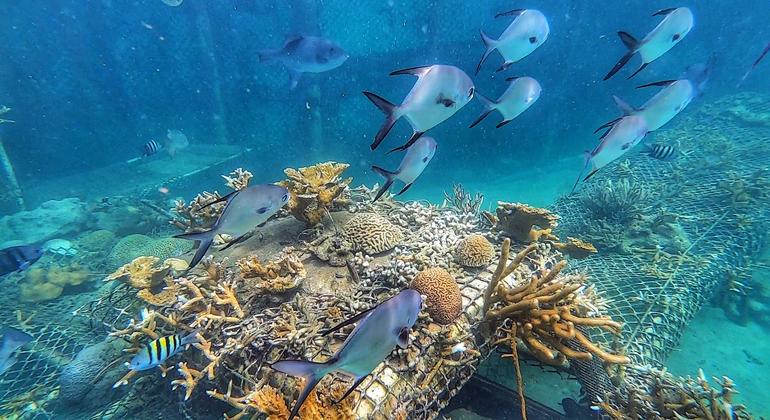
Fish swim over coral nurseries in Corales del Rosario National Park, Colombia.
In Corales del Rosario National Park we were able to spot some of these creatures up close. Some looked like big yellow brains floating in the ocean blue, others extended like underwater bunches of daisies, while others formed orange ‘pyramids’, and still others were so soft they swayed with the underwater currents in a hypnotic and inspiring dance.
Getting up close with coral is an amazing spectacle for nature lovers, but marine biologists can’t get enough of them because of the unique ways in which they function and reproduce.
Jaime Rojas, Scientific Director of the Research, Education and Recreation Centre (CEINER) in Oceanario, along with Ms. Alvarado, has been investigating for decades the different types of sexual and asexual reproduction of corals.
“Most corals [sexually] reproduce only once a year, and with certain species you must know exactly what day and what time this happens in order to collect the male and female reproductive products,” he emphasises.
Thanks to the permanent and diverse coral nurseries the Centre maintains, experts were able to identify the nearly extinct Elkhorn and Staghorn corals exact reproduction day and time, a first for Colombia.
“With that information, we collect the sexual products [eggs and sperm] and then go to the laboratory and do the fertilization and develop research in the cultivation of coral larvae. This is a strong line of work that we have in Oceanario with many allies and experts – even at the international level – and the hope is in the future to repopulate our reefs with these lab larvae”, he explains.
It typically takes coral 25 to 75 years to reach sexual maturity, one of the reasons why scientists have been betting on asexual reproduction as a quicker way to restore reefs, but the work on sexual reproduction is vital to keep a genetic bank of different coral species for the future.
Different types of nurseries
The most popular technique to grow and restore corals is the one Elvira and her team – as well as the over 32 allies all over Colombia are implementing – micro fragmentation.
The process of cutting small pieces of coral to encourage growth has been around since the 1960’s, but it was only in 2018 that a biologist in Florida accidentally discovered that cutting them into even smaller pieces made them grow faster.
Dr. David Vaughan mistakenly broke a staghorn coral that he had been growing for three years and the fragments fell to the bottom of a tank. To his surprise and shock, just weeks later, he observed that the small fragments had grown to the original size of the broken piece.
Ultimately, this technique makes corals grow 40 times faster than they would in the wild, providing hope for reefs worldwide.
Inside Oceanario, which is also one of the largest contributors to the One Million Corals for Colombia project, visitors – including children and local fishermen – are learning about this process in special sessions, and through a permanent underwater display of different kind of nurseries.
“We implement three different cultivation techniques. We have coral trees and rope-type nurseries that are for species with fast branching growth, and we have table-type nurseries for micro fragmentation of slow growing species,” Oceanario’s Marine Biologist Alexandra Hernández highlights.
UN News/Laura Quiñones
Tree-type coral nursery in Oceanario, Corales del Rosario National Park, Colombia.
To submerge oneself into the water with these nurseries feels like witnessing a miracle in the making.
It somehow resembles a backyard garden underwater. You see clothing lines, but instead of socks and t-shirts, there are little pieces of coral dangling there. Then there are the floating trees, with staghorn corals branching out like bananas.
And then you can see the tables, which have interesting shapes to make them even more beautiful – resembling a plane or a shipwreck – filled with all kinds of corals and colourful fish swimming around.
“With our work we don’t only seek to restore and leave it at that – because any restoration project that does not involve the community is destined to be lost. We can restore corals, but if we don’t teach people why they should be cared for, why they should be protected, what this work is like, people won’t value it and therefore it won’t take care of it,” Ms. Hernandez adds.
UN News/Laura Quiñones
Fragments of Acropora corals growing on a rope-type nursery in Oceanario, Colombia.
‘Life brings more life’
Coral reefs have survived the extinction of the dinosaurs, the ice age, and other massive environmental shifts, and with some help, they will survive the climatic changes that have thus far characterized the early 21st century.
Much is at stake: in addition to their natural beauty and the animal and plant species that depend on them to survive, coral reefs provide us, humans, with food security through fishing; protect us from flooding and storms; and generate income thanks to the millions of tourists and divers who travel to appreciate them. Some have anti-inflammatory properties, while others provide the raw material for some cancer-fighting medicines.
“Life brings more life, so when you restore these places that were initially degraded, you bring living fragments and they begin to grow, life will arrive, and with-it fish. And with the fish also comes the resurgence of the economic activities of the people of the region. This is beneficial for everyone and for the environment; let’s remember that 70 per cent of the oxygen we breathe is thanks to the oceans,” Ms. Hernández highlights.
A restoration project in Indonesia is living proof of her words. Scientists and community in Salisi’ Besar, South Sulawesi, planted 12,600 coral fragments in 2019. By 2021, reef coverage had increased from 1 per cent to more than 70 per cent, and marine life had increased by some 300 per cent. Fittingly, the restoration site was named ‘Hope Reef’.
“We need the biogeochemical cycles that come from this ecosystem. We need the fish, we need the lobster, we need the [sea] barrier. What is going to happen in 30 years when climate change raises the sea level if we don’t have that barrier? We’re going to have a lot of things happening,” adds Elvira Alvarado.
For both biologists, the importance of coral reefs and their restoration must go beyond the scientific community and divers and capture the general public’s attention.
“We need all these kinds of ecosystems. It’s not a question of what marine biologists love doing, it’s a question of why we do it: we do it because the people in the world need us. What would have happened if Jacques Cousteau hadn’t talked to us? No one would have known what we have in our oceans. We have to speak. We have to learn,” Elvira Alvarado highlights.
UN News/Laura Quiñones
Elvira Alvarado, Ecomares Marine Biologist, has been working for decades in coral research and restoration.
A ‘blue’ country
Those who are involved in the Million Corals for Colombia project deeply understand this message: in ecosystem restoration, as in many other efforts to reach a sustainable world, unity is power. Allies in the combat to save the planet can range from scientific experts like Ms. Alvarado, Ms. Hernandez, and Mr. Rojas, to diving schools, local communities, fishermen who work as coral gardeners, and even hotels.
Milena Marrugo works for Conservation International, the implementing partner organization which oversees the Million Corals project and coordinates the work of the actors working in the field. She accompanied UN News on the boat ride back to Cartagena.
“For many years this [restoration] work was very difficult, because everyone was working independently. In the past, allies had made the greatest effort working with whatever little they had, with few resources, and now being all truly united for a single purpose makes all the effort even greater and makes it possible for us to achieve such a high goal,” she says, adding that it is really important that the Government, which is making a big financial investment in the project, has begun to take notice of the importance of ocean restoration.
Ms. Marrugo explains that the project has also brought to light the amazing- and sometimes challenging- differences of the locations in which the coral restoration is being implemented all over Colombia. Not only because of the people, which include indigenous, Afro-Colombian and other coastal communities working hand in hand, but because of the diverse marine conditions.
“There are some areas where there is a lot of current, so certain types of nurseries are not possible. We have had to vary and experiment with different characteristics: now we have rope, table, star, spider, we have vertical and horizontal and other nursery variations. For example, in the Pacific, we realized that rope nurseries were going to be a problem for the migrating humpback whales”.
Colombian Environment Ministry
Divers pose with transplanted corals and a ‘One Million Corals for Colombia’ sign, the name of the biggest ocean restoration project in Latin-America.
The expert also highlights that these nurseries are being mostly built with eco-friendly or recycled materials that can be reused to continue the work in the future, because, from her perspective, the project cannot end after reaching the one million coral fragments.
“We want to take our corals, which are already in a nursery phase, to their natural environment so that they fulfil the fundamental role of truly restoring the reef, achieving these 200 hectares restored. This is one more step that we are working to achieve,” she adds, highlighting that nurseries also need constant maintenance and cleaning which takes time and money.
Don’t forget, although Colombia has always been seen as a ‘green country’ with its mountains and rich terrestrial ecosystems and biodiversity, almost half of its territory – some 48 per cent – is stretched between the Caribbean Sea and the Pacific Ocean.
“All life comes from the sea, but we have turned our backs on it. I live in the city of Cartagena where most people don’t even look over their shoulders to appreciate the beautiful sea and ecosystems they have. We must teach our children right now so that future generations really understand the importance of what the ocean provides for all of society.”
This is Ms. Marrugo’s message and a call to action for us all.
*According to Conservation International, as of the date of this article, there are more than 230,000 coral fragments in nurseries in Colombia, and over 12,000 have been transplanted to reefs.
This is Part I in a series of features on ocean restoration efforts in Colombia. Coming up next, we travel to the island of Providencia in the Seaflower UNESCO Biosphere Reserve, which was devastated by hurricane Iota in 2020. Evidence of the destruction wrought by the storm is still visible and the damage has severely impacted not only human infrastructure but also crucial carbon-capture ecosystems such as mangroves.