Ukraine is closing the book on scores of Russian authors and turning a deaf ear to its foe’s music, too.
The Ukrainian parliament Sunday approved a law that stops the printing of books by Russian citizens unless they give up their Russian passport and become Ukraine citizens. The ban only applies to those authors who held Russian citizenship after the 1991 collapse of the Soviet Union.
Books printed in Russia, its ally Belarus and occupied Ukrainian territory also can no longer be imported, and special permission is required for the importation of books in Russian from any other countries.
Another law passed Sunday puts the brakes on music by post-1991 Russian citizens played by media outlets and on public transportation. It also forces television and radio broadcasts to play more Ukrainian-language speech and music content. Ukrainian President Volodymyr Zelensky is expected to sign laws that would place limits on Russian books and music in Ukraine. Ukrainian Presidential Press Service/Handout via REUTERS
“The laws are designed to help Ukrainian authors share quality content with the widest possible audience, which after the Russian invasion do not accept any Russian creative product on a physical level,” Ukraine Culture Minister Oleksandr Tkachenko said.
The laws will go into effect once Ukrainian President Volodymyr Zelensky signs them as expected.
The new mandates are the latest push by Ukraine to rid itself of Russia’s influence over the country in a process dubbed “derussification.” One of the laws would ban books from Russia, Belarus or occupied Ukrainian territory from being imported. REUTERS/Stringer
Ukraine argues that the moves are necessary to undo centuries of Russian policies meant to erase Ukraine culture, while Russia has said such measures only oppress the large number of Russian speakers in Ukraine.
Scientific evidence shows that overexposure to UV radiation is the major cause of skin cancer. To help people protect themselves adequately, a consortium of UN agencies on Tuesday, launched an innovative new App that can help anyone, anywhere, determine the safe amount of time to stay outdoors, soaking up the rays.
The SunSmart Global UV App, is the collective brainchild of the World Health Organization (WHO), the International Labour Organization (ILO), the World Meteorological Organization (WMO) and the UN Environment Programme (UNEP).
Five-day forecast
“The SunSmart Global UV App provides five-day UV and weather forecasts at searchable locations”, said Carla Drysdale, spokesperson for WHO.
While speaking today at a briefing at the United Nations in Geneva, Ms. Drysdale added that “it highlights time slots when sun protection is required and aims to help people around the world know when to use sun protection, in an effort to reduce the global burden of skin cancer and UV-related eye damage”.
Developed by Australia’s Cancer Council Victoria and the Australian Radiation Protection and Nuclear Safety Agency, the app is based on the UV Index, which indicates the level of solar UV radiation at the earth’s surface.
The UV Index uses a scale of 1 (or Low) to 11 and higher (or Extreme). The higher the index value, the greater the potential for damage to the skin and eyes, and the less time it takes for harm to occur.
120,000 lives lost in 2020
“Globally, it’s estimated that over 1.5 million cases of skin cancer, that’s melanoma and non-melanoma combined, were diagnosed globally in 2020”, Ms. Drysdale said.
“During the same period, more than 120,000 people across the world lost their lives to this highly preventable disease”.
Much of UV-related illness and death can be avoided through a set of simple prevention measures such as limiting time in the midday sun, seeking shade when UV rays are most intense, and wearing protective clothing, hats and sunglasses – as well as the use of sunscreen.
Useful for work and play
“This app combines meteorological, environmental and health expertise to help protect people from the sun both at work and in their leisure” said WMO Secretary-General Professor Petteri Tallas. It is unique because it uses data from country-level weather and UV measuring stations to provide accurate and location-specific UV Index readings…It is a great example of science serving society.”
Vera Paquete-Perdigão, Director of the ILO’s Governance and Tripartism, Department, said the app was “a useful tool to assist companies and workers in identifying hazardous work, and planning safety and health measures.”
And speaking for UNEP on launch day, Meg Seki, Executive Secretary of UNEP’s Ozone Secretariat, noted that the highly effective Montreal Protocol, protects the stratospheric ozone layer which, in turn, protects human health and the environment by blocking out most of sun’s harmful ultraviolet radiation.
“Skin cancer can result from overexposure to the sun, so it is imperative for everyone to remain vigilant and ensure they protect themselves adequately with hats and sunscreen. The SunSmart App is a fantastic UV monitoring tool, and I would encourage everyone to use it.”
Northern exposure
According to WMO’s spokesperson Clare Nullis “it’s now the period of the year when UV radiation is at its maximum in Europe, in the northern hemisphere”.
“This is because of the position of the sun in the sky”, she added. “There are other factors that influence the amount of UV, which is the ground, clouds, the ozone layers, etc. So, all of these elements are being added into this app”.
The SunSmart Global UV app is available free of charge at both the Apple App Store and Google Play store for Android.
It provides personalized options so that users can take actions to protect prolonged excessive UV exposure, a major cause of skin cancer and other UV relate diseases.
EU job-seeking aid worth €1.5 million for dismissed workers in Greece and €17.7 million for 1 580 dismissed Air France workers
EU job-seeking aid for Greece
Workers made redundant in six companies producing household appliances in Attica, Greece, should receive €1.5 million in EU aid.
On Tuesday, the Committee on Budgets approved Greece’s request for funding from the European Globalisation Adjustment Fund for Displaced Workers (EGF). In their decision, MEPs acknowledge that “expenditure for new household appliances in Greece was strongly impacted first by the economic crisis from 2008 to 2016 and second by the COVID-19 pandemic”.
Reasons for the dismissals include domestic supply shortages of electrical components, high productions costs, difficulties in adapting to the digitalisation and automation of production processes.
The support for the dismissed workers will include advisory services and individual job-seeking assistance, training in digital skills, and tailored vocational training, leading to a certification, where possible, or support in securing higher education qualifications. Participants can also receive advice on how to start their own business coupled with a start-up grant of up to €22,000.
The total estimated cost of these measures is about €1.8 million, of which the EGF will cover 85% (€1.5 million). The Public Investment Programme of the Greek Ministry of Economy and Development will finance the remaining 15%.
The draft report by rapporteur Bogdan Rzońca (ECR, PL) recommending that Parliament approve the aid was passed by 29 votes, 1 against and no abstentions. The vote in plenary will take place on 23 June in Brussels.
EU job-seeking aid for France
1 580 workers from Air France and two of its subsidiaries in 16 regions in France, who lost their jobs because of the COVID-19 pandemic, should receive €17.7 million in EU aid.
On Tuesday, the Committee on Budgets approved France’s request for support from the European Globalisation Adjustment Fund for Displaced Workers (EGF). MEPs acknowledge that “Air France was severely impacted by the COVID-19 crisis, which caused a sharp decline in income and traffic”. The region Île-de-France (57% of the layoffs) has been most affected.
The support provided to the dismissed workers includes advisory services, career guidance, job search assistance and the possibility to learn new skills through tailored vocational training. Participants can also receive advice on how to start their own business and a start-up grant of up to €15 000. The support measures also include hiring benefits, salary top-ups and quick reemployment allowances for workers.
The total estimated cost of these measures is about €21 million, of which the EGF will cover 85% (€17.7 million). Air France will finance the remaining 15%.
The draft report by rapporteur Fabienne Keller (RENEW, FR) recommending that Parliament approve the aid was passed by 29 votes, 1 against and no abstentions.
Approval by plenary is expected on 23 June in Brussels.
Background
Under the new 2021-2027 EGF regulation, the Fund will continue to support Europe‘s workers and self-employed people whose work has stopped. The new rules allow support to be given to a larger number of people affected by having their jobs or sector restructured: all types of unexpected major restructuring events are eligible for support, including the economic effects of the COVID-19 crisis, as well as larger economic trends like decarbonisation and automation. Member states can apply for EU funding when at least 200 workers lose their jobs within a specific reference period.
Bringing together over a hundred participants from Europe and beyond, the virtual Assembly of the European Christian Environmental Network (ECEN) highlighted diverse Christian perspectives in addressing contemporary challenges posed by environmental degradation.
The Assembly, held from 13 to 15 June 2022 under the title “Challenges we are living in”, focused on challenges faced by communities on the way to a sustainable future, including issues related to energy security, the European Green Deal, and climate vulnerability from the church perspective.
“Our way of looking at nature and creation must change,” said Archbishop K. G. Hammar of the Church of Sweden, a keynote speaker. “We must let God transform our eyes so that we see what God sees when He looks upon His creation, and not with the eyes of greed or dominion.”
“Ecology has taught us that humans are not above everything else. We are part of everything and heavily dependent on the web of life, where we dwell. Theology must be metamorphosis theology. All theology must be kenosis theology and eco-theology,” added Archbishop Hammar.
Dr Ruth Valerio, Global Advocacy and Influencing Director at Tearfund, emphasised that hope is an integral part of all actions needed to save our common future. She underlined the links between worship, work, and witness, which formulate a holistic response to environmental challenges.
Members of European Parliament Sirpa Pietikainen from Finland and Martin Hojsík from Slovakia stressed that “there is no more time for mere discussion.” “We know what is the challenge, we have resources, we have still some time – let’s do what is needed.” They stressed that as “societies and communities we must admit that we have reached the limits of what the planet can bear. We have lost our humility. However, we still have solutions in our hands.”
The panel also explored topics such as ecological challenges, learning from the pandemic, energy security and growing vulnerability to climate change, the European Green Deal and the role of churches, advocacy and dialogue of churches with politics, networking and cooperation, as well as the environment, climate justice, and peace.
Finally the Assembly explored the role of care for creation and ecological justice in the upcoming Assembly of the World Council of Churches, it announced the winners of the ECEN Roman Juriga Award, and discussed concerns related to climate justice and a sustainable future from the perspective of the ecumenical youth.
For more information or an interview, please contact:
Ms Katerina Pekridou, CEC Executive Secretary for theological dialogue participated in a meeting of high-level delegation of religious leaders from Ukraine, who visited the secretariat of COMECE in Brussels, and exchanged with representatives of EU Churches and religious communities on perspectives for peace in their war-torn country and ways to support the Ukrainian population.
COMECE organised the meeting in collaboration with the EU office of the Konrad-Adenauer-Stiftung.
Among the members of the Ukrainian delegation were His Beatitude Epiphanius, Metropolitan of Kyiv and All Ukraine, H.E. Mgr. Vitalii Kryvytskyi, Bishop of Kyiv-Zhytomyr, Sheikh Akhmed Tamim, Supreme Mufti of Ukraine and Gennadii Bilorytskyi, Representative of the Union of Jewish Religious Organizations of Ukraine.
The delegation was received by Fr. Manuel Barrios Prieto, General Secretary of COMECE, together with H.E. Mgr. Franco Coppola, Apostolic Nuncio to Belgium and Luxembourg, as well as representatives of Brussels-based Catholic organisations and of other religious communities.
The theme of World Drug Day 2022 is ‘health and humanitarian crises’. In the lead up to the Day, UNODC is highlighting its work on drug prevention and treatment around the world, particularly in crisis situations.
Building Stronger Families to Prevent Drug Use and Trafficking among Rohingya Refugees in Bangladesh
Bangladesh, 21 June 2022 – The Rohingya people, a stateless Muslim minority population of Myanmar, can be considered among the most marginalized and vulnerable populations in the world. Denied citizenship in Myanmar, the Rohingyas have long been unable to exercise basic rights, such as the right to vote, travel, marry, access to shelter, food and health services, and many more.
An outbreak of violence in Myanmar in 2017 caused around a million Rohingya to flee across the border to Bangladesh and become refugees. The situation became so dire for the Rohingya that the International Court of Justice, the United Nations’ highest court, imposed provisional measures ordering Myanmar to “take all measures within its power” to prevent the commission of acts defined in the Genocide Convention.
As of May 2022, over 926,486 Rohingya refugees had sought refuge in Bangladesh, specifically in the country’s Cox’s Bazar district.
The influx of refugees has also reshaped drug prevention challenges in the region, with the Myanmar-Bangladesh border being a historical drug trafficking route. Bangladesh has long been both a destination and transit country for illicit drugs, particularly Yaba (Thai for “crazy medicine”), a combination of methamphetamine and caffeine.
A large number of vulnerable Rohingya refugees have thus become drug users. Others (particularly the young) are entering the drug business as a career path, often without their families’ knowledge or consent, due to limited employment options and livelihood opportunities.
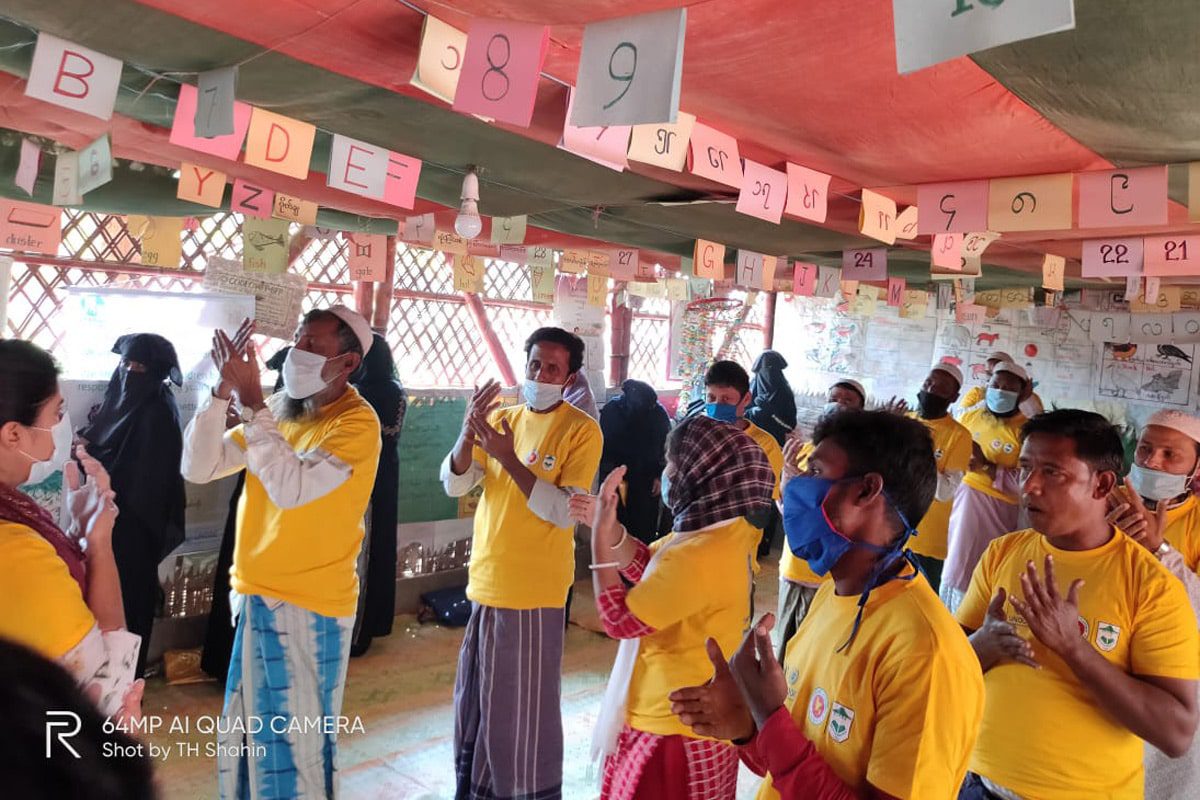
Together with the UN Refugee Agency (UNHCR), the UN Office on Drugs and Crime (UNODC) supported pre-piloting cycles of the ‘Strong Families’ Programme in four Rohingya refugee camps in Cox’s Bazar. Families are the most powerful social institution in South Asia, meaning that they can be useful tools in raising awareness of the perils of drug smuggling and use.
Strong Families supports caregivers to be better parents and strengthens positive, age-specific, and age-appropriate family functioning and interactions. The programme is broken down into caregiver sessions, child sessions, and family sessions to improve communication and relationships and reduce coercive parenting.
One woman participant endorsed the programme’s lessons, noting that “We need to make the children understand [about the importance of not using drugs]. We should not apply force; but have to make them realize this with patience and care.”
“You are raising the child in a stressful situation,” said Wadih Maalouf, Programme Officer, Prevention, Treatment, and Rehabilitation Section, UNODC, referring to the Rohingya humanitarian crisis. The programme helps you to identify “how can you overcome that stress, realize the stress of the child, and help the child overcome his or her stress.”
A male participant in the programme extolled the benefits of Strong Families, saying that “Actually talking to the children and listening to them will help me to raise my children better…I can also discuss my problems with other parents and how to build trusted relationships with children.”
The Strong Families programme, implemented in 22 countries around the world, has proven to delay initiation of substance abuse, prevent and reduce early aggressive behavior and delinquency, reduce anti-social peer affiliation, and increase peer pressure resistance skills.
The programme included a three-week training of stakeholders to develop a pool of trainers equipped to implement Strong Families, which included a research component to observe how changed behavior among families could help curb drug use among children.
Altogether, over 300 refugee families participated, which included more than 622 caregivers and 620 children. Additional sessions of Strong Families are envisioned to reach more refugees in the future.
The EP Fisheries Committee approved on Monday financial support for EU fisheries and the aquaculture sector in response to Russia’s invasion of Ukraine.
MEPs in the Fisheries Committee adopted their position on a Commission proposal to financially compensate EU fisheries and aquaculture hit by Russia’s war in Ukraine, unanimously with 24 votes.
The European Maritime and Fisheries Fund (EMFF), according to the text adopted by MEPs, would support companies whose fishing operations have been jeopardised by the war, and fisheries and aquaculture producer organisations and operators whose economic viability is threatened due to market and supply chain problems caused by the Russian military aggression. These include a rise in the price of energy, raw materials and fish feed. EU governments would be able to use their remaining EMFF resources for the 2014-20 programming period to address the war consequences in the fisheries and aquaculture sector.
MEPs amended the proposal to extend the compensation also to those companies whose economic viability has been impacted by the conflict and to the processing sector. 75% of co-financing from the Fund would cover their lost income and additional costs caused by disruption to supply chains after the start of the war on 24 February 2022.
Besides financial compensation, member states would also be allowed to use the state aid rules more flexibly. This would enable them to set up schemes to provide state aid to fisheries and aquaculture companies affected by the crisis.
Quote
Following the vote, EP rapporteur Nuno Melo (EPP, PT) said: “The report calls for specific measures to alleviate the market disruption to the seafood supply chain caused by the Russian aggression. The EU must take urgent action to mitigate the impact of the war, and ensure the survival of companies and jobs in the fisheries and aquaculture sectors.”
Next steps
This draft negotiating position should be submitted to the plenary vote in July. Once Parliament as a whole has approved it, MEPs will be ready to start talks with EU governments on the final shape of the legislation.
Background
In 2019, the EU fishing fleet totalled 73 983 vessels, providing direct employment to 129 540 fishers. Aquaculture employs around 75 000 people, with the processing industry comprising around 3 500 companies. Fuel prices are preventing fishing operators from breaking even and the scarcity of marine fuel keeps many vessels in port. Furthermore, there is a lack of sufficient alternatives for species such as Alaska pollack and Russian cod and the lack of vegetable oil is causing serious difficulties for the canning industry.
As a part of this push, the UN Scientific, Educational and Cultural Organization (UNESCO) is asking the world to join the revolution to unlock innovative ocean science solutions. UN News spoke to experts within and outside the UN system to reveal the importance of ocean literacy.
Empowering people to take action
Ocean literacy is commonly defined as an understanding of the ocean’s influence on you and your influence on the ocean.
Francesca Santoro, who is in charge of ocean literacy at UNESCO’s Intergovernmental Oceanographic Commission (IOC), explained however that the definition goes beyond that.
“It is really about empowering people with tools, to better use that ocean knowledge to become more responsible and able to take decisions that involve ocean resources, in a more knowledgeable way. It is really about being capable of understanding how much the oceans influence our life and how much we can influence the ocean in both positive and negative ways.”
Moken children swim in the Myeik Archipelago in Myanmar.
As the focal point for ocean science within the United Nations system, the IOC leads the UN Decade of Ocean Sciences for Sustainable Development (2021 to 2030), and supports ocean research institutions around the world to strengthen public engagement.
“IOC works mainly to strengthen the international collaboration on ocean science and ocean research – as no single country can undertake research on all ocean basins, by itself”, Ms. Santoro continued.
Critical moment
The Decade of Ocean Science is an opportunity to change the state of the ocean for the next 100 years.
Earlier this year, UNESCO launched a campaign to empower people to join the Generation Ocean global movement.
The idea is to use transformative storytelling to connect citizens with ocean knowledge and drive action to restore, protect, and live better with the ocean.
In an interview with UN News, Vinicius Grunberg Lindoso, Communications Officer at UNESCO’S Intergovernmental Oceanographic Commission, described how you can be a game changer at this critical moment.
Students as active agents of change
Some of IOC’s flagship programmes examine the particular impacts of climate change on the ocean, and how the ocean can be considered the best ally in fighting climate change.
Working closely with schools, teachers and educators, the UN Scientific agency uses results from its ocean research to develop lesson plans.
Aquarium’s help young children to discover the aquatic realm in an immersive environment.
“We develop a number of resources – booklets, videos or games – and we use them to collaborate with schools all around the world in order to engage people from an early age, from elementary school to high school. We use an approach that doesn’t include only learning objectives, it also includes what we call social emotional learning objectives, and behavioral learning, because we want the students to become active agents of change – so they can take part in initiatives that support ocean protection”, Ms. Santoro highlighted.
Blue schools
In Portugal, co-host along with Kenya of the UN Ocean Conference, which is taking place from 27 June through 1 July, the Oceano Azul Foundation has an important role in developing literacy and conservation practices there.
Working towards children’s climate education in Portugal, the Foundation aims to have more kids learning about ocean issues and their impact on the ocean, so when they grow to be decision makers, no matter what profession they choose, they will have an important role to play.
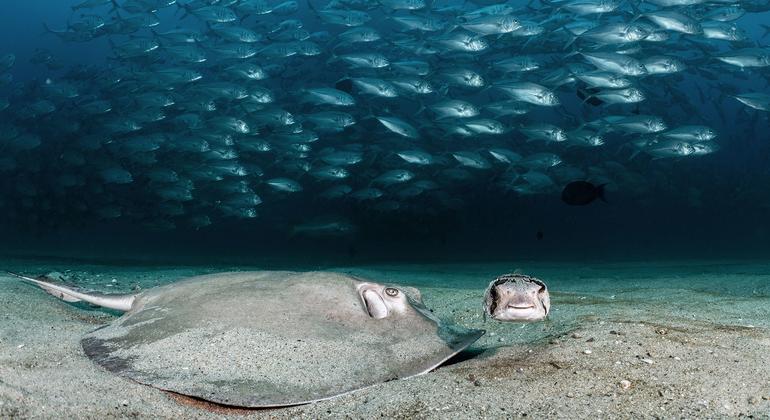
A Diamond Stingray and a one-eyed Porcupine fish search for a meal in the sand as hundreds of Big Eye Jacks school behind them.
Samuel Collins, Programme Manager at Oceano Azul, explained to UN News how the initiative works: “We must deliver information in a way that is digestible for different age groups. But considering the importance of these issues, and the impact they will have on the near future of the current generations, we have the responsibility to deliver certain information to the youth.”
Together with Oceanario de Lisboa, Oceano Azul has a programme to educate the blue generation, training teachers and providing them with the curriculum and resources to pass the message in the first cycle of education.
“They will do math, but they will speak about fish, they’ll learn French, speaking about the ocean, they’ll do history, but integrating oceanography, so it’s just reinforcing the curriculum, looking through a blue lens. They come to the Oceanario, and they do a lot of fantastic activities, and get excited, because there’s a huge amount of potential in a healthy ocean, and reinforcing that is important.”.
The programme envisages to bring ocean literacy to all children, resident in Portugal, with a special focus on the group between the ages 5 to 9 years old.
According to the Foundation, using Portugal as a starting point in the case of literacy will, nevertheless, allow the replication of actions in other countries, namely in Portuguese speaking countries and developing states.
Kindergarten of the Lagoon
Not so far away in Italy, Venice has for centuries illustrated the dynamic interaction between humankind and nature, underlining its capacity to act as a model for other similar ecosystems.
Due to its ideal characteristics and its designation as a UNESCO World Heritage site, ‘Venice and its Lagoon’ were selected as the implementation site of the pilot edition of the “Kindergarten of the Lagoon” Initiative, which was launched last May.
The new educational programme based on promoting ocean literacy principles and interaction with the environment, aims to foster a close connection between children and nature, using outdoor activities and interactions with the local community.
IOC-UNESCO
Children participate in drawing activities at an ocean awareness event, in Venice, Italy.
Thematic lessons are given to classes of 25 kindergarten students, conducted using outdoor education and aimed at discovering the lagoon ecosystem. This is then followed by creative stimulation and drawing at the end of each lesson.
In partnership with the Prada Group, UNESCO, hopes to empower youth in becoming the future Generation Ocean.
“The international community must make education one of the pillars of its action for the ocean and engage in education to help today’s youth become responsible and aware citizens of tomorrow,” said Ana Luiza M. Thompson-Flores, UNESCO Regional Bureau’s Director.
Lisbon: scale it up
The ocean literacy community will convene in Lisbon, Portugal, for the UN Ocean Conference, ensuring that ocean literacy is seen as a central element of ocean action.
“The last UN Ocean Conference [in 2017, in New York], ocean literacy was in its infancy, but now we can really prove that we have been able to achieve important results such as promoting the presence of ocean literacy in formal education, and we have an increasing network of blue schools around the world. But we need to scale this up, make sure that ocean literacy initiatives are happening around the world, and strengthen the collaboration to share good practices among different actors,” Ms. Santoro told UN News.
In Lisbon, on the first day of the 2022 Conference, there will be a high-level Ocean Decade Alliance Meeting, followed by an Ocean Decade Forum on 30 June, to convey a message of action, partnership, and inclusivity.
“My other expectation is to see our community include more and more stakeholders. Right now, we mainly have scientists and educators, but I think we need, for example, journalists, the media, to help us make sure the ocean is present in media outlets, and that people are more aware of the importance of the ocean for the future of this planet,” she added.
Creative community is ‘crucial’
UNESCO has a series of events lined up for the UN Ocean Conference in Lisbon – which include exhibitions such as the Ocean Decade Creative Exhibition at the city’s main Square, and a Generation Ocean Concert at the Rock in Rio Festival, on 26 June. Those events involve the global creative community, aiming to raise more awareness to ocean science and conservation.
For Ms. Santoro, the collaboration with the creative community is “crucial, especially because we are more aware that our emotions drive action. Working [more in depth] with artists, photographers, enhances the capacity of people to feel more connected to the ocean or to rediscover how much we are connected to it. The creative community is really helping us in finding this emotional part of our connection with it – so we need to work together, scientists and artists, to co-design and co-develop projects. No matter if you are a scientist or a journalist or an artist or a policymaker, or somebody working in the private sector. We should all come together and have a common vision and a common goal,” Ms. Santoro concluded.
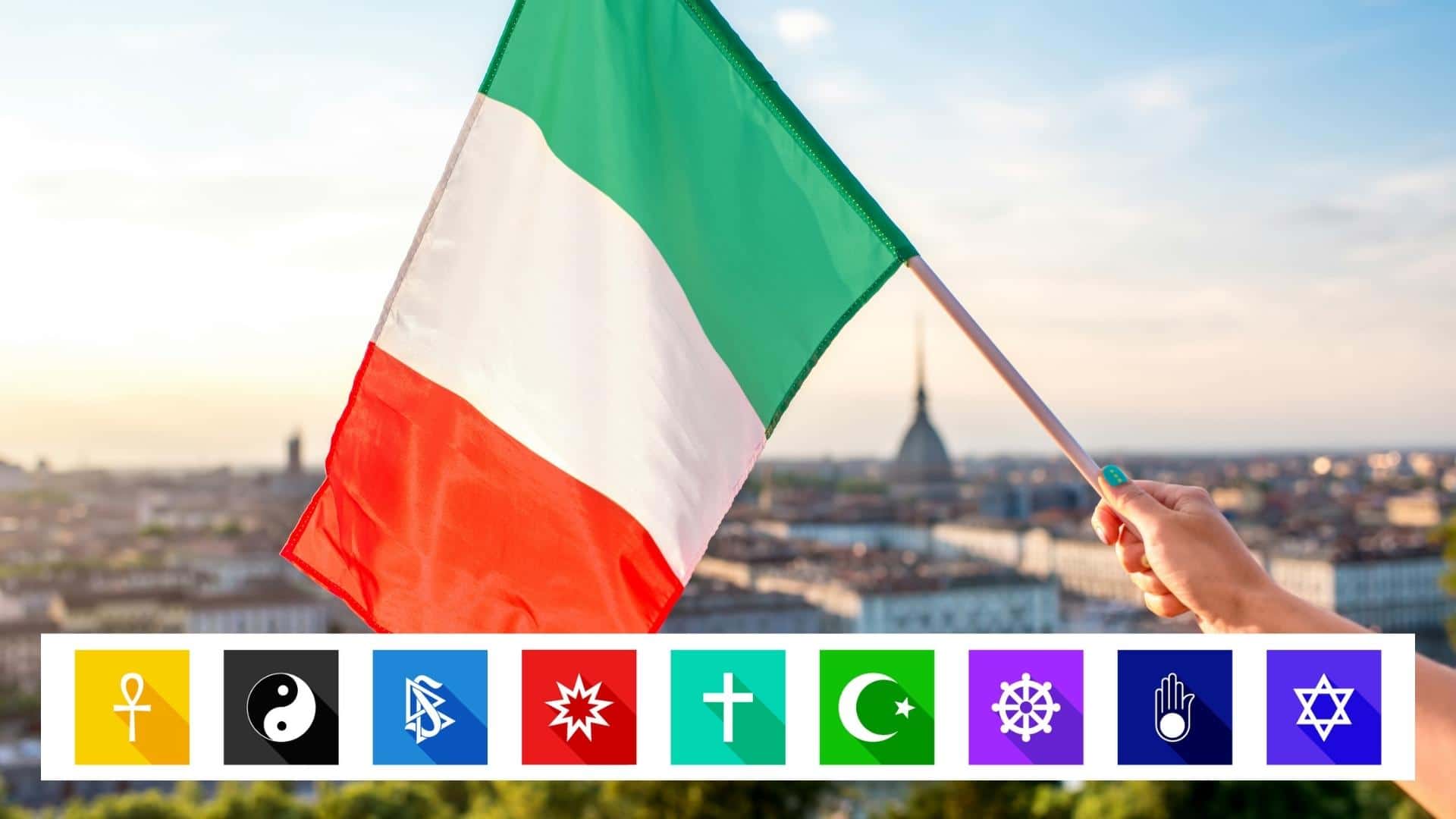
Italy is a multicultural and multi-religious country. Over the years both the number and the visibility of religious organizations present on the national territory have grown exponentially.
This event will take place tomorrow jun 21st 13:30h to 15:30, at Plesso Belmeloro, Via Andreatta, 8 | Aula N, in Bologna, as part of the hundreds of conferences organized by the European Academy of Religion.
Chair: Antonio Fuccillo (Università della Campania “Luigi Vanvitelli”)
Speakers:
Germana Carobene (Università di Napoli Federico II), Reflections on the new religious movements in Italy
Fabrizio D’Agostino (C.S.I.), Church of Scienntology and the Italian legal system
Gianfranco Macrì (Università di Salerno), A new governance of religious freedom in Italy is needed
Guido Morisco (Comunità bahá’í d’Italia), Italian Baha’í Community in the Italian legal context
Giancarlo Anello (Università di Parma), Defining Religion(s) by Legal Terms: A View from the Eastern World
Vincenzo Di Ieso (Chiesa Taoista d’Italia), Enculturation of Religious Identity: Dialogue between Faith and State
Therefore it is necessary to reserve a correct legal treatment, not only to religious denominations with well-established socio-anthropological traditions, but also in favor of recently established religious movements.
Hence the need to reverse the angle of observation, enhancing the point of view, beliefs and values of the religious actors involved in the most recent institutionalization processes in the Italian legal system in an emic perspective.
The panel assuming this particular perspective of analysis, will therefore host a multi-voiced dialogue between representatives of religious groups and jurists on the subject of organizational autonomy and the modalities for regulating relations between the State and religious confessions.
Italian society is pluralist in its constitutional pattern and religions, even with their differences, require equal freedom and equal legal recognition. Further requests are also addressed to the civil law systems by the so-called New Religious Movements (NRM).
This event will take place tomorrow jun 21st 10:15h, at Plesso Belmeloro, Via Andreatta, 8 | Aula L, in Bologna, as part of the hundreds of conferences organized by the European Academy of Religion.
Chair: Alfonso Celotto (Università Roma Tre)
Speakers:
Francesco Sorvillo (Università della Campania “Luigi Vanvitelli”), Religious denominations without agreement: Re-reading Article 8 of the Italian Constitution
Ludovica Decimo (Università della Campania “Luigi Vanvitelli”), Religious organizations in the Article 20 of the Italian Constitution
Miriam Abu Salem (Università della Campania “Luigi Vanvitelli”), The agreements between State and religious confessions: Present and future
Federico Gravino (Università di Firenze), The principle of equal freedom in the new religious geography
The latter break in consolidated socio-cultural contexts as a result of migration flows, but also to satisfy new needs in the religious field, and therefore as a counteraction to traditional patterns of religious affiliation and participation.
In relation to these circumstances, the re-reading of the art. 8 of the Italian Constitution acquires a fundamental importance, since it provides guarantees to all religions, regardless of their structure, consistency, or adherence to “traditional” conceptual paradigms.
The panel is focused, therefore, on a re-reading of the constitutional protocols, as corollary of the aforementioned art. 8 and of the related process of institutionalization of religious groups within the Italian legal system. This point of view allows us to closely investigate the relationship between the State and religious groups of the most different provenance and traditions, but also to explore the limits and criticalities that spread from the system of recognition to the social context, with important highlights on modern plural, multi-religious and multicultural democracies.