Anti-terrorism fight: the National Assembly adopts a measure targeting the release of people considered radicalized in prison
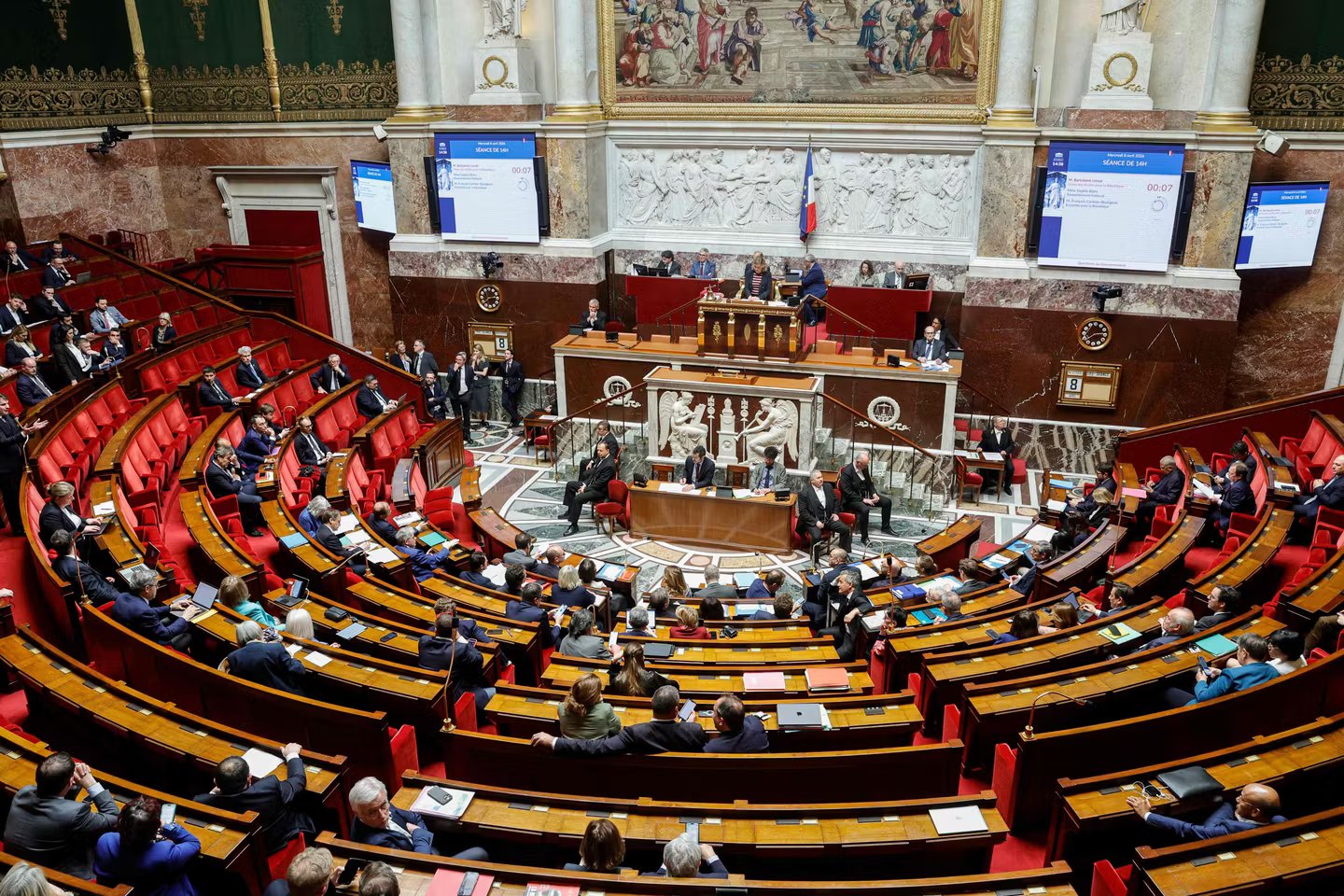
The deputies approved, on Wednesday April 15 in the evening, a measure to allow a court to order a series of special measures against a person considered to be radicalized during their detention, upon their release from prison, with the aim of preventing an act of a terrorist nature.
The National Assembly adopted an article of a bill from MP Charles Rodwell (Yvelines, Renaissance), supported by the government.
Rewritten by an amendment from the president of the Laws Committee, Florent Boudié (Gironde, Renaissance), it targets people sentenced to a prison sentence of at least ten years, who would present at the end of the execution of their sentence a “particular dangerousness (…) characterized by a very high probability of committing a terrorist act”, due to radicalization.
Filling “a hole in the racket”
The sentence enforcement court, at the request of the prosecutor, could then take a battery of measures, in particular “health, social, educational, psychological or psychiatric care” aimed at reintegration. It could also prohibit carrying out “an activity” in which “a terrorist act is particularly likely to be committed”.
A gradual tightening of the regime for monitoring prisoners for terrorism after their release from prison
Since 2016, the legislator has intervened four times to toughen the regime for the execution of sentences in matters of terrorism, with the laws of June 3, 2016, July 21, 2016, July 30, 2021 and December 22, 2021. The law is not retroactive, the systems governing the monitoring of those convicted of terrorism after their release apply differently depending on the date of commission of the crimes. facts. The most notable changes concern socio-judicial monitoring and sentence reductions.
In order to avoid quick releases from prison, the law of June 3, 2016 provided for the possibility of extending socio-judicial monitoring to acts of terrorism, monitoring which was then made obligatory by the law of August 10, 2020. This monitoring, pronounced upon conviction, provides for a certain number of obligations and prohibitions for a period of ten years for misdemeanors (twenty years by specially reasoned decision), twenty years for crimes, thirty years for crimes punishable by thirty years of imprisonment, and for an unlimited period for crimes punishable by life imprisonment.
These obligations may include summonses by the sentence enforcement judge, visits from the prison integration and probation service, the obligation to hold a job, residence in a specific location, a ban on contact with other people convicted of terrorism, an order for psychological and/or psychiatric care, treatment by a multidisciplinary “disengagement” system, such as the Pairs program for the least serious profiles, etc. In the event of violation of these obligations, the convicted person faces an additional sentence of three years in prison if convicted of a misdemeanor and seven years for a felony.
A second law, that of July 21, 2016, then provided for the elimination of automatic sentence reduction credits for acts of a terrorist nature, which were three months per year except in the event of an incident committed in detention. The additional sentence reductions reserved for prisoners demonstrating serious reintegration efforts, also capped at three months per year, were maintained. The entire system was then recast by the law of December 22, 2021 into a single sentence reduction regime, still limited to three months per year and based solely on “good behavior” and “serious reintegration efforts”.
A similar system exists for people convicted of terrorist acts but not for people radicalized during a prison sentence. Rapporteur Charles Rodwell talks about a way to fill “a hole in the racket”.
“Major slide”
The MP (Paris, Les Ecologistes) Léa Balage El-Mariky denounced on the contrary a “major shift” allowing “security measures no longer on the basis of acts, but on that of a supposed ideological adherence without conviction for acts of terrorism”. The MP (Vienna, Public Square) Sacha Houlié also supported an amendment to delete the article citing “serious risks of unconstitutionality”.
The Minister of the Interior, Laurent Nuñez, supported the principle, and highlighted some “300 people detained under common law, whose radicalization appeared during detention”.
Read also | Article reserved for our subscribers Prisons: the role of radicalization treatment districts called into question
Later, the deputies also adopted, against the advice of left-wing groups, an article concerning individual measures of administrative control and surveillance (Micas). These are administrative police acts against people to prevent an act of terrorism (prohibition on traveling outside a specific geographical area, ban on appearing in certain places, etc.).
If a judgment cancels the renewal of the measure, the article voted on would allow the Minister of the Interior when he appeals to request a stay of execution, so that Micas continues.
Newsletter
” Policy “
Every week, “Le Monde” analyzes current political issues for you
Register
The time limit for ruling on this request could go up to “five days” in total, argued Mr. Nuñez, considering the measure proportionate and necessary, arguing that approximately one in two cancellations of Micas were overturned on appeal, without convincing the left.
Originally published at Almouwatin.com