

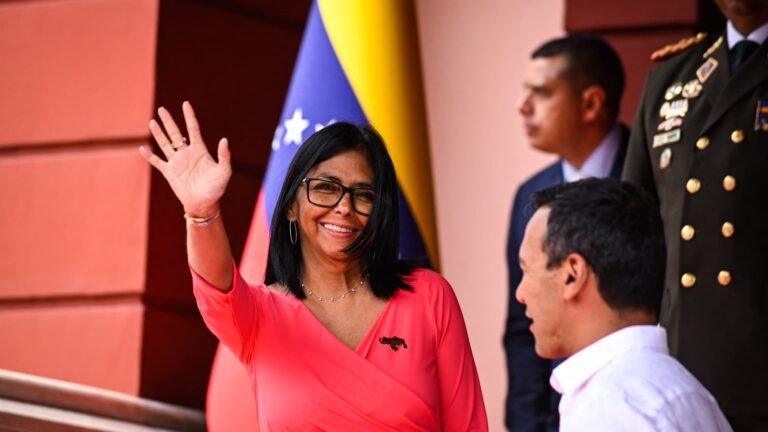

Venezuela’s interim president, Delcy Rodriguez, wore a pin representing her country and including Essequibo, a 160,000 km² oil-rich territory administered by Guyana but whose borders are at the heart of a dispute with Caracas.
Guyana’s President Irfaan Ali complained Tuesday about a brooch worn by Venezuela’s interim President Delcy Rodriguez during two official visits to the Caribbean, depicting his country’s map including Essequibo, a disputed region between the two countries.
This oil-rich territory of 160,000 km² has been administered by Guyana for more than a century but is at the heart of a dispute with Venezuela, the two countries opposing each other over the course of their common border. Repeated calls by deposed President Nicolas Maduro for the annexation of Essequibo have raised fears of armed conflict.
Former vice-president, Delcy Rodriguez, who succeeded Nicolas Maduro after his capture by the American army on January 3, was notably responsible for the Essequibo case before the International Court of Justice (ICJ). During her two official visits abroad this month, first to the island of Grenada and then to Barbados, Delcy Rodriguez wore a gold brooch depicting a map of Venezuela including the Essequibo.
“Ostentatious exhibition of symbols”
Guyana Irfaan Ali considered it “deeply regrettable” that, during these meetings, we could see “the ostentatious exhibition of symbols” affirming Venezuela’s territorial claim to this disputed area.
In a letter sent to the Caribbean Community (Caricom), the Guyanese president believes that neighboring Venezuela cannot claim to normalize, through symbols, maps, legislation, appointments or official exhibitions, an issue that remains to be resolved.
“Using CARICOM meetings to project or promote a territorial claim against a member state risks being interpreted as consent or tolerance. No act, whether deliberate or unintentional, should give the impression that Community platforms can be used to advance claims currently before the International Court of Justice,” he added.
The Maduro government relaunched territorial claims from 2019. In 2023, it organized a referendum on the creation of a new state as part of Venezuela, then in 2025 it chose a governor and deputies for this area, over which Caracas exercises no power. Guyana’s president said in early February that Maduro’s overthrow “does not eliminate or reduce” what he sees as a threat from Caracas to the Essequibo.
Originally published at Almouwatin.com